OAuth 2.0 for Identity Governance: A 2026 Enterprise Security Guide
OAuth 2.0 in 2026 enterprise identity governance — scope attestation, token lifecycle, consent-grant phishing, and the architectural choices Storm-2949 made visible.
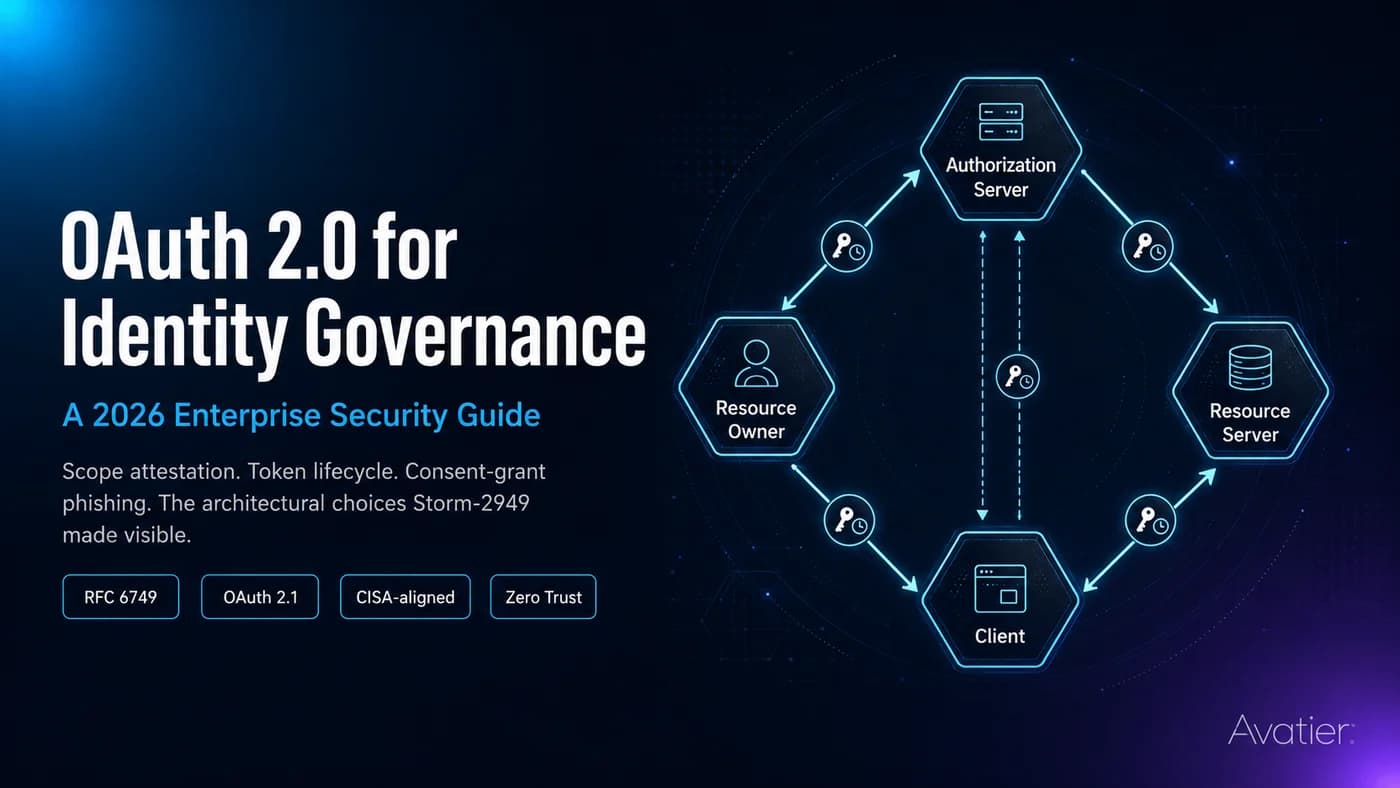
OAuth 2.0 in 2026 enterprise identity governance — scope attestation, token lifecycle, consent-grant phishing, and the architectural choices Storm-2949 made visible.
OAuth 2.0 is the protocol most enterprise authorization runs on. It is also the protocol most enterprise identity governance does not have a coherent answer for. In 2026, that gap matters more than it did two years ago — because the attacks that succeeded most visibly this year did not break OAuth. They abused it.
The Microsoft Storm-2949 disclosure on May 18, 2026 was the clearest example. Service-principal credential injection. Privileged authorizer takeover. Cloud-wide lateral movement through delegated permissions that were valid because OAuth said they were valid. We wrote about the broader governance failures in our Storm-2949 analysis. This piece is about the OAuth-specific layer of that story — and why an OAuth implementation that meets every published security best practice can still be the weak point of an identity governance program that doesn't treat OAuth grants, scopes, and refresh tokens as governance objects.
This is a 2026 refresh of a piece we published in 2025. The protocol fundamentals are unchanged. The 2026 update is what we have learned about how OAuth deployments fail in production, and what enterprise identity governance has to add to keep them working.
What OAuth 2.0 actually does (and what it doesn't)
OAuth 2.0 is an authorization protocol, specified in IETF RFC 6749. It is not an authentication protocol. The distinction matters because most production OAuth deployments are doing both — and most production OAuth deployments call all of it "OAuth" when the authentication layer is actually OpenID Connect (OIDC), built on top of OAuth.
When a user clicks "Sign in with Google" on a third-party site, two things happen at once. First, Google authenticates the user (this is OIDC). Second, Google issues the third-party application an access token that grants it specific permissions to call Google APIs on the user's behalf (this is OAuth). The user experience feels like one thing. The protocol layer is two.
For enterprise identity governance, the separation is operationally important. The authentication layer is what phishing-resistant MFA defends — covered comprehensively in our Best Passwordless Authentication Solutions guide. The authorization layer is what OAuth governance defends. They overlap at the moment of token issuance, and they diverge immediately afterward. A phishing-resistant authenticator on the front door does not constrain what the OAuth tokens issued behind that door can do — that is the governance layer's job.
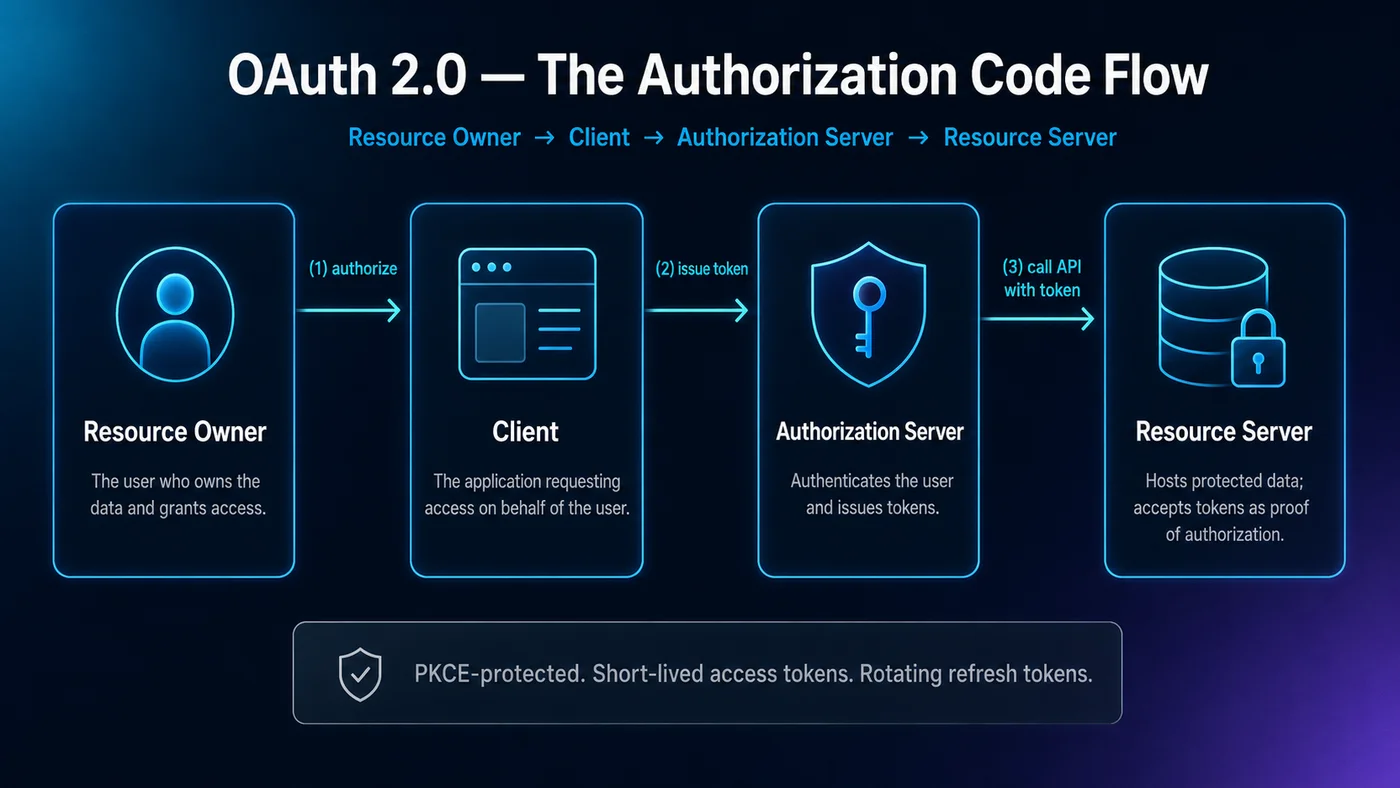 The canonical OAuth 2.0 authorization-code flow. The four roles, three protocol steps. Modern deployments add PKCE protection on the authorize step, short-lived access tokens at issuance, and refresh-token rotation at renewal.
Architecture: the four roles and the grant types that matter
OAuth 2.0 defines four roles in any authorization flow.
The resource owner is the entity that owns the protected data — typically the user, but in client-credentials flows it can be the application itself. The client is the application requesting access to the resource on the owner's behalf. The authorization server authenticates the resource owner and issues tokens. The resource server hosts the protected data and accepts tokens as proof of authorization.
In a typical enterprise deployment, the authorization server and resource server are operated by the same organization (e.g., Microsoft Entra ID acts as both for Microsoft 365 APIs). Third-party applications act as clients. Users are resource owners. The flows that pass tokens between these roles are called grant types, and in 2026 only a small subset of them should be in active use.
| Grant type | When to use | Status in 2026 |
|---|---|---|
| Authorization Code with PKCE | Web apps, mobile apps, SPAs — the default for any user-facing application | Recommended; required by OAuth 2.1 for all clients |
| Client Credentials | Server-to-server APIs where no user is involved | Recommended for service-to-service |
| Refresh Token | Renewing access tokens without re-authenticating the user | Recommended with token rotation |
| Device Authorization (Device Flow) | Constrained devices (smart TVs, CLI tools) with limited input | Use with care; high social-engineering risk if implemented naively |
| Authorization Code without PKCE | (legacy) | Avoid; OAuth 2.1 requires PKCE |
| Implicit Grant | (legacy) | Deprecated in OAuth 2.1 — remove |
| Resource Owner Password Credentials | (legacy) | Removed in OAuth 2.1 — remove |
The Authorization Code with PKCE flow is now the universal answer for user-facing clients. PKCE (pronounced "pixie") stands for Proof Key for Code Exchange and protects against the interception attack where a malicious app on a shared device steals an authorization code in transit. It was originally specified for mobile apps in RFC 7636 and is now considered the safe default for every client type, including confidential web apps. The OAuth 2.1 draft extends this requirement to all clients.
Where OAuth sits in zero-trust identity governance
Zero-trust identity governance treats every access decision as a fresh policy evaluation. OAuth fits this model well because tokens carry scope information that the resource server can evaluate at every request — but only if the governance layer is enforcing meaningful scopes in the first place, and only if those scopes are continuously attested against the business need they were originally granted for.
This is where most enterprise OAuth deployments quietly degrade. The first time a third-party application integrates, somebody — usually an application owner during an integration sprint — selects the OAuth scopes the application needs. That scope set then never changes. Three years later, the integration has expanded, the application owner has changed jobs twice, and the OAuth grant still authorizes the same scopes it did on day one. The governance question is not "did we make a good decision in 2023?" — it is "is that decision still right today?"
Identity governance answers that question with continuous attestation. The same discipline that the RACF mainframe access control world has applied to z/OS resource permissions for decades — periodic recertification, named ownership, deprovisioning on departure — applies identically to OAuth grants. The cloud is just a different surface for the same governance discipline.
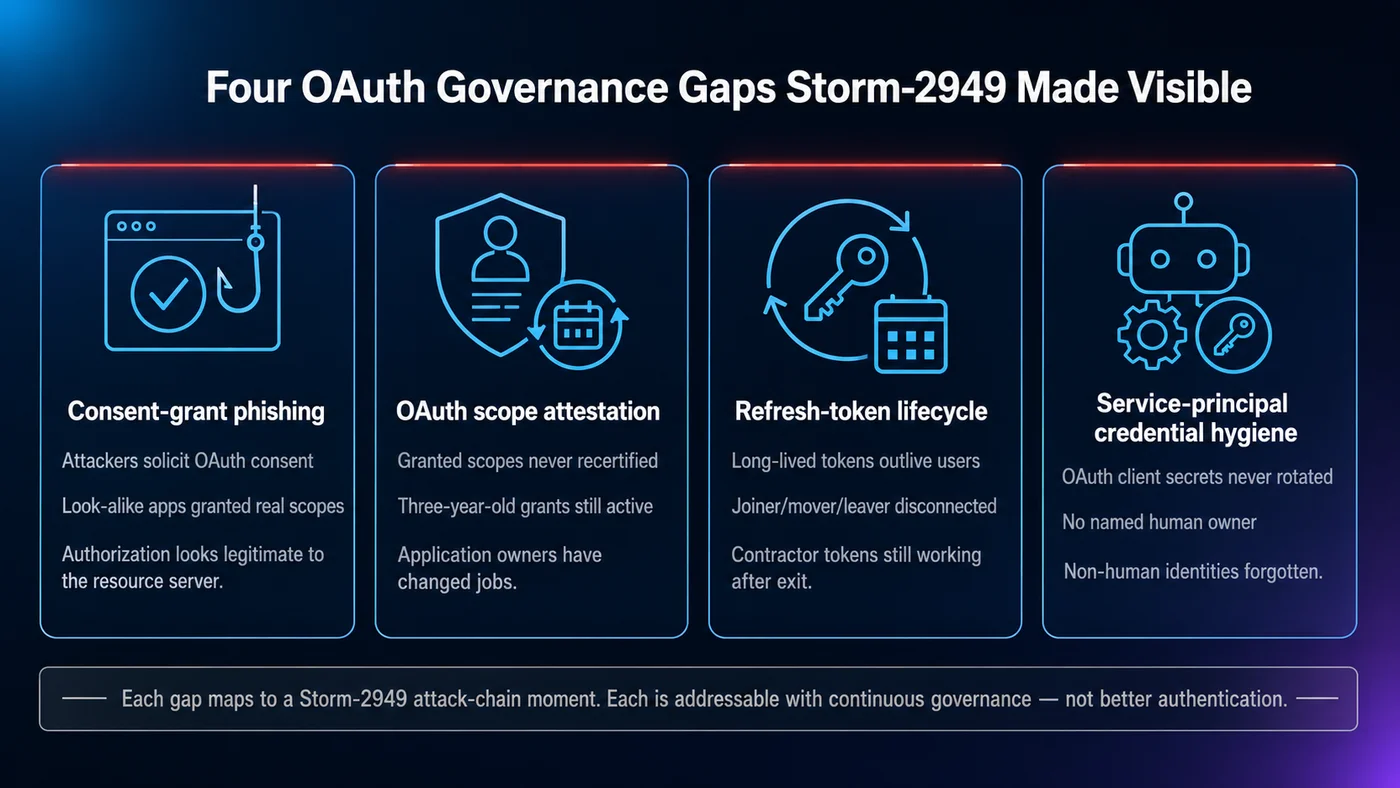 Four gaps, four controls. The OAuth-specific layer of the Storm-2949 attack chain — and the governance disciplines that close each gap before the next breach uses the same doors.
The four OAuth governance gaps Storm-2949 made visible
Storm-2949 was not framed in the security press as an OAuth incident. It was framed as an Entra ID Self-Service Password Reset (SSPR) incident. Both framings are correct. The OAuth-specific layer of the story, though, exposed four governance gaps that apply to every enterprise OAuth deployment — not just Microsoft tenants.
Consent-grant phishing
The attacker creates an application named something close to a trusted internal tool — "Avatier Reporting Sync" or "Office 365 Mailbox Verifier." They send a phishing email with a sign-in link. The user clicks, authenticates legitimately (their MFA works), and is presented with a consent screen asking them to grant the malicious app permission to read their mail, access their files, or impersonate them in API calls. They click consent. The OAuth grant is now active.
No password was stolen. No MFA prompt was bypassed. The attacker simply asked for permissions and received them, through the legitimate OAuth flow. From this moment on, the attacker holds OAuth tokens that authorize the granted scopes — and those tokens look indistinguishable from any other legitimate consent grant on the resource server. CISA and Microsoft have published advisories on this technique. The mitigation is not better authentication. It is consent-grant governance: admin consent required for high-impact scopes, monitoring for new grants to applications outside the approved catalog, and periodic attestation of every active grant.
OAuth scope attestation
Storm-2949 reached Microsoft Graph because the compromised users held standing API permissions through Graph scopes that had been granted long before the breach and never recertified. Scope attestation is the discipline of asking, quarterly or more often, whether each granted scope is still appropriate to its application's current business function. Most enterprises do not do this. They run access certification campaigns for human-identity role membership but do not run them for OAuth scopes granted to applications.
Operationally, scope attestation looks like this: the identity governance platform reads the OAuth consent grants and service-principal permissions inventory, joins it against the application inventory and the named owner, and produces a recertification campaign that asks each owner to confirm that the scopes their application still needs are appropriate. Grants that fail recertification are revoked. Grants whose owners have left the company are escalated. Grants whose applications are decommissioned are removed. None of this is novel governance. It is the same access certification discipline applied to a non-human-identity surface most enterprises have not extended their governance program to cover yet.
Refresh-token lifecycle
Refresh tokens in OAuth 2.0 are how applications keep working after the user closes the browser. The application keeps the refresh token, exchanges it for a fresh access token when the previous one expires, and the user never sees another sign-in prompt. This is essential for user experience. It is also the longest-lived credential in most OAuth deployments — and the one that most rarely gets reviewed when a user changes role, leaves the company, or has their account compromised.
The governance pattern is refresh-token lifecycle integrated with the joiner/mover/leaver workflow. When HR marks a user as departed, the lifecycle system revokes every refresh token associated with their identity across every OAuth-protected resource. When a user changes roles, the system can either revoke refresh tokens (forcing re-authentication with new scopes) or accept the trade-off of keeping old tokens valid until they naturally expire. The decision should be explicit, not accidental.
Service-principal credential hygiene
OAuth client credentials — the secrets that non-human applications use to authenticate to authorization servers — accumulate the same way human credentials do, but worse. They are created by application teams who later leave the company. They are stored in CI/CD systems whose access logs nobody monitors. They are rotated rarely, if ever. Storm-2949 attempted credential injection on a service principal precisely because non-human OAuth clients are a soft target across the industry.
Service-principal credential hygiene applies the same governance discipline to OAuth client secrets that the rest of identity governance applies to human credentials: named human ownership, scheduled rotation (90 days for privileged clients, longer for low-impact ones), permission recertification on the same cadence as human recertification, and explicit decommissioning when applications retire. The technology pattern is well-understood. The operational discipline is not yet widely deployed.
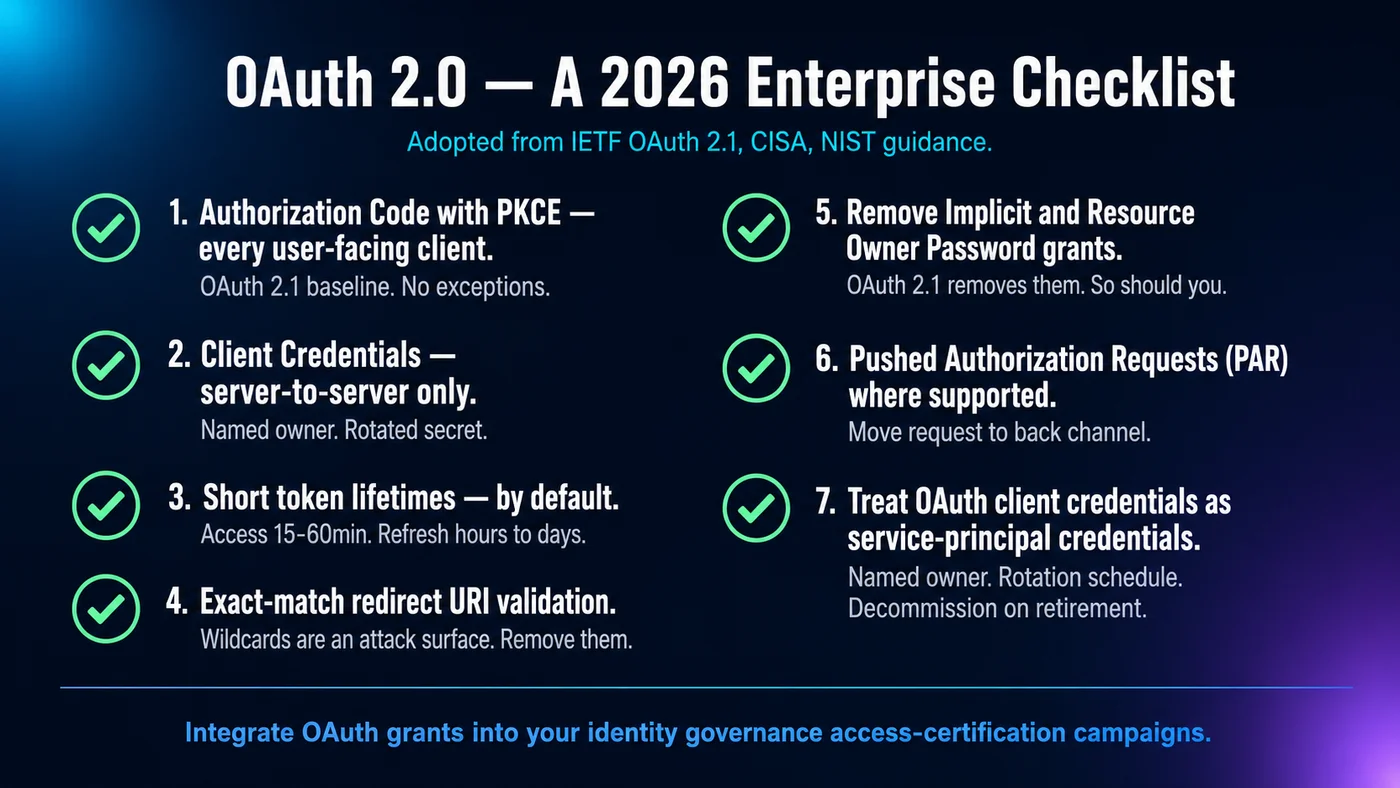 Seven baselines for OAuth in 2026 — protocol hygiene plus the governance disciplines that close the gaps the protocol itself does not.
Best practices: a 2026 enterprise OAuth checklist
Use Authorization Code with PKCE for every user-facing client, regardless of confidentiality. Use Client Credentials for service-to-service flows with named, rotated client secrets. Remove every Implicit grant and Resource Owner Password Credentials grant from your deployment — OAuth 2.1 does, and so should you.
Set short token lifetimes by default. 15-60 minutes for access tokens, 5-15 minutes for ID tokens, hours to days for refresh tokens with rotation enabled. Resist the operational pressure to extend these for "user convenience" — the convenience saves users a sign-in prompt every few hours and costs your organization the difference between a four-hour breach window and a two-week one when a token is stolen.
Enforce exact-match redirect URI validation. Wildcard redirect URIs are a documented attack surface in OAuth — they let an attacker redirect the authorization response to a host they control. The fix is uninteresting and well-documented; deploy it.
Implement Pushed Authorization Requests (PAR) where supported by your authorization server. PAR moves the authorization request from the front channel (where it can be manipulated by intermediaries) to the back channel (where it cannot). It is becoming the security default for high-assurance OAuth deployments.
Treat OAuth client credentials as service-principal credentials. Name an owner. Rotate the secret. Attest the granted scopes. Decommission when retired. The pattern is identical to the discipline you should already be running on Active Directory service accounts — which we cover in detail in the credential governance framework this blog anchors.
Integrate OAuth grants into your identity governance access-certification campaigns. The user's role membership in Active Directory is governed quarterly. The applications that user has consented to receive OAuth scopes from should be governed on the same cadence. Most enterprises do not yet do this. Closing that gap is the central 2026 maturity move for OAuth governance.
Avatier is a CISA Secure-by-Design Pledge signatory. Identity Anywhere aligns with CISA's published guidance on phishing-resistant MFA, and the platform's governance modules treat OAuth grants, scopes, and refresh tokens as governance objects with the same lifecycle, attestation, and recertification expectations as human identity.
OAuth 2.1 and beyond
The current Internet-Draft for OAuth 2.1 consolidates the operational best practices the OAuth community has converged on since RFC 6749 published in 2012. It does not introduce new fundamental capabilities. It removes legacy patterns that have proven unsafe.
The mandatory changes are: PKCE required for every client, including confidential ones; the Implicit grant removed; the Resource Owner Password Credentials grant removed; exact-match redirect URI validation required; refresh-token rotation strongly recommended (and in many implementations, required).
Several adjacent OAuth extensions are also gaining traction. Rich Authorization Requests (RAR, RFC 9396) enable more expressive permission requests than basic scopes. Pushed Authorization Requests (PAR, RFC 9126) move authorization parameters to the back channel. JWT-Secured Authorization Response Mode (JARM, draft-ietf-oauth-jarm) signs and optionally encrypts authorization responses. The Device Authorization grant (RFC 8628) has been refined in response to the social-engineering risks of the original specification.
The pattern across all of these is consistent: the OAuth 2.0 protocol fundamentals are stable. The mode of evolution is the security best practices around them, formalized into the specification rather than left to deployment discretion. Enterprises building for OAuth 2.1 today are anticipating publication of a specification that codifies the operational disciplines that mature deployments have already adopted.
Frequently asked questions
What is OAuth 2.0 in plain English?
OAuth 2.0 is an authorization protocol that lets a user grant a third-party application limited access to their resources without sharing their password. Instead of a password, the application receives a time-limited token that says "this app can do these specific things on this user's behalf, until this time." Defined in IETF RFC 6749, OAuth is the foundation of most enterprise API access today.
What is the difference between OAuth 2.0 and OpenID Connect (OIDC)?
OAuth 2.0 is about authorization — what an application is allowed to do. OpenID Connect (OIDC) sits on top of OAuth 2.0 and adds authentication — who the user is. OAuth issues access tokens for resource access; OIDC additionally issues ID tokens that describe the authenticated user. Enterprise identity solutions typically deploy them together — OIDC for sign-in, OAuth for downstream API authorization.
What are the OAuth 2.0 grant types, and which should we use?
The four primary grant types are Authorization Code (with PKCE), Client Credentials, Refresh Token, and Device Authorization. For web and mobile applications, use Authorization Code with PKCE. For server-to-server APIs, use Client Credentials. The Implicit grant and Resource Owner Password Credentials grant are deprecated in OAuth 2.1 and should not be used in new deployments.
What is consent-grant phishing, and why does it matter for OAuth?
Consent-grant phishing is an attack where an adversary creates a look-alike application and tricks users into granting OAuth scopes to it. Once granted, the attacker holds long-lived authorized access without ever stealing a password. CISA and Microsoft have published advisories on this technique. Unlike password phishing, consent-grant phishing leaves no broken authenticator behind — the attacker's access looks legitimate to the resource server because it is. Mitigation is governance, not authentication: continuous consent-grant attestation and admin-only consent for high-impact scopes.
How long should OAuth access tokens and refresh tokens live?
Typical safe defaults are 15-60 minutes for access tokens, 5-15 minutes for ID tokens, and hours to days (not weeks) for refresh tokens in enterprise contexts. Refresh tokens in the previous decade were often issued for 90 days or longer; modern guidance favors shorter lifetimes paired with rotating refresh tokens. The trade-off is user friction against blast radius — every additional hour of refresh-token validity is an hour an attacker has to use a stolen one.
Does OAuth 2.0 support phishing-resistant authentication?
OAuth 2.0 itself is an authorization protocol — it does not specify the authentication method. Phishing-resistant authentication (FIDO2, WebAuthn, PKI smart cards) is implemented at the authorization-server layer where the user is authenticated before OAuth tokens are issued. An enterprise OAuth deployment becomes phishing-resistant by enforcing phishing-resistant MFA at the IdP, then issuing OAuth tokens only after that authentication completes.
How does OAuth 2.0 fit into identity governance?
OAuth 2.0 issues credentials (tokens) and grants permissions (scopes) — both are governance objects. Identity governance for OAuth includes: scope attestation (periodic recertification that granted scopes are still appropriate), consent-grant monitoring (alert on new grants to high-impact scopes), refresh-token lifecycle (force re-authentication when users change roles or leave), and client-credential rotation (treat OAuth client secrets as service-principal credentials with named owners, rotation schedules, and decommissioning workflows).
What is OAuth 2.1 and how is it different from OAuth 2.0?
OAuth 2.1 is a consolidation of OAuth 2.0 best practices into a single specification rather than a fundamentally new protocol. The major changes are: PKCE required for all clients (including confidential ones), the Implicit grant deprecated, the Resource Owner Password Credentials grant removed, exact-match redirect URI validation required, and refresh-token rotation expected. OAuth 2.1 is a current Internet-Draft in the IETF OAuth Working Group; deployments treating it as the baseline today are anticipating publication.
ABOUT THE AUTHOR

More from IAM & Identity Governance

Identity Management and Digital Transformation in 2026
Every major transformation initiative — cloud migration, remote and hybrid work, mergers and acquisitions — eventually stalls on the same question: who gets access to what, and who decided? The 2026 strategy reference on identity management as the enabler and the bottleneck of digital transformation, the business case executives actually fund, and what modernization does not fix.

AI and Behavioral Analytics for Identity Monitoring: The 2026 Enterprise Reference
Static identity rules catch the attacks that announce themselves. They miss the ones that log in with valid credentials and behave almost normally. The 2026 reference on AI-driven identity monitoring — what behavioral analytics actually detects, the four telemetry sources that make or break the model, the false-positive economics nobody budgets for, and the honest limits of anomaly detection at enterprise scale.
Security Team Collaboration: A 2026 Framework for Identity Programs
Identity governance fails when it runs as a security-team-only initiative. The 2026 framework for cross-functional collaboration: four stakeholder groups, three coordination models, and how zero trust makes it a shared discipline.