SCIM Provisioning: The Standard Behind Automated Identity Sync (2026)
SCIM is the RESTful, JSON-based standard that automates identity provisioning and deprovisioning between a source of truth and downstream apps. What it is, how it works, and what it does not solve.

SCIM is the RESTful, JSON-based standard that automates identity provisioning and deprovisioning between a source of truth and downstream apps. What it is, how it works, and what it does not solve.
- SCIM (System for Cross-domain Identity Management) is a RESTful, JSON-based open standard — defined in RFC 7642, 7643, and 7644 — that automates the exchange of identity data between a source of truth (an HRIS or identity provider) and downstream applications, replacing manual account creation, CSV uploads, and helpdesk tickets with standardized API calls.
- SCIM's real value shows up in the joiner-mover-leaver lifecycle, and especially in the leaver case: when someone is terminated in the source system, SCIM pushes a deactivation event to every connected application at once, closing the orphaned-account window that manual deprovisioning leaves open for days or weeks.
- SCIM is a sync protocol, not a governance layer. It executes identity changes fast and consistently once a decision has already been made — it does not decide who should have access, run approval workflows, or catch a bad access grant. That decision layer is what IGA and access governance provide.
- Not every application supports SCIM natively, and support quality varies even among applications that claim it — custom attribute mapping, non-standard schemas, and partial endpoint coverage are the common implementation gaps that show up during rollout.
- SCIM materially reduces the population of orphaned and stale accounts that accumulate under manual, CSV-based, or ticket-driven provisioning, and faster deprovisioning is a direct, practical building block of a Zero Trust posture — but the protocol only closes the mechanical gap, not the governance gap above it.
SCIM — the System for Cross-domain Identity Management — is the RESTful, JSON-based open standard that automates how identity data moves between a source of truth, like an HRIS or identity provider, and the downstream applications that need user accounts. Instead of an administrator manually creating accounts in every application or re-uploading a CSV export each time someone joins, changes roles, or leaves, a SCIM-enabled source pushes standardized create, update, and deactivate calls automatically. That automation matters because manual provisioning does not scale past a few dozen applications and does not deprovision reliably at offboarding — which is exactly where orphaned-account risk accumulates.
This is the 2026 update to our earlier piece on SCIM and enterprise provisioning, first published in June 2025 (previously at https://www.avatier.com/blog/scim-enterprises-streamline/, now redirected here). The update strips out inflated third-party statistics that don't hold up to scrutiny and replaces them with a grounded technical and operational account of what SCIM actually does, how it mechanically works, and — just as importantly — what it does not solve.
What SCIM Actually Is
SCIM is a formal specification, not a marketing term or a loose convention. It is defined across three IETF RFCs: RFC 7642 lays out the use cases and conceptual model, RFC 7643 defines the core schema for identity resources, and RFC 7644 defines the RESTful protocol used to exchange them. Together, those three documents specify two things that matter to anyone implementing SCIM.
First, the schema. SCIM defines a standardized JSON representation for a User resource (attributes like username, given name, family name, email addresses, active status, and group memberships) and a Group resource (a name and a list of member references), with a well-defined mechanism for extending the schema with custom, enterprise-specific attributes without breaking interoperability. Second, the protocol. SCIM specifies the RESTful API operations — POST to create a resource, GET to read it, PUT or PATCH to update it, DELETE to remove it — along with filtering, pagination, and bulk-operation semantics so clients and servers can exchange identity data predictably at scale.
The reason this matters more than it might first appear is interoperability. Before SCIM became the default, provisioning integrations were often bespoke: a custom connector built for each identity-provider-to-application pair, maintained separately, breaking separately when either side changed. Because SCIM is a published, versioned standard, any identity provider that implements the client side and any application that implements the server side can interoperate without a custom-built integration in between. That is what turned automated provisioning from an enterprise-architecture project into a checkbox during SaaS procurement.
How SCIM Works, Mechanically
The mechanics follow a client-server pattern. The identity source of truth — typically an identity provider that has already synchronized from an HRIS, directory, or authoritative employee record system — acts as the SCIM client. Applications that support SCIM expose a SCIM server endpoint, usually documented alongside their admin console's SSO configuration.
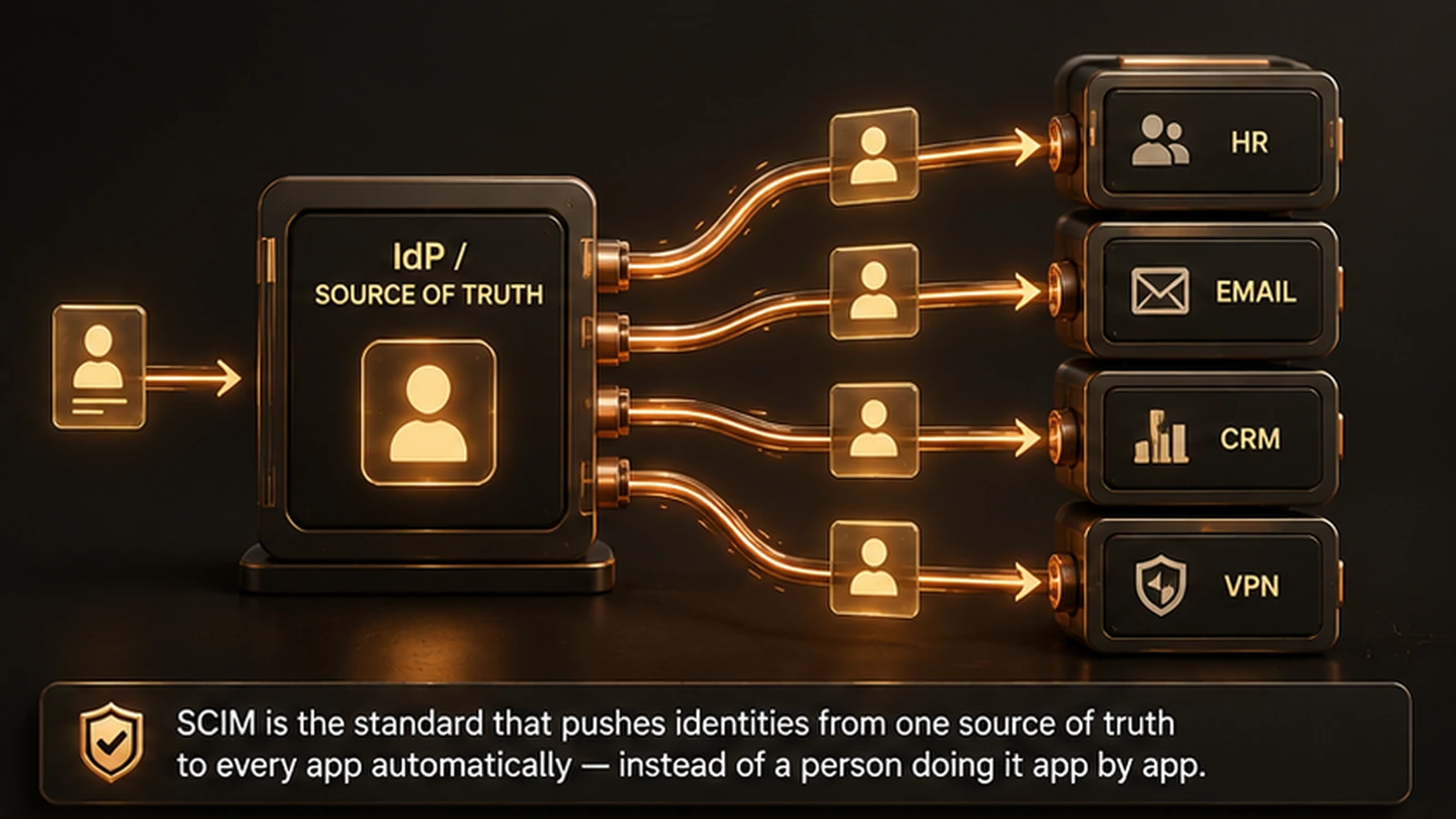 One change at the identity source of truth propagates automatically to every SCIM-connected application — no manual re-entry, no lag.
When an identity event occurs — a new hire is added, an attribute changes, an account needs to be disabled — the SCIM client formats that event as a standardized API call against the SCIM schema and sends it to each connected application's SCIM server endpoint. The server processes the call and updates its own account state to match: creating a new user record, updating an attribute or group membership, or flipping the account's active status. Because every application that correctly implements SCIM speaks the same schema and the same protocol, the source system does not need application-specific logic for each downstream target — it sends one standardized call per event, and every connected application interprets it the same way.
This is the mechanical core of automated provisioning: the source system pushes, the target system receives and applies, and the two stay synchronized without a human re-keying data in between. It is a comparatively simple architectural pattern, and the simplicity is deliberate — SCIM was designed to be implementable without heavyweight infrastructure, which is a large part of why adoption spread as quickly as it did across enterprise SaaS.
The Joiner-Mover-Leaver Lifecycle: Where the Real Value Lives
SCIM's mechanics are straightforward, but its value is best understood through the three lifecycle events it automates: joiner, mover, and leaver. Together they form the backbone of enterprise identity lifecycle management, and SCIM is the execution layer that makes each event propagate consistently.
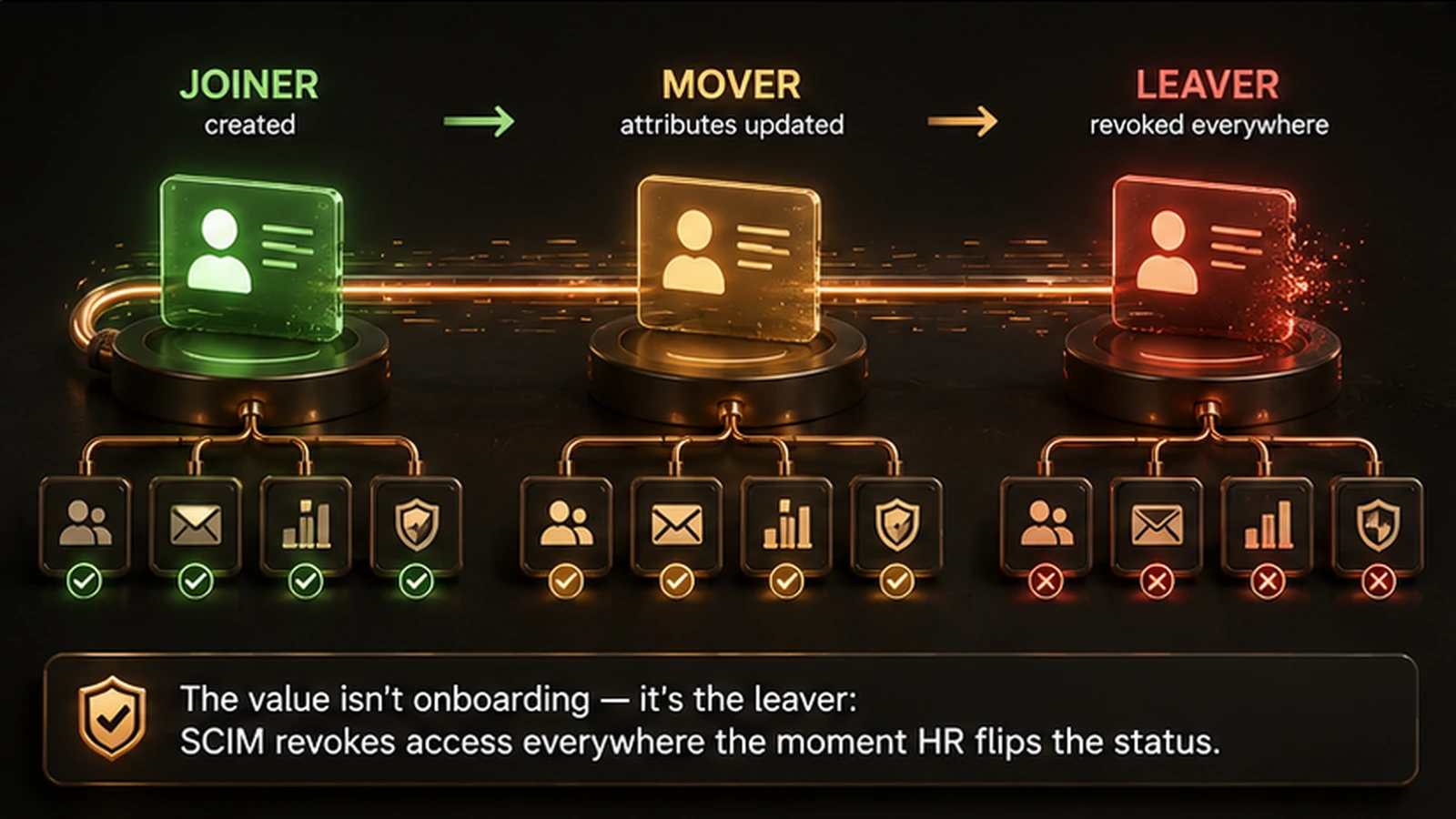 The leaver event is where orphaned-account risk actually lives — SCIM is what closes it automatically, everywhere, at once.
Joiner. When a new hire is added to the source of truth — usually driven by an HRIS-based lifecycle trigger — SCIM pushes create events out to every connected application, provisioning the accounts and starting group memberships the new hire needs on day one, without a manual setup checklist for each application.
Mover. When someone changes role, team, or department, the source record updates, and SCIM pushes corresponding attribute and group-membership updates downstream. This is the event manual provisioning handles worst: a transfer often means removing access the old role required while adding access the new role requires, and manual processes routinely complete the "add" half while skipping the "remove" half, leaving accumulated access behind.
Leaver. When someone is terminated in the source system, SCIM pushes a deactivation event to every connected application simultaneously. This is where SCIM's value is most concrete and most defensible under audit. Manual, per-application offboarding depends on a person remembering to disable an account in every system the departed employee touched — and it is precisely the systems that get missed, days or weeks after the fact, where orphaned accounts persist. SCIM's simultaneous deactivation closes that window at the moment the source record changes, not whenever an administrator gets around to the ticket.
The leaver case is worth dwelling on because it is where the abstract case for "automation" becomes a concrete security control. An account that should have been disabled and was not is not a theoretical risk — it is a standing credential, unmonitored, that an attacker or a disgruntled former employee can use for as long as it survives. Closing that gap automatically, at the moment of the triggering event rather than at the pace of a manual checklist, is the single clearest reason enterprises adopt SCIM.
SCIM vs. Manual and CSV-Based Provisioning
The contrast with manual provisioning is where SCIM's design choices become concrete. Manual provisioning — an administrator working through a ticket, or a periodic CSV export re-uploaded into each target system — depends on a person executing the same account-management steps correctly and promptly, application by application, every time an identity event occurs.
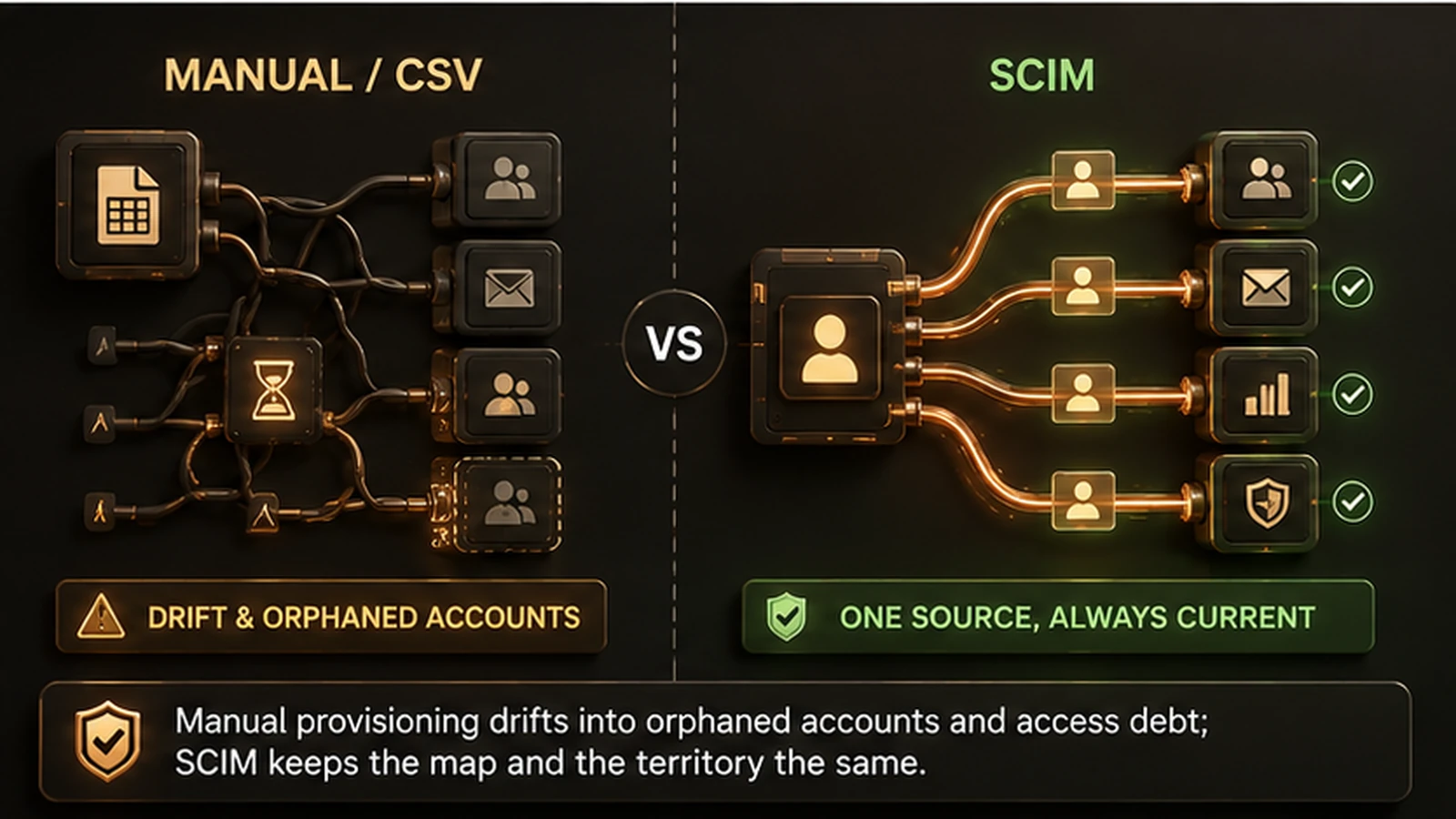 Manual provisioning drifts by design. SCIM keeps the source of truth and every downstream target in sync, continuously.
That dependency produces predictable failure modes. A CSV export reflects the state of the source system at the moment it was generated — the instant a new hire, transfer, or termination happens after that export runs, the target systems are out of date until the next manual cycle. Account creation lags behind actual start dates. Deactivation lags behind actual departure dates, sometimes by a considerable margin, because deprovisioning is rarely anyone's top priority on a given day. And because each application is updated by hand, there is no single, consistent, machine-generated record of what changed, when, and why — the audit trail is whatever notes the administrator happened to leave in the ticket.
SCIM replaces that dependency on human follow-through with automated, standardized API calls triggered directly by the identity event itself. There is no export-and-reupload cycle, because the sync happens continuously as events occur at the source. There is no per-application manual step to forget, because the same standardized call reaches every connected application at once. And because the sync itself is the mechanism, every create, update, and deactivate event produces a structured, timestamped record that becomes part of the audit trail without extra effort. The operational difference is not "SCIM is faster" in the abstract — it is that manual provisioning drifts by design, and SCIM is architected specifically so that drift cannot accumulate between source and target.
Where SCIM Fits Relative to Broader IGA
It is worth being precise about what SCIM is not, because the most common architectural mistake is treating SCIM as a substitute for identity governance rather than as the execution layer beneath it. SCIM is a synchronization protocol. It moves identity data from a source to a target, reliably and in a standardized format. It does not decide who should have access to what.
That decision — who should have access, under what conditions, approved by whom, subject to what segregation-of-duty checks — is the job of identity governance and administration. A self-service access request workflow is a good illustration of the boundary: the request, the approval routing, and the policy checks happen in the governance layer, and once a request is approved, SCIM (or an equivalent provisioning mechanism) is what actually executes the grant in the target system. SCIM has no opinion about whether the request should have been approved in the first place.
This division of labor matters because it clarifies what SCIM will and will not fix. If your access request approvals are rubber-stamped without real review, SCIM will execute those bad approvals faster and more consistently than a manual process would have — automation amplifies whatever policy sits above it, for better or worse. If your organization has not defined who owns approval for a given resource, SCIM has nothing to synchronize against, because there is no governed decision for it to execute. SCIM is the reliable plumbing; IGA is the policy layer that decides what should flow through the pipes. Enterprises that get the most value from SCIM are the ones that already have governance discipline above it — the automation compounds a sound process instead of masking a broken one.
Implementation Considerations
Rolling out SCIM provisioning across an enterprise application portfolio surfaces a consistent set of practical considerations, independent of which identity provider or IGA platform sits on the client side.
Application SCIM support varies more than the marketing suggests. Most mainstream enterprise SaaS platforms publish a SCIM endpoint today, and SCIM support has become close to a baseline expectation during procurement. But coverage is uneven. Legacy on-premises applications, older systems adjacent to mainframe environments, and niche or industry-specific software frequently have no SCIM endpoint at all, and those applications need a different provisioning path — sometimes a connector-based integration, sometimes a manual or semi-automated process that has to be governed separately.
"Supports SCIM" does not always mean full parity. Even among applications that advertise SCIM support, implementations differ in completeness. Some support user provisioning but only partial group sync. Some support the core schema but handle custom or industry-specific attributes inconsistently, requiring configuration work on both sides to map fields correctly. It is worth validating actual endpoint behavior against your specific attribute requirements during a pilot rather than assuming the vendor's SCIM badge means full functional parity with your other integrations.
Rollout sequencing matters more than most teams expect. A phased approach — starting with the highest-volume or highest-risk applications, validating attribute mapping and lifecycle behavior thoroughly, then expanding — surfaces schema mismatches and edge cases while the blast radius is still small. Attempting a full-portfolio cutover at once tends to surface the same handful of mapping issues repeatedly, just at a scale that is harder to unwind.
Legacy systems need a deliberate non-SCIM plan, not a gap. Applications that will never support SCIM — whether due to age, vendor limitations, or architecture — should be explicitly identified and given an alternative provisioning path, even if that path is a governed manual process with its own audit controls. The risk is not that legacy systems lack SCIM; it's when that gap goes unacknowledged and the legacy application quietly falls outside the lifecycle automation everything else benefits from, becoming an unmonitored blind spot rather than a known, managed exception.
Security Benefits
SCIM's security value is concrete and largely follows from the mechanics already described, rather than from any feature marketed as a security add-on. Reduced orphaned accounts is the most direct benefit: because deactivation events fire automatically to every connected application the moment a leaver event occurs at the source, accounts stop surviving past an employee's actual departure by days or weeks, which is where manual deprovisioning consistently fails.
Faster, more consistent deprovisioning compounds into a meaningfully smaller standing attack surface — every account that would have persisted under a manual process, and did not, is one less unmonitored credential available to an attacker, a departed employee, or simple negligence. And because SCIM produces a structured, timestamped record of every create, update, and deactivate event as a byproduct of how it operates, the resulting data feeds directly into audit reporting and access certification without requiring separate manual reconciliation.
SCIM also supports Zero Trust architecture in a practical, unglamorous way: Zero Trust depends on evaluating access continuously against current, accurate identity state, and SCIM is what keeps that identity state current across the application portfolio in near real time rather than as of the last manual sync. None of this makes SCIM a complete security control on its own — it synchronizes state, it does not evaluate whether a given access grant is appropriate — but as the automated execution layer underneath governance and Zero Trust policy, it closes one of the most persistent and most preventable sources of identity risk in the enterprise.
What Avatier Ships Toward This Pattern
Avatier Identity Anywhere Lifecycle Management treats SCIM as the standard execution mechanism for the provisioning decisions made upstream in the governance layer, rather than as a bolt-on integration feature. The platform's connector library covers the major SCIM-native SaaS applications out of the box, while also maintaining native, non-SCIM connectors for the legacy and mainframe-adjacent systems — including RACF, ACF2, and Top Secret environments — that never adopted the standard and are unlikely to.
That combination matters in practice, because most real enterprise portfolios are mixed: a majority of modern SaaS applications that speak SCIM cleanly, alongside a meaningful minority of legacy systems that do not and never will. Treating those as one governed lifecycle — rather than a SCIM-automated majority and an ungoverned legacy exception — is what keeps the joiner-mover-leaver lifecycle complete instead of leaving gaps at exactly the systems most likely to be overlooked. Certification workflows, access requests, and lifecycle triggers in Avatier's platform drive the same automated create, update, and deactivate events across both SCIM-native and legacy connectors, so the leaver event closes access everywhere, not just in the applications that happened to support the modern standard.
The Avatier Trust Center publishes the compliance posture behind that platform, including SOC 2 Type II with zero exceptions noted, ISO/IEC 27001:2022 certification, PCI DSS v4.0.1 compliance, and CSA STAR Level 1 attestation. The architectural pattern of pairing standards-based provisioning with governed lifecycle triggers works independent of vendor — the point here is the pattern, not a product pitch — but it is the combination that determines whether SCIM adoption actually closes the orphaned-account problem or just automates it for the subset of applications that happen to support the standard.
The Honest Closing: What SCIM Does Not Solve
SCIM is plumbing, not policy, and it is worth ending on that distinction plainly rather than overselling the standard. SCIM will execute a create, update, or deactivate event fast, consistently, and across every connected application at once — but it has no mechanism for deciding whether that event should have happened in the first place. A broken approval workflow that grants access nobody should have gets executed by SCIM exactly as reliably as a correct one. A role definition that has drifted into excessive privilege gets synchronized downstream just as faithfully as an appropriately scoped one. Automation amplifies whatever decision quality sits above it; it does not improve that decision quality on its own.
That means the enterprises that get the most out of SCIM are the ones that treat it as one layer in a larger stack, not the whole stack. The governance decisions — who should have access, approved through what policy, reviewed on what cadence, checked against what service account and non-human identity exposure, informed by what ticket-driven shadow access risk — sit above SCIM, not inside it. For the governance layer itself, our pieces on best identity governance and administration solutions and best identity lifecycle management solutions cover that territory directly. SCIM's job is narrower and, done well, more reliable than most governance processes it feeds: keep the source of truth and every downstream application in sync, every time, without drift. Get the governance right, and SCIM is what makes that governance actually show up consistently across the application portfolio it's supposed to protect.
ABOUT THE AUTHOR

More from IAM & Identity Governance

What Identity-Management Failure Actually Costs (2026)
The cost of identity-management failure is not a single line item — it is a breach that starts with a compromised or over-provisioned credential, the downtime while responders lock the environment down, the compliance penalties that follow inadequate access controls, and the customer and market trust that erodes long after the incident closes. This 2026 reference separates the cost of IAM failure from the cost of the IAM program, gives extractable answers to how each failure channel becomes real money, and covers the controls that lower the risk without ever eliminating it.

CIAM vs. Workforce Identity Management: 2026 Reference
A senior practitioner's 2026 comparison of CIAM (customer identity) and workforce identity management — what actually differs, when to use each, how they sit in an enterprise architecture, and the one governance model underneath both.

Break-Glass Emergency Access: A 2026 Best-Practices Guide
A break-glass account is a pre-provisioned, tightly governed emergency credential that grants high-privilege access when normal authentication paths are unavailable — during an outage, an admin lockout, or a disaster-recovery scenario. The 2026 reference on what break-glass means in technology, when to invoke it, and the approval, auditing, time-boxing, and rotation controls that keep the emergency credential from becoming a standing back door.