Password Policy for Enterprise Authentication 2026: The NIST 800-63B Rev. 4 Reference
The password policy that actually reduces risk is not the password policy most enterprises still enforce. NIST 800-63B Rev. 4 (finalized 2025) dismantles the composition rules and periodic-reset mandates that defined the 2000s and codifies a fundamentally different discipline — length over complexity, breach-corpus screening, banned-list enforcement, no forced periodic rotation. The 2026 enterprise reference on the modern password policy, the AAL1/2/3 assurance-level mapping, the enforcement architecture that operationalizes it, and the migration path from the legacy policy every enterprise still carries.
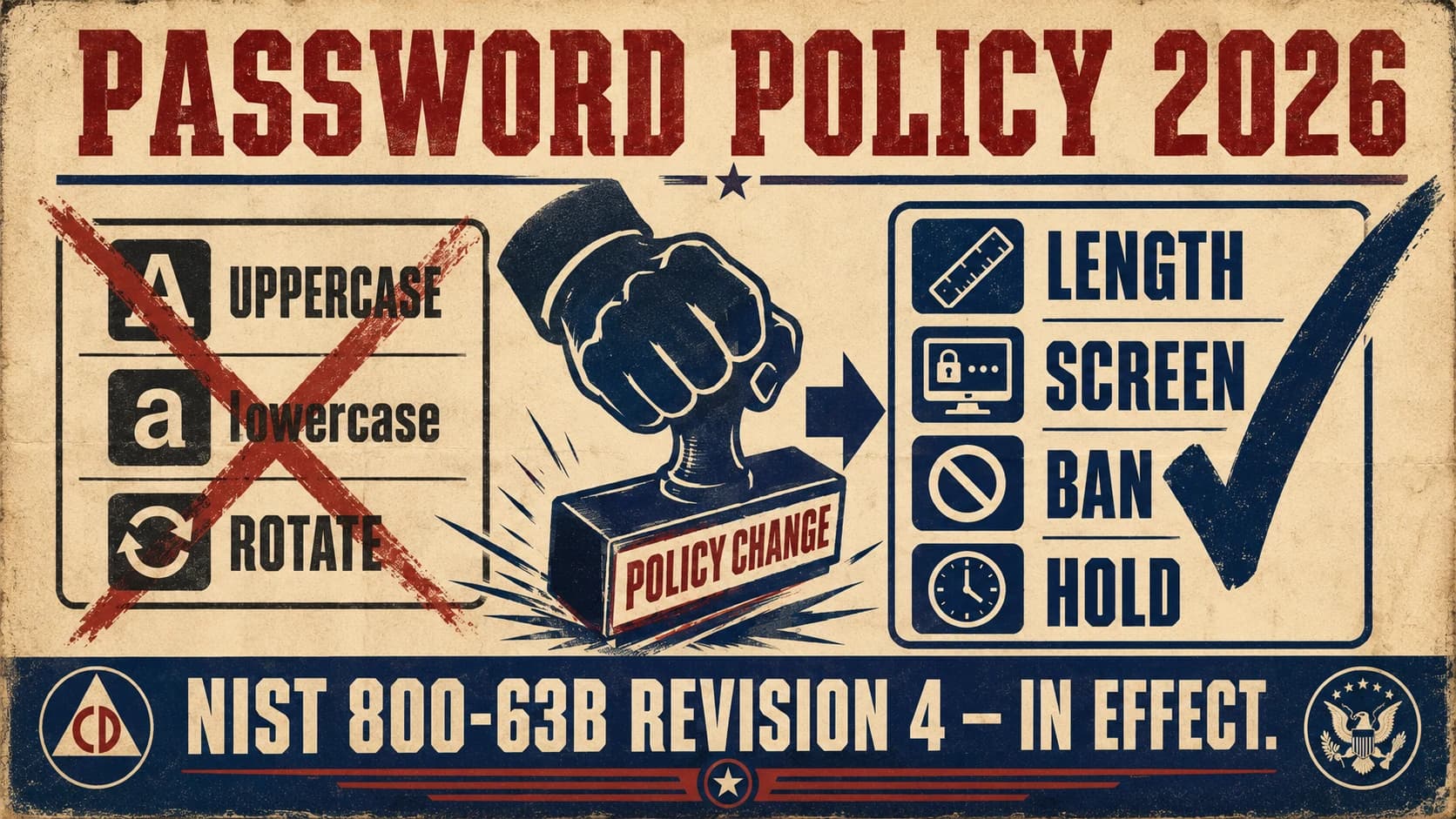
The password policy that actually reduces risk is not the password policy most enterprises still enforce. NIST 800-63B Rev. 4 (finalized 2025) dismantles the composition rules and periodic-reset mandates that defined the 2000s and codifies a fundamentally different discipline — length over complexity, breach-corpus screening, banned-list enforcement, no forced periodic rotation. The 2026 enterprise reference on the modern password policy, the AAL1/2/3 assurance-level mapping, the enforcement architecture that operationalizes it, and the migration path from the legacy policy every enterprise still carries.
- NIST 800-63B Rev. 4 (finalized 2025) codified the shift away from the composition-rule and periodic-rotation password policy that defined the 2000s. The modern discipline is length over complexity, breach-corpus screening at set-time, banned-list enforcement against known-compromised passwords, and no forced periodic rotation absent evidence of compromise. Every enterprise carries a legacy policy that violates the new discipline in some way; the migration is the operational reality of 2026.
- Four operational pillars define the modern password policy: (1) minimum length 15+ characters recommended for AAL2 (not 8 with composition rules), (2) screen every set attempt against known-compromised credential corpuses (Have I Been Pwned corpus, threat-intel breach data, internal history), (3) no forced periodic rotation absent evidence of compromise (rotate on compromise indicators, not on calendar), (4) rate limiting and adaptive MFA on authentication attempts (the attacker who acquires a valid password should still be stopped by additional layers).
- The AAL mapping matters operationally. AAL1 (single-factor authentication) permits memorized secrets alone but requires the modern policy; AAL2 (multi-factor authentication) requires a memorized secret paired with a possession-based authenticator or a biometric authenticator, and the memorized-secret portion follows the modern policy; AAL3 (hardware-based multi-factor authentication with cryptographic verification) requires hardware-bound authenticators and generally reduces the load on the memorized secret to the point where the policy discipline shifts from 'password' to 'PIN unlocking a hardware credential' — a different discipline entirely.
- The enforcement architecture composes password validation at set-time (checking length, banned lists, and breach-corpus screening) with runtime authentication controls (rate limiting, adaptive MFA triggers on risky attempts, session risk monitoring). The password policy alone doesn't produce security; the composition with the [phishing-resistant MFA architecture](https://identitychallengecard.avatier.com/en/blog/phishing-resistant-mfa-enterprise-2026/) and [adaptive authentication risk model](https://identitychallengecard.avatier.com/en/blog/adaptive-authentication-risk-based-mfa-2026/) is what produces defense in depth.
- The migration from legacy policy is operationally hard but architecturally straightforward. Screen the current policy against NIST 800-63B Rev. 4 requirements to identify specific gaps. Roll out breach-corpus screening at set-time immediately (no user-visible change). Deprecate forced periodic rotation across a scheduled window. Update the help desk scripts and user-facing messaging. Coordinate with compliance to reflect the change in policy documentation. The technical work is measurable in weeks; the change management is measurable in months.
The password policy that actually reduces risk in 2026 is not the password policy most enterprises still enforce. The dominant enterprise policy — 8 characters minimum, must include uppercase, lowercase, digit, and special character, must be rotated every 90 days, cannot be reused for 12 cycles — was codified in the mid-2000s and reflects a threat model that no longer describes how passwords actually get compromised. The modern policy, codified in NIST Special Publication 800-63B Rev. 4 (finalized in 2025), reflects two decades of empirical breach data and academic research on password entropy and user behavior.
The changes are substantial. Composition rules are gone. Forced periodic rotation is gone. Length becomes the primary entropy driver. Breach-corpus screening becomes mandatory. Paste into password fields is required to be supported. The full Unicode character set is available. The policy discipline compresses to four operational pillars: length over complexity, breach-corpus screening at set-time, banned-list enforcement, and rotation-on-compromise rather than rotation-on-calendar.
This piece is the 2026 enterprise reference on the modern password policy — what NIST 800-63B Rev. 4 requires, how it maps to the AAL assurance levels, what the enforcement architecture looks like, and how enterprises migrate from the legacy composition-rule policy. Companion pieces cover adjacent layers: the Phishing-Resistant MFA piece on ICC covers the credential-class architecture that produces the MFA half of AAL2 and AAL3; the Adaptive Authentication piece on ICC covers the risk-scoring layer that composes with the password policy at runtime; the Passwordless Login piece covers the architecture that eventually reduces the load on passwords substantially; the Temporary Password Best Practices piece covers the compromise-response rotation pattern.
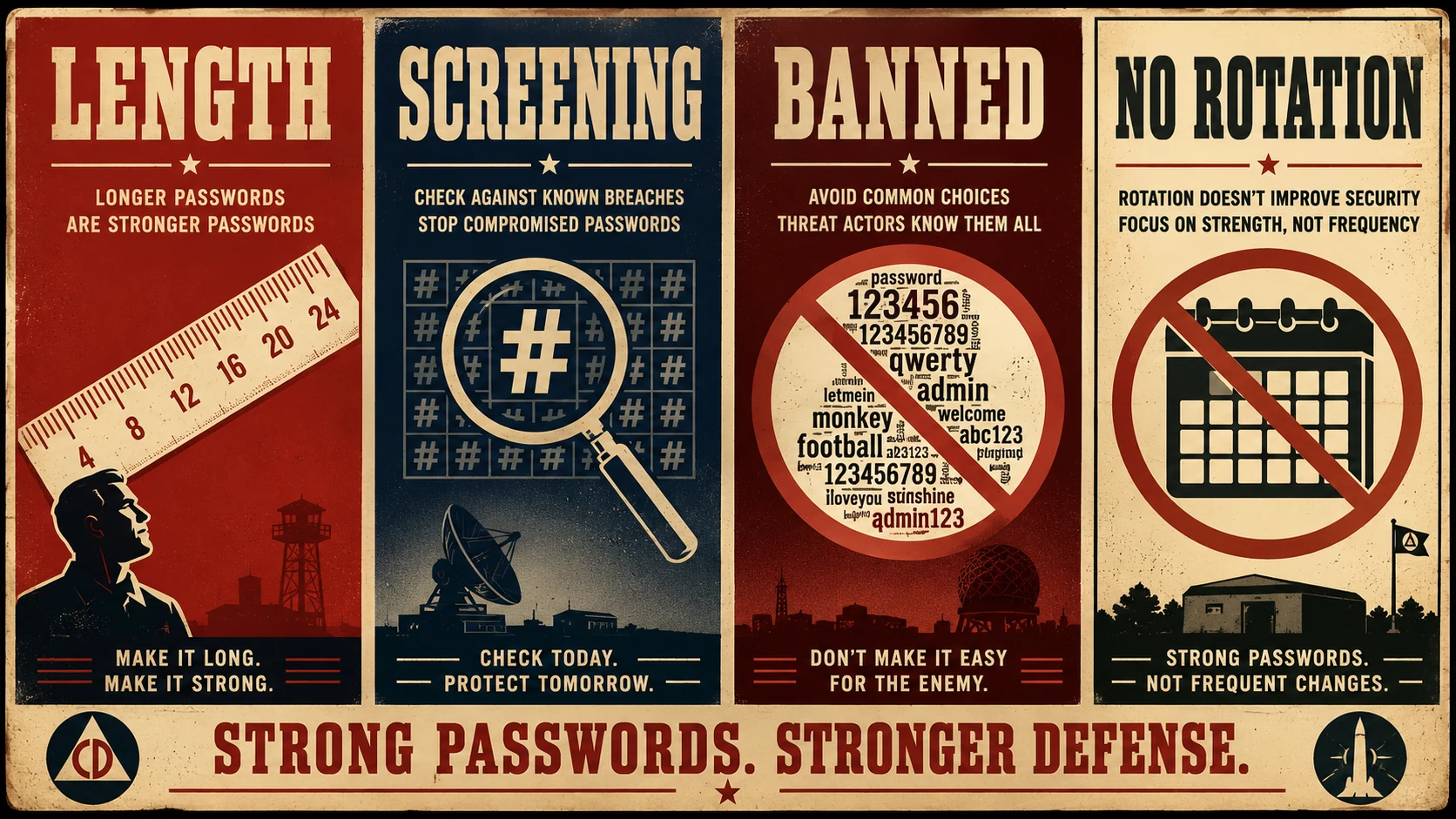 Four pillars, one policy. Each pillar addresses a different failure mode of the legacy composition-rule policy; composition with runtime authentication controls produces the defense in depth.
What NIST 800-63B Rev. 4 requires
The standard uses specific normative language — SHALL, SHALL NOT, SHOULD, MAY — that distinguishes required behavior from recommended behavior. The requirements for memorized secrets (the technical term for passwords in the standard) are precise.
The verifier SHALL require memorized secrets to be at least eight characters in length. The standard permits the minimum at eight, but the guidance strongly recommends substantially higher — 15 or more characters is the current recommendation for AAL2-level protection. The empirical rationale is that entropy scales linearly with length, so the difference between a well-chosen 15-character passphrase and an 8-character password is roughly two orders of magnitude in resistance to brute-force attack.
The verifier SHALL compare the prospective memorized secret against a list of known-compromised values. The list must include values obtained from previous breach corpuses, dictionary words, repetitive or sequential characters, and context-specific words like the name of the service, the username, or derivatives thereof. The implementation typically uses the Have I Been Pwned Pwned Passwords service, which as of 2026 tracks approximately 850 million unique compromised password hashes drawn from publicly disclosed breaches. Commercial threat-intelligence services provide additional coverage for credential dumps from underground markets.
The verifier SHALL NOT impose other composition rules on memorized secrets. The prohibition is explicit — no uppercase-lowercase-digit-special-character requirements, no first-character-must-be-a-letter rules, no restriction on which specific characters can appear. The verifier SHALL permit all printable ASCII characters and SHOULD accept Unicode characters. Space characters SHALL be permitted (multi-word passphrases depend on space characters).
The verifier SHALL NOT require memorized secrets to be changed arbitrarily. The verifier SHALL force a change if there is evidence of compromise of the authenticator. The evidence-based rotation trigger is fundamentally different from calendar-based rotation. Evidence includes the password appearing in a new breach corpus, the account showing anomalous authentication patterns detected by ITDR tooling, the user self-reporting a compromise, or forensic analysis identifying credential exposure through phishing or similar attack.
The verifier SHOULD offer guidance to the subscriber to assist the user in choosing a strong memorized secret. The guidance can include a password strength meter, examples of good passphrases, and specific rejection reasons when a chosen password fails the screening.
The verifier SHALL support paste functionality in password fields. Password managers depend on paste; blocking paste weakens security by pushing users toward simpler passwords they can type without error. This is a common legacy-policy violation — many enterprise applications historically blocked paste "for security reasons" that were never actually security reasons.
The four operational pillars
The requirements compose into four operational pillars that the enterprise policy needs to implement.
Pillar one: length over complexity. The policy specifies a minimum length aligned to the intended assurance level. For AAL1 use cases (low-risk applications), 8 characters is the standard minimum but the guidance recommends higher. For AAL2 use cases (the majority of enterprise applications), 15 characters or more is the current recommendation. For high-risk applications approaching AAL3 territory, 20+ character passphrases are appropriate — though AAL3 typically shifts to hardware-bound authenticators where the memorized secret becomes a PIN with different discipline. The user-facing guidance encourages passphrases over passwords — three or four unrelated words with spaces between them produces high entropy and is memorable.
Pillar two: breach-corpus screening at set-time. Every password-set attempt runs through the screening before the password is accepted. The implementation uses a k-anonymity pattern to preserve the plaintext password within the enterprise environment. The first five characters of the password's SHA-1 hash are sent to the corpus service; the service returns all matching hash suffixes; the enterprise's password validator checks locally whether the full hash matches. The plaintext password never leaves the enterprise environment. The screening should include the Have I Been Pwned Pwned Passwords service, commercial threat-intelligence corpuses relevant to the industry, the user's own previous passwords in the enterprise (internal history), and organization-specific banned strings (company name, common product names, common local geographic references, current CEO name and other predictable derivatives).
Pillar three: banned-list enforcement. Beyond the breach-corpus screening, the policy maintains an organization-specific banned list. The list includes the specific values NIST calls out — dictionary words, repetitive or sequential characters, context-specific words like the service name and derivatives — and enterprise-specific additions that the security team maintains. The banned list is enforced at set-time alongside the breach-corpus check.
Pillar four: no forced periodic rotation. The password is set once and used until compromise indicators trigger rotation. The compromise indicators that should force rotation include the password appearing in a new breach corpus (the enterprise re-screens the currently-active password against updated corpuses periodically), the user's account showing anomalous authentication patterns flagged by ITDR tooling, the user self-reporting a compromise, forensic analysis identifying credential exposure, or organization-wide compromise events like a phishing campaign that specifically targeted the enterprise. The rotation is triggered by specific evidence rather than by calendar cycle.
The AAL assurance-level mapping
The password policy discipline maps differently across the three Authenticator Assurance Levels. Understanding the mapping is what determines which password patterns satisfy which use cases.
AAL1 permits single-factor authentication. A memorized secret alone, following the modern policy, is acceptable at AAL1. Use cases include low-risk applications where the impact of credential compromise is manageable through other means — read-only access to non-sensitive information, self-service applications with limited action scope, informational portals. The policy discipline is important because the memorized secret is the only authentication factor. Length recommendation is at least the standard minimum (8 characters), though 12+ is common practice even at AAL1 for meaningful entropy.
AAL2 requires multi-factor authentication. A memorized secret paired with a possession-based authenticator (smartphone-based OTP, push notification with cryptographic verification, hardware token) or a biometric authenticator with cryptographic binding. AAL2 is the target for the vast majority of enterprise applications — business systems, collaboration tools, engineering resources, financial applications below the high-impact threshold. The memorized-secret portion follows the modern policy with length recommendation at 15+ characters. The MFA portion is where the phishing-resistant credential architecture applies.
AAL3 requires hardware-based multi-factor authentication with cryptographic verification. The authenticator combination is a hardware-bound cryptographic authenticator (hardware FIDO2 key, smart card, PIV credential) with a memorized-secret unlock (PIN) and cryptographic verification of the authentication ceremony. At AAL3 the "password" discipline shifts substantially — the memorized secret is a PIN unlocking a hardware credential rather than a password authenticating directly to a service. The PIN can be shorter (6-8 digits is common) because it's protecting a hardware-bound cryptographic key and has rate limiting on incorrect attempts that prevent brute force. The high-impact applications that require AAL3 include financial trading systems, healthcare records with high sensitivity, critical infrastructure control, and regulated environments where compromise has significant consequences.
The mapping matters because it determines what the memorized-secret policy actually needs to accomplish. At AAL1 the policy is the whole security story. At AAL2 the policy is one of two factors, and the composition with MFA matters as much as the policy itself. At AAL3 the memorized secret is a PIN protecting a hardware credential — different discipline entirely.
The enforcement architecture
The password policy alone doesn't produce security. The composition with runtime authentication controls is what produces defense in depth.
The set-time controls validate the password against the policy at the moment the user attempts to set or change it. Length check. Breach-corpus screening. Banned-list check. Internal-history check. Rejection with clear guidance on failure. Success moves the password into the credential store with appropriate hashing (Argon2id or bcrypt with sufficient work factor; PBKDF2-HMAC-SHA-256 with at least 600,000 iterations is the current minimum for PBKDF2 implementations under NIST guidance).
The authentication-time controls apply when the user attempts to authenticate with the password. Rate limiting on failed attempts — the specific threshold varies by risk, but 5-10 failed attempts in a short window should trigger throttling and 20+ in a longer window should trigger account lockout with recovery flow. Adaptive authentication risk scoring evaluates the specific attempt against contextual signals (unfamiliar device, unfamiliar geography, unfamiliar time-of-day, session characteristics inconsistent with the user's baseline). High-risk attempts trigger additional friction — challenge for stronger authenticator, session challenge that requires re-verification, or outright denial pending human review. The Adaptive Authentication piece on ICC covers the risk-scoring architecture.
The post-authentication controls apply during the user's session. Session risk monitoring detects behavior that suggests the session may have been hijacked or the user's context has changed in ways consistent with attack — sudden shift in geolocation, sudden shift in device characteristics, actions inconsistent with the user's baseline pattern. The Continuous Authentication piece on ICC covers session-level treatment for high-risk workforces.
The compromise-response controls apply when evidence of credential compromise emerges. The password gets re-screened against updated breach corpuses periodically; if the currently-active password now appears in a corpus, the user is forced to change it. ITDR tooling detecting anomalous patterns can trigger session termination and forced re-authentication with elevated verification. User self-reports of compromise trigger immediate rotation and additional monitoring. The compromise-response pattern is what makes rotation-on-compromise-indicator work — the indicators need to be operationalized as automatic triggers, not manual processes.
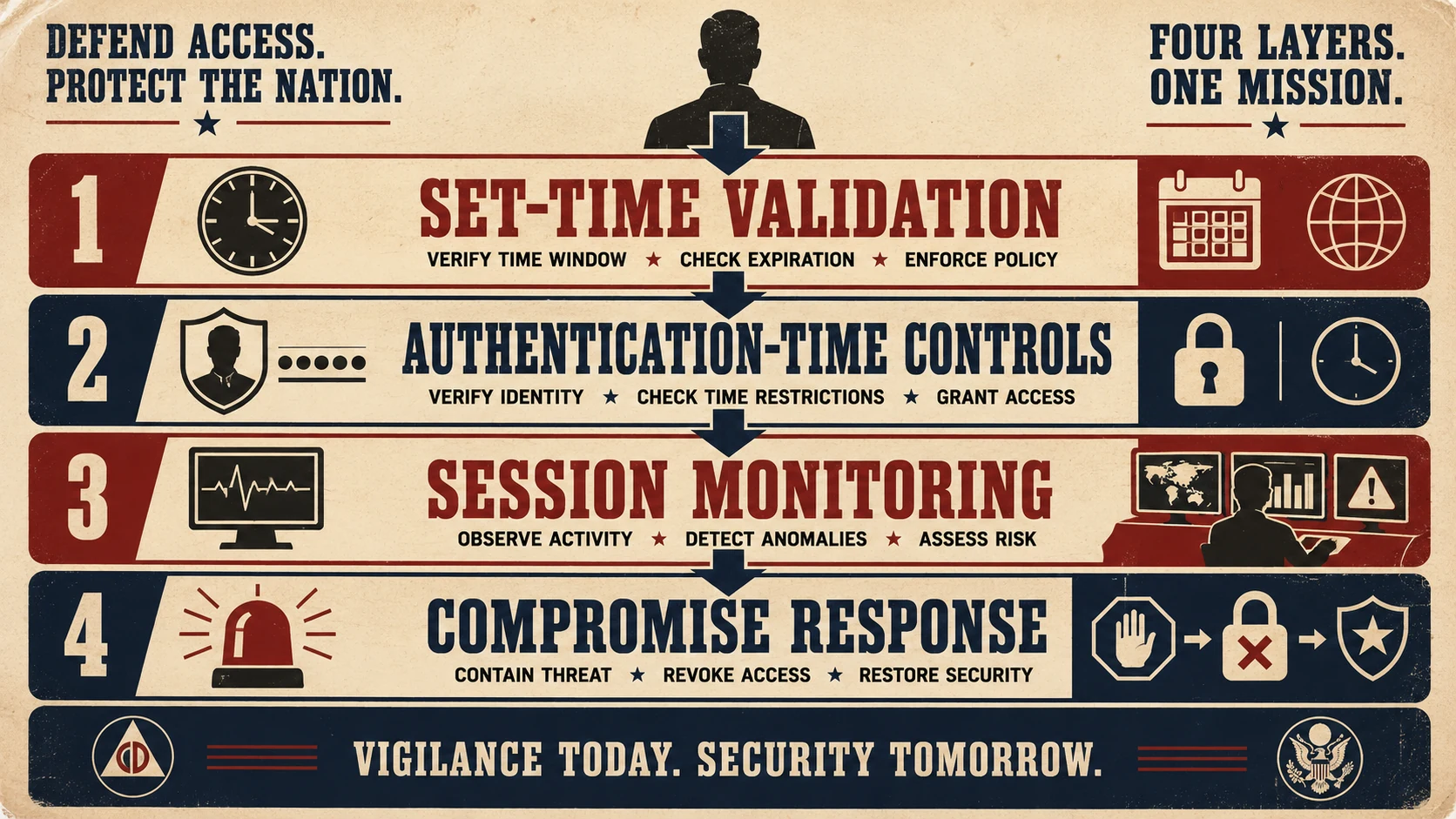 Four enforcement layers, one composed defense. Each layer catches different failure modes; skipping any layer produces a specific gap that the others don't cover.
Migration from the legacy composition-rule policy
Every enterprise carries a legacy policy that violates the modern discipline in some way. The migration is the operational reality of 2026 — technically straightforward, organizationally complex.
Step one is measurement. Screen the current policy against NIST 800-63B Rev. 4 requirements to identify specific gaps. Common gaps include: composition rules that force uppercase/lowercase/digit/special-character combinations (violates SHALL NOT impose composition rules), periodic rotation on 30/60/90-day cycles (violates SHALL NOT require arbitrary changes), maximum length caps below 64 characters (violates minimum required length behavior), character exclusions that block certain special characters (violates SHALL permit all printable ASCII), paste-blocking in password fields (violates SHALL support paste functionality), absence of breach-corpus screening (violates SHALL compare against known-compromised list). Document the specific gaps.
Step two is the sequence. Some changes can roll out immediately without user-visible impact — breach-corpus screening at set-time is invisible to users who choose non-compromised passwords, and produces clear feedback only when the user's chosen password appears in the corpus. Some changes require user-facing communication — deprecating forced periodic rotation changes the user's expected experience and needs to be paired with communication about why the policy is changing. Some changes require compliance coordination — the enterprise's policy documentation, its regulatory attestations, and its security-questionnaire responses all need updating to reflect the new discipline. Some changes require help desk retraining — the scripts for password reset need to reflect the new patterns.
Step three is the coordination with adjacent policies. Password reset flows need updating — the temporary password issued during a reset should follow the modern discipline (long, screened, force change at first use). The Temporary Password Best Practices piece covers this specific pattern. Onboarding flows need updating — the initial password set by a new hire should follow the modern discipline from the start rather than being weaker "just for onboarding." Service account credential management needs alignment — the Service Account Governance piece covers the non-human-identity credential pattern.
Step four is the measurement of outcomes. The migration should reduce specific metrics — help desk password-reset volume (the elimination of forced rotation drops the volume substantially), account lockouts due to failed attempts on rotation deadlines (goes to zero), and user-reported password frustration. It should not reduce credential-compromise indicators — if the shift to length-based policy correlated with an increase in credential compromise, that would suggest something specific in the enterprise's threat model that needs additional treatment. In empirical enterprise deployments, the modern policy reduces support burden substantially and doesn't degrade credential-compromise metrics.
The migration is measurable in months, not years, for a determined enterprise. The technical work of updating the password validator, rolling out breach-corpus screening, and disabling forced rotation is a matter of weeks. The organizational work — updating documentation, communicating to users, coordinating with compliance, retraining help desk — is where most of the calendar time goes.
The threat model the modern policy addresses
The legacy composition-rule policy was designed against a specific threat model: offline brute-force attack against a stolen password hash. The assumption was that an attacker who obtained a hashed password database could try candidate passwords rapidly, and increasing the character space through composition rules would slow them down. The assumption was partially correct — composition rules do slow offline brute force somewhat — but it missed the empirical reality that most password compromises don't happen through offline brute force.
The modern threat model reflects how passwords actually get compromised in 2026. Phishing extracts the password directly from the user through a convincing spoofed login page — the password's entropy doesn't matter because the attacker gets it verbatim. Credential stuffing uses passwords compromised in other services against the enterprise's authentication endpoints — the entropy against brute force doesn't matter because the attacker is trying known-valid credentials from other breaches. Keylogger malware captures the password as the user types it — entropy doesn't matter because the attacker gets it verbatim. Business email compromise convinces the user to share the password directly under a pretext — entropy doesn't matter because the user hands it over. Session hijacking bypasses the password entirely by stealing the authenticated session token — entropy doesn't matter because the attacker doesn't need the password.
The modern policy addresses the threat model through the composition of controls rather than through password entropy alone. Breach-corpus screening prevents credential stuffing at set-time — the user can't set a password that's already been compromised in another service, so credential stuffing loses its primary attack surface. Phishing resistance shifts to the MFA architecture where cryptographic binding to the legitimate relying party prevents the attacker from replaying a captured credential. Session hijacking is addressed through session-level risk monitoring and the continuous authentication pattern for high-risk workforces.
The password policy is one control in a composition. The modern discipline is designed to be the right control in that composition — not to be the only defense against threats it can't actually defend against.
Closing
The password policy that reduces risk in 2026 is not the policy most enterprises still enforce. NIST 800-63B Rev. 4 codified a fundamentally different discipline — length over complexity, breach-corpus screening at set-time, banned-list enforcement, no forced periodic rotation absent evidence of compromise. The AAL1/2/3 mapping determines which authenticator patterns satisfy which use cases. The enforcement architecture composes set-time validation with authentication-time controls, session-time monitoring, and compromise-response.
The migration from the legacy composition-rule policy is operationally hard but architecturally straightforward. Screen the current policy against the standard's requirements. Roll out breach-corpus screening immediately. Deprecate forced rotation across a scheduled window. Update the adjacent flows — temporary passwords, onboarding, service accounts. Coordinate the communication with compliance and help desk. The technical work is weeks; the organizational work is months.
The threat model the modern policy addresses is the threat model that actually describes how passwords get compromised — phishing, credential stuffing, keyloggers, business email compromise, session hijacking. The password entropy against offline brute force is a smaller part of the picture than the legacy policy assumed. The composition with MFA, adaptive authentication, and session risk monitoring is what produces defense in depth. The password policy is one layer of that composition — the right layer, doing the right work — and 2026 is the year most enterprises finish migrating to it.
ABOUT THE AUTHOR

More from Pillar 1: Password Firewall
Password Complexity vs Password Strength: What 2026 Got Right
Complexity rules don't measure what attackers actually exploit. Strength does. The architecture that produces strong workforce passwords without the 'Spring2026!' rotation theater that wastes everyone's time.

Password Aging Policies in 2026: What NIST Actually Says
Mandatory password rotation on a fixed calendar is no longer best practice — NIST SP 800-63B favors length and breach screening over forced expiration, and here's what to do instead.
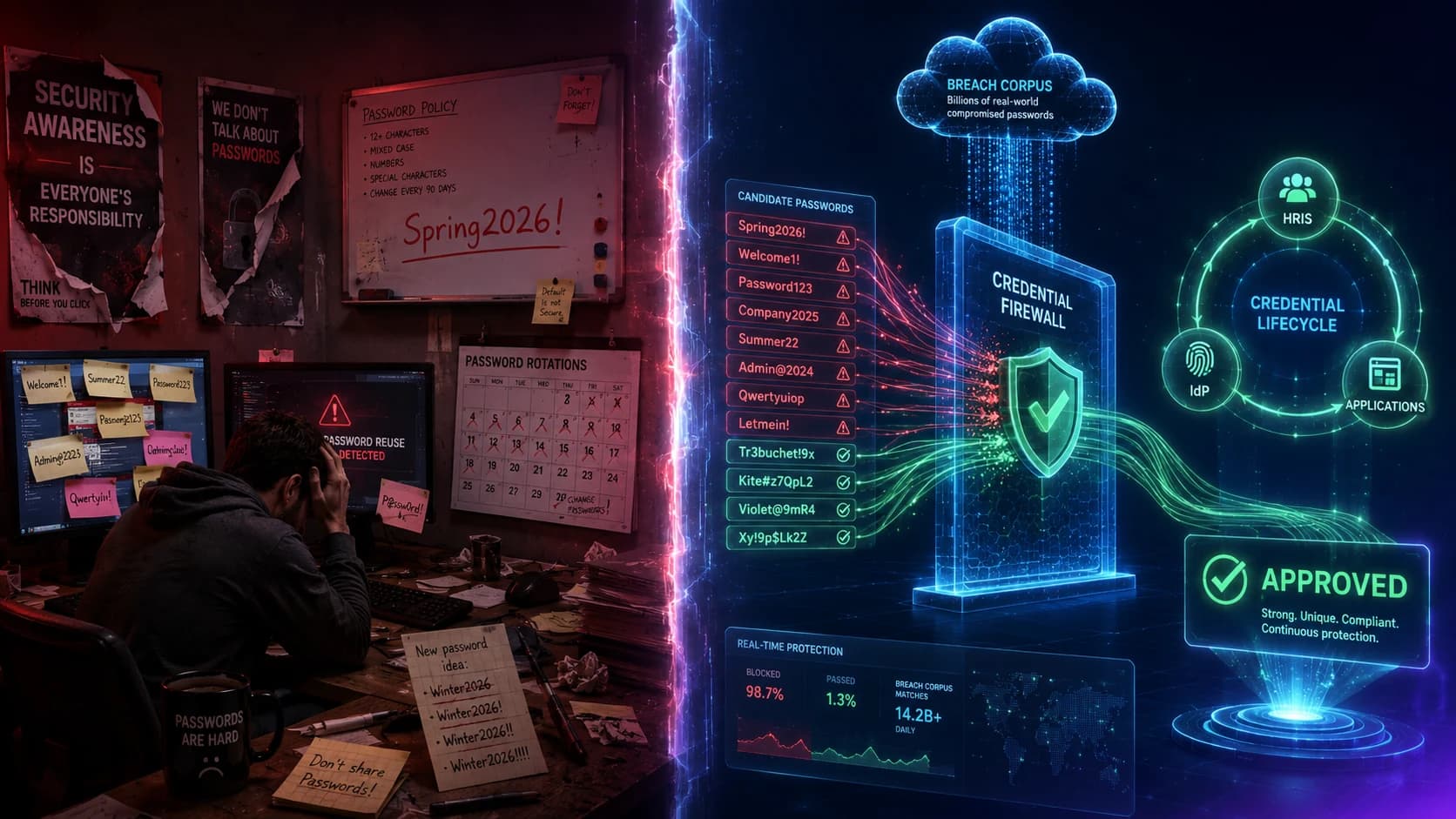
Weak Passwords in 2026: Architecture, Not Awareness
Why weak passwords persist in 2026 despite decades of training — and the policy-enforcement, credential-firewall, and lifecycle controls that eliminate them at scale.