POSTS FOR

CISOs

Security leaders evaluating credential governance, authentication architecture, and identity risk reduction.

Showing 71

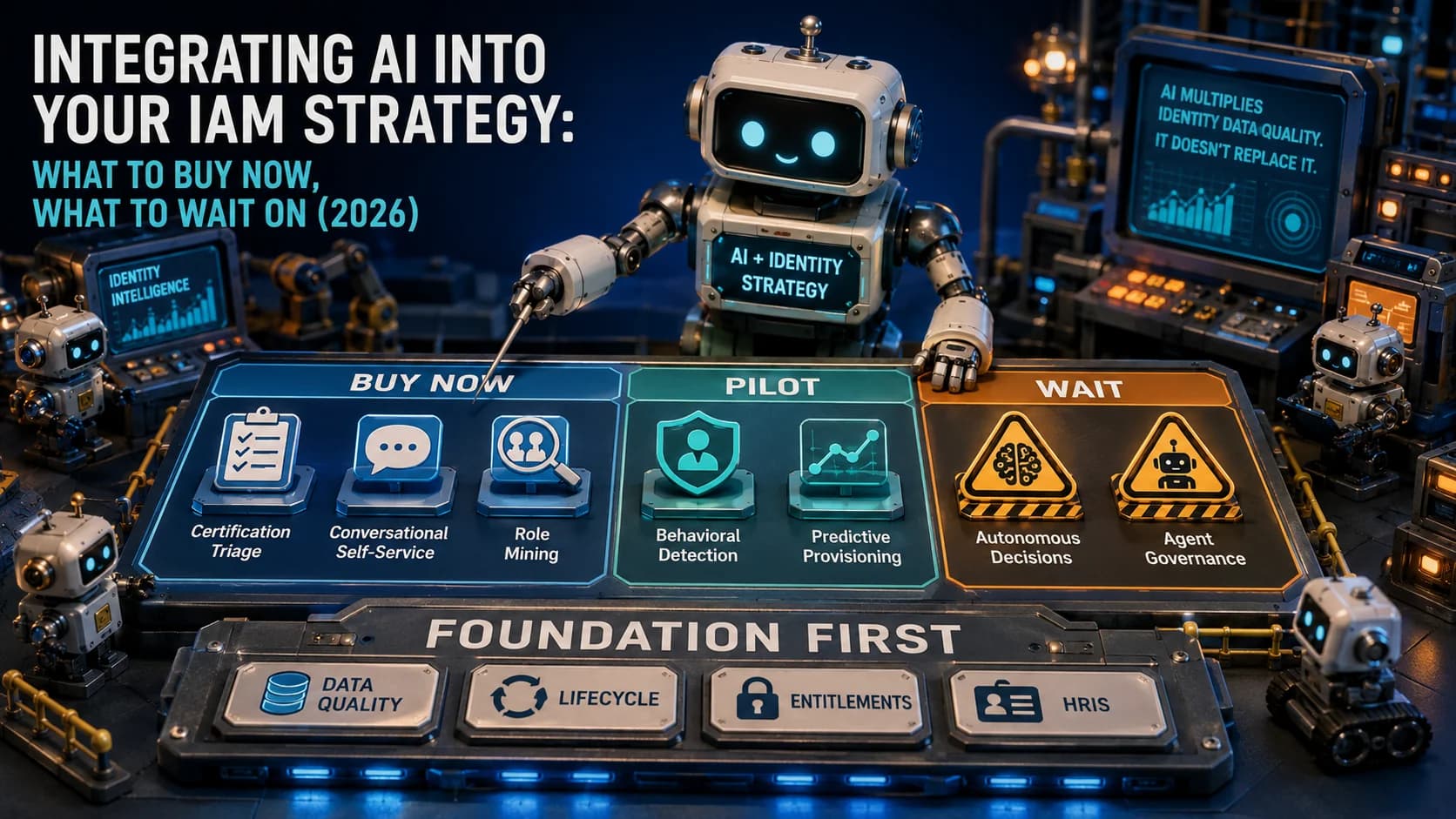
Integrating AI into IAM strategy 2026 executive roadmap — the buy-now tier of AI capabilities with clear mechanisms and near-term payback (certification triage that ranks reviewer attention by anomaly, conversational self-service that deflects help desk tickets, and role mining that proposes candidate roles from observed access patterns), the pilot tier requiring careful scoping (behavioral detection and predictive provisioning), the wait tier where vendor claims outrun delivery (autonomous access decisions and agent governance), the five-dimension readiness test that determines whether AI produces value or an expensive description of an existing mess, and the sequencing rule that AI multiplies identity data quality rather than substituting for it.
IAM & Identity Governance

Integrating AI Into Your IAM Strategy: What to Buy Now, What to Wait On (2026)

Every identity vendor's 2026 roadmap says AI. Most enterprises can't tell which parts will pay for themselves next quarter and which are demos with a release date attached. After three decades building identity automation, my read: three AI capabilities are worth buying today, two are worth piloting, and one category is worth refusing until the vendors can answer five questions. Plus the readiness test that decides whether any of it works for you — and the ordering mistake that wastes more AI budget than any bad vendor choice.

17 luglio 2026Nelson Cicchitto
Read more
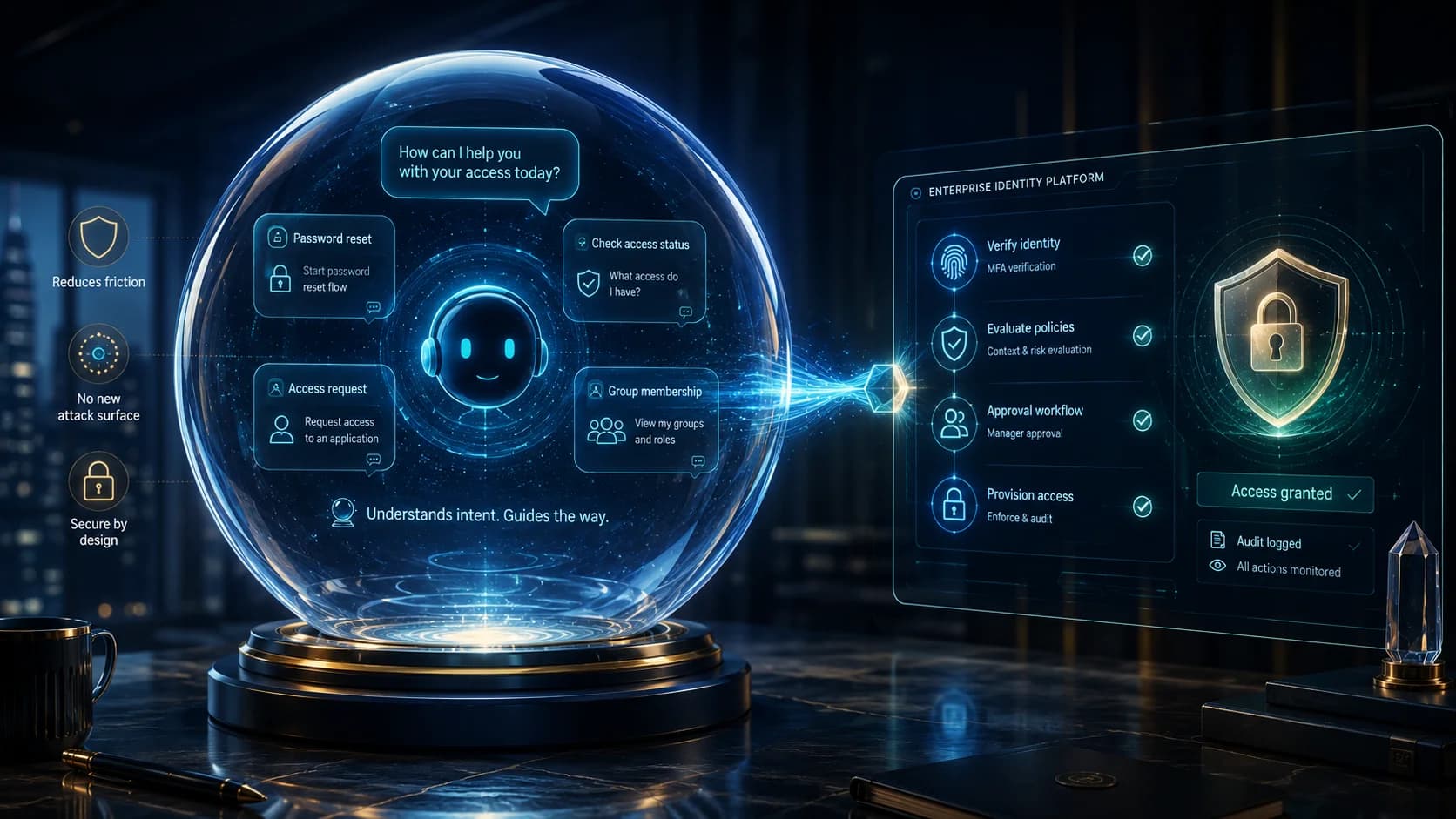
AI virtual assistants for identity management 2026 enterprise reference — conversational identity architecture where the language model handles intent understanding and workflow navigation while identity verification, authorization, and execution stay in the identity platform outside the model's control. Covers the four workflows worth deflecting to chat (password reset, access requests, access status inquiries, and group membership changes), the prompt-injection and social-engineering attack surface a naive chatbot deployment opens, the verification-outside-the-model design rule, and the deflection math against the $480-per-employee-per-year password support baseline.
Pillar 3: Assisted Reset

AI Virtual Assistants for Identity Management: Conversational Access Without a New Attack Surface (2026)

A chatbot that resets passwords is trivial to build and a genuinely bad idea — because the hard part of a password reset was never the conversation, it was proving who is asking. The 2026 reference on conversational identity done properly: the four workflows worth deflecting to chat, why identity verification must live outside the language model, the prompt-injection and social-engineering surface a naive deployment opens, and the deflection math against a $480-per-employee support baseline.

17 luglio 2026Leonardo Cuenca
Read more
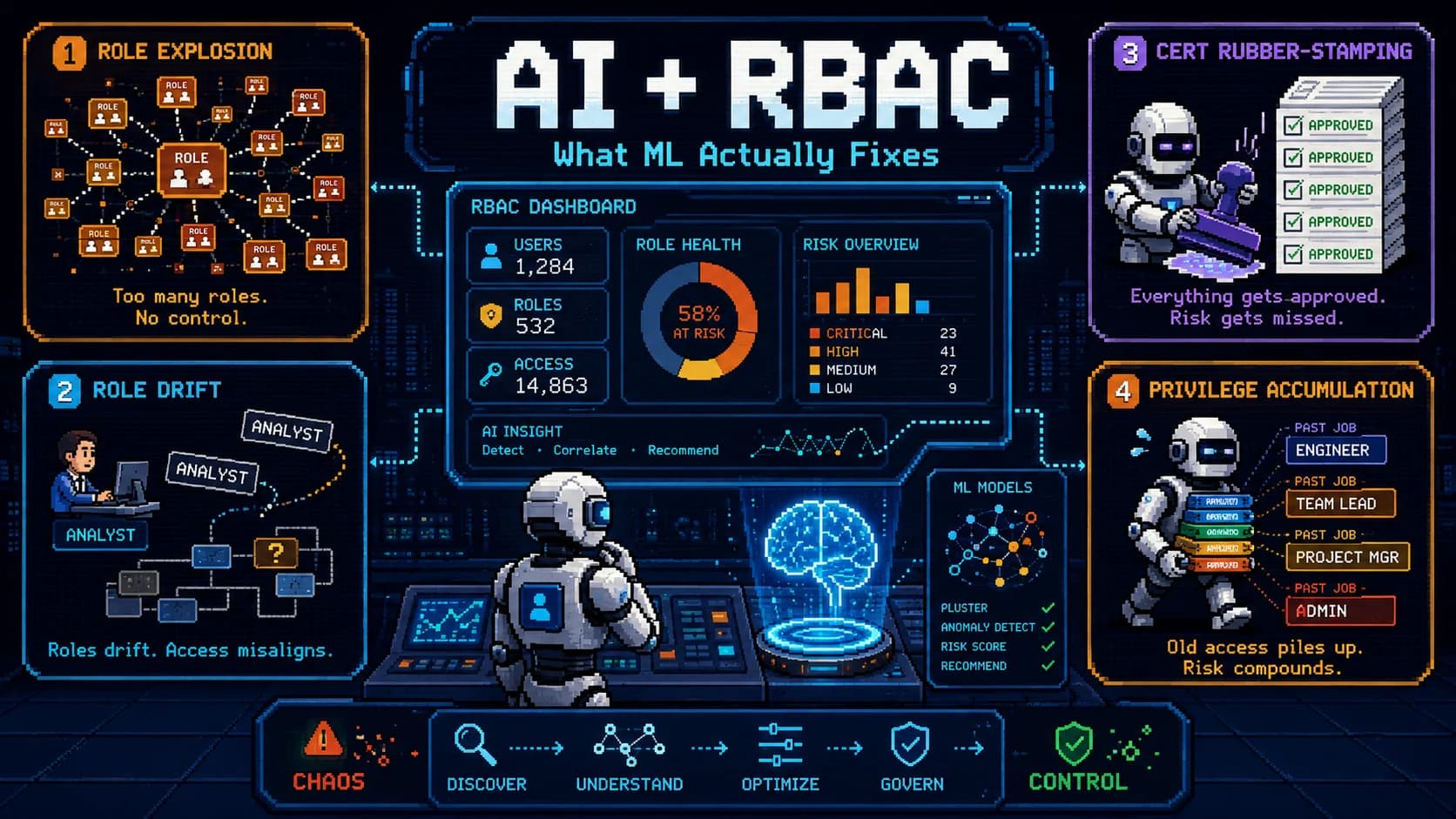
AI and role-based access control 2026 enterprise reference — the four RBAC failure modes machine learning attacks (role explosion where role count outgrows the workforce, role drift where definitions diverge from actual job function, certification rubber-stamping where reviewers approve everything because everything looks the same, and privilege accumulation where movers keep prior-role entitlements), what AI-assisted role mining and entitlement clustering actually produce, where human judgment remains mandatory for business context, and why running role mining on unclean entitlement data industrializes the existing mess rather than fixing it.
Access Management

AI and Role-Based Access Control: What Machine Learning Actually Fixes in RBAC (2026)

RBAC's problems are well documented and thirty years old: role explosion, role drift, rubber-stamped certifications, and privilege that only ever accumulates. AI is the first tool that attacks them at the scale they occur — but only three of the four are genuinely solvable by a model. The 2026 reference on AI-assisted role mining, entitlement clustering, certification triage, and predictive provisioning: what each one actually does, where the human stays in the loop, and why role mining on bad data just industrializes the mess.

17 luglio 2026Ekna Padmaraj
Read more
AI and behavioral analytics for identity monitoring 2026 enterprise reference — how machine learning models establish per-user and per-peer-group behavioral baselines from four telemetry sources (authentication events, entitlement state, resource access patterns, and device and network context), what anomaly detection actually catches that static rules miss (credential-valid account takeover, insider privilege abuse, and slow lateral movement), the false-positive economics that determine whether an analyst team trusts the model, and the honest limits of behavioral detection at enterprise scale.
IAM & Identity Governance

AI and Behavioral Analytics for Identity Monitoring: The 2026 Enterprise Reference

Static identity rules catch the attacks that announce themselves. They miss the ones that log in with valid credentials and behave almost normally. The 2026 reference on AI-driven identity monitoring — what behavioral analytics actually detects, the four telemetry sources that make or break the model, the false-positive economics nobody budgets for, and the honest limits of anomaly detection at enterprise scale.

17 luglio 2026Marcelo Victor
Read more
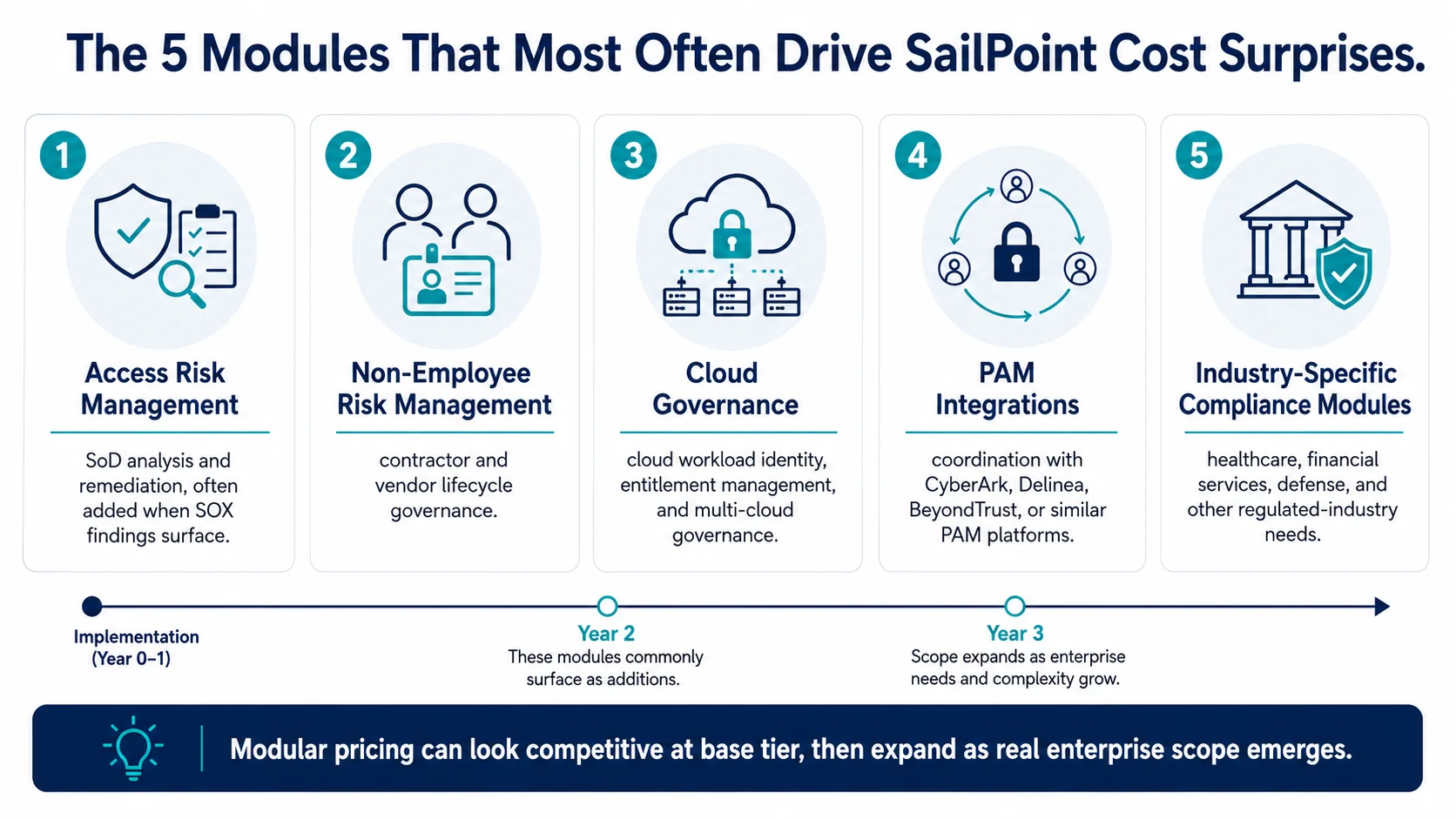
SailPoint vs Avatier 2026 pricing model comparison — the two fundamentally different pricing philosophies (modular per-capability with premium tiers versus all-inclusive licensing bundling the same capability set), the specific modules that drive SailPoint cost surprises at 18-24 months of deployment, the Avatier all-inclusive positioning that folds IGA workflow / access certification / lifecycle automation / SoD / role management / password management / connector library into base licensing, and the buyer-side comparison discipline covering apples-to-apples module mapping, hidden connector economics, and three-year TCO framing.
Buyer's Guides

SailPoint vs Avatier: The 2026 Enterprise Pricing Model Comparison

Enterprise IAM buyers evaluating SailPoint against Avatier are comparing two fundamentally different pricing philosophies — modular per-capability pricing with premium tiers and per-connector charges versus all-inclusive licensing that bundles the same capability set into the base license. The 2026 enterprise reference on the structural pricing differences, the modules that drive most of the SailPoint cost surprises, the Avatier all-inclusive positioning, and the buyer-side comparison discipline that produces defensible vendor selection instead of feature-checklist theater.

9 luglio 2026Marcelo Victor
Read more
IAM costs and investment readiness 2026 enterprise reference — the five cost drivers of identity and access management investment (licensing, implementation and professional services, infrastructure, ongoing operations, and hidden compliance surface), the four return categories that justify the spend (help desk reduction, breach risk reduction, audit and compliance efficiency, workforce productivity), and the five-dimension readiness assessment covering identity data quality, ownership model, process maturity, integration surface, and executive sponsorship that predicts whether an enterprise realizes IAM ROI or joins the stalled-program statistics.
IAM & Identity Governance

The Truth About IAM Costs: Is Your Business Ready to Invest in 2026?

IAM investment questions rarely fail on the ROI math — the math works. They fail on readiness: enterprises buy governance platforms before the identity data, ownership model, and process discipline exist to use them. The 2026 reference on what IAM actually costs across its five cost drivers, what the investment returns and when, and the five-dimension readiness assessment that predicts whether your organization will realize the ROI or join the roughly half of IGA programs that stall.

16 luglio 2026Ekna Padmaraj
Read more
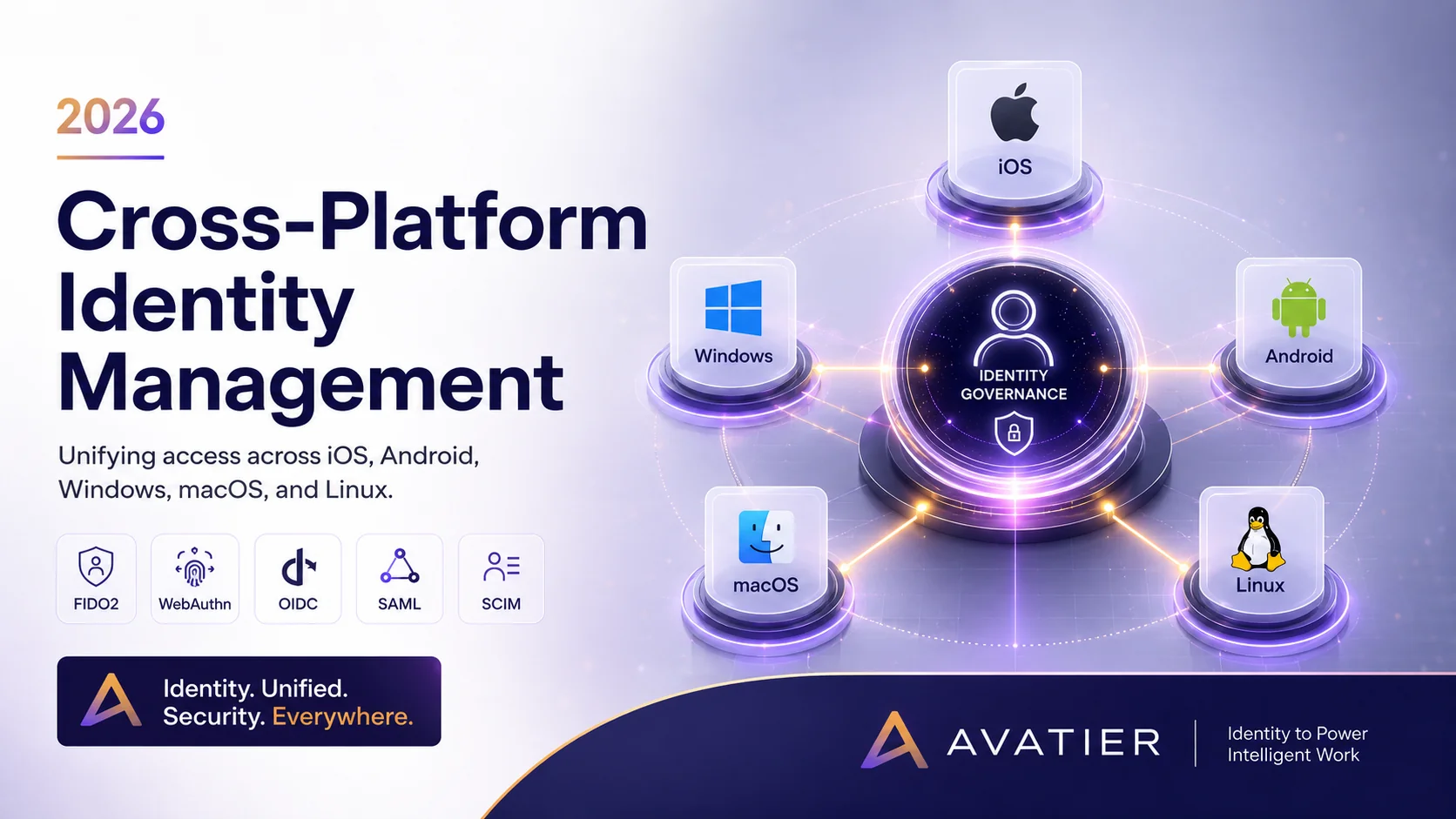
Cross-platform identity management 2026 enterprise reference — unifying authentication and identity governance across iOS, Android, Windows, macOS, Linux, and shared frontline devices. Covers the platform-agnostic identity architecture built on FIDO2/WebAuthn, OIDC, SAML, and SCIM standards, the passkey ecosystem fragmentation between iCloud Keychain, Google Password Manager, and Windows Hello, the per-platform security capability mapping (Secure Enclave, StrongBox, TPM), the workforce segments that platform-bound authentication excludes, and the unified policy engine that produces one identity experience across every device class.
Access Management

Cross-Platform Identity Management: Unifying Access Across iOS, Android, Windows, macOS, and Linux in 2026

The average enterprise workforce now authenticates from three or more platforms daily — iOS, Android, Windows, macOS, Linux, and shared frontline devices — and every platform ships its own credential store, biometric stack, and passkey ecosystem. The 2026 reference on unifying identity across all of them: the platform-agnostic architecture, the passkey fragmentation problem nobody warned you about, per-platform security capability mapping, the workforce segments platform-bound authentication leaves behind, and the deployment discipline that produces one identity experience instead of five.

16 luglio 2026Henrique Ferreira
Read more

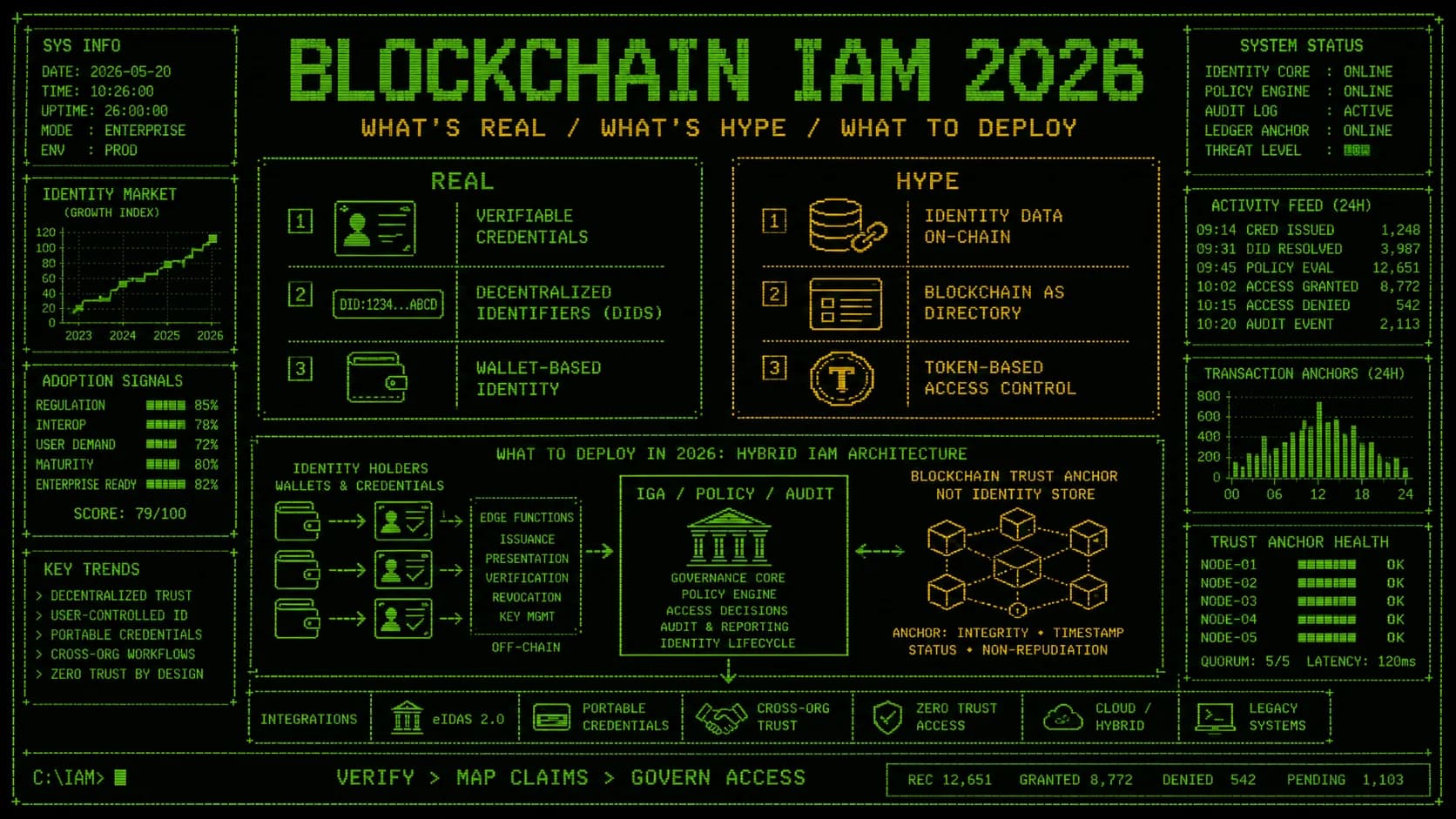
Blockchain-based IAM for enterprise 2026 reference — separating the decentralized identity patterns that work from the hype. Covers W3C Verifiable Credentials and Decentralized Identifiers (DIDs), wallet-based identity under the EU eIDAS 2.0 mandate, the three enterprise use cases with real traction (portable workforce credentials, reusable identity verification, cross-organization trust without federation agreements), the anti-patterns that failed (identity data on-chain, blockchain as a directory replacement, tokens as access control), and the hybrid architecture that connects decentralized credentials to centralized IGA lifecycle, certification, and audit accountability.
IAM & Identity Governance

Blockchain-Based IAM for the Enterprise: What's Real, What's Hype, and What to Deploy in 2026

A decade after the first blockchain identity white papers, the technology has sorted itself into two piles: a small set of patterns that genuinely work — verifiable credentials, decentralized identifiers, and wallet-based identity now backed by the EU's eIDAS 2.0 mandate — and a large pile of abandoned projects that tried to put identity itself on a chain. The 2026 enterprise reference on where blockchain-based IAM delivers (portable workforce credentials, reusable verification, cross-organization trust), where it never will (replacing your directory, lifecycle, or governance), and the architecture pattern that connects decentralized credentials to centralized accountability.

16 luglio 2026Marcelo Victor
Read more
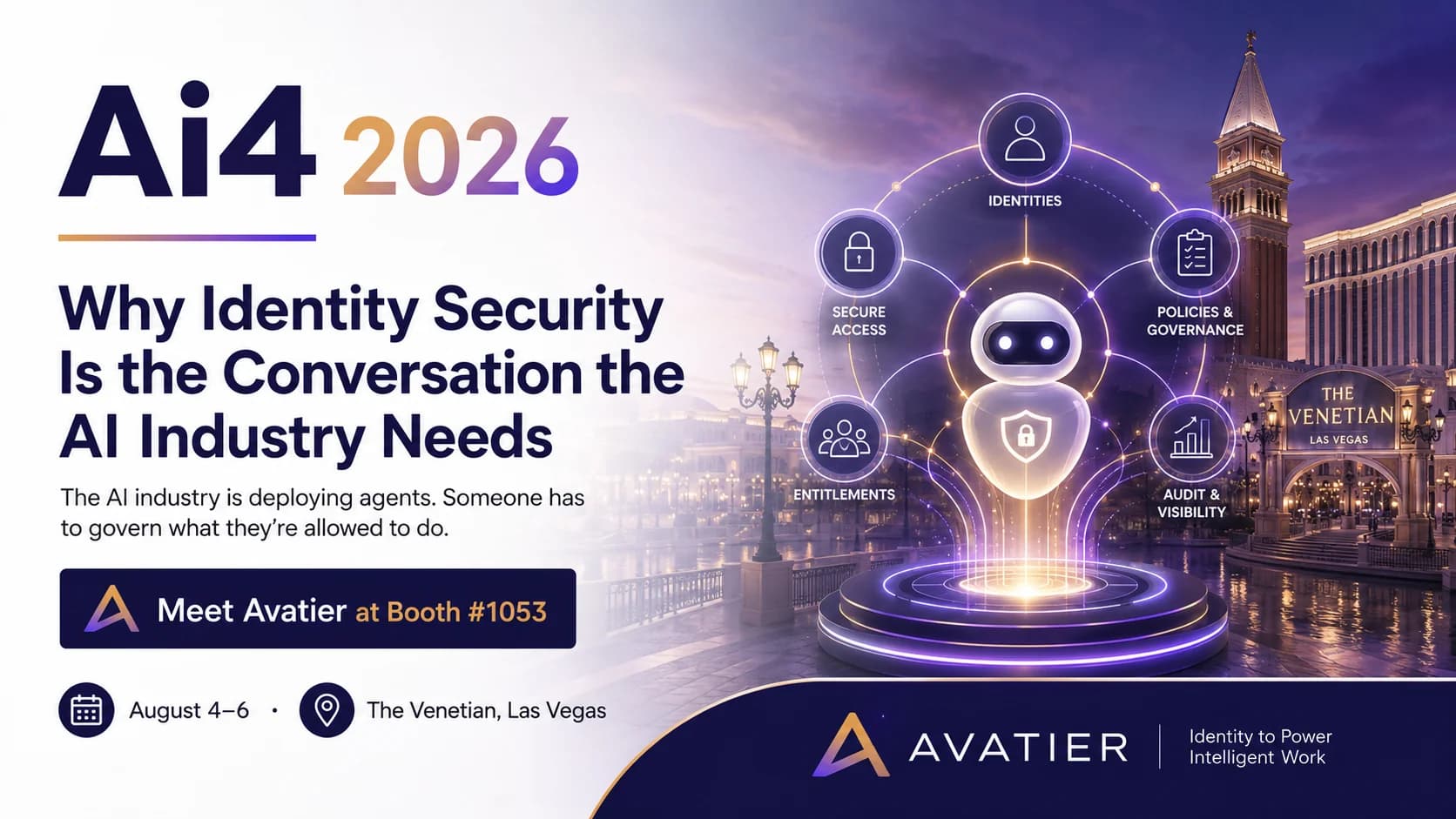
Avatier at Ai4 2026, Booth #1053 — identity security in the agentic AI era. August 4-6, 2026 at The Venetian, Las Vegas: why the AI industry's shift from models to autonomous agents makes identity governance the missing layer, the five identity questions to ask every AI vendor on the show floor, and what Avatier is bringing to America's largest AI conference — live demos, product announcements, and a point of view on why AI agents need the same joiner-mover-leaver lifecycle, least-privilege entitlements, certification campaigns, and threat detection long applied to human identities.
IAM & Identity Governance

Ai4 2026: Why Identity Security Is the Conversation the AI Industry Needs — Meet Avatier at Booth #1053

Ai4 2026 lands in Las Vegas August 4-6 with three full tracks on AI agents, a cybersecurity track, and an oversight track on AI governance and model risk. The agenda is telling you something: the enterprise AI conversation has shifted from what models can do to what agents are allowed to do — and that is an identity question. Avatier will be at Booth #1053 with live demos, product announcements, and a point of view on why every autonomous agent needs the same lifecycle, governance, and least-privilege discipline you apply to human identities.

16 luglio 2026Nelson Cicchitto
Read more
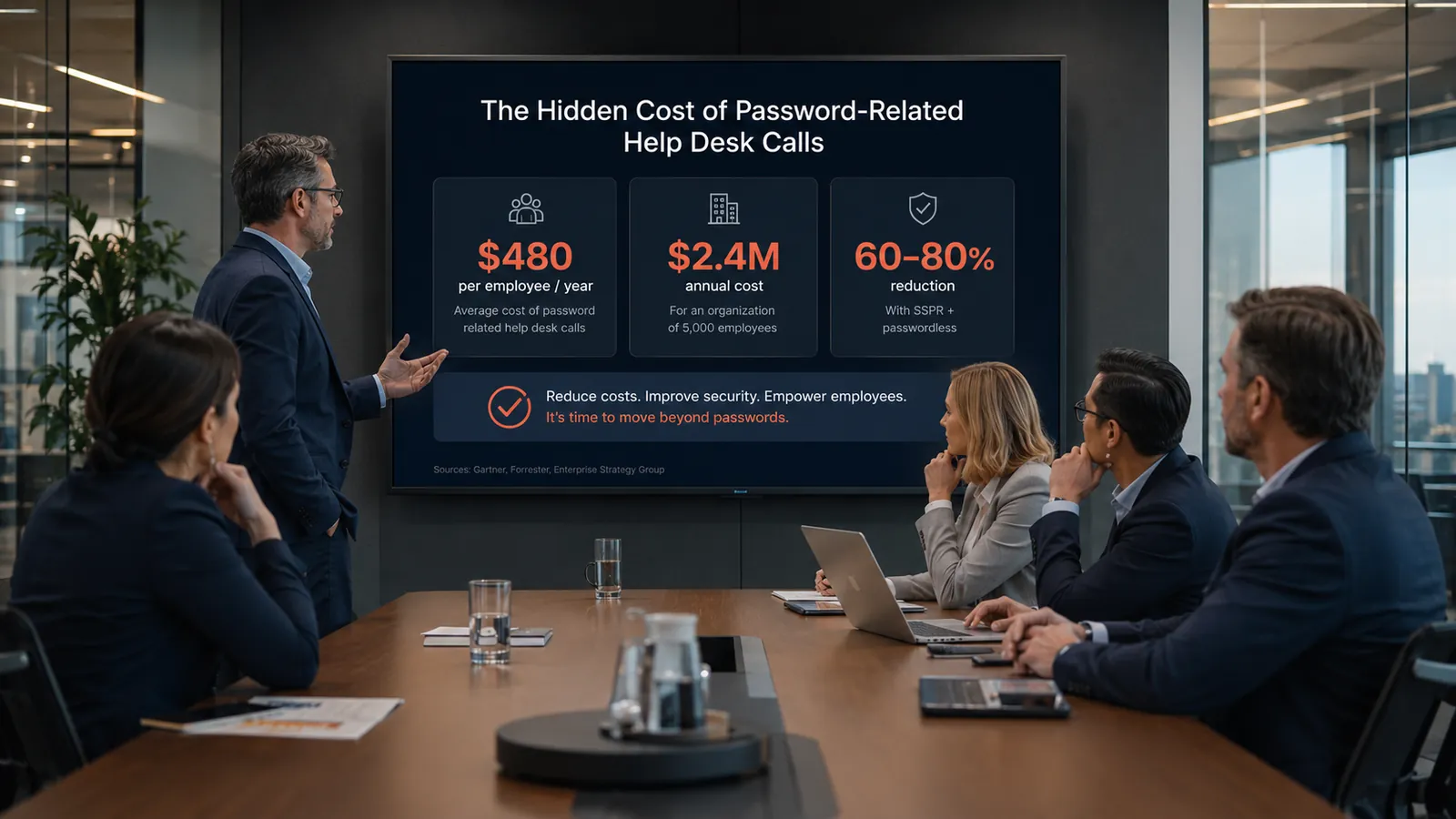
Password help desk cost analysis 2026 enterprise reference — the $480 per employee per year baseline cost that dominates IT operational spend at scale, the specific cost components (help desk labor at $70 per ticket including workflow overhead, workforce productivity loss at 15-30 minutes per incident, opportunity cost of help desk labor freed up for higher-value work), the volume drivers that scale the number by industry (workforce turnover, password policy complexity, credential silo count, seasonal populations), the SSPR and passwordless architectural interventions that reduce ticket volume 60-80%, and the CFO-defensible ROI model showing 18-36 month payback and 3-5x returns on SSPR + passwordless deployment investment.
Pillar 4: Login Reset

Password Help Desk Cost Analysis: The 2026 $480-Per-Employee Reference

Password-related help desk calls cost the average enterprise $480 per employee per year — a hidden line item that dominates IT operational cost at scale and produces $2.4M in annual burn for a 5,000-employee enterprise. The 2026 enterprise reference on the specific cost components, the volume drivers that scale the number by industry, the SSPR and passwordless architectural interventions that reduce it 60-80%, and the CFO-defensible ROI model that justifies the reduction investment.

15 luglio 2026Ekna Padmaraj
Read more
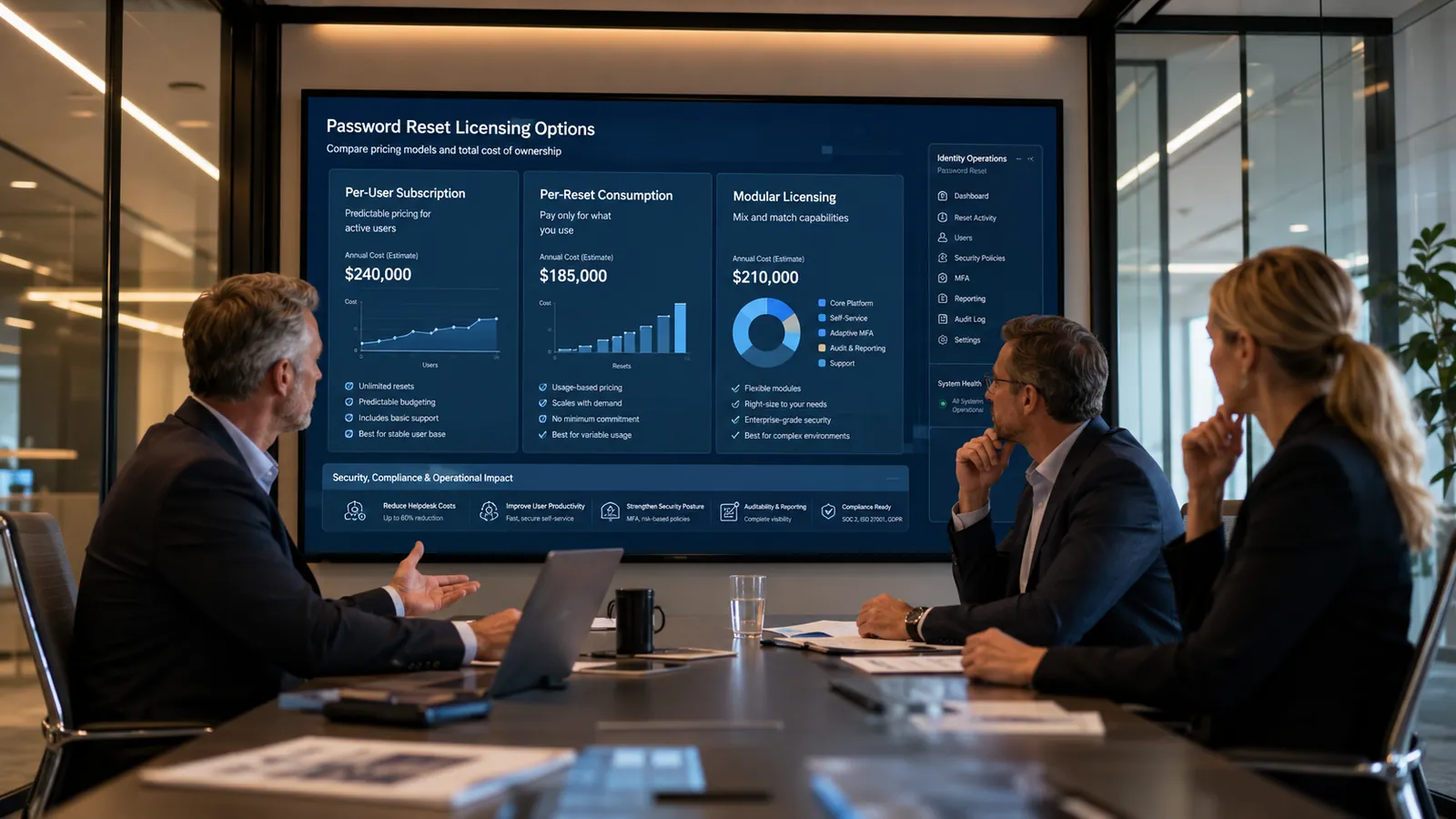
Login reset licensing models 2026 enterprise cost structure reference — the three pricing philosophies dominating password reset infrastructure (per-user subscription for stable workforces, per-reset-event consumption for variable volumes, modular capability-based licensing with add-ons), the specific line items that drive TCO variance including SSPR portal / pre-login CredentialProvider / deviceless FIDO2 for smartphone-unavailable segments / audit-trail integration / connector library, the six-criterion buyer discipline for reset-workflow vendor selection, and the composition with the broader IAM licensing model that determines whether reset infrastructure is folded into base licensing or sold as separate premium modules.
Buyer's Guides

Login Reset Licensing Models: The 2026 Enterprise Cost Structure Reference

Enterprise password reset licensing has three fundamentally different pricing models — per-user subscription, per-reset-event consumption, and modular capability-based licensing — and the fit between model and buyer profile determines whether TCO tracks the vendor's list-price projection or surprises 18-24 months into deployment. The 2026 enterprise reference on the three licensing models, the specific line items that drive cost variance, and the buyer discipline that produces defensible reset-workflow vendor selection.

15 luglio 2026Marcelo Victor
Read more
Avatier vs Okta 2026 enterprise pricing model comparison — the two fundamentally different pricing philosophies (Avatier all-inclusive licensing bundling IGA workflow / access certification / lifecycle automation / SoD / role management / password management / connector library into base license, versus Okta workforce IdP with tiered pricing where SSO / MFA / adaptive baseline is included but Identity Governance and Lifecycle Management are premium modules above federation baseline), the specific modules producing Okta cost variance at scale, and the six-criterion buyer discipline for defensible vendor selection covering apples-to-apples capability comparison, connector economics for legacy environments including RACF and iSeries, TCO framing across three-year deployment horizon, composition with broader IAM platform for governance depth, and reference customer validation.
Buyer's Guides

Avatier vs Okta: The 2026 Enterprise Pricing Model Comparison

Enterprise IAM buyers evaluating Avatier against Okta are comparing two fundamentally different pricing philosophies — all-inclusive licensing that bundles IGA workforce lifecycle and identity governance into base pricing versus a workforce IdP with tiered pricing where governance capability is priced as premium modules above the federation baseline. The 2026 enterprise reference on the structural pricing differences, the specific modules that produce Okta cost variance at scale, and the buyer discipline for defensible vendor selection.

15 luglio 2026Marcelo Victor
Read more
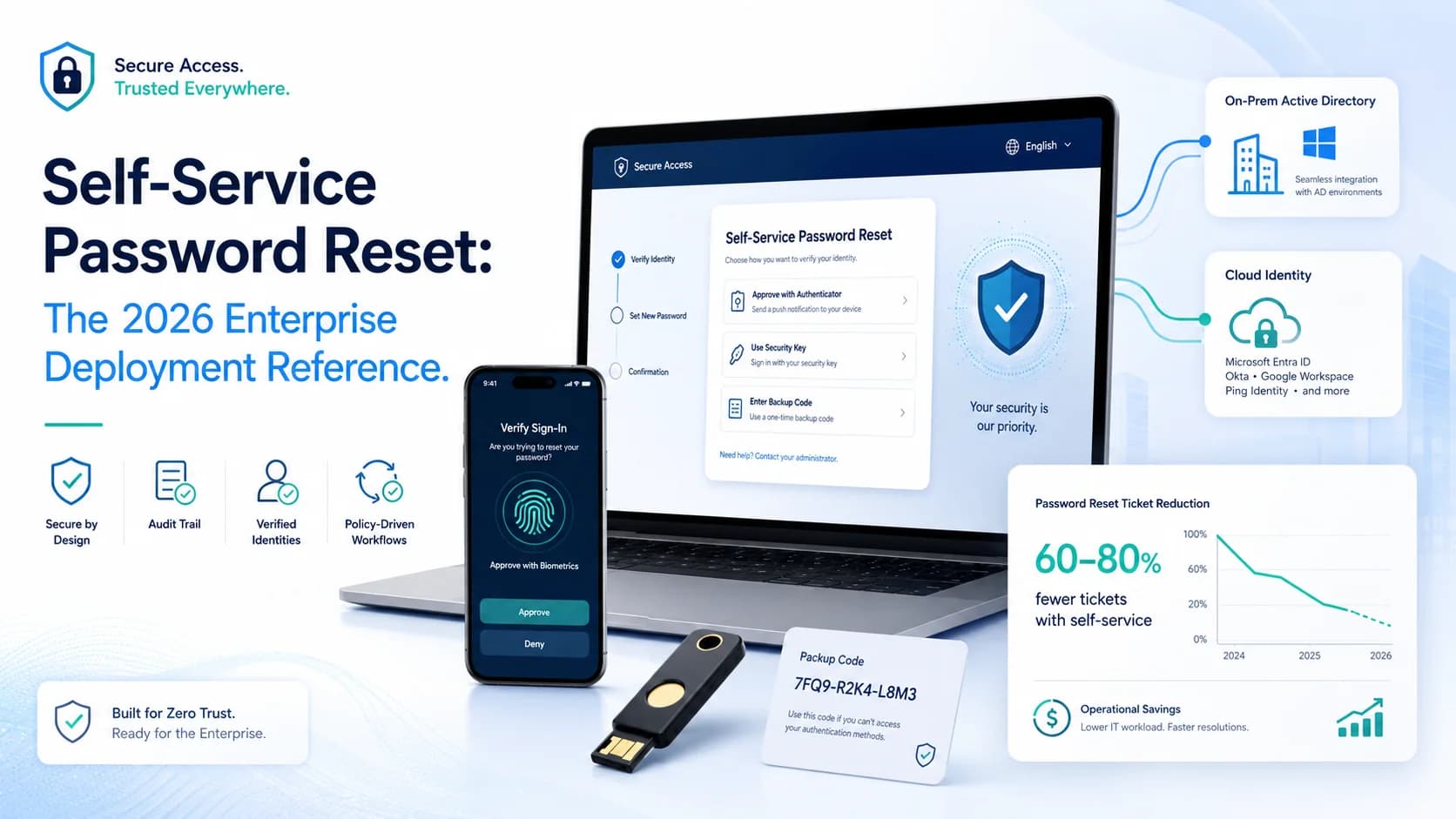
Self-service password reset SSPR 2026 enterprise deployment reference — the SSPR architecture that reduces password reset ticket volume 60-80% versus help-desk-only reset, the five configuration elements that determine effectiveness (strong authenticator-based verification, domain workstation pre-login coverage, frontline segment coverage, audit-trail integration, rate-limiting and abuse detection), the vendor-neutral comparison discipline for SSPR selection, the compliance requirements under SOX / PCI-DSS / HIPAA / NIST 800-63B Rev. 4, and the operational metrics that distinguish well-configured SSPR from poorly-configured SSPR.
Pillar 4: Login Reset

Self-Service Password Reset: The 2026 Enterprise Deployment Reference

Self-service password reset (SSPR) is the operational lever that moves enterprise password reset economics from $70-per-ticket help-desk-only to 60-80% ticket-volume reduction — when deployed with modern authenticator-based verification, coverage across the domain workstation and frontline segment cases, and audit-trail integration that satisfies SOX / PCI-DSS / HIPAA. The 2026 enterprise reference on SSPR deployment architecture, the five configuration elements that determine effectiveness, and the vendor-neutral comparison discipline for SSPR selection.

14 luglio 2026Marcelo Victor
Read more
Active Directory login reset for domain-joined environments 2026 enterprise reference — the pre-login reset architecture that runs before the user has authenticated to the Windows workstation via a CredentialProvider surfacing the reset flow at the login screen, the on-premises AD versus Entra ID hybrid deployment patterns, the compliance requirements from SOX / PCI-DSS / HIPAA / NIST 800-63B that shape domain reset workflow, the identity verification factors that satisfy modern audit expectations, and the deployment discipline that keeps AD reset defensible for domain-joined Windows environments spanning on-premises AD, Azure AD Connect, and Entra ID cloud identity.
Pillar 4: Login Reset

Active Directory Login Reset for Domain-Joined Environments: The 2026 Reference

Active Directory login reset for domain-joined Windows workstations is the specific reset architecture where users can't reach a self-service portal because they can't log in at all. The 2026 enterprise reference on the pre-login reset architecture, the Windows CredentialProvider integration, the on-premises AD versus Entra ID hybrid patterns, the compliance requirements that shape domain reset workflow, and the deployment discipline that keeps AD reset defensible under SOX and PCI-DSS audit.

14 luglio 2026Henrique Ferreira
Read more

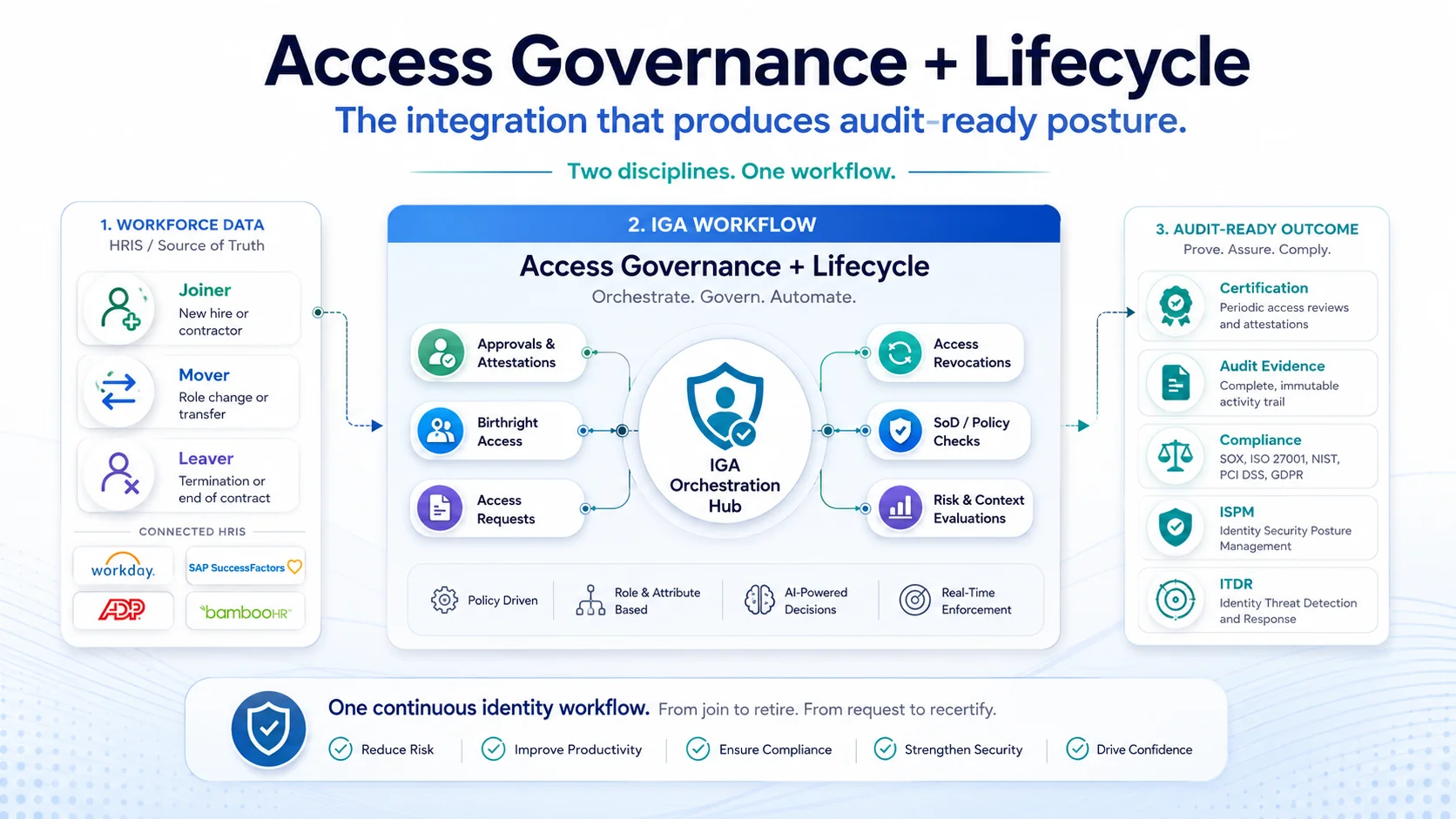
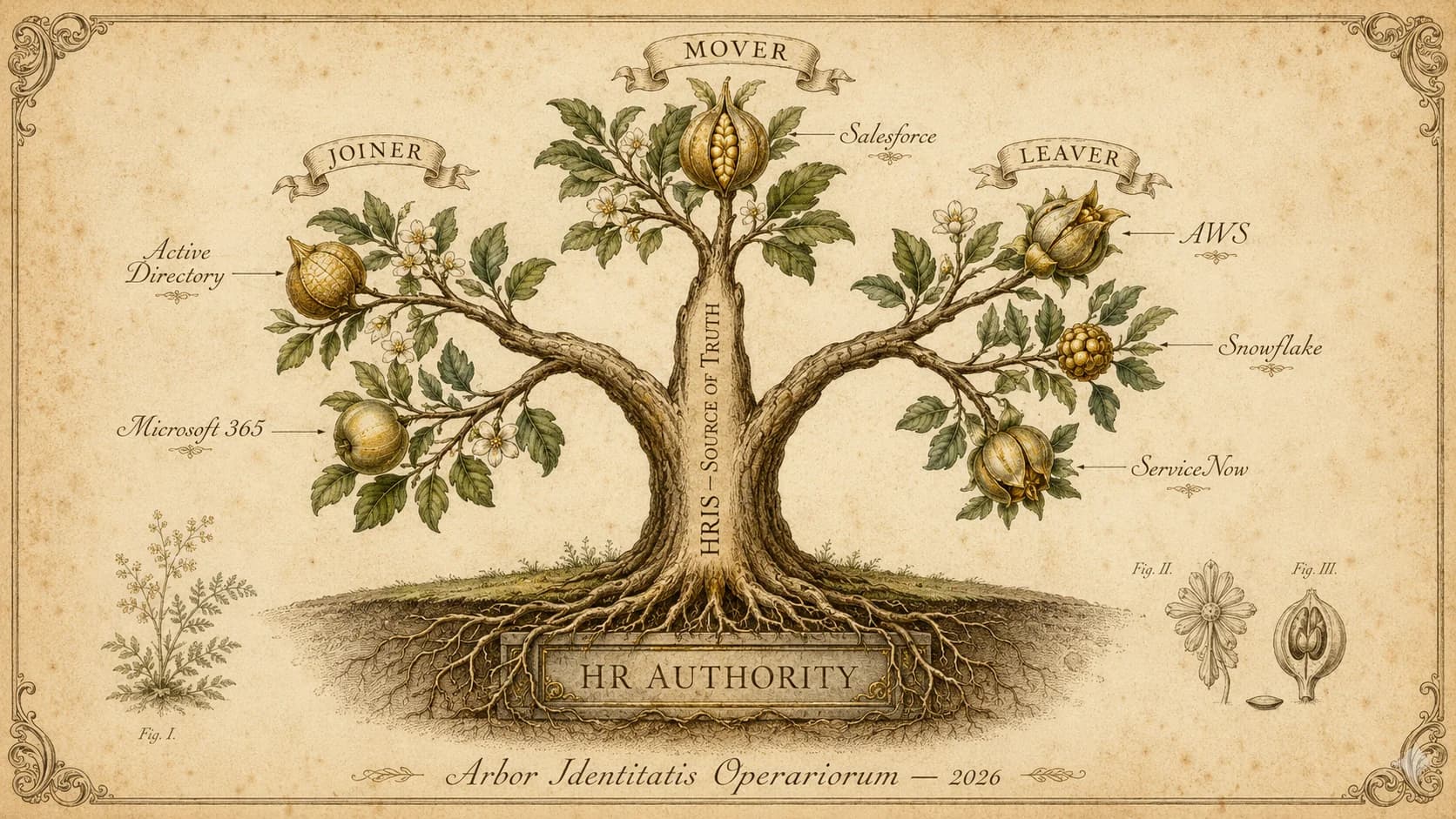
Access governance and user lifecycle management integration 2026 enterprise reference — the composed architecture where HRIS-driven joiner-mover-leaver events trigger access changes through IGA workflow, access certification campaigns reason against current lifecycle state rather than snapshot data, remediation workflow closes the loop through the lifecycle system, and the audit-ready posture that emerges when the two disciplines run as one continuous workflow rather than parallel silos, with specific integration patterns for SAP SuccessFactors and Workday HRIS platforms feeding SailPoint / Saviynt / Avatier IGA and downstream target systems.
IAM & Identity Governance

Integrating Access Governance with User Lifecycle Management: The 2026 Enterprise Reference

Access governance and user lifecycle management are two identity disciplines that only produce defensible IAM posture when they're integrated as one continuous workflow — HRIS-driven lifecycle events triggering access changes, certification campaigns reasoning against lifecycle state, and remediation workflow that closes the loop through lifecycle rather than parallel to it. The 2026 enterprise reference on the integration architecture, the failure modes when lifecycle and governance run as silos, and the operational discipline that produces audit-ready posture.

14 luglio 2026Ekna Padmaraj
Read more
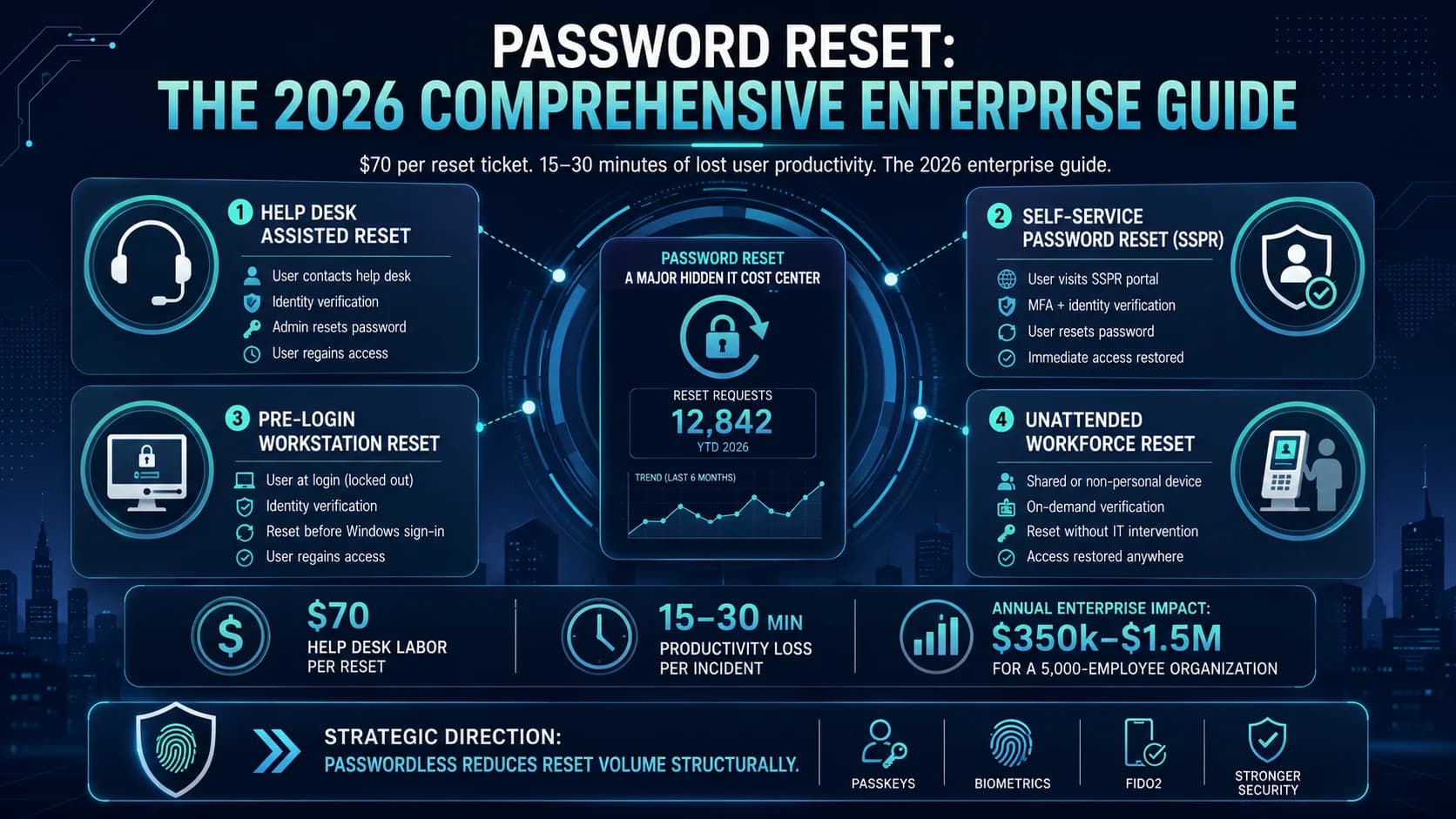
Password reset 2026 comprehensive enterprise guide — the reset cost economics at $70 per ticket and 15-30 minutes workforce productivity per incident, the four workflow architectures (help desk assisted reset, self-service password reset SSPR, pre-login reset for domain-joined workstations, unattended workforce reset for shared stations and manufacturing floor), the compliance implications under SOX / PCI-DSS / HIPAA / NIST 800-63B, the SSPR deployment discipline that reduces ticket volume 60-80%, and the passwordless migration path that eliminates the reset problem structurally through platform passkeys, hardware FIDO2, and deviceless FIDO2 credentials.
Pillar 4: Login Reset

Password Reset: The 2026 Comprehensive Enterprise Guide

Enterprise password reset is one of the largest hidden cost centers in enterprise IT — help desk labor at $70 per reset ticket, workforce productivity losses at 15-30 minutes per user per incident, and the security surface every recovery flow creates. The 2026 comprehensive reference on the reset cost economics, the four workflow architectures, the compliance implications, the self-service reset (SSPR) discipline that reduces ticket volume 60-80%, and the passwordless migration path that eliminates the reset problem structurally.

9 luglio 2026Henrique Ferreira
Read more

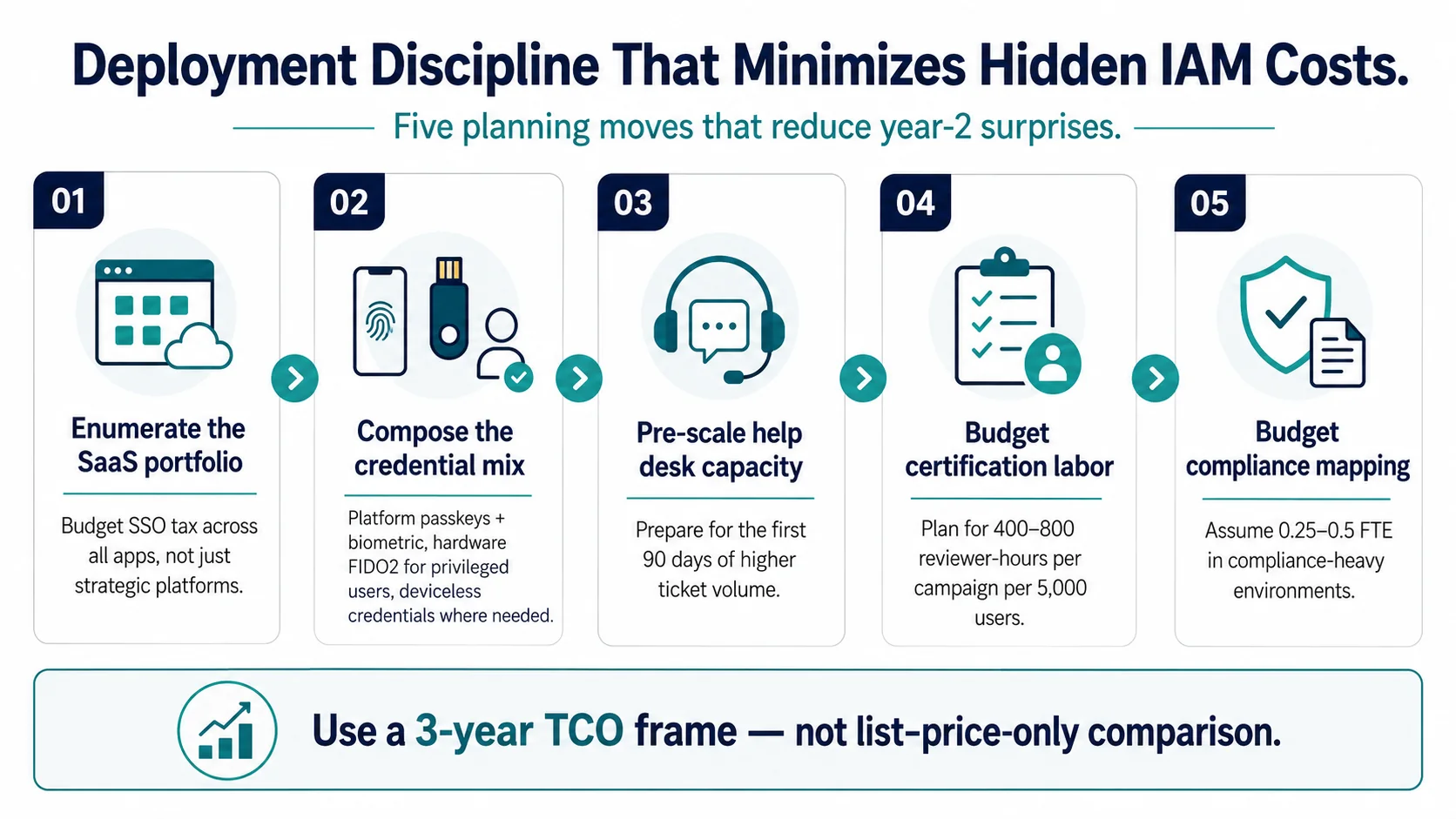
The hidden costs of identity management 2026 enterprise reference — the five hidden cost categories (SSO integration tax per SaaS application typically $500-2,000 annually, MFA credential distribution and refresh at fleet scale, help desk rollout volume producing 3-5x normal ticket load in the first quarter, certification-campaign labor at 400-800 reviewer-hours per quarterly campaign, the ongoing compliance-mapping work at 0.25-0.5 FTE for regulated enterprises), the operational surface each hidden cost creates at scale, why the pattern surfaces at 12-18 months of deployment, and the deployment discipline that minimizes each category.
Buyer's Guides

The Hidden Costs of Identity Management: The 2026 Enterprise Reference

Enterprise IAM has five hidden cost categories that auditors surface and buyers systematically undercount — the SSO integration tax per SaaS application, MFA credential distribution and refresh, help desk rollout volume, certification-campaign labor, and the ongoing compliance-mapping work that keeps audit-ready posture defensible. The 2026 enterprise reference on what each hidden cost actually costs at scale, why they surface only in year 2, and the deployment discipline that minimizes them.

9 luglio 2026Ekna Padmaraj
Read more
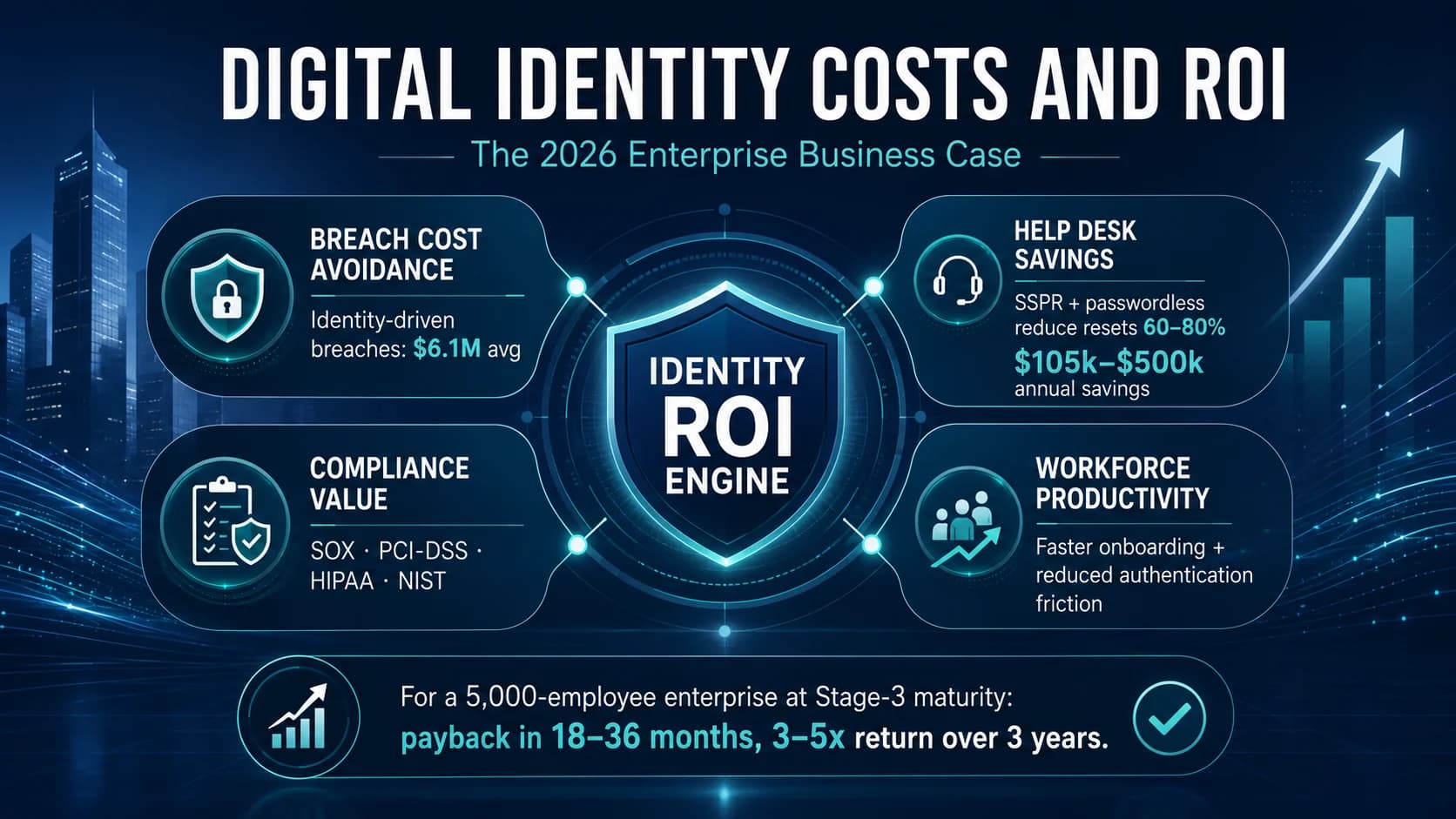
Digital identity costs and ROI 2026 enterprise business case — the four ROI categories (breach cost avoidance modeled against IBM Cost of a Data Breach report at $4.9M average with identity-driven breaches costing $6.1M, help desk savings at $105k-$500k annually from SSPR and passwordless deployment, compliance value from SOX / PCI-DSS / HIPAA / NIST framework alignment, workforce productivity gains from lifecycle automation and reduced authentication friction), the maturity-ladder curve showing where returns compound, the common ROI framing mistakes that undersell mature IAM investment, and the defensible business case for enterprise identity funding.
Buyer's Guides

Digital Identity Costs and ROI: The 2026 Enterprise Business Case

Enterprise IAM investment isn't a cost center — it's a four-category ROI generator that returns breach cost avoidance, help desk savings, compliance value, and workforce productivity gains. The 2026 enterprise reference on what each ROI category actually returns at scale, the maturity-ladder curve that shows where returns compound, the common ROI framing mistakes that make IAM look worse on paper than in reality, and the business case that produces defensible funding for enterprise identity programs.

9 luglio 2026Marcelo Victor
Read more
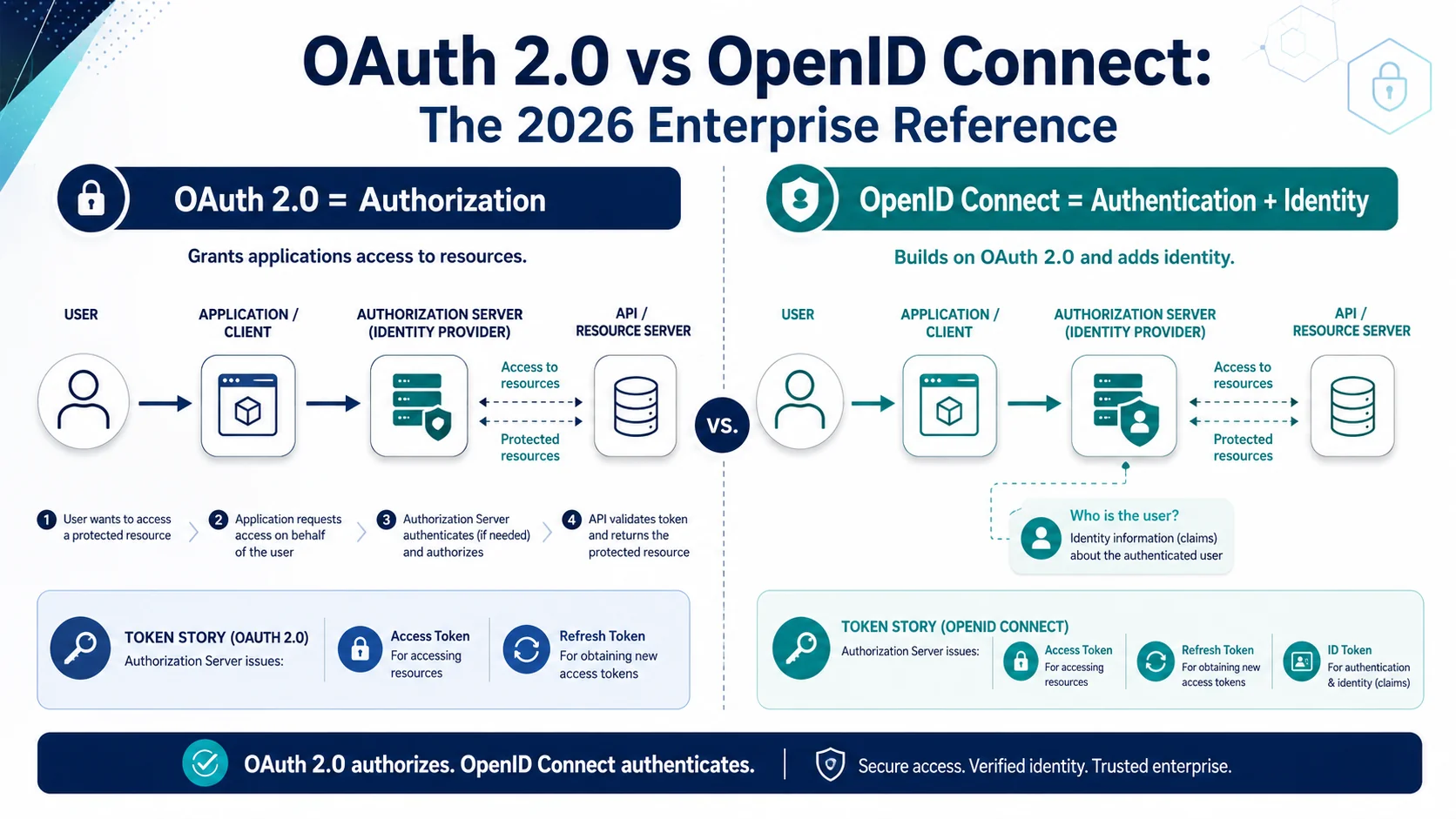
OAuth 2.0 vs OpenID Connect enterprise 2026 reference — the authorization framework vs the identity layer on top, the three token types (access, refresh, ID) and what each proves, the four enterprise use cases (workforce SSO, API delegation, third-party integrations, mobile app authentication), the common misuse patterns (using OAuth access tokens as identity proof, mixing authorization and authentication semantics), and the composition patterns that let both protocols do the job they're actually good at.
IAM & Identity Governance

OAuth 2.0 vs OpenID Connect: The 2026 Enterprise Reference

OAuth 2.0 and OpenID Connect are routinely confused in enterprise IAM conversations — they solve different problems and shouldn't be substituted for each other. The 2026 enterprise reference on what each actually does, the token types each issues, the four enterprise use cases and which protocol fits each, the common misuse patterns that produce security incidents, and the composition patterns that let both protocols do the job they're actually good at.

8 luglio 2026Marcelo Victor
Read more
Multi-cloud identity management 2026 enterprise reference — the federation-first architecture that unifies AWS, Azure, GCP, and SaaS estate identity, the human-vs-workload identity split that determines architectural patterns, the four cloud-native IAM primitives (AWS IAM Identity Center, Azure AD, Google Cloud Identity, SaaS-native IdP integrations), the workload identity federation architecture that eliminates long-lived cloud credentials, the four anti-patterns that produce audit findings (per-cloud silos, root-account sprawl, static-credential accumulation, cross-cloud entitlement drift), and the operational pattern that composes coherently across the multi-cloud estate.
IAM & Identity Governance

Multi-Cloud Identity Management: The 2026 Enterprise Reference

Multi-cloud identity management is where every enterprise IAM program actually lives in 2026 — federated humans and workload identities spanning AWS, Azure, GCP, and the SaaS estate, with wildly different native IAM primitives per cloud. The 2026 enterprise reference on the federation-first architecture that keeps this coherent, the human-vs-workload identity split, the four multi-cloud anti-patterns that produce audit findings, and the operational pattern that scales without producing per-cloud identity silos.

8 luglio 2026Ekna Padmaraj
Read more
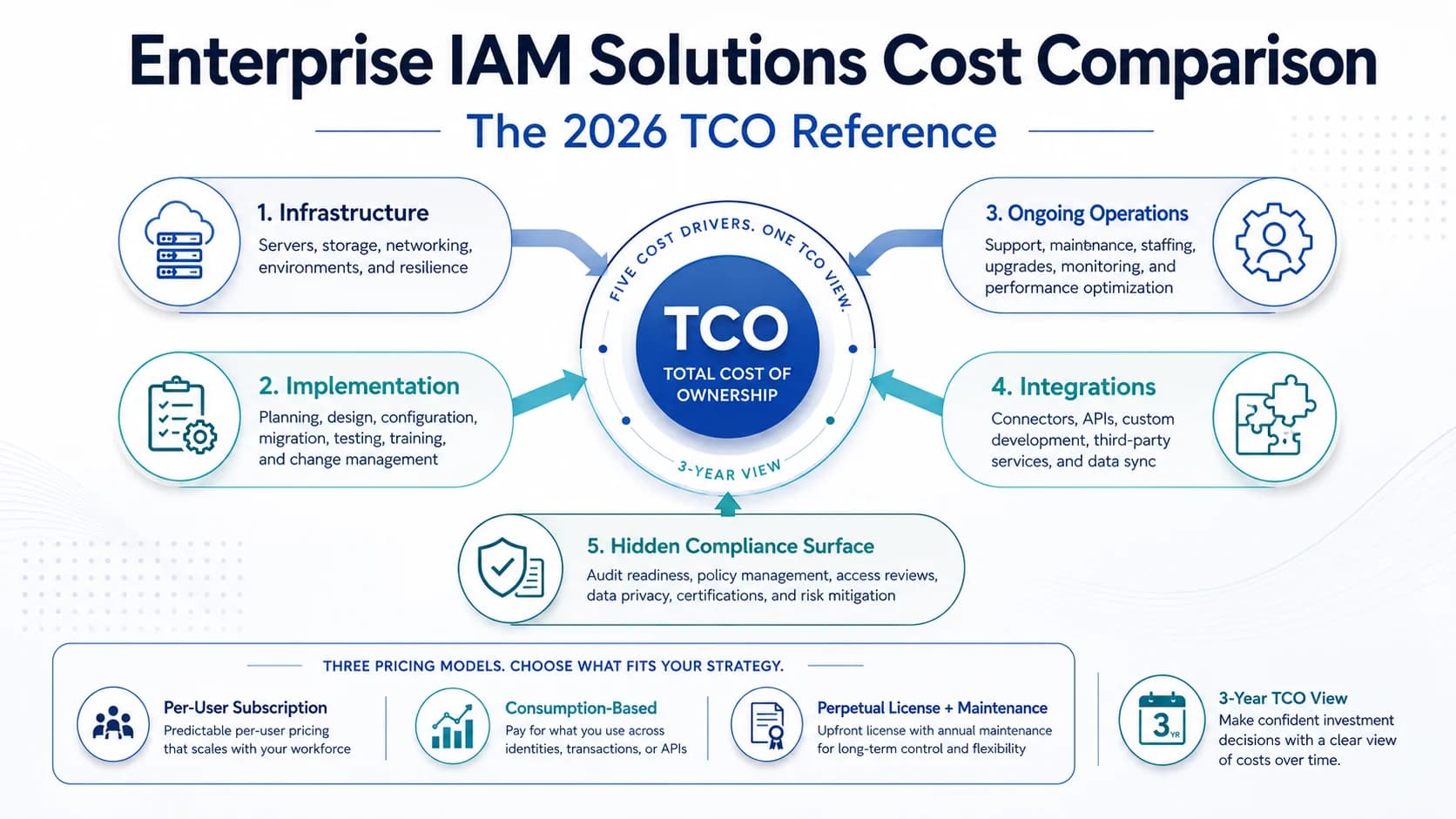
Enterprise IAM solutions cost comparison 2026 TCO reference — the five cost drivers (infrastructure, implementation, ongoing operations, integrations, hidden compliance surface), the three pricing models (per-user, consumption, perpetual license), the hidden costs auditors surface, the vendor comparison framework covering the mature 2026 IGA and access-management vendor landscape, the three-year TCO calculation, and the buyer-side discipline that produces defensible cost comparison instead of list-price theater.
Buyer's Guides

Enterprise IAM Solutions Cost Comparison: The 2026 TCO Reference

Enterprise IAM total cost of ownership isn't a per-user list price — it's a five-driver model where infrastructure, implementation, ongoing operations, integrations, and the hidden compliance surface compose into the actual multi-year spend. The 2026 enterprise reference on what drives IAM cost, how to compare vendor pricing models honestly, the hidden costs auditors surface, and the three-year TCO calculation frame that separates real cost comparison from list-price theater.

8 luglio 2026Marcelo Victor
Read more
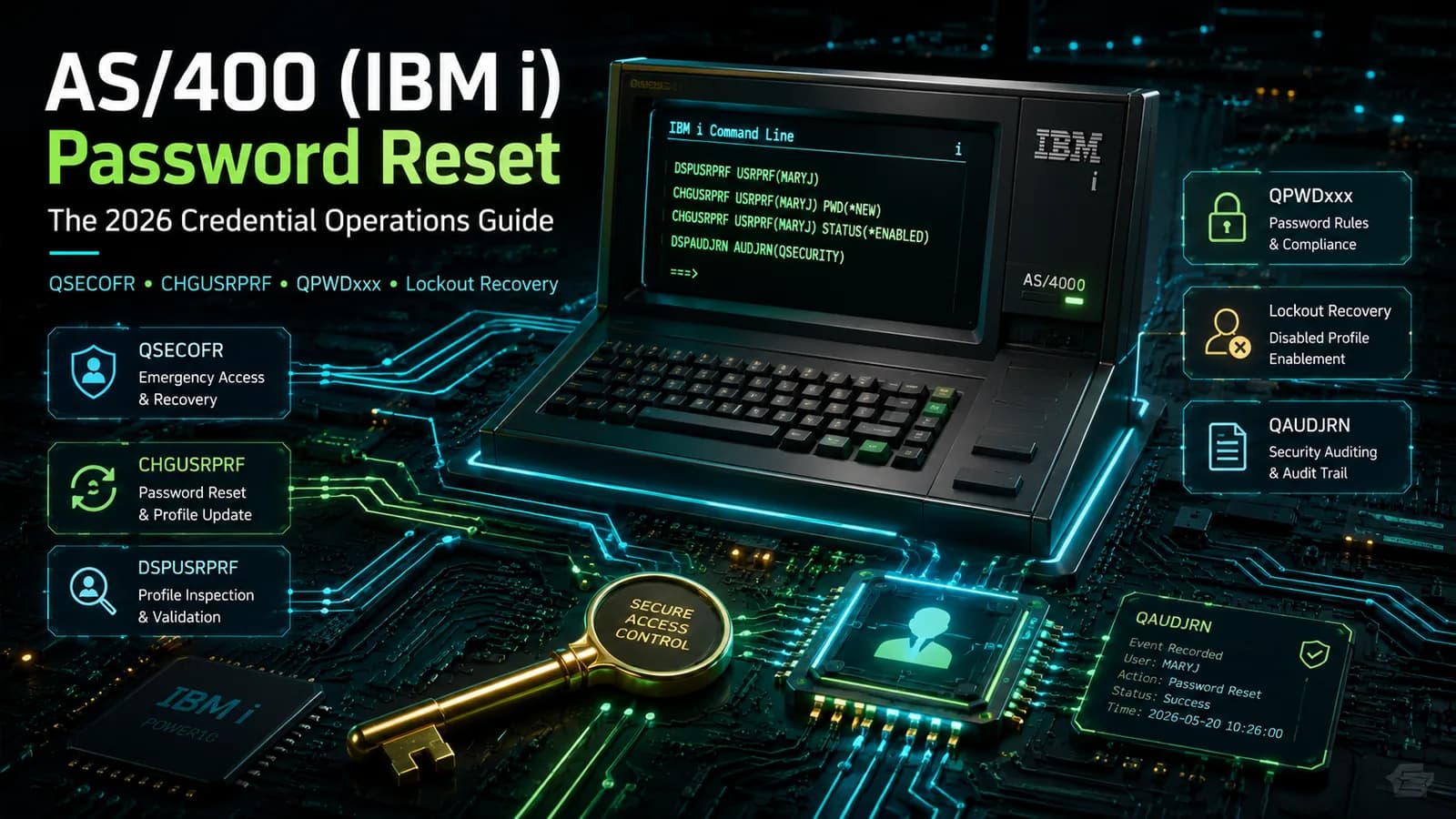
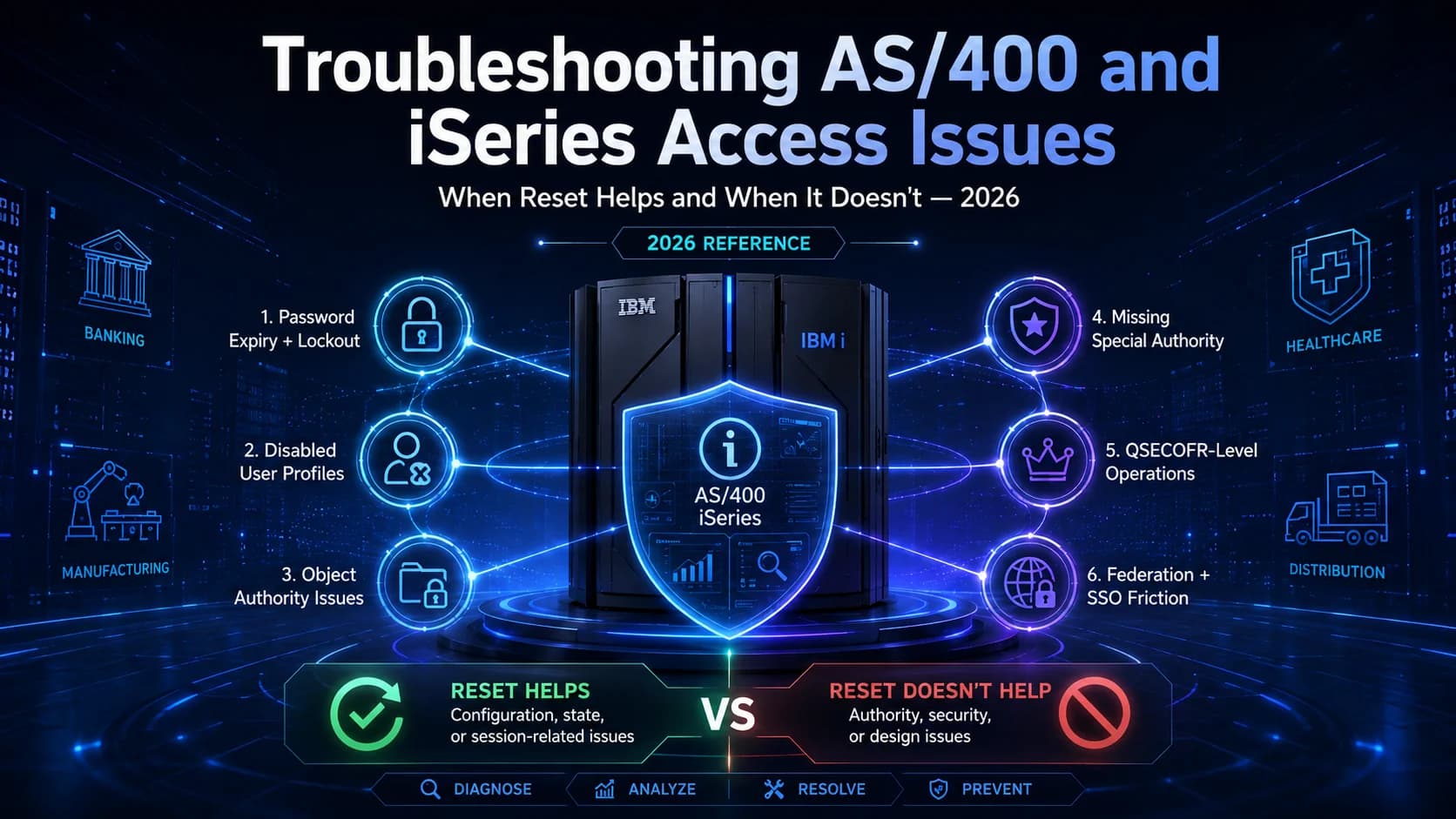
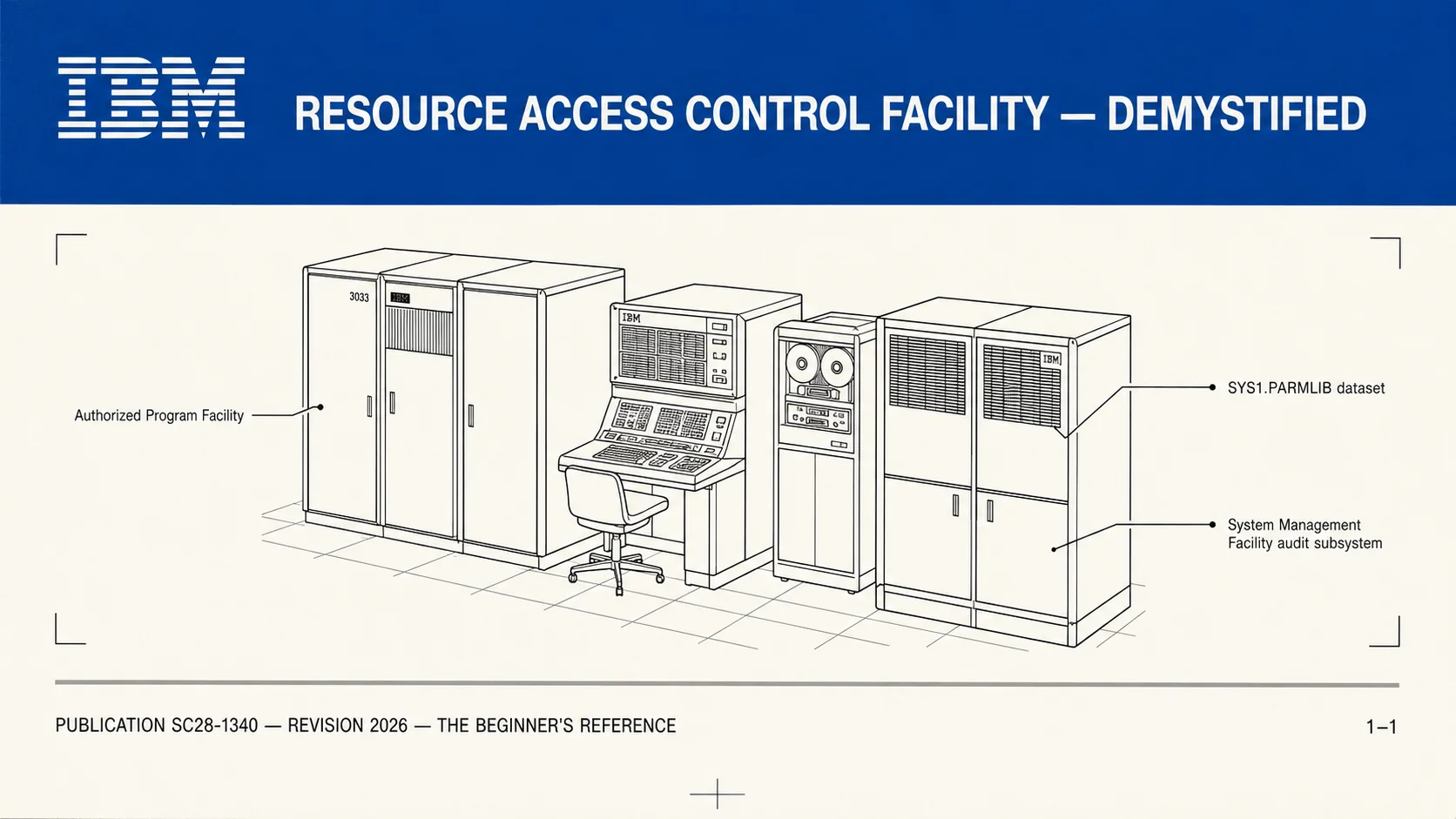
Troubleshooting AS/400 iSeries access issues 2026 — the six most common diagnostic categories (password expiry lockout, disabled user profiles, object-level authority issues, special authority missing, QSECOFR-level operations issues, federation and SSO integration friction), when reset is the right answer versus when it isn't, the diagnostic commands and system-value checks, and the federation-first architecture that reduces recurrence of these issues.
RACF & Mainframe

Troubleshooting AS/400 and iSeries Access Issues: When Reset Helps and When It Doesn't 2026

iSeries (IBM i, AS/400) access issues concentrate in six diagnostic categories — password expiry, disabled user profiles, object authority, special authority, QSECOFR operations, and federation-integration friction. The 2026 reference on the diagnostic pattern for each, when reset is the right answer, and how federation-first architecture reduces recurrence.

7 luglio 2026Henrique Ferreira
Read more

Legacy IAM to modern IAM migration playbook 2026 — the 5-phase playbook (HRIS-driven lifecycle foundation, federation and SSO, phishing-resistant MFA, IGA workflow and certification, ISPM and ITDR risk layer), what legacy IAM actually means operationally (5 markers), the common migration failure modes, and the RACF/AS400 migration path for organizations still running mainframe-era access control.
IAM & Identity Governance

The Legacy IAM to Modern IAM Migration Playbook 2026

Most enterprises don't have modern IAM — they have some modern IAM layered on top of legacy IAM that never got retired. The 2026 enterprise reference on the 5-phase migration playbook that actually finishes the job: HRIS-driven lifecycle foundation, federation and SSO, phishing-resistant MFA, IGA workflow and certification, and the risk-evaluation layer above.

6 luglio 2026Ekna Padmaraj
Read more
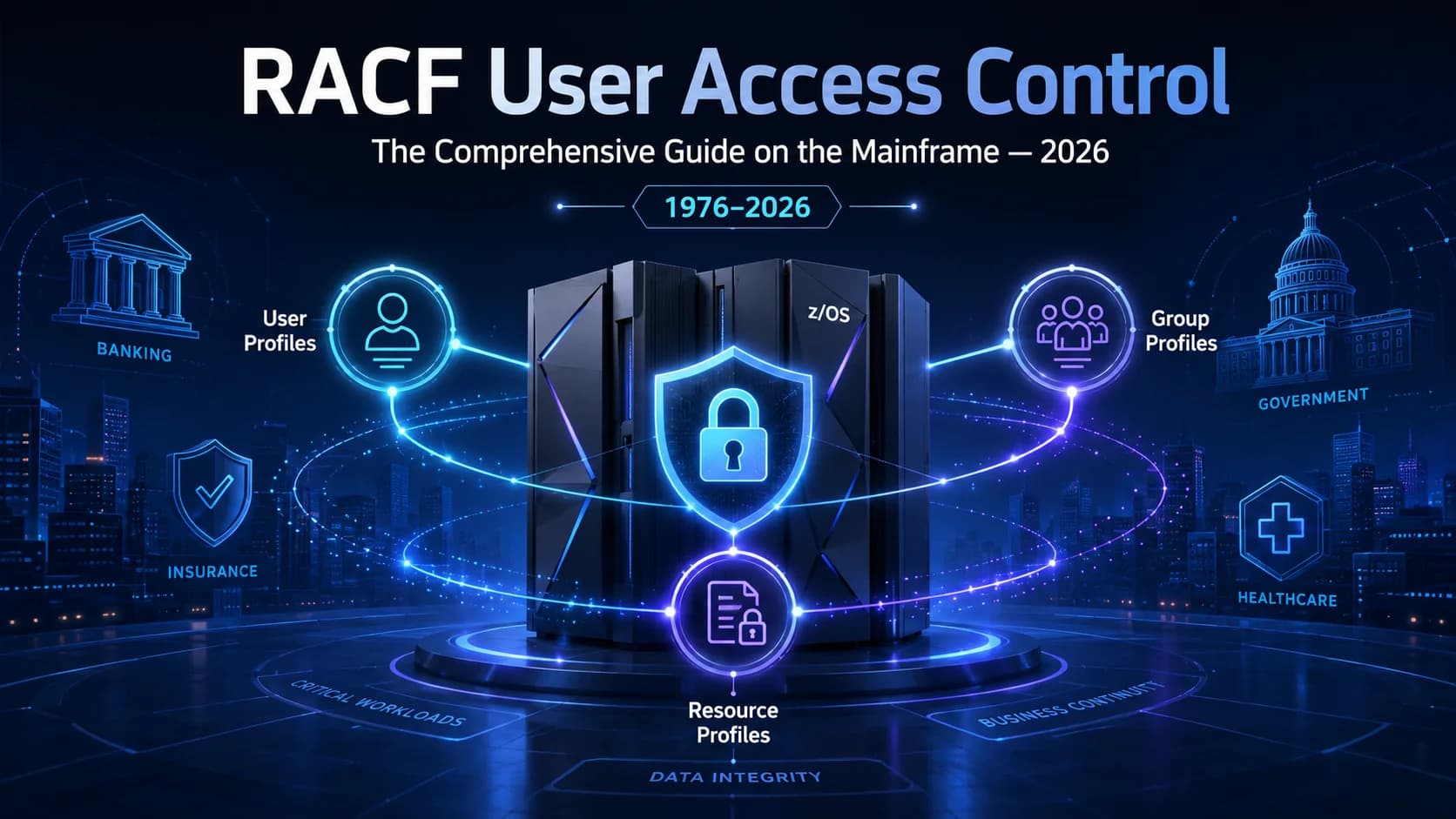
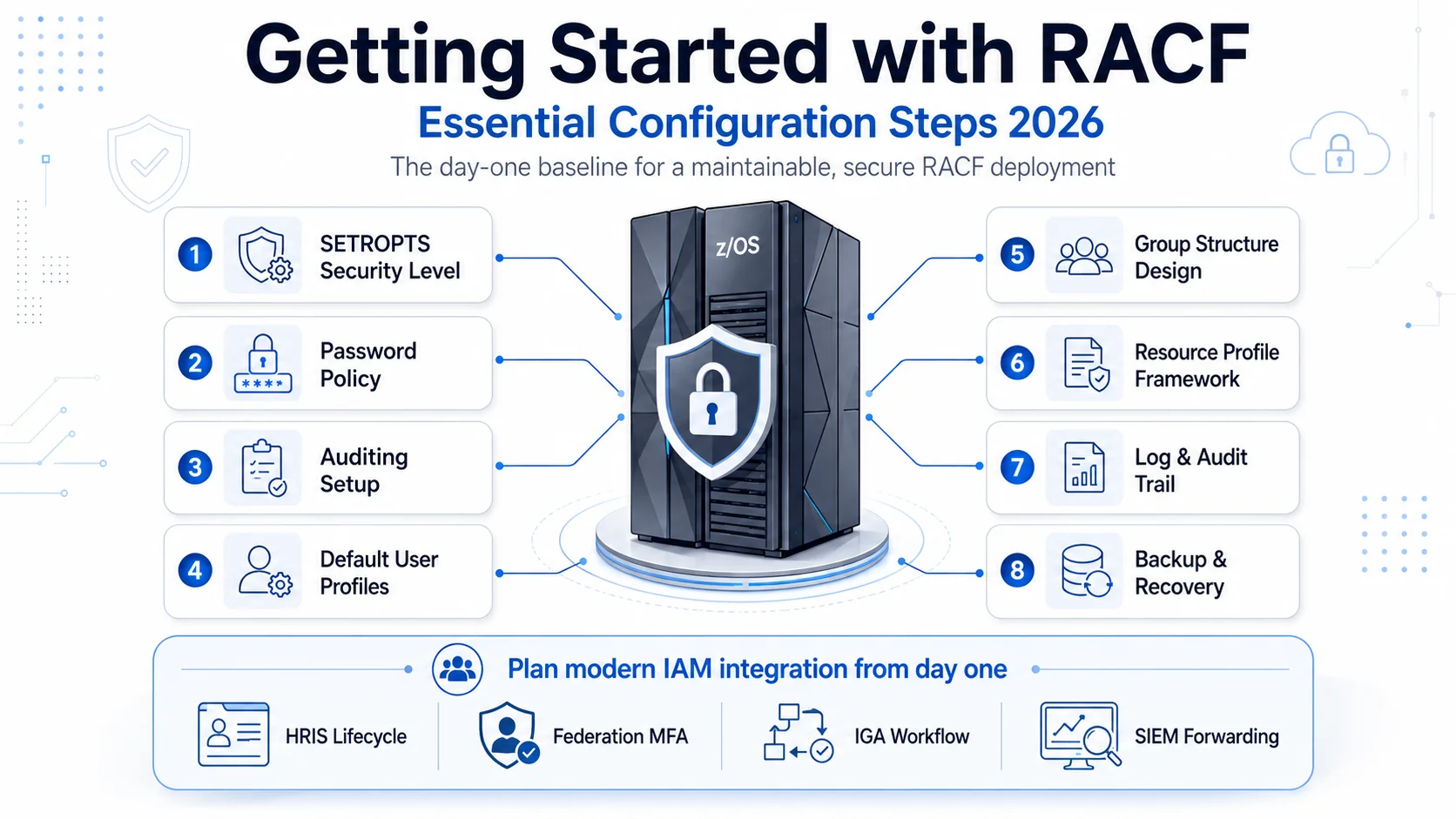
Getting started with RACF essential configuration 2026 — the eight essential initial configuration areas (system-wide security level SETROPTS, password policy, auditing setup, default user profile settings, group structure design, base resource profile framework, log and audit trail configuration, backup and recovery), the configuration discipline that produces a maintainable baseline, common getting-started mistakes, and the modern IAM integration handshake to plan for from day one.
RACF & Mainframe

Getting Started with RACF: Essential Configuration Steps 2026

New RACF administrators face a configuration surface that took decades to accumulate — options, system values, class settings, defaults across dozens of dimensions. The 2026 reference on the eight essential initial configuration areas, the discipline that produces a maintainable baseline, and the modern IAM integration handshake to plan for from day one.

7 luglio 2026Ekna Padmaraj
Read more
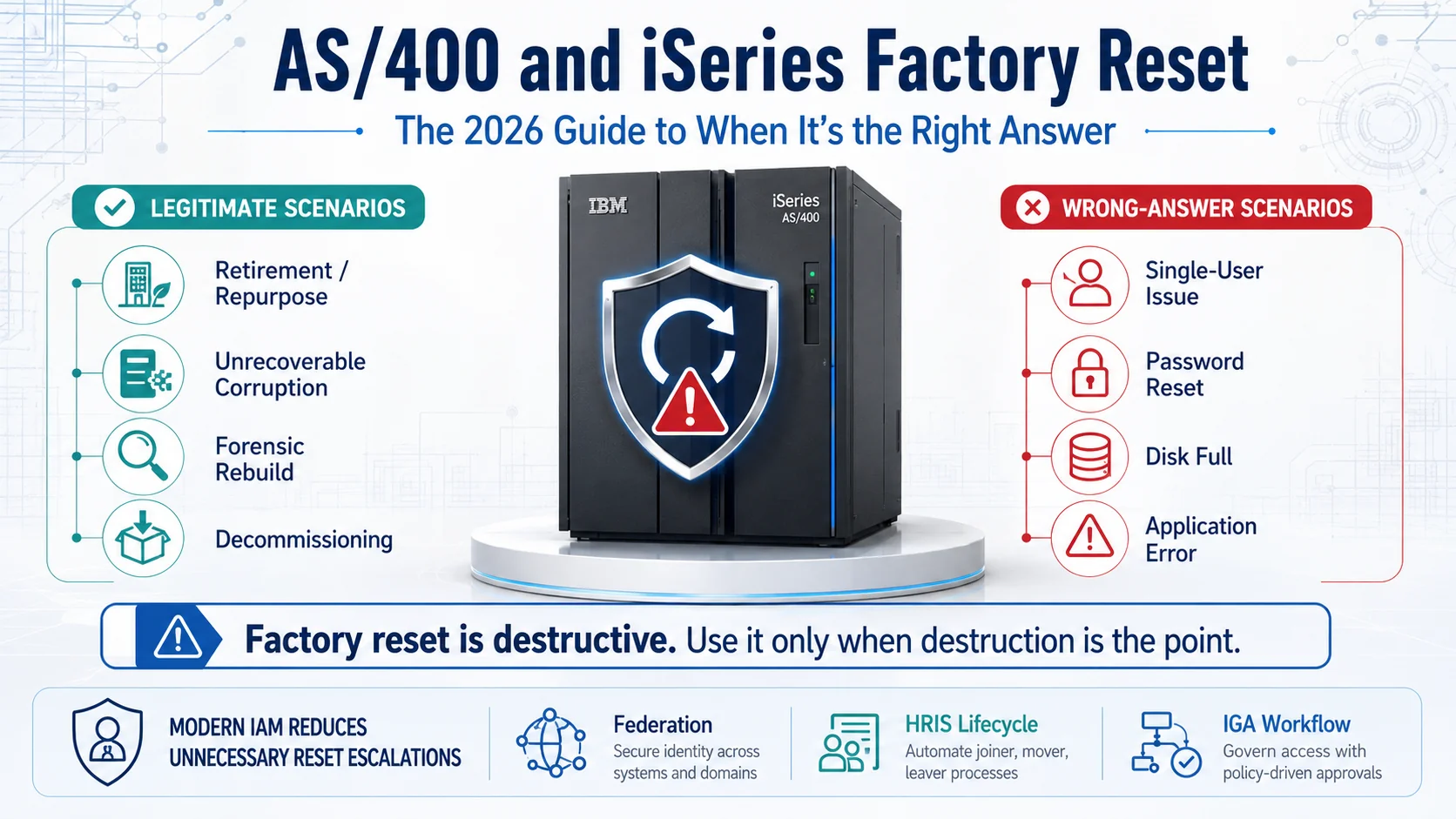
AS/400 iSeries factory reset guide 2026 — what factory reset actually means (destructive install from D-mode with all customer data lost), the four scenarios where it's legitimately appropriate (hardware retirement or repurpose, unrecoverable corruption, forensic evidence preservation before rebuild, decommissioning), the many scenarios where it's the wrong answer (single-user issue, password reset, disk full, application error), the pre-reset checklist and procedure, and the modern IAM integration that reduces recurrence of the underlying situations.
RACF & Mainframe

AS/400 and iSeries Factory Reset: The 2026 Guide to When It's the Right Answer

IBM iSeries factory reset is a destructive operation that returns the system to shipped configuration. The 2026 reference on the four scenarios where it's actually the right answer, the many more where it's the wrong answer, the pre-reset checklist that prevents data loss, and the modern IAM integration patterns that reduce recurrence of the underlying situations.

7 luglio 2026Marcelo Victor
Read more
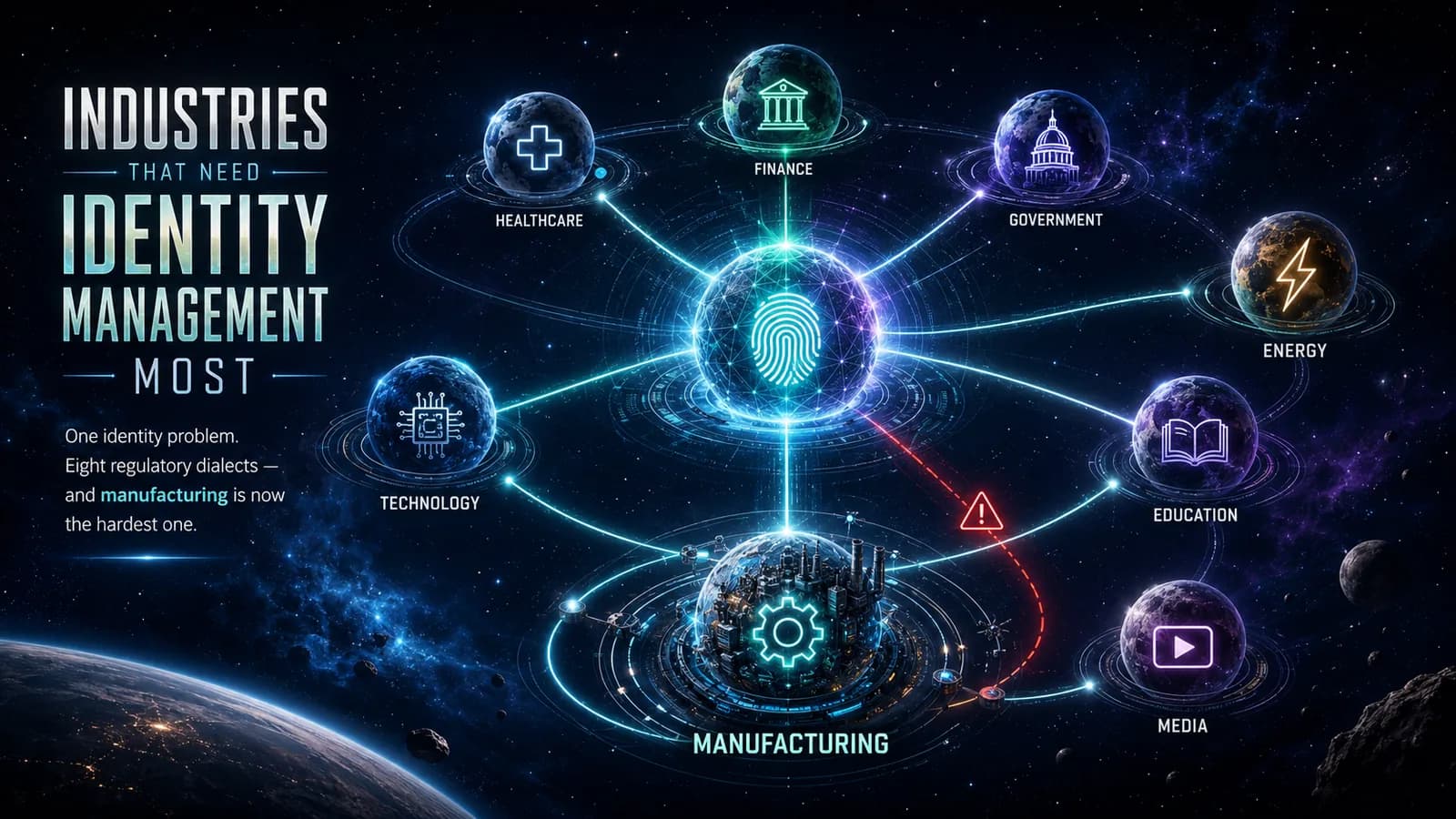
HIPAA Section 164.312 access controls healthcare 2026 — the five technical safeguards (access control, audit controls, integrity, person or entity authentication, transmission security), the addressable vs required distinction, the unique user identification challenge in shared-workstation healthcare environments, break-glass emergency access patterns, and the architecture that produces defensible audit evidence for HHS OCR.
Compliance & Audit

HIPAA §164.312 Access Controls: What Healthcare IT Actually Owes Auditors 2026

HIPAA §164.312 defines five technical safeguards for ePHI — access control, audit controls, integrity, person or entity authentication, and transmission security. The 2026 enterprise reference on what each standard actually requires from IAM, the addressable-vs-required distinction that trips up healthcare IT programs, and the architecture that produces defensible evidence at audit.

6 luglio 2026Andre Arantes
Read more
Access review auditor wants vs checkbox review 2026 — the three questions auditors ask that checkbox reviews cannot answer (was risk considered, was engagement real, was disposition defensible), the risk-weighted review architecture that produces evidence across SOX PCI HIPAA and SOC 2 simultaneously, the operational patterns for reviewer engagement and disposition tracking, and the Trust Center posture that supports customer audit programs.
Compliance & Audit

The Access Review Your Auditor Wants vs What You're Running 2026

Most enterprise access reviews are checkbox exercises that pass IAM policy but fail audit scrutiny. The 2026 enterprise reference on the three questions auditors ask that checkbox reviews can't answer, the risk-weighted review architecture that produces defensible evidence across SOX, PCI-DSS, HIPAA, and SOC 2 simultaneously, and the operational patterns that make the shift sustainable.

6 luglio 2026Ekna Padmaraj
Read more
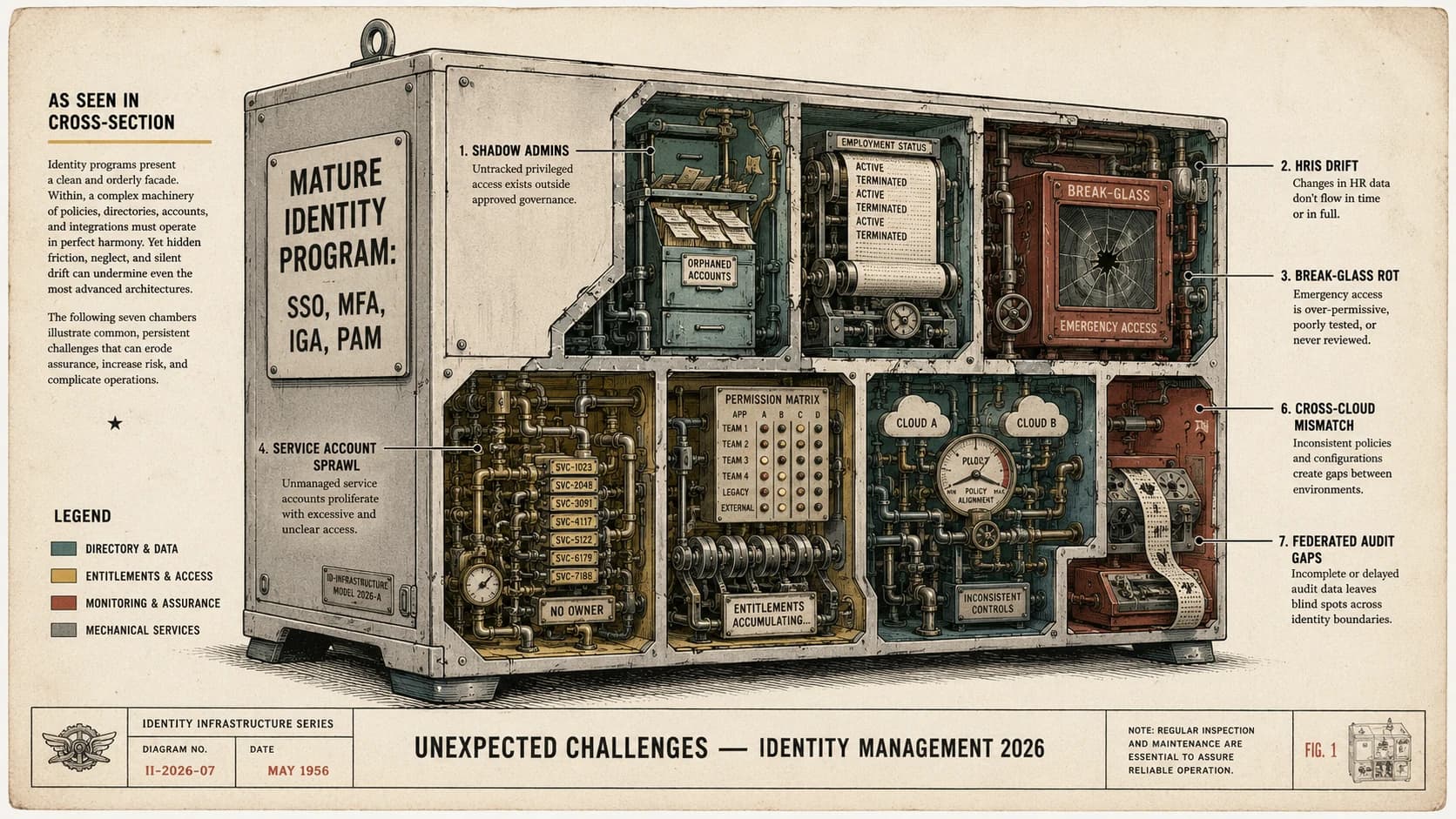
The unexpected challenges of identity management 2026 — the seven hidden failure modes that undermine mature enterprise identity programs after the obvious controls are deployed (SSO live, MFA enforced, IGA operational, PAM covering privileged accounts): shadow admins that inherit privilege through nested groups nobody audits, HRIS-drift orphan accounts where the identity system trusts a source of truth that has itself drifted, break-glass credential rot where the emergency-access accounts are rarely tested and quietly become the highest-value targets in the environment, service account sprawl where non-human identities outnumber human identities and receive almost no governance attention, permission drift over time where accumulated entitlements from role changes and project assignments are never pruned, cross-cloud entitlement mismatch where the same user has fundamentally different permission profiles across AWS/Azure/GCP because no unified CIEM layer normalizes them, and federated audit-trail gaps where the authentication events split across identity providers and never reconstruct end-to-end. Diagnostic patterns and remediation architecture for each.
IAM & Identity Governance

The Unexpected Challenges of Identity Management 2026: Seven Hidden Failure Modes Every Program Underestimates

Every mature identity program clears the obvious hurdles — SSO is live, MFA is enforced, IGA is deployed, PAM covers privileged accounts. And every mature identity program still gets breached through a set of hidden failure modes that don't appear on the architecture diagram. The 2026 enterprise reference on the seven challenges that undermine identity programs after the obvious problems are solved — shadow admins, HRIS-drift orphans, break-glass credential rot, service account sprawl, permission drift over time, cross-cloud entitlement mismatch, and federated audit-trail gaps.

1 luglio 2026Marcelo Victor
Read more
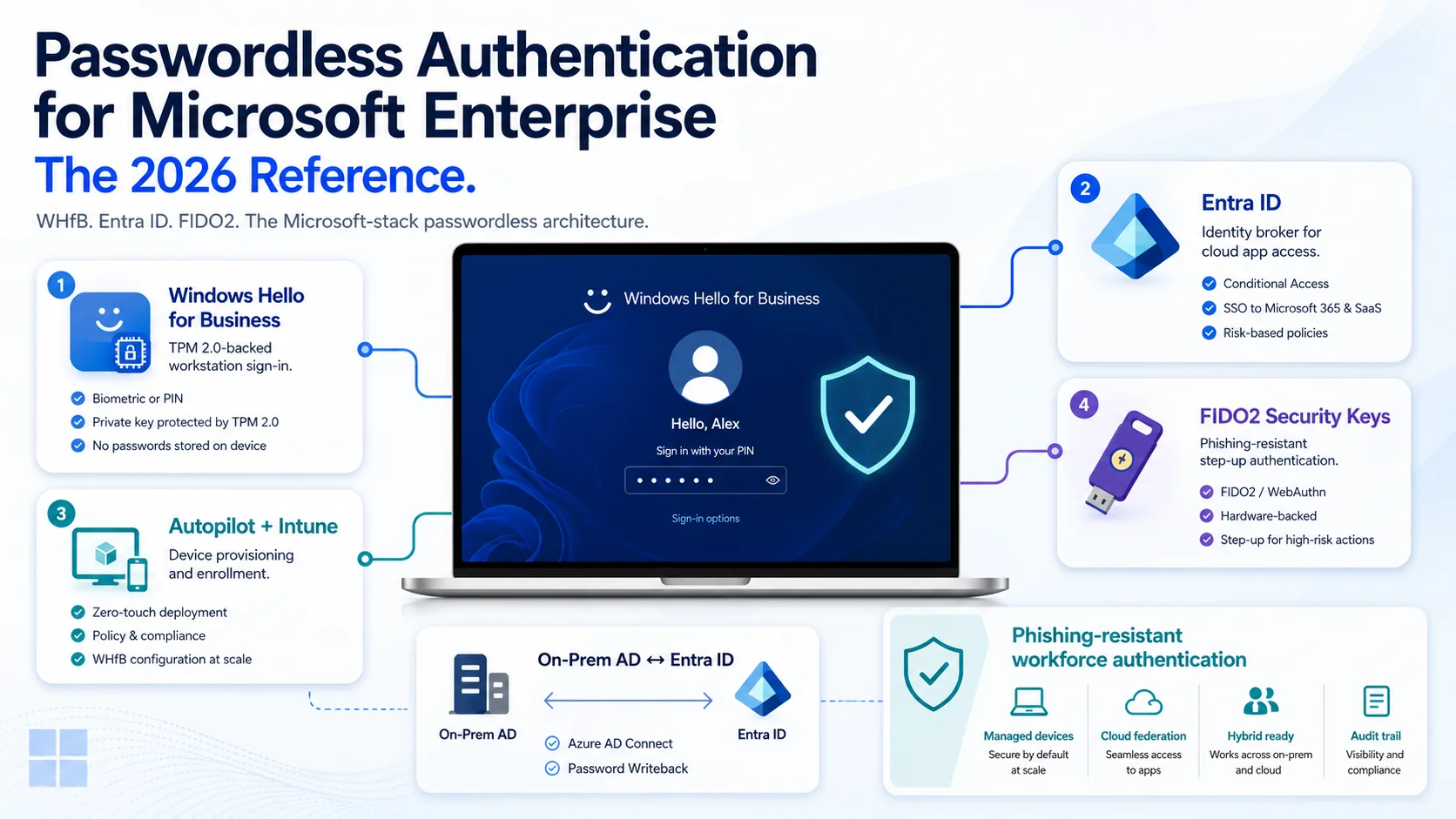
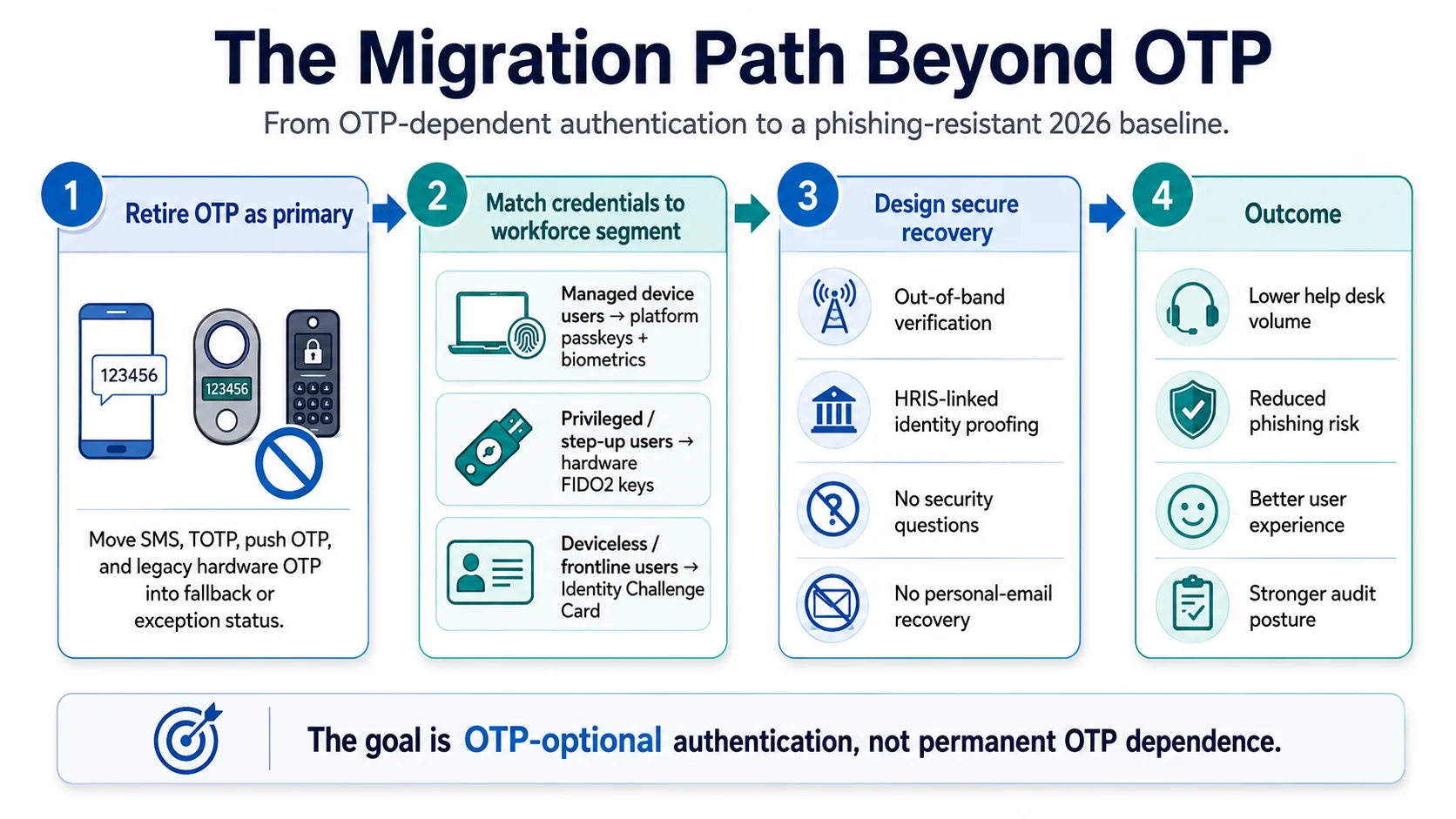
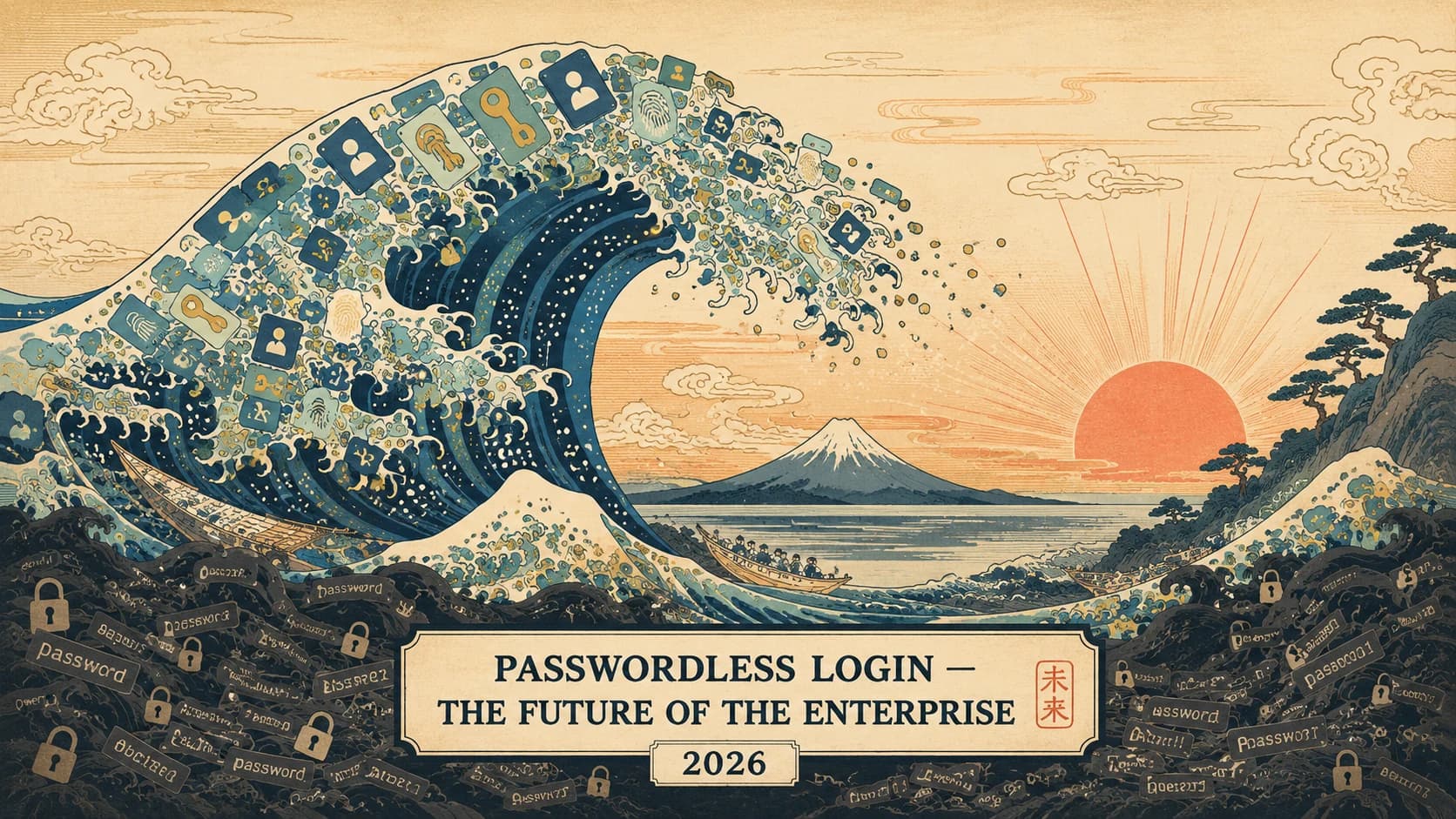
Passwordless login enterprise 2026 — where passwordless actually lives operationally after passkeys reached mainstream enterprise deployment through 2025, the WebAuthn credential architecture that makes 'passwordless' cryptographically meaningful rather than just cosmetic, the platform-native passkey systems (iCloud Keychain, Google Password Manager, Microsoft Entra ID) that cover the majority of workforce devices, the sync-vs-device-bound trade-off that shapes deployment decisions, the hardware FIDO2 authenticator path for AAL3 use cases in regulated industries, the recovery-account problem that determines whether a passwordless deployment succeeds or produces a support-burden crisis, the cross-device UX patterns that address the fundamental multi-device reality of enterprise workforce, and the migration architecture from the legacy password-first environment every enterprise still operates.
Access Management

Passwordless Login: The Future is Here — 2026 Enterprise Reference on Passkey Adoption, FIDO2, and the Path Beyond Passwords

Passwordless is no longer future-tense. Passkey adoption reached mainstream enterprise deployment in 2025, hardware FIDO2 keys are the AAL3 credential across regulated industries, and platform-native passkey systems (iCloud Keychain, Google Password Manager, Microsoft Entra ID) cover the majority of workforce devices. The 2026 enterprise reference on where passwordless actually lives operationally, the sync-vs-device-bound trade-offs, the recovery-account problem that determines whether the deployment succeeds, and the cross-device UX patterns that make passwordless work at workforce scale.

1 luglio 2026Henrique Ferreira
Read more

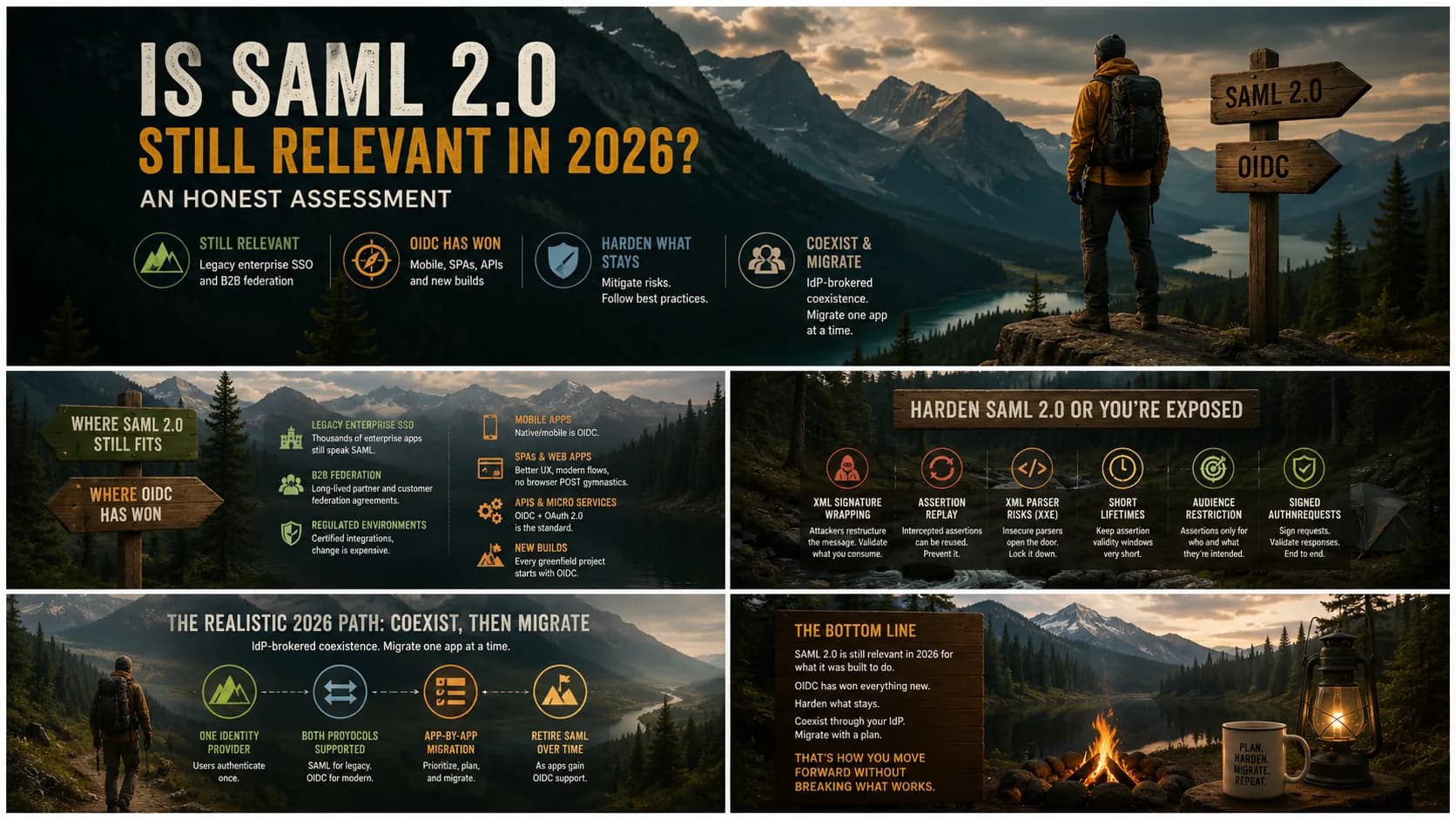
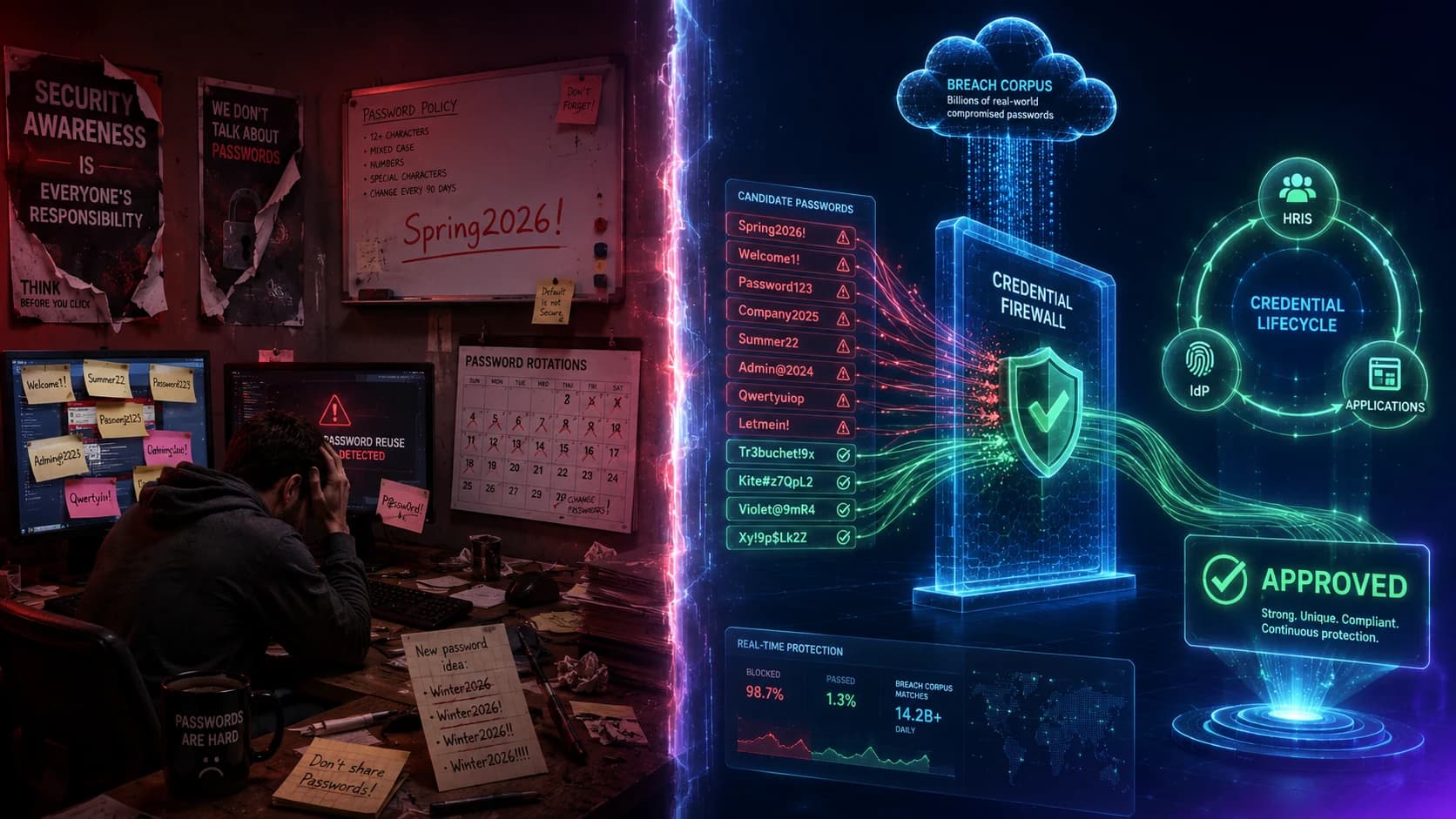
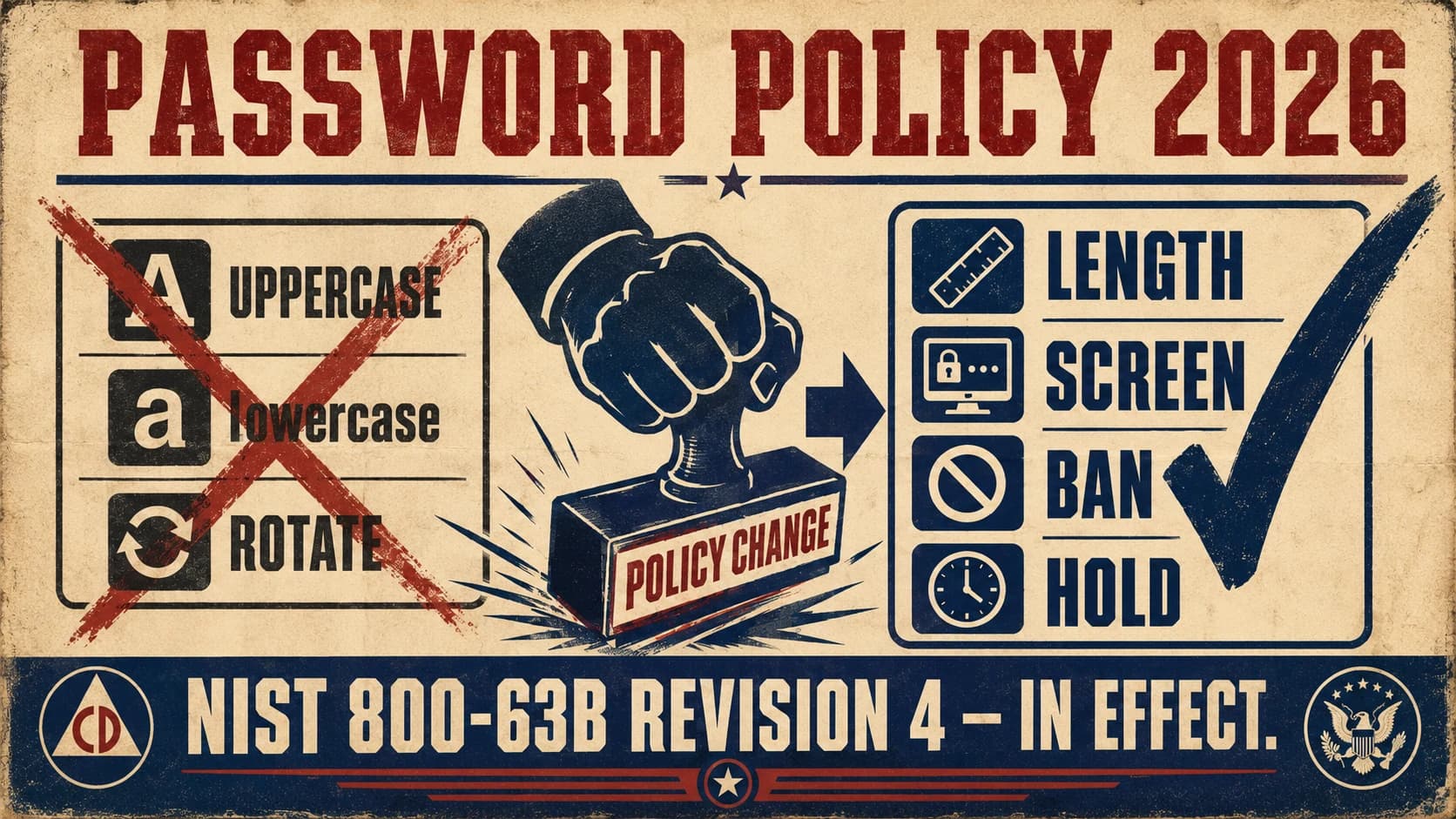
Password policy for enterprise authentication 2026 — the NIST 800-63B Rev. 4 reference (finalized 2025) that dismantles composition rules and periodic-reset mandates and codifies the modern discipline of length over complexity, breach-corpus screening, banned-list enforcement, and no forced periodic rotation absent evidence of compromise, the AAL1/2/3 assurance level mapping that determines which authenticator patterns satisfy which use cases, the enforcement architecture that composes password validation with adaptive MFA triggers and rate limiting, the migration path from the legacy composition-rule policy every enterprise still carries, and the operational reality that most password compromises today happen through phishing and credential reuse rather than through the brute-force attacks the legacy policies were designed to prevent.
Pillar 1: Password Firewall

Password Policy for Enterprise Authentication 2026: The NIST 800-63B Rev. 4 Reference

The password policy that actually reduces risk is not the password policy most enterprises still enforce. NIST 800-63B Rev. 4 (finalized 2025) dismantles the composition rules and periodic-reset mandates that defined the 2000s and codifies a fundamentally different discipline — length over complexity, breach-corpus screening, banned-list enforcement, no forced periodic rotation. The 2026 enterprise reference on the modern password policy, the AAL1/2/3 assurance-level mapping, the enforcement architecture that operationalizes it, and the migration path from the legacy policy every enterprise still carries.

1 luglio 2026Garrett Garitano
Read more
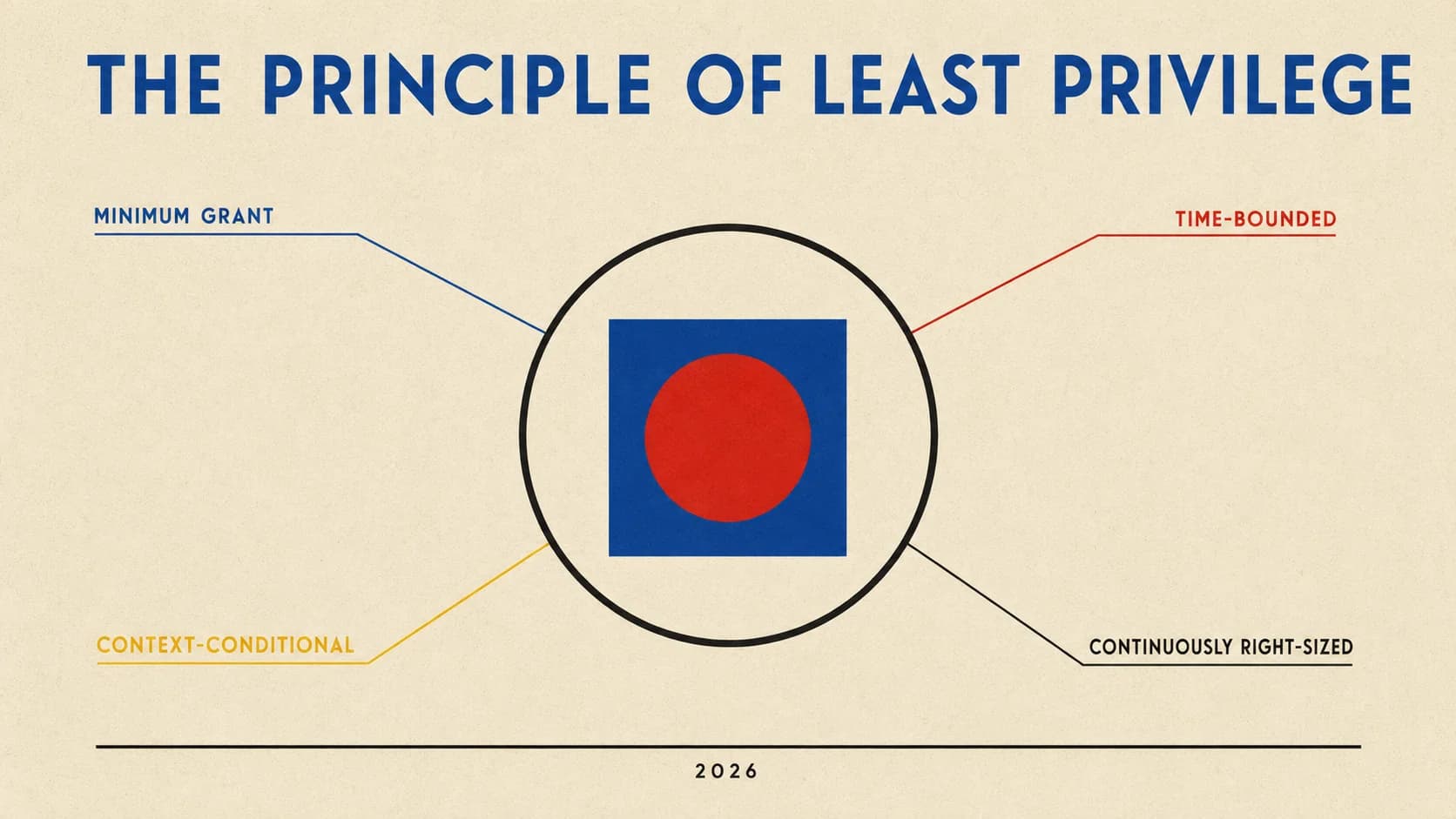
The principle of least privilege for enterprise access control 2026 — the foundational access-management principle defined operationally (every identity gets only the permissions required for its current task scope), the four architectural patterns that produce least privilege in practice (role-based baselining, just-in-time elevation, attribute-conditional grants, continuous right-sizing), the failure modes that explain why most programs miss the target despite stated commitment, and the composition with JIT access and Zero Standing Privilege that defines the modern access envelope.
Access Management

The Principle of Least Privilege: Why It Matters for Enterprise Access Control 2026

Least privilege is the foundational principle every enterprise access program claims to follow and almost none actually achieves. The 2026 enterprise reference on what least privilege actually means operationally, the four architectural patterns that produce it, the failure modes that explain why most programs miss the target, and how least privilege composes with JIT access and Zero Standing Privilege to produce the modern access envelope.

30 giugno 2026Leonardo Cuenca
Read more
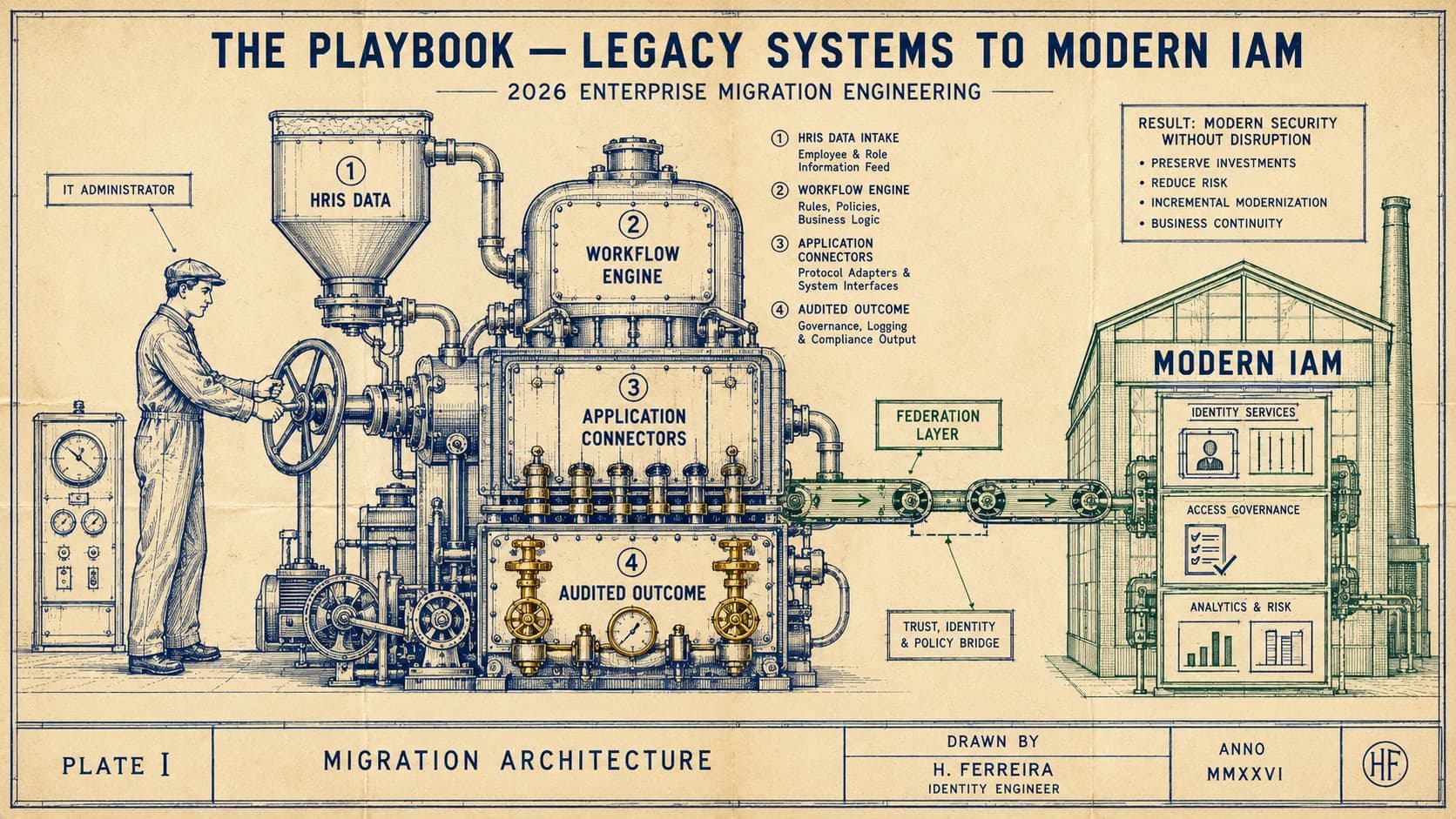
Playbook moving legacy systems to modern IAM 2026 — the legacy IAM landscape still in production (Sun IDM, Oracle Identity Manager, NetIQ, on-prem AD, mainframe security managers), the five-phase migration playbook (inventory and dependency mapping, federation-based parallel-running, lifecycle workflow port, application connector cutover, legacy decommission), the risk patterns that derail legacy IAM migrations, and the architectural patterns that succeed in production.
IAM & Identity Governance

The Playbook: Moving Legacy Systems to Modern IAM 2026

Most enterprises still run a meaningful share of business-critical workloads on identity infrastructure from a previous era — Sun Identity Manager, Oracle Identity Manager, NetIQ, on-prem AD with manual provisioning, ACF2 / RACF / Top Secret on the mainframe. The 2026 enterprise playbook for moving them to modern IAM without breaking the workloads they secure.

30 giugno 2026Henrique Ferreira
Read more

SOX compliance for identity teams 2026 — the five IT general controls domains that depend on identity (access provisioning, access deprovisioning, periodic access review, privileged access, segregation of duties), the auditor expectations that shifted in the post-2025 SOX audit cycle (engagement evidence per attestation, reconciliation rate questions, outcome materiality), the documentation patterns that produce clean walkthroughs, and the integrated identity architecture that turns SOX from quarterly scramble to continuous defensible posture.
Compliance & Audit

SOX Compliance for Identity Teams 2026: What Auditors Actually Want to See

Sarbanes-Oxley Section 404 places IT general controls (ITGC) over financial systems squarely in the IAM team's lap — even though SOX itself doesn't mention identity once. The 2026 enterprise reference on the five SOX ITGC domains that depend on identity controls, the auditor expectations that shifted in the post-2025 audit cycle, and the architecture that produces clean SOX walkthroughs.

29 giugno 2026Ekna Padmaraj
Read more
HIPAA access audits for healthcare identity teams 2026 — the five HIPAA Security Rule Technical Safeguards under § 164.312 that depend on identity controls (Access Control, Unique User Identification, Emergency Access Procedure, Person or Entity Authentication, Audit Controls), the OCR enforcement pattern that intensified through 2024-25, the operational reality of HIPAA-compliant break-glass procedures, and the integrated architecture that produces continuously defensible HIPAA posture for healthcare IT teams.
Compliance & Audit

HIPAA Access Audits for Healthcare Identity Teams 2026

HIPAA Security Rule § 164.312 places identity controls at the center of every covered entity's access-audit risk. OCR enforcement actions have intensified through 2024-25, and the 2026 audit profile is substantively harder than the prior decade. The enterprise reference on the five Technical Safeguards that depend on identity controls, the post-2024 OCR enforcement pattern, and the architecture that produces defensible HIPAA access-audit posture for healthcare IT.

29 giugno 2026Garrett Garitano
Read more
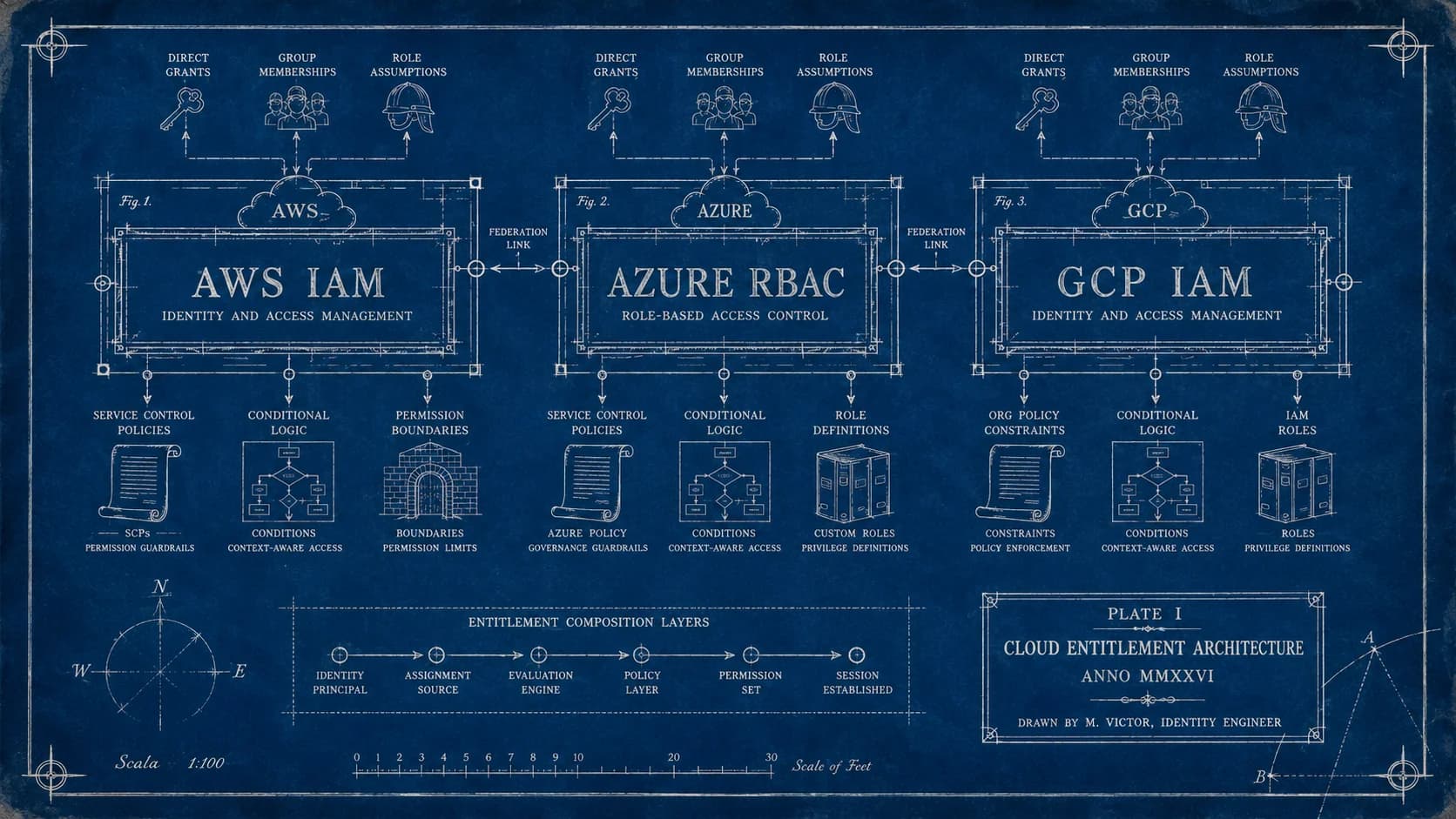
CIEM cloud infrastructure entitlement management 2026 — the analyst category that handles cloud-specific entitlement complexity (AWS IAM, Azure RBAC, GCP IAM), the four CIEM evaluation domains (effective-permission visibility, least-privilege baselining, machine-identity governance, multi-cloud federation), the mid-2026 vendor landscape (Wiz, Microsoft Entra Permissions Management, Permiso, Sonrai, Saviynt, Authomize, Tenable Cloud Security), the architectural composition with IGA + PAM + ISPM, and the operational reality of governing cloud entitlements at the scale that traditional IGA platforms weren't built for.
IAM & Identity Governance

CIEM: Cloud Infrastructure Entitlement Management for Enterprise 2026

Traditional IGA was built for workforce identity in defined business systems. Cloud infrastructure is a different problem — thousands of permissions per cloud account, machine-identity dominance, inheritance through nested groups and policies, scale that no human reviewer can certify manually. CIEM is the emerging analyst category that handles this complexity. The 2026 enterprise reference on the four CIEM domains, the vendor landscape, and the architectural composition with IGA, PAM, and ISPM.

29 giugno 2026Marcelo Victor
Read more
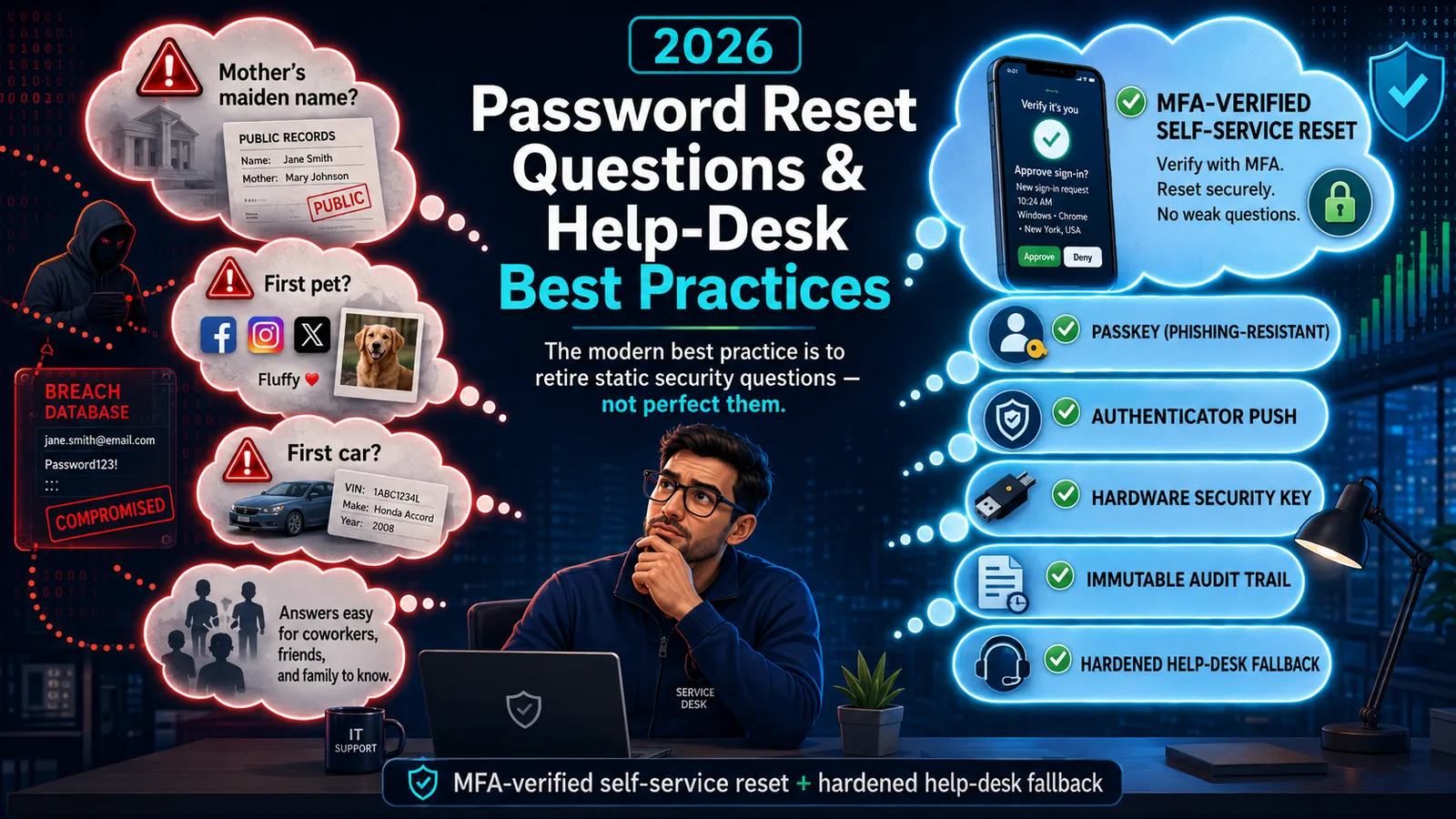
Temporary password best practices 2026 — the NIST 800-63B Rev. 4 requirements that changed in 2025, the threat model that explains why temporary passwords are the most exploited recovery credential class in enterprise environments, the six operational best practices for the temporary-password segment that remains, the workflow-verified recovery patterns that are replacing temporary passwords in 2026 deployments, and the legitimate edge cases where temporary passwords still operate.
Pillar 3: Assisted Reset

Temporary Password Best Practices 2026: NIST 800-63B Rev. 4 and Beyond

Temporary passwords are the recovery credential class that most enterprises still issue, share insecurely, and persist beyond their intended scope. NIST 800-63B Rev. 4 raised the bar in 2025, and the 2026 architectural pattern moves further — away from temporary passwords toward workflow-verified recovery. The enterprise reference on what's required, what's recommended, and where temporary passwords genuinely still belong.

25 giugno 2026Andre Arantes
Read more
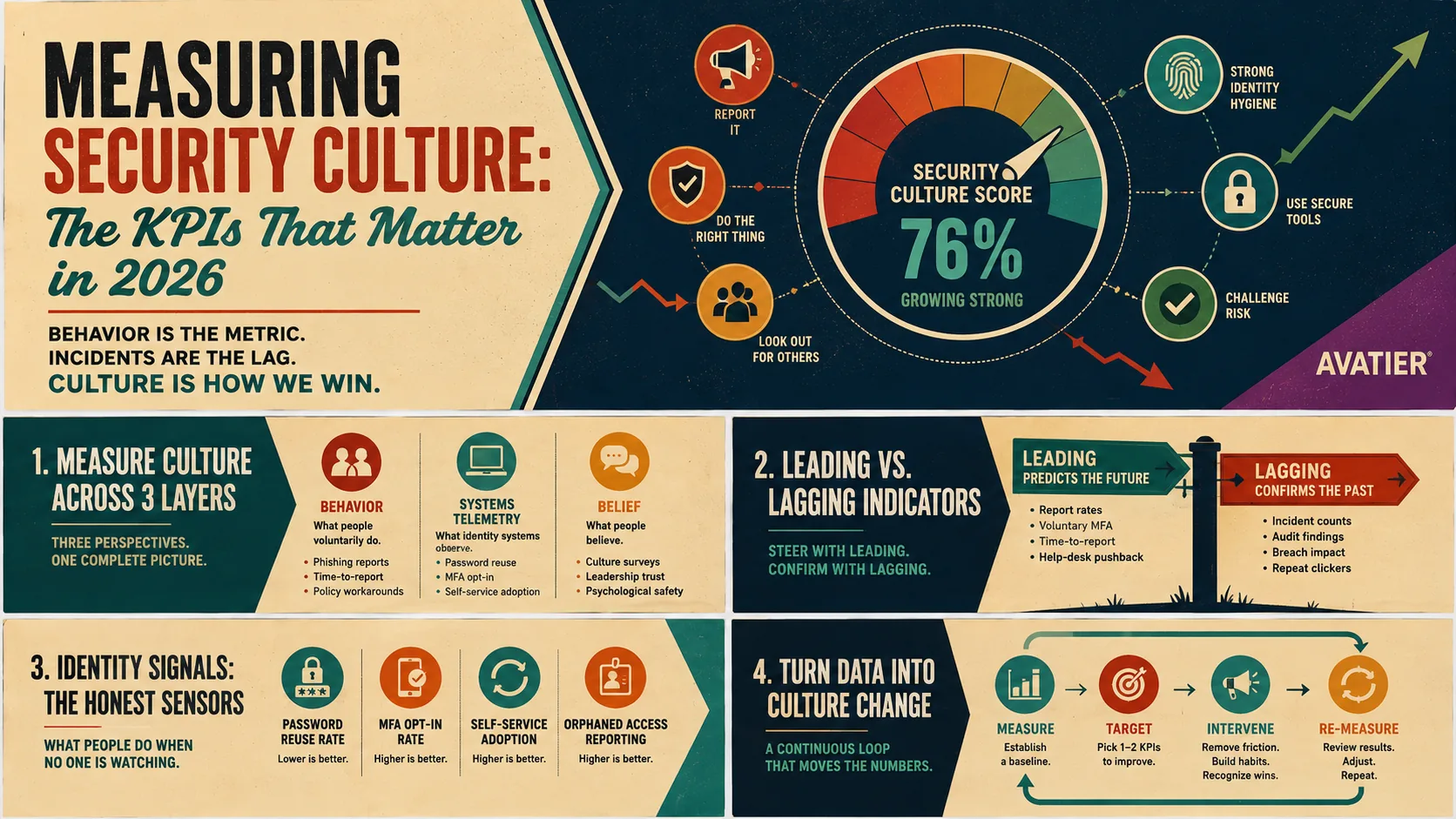
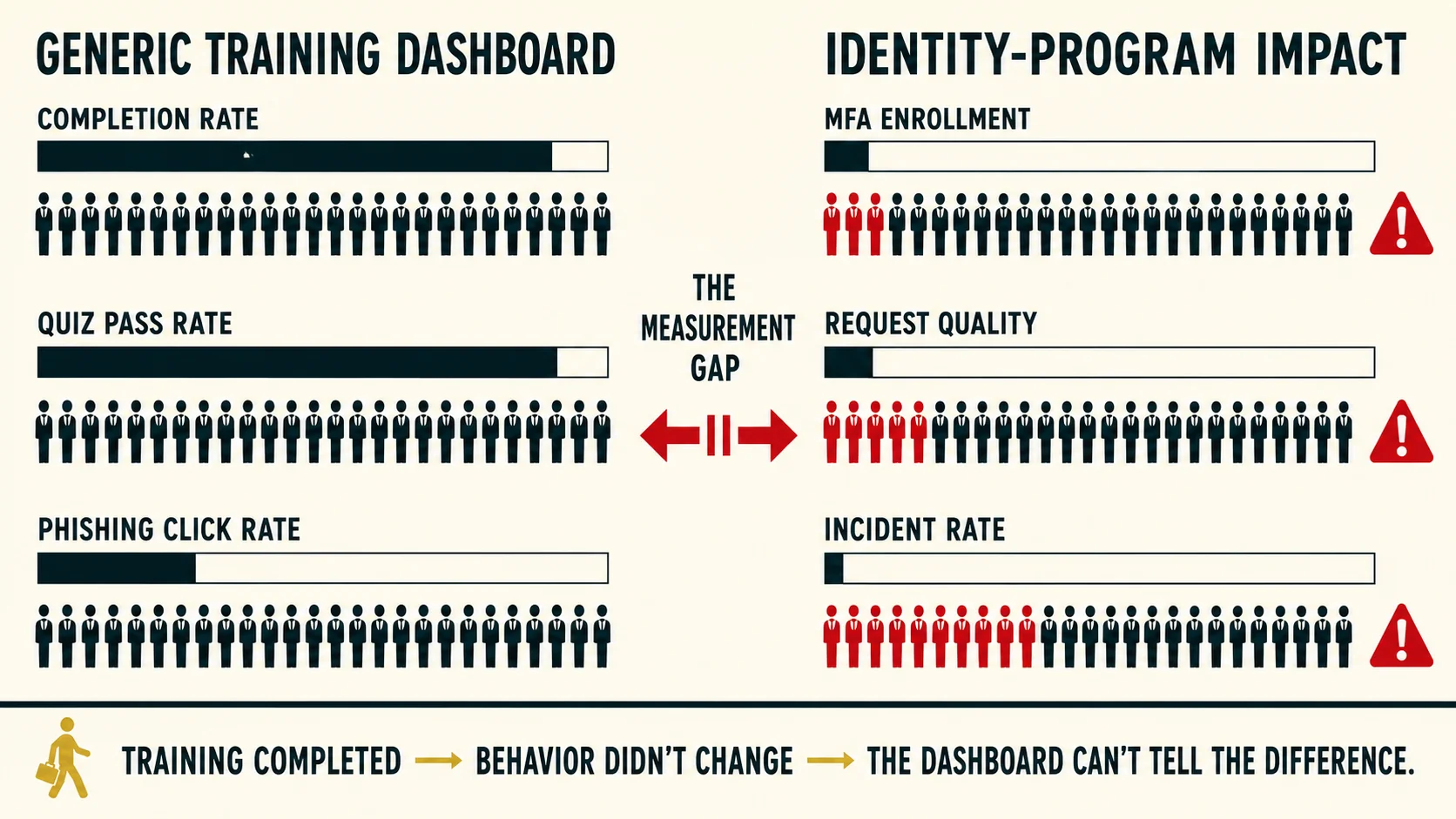
Security awareness training KPIs for identity programs 2026 — the five identity-specific KPI categories that matter (phishing simulation performance with identity-system context, MFA adoption and friction metrics, credential hygiene behaviors, access request patterns, identity-incident impact), the telemetry integration between training platforms and IAM that makes the metrics measurable, the architecture that catches training-to-behavior correlations, and the operational pitfalls (vanity metrics, attestation fatigue, training-without-identity-context) that produce dashboards full of green numbers and unchanged risk.
IAM & Identity Governance

Security Awareness Training KPIs for Identity Programs 2026

Most security awareness training dashboards measure participation and quiz scores. Identity programs need to measure something different — whether the training actually changed the credential-handling, MFA-adoption, and access-request behaviors that determine the identity-attack surface. The 2026 enterprise reference on the five identity-specific KPI categories, the telemetry integration that makes them measurable, and where most training measurement programs break.

25 giugno 2026Garrett Garitano
Read more
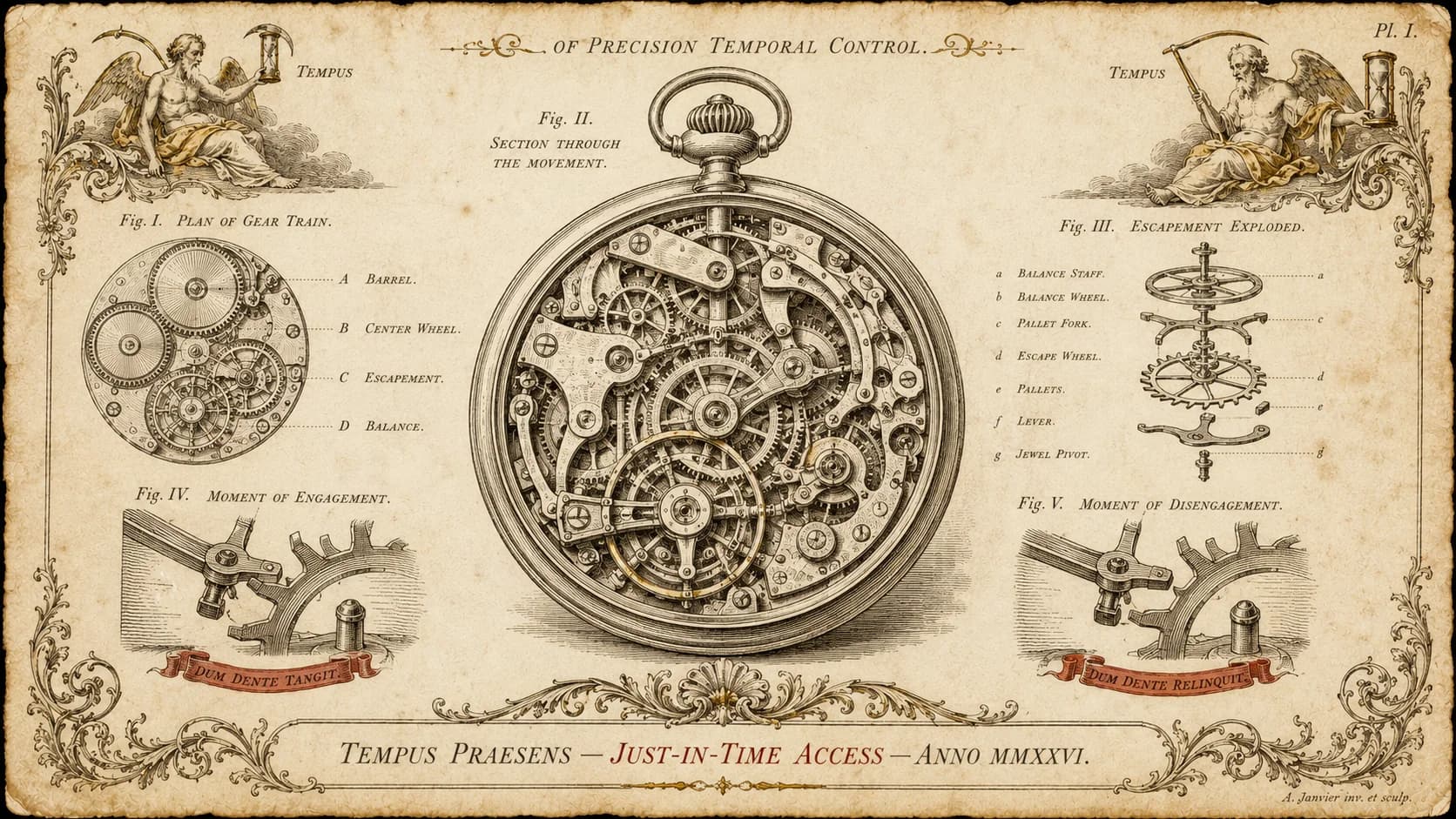
Just-in-time access and zero standing privilege for enterprise 2026 — the architectural shift from standing privilege (users hold permanent entitlements regardless of whether they're using them right now) to Zero Standing Privilege (nobody has permanent privileged access; entitlements are granted at the moment of need and revoked automatically when the task completes), the four architectural patterns that enable JIT (time-bounded access, workflow-attested elevation, risk-evaluated approval, auto-revocation), the five workforce segments where the pattern is operationally mature, and the operational pitfalls that produce broken-glass scenarios when JIT is deployed without the necessary fallback paths.
Access Management

Just-in-Time Access and Zero Standing Privilege for Enterprise 2026

Standing privilege is the legacy pattern — users (and service accounts, and AI agents) hold permanent entitlements regardless of whether they're using them right now. Zero Standing Privilege flips the model: nobody has permanent privileged access; access is granted at the moment of need and revoked automatically when the task completes. The 2026 enterprise reference on JIT access architecture, the workforce segments where it's operationally mature, and where the pattern breaks.

25 giugno 2026Leonardo Cuenca
Read more
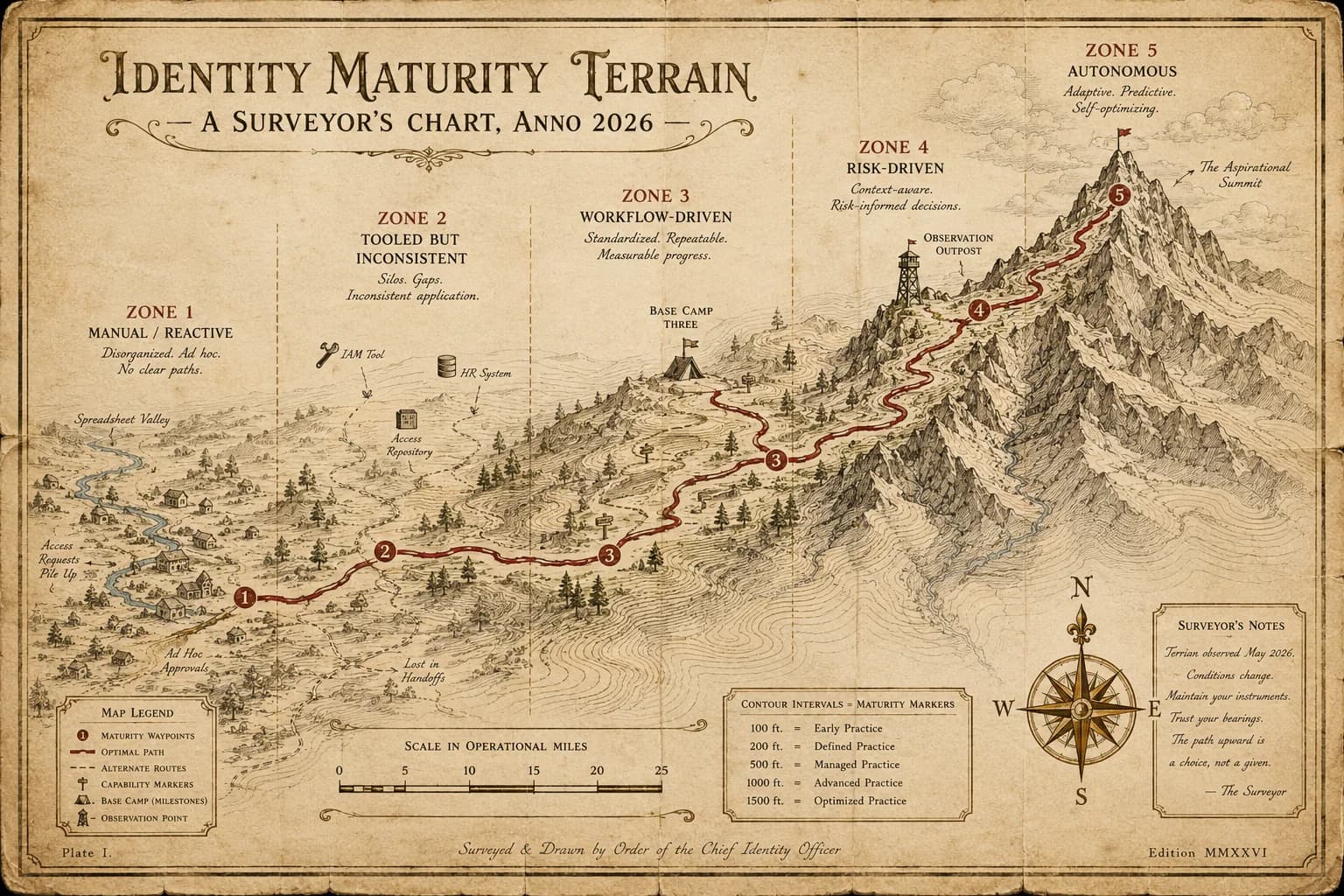
Why your IGA project failed and how to recover 2026 — the four failure patterns that produce stalled IGA deployments (connector backlog with uncovered target systems, workflow complexity that nobody can complete, catalog drift between IGA and reality, stakeholder fatigue with managers no longer engaging), the decision framework for restart vs continue, the four-phase recovery path that doesn't require rip-and-replace, and the Stage 2 to Stage 3 transition in the broader identity maturity model that successful recoveries are usually executing.
IAM & Identity Governance

Why Your IGA Project Failed — And How to Recover Without Starting Over 2026

60% of IGA deployments stall. The platform is in production, the consultants left, the certification campaigns happen on paper but produce nothing actionable, and leadership wants to know why the program isn't delivering. The 2026 enterprise reference on the four failure patterns that produce stalled IGA, when to restart vs continue, and what a phased recovery actually looks like.

25 giugno 2026Henrique Ferreira
Read more

The access review your auditor actually wants 2026 — the three questions sophisticated 2026 auditors ask (specific approval decision audit trail with engagement evidence, reconciliation rate between IGA catalog and actual target-system entitlements, what materially changed as a result of the review cycle), the five review patterns that pass these auditor tests (risk-stratified queues, engagement enforcement, reconciliation-anchored coverage, outcome-tracked cycles, continuous between-cycle review), and the operational gap between checkbox reviews most teams still run and the substantive reviews auditors increasingly demand.
Compliance & Audit

The Access Review Your Auditor Actually Wants 2026

Most enterprise access reviews are checkbox exercises — manager attests, audit log records, cycle closes. The auditor walks away with a binder of attestation evidence and the program reports clean. The 2026 auditor profile asks harder questions: did the reviewer actually engage, does the catalog match target-system reality, and what changed as a result. The enterprise reference on the three questions auditors actually ask now and the five review patterns that pass the test.

25 giugno 2026Ekna Padmaraj
Read more

Shadow IT provisioning ticket-driven access risk 2026 — the five informal provisioning paths that bypass IGA (Slack DM requests, ServiceNow tickets routed to direct grant, manager Excel re-uploads, tool-side admin self-service, vendor SaaS self-provisioning), the architectural pattern that captures these without disrupting operational flow (target-system reconciliation, ticket integration, governed self-service portal), and the audit risk that grows in proportion to ungoverned provisioning volume.
IAM & Identity Governance

Shadow IT Provisioning: The Access Risk Living in Your Ticketing System 2026

Most enterprise access doesn't flow through the IGA platform — it flows through Slack DMs, ServiceNow tickets routed to direct grant, manager spreadsheets, tool-side admin self-service, and vendor SaaS self-provisioning. The 2026 enterprise reference on shadow IT provisioning, why it bypasses even mature IGA programs, and the architectural pattern that captures it without breaking the operational flow.

24 giugno 2026Marcelo Victor
Read more

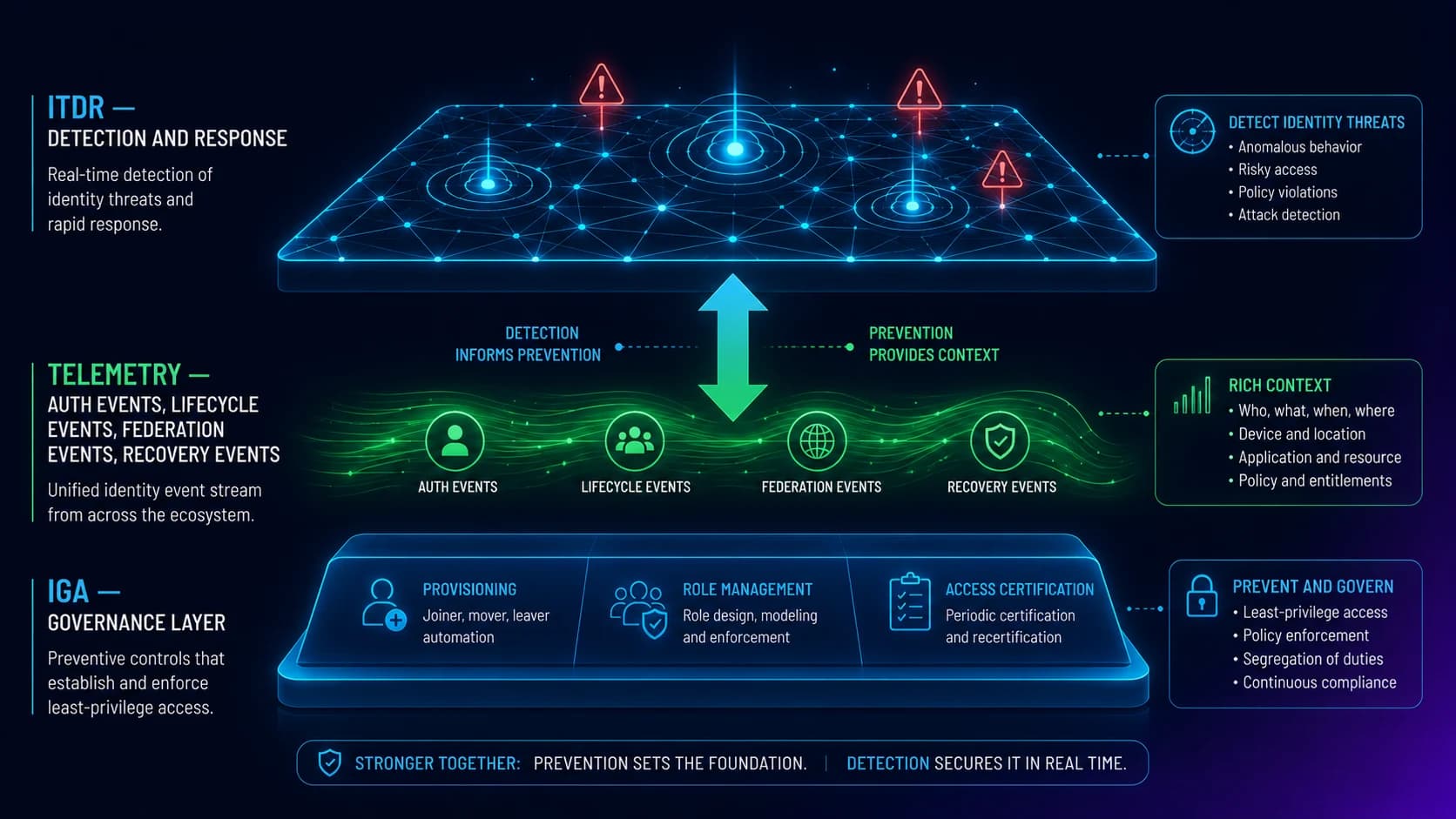
Identity security posture management ISPM 2026 — the emerging analyst category that evaluates whether identity infrastructure is configured according to policy, the four evaluation domains (configuration posture, entitlement posture, access pattern posture, identity inventory posture), the vendor landscape (Authomize, Veza, Silverfort, Permiso, Push Security, Sweet Security, Reco), the architectural composition with IGA and ITDR, and the operational findings ISPM tools surface that other layers miss.
IAM & Identity Governance

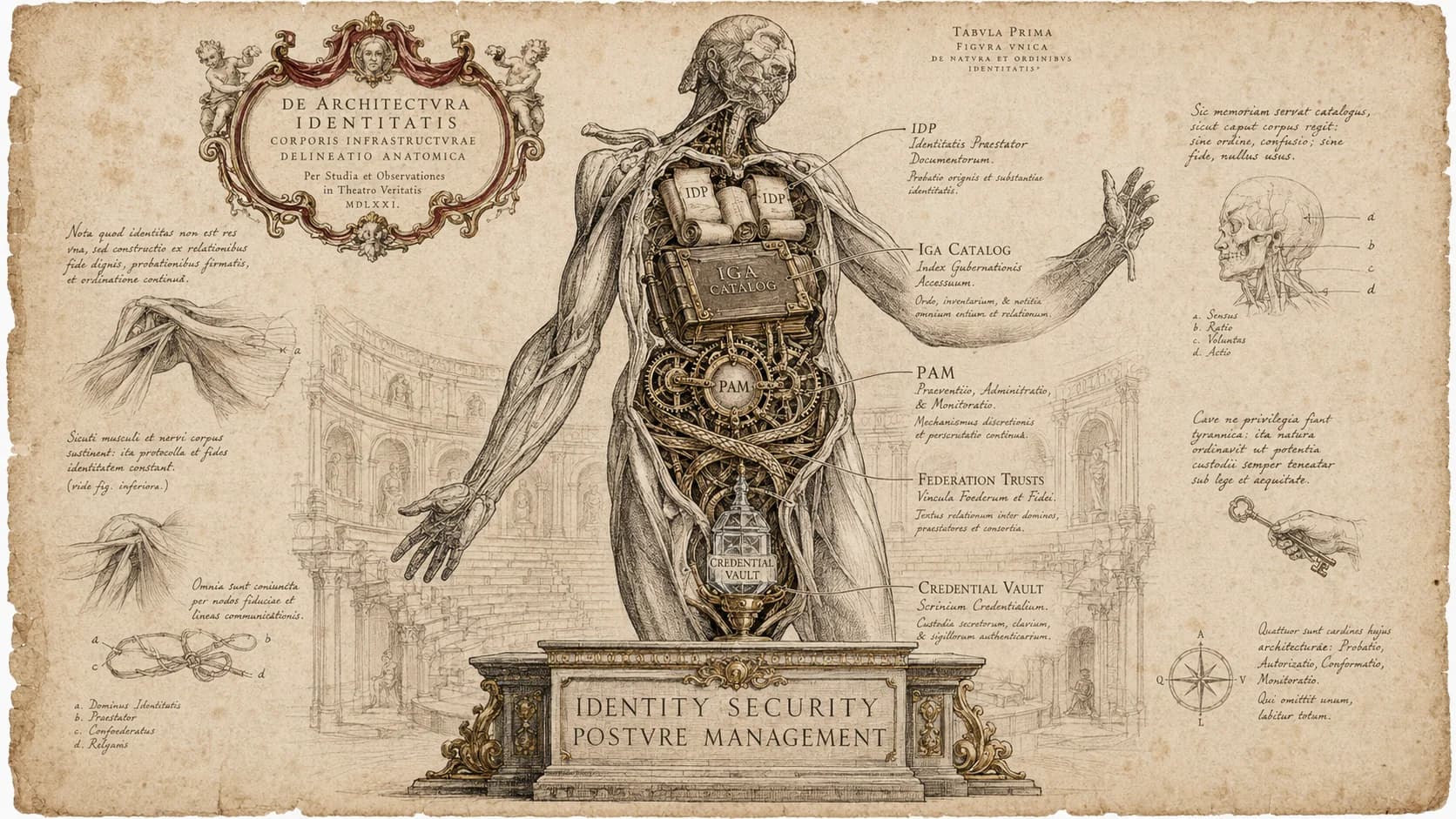
Identity Security Posture Management (ISPM) for Enterprise 2026

ISPM is the emerging analyst category that sits above IGA and beside ITDR — the preventive posture audit, drift detection, and identity-asset inventory layer that answers 'is our identity infrastructure currently configured the way our policy says it should be.' The 2026 enterprise reference on the evaluation domains, vendor landscape, and integration architecture.

24 giugno 2026Marcelo Victor
Read more

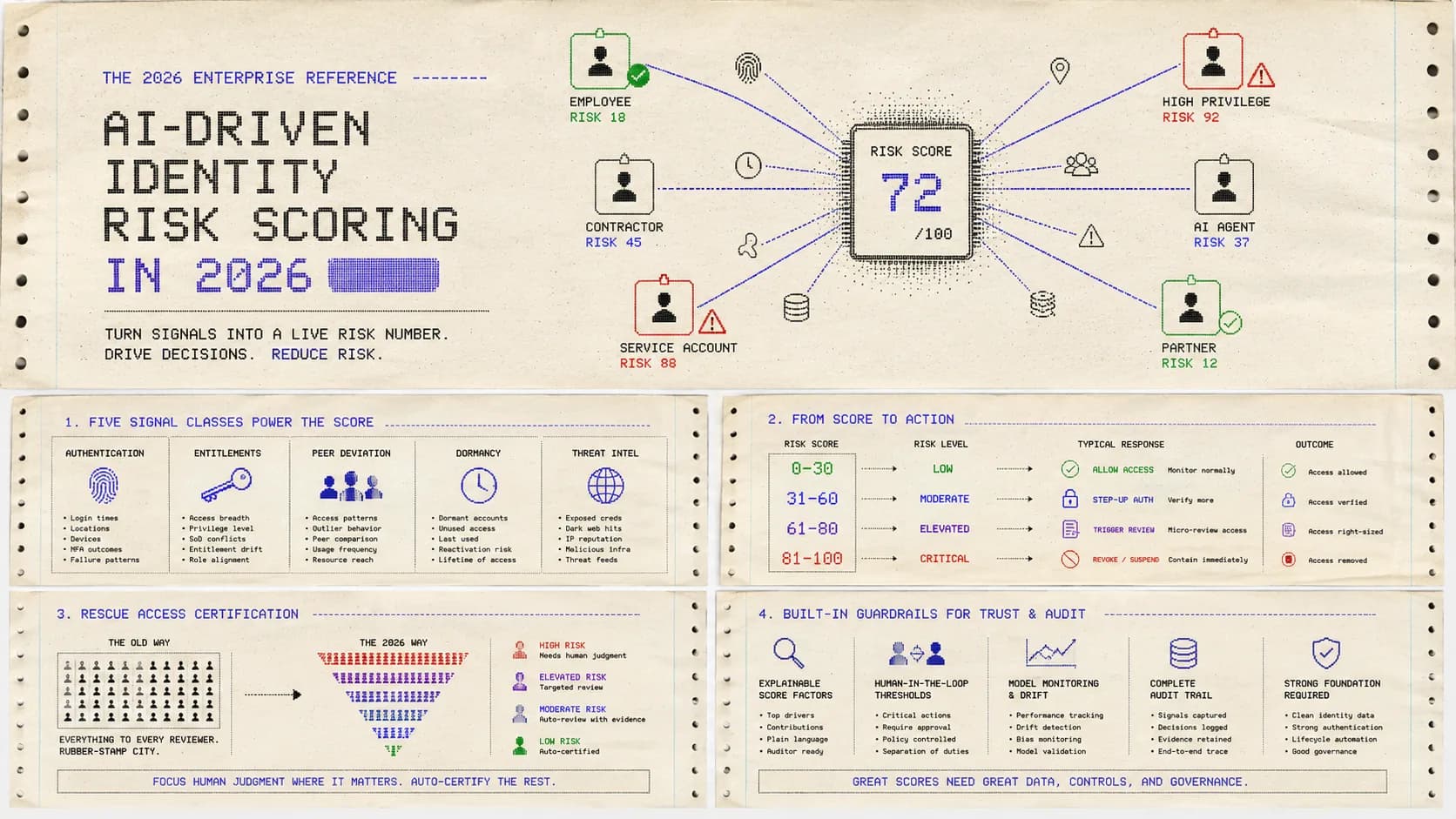
AI-augmented access certification campaigns 2026 — the four things AI actually does in certification (risk stratification, anomaly surfacing, behavioral attestation, bulk decision grouping), the architecture that lets AI add value rather than noise, the time-savings reality (3 weeks compressed to 3 days at the median), and the operational pitfalls that produce attestation fatigue when AI recommendations are deployed without discipline.
IAM & Identity Governance

AI-Augmented Access Certification: Cutting Campaigns from 3 Weeks to 3 Days 2026

Quarterly access certification campaigns are the operational backbone of IGA — and the place where certification fatigue does the most damage. The 2026 enterprise reference on what AI actually automates in certification (not the vendor-marketing version), where the time savings come from operationally, and where AI-augmented certification breaks if you skip the architectural discipline.

24 giugno 2026Ekna Padmaraj
Read more

Service Account Governance and Non-Human Identity for enterprise 2026 — covering the NHI category (service accounts, workload identities, API credentials, automation agents, AI agent identities), the governance gaps where credentials live in config files and orphaned scripts, the workload identity federation patterns (Kubernetes service tokens, AWS IAM roles, Azure managed identities), and the architecture that brings NHI under the same lifecycle discipline as human identities.
IAM & Identity Governance

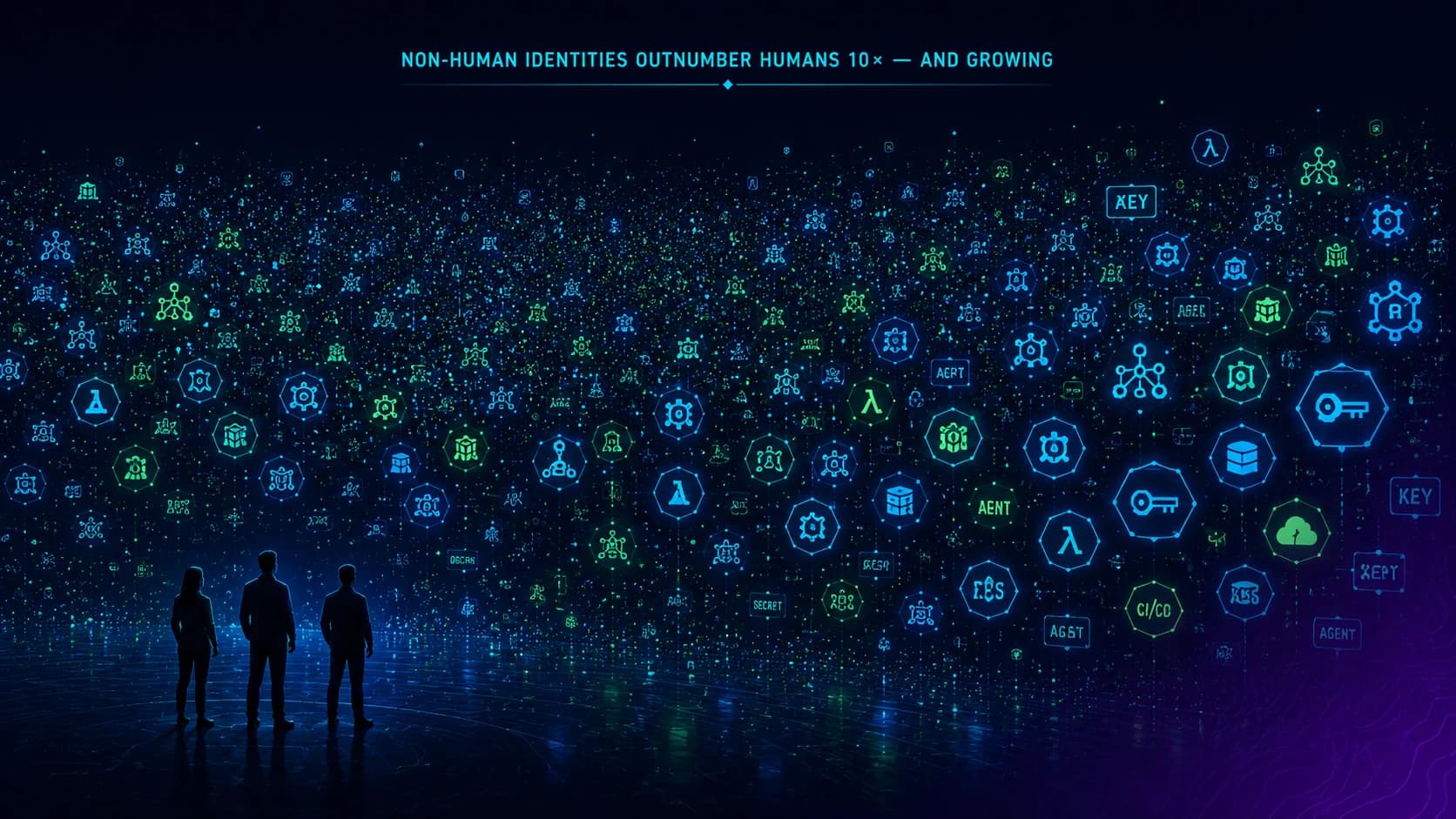
Service Account Governance and Non-Human Identity for Enterprise 2026

Non-human identities — service accounts, workload identities, API credentials, automation agents, and the rapidly growing population of AI agent identities — now outnumber human identities in most 2026 enterprises by 10× or more. The reference on what NHI is, where the governance gaps are, and the architecture that brings non-human credentials under the same lifecycle discipline as humans.

16 giugno 2026Marcelo Victor
Read more
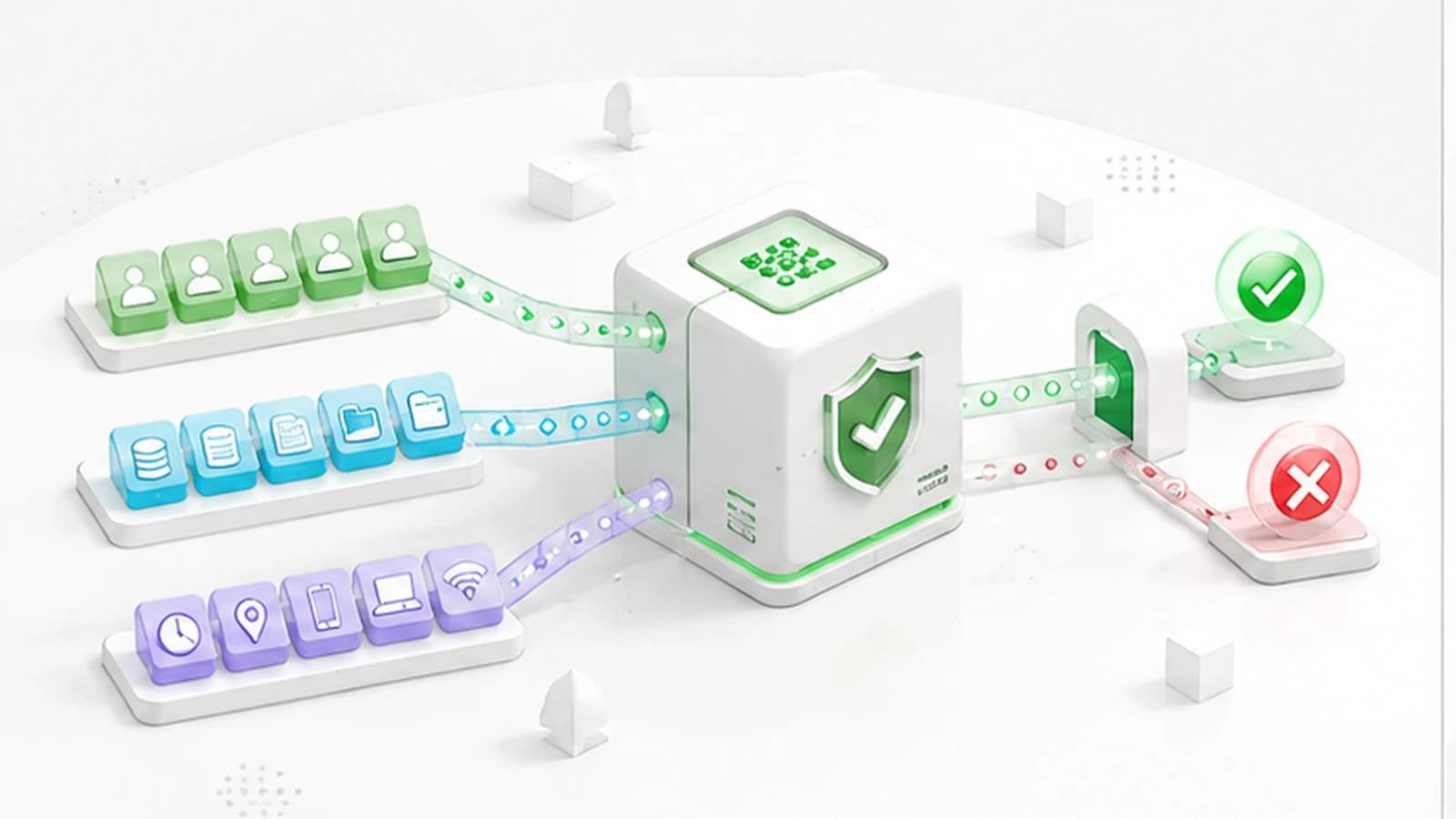
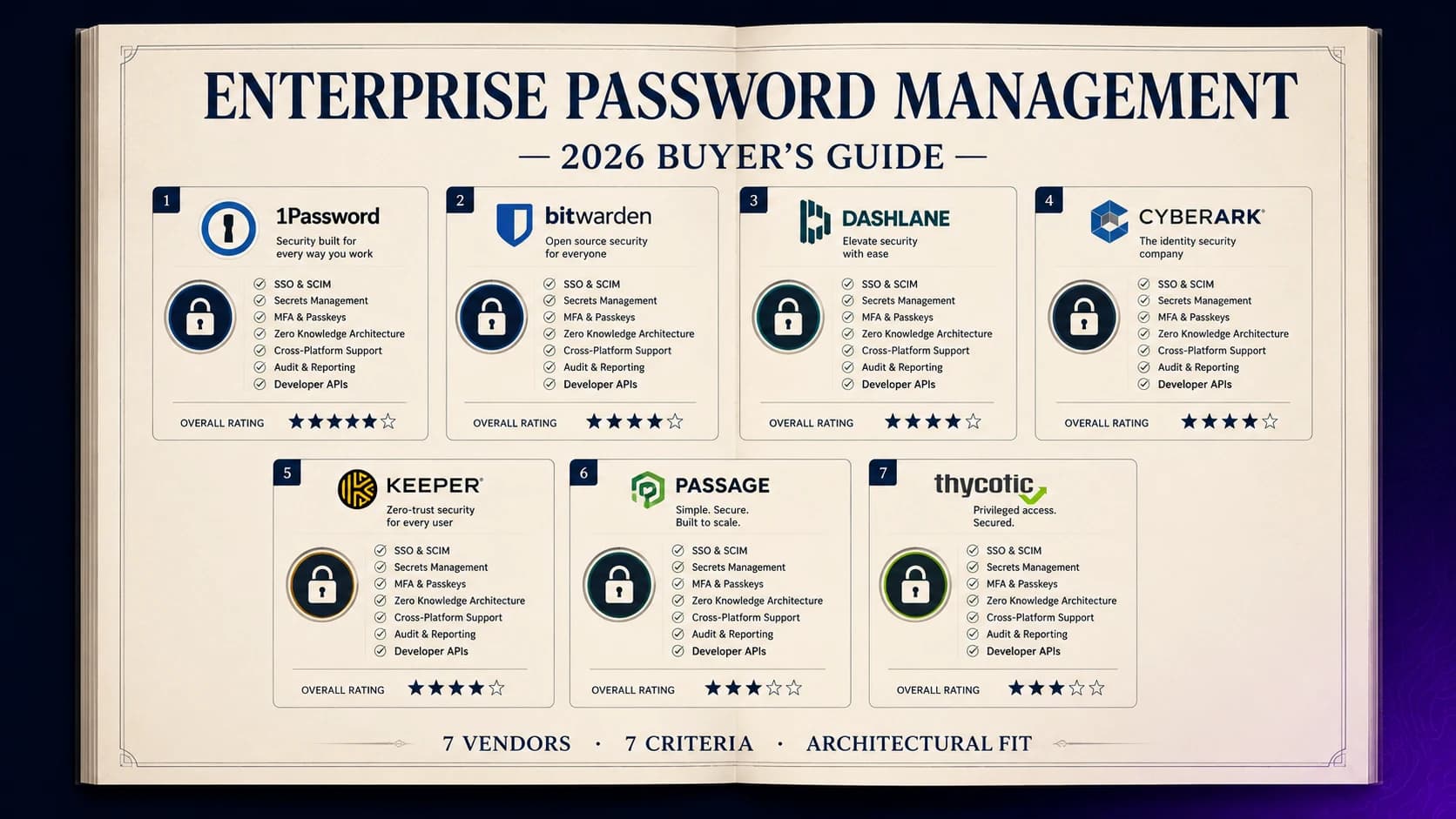
The 2026 enterprise password management software buyer's guide — covering the dominant vendors (1Password Teams, LastPass Enterprise, Bitwarden Enterprise, Dashlane Business, Keeper, NordPass Business, Avatier Password Station), the evaluation criteria that actually matter (workforce-segment fit, SSO and SCIM integration, breach-corpus enforcement, recovery channel hardening, mainframe and legacy app coverage), and the architectural fit decisions for different enterprise profiles.
Buyer's Guides

Best Enterprise Password Management Software for 2026

Enterprise password management software handles the password reality enterprises can't yet escape — legacy applications, frontline workers, contractor populations, and the long tail of systems that won't go passwordless this decade. The 2026 buyer's guide compares the major vendors, the evaluation criteria that actually matter, and the architectural fit decisions for different workforce profiles.

4 agosto 2025Ekna Padmaraj
Read more

Privileged Access Management for enterprise 2026 — the discipline covering the small but high-impact population of privileged identities, the four core capabilities (vaulting, session brokering, just-in-time elevation, session monitoring), where PAM overlaps and diverges from IGA, and the integrated architecture that secures the privileged surface across modern and mainframe environments.
Access Management

Privileged Access Management (PAM) for Enterprise in 2026

Privileged Access Management is the discipline that governs the small population of identities with disproportionately large blast radius — domain admins, mainframe operators, financial-system controllers, security tools, service accounts. The 2026 reference on what PAM actually covers, where it overlaps and diverges from IGA, and the architecture that gets both right.

15 giugno 2026Marcelo Victor
Read more

Savings Calculator

Password Reset Cost Calculator

Enter your company size and see how much your help desk spends on password resets — and how much Avatier Credential Governance saves.


Horizon
Total Resets per Year
18,000
Annual Cost Without Automation
$500,000

Avatier Credential Governance reduces your cost by

$350,000

Over 1 year

See the full methodology and sources →