SOX Compliance for Identity Teams 2026: What Auditors Actually Want to See
Sarbanes-Oxley Section 404 places IT general controls (ITGC) over financial systems squarely in the IAM team's lap — even though SOX itself doesn't mention identity once. The 2026 enterprise reference on the five SOX ITGC domains that depend on identity controls, the auditor expectations that shifted in the post-2025 audit cycle, and the architecture that produces clean SOX walkthroughs.
Sarbanes-Oxley Section 404 places IT general controls (ITGC) over financial systems squarely in the IAM team's lap — even though SOX itself doesn't mention identity once. The 2026 enterprise reference on the five SOX ITGC domains that depend on identity controls, the auditor expectations that shifted in the post-2025 audit cycle, and the architecture that produces clean SOX walkthroughs.
- Sarbanes-Oxley Section 404 doesn't mention identity once — but the IT general controls (ITGC) framework auditors actually walk through during SOX audits places identity controls at the center of five operational domains: access provisioning, access deprovisioning, periodic access review, privileged access, and segregation of duties.
- Five SOX ITGC domains depend on identity controls in 2026: (1) access provisioning (every grant tied to authorized request + business justification), (2) access deprovisioning (leavers removed within defined SLA), (3) periodic access review (certification campaigns demonstrating engagement and outcome change), (4) privileged access (just-in-time elevation, vault enforcement, session recording), (5) segregation of duties (toxic-combination prevention enforced at grant time and at periodic review).
- Post-2025 SOX audit cycles shifted toward substantive scrutiny over checklist completion. Auditors increasingly probe engagement evidence per attestation, reconciliation rate between IGA catalog and target-system reality, and outcome materiality (what changed as a result of this review cycle). The CGov [Access Review piece](/en/blog/access-review-auditor-actually-wants-2026/) covers exactly these auditor questions.
- The documentation that produces clean SOX walkthroughs has three properties: (1) trail-of-evidence completeness (every control activity has timestamped, attributed, system-of-record audit data), (2) reconciliation transparency (the gap between IGA catalog and target-system reality is measured and reported, not hidden), and (3) outcome reporting (each cycle's findings are quantified and remediation is tracked).
- The 2026 reference architecture composes the IGA platform (workflow and certification), the HRIS integration (lifecycle authority — see our [HRIS-Driven Lifecycle piece](/en/blog/hris-driven-identity-lifecycle-successfactors-workday-2026/)), the PAM platform (privileged access — see our [PAM piece](/en/blog/privileged-access-management-pam-enterprise-2026/)), and the ISPM posture audit (continuous between-cycle review — see our [ISPM piece](/en/blog/identity-security-posture-management-ispm-2026/)) into a SOX posture that is continuously defensible rather than quarterly-scramble-defensible.
Sarbanes-Oxley turned twenty-three years old in 2025. The law that emerged from the Enron and WorldCom accounting scandals has shaped enterprise compliance practice in ways the original drafters didn't anticipate — most notably by making identity management one of the most-audited functions in any public company. The IT general controls (ITGC) framework that auditors use to evaluate the technology side of internal control over financial reporting places identity controls at the center of five operational domains. Every public company subject to SOX walks through these domains every audit cycle. Every SOX audit cycle produces management letters, findings, and remediation timelines based partly on how well the identity team can demonstrate control effectiveness.
What's worth noting is that SOX itself never mentions identity. Section 404 of the law, the section that drives most identity-related compliance work, requires public companies to maintain "adequate internal control over financial reporting" and to have those controls audited. The audit framework that implements that requirement — PCAOB Auditing Standard No. 5 and its successors, the COSO framework that most auditors reference — translates the abstract requirement into concrete identity controls. So the identity team's SOX work is real even though it's not legally mandated by name. The audit framework that implements the law is what makes it real.
This piece is the 2026 enterprise reference on SOX compliance for identity teams. The five ITGC domains that depend on identity controls, the auditor expectations that shifted in the post-2025 audit cycle, the documentation patterns that produce clean walkthroughs, and the integrated identity architecture that turns SOX from a quarterly scramble into continuously defensible posture. The companion pieces cover adjacent territory in detail: the Access Review piece covers the audit-engagement questions auditors increasingly ask, the Shadow IT Provisioning piece covers the reconciliation gap, the HRIS-Driven Lifecycle piece covers the lifecycle automation foundation, the PAM piece covers the privileged-access domain, the ISPM piece covers the continuous-posture layer, and the AI-Augmented Certification piece covers the engagement-quality certification pattern. This piece is the SOX-specific framing that connects them.
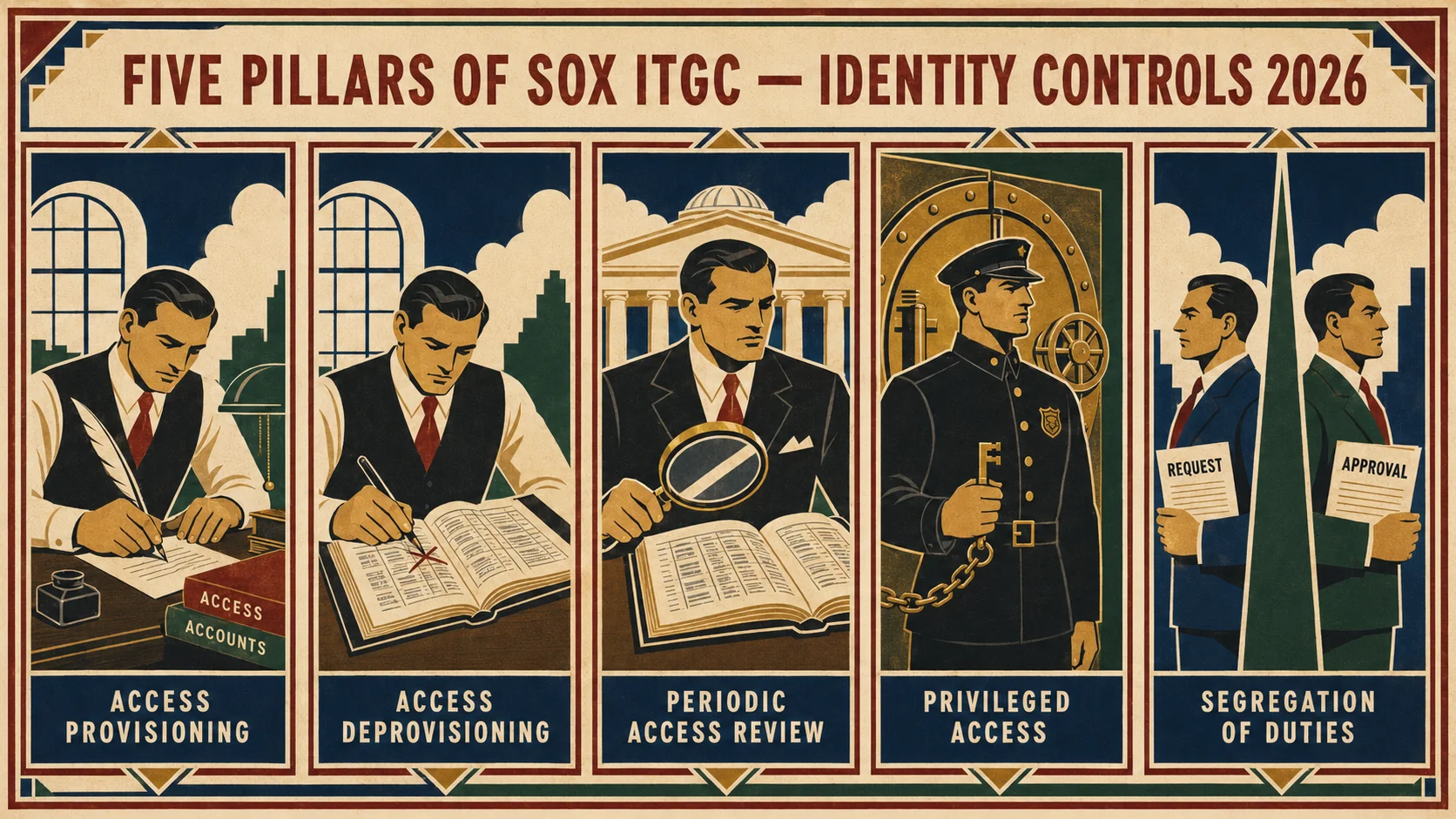 Five domains, one walkthrough. Each domain has audit-evidence requirements the identity team has to produce. The architectural test is whether the evidence is produced continuously by operational systems or assembled ad-hoc at audit time.
The five SOX ITGC domains that depend on identity controls
Every SOX audit cycle walks through these five domains in some form. The labels vary slightly between audit firms (Deloitte, EY, KPMG, PwC, and the second-tier firms each have their own walkthrough templates) but the substantive requirements converge.
1. Access provisioning. Every grant of access to a financial system — or to a system that feeds financial data — must have documented authorization, documented business justification, and an audit trail showing the request, the approval, the grant, and the timestamps. The audit walkthrough samples specific grants from the cycle and asks the identity team to walk through the evidence trail. "Show me how user X received access to system Y" should be answerable in minutes, not days, with system-of-record audit data.
The failure mode here is provisioning that happens outside the IGA platform — the Slack DM grants, the ServiceNow tickets routed to direct admin grants, the manager Excel re-uploads. The CGov Shadow IT Provisioning piece covers this gap in detail. Auditors increasingly probe the reconciliation rate between IGA catalog and actual target-system state; a high gap produces findings.
2. Access deprovisioning. Leavers — employees who separate from the organization for any reason — must have their access to financial systems removed within a defined SLA (typically same-day for high-impact systems, within 24 hours for the broader workforce). The audit walkthrough samples specific leavers and asks the identity team to demonstrate timely removal across all financial systems the user had access to.
The failure mode here is partial deprovisioning — the leaver is removed from Active Directory but their AWS account still works because AWS wasn't integrated into the leaver workflow, or their ERP access persists because the ERP integration handles only certain user types. The mature 2026 deployment runs the leaver workflow across every system the user touched, with completion evidence per system. The CGov HRIS-Driven Lifecycle piece covers the lifecycle-automation foundation that makes this reliable.
3. Periodic access review. Certification campaigns demonstrate that reviewers engaged substantively with the entitlements they attested to. The audit walkthrough samples specific attestations and asks the identity team to demonstrate that the reviewer actually examined the entitlement, made a substantive judgment, and produced an outcome (approve, revoke, reassign).
The failure mode here is pattern-clicking — reviewers complete the certification by clicking 'approve' on every entitlement without examination, producing attestation records that satisfy the legacy audit framing but fail the post-2025 substantive-scrutiny framing. The CGov Access Review piece covers exactly this auditor question and the architectural mitigations.
4. Privileged access. Privileged accounts — administrative, service, emergency-break-glass — receive additional controls beyond the standard access controls. Just-in-time elevation rather than standing privilege. Credential vaulting rather than memorized passwords. Session recording for forensic review. Change-control linkage so every privileged action ties to an authorized change ticket.
The failure mode here is standing privilege — administrative accounts that hold permanent elevation, service accounts with unrotated credentials in production for years, emergency credentials shared across the operations team. The CGov PAM piece covers the platform layer and the CGov JIT/ZSP piece covers the access-pattern modernization that reduces standing privilege.
5. Segregation of duties. Toxic combinations of access — request + approve, originate + reconcile, develop + deploy to production — are prevented at grant time and surfaced at periodic review. The audit walkthrough samples specific users and asks the identity team to demonstrate that the user's combination of entitlements doesn't violate any documented SoD rule.
The failure mode here is cumulative SoD drift — the user accumulated entitlements through role changes, project assignments, and one-off grants over years, and the cumulative combination violates an SoD rule that the original grants didn't trip. The CGov MFA vs IGA piece (on ICC) covers this pattern as "toxic entitlement accumulation" — it's the attack pattern MFA cannot stop because it isn't an attack on the credential, it's a structural problem with the entitlement state.
The five domains compose into the SOX ITGC walkthrough. A clean walkthrough produces no findings; a partial walkthrough produces management letters; a failing walkthrough produces remediation timelines and supervisory consequences.
What changed in the 2025-26 SOX audit cycle
Three shifts dominated the post-2025 audit cycle and continue to define the 2026 audit posture. Identity teams whose practices haven't adjusted to these shifts are increasingly producing findings that wouldn't have surfaced a few years earlier.
Substantive scrutiny over checklist completion. Auditors no longer accept "the cycle ran" as evidence of control effectiveness. They want to see specific decisions and walk through the evidence that the reviewer engaged with the decision. The pattern is the same one documented in our Access Review piece — engagement evidence per attestation (mouse hover patterns, time-on-decision metrics, periodic challenge questions, override patterns) is now the audit-walkthrough standard, not just attestation completion. Identity teams running checkbox certifications produce records that satisfy the count but fail the substance test.
Reconciliation rate questions. Auditors now explicitly ask "what's your reconciliation rate between the IGA catalog and actual target-system entitlements." The question is a probe for the shadow-provisioning gap documented in our Shadow IT Provisioning piece. A reconciliation rate under 90% produces findings; a rate the identity team can't even measure produces more serious findings. The mature 2026 deployment runs continuous target-system reconciliation and reports the rate as a tracked metric.
Outcome materiality. Review cycles that approve everything unchanged are flagged as red flags rather than as clean attestations. The pattern that triggered the shift is the realization that a zero-change certification cycle almost always indicates the cycle didn't catch what it should have — either the entitlement state was already perfect (extremely rare) or the cycle didn't surface the issues that exist (the common case). Auditors now expect each cycle to produce structured findings (entitlements removed, ownership transferred, SoD violations resolved) with quantified outcomes.
The three shifts compound. Pattern-click certifications that produced no outcomes used to pass; they now produce findings. Shadow provisioning that produced reconciliation gaps used to be invisible; it now produces explicit findings when auditors probe the reconciliation question. The audit cycle of 2025-26 is substantively harder than the audit cycle of 2020-21, and the identity teams whose practices haven't kept pace are noticing.
 Same controls, different evidence bar. The 2025-26 audit cycle is what produces findings against practices that satisfied prior cycles. The shift is in the evidence depth, not in the underlying rules.
The documentation that produces clean SOX walkthroughs
Three documentation properties separate identity teams that pass SOX walkthroughs cleanly from those that struggle through them. The properties are operational — they describe how the identity systems actually work, not just what documentation gets assembled at audit time.
Trail-of-evidence completeness. Every control activity produces timestamped, attributed, system-of-record audit data. The provisioning event records the requester, the approver, the approval rationale, the system granted, the entitlement granted, the effective date. The deprovisioning event records the trigger (HRIS termination, manual revocation, certification revocation), the timestamp, the systems affected, the completion confirmation per system. The certification attestation records the reviewer, the decision, the rationale, the timestamp, and the engagement signals (time on decision, mouse hover, challenge-question response). The privileged elevation records the requester, the approver, the target system, the duration, the session recording reference, the related change ticket.
The architectural test is whether the audit data is produced continuously by operational systems or assembled ad-hoc at audit time. Audit-time assembly is fragile (records get lost, timestamps get inconsistent, attribution gets fuzzy). Continuous production is robust (records exist as a natural byproduct of operations).
Reconciliation transparency. The gap between IGA catalog and target-system reality is measured, reported, and remediated rather than hidden. The mature 2026 deployment runs target-system reconciliation against each in-scope financial system on a defined cadence (typically weekly for high-change systems, monthly for stable systems). The reconciliation produces a measurable rate. Drift findings flow into the remediation workflow. The identity team can answer the auditor's reconciliation-rate question with a credible number and supporting data.
The architectural test is whether the identity team measures the reconciliation rate as a KPI. Teams that don't measure it usually have uncomfortable numbers; teams that do measure it have actionable insight and a defensible audit answer.
Outcome reporting. Each certification cycle produces a structured report of what changed. Number of entitlements removed. Number of ownership transfers. Number of SoD violations resolved. Number of dormant accounts cleaned up. The report becomes part of the audit-evidence package, demonstrating that the cycle produced material change rather than just process completion. Trend tracking over multiple cycles shows program effectiveness over time.
The architectural test is whether outcome metrics are tracked as a first-class KPI or surfaced only at audit time. Teams that treat outcomes as a continuous metric produce audit positions that improve over time; teams that surface outcomes only at audit time often discover their cycles weren't producing meaningful change.
The integrated identity architecture that turns SOX into continuously defensible posture
The 2026 reference architecture composes four layers that together produce SOX defensibility as a continuous state rather than a quarterly scramble.
Layer 1: HRIS-driven lifecycle automation. The HRIS (SAP SuccessFactors, Workday, BambooHR, ADP, UKG) drives the joiner-mover-leaver workflow through SCIM push, delta synchronization, full reconciliation, and webhook events into the IGA platform. The architecture documented in our HRIS-Driven Lifecycle piece produces the authoritative provisioning and deprovisioning trail SOX requires. New hires get provisioned with full audit trail; leavers get deprovisioned within SLA with completion evidence per system.
Layer 2: IGA workflow and certification. The IGA platform handles access requests, approvals, certifications, and segregation-of-duty enforcement. Workflow audit trails feed the SOX evidence package. Certification campaigns run on cadence with engagement enforcement (per the Access Review piece and AI-Augmented Certification piece). SoD rule enforcement prevents toxic combinations at grant time and surfaces accumulated combinations at periodic review.
Layer 3: PAM for privileged access. The PAM platform handles privileged accounts — vaulting, just-in-time elevation, session recording, change-control linkage. The architecture documented in our PAM piece produces the privileged-access evidence SOX requires. Service accounts go through dedicated lifecycle workflows; emergency credentials require break-glass approval with mandatory post-incident review.
Layer 4: ISPM for continuous posture. The ISPM layer (per our ISPM piece) runs continuously between formal certification cycles, catching drift the periodic cycles would miss. Orphan admin accounts, dormant entitlements, configuration drift, reconciliation gaps — all surfaced continuously rather than waiting for quarter-end. The continuous layer is what turns "we passed SOX last quarter" into "we are SOX-defensible every day of the year."
The four layers compose. HRIS-driven lifecycle produces the foundational provisioning/deprovisioning trail. IGA produces the workflow and certification evidence. PAM produces the privileged-access evidence. ISPM produces the continuous-posture evidence. Together they produce a SOX posture that doesn't require quarter-end scrambling because the evidence is continuously generated by operational systems.
Where SOX compliance work breaks for identity teams
Four failure modes recur in 2026 SOX audit cycles. Each is operationally addressable; each is also extremely common in identity teams whose practices haven't kept pace with the 2025-26 expectation shift.
Audit-time assembly. The identity team assembles SOX evidence in the weeks before the audit by running ad-hoc queries, exporting reports, and compiling spreadsheets. The output sometimes passes the audit but produces brittle evidence that gaps appear in under detailed walkthrough. The mitigation is continuous evidence production — the operational systems generate audit-quality data as a byproduct of normal operations.
Reconciliation gap hidden rather than measured. The identity team doesn't run reconciliation and doesn't know the gap. When the auditor asks the reconciliation question, the team has no answer. The mitigation is continuous target-system reconciliation per the architecture documented in our Shadow IT Provisioning piece.
Certification cycles that approve everything. The cycle completes; the audit log shows attestations; the auditor probes a specific attestation and finds no engagement evidence. The mitigation is engagement enforcement — mouse hover capture, time-on-decision metrics, periodic challenge questions, pattern-click detection.
Privileged access as standing entitlement. Administrative accounts hold permanent elevation. Service accounts have unrotated credentials. The auditor finds dormant privileged access that produces immediate findings. The mitigation is just-in-time elevation and credential rotation per the PAM piece and JIT/ZSP piece.
The four failure modes share a common cause: SOX is treated as a quarterly project rather than as a continuous property of the identity architecture. Teams that make the transition from project to property find the audit cycle becomes routine; teams that don't continue to scramble.
The 2026 reference path
Anchor your SOX work to the five ITGC domains explicitly. Access provisioning, access deprovisioning, periodic access review, privileged access, segregation of duties. Each domain has audit-evidence requirements the identity team has to produce continuously, not just at audit time.
Build the documentation discipline that satisfies post-2025 expectations. Trail-of-evidence completeness, reconciliation transparency, outcome reporting. The three properties together separate clean walkthroughs from troubled ones.
Compose the four-layer architecture. HRIS-driven lifecycle for the foundational trail. IGA for workflow and certification. PAM for privileged access. ISPM for continuous posture. The composition produces SOX defensibility as a continuous state.
Measure the reconciliation rate as a KPI. Teams that measure it have actionable insight and a defensible answer; teams that don't have uncomfortable surprises during the audit walkthrough.
Track certification outcome materiality. Number of entitlements removed, ownership transfers, SoD violations resolved per cycle. The trend over time is the audit-cycle program-effectiveness metric.
SOX turned twenty-three in 2025. The expectations the law produced in its early years are still in force; the expectations the 2025-26 audit cycle layered on top are now also in force. Identity teams whose practices kept pace will continue to pass walkthroughs cleanly. Identity teams whose practices stayed in the 2020 model are producing findings that wouldn't have surfaced a few years earlier. The architecture this piece describes is the path forward — continuously defensible rather than quarterly-scramble defensible. Make the transition deliberately.
ABOUT THE AUTHOR

More from Compliance & Audit

CIA Triad Security Costs: A 2026 Risk Framework
The CIA triad — confidentiality, integrity, availability — is a practical cost framework for identity programs, not just theory. Here's what neglecting each pillar actually costs.

Why FISMA Compliance Programs Still Fail in 2026
Federal agencies pass FISMA audits every year and still get breached — the identity governance gaps assessors keep missing are the same ones attackers exploit.

Real-Time Regulatory Monitoring: How It Actually Works in 2026
Real-time regulatory monitoring replaces the quarterly compliance scramble with a continuous detect-assess-remediate loop, but only if the identity data underneath it is accurate to begin with.