Integrating AI Into Your IAM Strategy: What to Buy Now, What to Wait On (2026)
Every identity vendor's 2026 roadmap says AI. Most enterprises can't tell which parts will pay for themselves next quarter and which are demos with a release date attached. After three decades building identity automation, my read: three AI capabilities are worth buying today, two are worth piloting, and one category is worth refusing until the vendors can answer five questions. Plus the readiness test that decides whether any of it works for you — and the ordering mistake that wastes more AI budget than any bad vendor choice.
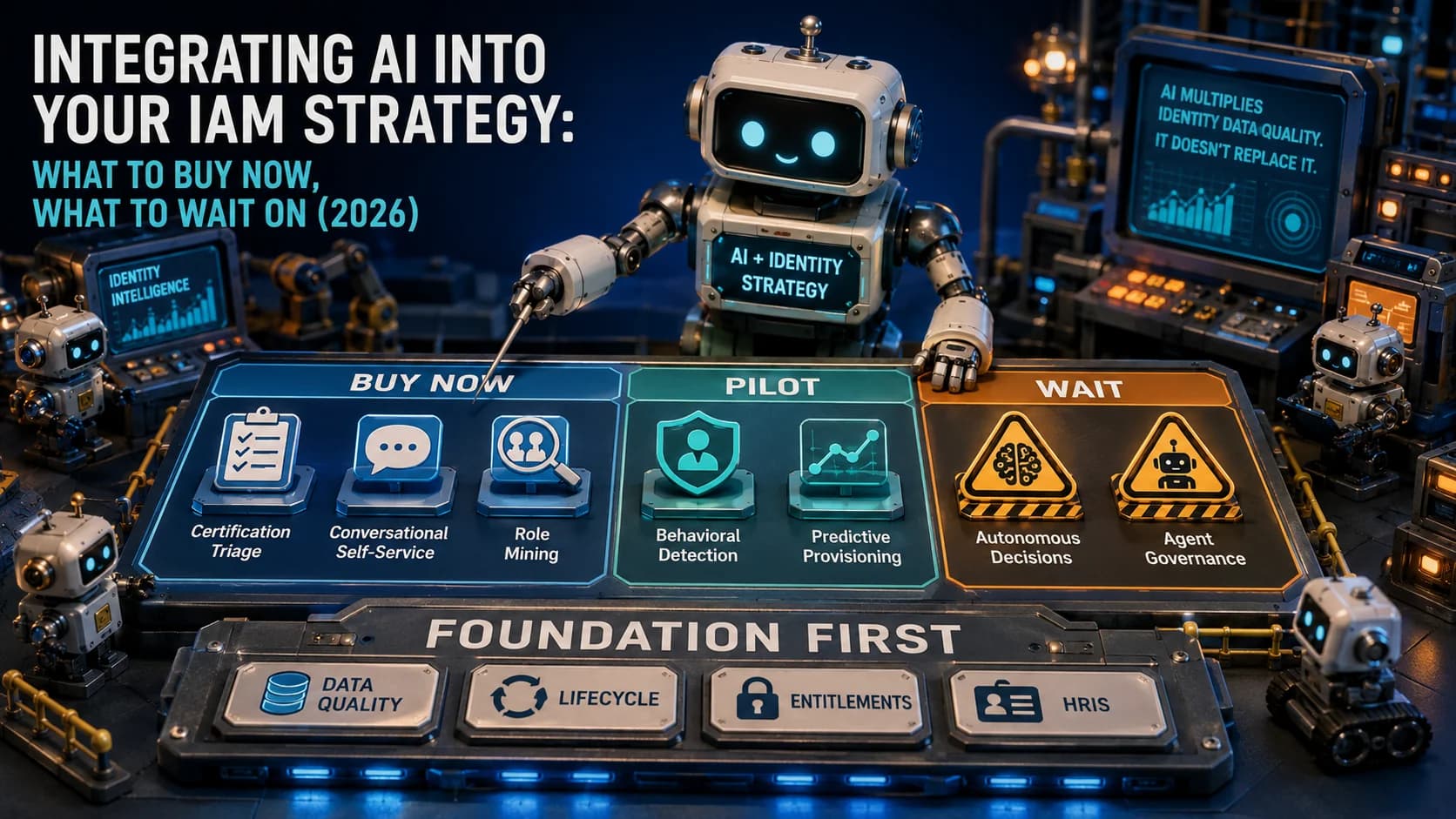
Every identity vendor's 2026 roadmap says AI. Most enterprises can't tell which parts will pay for themselves next quarter and which are demos with a release date attached. After three decades building identity automation, my read: three AI capabilities are worth buying today, two are worth piloting, and one category is worth refusing until the vendors can answer five questions. Plus the readiness test that decides whether any of it works for you — and the ordering mistake that wastes more AI budget than any bad vendor choice.
- Buy now — three AI capabilities have clear mechanisms and near-term payback: certification triage (ranks reviewer attention by anomaly instead of presenting 400 identical rows), conversational self-service (deflects password and access-request tickets against a $480-per-employee-per-year support baseline), and role mining as hypothesis generation (proposes candidate roles from observed access, with a human owner validating each one).
- Pilot, don't standardize — behavioral detection and predictive provisioning both work, and both fail badly on unclean data. Detection needs months of baselining through a full seasonality cycle before precision is usable. Predictive provisioning will happily recommend your existing over-provisioning to every new hire unless birthright policy gates it. Run them in observation mode against real adjudication first.
- Wait — autonomous access decisions and agent governance. Autonomous approval fails the audit question, not the technical one: 'the model approved it' is not an answer for a SOX or HIPAA reviewer, and it isn't one you want after an incident. Agent governance is a real and urgent need that the industry, Avatier included, has not solved. Refuse the vendors claiming otherwise until they answer five specific questions.
- The ordering mistake that wastes the most AI budget: buying the model before fixing the data. Every capability above is a multiplier on identity data quality — entitlements that are correct, lifecycle events that fire, an HRIS that is authoritative about who works here. A multiplier on a broken input produces a confident, well-visualized wrong answer, quarterly, forever.
- The readiness test is the same five dimensions that decide any IAM investment: identity data quality, ownership model, process maturity, integration surface, executive sponsorship ([IAM Costs and Investment Readiness piece](/en/blog/iam-costs-investment-readiness-2026/)). Below the threshold, the highest-ROI AI purchase available is the lifecycle automation that makes AI worth buying later.
Every identity vendor's 2026 roadmap says AI. Mine included. That is not useful information to a CIO trying to decide what to fund next quarter.
The useful question is narrower: which AI capabilities in identity management have a mechanism you can explain, a payback you can measure, and a failure mode you can live with — and which ones are demos with a release date attached?
I have been building identity automation since 1995. I have watched several technology waves arrive at the identity layer, and the pattern repeats: the capability is real, the timeline is wrong, and the organizations that win are the ones that got the sequence right rather than the ones that bought first. Here is my honest read on where AI sits in an IAM strategy today.
Buy now: three capabilities with clear mechanisms
1. Certification triage. The highest-confidence AI purchase in identity governance, because the problem it solves isn't a people problem.
Reviewers rubber-stamp access certifications. Everyone knows this. The instinct is to blame reviewer diligence, and that instinct is wrong. Hand someone 400 entitlements presented as a flat list with no risk signal and no context, and bulk approval is the only rational response — the task was designed to produce that outcome.
Anomaly ranking redesigns the task. The 380 entitlements that match the reviewer's peer group exactly get presented as routine. The 20 that don't — this person holds access nobody with their job title holds; this one hasn't been used in eleven months; this combination crosses a separation-of-duties line — go to the top. Reviewer attention lands where the risk is.
Mechanism: obvious. Payback: the next audit cycle. Risk: low, because the model orders the queue and the human still decides (AI Access Certification piece).
2. Conversational self-service. Password-related support costs the average enterprise about $480 per employee per year (Password Help Desk Cost Analysis piece). At 5,000 employees that's $2.4M a year, filed in most budgets under "help desk labor" rather than "password costs," which is why it survives.
Conversational interfaces attack that number directly: reset and access requests handled in the chat surface people already have open, with identity verification that meets the same bar as the portal. The reason this belongs in the buy tier is that deflection is measurable weekly — you know within a month whether it's working (AI Virtual Assistants for Identity Management piece).
3. Role mining as hypothesis generation. Not role mining as automation — as search. The model clusters users by observed access and proposes candidate roles; a named business owner validates each one and accepts accountability. That division of labor is the whole value: the machine searches a space no analyst can hold in their head, the human makes the call (AI and Role-Based Access Control piece).
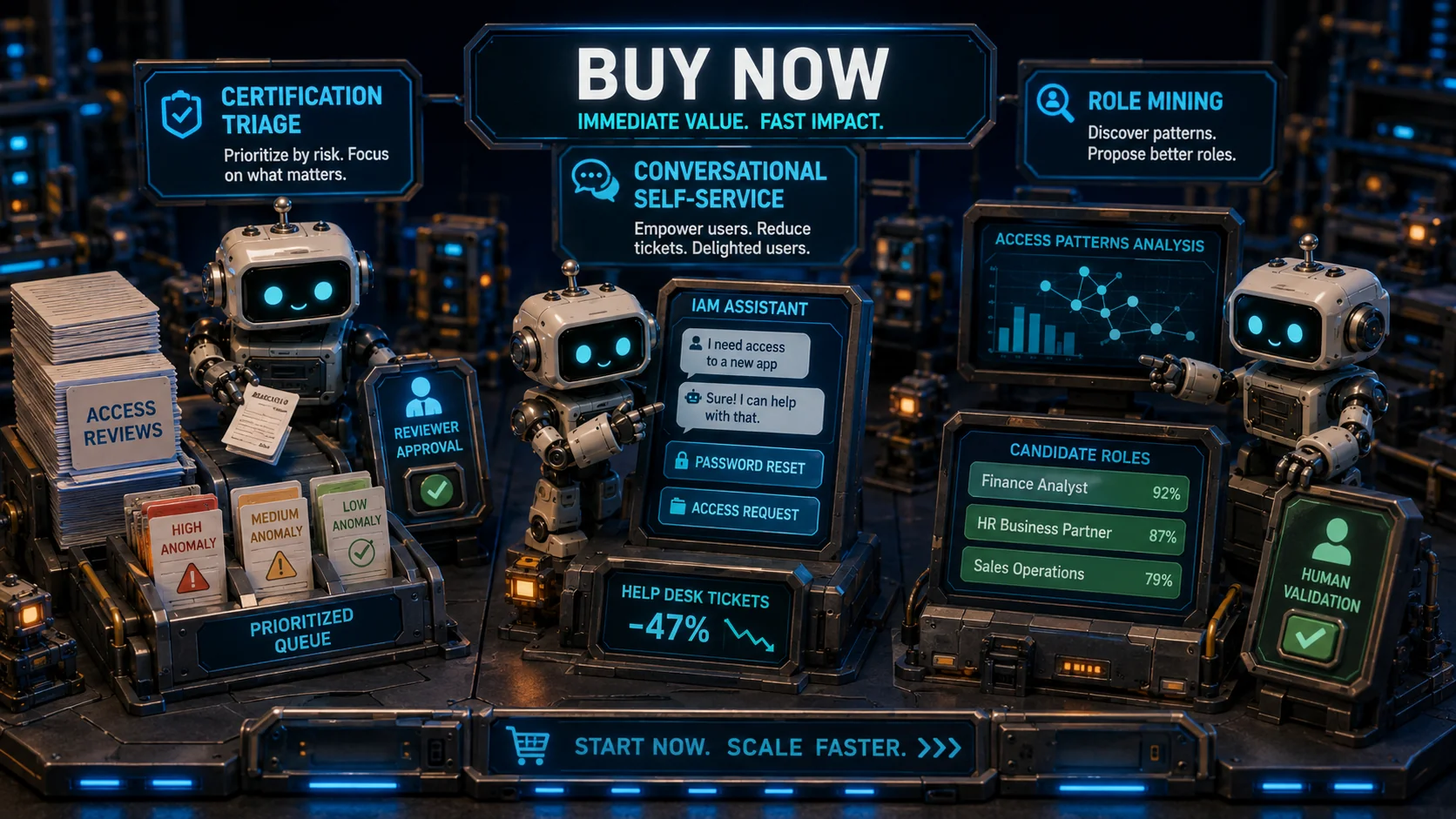 The three with mechanisms you can explain to a CFO and payback you can measure inside a quarter.
Pilot, don't standardize: two that work and fail badly
Behavioral detection. It works. It also needs months of baselining through a full seasonality cycle before precision is usable, and identity activity has quarter-end and audit-cycle rhythms that look like anomalies to a model that hasn't seen one yet.
The failure mode isn't technical, it's organizational: route day-one output to a pager, burn your analysts' trust in the first month, and you own a dashboard nobody reads. Run observation-only, adjudicate with real analysts, wire to response after precision earns it (AI Analytics for Identity Monitoring piece).
Predictive provisioning. Suggesting likely entitlements at joiner time from peer patterns cuts the first-week ticket storm. It will also recommend your existing over-provisioning to every new hire, confidently, forever — because that's what the peer data says.
Birthright policy has to gate the recommendation, never the reverse. Pilot it on one department, measure whether the suggestions get overridden, and expand only if the answer is no.
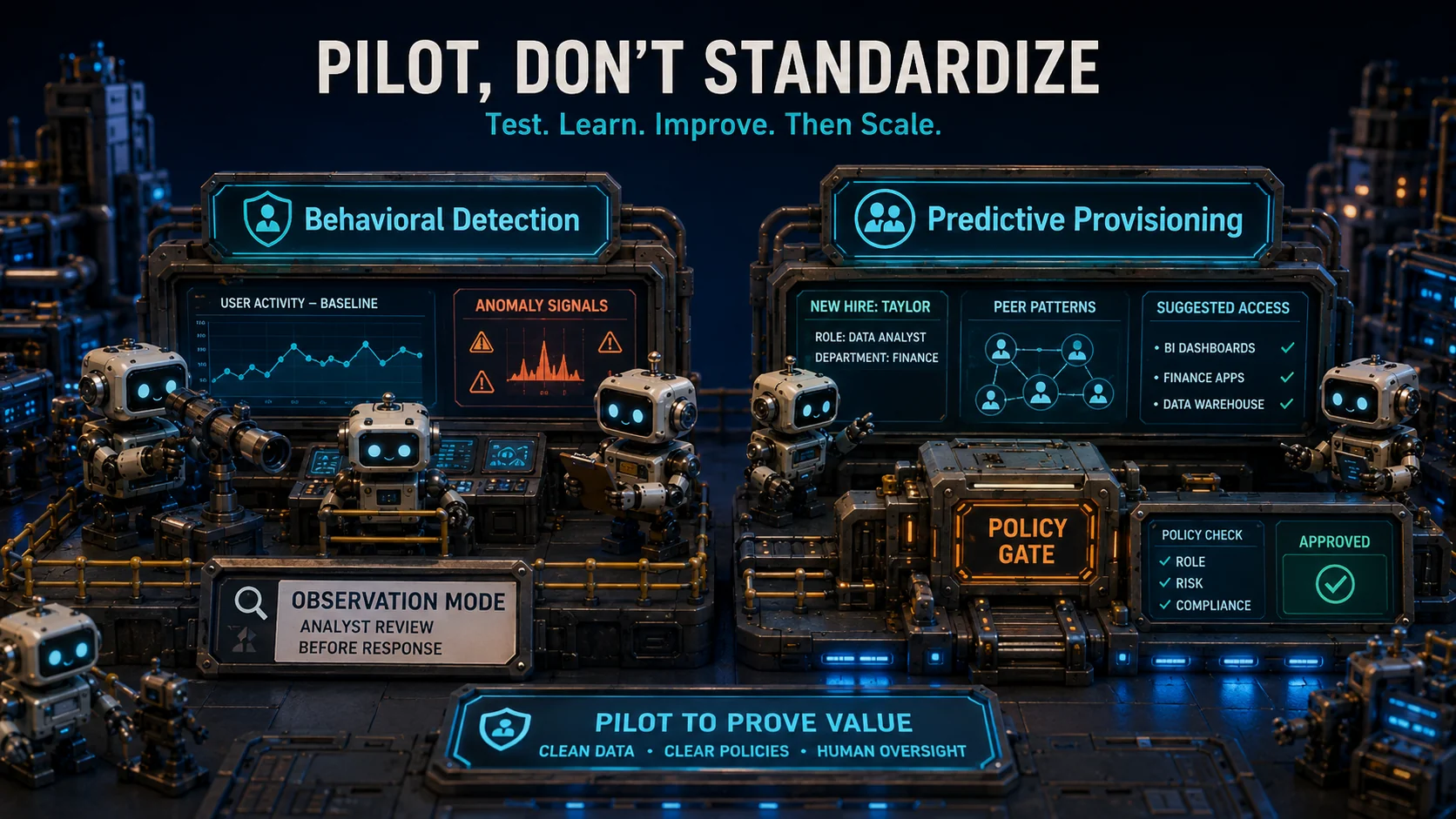 Both work. Both fail badly on unclean data or without a gate. That's what makes them pilots rather than standards.
Wait: two categories the market is overselling
Autonomous access decisions. Vendors will show you a model approving access requests without human review. The technical demo is impressive. The problem isn't technical.
"The model approved it" is not an answer a SOX or HIPAA auditor accepts, and it is not an answer you want to give your board after an incident. Access decisions need an accountable human name attached (Access Review — What the Auditor Actually Wants piece). Automate the routine and the reversible; keep a person on the consequential. That line will move over time, and it hasn't moved yet.
Agent governance. This one deserves directness, because it's the loudest claim in the market right now and I'm about to spend a week at an AI conference surrounded by it.
Enterprises are deploying AI agents that plan, call tools, and act on systems of record. Those agents hold credentials someone granted and nobody reviews, they live outside the joiner-mover-leaver lifecycle, and they never appear in a certification campaign. That is a real gap, and it will surface as an audit finding before it surfaces as a product.
The industry has not solved it. Avatier has not solved it — our platform does not govern AI agents today. I would rather tell you that than sell you a service-account workflow with a new label on it, which is what a fair amount of "agentic identity governance" currently amounts to.
What I'd do instead in 2026: inventory where agents are being deployed and under what credentials — most organizations cannot answer this and the answer is usually alarming. Then apply five questions to any vendor claiming to close the gap: What identity does the agent act under? Where is its access policy enforced? What is its credential lifecycle? Where does its activity land for audit? Can you revoke it in one step? Our Ai4 2026 piece covers the reasoning behind each.
 Autonomous approval fails the audit question, not the technical one. Agent governance is an industry gap — ours included.
Then spend the budget on the foundation any eventual answer requires: attributable identities, clean entitlement state, working revocation. Organizations that build that now will adopt agent governance in months once it's real. The ones that skip it will need years — and they will skip it, because the foundation is boring and the agent demo is not.
The ordering mistake that wastes the most budget
Here is the single most expensive error I see, and it has nothing to do with vendor selection.
Every capability above is a multiplier on identity data quality. Certification triage ranks by anomaly — which requires knowing what normal is, which requires entitlements that are correct. Role mining clusters observed access — on bad data it discovers "the role of person who has too much access," names it something respectable, and industrializes it. Behavioral detection baselines activity — in an environment where lifecycle is broken, it produces a faithful, confident, well-visualized description of your mess. Quarterly. Forever.
A multiplier on a broken input doesn't fix the input. It scales it.
So the sequencing rule is uncomfortable but simple: if your identity foundation isn't clean, the highest-ROI AI purchase available to you is the lifecycle automation that makes AI worth buying later. Fix the HRIS as authoritative source. Fix mover events so they revoke as well as grant. Fix the entitlement catalog. Then buy the model.
That's not a fashionable thing for a vendor CEO to say in 2026. It's what three decades of watching identity programs succeed and fail has taught me.
The readiness test
Same five dimensions that decide any IAM investment, scored 1–5 (IAM Costs and Investment Readiness piece has the full version):
| Dimension | The AI-specific question |
|---|---|
| Identity data quality | Is there one authoritative source for who works here and in what role? |
| Ownership model | Who owns the outcome when the model is wrong? |
| Process maturity | Do documented joiner-mover-leaver processes exist to automate? |
| Integration surface | Is the telemetry the model needs actually being collected? |
| Executive sponsorship | Who spends political capital when an app owner refuses to onboard? |
20–25: buy the top tier now, pilot the middle. 15–19: buy certification triage and conversational self-service — both are bounded and both self-fund — while you close the weakest dimension. Below 15: don't buy AI. Buy lifecycle automation and revisit in two quarters. The model will still be there, it will be better, and it will actually work on your data.
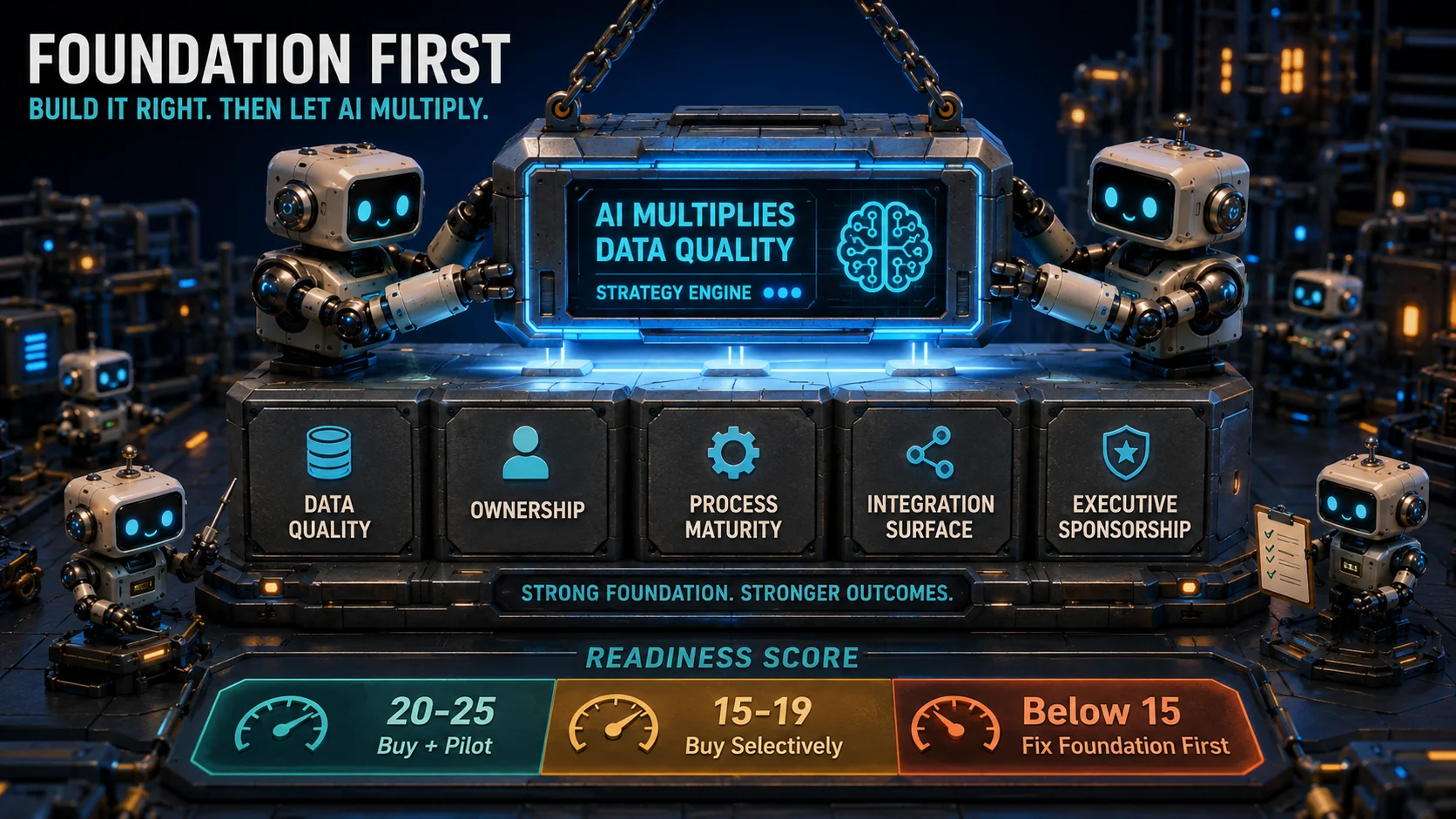 AI multiplies identity data quality. It doesn't replace it — and a multiplier on a broken input just scales the problem.
The strategic read
AI in identity management is not a shortcut past identity hygiene. It is an attention allocator: it finds the twenty things worth a human's judgment inside the four hundred that aren't, and it does that at a scale human attention was never going to cover.
That's genuinely valuable, and it's worth precisely nothing if the underlying state is wrong.
Every technology wave eventually meets the identity layer. Client-server met it with directories. The web met it with federation. Cloud met it with entitlement management. Agentic AI is meeting it right now — faster than any wave before it, because agents multiply both the number of identities and the consequences of governing them badly.
The organizations that come through it well won't be the ones that bought the earliest. They'll be the ones whose foundation was ready when the capability became real.
I'll be at Ai4 2026 in Las Vegas, August 4–6, at Booth #1053 having exactly this argument with anyone who wants to have it. Come find me.
ABOUT THE AUTHOR

More from IAM & Identity Governance

Identity Management and Digital Transformation in 2026
Every major transformation initiative — cloud migration, remote and hybrid work, mergers and acquisitions — eventually stalls on the same question: who gets access to what, and who decided? The 2026 strategy reference on identity management as the enabler and the bottleneck of digital transformation, the business case executives actually fund, and what modernization does not fix.

AI and Behavioral Analytics for Identity Monitoring: The 2026 Enterprise Reference
Static identity rules catch the attacks that announce themselves. They miss the ones that log in with valid credentials and behave almost normally. The 2026 reference on AI-driven identity monitoring — what behavioral analytics actually detects, the four telemetry sources that make or break the model, the false-positive economics nobody budgets for, and the honest limits of anomaly detection at enterprise scale.

Security Team Collaboration: A 2026 Framework for Identity Programs
Identity governance fails when it runs as a security-team-only initiative. The 2026 framework for cross-functional collaboration: four stakeholder groups, three coordination models, and how zero trust makes it a shared discipline.