9 Best Identity Governance and Administration (IGA) Solutions for 2026
A 2026 buyer's guide to enterprise identity governance and administration — nine vendors compared on lifecycle automation, access certification, mainframe coverage, and the honest trade-offs that determine which deployments succeed.
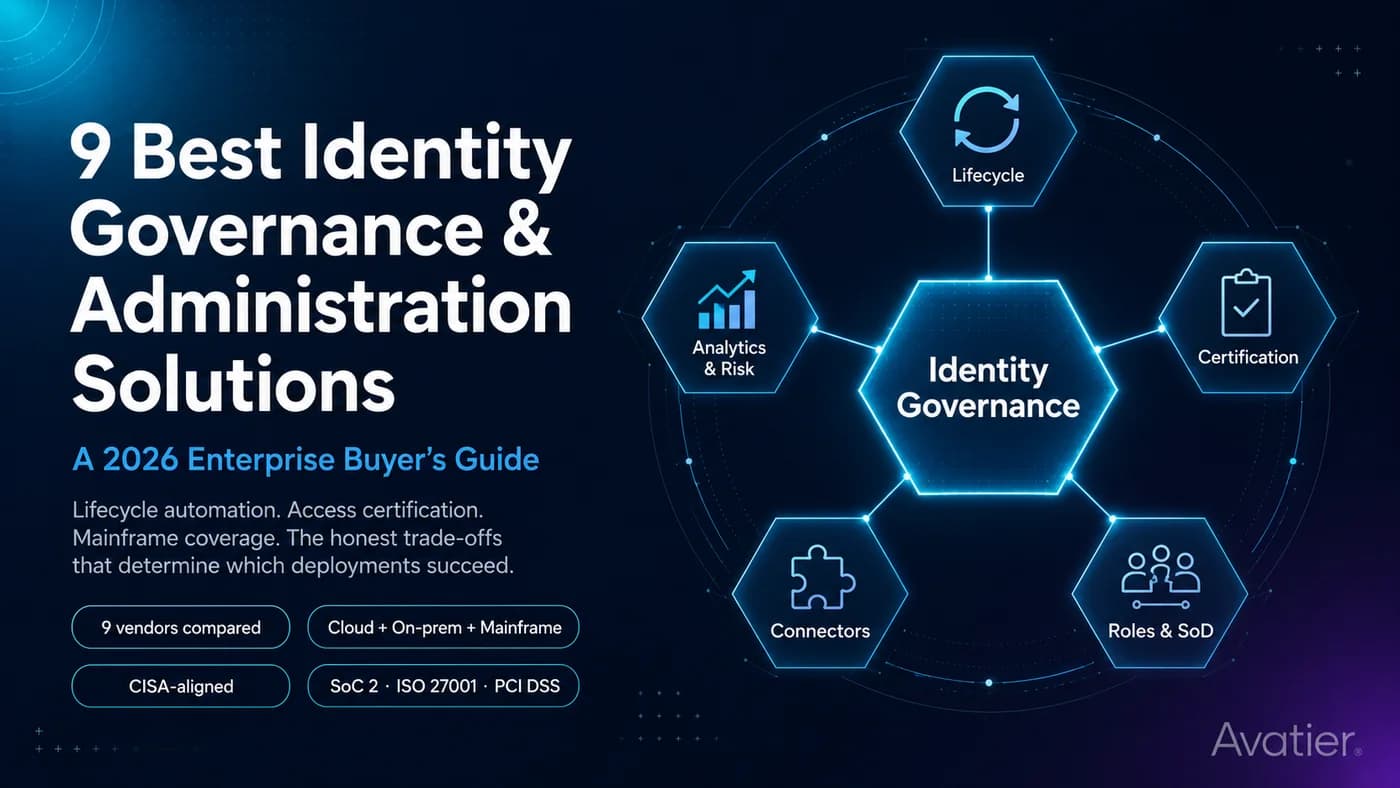
A 2026 buyer's guide to enterprise identity governance and administration — nine vendors compared on lifecycle automation, access certification, mainframe coverage, and the honest trade-offs that determine which deployments succeed.
Identity governance and administration sits between two security categories that get most of the attention. On one side: authentication, MFA, passwordless — the disciplines that decide who can sign in. On the other side: detection and response — the disciplines that find what has gone wrong after the fact. IGA is the discipline in the middle: the one that asks, every day, whether the access each identity holds is still appropriate, who attested to it, when it expires, and what would alert someone if it changed without a corresponding workflow ticket.
The 2026 case for IGA is sharper than it was two years ago. Cloud-wide breaches like Storm-2949 — covered in our identity governance failure analysis — did not break authentication. They abused the identity governance gaps around it. Service principals whose credentials were never rotated. Standing privileged roles that were never recertified. Authenticator-method changes that no governance control was watching. Each one was an IGA gap, not an IAM gap.
This buyer's guide compares nine identity governance and administration platforms for 2026 — the eight that dominate analyst evaluations and our own Avatier Identity Anywhere — across lifecycle automation, certification depth, mainframe coverage, deployment realism, and the honest trade-offs that determine which deployments succeed in production. The list is alphabetical, not ranked. The right pick depends on your environment, your existing IAM stack, and the specific governance gaps you are closing first.
Why IGA matters in 2026
Three forces have moved IGA from "compliance checkbox" to "primary security control" since 2024.
First, identity is the attack surface. Forbes reported in May 2026 that compromised credentials or accounts are involved in 66 percent of breach pathways. The Forbes article also noted that only 44 percent of organizations report high confidence in their ability to prevent identity-based security incidents — a gap between the threat landscape and the deployed controls that IGA is specifically designed to close. Unauthorized access accounts for 49 percent of all data breaches according to industry research; in environments lacking strong governance controls, organizations experienced access-related security incidents 83 percent of the time.
Second, identity sprawl has become structural. More than 60 percent of organizations now manage over 21 disparate identities per user across their stack. The average enterprise deploys 89 different applications; large enterprises run 187 on average. Each application is a potential identity silo. Each role change adds permissions that rarely get removed. Each contractor onboarding starts a credential lifecycle that rarely closes cleanly when the engagement ends. IGA is the discipline that asks, against that sprawl, whether each identity's access is still appropriate.
Third, regulatory frameworks now place identity governance at the center of cybersecurity accountability. SOX mandates centralized access management and segregation-of-duties enforcement. HIPAA requires audit controls. GDPR requires consent records and the right to deprovision. SOC 2 expects documented evidence of access reviews. Each framework has its own language, but the operational requirement is the same — automated, continuous, attestable identity governance.
The architectural pattern most mature enterprises converge on combines cloud-native IGA for the speed-of-change layer with hybrid governance for the legacy and mainframe footprint. Cloud-native architectures demonstrate 43 percent better elastic scaling during peak demand compared to hybrid approaches, and container-based designs can reduce implementation time by 75 percent while lowering three-year TCO by 42 percent — figures Avatier's own cloud-native vs hybrid identity analysis covers in more depth.
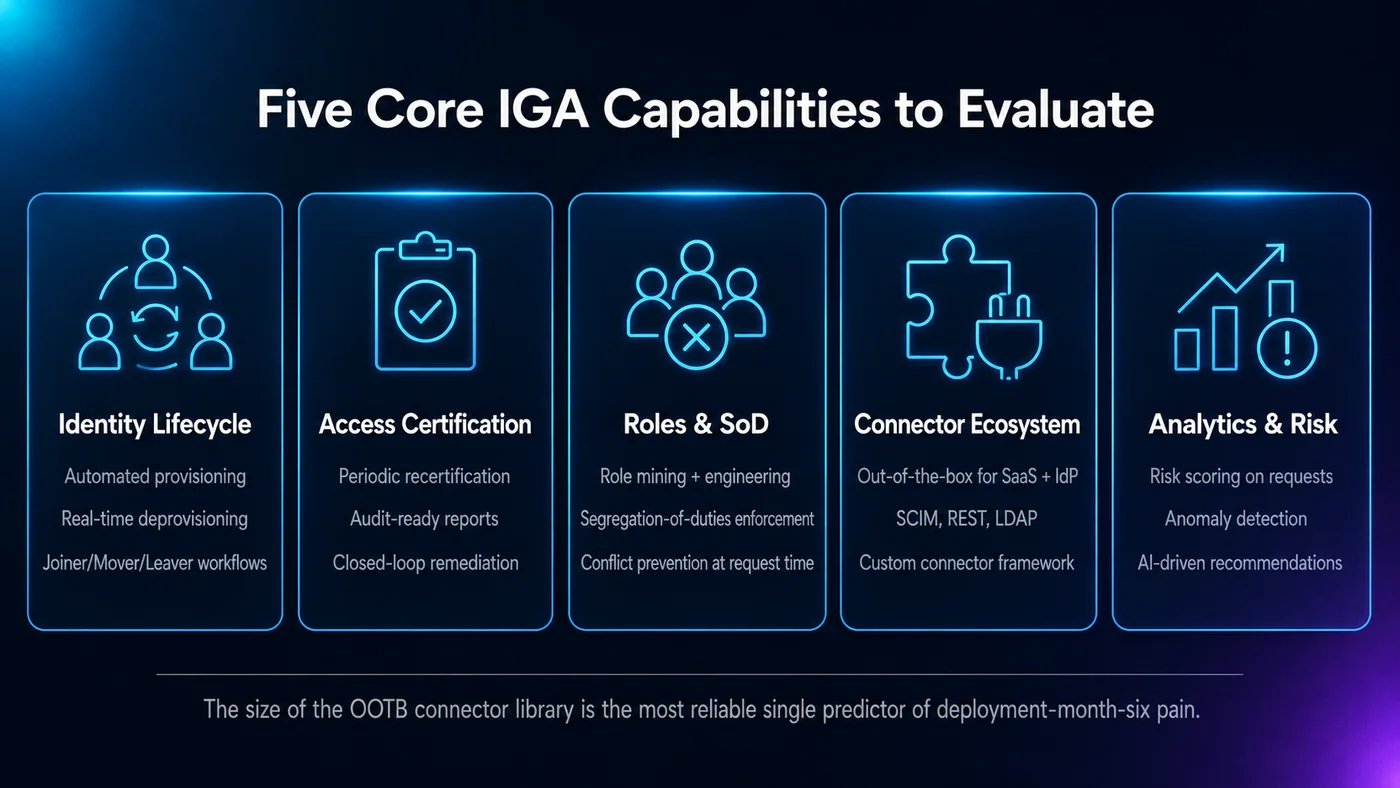 Five capabilities that determine whether an IGA platform is a control surface or a reporting layer. The maturity test for each one is whether it runs without manual exports.
What to look for in an IGA platform
Selecting an IGA platform reduces to evaluating six capability areas. The relative weight of each depends on your environment, but no production-grade IGA program can ignore any of them.
Identity lifecycle management. Automated provisioning, modification, and deprovisioning across every in-scope application. Joiner/mover/leaver workflows that propagate within minutes, not nightly batch jobs. Real-time enforcement that closes the gap between an HR event and the corresponding access change.
Access review and certification. Automated recertification campaigns that route reviews to the right approvers, generate audit-ready reports, and produce closed-loop remediation when access is revoked. The maturity test is whether certifications run quarterly without the IGA team manually exporting spreadsheets.
Role-based access control and policy enforcement. Role mining to discover existing access patterns, role engineering to build maintainable roles, and segregation-of-duties enforcement that prevents conflicting privileges. Mature programs deploy role-based access as a control surface; immature ones deploy it as a reporting layer.
Connector ecosystem. Out-of-the-box integrations with HR systems (Workday, SAP SuccessFactors, BambooHR), identity providers (Entra ID, Okta, Ping), and target applications (ServiceNow, Salesforce, AWS, Azure, GCP). SCIM, REST, and LDAP support for the long tail. Custom connector frameworks for legacy and bespoke applications. The size of the OOTB connector library is the most reliable single predictor of deployment-month-six pain.
Analytics and risk management. Risk scoring on access requests, anomaly detection on identity behavior, and AI-driven recommendations for new-user access based on peer analysis. Mature platforms surface unusual permission changes; the most mature ones predict them before they happen.
Cloud-native vs hybrid deployment. Cloud-native architectures scale better and deploy faster; hybrid architectures handle legacy and on-premises systems more naturally. Most enterprises end up running both, with the modern IGA platform as the governance authority and the legacy IGA tools as connectors.
How to read this guide
The nine vendors below are alphabetical, not ranked. There is no universally "best" IGA platform — the right pick depends on your environment, your existing IAM stack, and the specific governance gaps you are closing first.
Each vendor entry follows the same template: what it is, how it governs, standards and compliance, honest trade-offs, and where it fits in your stack. The "honest trade-off" line is the differentiator most readers tell us they cannot find elsewhere. Every vendor — including Avatier — gets one line acknowledging where it is not the right fit. That column is what makes this a buyer's guide rather than a sales pitch.
The closing section maps platforms to four organizational profiles — Microsoft-first cloud enterprises, AD-centric hybrid shops, mainframe-and-cloud mixed environments, and mid-market cloud-first organizations. Use that section once you have read the comparison; do not start there.
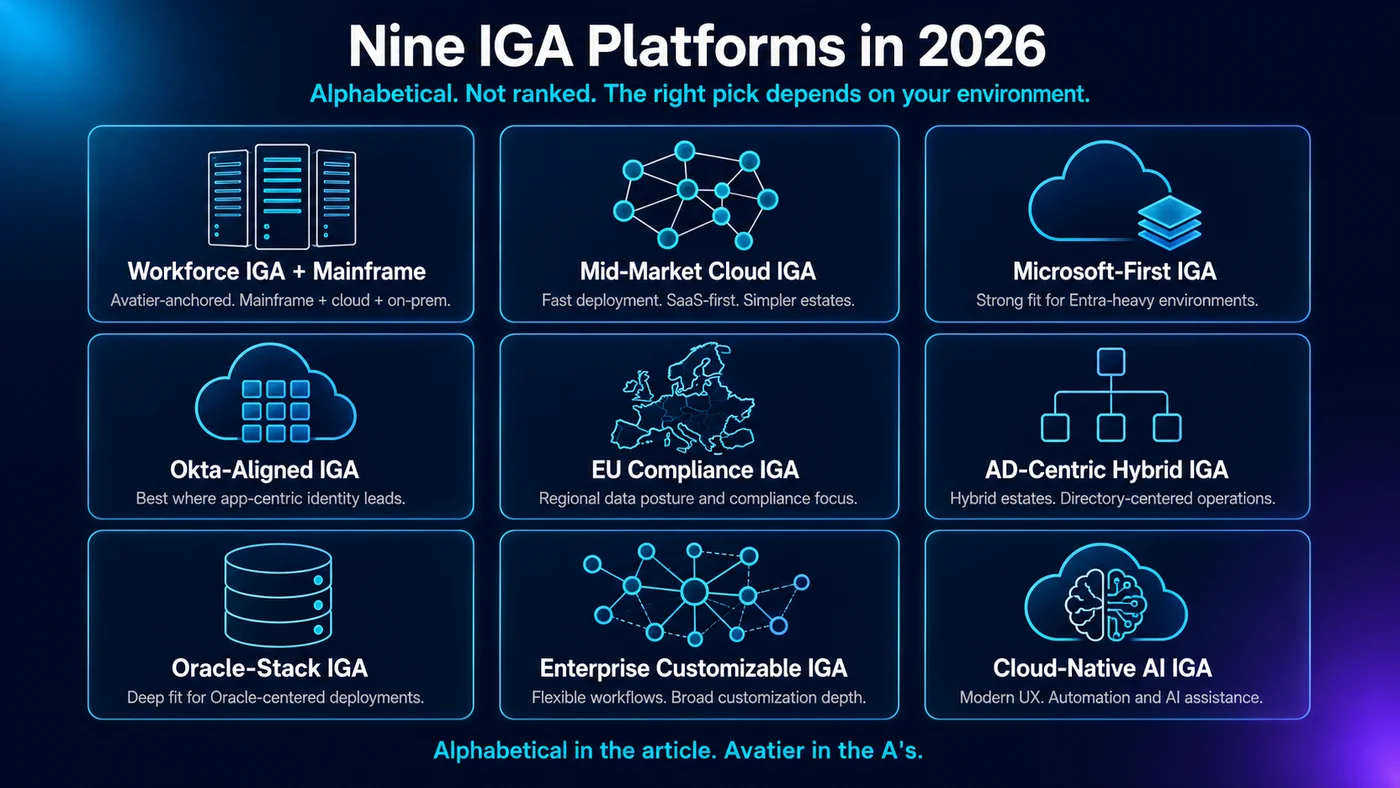 Nine IGA platforms, nine categorical fits. The 3×3 layout is intentional — there is no single best IGA category, only the best fit for your environment.
Comparison table — 9 IGA solutions at a glance
The table is the fastest way to triage shortlist candidates. Deployment time is realistic-for-first-production-use, not "weeks-to-go-live" marketing copy. Pricing reflects publicly disclosed rates as of June 2026. The honest trade-off column is what you should bring to the vendor's sales call. On narrower screens, scroll the table horizontally to see all columns.
| Vendor | Deployment model | Mainframe coverage | Lifecycle automation | Pricing model | Best for | Honest trade-off |
|---|---|---|---|---|---|---|
| Avatier Identity Anywhere | Cloud + on-prem | Yes — RACF, ACF2 (z/OS), AS400 | Full joiner/mover/leaver + service-desk identity verification | Per-user subscription | Mixed environments with cloud, on-prem, and mainframe footprints | CGov-anchored IGA voice; less optimized for pure-cloud CIAM scenarios than Saviynt or Okta. |
| ConductorOne | Cloud-native | No | No-code workflows; AI-agent governance via MCP | Per-user subscription | Mid-market cloud-first organizations needing rapid deployment | Mid-market focus; large-enterprise role engineering and SoD depth still maturing. |
| Microsoft Entra ID Governance | Cloud-native | No (native); 3rd-party connectors required | Lifecycle workflows for Microsoft 365 estates | $12/user/month in Entra Suite | Microsoft 365 estates with predominantly Microsoft identities | Native coverage strongest inside Microsoft; non-Microsoft applications need Logic Apps or third-party connectors. |
| Okta Identity Governance | Cloud-native (SaaS) | No | Birthright provisioning + lifecycle workflows | $6-17/user/month tiered | Organizations already on Okta as the workforce IdP | Best fit when Okta is the IdP; less compelling as the IGA layer over a non-Okta IdP. |
| Omada Identity | Cloud + hybrid | Limited | 12-week Accelerator deployment; 80% OOTB functionality | Quote-only | European enterprises where GDPR-by-design is a procurement requirement | EU-compliance focus is a strength in Europe and a positioning issue in some US-only RFPs. |
| One Identity Manager | Hybrid | Limited (via custom connectors) | Lifecycle workflows with deep AD integration | Quote-only | AD-centric IT shops extending into hybrid cloud | Active Directory depth comes with platform-engineering effort; modular architecture rewards mature teams and punishes lean ones. |
| Oracle Identity Governance | Hybrid | Limited (via custom connectors) | Provisioning + certification campaigns | Quote-only | Oracle-stack enterprises with existing Oracle middleware | Strongest in Oracle-heavy environments; integration with non-Oracle stacks requires more bespoke work than cloud-native alternatives. |
| SailPoint IdentityIQ | Hybrid | Yes (via custom development) | AI-driven provisioning + automated certifications | $10/user/month subscription | Complex Fortune 500 environments with bespoke requirements | Customization power requires Java development capacity; deployments are typically multi-quarter, not multi-week. |
| Saviynt | Cloud-native | Limited | Up to 75% of access decisions automated by AI | Per-user tiered (Essentials/Pro/Premium) | Cloud-first enterprises consolidating multiple legacy IGA tools | Cloud-native depth is the strength; very large on-premises and mainframe footprints fit other platforms better. |
The 9 best identity governance and administration solutions for 2026
Alphabetical. Each entry follows the same five-question template.
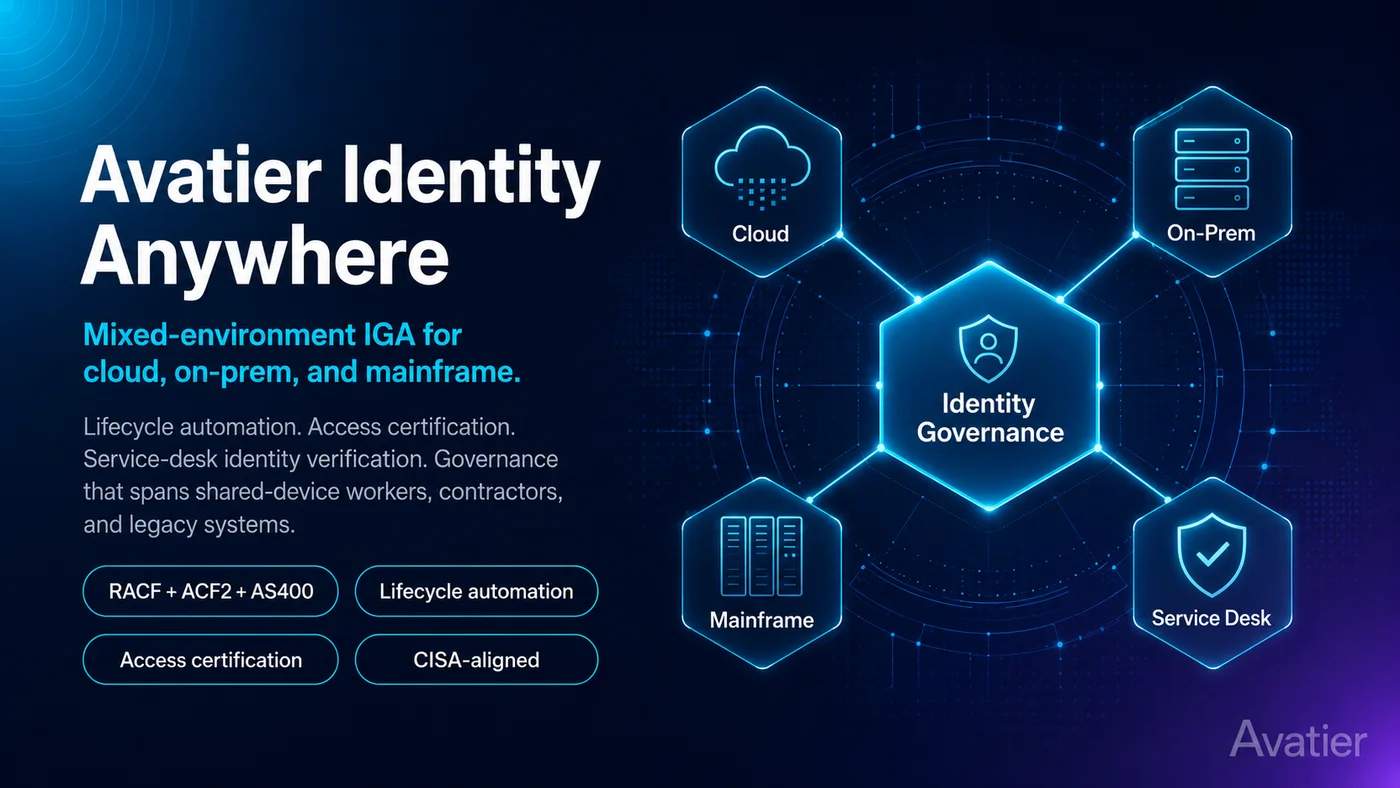
1. Avatier Identity Anywhere
What it is. A workforce identity governance and administration platform anchored on the five pillars of credential governance — password firewall, password portal, assisted reset, login reset, and passwordless login — extended into lifecycle automation, access certification, role engineering, and segregation-of-duties enforcement across cloud, on-premises, and mainframe environments.
How it governs. Joiner/mover/leaver workflows propagate identity changes in real time across the entire workload graph. Access certification campaigns route reviews to the right approvers and produce closed-loop remediation. Service-desk identity verification — covered in detail in our Storm-2949 governance analysis — breaks the social-engineering attacks that the rest of the IGA category does not address. Mainframe coverage spans RACF, ACF2, and AS400, integrated into the same lifecycle attestation as cloud workloads — see our RACF vs ACF2 comparison for the underlying mainframe governance story.
Standards and compliance. Avatier is a CISA Secure-by-Design Pledge signatory, SOC 2 Type II audited with zero exceptions noted, ISO/IEC 27001:2022 certified, PCI DSS v4.0.1 compliant, CSA STAR Level 1, NIST 800-53 Rev. 5 aligned, and aligns with CISA's published guidance on phishing-resistant MFA. Full posture published at trust.avatier.com.
Trade-offs. Avatier is a CGov-anchored IGA voice — the platform's strength is workforce identity governance across mixed environments including mainframe and shared-device populations. It is less optimized for pure cloud-native CIAM scenarios where Saviynt or Okta's CIAM products fit more naturally.
Where it fits in your stack. Mixed environments where the user mix includes mainframe operators, shared-device workers, contractors, or service-desk-heavy operations. Organizations that have struggled to bring mainframe identity into the same governance lifecycle as cloud workloads. Disclosure: this is the platform behind the site you are reading.
2. ConductorOne
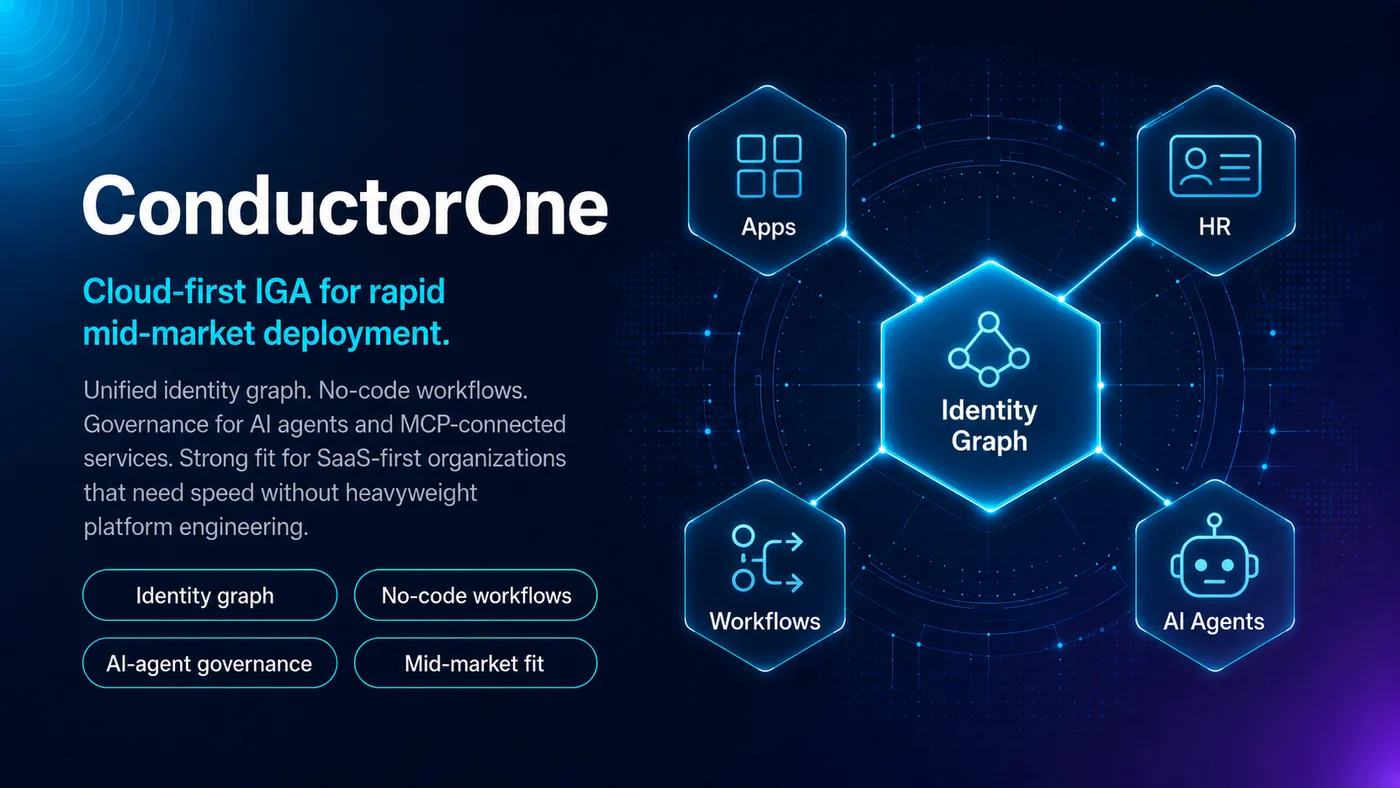
What it is. A unified-identity-graph IGA platform focused on mid-market organizations. The differentiator is a no-code workflow editor that compresses traditional 6-month IGA deployments into weeks.
How it governs. Identity-graph technology unifies the view of who has access to what across the IT stack. The platform has extended governance to AI agents and Model Context Protocol (MCP) integrations — an area few traditional IGA vendors have addressed.
Standards and compliance. SOC 2 Type 2, ISO 27001-aligned (verify current attestation status before deployment).
Trade-offs. Mid-market focus is a deliberate positioning choice. Large-enterprise role engineering depth, complex SoD policy frameworks, and connector breadth for legacy bespoke applications are not the strongest parts of the platform.
Where it fits in your stack. Cloud-first mid-market organizations that need rapid IGA deployment without the platform-engineering investment that enterprise IGA tools require. Less appropriate for Fortune 500 environments with extensive legacy application portfolios.
3. Microsoft Entra ID Governance
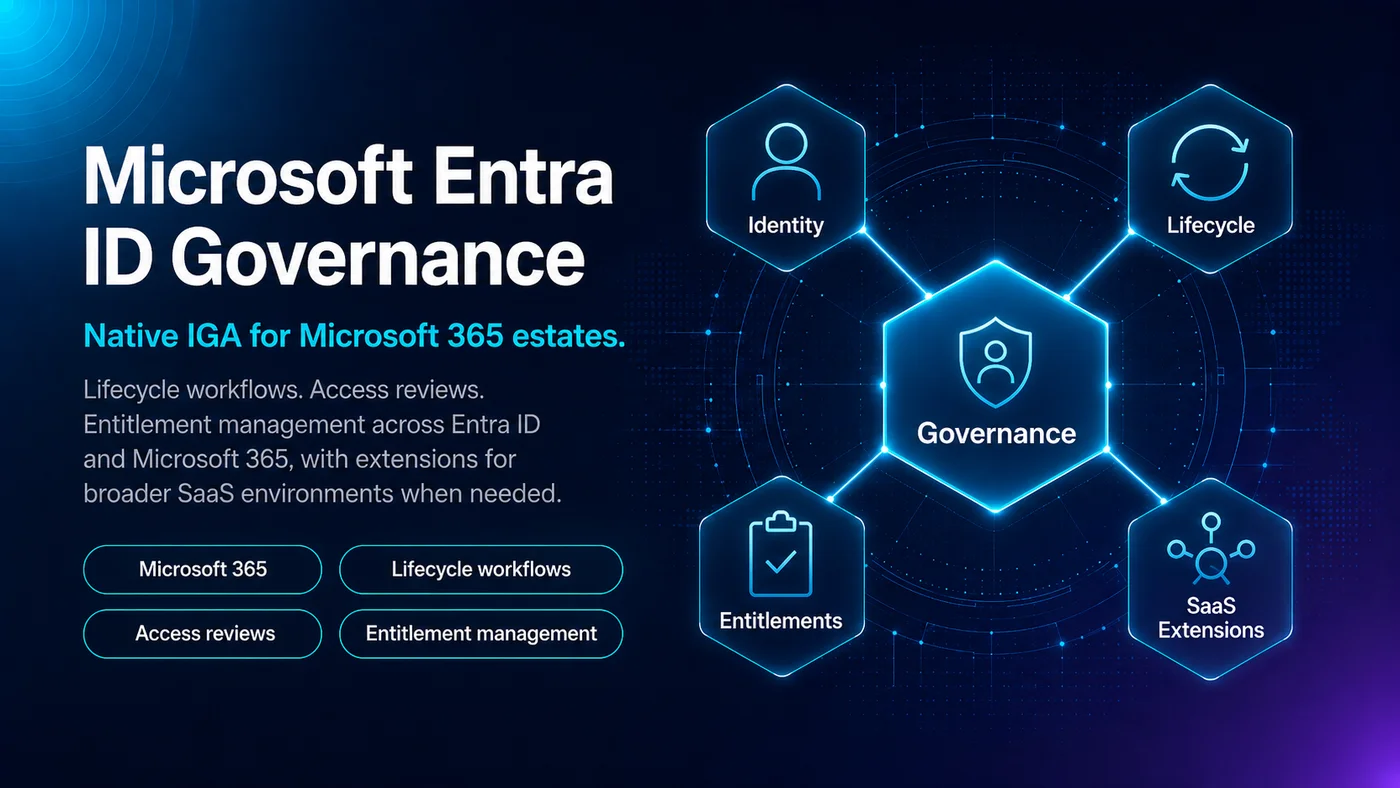
What it is. Microsoft's native IGA layer inside Entra ID, sold as part of the Entra Suite at $12 per user per month. Lifecycle workflows automate joiner, mover, and leaver scenarios; Logic Apps extensions provide additional functionality.
How it governs. Tight integration with Entra ID and Microsoft 365 for native provisioning across Microsoft applications. Lifecycle workflows trigger on HR events from supported systems. Access reviews and entitlement management cover Microsoft applications and federated SaaS through Entra ID.
Standards and compliance. Microsoft publishes comprehensive compliance attestations (SOC 1/2/3, ISO 27001, FedRAMP High, multiple regional certifications).
Trade-offs. Native coverage is strongest inside Microsoft. Non-Microsoft applications require Logic Apps or third-party connectors. Mainframe and legacy environments need bridges to Entra that other platforms address more directly. Premium-tier licensing hides several capabilities behind paid SKUs.
Where it fits in your stack. Microsoft 365 estates where Entra is already the workforce IdP and most identities live inside the Microsoft graph. Less compelling for heterogeneous environments where Microsoft is one IdP among several.
4. Okta Identity Governance
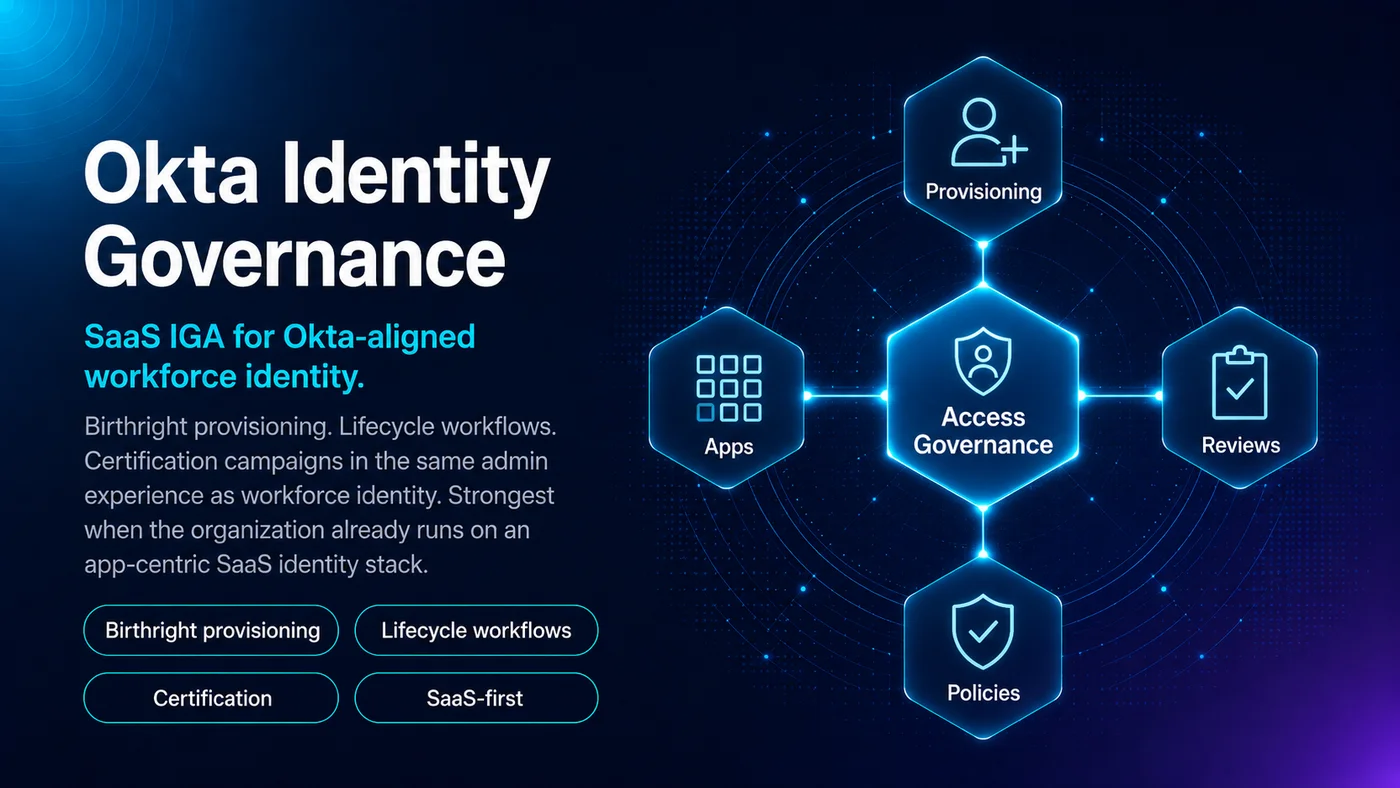
What it is. Okta's SaaS-based IGA, layered on Okta Workforce Identity Cloud. Lifecycle management and access governance share the same identity model as Okta's SSO and MFA products.
How it governs. Birthright provisioning assigns new employees to standard applications based on profile attributes from the connected HR system. Access reviews and certification campaigns run inside the Okta admin experience. The platform shares Okta's connector ecosystem for SaaS application coverage.
Standards and compliance. Okta publishes SOC 2 Type II, ISO 27001, FedRAMP Moderate (verify current attestation for the IGA product specifically).
Trade-offs. Best fit when Okta is already the workforce IdP. Less compelling as the IGA layer over a non-Okta IdP — most of the value comes from the shared identity model with Okta SSO and MFA, which is exactly what disappears when the IdP is something else.
Where it fits in your stack. Organizations standardized on Okta as the workforce IdP. Less natural for Microsoft-first or Ping-centric environments.
5. Omada Identity
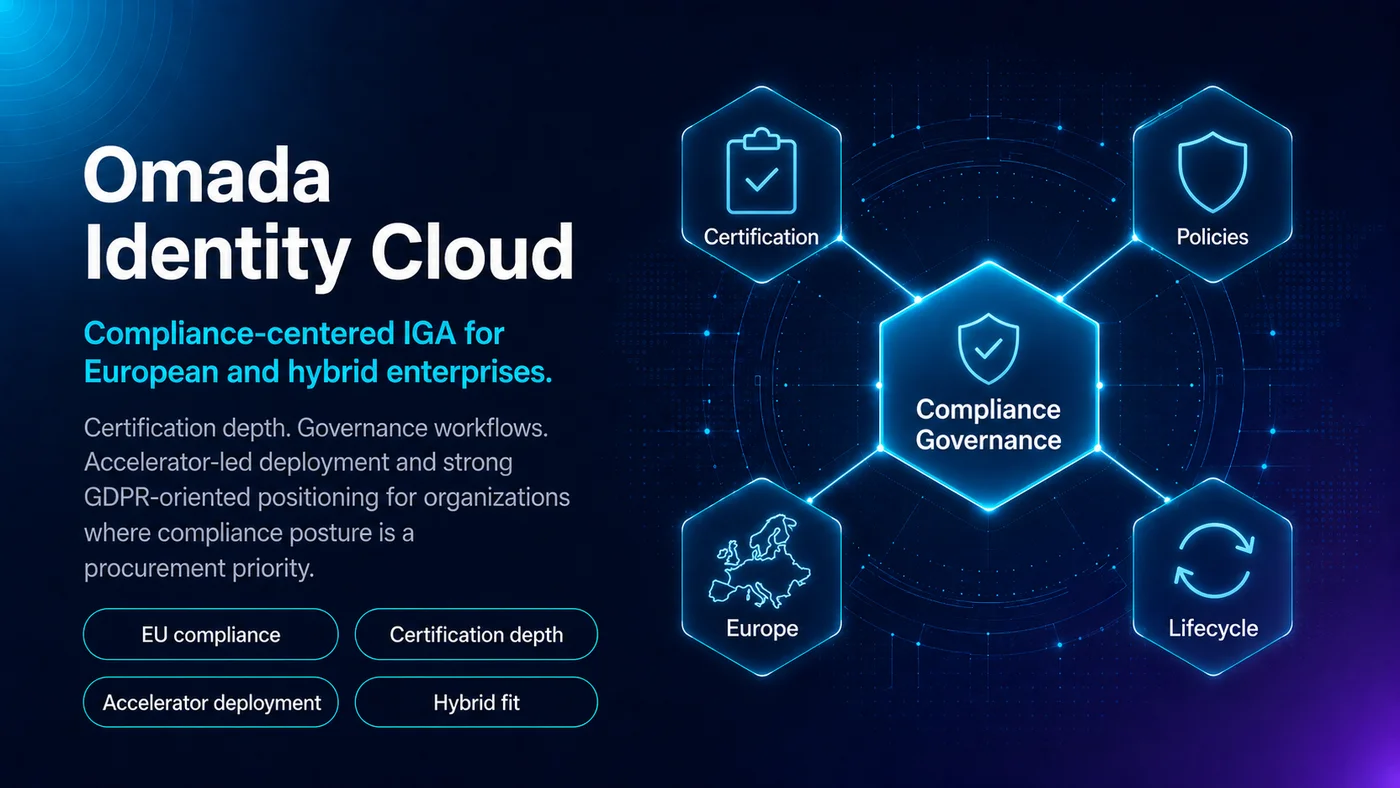
What it is. A European-focused IGA platform with an explicit GDPR-by-design positioning and a 12-week deployment guarantee through the Accelerator Package.
How it governs. The Accelerator deployment model delivers 80 percent of platform functionality out-of-the-box without custom configuration — a deliberate counter to the multi-month implementations that have historically defined enterprise IGA.
Standards and compliance. Strong EU compliance posture (verify specific certifications for the deployment in question).
Trade-offs. EU-compliance focus is a procurement strength in Europe and a positioning issue in some US-only RFPs that prefer US-headquartered vendors with US-federal-government attestations.
Where it fits in your stack. European enterprises where GDPR-by-design is a procurement requirement and 12-week-to-production is a hard deadline. Less compelling for US-federal procurement where FedRAMP authorization is required.
6. One Identity Manager
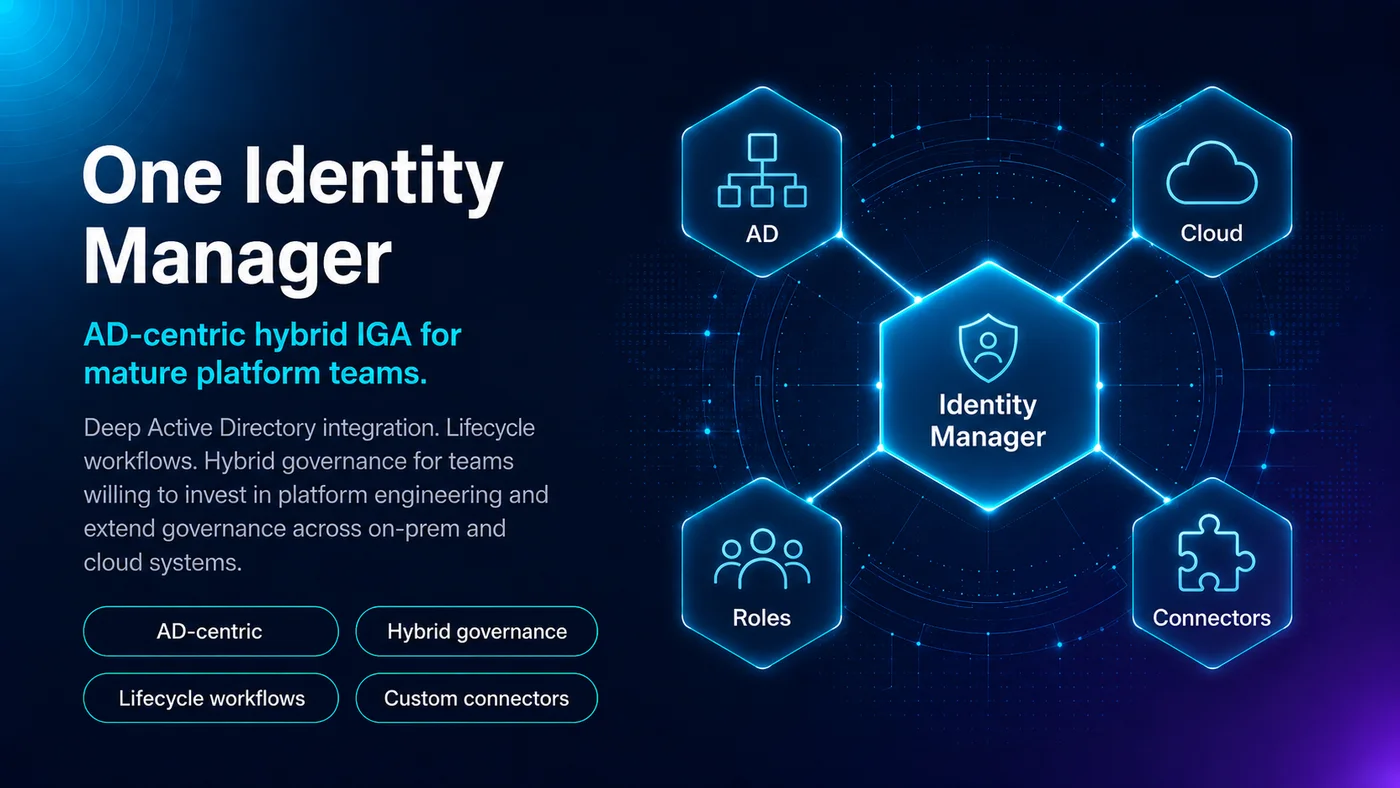
What it is. A hybrid IGA platform from One Identity, with deep Active Directory integration and a modular architecture. Starling Connect provides hundreds of cloud connectors.
How it governs. Modular components let teams deploy specific governance capabilities incrementally — privileged access governance, behavior-driven policy decisions, role engineering — without committing to a single-package implementation.
Standards and compliance. SOC 2, ISO 27001, FedRAMP Moderate (verify current status).
Trade-offs. Active Directory depth comes with platform-engineering effort. The modular architecture rewards mature platform teams and punishes lean ones — small IGA teams can struggle to operate the platform at the same maturity as the bigger shops it was designed for.
Where it fits in your stack. AD-centric IT shops with mature platform teams extending into hybrid cloud. Less appropriate for cloud-first organizations that do not run substantial Active Directory infrastructure.
7. Oracle Identity Governance
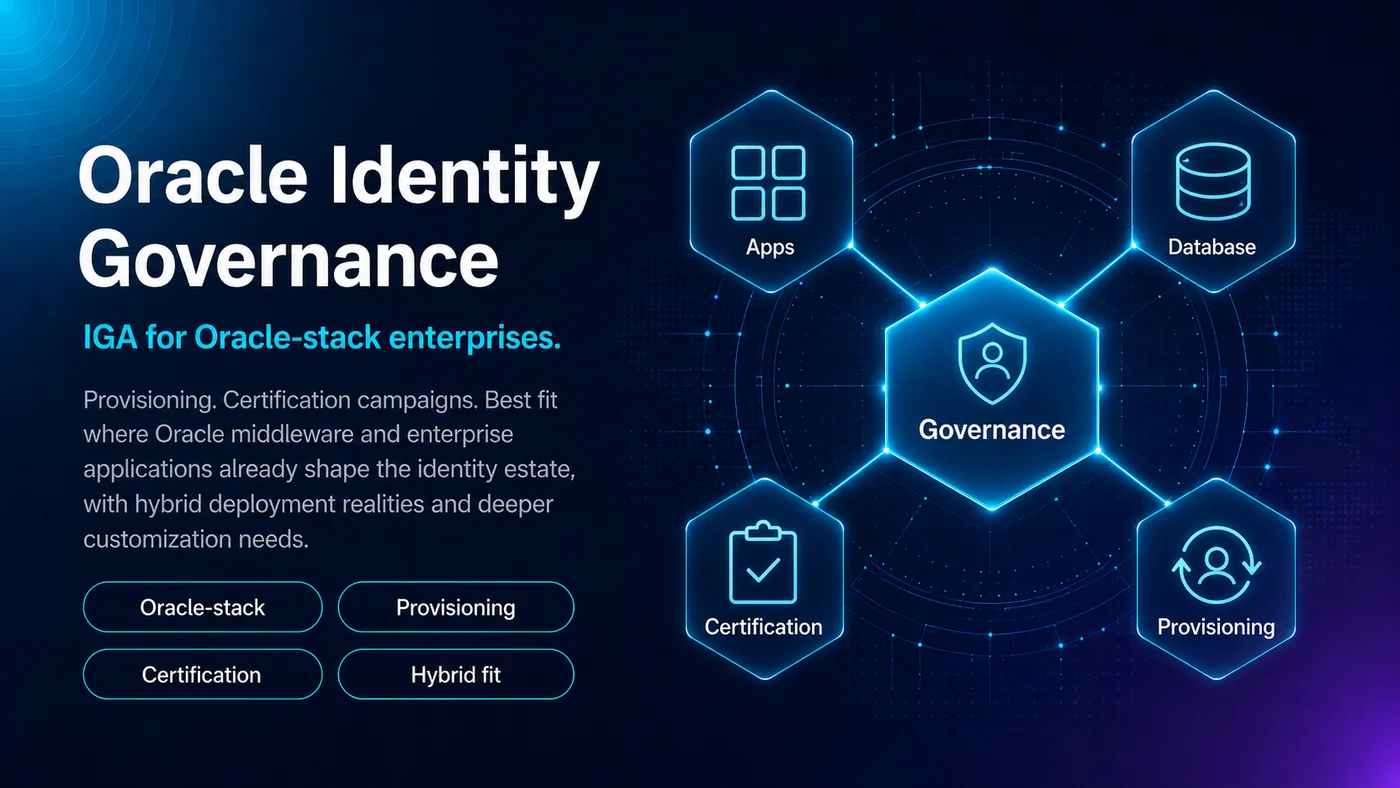
What it is. Oracle's IGA platform, focused on provisioning, lifecycle management, certification campaigns, and segregation-of-duties enforcement. Closed-loop remediation capabilities are built in.
How it governs. Certification campaigns route to appropriate reviewers and produce audit trails. SoD policies enforce conflict prevention at access-request and access-review time.
Standards and compliance. Oracle publishes SOC 1/2, ISO 27001 attestations (verify for the IGA product specifically).
Trade-offs. Strongest fit in Oracle-stack enterprises. Integration with non-Oracle workloads is possible but requires more bespoke connector work than cloud-native alternatives. Deployments are platform-engineering-heavy.
Where it fits in your stack. Oracle-heavy enterprises with existing Oracle middleware investments. Less compelling for cloud-first organizations where Oracle is one application vendor among many.
8. SailPoint IdentityIQ
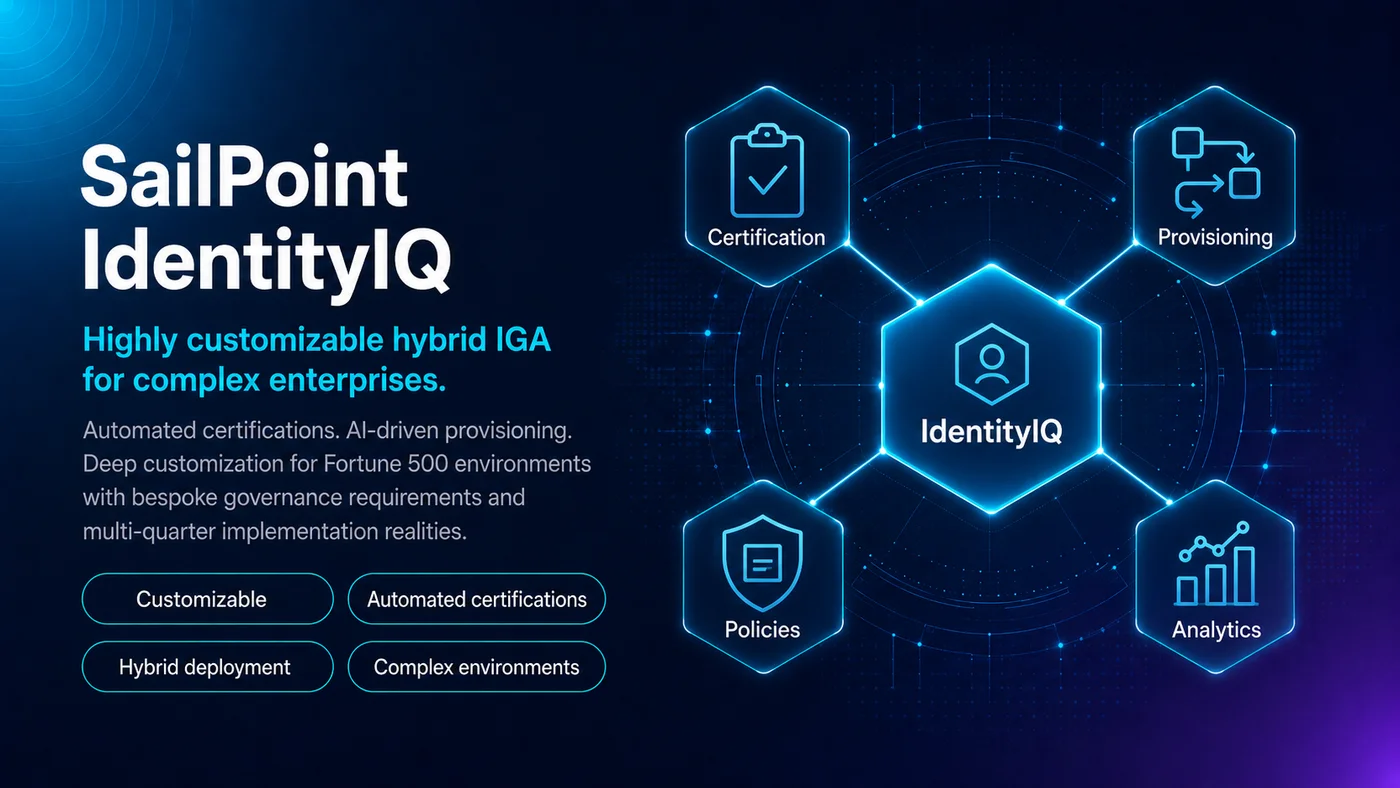
What it is. The enterprise-IGA reference platform — Java-based, deeply customizable, with extensive connector library and a long track record in complex Fortune 500 environments.
How it governs. AI and machine learning automate provisioning, access certifications, and SoD enforcement. The connector library spans IT service management, enterprise applications, privileged access management, and cloud collaboration tools. Pricing follows a subscription model starting at $10 per user per month.
Standards and compliance. SailPoint publishes SOC 2 Type II, ISO 27001, FedRAMP Moderate (verify current attestations).
Trade-offs. Customization power requires Java development capacity. Deployments are typically multi-quarter, not multi-week. The platform rewards mature IGA teams and punishes organizations expecting cloud-native deployment speed.
Where it fits in your stack. Complex Fortune 500 environments where bespoke fit, deep customization, and connector breadth matter more than deployment speed. Less appropriate for mid-market organizations needing rapid deployment.
9. Saviynt
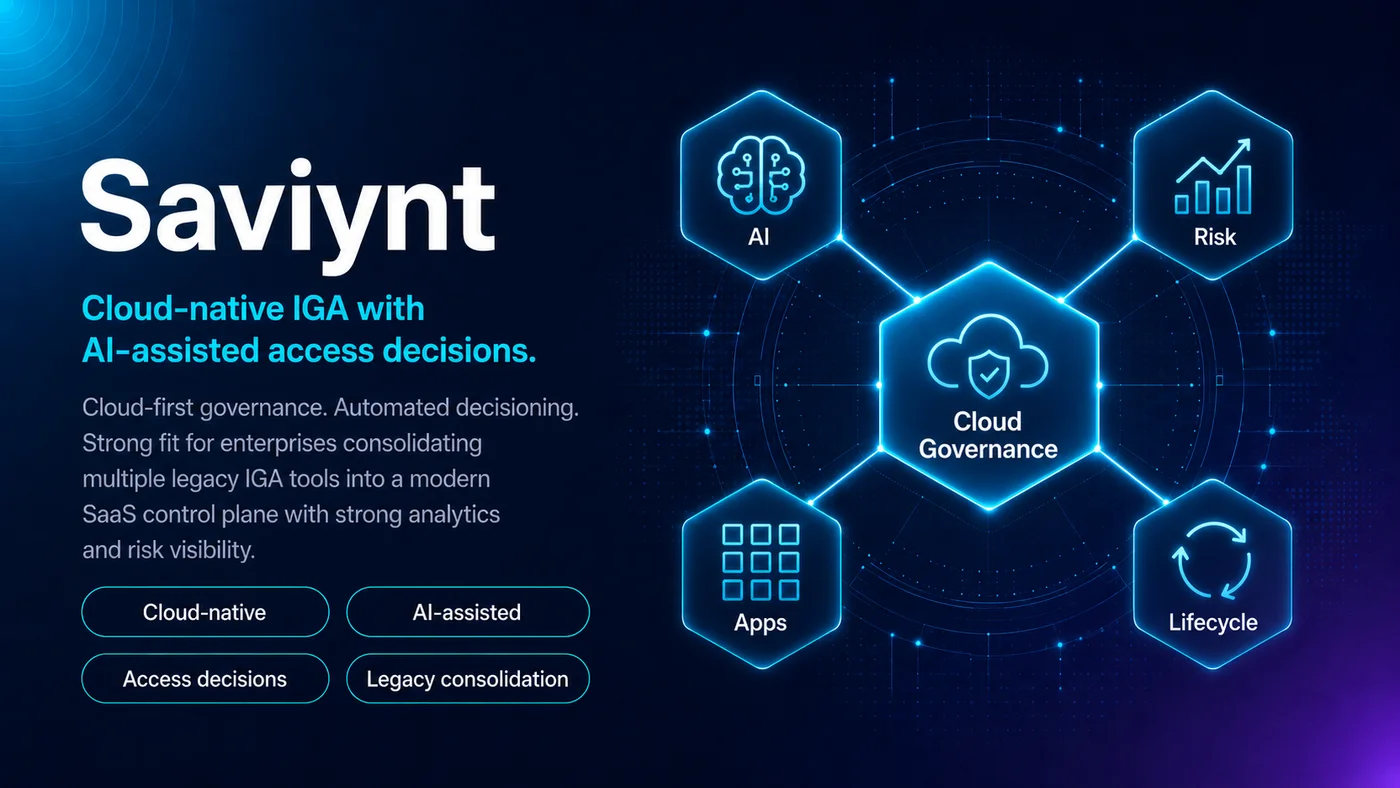
What it is. A cloud-native IGA platform with AI-driven access recommendations and broad CIAM, B2B, and workforce coverage.
How it governs. AI-powered access recommendations automate up to 75 percent of access review decisions and reduce decision times by up to 70 percent in Saviynt's customer base. A Forrester Total Economic Impact study Saviynt commissioned estimates organizations can save $34.40M and achieve 240 percent ROI over three years (figures from Saviynt's published analyst report; validate against your own environment). The platform offers three tiers — Essentials, Pro, and Premium — priced per user.
Standards and compliance. SOC 2 Type II, ISO 27001, FedRAMP High (verify current attestations).
Trade-offs. Cloud-native depth is the strength. Very large on-premises footprints and mainframe environments fit other platforms better. The AI-recommendation surface requires deployment maturity to operate well — out-of-the-box recommendations need tuning against the customer's risk tolerance.
Where it fits in your stack. Cloud-first enterprises consolidating multiple legacy IGA tools. Less appropriate for environments where mainframe and on-premises remain dominant.
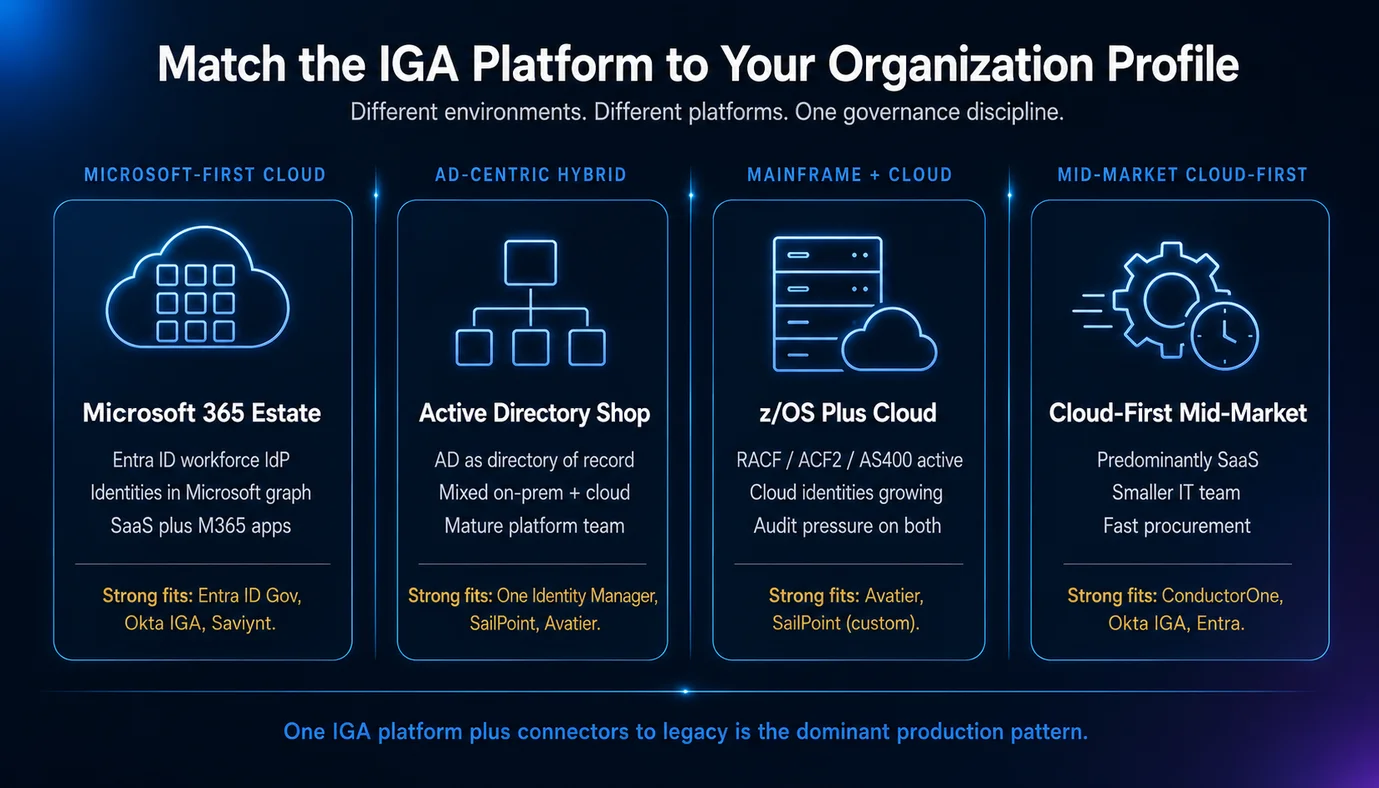 Most enterprises pick one IGA platform for the workforce layer and accept that legacy and mainframe environments need bridges. The multi-platform pattern is the dominant one in production deployments.
How to choose IGA by organizational profile
The vendor-by-vendor analysis is necessary but not sufficient. Most enterprises end up with a primary IGA platform plus connectors or governance bridges to legacy systems. Use this section to map your environment to platforms.
Microsoft-first cloud enterprises
Microsoft 365 estate, Entra ID as the workforce IdP, most identities already in the Microsoft graph.
Strong fits: Microsoft Entra ID Governance (native), Okta Identity Governance (if Okta is also in the stack), Saviynt (if consolidating multiple tools).
AD-centric hybrid shops
Active Directory as the directory of record, mixed on-premises and cloud applications, mature platform engineering team.
Strong fits: One Identity Manager (AD depth + Starling Connect for cloud), SailPoint IdentityIQ (enterprise complexity), Avatier Identity Anywhere (mixed environment).
Mainframe-and-cloud mixed environments
z/OS RACF or ACF2 in production, AS400 footprint, cloud identities growing rapidly, audit pressure across both surfaces.
Strong fits: Avatier Identity Anywhere (native mainframe coverage), SailPoint IdentityIQ (mainframe via custom development).
Less appropriate: ConductorOne, Saviynt, Microsoft Entra (mainframe coverage requires bridges).
Mid-market cloud-first organizations
Predominantly SaaS application portfolio, smaller IT team, faster procurement cycles, deployment speed weighted heavily.
Strong fits: ConductorOne (no-code workflows), Okta Identity Governance (if Okta is the IdP), Microsoft Entra (if Microsoft is the stack).
Less appropriate: SailPoint IdentityIQ, Oracle IGA, One Identity Manager (deployment effort exceeds the value at this scale).
European enterprises with GDPR-by-design procurement
GDPR compliance is a hard procurement requirement, European data residency matters, deployment timeline is shorter than US-typical.
Strong fits: Omada Identity (12-week Accelerator), Saviynt (cloud-native with EU posture).
Frequently asked questions
What is identity governance and administration (IGA)?
Identity governance and administration (IGA) is the discipline of managing the entire lifecycle of digital identities — creation, modification, attestation, and deprovisioning — alongside the access rights those identities hold. IGA platforms automate provisioning, run access-certification campaigns, enforce segregation of duties, and produce the audit trails regulators require. IGA differs from identity and access management (IAM): IAM controls who can sign in; IGA controls whether the access an identity holds is still appropriate over time.
What is the difference between IAM and IGA?
IAM (identity and access management) handles authentication and authorization at the moment of access — who can sign in, with what credential, to which application. IGA (identity governance and administration) handles the discipline around that access — who reviewed it, who attested to it, when it expires, what triggers recertification, and how it gets deprovisioned. Most enterprises need both. IAM without IGA produces orphaned accounts and standing privilege; IGA without IAM has no live access decisions to govern.
What are the core capabilities of an IGA platform?
Five capabilities are table-stakes for any IGA platform in 2026 — automated identity lifecycle (joiner/mover/leaver workflows), access certification (periodic recertification campaigns), role-based access control with role mining and segregation-of-duties enforcement, a connector ecosystem that integrates the platform with HR systems and target applications, and analytics and risk scoring that surface anomalous access patterns. Modern platforms add AI-driven access recommendations, cloud-native scaling, and credential lifecycle for non-human identities.
Why is IGA more important in 2026 than it used to be?
Identity is now the primary attack vector. Forbes reported that compromised credentials or accounts are involved in 66 percent of breach pathways, and 49 percent of breaches involve unauthorized access. Cloud-wide breaches like Storm-2949 succeeded because identity governance was absent — service-principal credentials were never rotated, standing privileged roles were never recertified, and authenticator-method changes were never attested. The control gap that IGA closes is the one most enterprises have not yet operationalized.
How does IGA support compliance with SOC 2, ISO 27001, GDPR, and HIPAA?
IGA platforms produce the audit trails and enforcement controls these frameworks require. SOC 2 expects evidence of access reviews and least-privilege enforcement; ISO 27001 requires documented access management procedures; GDPR requires consent records and the right to be forgotten; HIPAA requires audit controls and access controls on protected health information. An IGA platform automates the recertification campaigns and produces the audit-ready reports that turn compliance from a quarterly fire drill into a continuous control.
What is segregation of duties (SoD) and how does IGA enforce it?
Segregation of duties (SoD) is the control that prevents one person from holding conflicting permissions — for example, the ability to create a vendor record and the ability to approve payments to that vendor. IGA platforms enforce SoD through policy rules that flag or block role assignments and access grants that would create conflicts. Effective SoD enforcement depends on accurate role definitions, which is why role mining and role engineering are typically the first capabilities enterprises deploy in an IGA program.
How does IGA handle non-human identities (service accounts, service principals, machine identities)?
Non-human identities outnumber human identities in most enterprise cloud environments and present a larger governance challenge because they have no human owner by default. Mature IGA programs treat non-human identities — Active Directory service accounts, Azure service principals, AWS IAM roles, OAuth client credentials — as governance objects with named human owners, scheduled credential rotation, periodic permission recertification, and explicit decommissioning workflows. The Storm-2949 breach is a recent case study in what happens when this governance discipline is absent.
How long does an IGA implementation typically take?
Enterprise IGA implementations historically run 6 to 18 months for first production use, with full coverage across all in-scope applications often taking 8 or more years for large organizations with backlogs exceeding 600 applications. Modern cloud-native IGA platforms reduce initial deployment to weeks rather than months, but application onboarding remains the longest pole — most platforms ship strong out-of-the-box connectors for common SaaS and IdP integrations and require custom connector work for legacy and bespoke applications.
Bottom line — shortlist two, pilot one
The honest finishing move in this category is to shortlist two platforms, pilot one against your hardest governance gap, and decide from data. Most enterprises pick one platform for the workforce IGA layer and accept that legacy and mainframe environments need bridges. The multi-platform pattern is the dominant one in production deployments.
If your hardest gap is mainframe identity coverage, shared-workstation governance, or service-desk identity verification, book an executive briefing with Avatier — those are the segments Identity Anywhere was built for. If your hardest gap is cloud-native consolidation of multiple legacy IGA tools, look at Saviynt and Okta Identity Governance first. If your hardest gap is Active Directory depth, look at One Identity Manager or SailPoint IdentityIQ. The right outcome is a deployment that fits your environment.
For the broader governance discipline this site is built around — the five pillars of credential governance — start at the credential governance home. For the breach analysis that frames why IGA matters more in 2026 than it did two years ago, the Storm-2949 governance failure analysis is the companion piece. For mainframe-specific governance, the RACF vs ACF2 comparison goes deeper on the z/OS surface.
ABOUT THE AUTHOR

More from Buyer's Guides
IAM Vendors in 2026: How the Market Breaks Down
A category-level guide to how the IAM vendor market segments into suites, point solutions, and platform plays, plus the criteria and red flags that separate real capability from marketing claims.
SailPoint vs Avatier: The 2026 Enterprise Pricing Model Comparison
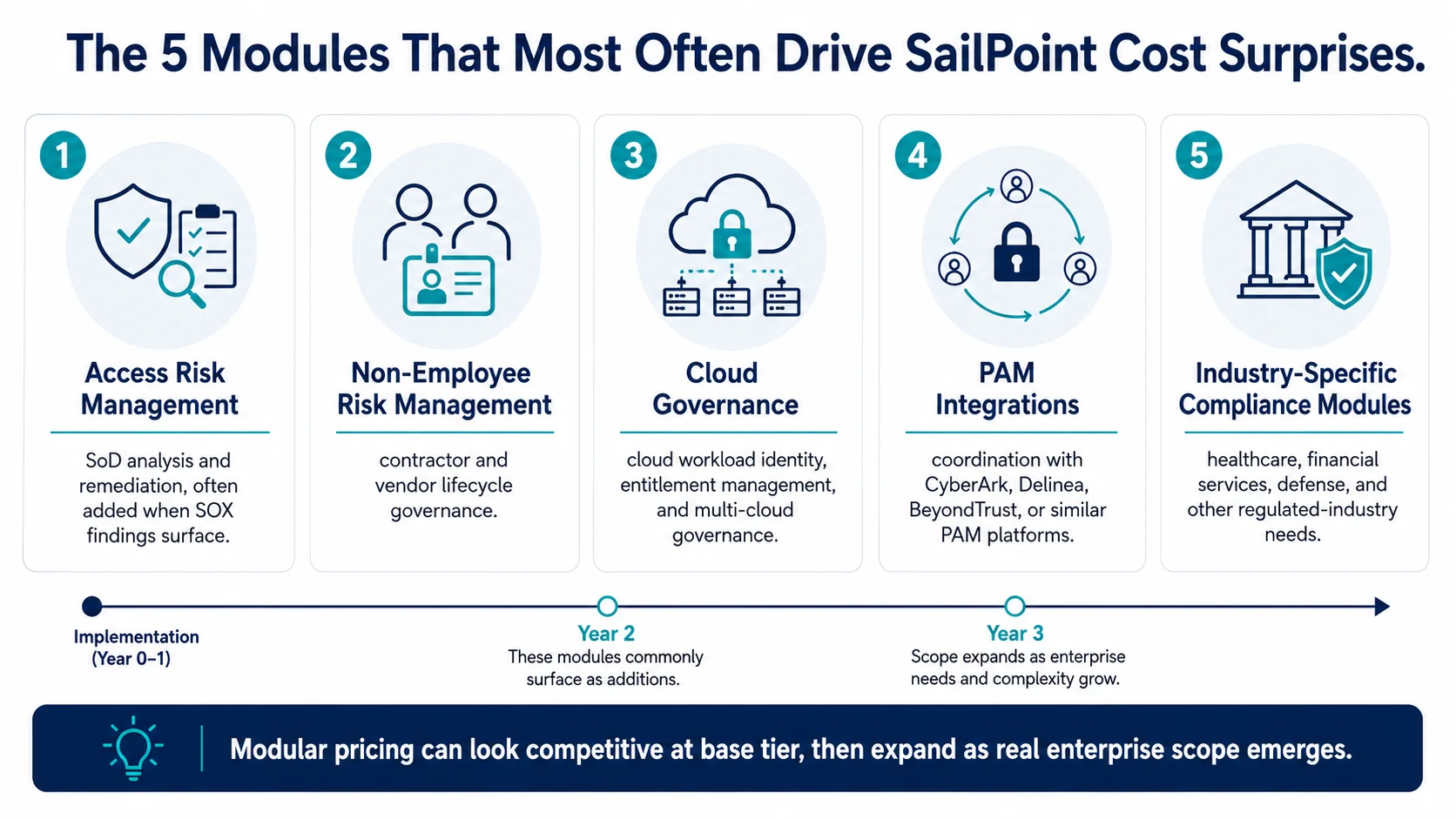
Enterprise IAM buyers evaluating SailPoint against Avatier are comparing two fundamentally different pricing philosophies — modular per-capability pricing with premium tiers and per-connector charges versus all-inclusive licensing that bundles the same capability set into the base license. The 2026 enterprise reference on the structural pricing differences, the modules that drive most of the SailPoint cost surprises, the Avatier all-inclusive positioning, and the buyer-side comparison discipline that produces defensible vendor selection instead of feature-checklist theater.

Login Reset Licensing Models: The 2026 Enterprise Cost Structure Reference
Enterprise password reset licensing has three fundamentally different pricing models — per-user subscription, per-reset-event consumption, and modular capability-based licensing — and the fit between model and buyer profile determines whether TCO tracks the vendor's list-price projection or surprises 18-24 months into deployment. The 2026 enterprise reference on the three licensing models, the specific line items that drive cost variance, and the buyer discipline that produces defensible reset-workflow vendor selection.