Selecting an Identity Vendor: 12 Criteria for 2026
The evaluation framework for choosing an identity management vendor — what 2026 looks like for each criterion, what to ask in demos, and what trade-offs the vendor probably won't surface.
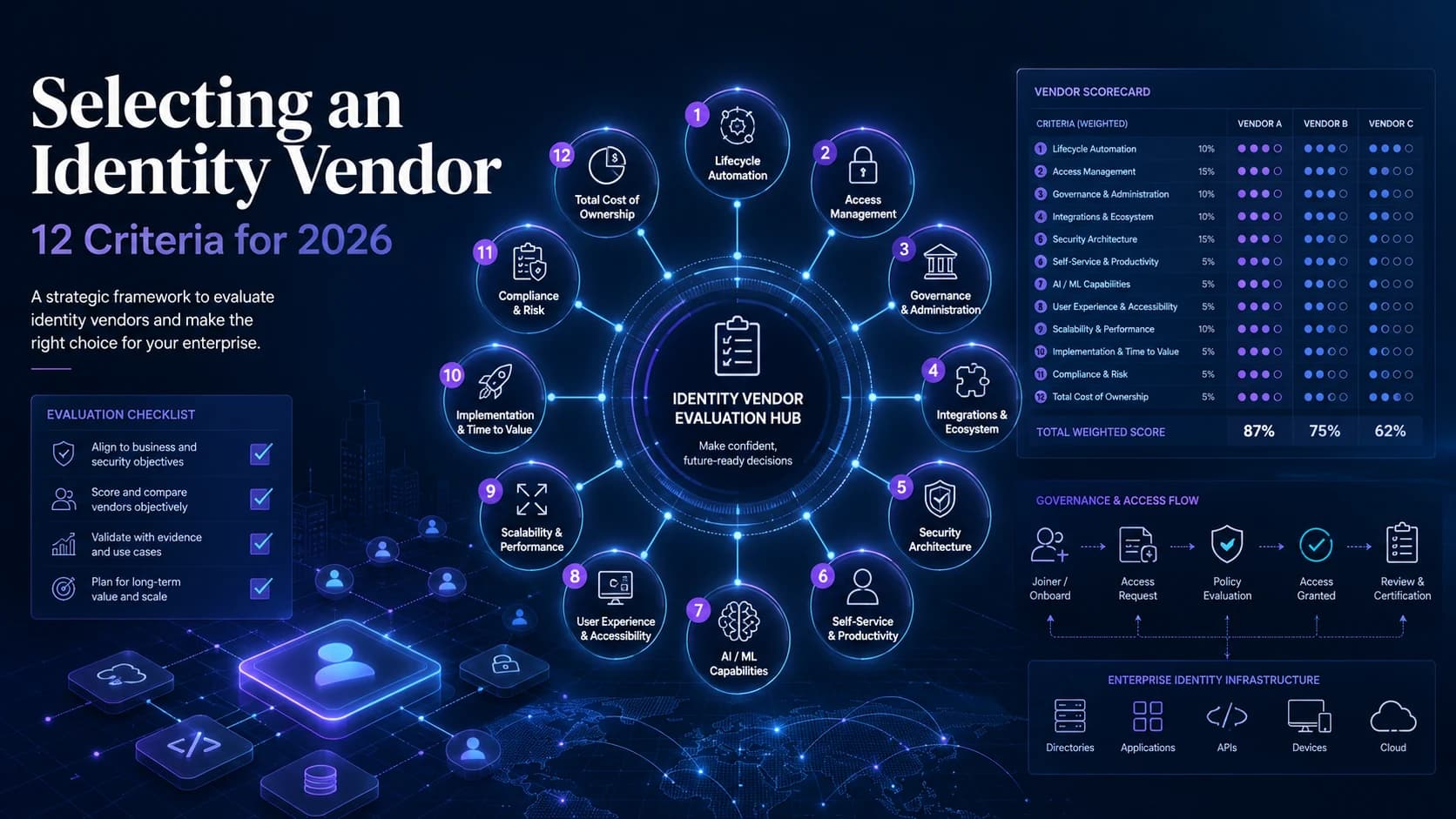
The evaluation framework for choosing an identity management vendor — what 2026 looks like for each criterion, what to ask in demos, and what trade-offs the vendor probably won't surface.
Selecting an identity-management vendor is an enterprise decision that compounds for years. The platform you choose shapes how your workforce signs in, how access gets provisioned, how compliance evidence is collected, how the security team responds to identity events, and how integration projects with adjacent systems get scoped. Getting it right is worth the time the evaluation takes. Getting it wrong is expensive to correct — usually three to five years of migration friction and parallel-platform operating cost.
This piece is the evaluation framework — what each criterion means in 2026, what questions to ask in vendor demos, and what trade-offs the vendor probably won't surface on their own. It's the structural complement to our specific vendor buyer's guides (IGA, ILM, MFA, Passwordless), which rank specific platforms. This piece is how you apply the framework to those shortlists.
Twelve criteria. Each one has a definition, a demo question worth asking, and an honest trade-off most vendors will work around if you let them.
1. Identity lifecycle automation
What 2026 looks like. Native HRIS integration with Workday, SAP SuccessFactors, UKG, BambooHR, Oracle HCM. Joiner/mover/leaver event publishing. Automated provisioning across the application catalog. Role-based access control with policy-driven exception handling. Self-service request workflow with approval routing. Lifecycle-aware credential rotation tied to role transitions.
Demo question. "Walk us through what happens in your platform when a new hire joins on Monday, becomes a contractor in week 3 due to a hiring freeze, transitions back to FTE in week 8 with a new role, takes a 4-week leave of absence in month 6, and is terminated in month 9. Show us the event log at each step and how the access changes propagate."
Honest trade-off vendors won't surface. Most platforms have strong joiner and leaver flows. The mover flow — especially complex role transitions across privilege boundaries — is where they vary substantially. If your workforce has heavy role-change activity (which most enterprises do), the mover flow matters disproportionately.
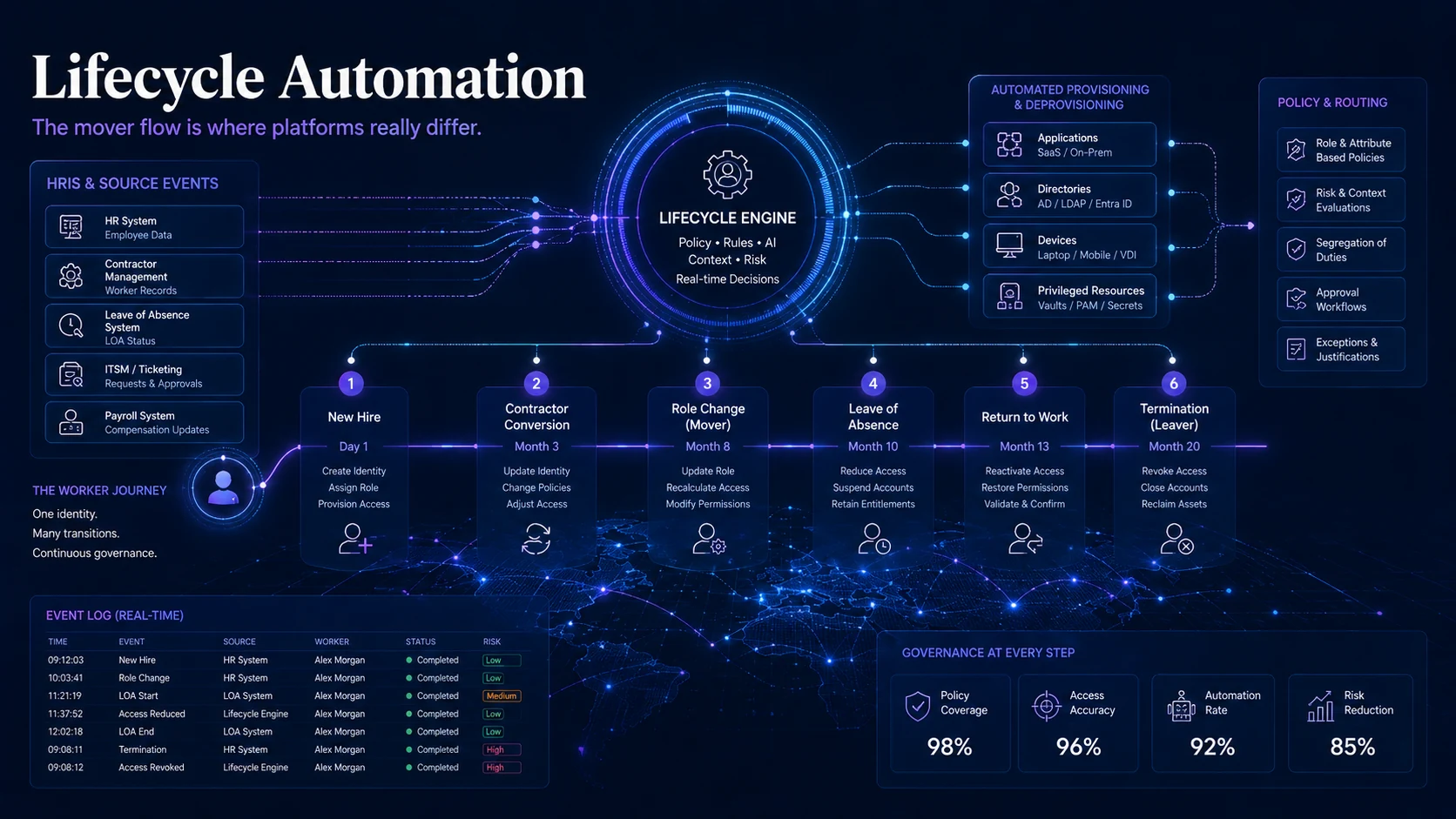 The mover flow — contractor conversions, role transitions, leaves of absence, return-to-work — is the edge case that exposes how platforms actually differ. Joiner and leaver flows are usually solid; mover is where the trade-offs live.
2. Access management and authentication
What 2026 looks like. Single sign-on with broad protocol support (SAML 2.0, OAuth 2.1, OIDC, WS-Fed). Federated identity with major IdPs (Entra ID, Okta, Google, Ping). Adaptive authentication with risk scoring. Phishing-resistant MFA support (FIDO2, passkeys, hardware tokens). Session-management policies for token lifetime, refresh, and revocation.
Demo question. "Show us how your platform handles a sign-in from a new device in an unfamiliar country, during a documented business trip, with phishing-resistant MFA. Then show us the same scenario with SMS OTP. Explain the risk-scoring difference between the two."
Honest trade-off vendors won't surface. Most platforms support phishing-resistant MFA but their recovery flows are often weak — the Storm-2949 attack pattern exploits this. Ask specifically about workflow-tied recovery, not just primary-auth MFA.
3. Identity governance and access certification
What 2026 looks like. Automated certification campaigns with risk-based scoping. Segregation-of-duties policy engine with conflict detection. Continuous access review (event-triggered rather than calendar-triggered). Policy-driven exception management with approval routing. Audit-evidence generation aligned to compliance frameworks (SOC 2, ISO 27001, PCI DSS, HIPAA, NIST 800-53).
Demo question. "Run a certification campaign for our finance application. Show us how risk-based scoping reduces the certification scope from 'every user' to 'users with elevated risk indicators.' Show us how a reviewer disposition propagates to the audit evidence."
Honest trade-off vendors won't surface. Certification fatigue is real. Vendors often demo certification campaigns at small scale where every entry can be reviewed thoughtfully. At enterprise scale, certifications get rubber-stamped without risk-based scoping. The differentiator is whether the platform actually reduces the scope or just runs the same campaign faster.
4. Self-service capabilities
What 2026 looks like. Self-service password reset with workflow-tied verification (post-Storm-2949 — knowledge-based questions alone are no longer acceptable for high-privilege accounts). Self-service access requests with approval routing. Self-service group management with policy-driven controls. Self-service delegation for managers and team leads. Self-service profile management for user-modifiable attributes.
Demo question. "Show us self-service password reset for a privileged account. Walk through the verification flow. Demonstrate what happens if the verification fails — does the workflow escalate to the help desk, or does it just deny? How does the audit log capture the verification attempt?"
Honest trade-off vendors won't surface. Self-service is the helpdesk-cost-reduction story, but the security implications got more serious post-Storm-2949. Vendors that pitch self-service as a cost-savings win without addressing the verification architecture are selling an outdated story. The verification architecture is the substance.
5. Integration ecosystem
What 2026 looks like. Pre-built connectors covering 500+ applications across SaaS, on-premise, cloud infrastructure, and legacy. SCIM 2.0 and OAuth 2.1 standards-based provisioning. Custom connector framework for proprietary applications. API-first architecture with comprehensive REST and GraphQL coverage. Webhook support for event-driven integrations. Connector update cadence that keeps pace with target-platform changes.
Demo question. "List the applications in our environment that don't have native connectors. Walk us through the custom connector build process for one of them. Show us the connector framework — is it actually a development project, or is it a configuration exercise?"
Honest trade-off vendors won't surface. Pre-built connector counts (500+, 1000+) sound impressive but are often padded with one-off custom builds or shallow integrations. The relevant question is whether the connectors are maintained — when the target platform changes its API, does the connector update automatically, and how quickly.
6. Security architecture and zero-trust posture
What 2026 looks like. Zero-trust principles with continuous verification and least-privilege defaults. Privileged access management with just-in-time elevation. Behavioral analytics and risk scoring. CISA Secure-by-Design alignment. Documented threat-model coverage with attack-pattern responses (Storm-2949, AiTM phishing, credential stuffing, push fatigue).
Demo question. "Walk us through how your platform would respond to a documented Storm-2949 attack chain: attacker initiates SSPR on a privileged account, social-engineers the user into approving the MFA prompt for the reset, takes over the account. Where would your platform have stopped the attack? Show us the audit trail."
Honest trade-off vendors won't surface. Most platforms align with NIST 800-53 Rev. 5 in marketing material; fewer carry FedRAMP authorization. For commercial customers, alignment is usually sufficient; for federal customers, authorization is required. Ask specifically about the authorization level (Low, Moderate, High) if federal posture matters.
7. AI and machine-learning capabilities
What 2026 looks like. Behavioral baselines per user (not just per workforce). Risk scoring that integrates lifecycle state, workflow context, authenticator factor, and change-management calendar. Adaptive thresholds with analyst-disposition feedback loops. Anomaly detection on lifecycle events. AI-driven access recommendations and certification scoping.
Demo question. "Show us how your AI integrates with the lifecycle layer. If a user joined yesterday and is touching dozens of applications for the first time, does your system flag that as anomalous, or does it recognize the joiner event and contextualize the activity?"
Honest trade-off vendors won't surface. AI is a real differentiator but it amplifies whatever signal is already in the underlying integrations. A vendor with sophisticated AI on top of weak lifecycle integration produces worse results than a vendor with simpler AI and strong integration. The deeper false-positive reduction analysis covers this pattern in detail.
8. User experience and accessibility
What 2026 looks like. Modern, intuitive UI with minimal training requirement. Native mobile applications and responsive web interface. WCAG 2.2 AA accessibility compliance. Internationalization support with at least 10 major languages. Customizable branding for the user-facing surfaces. Consistent UX across the platform modules.
Demo question. "Walk a non-IT business user through a self-service access request. How long does the request take from intent to submission? Show us the same flow on mobile. Show us the request in three non-English languages."
Honest trade-off vendors won't surface. UX matters because user adoption matters. A platform that's technically powerful but operationally awkward gets routed around — users find workarounds and shadow IT emerges. The differentiator is whether users actually use the self-service surfaces or just call the help desk anyway.
9. Scalability and performance
What 2026 looks like. Authentication throughput sized to your peak load (typically 5-10× your average). Provisioning throughput sized to your bulk operations (HRIS sync, M&A integration, mass termination). Geographic distribution with sub-200ms response times in your major operating regions. High-availability architecture with documented RTO/RPO. Horizontal scaling with documented capacity planning.
Demo question. "Walk us through your scaling architecture. What's the documented capacity for authentication, provisioning, and certification workloads? What's the RTO and RPO for the highest-tier SLA? Have you operationally validated those SLAs in customer environments at our scale?"
Honest trade-off vendors won't surface. Cloud-native platforms have impressive theoretical scaling characteristics but their practical limits are usually constrained by something specific — connector throughput, database write capacity, regional failover behavior. Ask for documented operational case studies at scale, not just architecture diagrams.
10. Implementation methodology and support
What 2026 looks like. Structured implementation methodology with documented phase gates and deliverables. Professional services capacity in your geography and time zone. 24/7 support availability with tiered response times. Customer success engagement for ongoing optimization. Documented success metrics and value-realization measurement.
Demo question. "Walk us through your implementation methodology for an organization our size with our complexity. Who's on the implementation team? What's the customer's responsibility versus the vendor's? What's the documented timeline for first value, full deployment, and value realization?"
Honest trade-off vendors won't surface. Implementation timelines vary by complexity, not by vendor optimism. A vendor quoting 12 weeks for a 12-month problem is setting up the difficult-conversations meeting six months in. Compare timelines across vendors but cross-reference against the actual scope, not just the headline number.
11. Compliance and regulatory support
What 2026 looks like. Built-in audit-evidence generation aligned to major frameworks (SOC 2 Type II, ISO/IEC 27001:2022, PCI DSS v4.0.1, HIPAA, NIST 800-53 Rev. 5, GDPR). Industry-specific compliance modules (HIPAA for healthcare, FERPA for education, GLBA for financial services). Pre-built compliance dashboards. Audit-ready reporting with reviewer disposition tracking. Trust-Center disclosure of the vendor's own compliance posture.
Demo question. "Show us the audit-evidence trail for [your specific compliance framework]. Walk us through how you'd respond to an auditor request for the access certification evidence for the past quarter. How much of this is automated versus manual?"
Honest trade-off vendors won't surface. "Compliance-ready" doesn't mean compliant — the customer is still responsible for the controls. The vendor's role is to make the evidence easy to collect and the controls easy to enforce. The differentiator is whether the audit-evidence flow is a one-click report or a manual reconstruction.
12. Total cost of ownership
What 2026 looks like. Transparent licensing aligned to seat count, transaction volume, or hybrid models. Documented implementation cost ranges by complexity profile. Ongoing operational cost including support, maintenance, and upgrades. Integration cost for connector builds and customization. Team capacity cost for administration and optimization. Documented value realization with ROI assumptions.
Demo question. "Build us a 5-year TCO model for our environment. Show the license cost, implementation services, ongoing support, and the customer-team capacity required to run the platform. What's the largest cost variable — what would change the total cost by 25%?"
Honest trade-off vendors won't surface. The headline license number is usually 40-60% of the 5-year total. The rest is implementation services, integration work, ongoing optimization, and customer-team capacity. Vendors that emphasize license-only pricing are usually masking the implementation cost. Ask for the all-in number with documented assumptions.
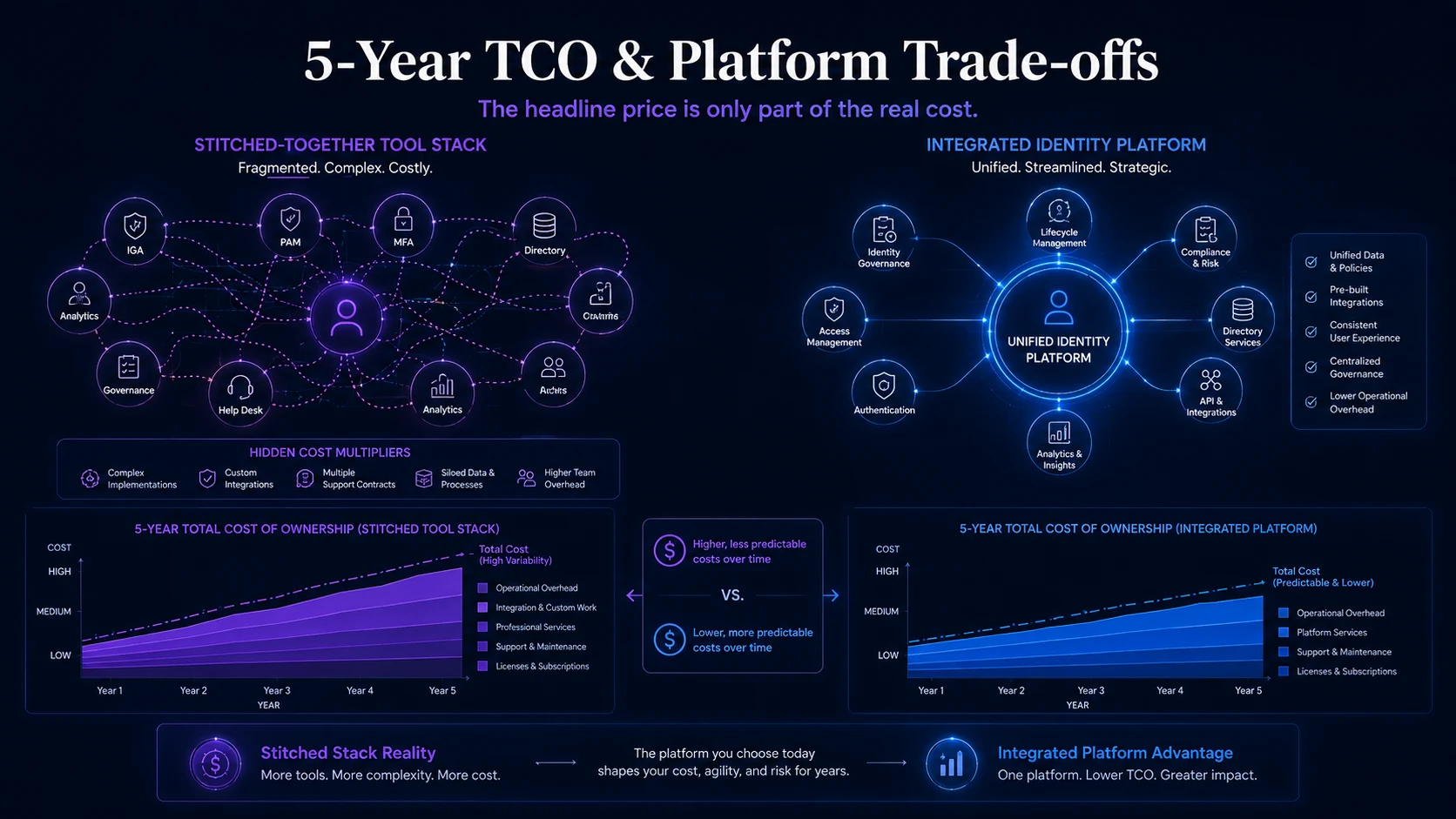 The TCO comparison that vendors rarely build for you. License cost is the visible number; integration projects, custom connectors, vendor coordination, audit overhead, and license sprawl are the cost multipliers that compound across the 5-year horizon.
How to apply the framework
The twelve criteria above are not equally weighted. The weights depend on your organization's priorities. A starting weighting that works for most enterprise selections:
| Criterion | Weight |
|---|---|
| Lifecycle automation | 15% |
| Access management & authentication | 12% |
| Identity governance & certification | 12% |
| Integration ecosystem | 10% |
| Compliance & regulatory support | 10% |
| Implementation & support | 10% |
| Total cost of ownership | 10% |
| Security architecture & zero trust | 8% |
| Self-service capabilities | 5% |
| AI/ML capabilities | 5% |
| Scalability & performance | 5% |
| UX & accessibility | 3% |
Adjust the weights to your environment. Federal customers should shift weight toward compliance and security. Cost-sensitive mid-market should shift toward TCO and implementation. Large enterprises with complex application portfolios should shift toward lifecycle automation and integration ecosystem.
The structured selection process
Six phases, twelve to twenty-four weeks total.
Phase 1 (3-4 weeks): Requirements definition. Document your environment, your constraints, your priorities, and your weighted scoring rubric. Get sign-off from IT leadership, security, compliance, HR, and the business stakeholders.
Phase 2 (3-4 weeks): Shortlist development. Issue an RFI to 5-8 vendors. Use the responses to narrow to 3-5 finalists. Reference the IGA, ILM, MFA, and Passwordless buyer's guides for landscape context.
Phase 3 (3-4 weeks): Demo evaluation. Run scripted demo scenarios against each finalist. Use the demo questions from each criterion above. Score against your rubric.
Phase 4 (4-6 weeks): Proof of concept. Run the top one or two vendors in a POC environment with your real HRIS data and a representative application sample. This is the phase that surfaces the trade-offs vendors won't volunteer.
Phase 5 (3-4 weeks): References and negotiation. Check 3-5 references for each finalist. Negotiate pricing, SLAs, professional services, and exit clauses. Get legal sign-off.
Phase 6 (1-2 weeks): Decision and contract. Make the decision, document the rationale, sign the contract, kick off implementation.
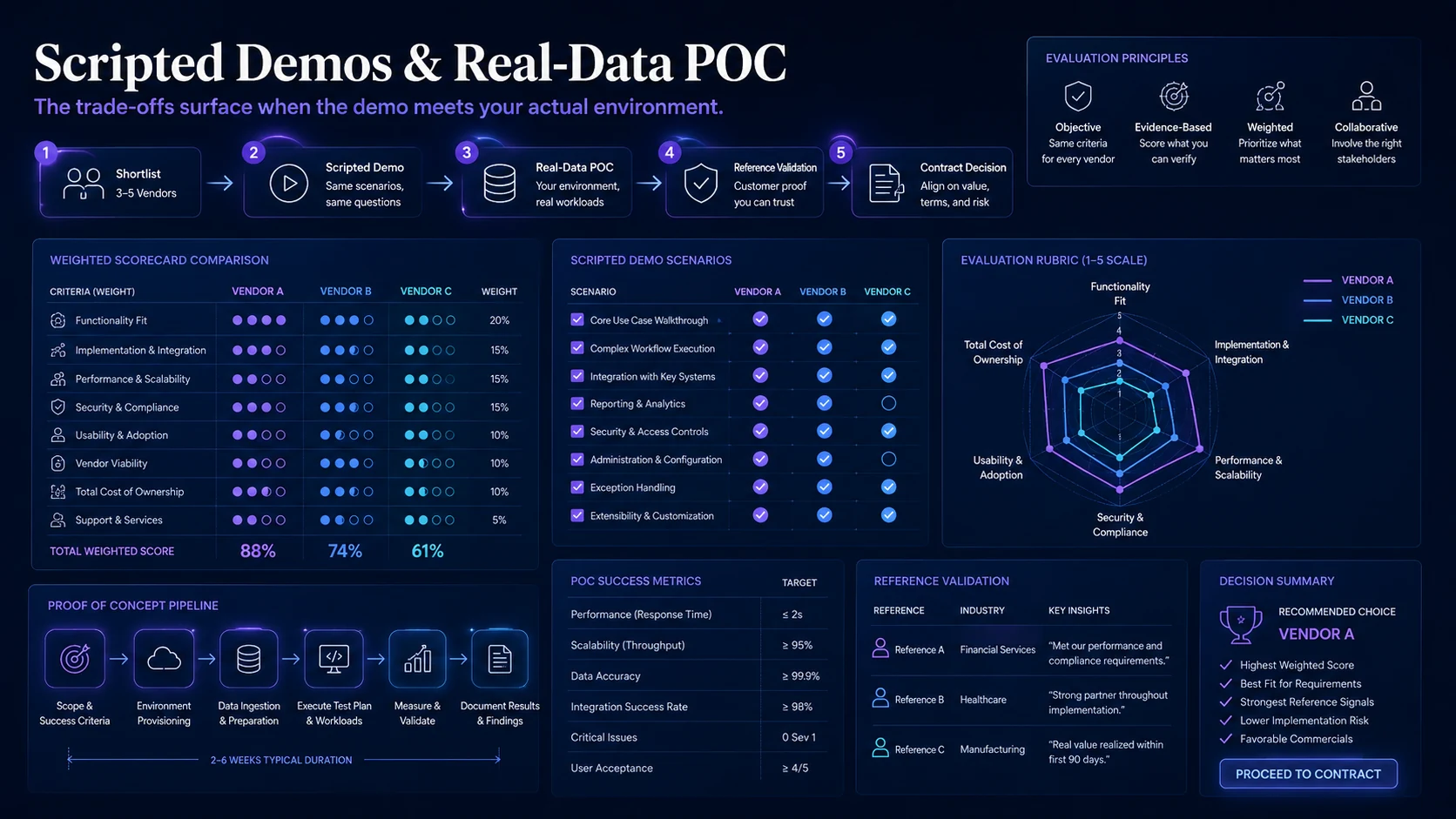 Scripted demos with weighted scoring. Real-data POC with operational metrics. Reference validation with documented questions. The decision becomes defensible because the process is structured.
What Avatier is, and what it isn't
To be transparent about our own position: Avatier Identity Anywhere is built around the integrated-platform thesis — one unified architecture for lifecycle, governance, authentication, and password management, rather than a portfolio of separately-acquired components stitched together. We're a CISA Secure-by-Design Pledge signatory, our Trust Center publishes our SOC 2 Type II (zero exceptions), ISO/IEC 27001:2022, PCI DSS v4.0.1, CSA STAR Level 1, and NIST 800-53 Rev. 5 alignment posture. We rank in our own buyer's guides because we think the integrated thesis is genuinely competitive — and we put ourselves alongside the alternatives so you can apply the framework above to all of us.
Where Avatier fits well: mixed-estate enterprises with modern SaaS plus on-premise plus legacy/mainframe; organizations that want lifecycle, governance, and password management on a single platform; security-conscious customers who want workflow-tied verification post-Storm-2949; and customers who value rapid time-to-value over multi-year deployment cycles. Where Avatier fits less well: cloud-only modern-SaaS-only organizations with no legacy estate; customers requiring FedRAMP authorization (we're aligned, not authorized); and customers whose primary identity gravity is inside a specific vendor ecosystem (Microsoft-only, Okta-only) where the ecosystem-native vendor's depth outweighs the integration breadth.
The closing framing
Vendor selection is a choice with multi-year consequences and substantial reversal cost. The teams that do it well treat it as a structured evaluation with explicit criteria, documented weightings, scripted demos, real-data POC, and reference validation. The teams that do it poorly skip the structure and end up litigating the choice for years afterward.
The framework above is a starting point. Adapt the weights to your environment. Tighten the demo questions to your specific requirements. Insist on the POC phase even when the vendor is reluctant. Cross-reference vendor claims against the specific IGA, ILM, MFA, and Passwordless buyer's guides for landscape context.
The selection itself is short. The platform you choose will be with you for years. Spend the time on the evaluation; the post-deployment savings on the right choice will dwarf the few months you spent picking it.
ABOUT THE AUTHOR

More from Buyer's Guides
IAM Vendors in 2026: How the Market Breaks Down
A category-level guide to how the IAM vendor market segments into suites, point solutions, and platform plays, plus the criteria and red flags that separate real capability from marketing claims.
SailPoint vs Avatier: The 2026 Enterprise Pricing Model Comparison
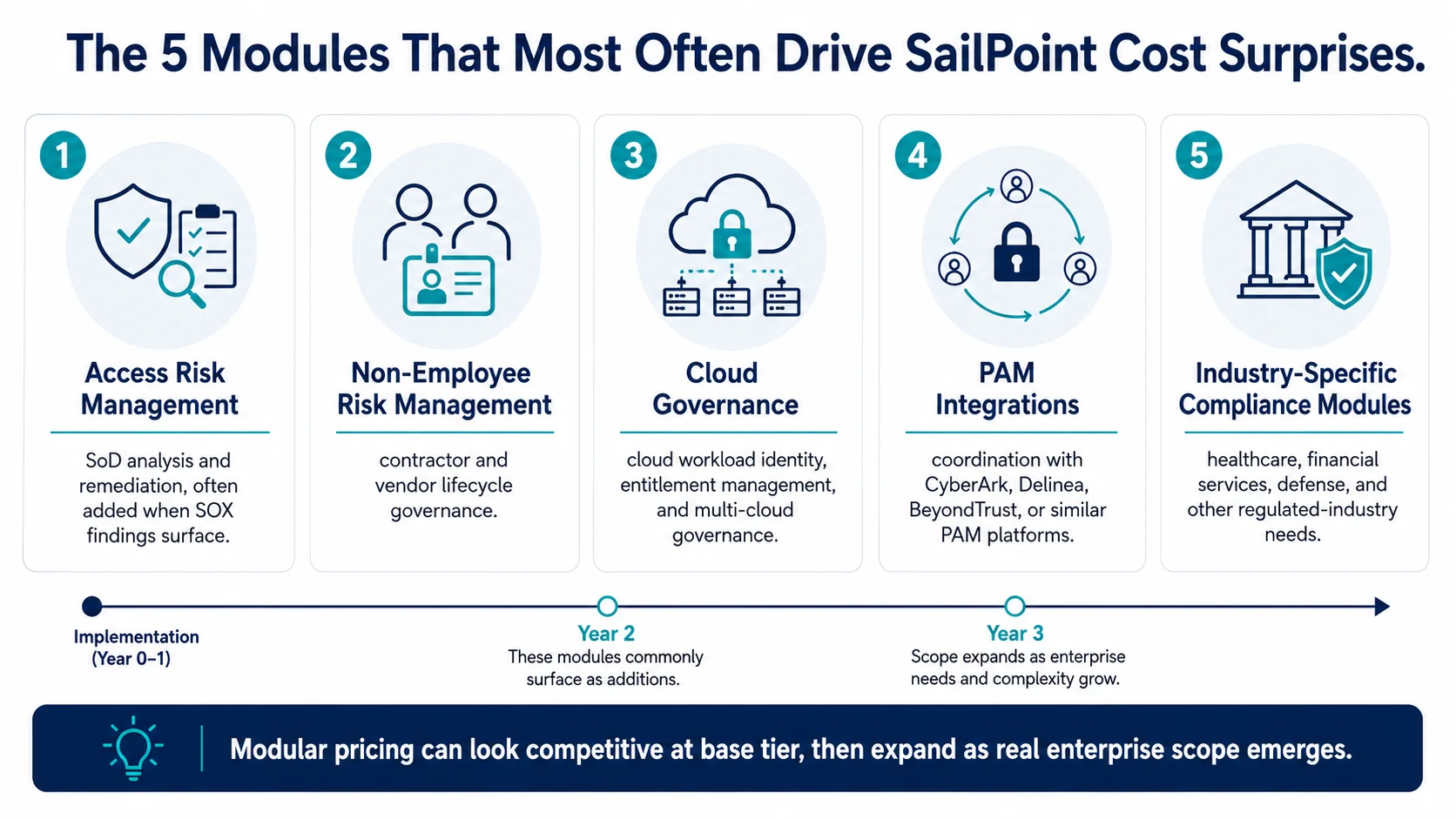
Enterprise IAM buyers evaluating SailPoint against Avatier are comparing two fundamentally different pricing philosophies — modular per-capability pricing with premium tiers and per-connector charges versus all-inclusive licensing that bundles the same capability set into the base license. The 2026 enterprise reference on the structural pricing differences, the modules that drive most of the SailPoint cost surprises, the Avatier all-inclusive positioning, and the buyer-side comparison discipline that produces defensible vendor selection instead of feature-checklist theater.
Login Reset Licensing Models: The 2026 Enterprise Cost Structure Reference
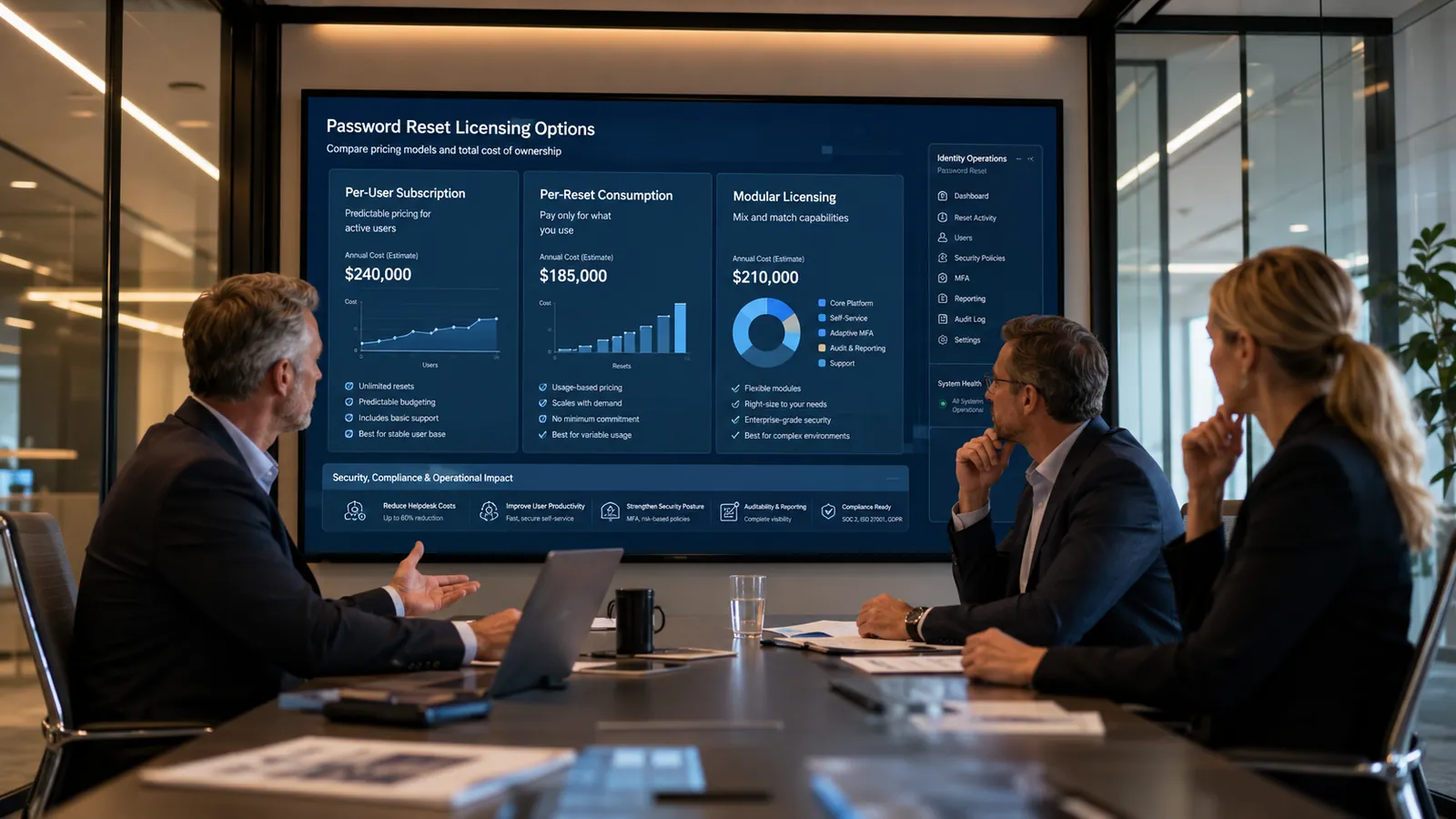
Enterprise password reset licensing has three fundamentally different pricing models — per-user subscription, per-reset-event consumption, and modular capability-based licensing — and the fit between model and buyer profile determines whether TCO tracks the vendor's list-price projection or surprises 18-24 months into deployment. The 2026 enterprise reference on the three licensing models, the specific line items that drive cost variance, and the buyer discipline that produces defensible reset-workflow vendor selection.