CIEM: Cloud Infrastructure Entitlement Management for Enterprise 2026
Traditional IGA was built for workforce identity in defined business systems. Cloud infrastructure is a different problem — thousands of permissions per cloud account, machine-identity dominance, inheritance through nested groups and policies, scale that no human reviewer can certify manually. CIEM is the emerging analyst category that handles this complexity. The 2026 enterprise reference on the four CIEM domains, the vendor landscape, and the architectural composition with IGA, PAM, and ISPM.
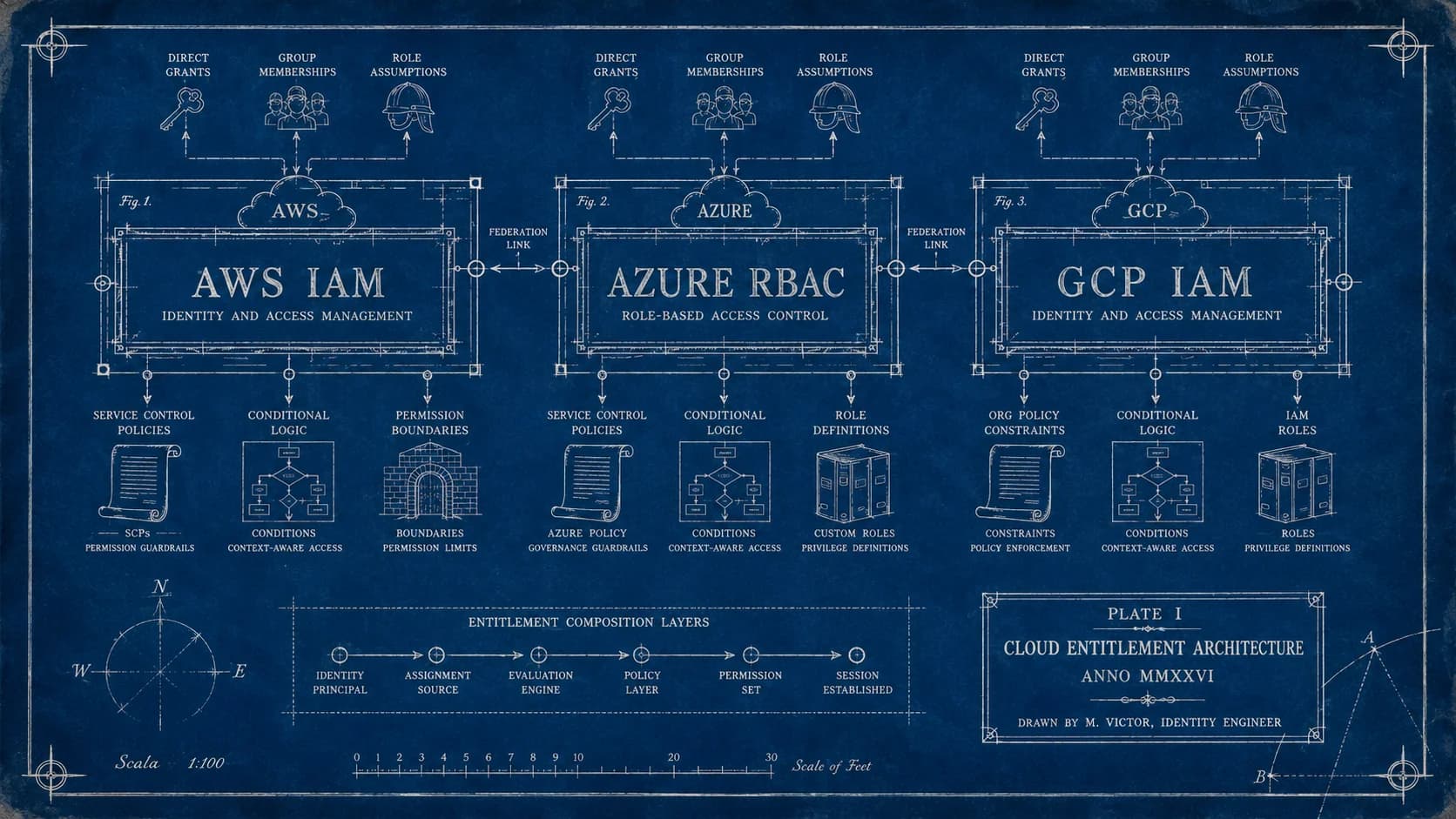
Traditional IGA was built for workforce identity in defined business systems. Cloud infrastructure is a different problem — thousands of permissions per cloud account, machine-identity dominance, inheritance through nested groups and policies, scale that no human reviewer can certify manually. CIEM is the emerging analyst category that handles this complexity. The 2026 enterprise reference on the four CIEM domains, the vendor landscape, and the architectural composition with IGA, PAM, and ISPM.
- Traditional IGA was built for workforce identity in defined business systems. Cloud infrastructure produces a different problem class — thousands of granular permissions per cloud account, dominant machine identities (service accounts, EC2 roles, Lambda functions), inheritance through nested groups and policies, and scale that no human reviewer can certify manually.
- CIEM (Cloud Infrastructure Entitlement Management) is the analyst category that handles cloud-specific entitlement complexity. Gartner formalized the category in 2020-21; vendor maturity reached enterprise-deployment-ready scale around 2023-24; the 2026 mainstream enterprise deployment is now common in cloud-mature organizations.
- Four CIEM evaluation domains define the 2026 baseline: effective-permission visibility (what permissions does this identity actually have, including inherited and conditional), least-privilege baselining (what permissions are actually used vs granted), machine-identity governance (service accounts, IAM roles, function-level identities dominate cloud volume), and multi-cloud federation (AWS + Azure + GCP composed into a unified posture).
- The 2026 vendor landscape consolidated around Wiz (broad cloud security platform that absorbs CIEM), Microsoft Entra Permissions Management (formerly CloudKnox, now Microsoft-integrated), Permiso, Sonrai, Saviynt, Authomize, Sweet Security, and Tenable Cloud Security. Procurement decisions turn on existing cloud security tooling, multi-cloud breadth, and IGA integration depth.
- CIEM composes with the broader identity stack: IGA handles workforce identity, PAM handles privileged accounts and human break-glass, ISPM handles posture audit across the full identity surface, and CIEM handles cloud-specific entitlement complexity. The four layers together cover the 2026 enterprise identity-security envelope; CIEM alone covers the cloud entitlement subset that the other three handle only partially.
Traditional Identity Governance and Administration platforms were built for a problem shape that doesn't fit cloud infrastructure cleanly. The IGA model assumes entitlement catalogs in the dozens to low hundreds, human users dominating the identity volume, certifications that human reviewers can complete manually, and target systems with well-defined application boundaries. The model worked for the application landscape that dominated enterprise IT through the 2000s and 2010s — Active Directory, the ERP, the CRM, the email platform, a few dozen line-of-business applications.
Cloud infrastructure produces a different problem shape. AWS IAM alone has over 14,000 individual API permissions. Azure RBAC has thousands of built-in role definitions plus the ability to define custom roles. GCP IAM has thousands of granular permissions across its services. In any given AWS account, 80-95% of all identities are machine identities — service accounts, EC2 instance profiles, Lambda execution roles, ECS task roles, Step Functions execution roles. The effective permissions an identity actually has often differs substantially from what was directly granted because cloud entitlements compose through multiple mechanisms (direct grant, group membership, role assumption, service control policies, organization policies, conditional logic). Traditional IGA looking at this landscape sees a problem it wasn't built to solve.
CIEM (Cloud Infrastructure Entitlement Management) is the analyst category that emerged to solve it. Gartner formalized CIEM in 2020-21 as a distinct category. Vendor capabilities matured through 2022-23 to enterprise-deployment-ready scale. The 2026 mainstream enterprise deployment is now common in cloud-mature organizations — banks, technology firms, government cloud workloads, retail commerce platforms, healthcare cloud migrations.
This piece is the 2026 enterprise reference on CIEM. The four evaluation domains that define the category, the mid-2026 vendor landscape, the operational failure modes that recur in deployments, and the architectural composition with the broader identity stack. The companion pieces cover adjacent layers: the Best IGA Solutions piece covers the IGA platform layer CIEM composes with, the Service Account Governance / NHI piece covers the machine-identity inventory layer CIEM scrutinizes, the PAM piece covers the privileged-access intersection, the ISPM piece covers the posture-audit layer that runs alongside CIEM, and the Identity Maturity Model piece covers where CIEM deployment sits in the broader maturity ladder (typically a Stage 4 capability).
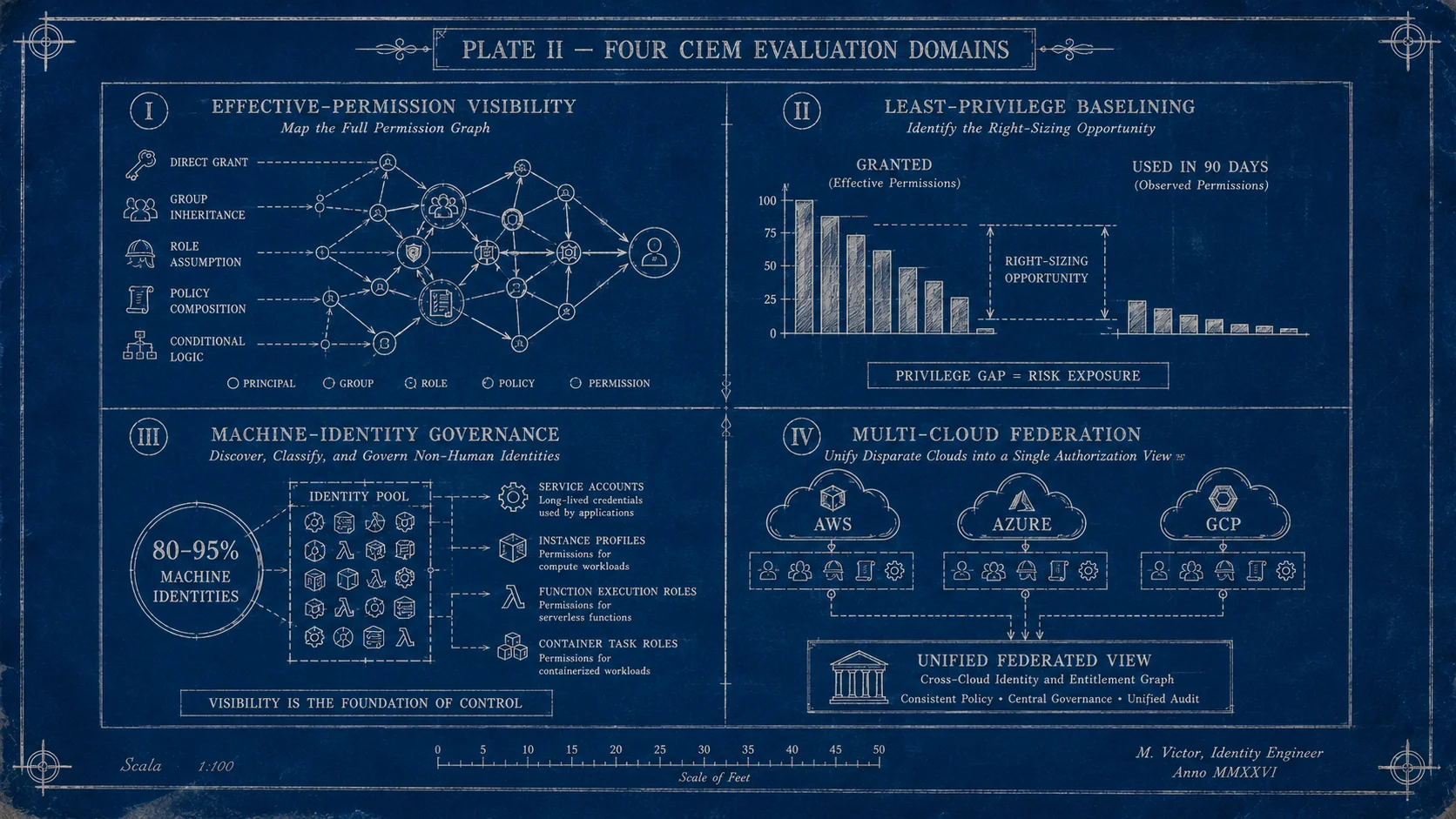 Four CIEM evaluation domains. Each addresses a cloud-specific entitlement problem that traditional IGA covers only partially or not at all. The composition is the analyst category's reason for existing.
Why cloud entitlements need a separate category
Three structural reasons drive the existence of CIEM as a distinct category from IGA. Each maps to a specific cloud-platform characteristic that breaks the assumptions IGA was designed around.
Permission granularity at scale. AWS IAM exposes over 14,000 individual API permissions across its services. Each permission represents a specific action a principal can take — s3:GetObject, ec2:DescribeInstances, iam:PassRole, kms:Decrypt, and 13,996 others. Azure RBAC has thousands of built-in role definitions plus custom role flexibility. GCP IAM has thousands of granular permissions. Traditional IGA was designed for entitlement catalogs measured in the dozens to low hundreds — the line-of-business application has 50 roles, the ERP has 200 roles, the CRM has 80 roles. The cloud scale exceeds what manual certification can handle by two to three orders of magnitude.
The implication is operational. A traditional IGA certification campaign that lists 50 application roles for a manager to review is workable. The same campaign that lists 14,000 AWS permissions per user account is not. Human reviewers can't process that volume; the campaigns either fail to complete or complete with pattern-clicked attestations that satisfy the count and fail the substance. CIEM platforms solve this by computing risk-weighted summaries — surfacing the high-risk permissions for review and auto-classifying the routine permissions.
Machine-identity dominance. Cloud workloads run as service accounts, instance profiles, function-execution roles, container task roles — not as human users. In a typical AWS account, 80-95% of all identities are machine identities. In Azure and GCP, the ratios are similar. The cloud's compute and service model assumes identity-bearing workloads, not just identity-bearing humans.
Traditional IGA was built for human-user lifecycle. Onboarding produces a human user; offboarding removes that human user; certifications review human users' access. Machine identities exist in IGA platforms but typically as second-class citizens — limited automation, less mature lifecycle, separate workflows. CIEM platforms handle machine identities as the primary entity class, with native understanding of the cloud-specific lifecycle (instance profile rotation, Lambda execution role inheritance, ECS task definition versioning) that IGA platforms can only partially model.
Effective-permission complexity. Cloud entitlements compose through multiple mechanisms: direct grant to the principal, group membership inheritance, role assumption (sometimes through chained assume-role calls), service control policy (SCP) restrictions at the organization level, organization-level policies, conditional logic that limits when permissions apply (time of day, source IP CIDR, resource tag, request context). The effective permissions an identity actually has often differs substantially from what was directly granted to that identity.
Computing the effective permissions for a given identity requires cloud-platform-aware analysis — understanding how SCPs constrain account-level permissions, how condition keys narrow grants, how role-chaining produces transitive access. Traditional IGA's entitlement model isn't built for this; CIEM platforms are.
The four CIEM evaluation domains
Four operational domains define what CIEM platforms do. Mature 2026 procurement decisions evaluate each domain explicitly because vendors vary in their relative depth across the four.
Effective-permission visibility. The foundational CIEM capability. For any cloud identity (human or machine), what permissions does the identity actually have when all composition mechanisms are considered? The platform reads the cloud-platform metadata (IAM policies, group memberships, role assumptions, SCPs, organization policies), computes the effective permission set, and surfaces it in a human-readable form. The output supports both forensic investigation (the security team asks "what could this compromised credential have done?") and proactive review (the security team asks "what permissions exist that don't need to exist?").
The architectural test is whether the platform's effective-permission analysis matches the cloud platform's actual behavior under realistic conditions. Cloud platforms occasionally introduce new permission types, new policy composition mechanisms, new condition keys; CIEM platforms have to keep current. Vendor selection should validate this against the buyer's specific cloud usage patterns.
Least-privilege baselining. Beyond what permissions an identity has, what permissions does it actually use? The CIEM platform observes cloud activity over a measurement window (typically 30-90 days) and produces a usage profile — which API calls each identity actually makes, against which resources. The gap between granted permissions and used permissions is the right-sizing opportunity. The platform recommends removing the unused permissions or moving the identity to a narrower role.
The operational implication is large. In most cloud environments, machine identities typically use 5-15% of the permissions they were granted; human identities use 20-40%. Right-sizing produces substantial reduction in blast radius without breaking workload functionality (the unused permissions weren't being used). The challenge is producing right-sizing recommendations the team can actually action — risk-weighted prioritization is the practical answer.
Machine-identity governance. The CIEM platform handles machine identities as first-class entities. Inventory (every service account, IAM role, instance profile, execution role, task role with attributes — what workload owns it, what permissions it has, what activity it's seen recently). Lifecycle (creation events tied to authorized infrastructure provisioning, rotation events tracked, deprovisioning when the workload retires). Posture audit (machine identities with elevated permissions but no recent activity are dormant attack surface — same logic as orphan admin accounts but applied to the machine-identity class).
The composition with workforce IGA matters here. The Service Account Governance / NHI piece covers the broader machine-identity inventory pattern; CIEM is the cloud-specific instance of that pattern.
Multi-cloud federation. Large enterprises rarely use only one cloud. AWS + Azure is common for enterprises that started on AWS and added Microsoft 365 / Azure as the corporate workload runs in parallel. AWS + Azure + GCP is common for technology-mature enterprises. Some add Oracle Cloud (often for specific Oracle workloads), IBM Cloud (legacy workloads), Alibaba (China market). The CIEM platform composes the entitlement posture across the cloud landscape into a unified view rather than treating each cloud as a separate problem.
The depth of multi-cloud support varies meaningfully across vendors. Some platforms have deep AWS support and shallower Azure / GCP support; others have balanced multi-cloud depth from the start. Procurement should match the platform's actual cloud-specific maturity to the enterprise's actual cloud landscape.
The 2026 CIEM vendor landscape
The CIEM market consolidated meaningfully through 2024-25. Several pure-play CIEM vendors were acquired into broader cloud-security platforms; Microsoft's CloudKnox acquisition (now Microsoft Entra Permissions Management) brought CIEM into the Microsoft identity stack natively. The 2026 vendor landscape is more concentrated than the 2022-23 picture but still presents real procurement choice.
| Vendor | Multi-cloud breadth | Machine-identity depth | IGA integration | Distinguishing emphasis |
|---|---|---|---|---|
| Wiz | ✓ deep | ✓ deep | partial | Broad cloud security platform; CIEM is one component among CSPM, CWPP, DSPM |
| Microsoft Entra Permissions Management | ✓ broad (AWS, Azure, GCP) | ✓ deep | ✓ Microsoft-native | Microsoft-integrated; strong if Microsoft identity is the IDP |
| Permiso | ✓ broad | ✓ | ✓ | Cloud-native focus, behavioral analytics for identity |
| Sonrai | ✓ deep | ✓ deep | partial | Identity-graph architecture, deep effective-permission analysis |
| Saviynt | ✓ partial | ✓ | ✓ deep | IGA platform that extends into CIEM; strong if IGA-led architecture |
| Authomize | ✓ partial | ✓ | ✓ | ISPM-adjacent; broader identity posture coverage |
| Sweet Security | ✓ partial | ✓ | partial | Runtime correlation across cloud-workload-identity |
| Tenable Cloud Security | ✓ broad | ✓ | partial | Vulnerability-management-platform extension into CIEM |
The procurement decision matrix in 2026 turns on three considerations. First, existing cloud security tooling — if the enterprise already has Wiz, Microsoft Defender for Cloud, Tenable, or Palo Alto Prisma, the CIEM choice often follows from those platform commitments. Second, multi-cloud breadth — the enterprise's actual cloud landscape determines which vendor's depth matters most. Third, IGA integration depth — the CIEM findings need to flow into the broader IGA workflow for closed-loop remediation; integration maturity varies by vendor pair.
The 2026 procurement caution is that the cloud security market continues to consolidate. Cisco's Splunk acquisition reshaped SOC tooling; Palo Alto's various acquisitions reshaped cloud security; further consolidation through 2026-27 is likely. Procurement should anticipate the market continuing to move and pick vendors whose architecture is open enough to swap or augment if the landscape shifts.
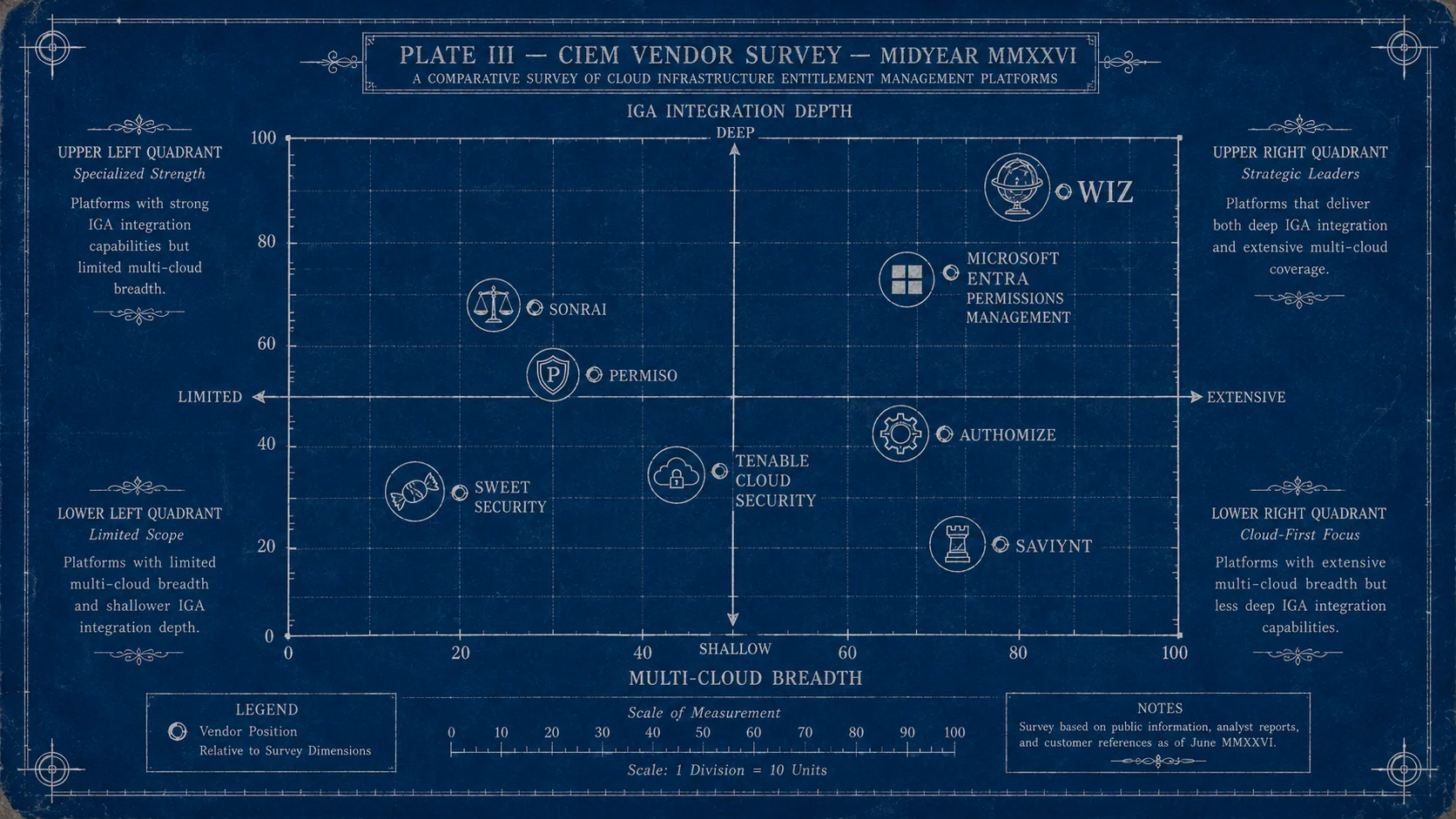 Mid-2026 vendor landscape. The market consolidated through 2024-25 but still presents real procurement choice. Pick on multi-cloud breadth, IGA integration depth, and alignment with existing cloud-security tooling.
Where CIEM breaks operationally
Four failure modes recur in 2026 CIEM deployments. Each is operationally addressable when treated as a design constraint; each is also common when teams deploy CIEM as a tool and not as part of a broader operational discipline.
Alert fatigue from least-privilege findings. The CIEM platform identifies thousands of right-sizing opportunities across the cloud landscape. The team can't action all of them — there isn't enough time, and many findings are low-risk. The pattern produces a backlog that grows faster than the team can drain it, and after a few months the findings start getting dismissed without engagement. The mitigation is risk-weighted prioritization (high-blast-radius findings first — admin permissions, unused but dangerous permissions, machine identities with elevated entitlements that haven't been active) combined with integration into the IGA workflow so findings flow into remediation queues with owner assignment.
Cloud-native developer friction. Least-privilege recommendations sometimes break workload functionality. The developer is iterating on a new feature, the CIEM platform recommends narrowing the workload's permissions to exclude one the developer hasn't started using yet but plans to, the narrowing breaks the iteration cycle. Developers learn to route around the CIEM platform's recommendations — either by getting them dismissed or by working in environments where they're not enforced. The mitigation is pre-production CIEM that catches issues in dev/staging before they reach production, plus developer-friendly remediation UX that explains why the recommendation is being made and offers fast paths to exceptions when needed.
Multi-cloud integration gaps. The CIEM platform supports the primary cloud well but produces shallower visibility on the secondary and tertiary clouds. The enterprise has 95% visibility on AWS, 70% on Azure, 40% on GCP — but the 30% gap on GCP is where the dormant attack surface accumulates. The mitigation is vendor selection that matches the actual cloud landscape; if the enterprise is genuinely multi-cloud, a platform with balanced multi-cloud depth (or composing multiple platforms with strong integration) is required.
Machine-identity sprawl tolerance. CIEM identifies machine identities but doesn't directly govern their lifecycle. The platform tells you the inventory exists; it doesn't necessarily prevent new identities from being created without authorization or ensure dormant ones get cleaned up. Identities accumulate over time even with CIEM in place. The mitigation is composition with the NHI / Service Account Governance pattern for the lifecycle layer — CIEM observes; NHI governance acts on the lifecycle.
The four failure modes share a structural property: CIEM is a discovery and analysis layer, and it produces value only when the findings flow into remediation operationally. Deployments that treat CIEM as a tool without the surrounding operational discipline produce dashboards full of findings and no measurable reduction in attack surface.
How CIEM composes with the broader identity-security stack
CIEM is one layer in the 2026 identity-security envelope, not a replacement for any of the others. The composition with adjacent layers determines whether the deployment produces operational value.
CIEM + IGA. CIEM findings flow into IGA's recertification and remediation workflows. The IGA platform handles the workflow side — owner assignment, approval routing, remediation tracking, audit trail. CIEM handles the analysis side — effective-permission computation, usage baselining, right-sizing recommendations. The two compose into closed-loop remediation. Without IGA integration, CIEM produces findings that don't flow into action.
CIEM + PAM. Cloud privileged access — admin access to AWS accounts, owner access to Azure subscriptions, project-owner roles in GCP — intersects with traditional privileged access. The PAM piece covers the privileged-access platform layer; CIEM identifies cloud privileged entitlements that the PAM platform should be governing (and often surfaces gaps where they aren't). The two compose: CIEM tells you what cloud privileged access exists; PAM controls who can use it and how.
CIEM + ISPM. The ISPM piece covers the broader identity-posture audit category. ISPM covers the full identity surface (workforce + machine + agent identities, across all systems including on-prem); CIEM is the cloud-specific instance with deeper cloud-platform-aware analysis. Mature deployments use both — ISPM for the broad coverage, CIEM for the cloud-deep coverage. Some vendors offer both capabilities in one platform; others position separately.
CIEM + NHI / Service Account Governance. The Service Account Governance / NHI piece covers the machine-identity inventory and lifecycle pattern. CIEM observes the machine-identity inventory in the cloud; NHI governance acts on the lifecycle. The two compose for cloud machine identities specifically.
CIEM + ITDR. The ITDR piece covers the threat-detection layer for active attacks. ITDR detects when an identity is being misused; CIEM identifies whether the identity should have had the permissions that enabled the misuse. The composition catches both the active threat (ITDR) and the latent exposure (CIEM).
The 2026 reference path
Deploy CIEM if your cloud landscape is at the scale or complexity where IGA alone can't handle the entitlement governance. The threshold varies by environment, but most enterprises with three or more AWS production accounts, or Azure footprints over 50 subscriptions, or multi-cloud (AWS + Azure + GCP) at any scale benefit from CIEM. Smaller or single-cloud deployments may not justify the platform.
Pick the vendor based on actual cloud landscape and existing tooling. Wiz if you're already on Wiz for broader cloud security. Microsoft Entra Permissions Management if Microsoft is your identity stack. Sonrai or Permiso if you want CIEM-specific depth. Saviynt if your strategy is IGA-led and you want CIEM integrated into the IGA platform.
Integrate with IGA from the start. CIEM findings have to flow into remediation workflows; deployments without IGA integration produce dashboards that don't drive action. The architectural pattern is CIEM as the analysis layer, IGA as the workflow layer, both feeding the broader identity audit trail.
Prioritize findings by risk. The CIEM platform produces thousands of findings; the team can't action all of them. Risk-weighted prioritization — admin permissions first, unused but dangerous permissions next, dormant machine identities with elevated entitlements after that — produces operational progress.
Address developer friction explicitly. Pre-production CIEM, developer-friendly remediation UX, fast exception paths. Without these, developers route around the platform and the findings backlog grows without operational improvement.
Compose with the broader stack. IGA workflow, PAM for privileged access, ISPM for posture audit, NHI governance for machine-identity lifecycle, ITDR for active threats. The composition is what produces the 2026 identity-security envelope; CIEM alone covers the cloud-entitlement subset.
CIEM is one of the meaningful 2026 architectural additions available to enterprise identity programs operating in cloud-mature environments. The analyst category is mature, the vendor landscape is procurement-ready, the operational patterns are well-understood. Deploy it deliberately as part of the broader identity-security stack, not as a standalone tool.
ABOUT THE AUTHOR

More from IAM & Identity Governance

Identity Management and Digital Transformation in 2026
Every major transformation initiative — cloud migration, remote and hybrid work, mergers and acquisitions — eventually stalls on the same question: who gets access to what, and who decided? The 2026 strategy reference on identity management as the enabler and the bottleneck of digital transformation, the business case executives actually fund, and what modernization does not fix.

AI and Behavioral Analytics for Identity Monitoring: The 2026 Enterprise Reference
Static identity rules catch the attacks that announce themselves. They miss the ones that log in with valid credentials and behave almost normally. The 2026 reference on AI-driven identity monitoring — what behavioral analytics actually detects, the four telemetry sources that make or break the model, the false-positive economics nobody budgets for, and the honest limits of anomaly detection at enterprise scale.
Security Team Collaboration: A 2026 Framework for Identity Programs
Identity governance fails when it runs as a security-team-only initiative. The 2026 framework for cross-functional collaboration: four stakeholder groups, three coordination models, and how zero trust makes it a shared discipline.