The Unexpected Challenges of Identity Management 2026: Seven Hidden Failure Modes Every Program Underestimates
Every mature identity program clears the obvious hurdles — SSO is live, MFA is enforced, IGA is deployed, PAM covers privileged accounts. And every mature identity program still gets breached through a set of hidden failure modes that don't appear on the architecture diagram. The 2026 enterprise reference on the seven challenges that undermine identity programs after the obvious problems are solved — shadow admins, HRIS-drift orphans, break-glass credential rot, service account sprawl, permission drift over time, cross-cloud entitlement mismatch, and federated audit-trail gaps.
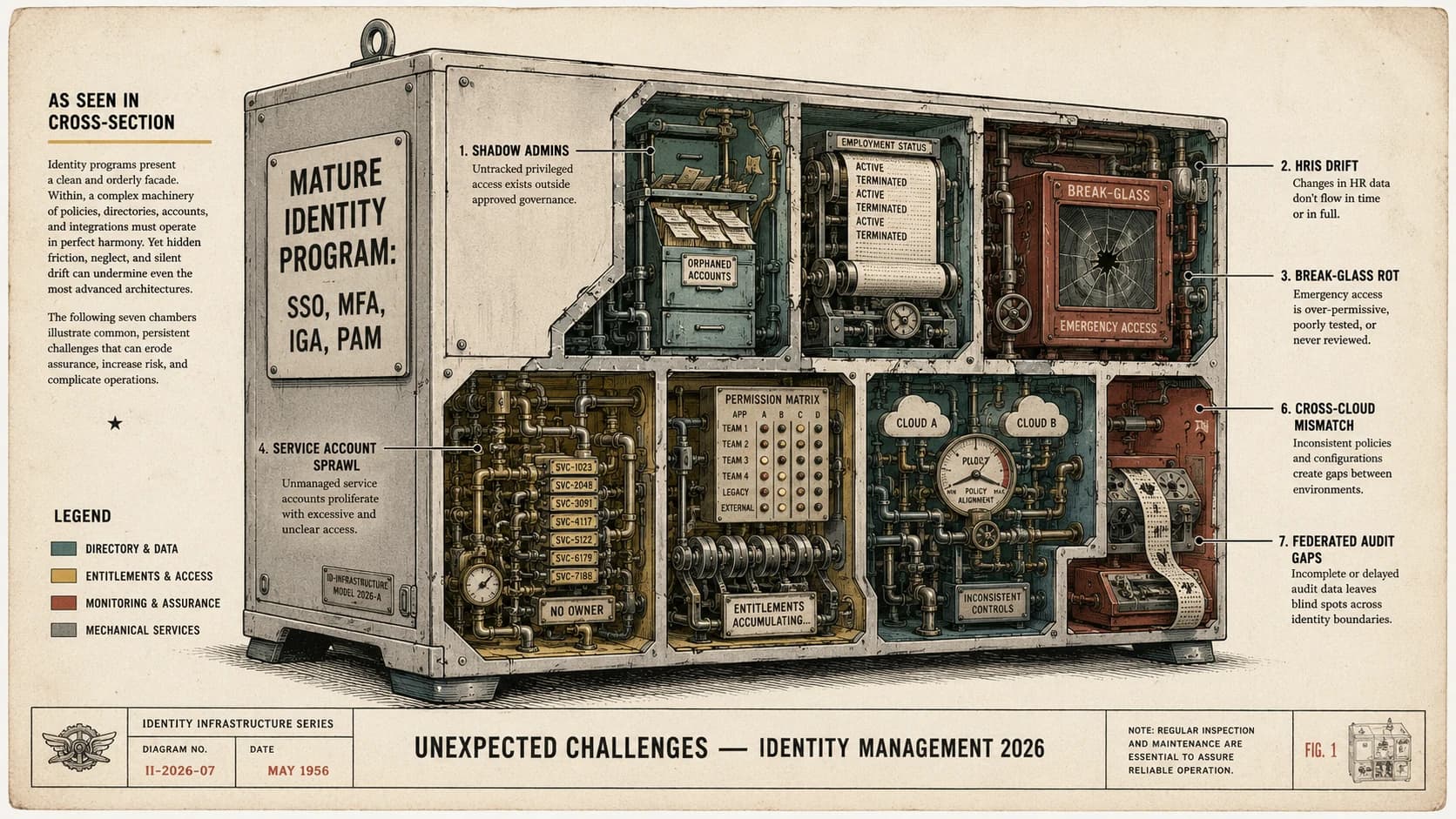
Every mature identity program clears the obvious hurdles — SSO is live, MFA is enforced, IGA is deployed, PAM covers privileged accounts. And every mature identity program still gets breached through a set of hidden failure modes that don't appear on the architecture diagram. The 2026 enterprise reference on the seven challenges that undermine identity programs after the obvious problems are solved — shadow admins, HRIS-drift orphans, break-glass credential rot, service account sprawl, permission drift over time, cross-cloud entitlement mismatch, and federated audit-trail gaps.
- Every mature identity program clears the visible hurdles — SSO deployed, MFA enforced, IGA operational, PAM covering privileged accounts. Every mature identity program still carries a set of hidden failure modes that don't appear on the architecture diagram. The 2026 enterprise reference identifies seven challenges every program underestimates.
- The seven hidden failure modes: (1) shadow admins who inherit privilege through nested group membership nobody audits, (2) HRIS-drift orphan accounts created by identity systems that trust an authoritative source that has itself drifted from operational reality, (3) break-glass credential rot where emergency-access accounts become the highest-value targets in the environment because they're rarely tested, (4) service account sprawl where non-human identities outnumber humans and receive almost no governance attention, (5) permission drift where accumulated entitlements from years of role changes and project assignments are never pruned, (6) cross-cloud entitlement mismatch where the same identity has fundamentally different permission profiles across AWS/Azure/GCP because no unified [CIEM](/en/blog/ciem-cloud-infrastructure-entitlement-management-2026/) layer normalizes them, and (7) federated audit-trail gaps where authentication events split across identity providers and never reconstruct end-to-end.
- Each failure mode has a diagnostic pattern the identity team can use to detect it in their environment, an operational remediation path, and an architectural change that reduces future recurrence. The failure modes recur because they emerge from the interaction between components rather than from any single component's misconfiguration — which is why single-component audits keep missing them.
- The composition matters as much as the individual failure modes. Shadow admins interact with permission drift (the drift produces the group memberships the shadow admin inherits from). HRIS-drift orphans interact with service account sprawl (orphan human accounts get repurposed as service accounts). Cross-cloud entitlement mismatch interacts with federated audit-trail gaps (the mismatch is only visible in a unified audit trail that doesn't exist). Treating them as independent failure modes produces incomplete remediation.
- The 2026 reference architecture positions [Identity Security Posture Management (ISPM)](/en/blog/identity-security-posture-management-ispm-2026/) as the layer that continuously detects the failure modes, [Identity Threat Detection and Response (ITDR)](/en/blog/identity-threat-detection-response-itdr-2026/) as the layer that responds to active exploitation, and [Service Account Governance](/en/blog/service-account-governance-non-human-identity-2026/) as the discipline that closes the non-human-identity gap. Composition across these layers is what turns visibility into remediation.
Every mature identity program clears the visible hurdles. Single sign-on is deployed and covers the majority of enterprise applications. Multi-factor authentication is enforced. Identity Governance and Administration is operational with periodic access reviews. Privileged Access Management protects the accounts that would produce the worst blast radius if compromised. The architecture diagram looks clean; the compliance auditor's checklist shows green.
And the mature program still gets breached — through failure modes that don't appear on the architecture diagram, don't show up in the vendor's product demo, and don't get caught by the access-review platform. The failure modes are unexpected because they don't emerge from any single component's misconfiguration. They emerge from the interaction between components, from the drift of individual components over time, and from the gaps between the human-workforce governance the identity program was designed around and the operational reality where non-human identities dominate the environment.
This piece is the 2026 enterprise reference on the seven hidden failure modes that undermine mature identity programs — shadow admins that inherit privilege through nested groups nobody audits, HRIS-drift orphan accounts where the identity system trusts a source of truth that has itself drifted from operational reality, break-glass credential rot where the emergency-access accounts are rarely tested and quietly become the highest-value targets in the environment, service account sprawl where non-human identities outnumber human identities and receive almost no governance attention, permission drift over time where accumulated entitlements from years of role changes and project assignments are never pruned, cross-cloud entitlement mismatch where the same identity has fundamentally different permission profiles across AWS/Azure/GCP because no unified CIEM layer normalizes them, and federated audit-trail gaps where the authentication events split across identity providers and never reconstruct end-to-end. Each challenge gets a diagnostic pattern the identity team can use to detect it, a remediation path, and an architectural change that reduces future recurrence.
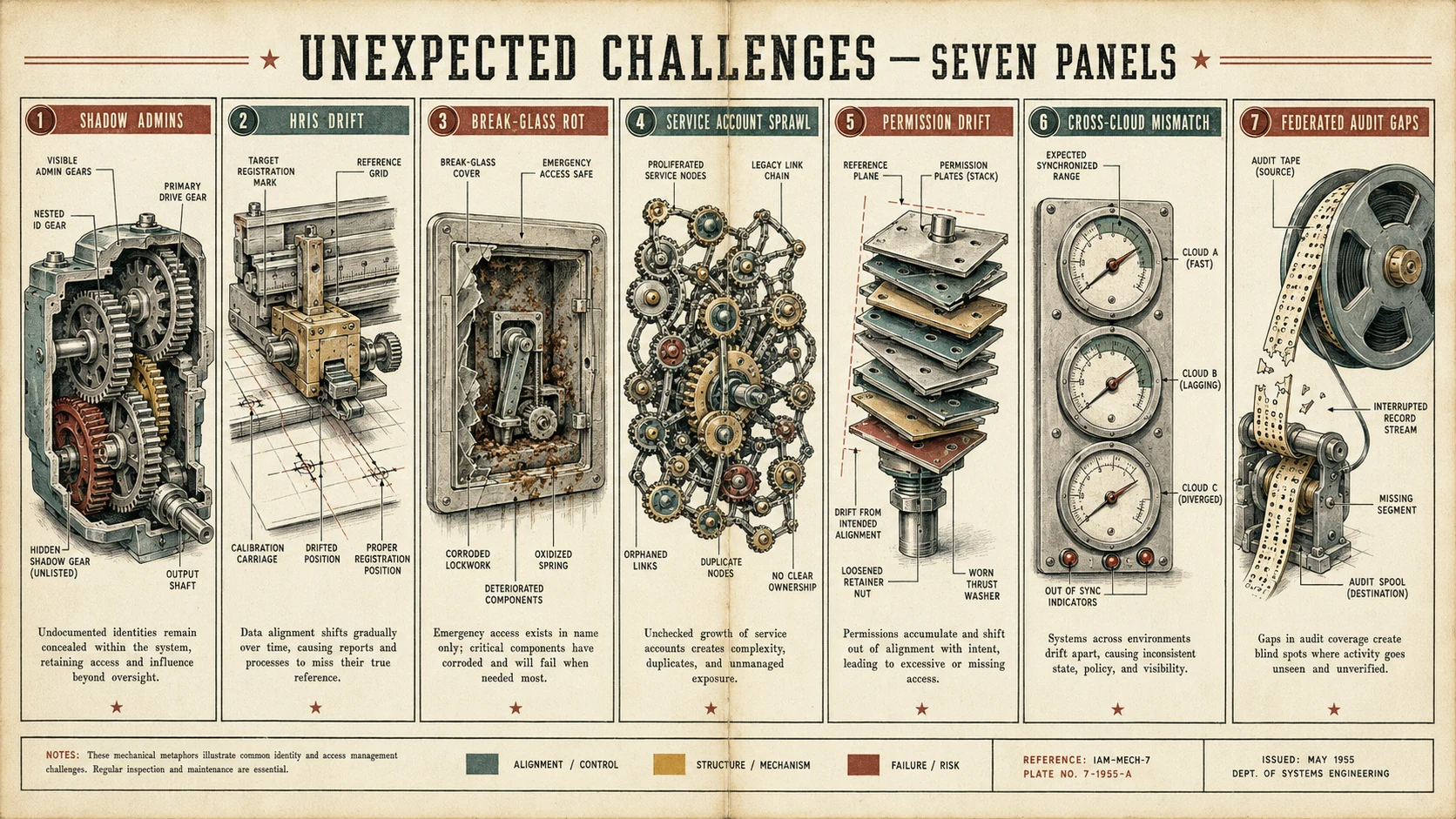 Seven failure modes, one architectural pattern. Each challenge emerges from the interaction between identity components rather than from any single component's misconfiguration — which is why single-component audits keep missing them.
Challenge 1: Shadow admins
A shadow admin is an identity that holds effective administrative privilege without being formally designated as an administrator in the identity system. The most common pattern is inherited privilege through nested group membership. A user is added to Group A for one purpose — access to a specific application, membership in a project team, inclusion in a distribution list. Group A is nested inside Group B for administrative convenience. Group B is nested inside Group C. Somewhere in the nesting chain, one of the groups receives an administrative role assignment. The user's direct group memberships don't show admin privilege; the user's effective permissions after nested-group expansion do.
The failure mode survives identity-program maturity because the access-review interface presents the wrong picture. Most access reviews audit direct role assignments rather than transitive computed permissions. The reviewer sees "user is a member of Marketing-Team-Distribution-List" and approves the assignment as reasonable; the reviewer doesn't see that Marketing-Team-Distribution-List is nested inside Marketing-Ops, which is nested inside Corporate-Ops, which holds a permission to modify shared drive access controls, which the shadow admin can use to grant themselves access to any drive in the organization.
The diagnostic pattern is straightforward once you know to look for it. Run a query that expands every group membership recursively and computes the effective permission set for every identity in the environment. Compare the effective permission set against the direct role assignments. The identities whose effective permissions substantially exceed their direct assignments are the shadow-admin candidates. In most mature environments, the query finds between two and twelve shadow admins the identity team was unaware of.
The remediation requires computing effective permissions rather than reviewing assigned permissions, which is a workload most access-review platforms weren't built for. The architectural change is treating the nested-group expansion as a first-class access-review input — every access review campaign computes effective permissions, presents them to the reviewer alongside the assigned permissions, and flags the delta as a specific attention item. The ISPM posture audit architecture is designed for exactly this pattern.
Challenge 2: HRIS-drift orphan accounts
The identity system trusts an HRIS platform — SAP SuccessFactors, Workday, BambooHR, ADP, UKG — as the authoritative source of truth for workforce identity. The identity system provisions accounts when a new hire appears in HRIS, updates entitlements when a role change appears in HRIS, and deprovisions accounts when a termination appears in HRIS. The architectural assumption is that HRIS accurately reflects operational reality.
HRIS drifts from operational reality in several ways. Contractors and consultants are frequently tracked in a separate vendor management system that doesn't feed HRIS, so the identity system never learns about their departure — the vendor management system marks the contract complete, but nothing propagates to identity provisioning. Employees who transition between employment types (full-time to contractor, contractor to full-time) may be reprovisioned as new identities while the old identity persists. Employees who move between subsidiaries or acquisition entities may be recreated in the acquiring entity's HRIS while the original entity's HRIS still shows them active. Employees marked "on leave" in HRIS produce accounts that the identity system keeps active indefinitely, even when the leave has extended into what should be a termination pattern. Employees terminated on a Friday may not appear as terminated in HRIS until Monday's provisioning cycle, producing a 72-hour window where the identity is still fully active despite operational separation.
Each pattern produces orphan accounts — identities that exist in the identity system but have no active human behind them. The orphans concentrate risk because they typically retain access to the same resources the active human had access to, are unlikely to have MFA re-enrolled or password rotations completed on schedule (because the human isn't there to interact with the notifications), and are rarely used in ways that would flag anomalous behavior in an ITDR system. The orphan account is a low-noise, high-privilege identity — exactly the target pattern that attackers look for.
The remediation isn't fixing the HRIS integration. Every HRIS integration will have drift; the drift is the operational failure mode, not a specific integration bug. The remediation is adding independent verification layers that catch the drift the HRIS integration alone will miss — last-login analytics that flag identities that haven't authenticated in over 90 days, usage-pattern analysis that flags identities whose access patterns have collapsed to zero, manager attestation cycles that require confirmation the identity should still be active, and integration with the vendor management system directly rather than relying on HRIS to represent contractor status. The IGA Project Failed piece covers the broader recovery pattern when the identity system has been running on drifted HRIS data for years.
Challenge 3: Break-glass credential rot
Every enterprise creates break-glass accounts — the emergency-access accounts that let administrators regain access when the primary authentication paths fail. SSO infrastructure goes down and administrators need to log in to the SSO infrastructure to fix it. MFA infrastructure is unavailable and administrators need to bypass MFA to reach the MFA infrastructure. The primary admin accounts are locked out through some misconfiguration and administrators need alternative access to unlock them. The break-glass accounts are the answer to these scenarios by design.
The accounts are supposed to be tightly controlled. Strong passphrase in a physical safe. Hardware token in a separate physical safe. Break-glass procedure requiring dual authorization to open both safes. Quarterly test of the procedure that rotates the passphrase, updates the token firmware, and validates the documentation. The controls are designed to make the accounts survive the operational failure modes they exist to handle, while making them essentially unavailable for routine use.
In operational practice, the accounts drift into a specific failure pattern. The passphrase is written down and stored in the safe, but it's not rotated after each use because the person who used it doesn't want to write down the new one and re-secure the safe. The hardware token is stored in the safe, but its firmware update requires connecting it to a workstation for an hour, which nobody has scheduled in the past 18 months. The break-glass procedure is documented in a runbook, but the runbook hasn't been executed in a real drill in over two years — the current administrators aren't sure whether the safe combinations still work, whether the token still boots, whether the documented recovery steps still apply to the current version of the identity infrastructure.
The rot combines with three architectural characteristics that make break-glass accounts the highest-value target in most mature environments. The accounts have MFA-bypass privilege by design — they can authenticate without the MFA infrastructure being available, which means an attacker who obtains the account credentials also gets to skip the MFA check. The accounts frequently have global administrative privilege because the emergency scenarios they were designed for require the ability to reach anywhere. And because the accounts are rarely used legitimately, any use of them should generate a strong alert — but in most environments, the alerting on break-glass accounts is configured for the initial deployment and then never validated against subsequent alerting infrastructure changes, so the alerts silently stop working.
The remediation combines regular scheduled tests of the break-glass procedure (which forces credential rotation as a side effect of the test), independent audit logging that fires alerts on any break-glass account use through a channel independent of the primary identity infrastructure, and split-knowledge cryptographic patterns that prevent any single individual from executing the break-glass procedure alone. The PAM piece covers the architectural pattern for break-glass management within the broader privileged-access lifecycle.
Challenge 4: Service account sprawl
Non-human identities outnumber human identities in every mature enterprise environment. Typical enterprise counts run 10-45x more non-human than human — service accounts for applications, application accounts for automation, API keys for integrations, workload identities for containers and Lambda functions, machine identities for infrastructure, robotic process automation accounts, ETL and data pipeline accounts, monitoring accounts, backup accounts, deployment accounts. The count of non-human identities grows linearly with the count of applications, integrations, and workloads — which grows exponentially with cloud adoption and microservice architectures.
The identity governance program treats non-human identities as a secondary concern because the program was designed for human workforce management. The joiner-mover-leaver lifecycle doesn't apply cleanly to service accounts — they're created for a purpose and then persist indefinitely. The access-review workflow doesn't apply cleanly — service accounts don't have a manager who can attest to their access requirements, and the technical owner recorded in the account metadata may have left the company years ago. The least-privilege discipline that the identity program applies to human accounts is often abandoned for service accounts, which frequently need broad standing privilege to function reliably in ways that make least-privilege scoping operationally difficult.
The sprawl produces three specific risk patterns. Service accounts with credentials that were rotated once at creation and never rotated again — because there's no automated rotation and manual rotation would require coordinating with every application that uses the credential. Service accounts owned by "the platform team" or "the DevOps group" as a collective ownership pattern that means nobody owns them individually and nobody feels responsible for their governance. Service accounts inherited from acquired companies whose original technical context has been lost — the identity team knows the account exists and is used, but nobody remembers what it's used for or whether it's still needed.
The remediation is Service Account Governance — the discipline covered in depth in our companion piece. The ownership taxonomy that assigns individual (not collective) ownership. The automated inventory pattern that continuously discovers service accounts across the environment. The rotation architecture that handles the coordination problem so credential rotation isn't manual. The deprecation workflow that identifies service accounts that haven't been used in the measurement window and processes them through a deprecation review. The failure mode isn't a lack of tooling; it's a lack of assigned discipline and ownership.
Challenge 5: Permission drift over time
Permission drift accumulates through the mismatch between how permissions are added and how permissions are removed. Permissions are added through many channels — role assignments during onboarding, project-specific provisioning for temporary team assignments, incident-response temporary grants that never get revoked when the incident closes, delegated access from a manager who is granting one-time help, self-service requests through the IGA portal, integration-driven grants when a user is added to a Slack channel or a SharePoint site or a Notion workspace or a Jira project. Permissions are removed through fewer channels — role changes that trigger provisioning updates, terminations that trigger deprovisioning, and periodic access reviews.
The imbalance between the many addition paths and the few removal paths means the arithmetic runs in one direction over time. An engineer with ten years of tenure at a company has accumulated permissions from ten years of role assignments, project rotations, temporary elevations, and integration-driven grants. If the engineer started in customer support, moved to backend engineering, moved to platform engineering, and is now on the security team, they likely still hold customer support tool access, backend engineering resource access, and platform engineering infrastructure access — because the identity system's removal channels never caught the transitions.
Access reviews catch some of the drift, but access reviews suffer from their own failure modes. The reviewer often lacks the context to evaluate whether a specific entitlement is still needed. The reviewer sees "Engineer X has access to customer support ticketing platform" and doesn't know whether Engineer X still occasionally handles customer escalations, so the safe answer is "approve." The safe answer accumulates across thousands of entitlement decisions, across quarterly reviews, across years of program operation. The drift compounds.
The Principle of Least Privilege piece covers the continuous right-sizing pattern that closes the gap — the identity platform observes which permissions are actually used versus granted over a measurement window and automatically removes the unused ones. The pattern converts the drift's direction — from monotonic accumulation to continuous equilibrium. The MFA vs IGA piece on ICC calls the accumulated entitlement pattern "toxic entitlement accumulation" — the attack vector that MFA structurally cannot stop because the entitlements are held by the legitimate user whose MFA works correctly.
Challenge 6: Cross-cloud entitlement mismatch
The same identity — a specific engineer, an SRE, a security responder, a data scientist — holds fundamentally different permission profiles across AWS, Azure, and GCP because no unified CIEM layer normalizes them. The mismatch emerges from independent adoption timelines. The AWS estate was adopted first, has the most mature governance discipline, uses tightly scoped IAM roles with resource-scoped policies and JIT elevation for admin tasks. The Azure estate was adopted second, has intermediate governance discipline, uses Contributor role at the subscription level for most engineers because that's what the initial rollout established. The GCP estate was adopted most recently, has the least mature governance discipline, uses broad Editor or Owner roles at the project level because the workloads are still being stabilized.
The same engineer holds tightly scoped AWS access, moderately broad Azure access, and very broad GCP access — not because the engineer's job requires different scopes across clouds, but because the platform teams reached different governance maturity levels at different times. The identity risk from the mismatch is asymmetric. An attacker who compromises the engineer's identity will use the least-scoped cloud as the entry point — GCP, in this pattern — and will find broad permissions that support lateral movement, resource creation, and data exfiltration. The attacker then moves toward equivalent access in the tighter-scoped clouds through indirect paths — federated roles that assume across clouds, shared secrets stored in one cloud but usable in others, cross-cloud replication that grants read access to data that the tighter-scoped access model was designed to protect.
The remediation requires the CIEM layer that provides a unified view of entitlement across clouds, along with the discipline to converge the profiles down to consistent least-privilege scope across all three environments. Without the unified view, the mismatch is only visible through incident forensics after a breach — the security team reconstructs the attack path after the fact and discovers the mismatch was the enabling condition. The CIEM piece covers the architectural pattern in depth: the entitlement inventory across clouds, the normalized permission model that maps cloud-specific IAM primitives to a unified vocabulary, and the right-sizing workflow that converges the profiles down to what the identity actually uses across environments.
Challenge 7: Federated audit-trail gaps
An authentication event or an access decision in a modern enterprise environment frequently splits across multiple identity providers. The user authenticates through the workforce IdP (Azure AD, Okta, Ping). That IdP asserts identity through federation to a cloud provider IdP (AWS IAM Identity Center, Google Cloud Identity, Azure AD federation to Azure resources). The cloud provider IdP issues session tokens. The session tokens are used against a resource that logs the access into a fourth audit system (the application's own audit log, or a database audit trail, or a specific service's activity log).
The four audit trails live in four different platforms, with four different formats, four different retention policies, and four different correlation identifiers. Reconstructing the end-to-end flow — "what did the user actually do in the fifteen minutes after they authenticated?" — requires correlating across all four systems, and the correlation isn't automatic. The user's identity in the workforce IdP has a specific SID; the identity in the cloud IdP after federation has a different principal identifier; the session token has yet another identifier; the application audit log records the identifier the application actually saw, which may be either the cloud identifier or a derivative depending on how the application receives identity.
Identity abuse hides in the gaps between the audit trails. The attacker's actions are individually visible in each system — the workforce IdP recorded the authentication, the cloud IdP recorded the federated session establishment, the session token was recorded in the token issuance log, the application recorded the access. But the trail across systems doesn't reconstruct without dedicated correlation work, and most environments don't do the correlation continuously. The abuse is discovered — if it's discovered — only during post-incident forensics when someone spends days reconstructing the timeline manually.
The remediation combines centralized log ingestion (SIEM), identity-specific detection tooling (ITDR) that understands the federation flow and correlates across the trail fragments, and the operational discipline of consistent correlation-ID propagation across the federated authentication chain. Most 2026 environments have some version of this gap; mature environments have measured the gap, have a plan to close it, and have specific detection rules that fire when a federated chain shows patterns consistent with abuse — access from unfamiliar cloud IdP session tokens, cross-cloud federated access from a workforce IdP session that hasn't been recently reauthenticated, application-level access that can't be traced back to a workforce IdP authentication event within a reasonable window.
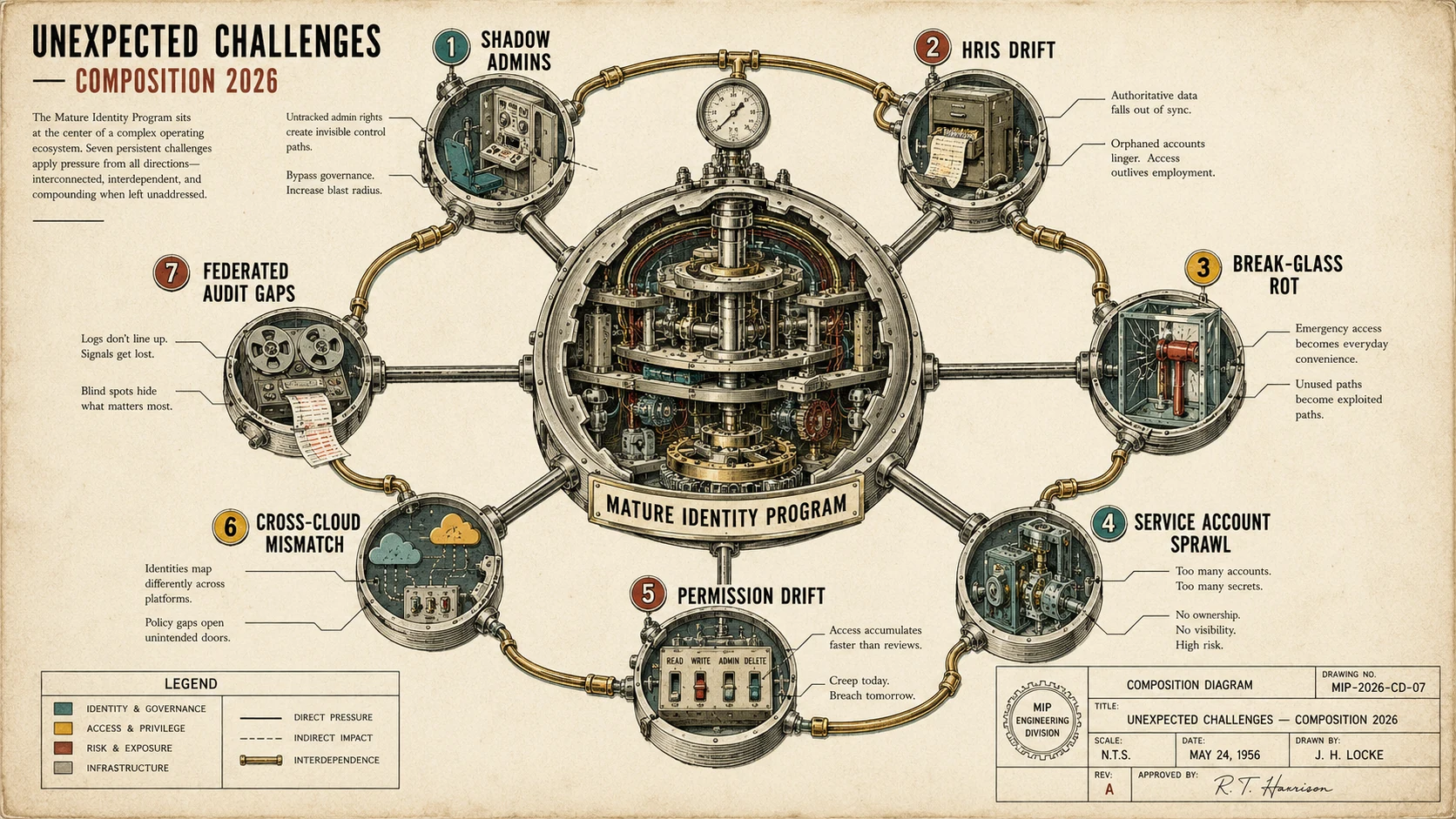 The seven challenges interact rather than existing independently. Effective remediation treats them as a composed system rather than a set of independent issues.
Why single-component audits keep missing them
The seven failure modes recur across mature identity programs because they emerge from the interaction between components rather than from any single component's misconfiguration. The IGA platform is configured correctly. The SSO IdP is configured correctly. The PAM system is configured correctly. Every individual component passes its audit. The failure mode lives in the space between them.
Shadow admins emerge from the interaction between group management (typically in Active Directory or Azure AD) and the access review workflow (typically in the IGA platform) — the group management supports arbitrary nesting depth, the access review doesn't compute effective permissions after nesting expansion. Neither component is misconfigured; the interaction produces the gap.
HRIS-drift orphans emerge from the interaction between the HRIS integration and the operational reality that produces contractor status, subsidiary movement, leave-of-absence patterns, and termination-cycle lag. The HRIS is configured correctly for what it tracks; the integration is configured correctly for how it processes HRIS updates; the drift is the operational reality that neither component was designed to model.
Break-glass credential rot emerges from the interaction between the break-glass account design (which requires infrequent use) and the operational realities of documentation freshness, credential rotation discipline, and alert-configuration drift over time. The account is configured correctly at design time; the operational reality erodes the controls over quarters and years.
Service account sprawl emerges from the interaction between application architectures (which produce ever more non-human identities as microservices, automation, and integrations grow) and the workforce-centric governance model of the identity program.
Permission drift emerges from the interaction between the many addition paths and the few removal paths, and from the interaction between the reviewer's context-limited judgment and the growing volume of entitlements they're asked to certify.
Cross-cloud entitlement mismatch emerges from the interaction between independent cloud-team maturity levels and the absence of a unifying CIEM layer.
Federated audit-trail gaps emerge from the interaction between multiple identity provider ecosystems and the absence of dedicated correlation infrastructure.
The pattern is consistent. Every one of the seven challenges lives in the interaction space between components. Single-component audits look at individual configurations. The failure modes require a composition-level audit — one that traces the interactions across components rather than validating each component independently.
The 2026 remediation architecture
The Identity Security Posture Management (ISPM) layer is the architectural pattern designed for detecting the seven failure modes continuously rather than on periodic audit cycles. ISPM computes effective permissions across nested group hierarchies (shadow admin detection). ISPM correlates identity activity against HRIS records with independent signal (HRIS-drift detection). ISPM monitors break-glass account status and alerts on stale credentials or missed test cycles (break-glass rot detection). ISPM inventories non-human identities alongside human identities and applies governance workflows to both (service account sprawl detection). ISPM measures permission drift over time and flags entitlements without recent use (permission drift detection). ISPM composes with CIEM for cross-cloud entitlement normalization (cross-cloud mismatch detection). ISPM ingests audit-trail data from federated identity providers and correlates across them (federated audit-trail gap detection).
The Identity Threat Detection and Response (ITDR) layer is the architectural pattern designed for responding to active exploitation of the seven failure modes. ITDR detects the anomalous authentication patterns that indicate shadow admin abuse, break-glass account use outside the sanctioned procedure, orphan account reactivation, service account use outside its normal pattern, permission drift being exploited for lateral movement, cross-cloud lateral movement through federated sessions, and audit-trail gap exploitation through unusual session-token use.
The Service Account Governance discipline closes the non-human-identity gap directly.
The composition matters. ISPM without ITDR produces visibility without response — the failure modes are detected but not addressed at runtime. ITDR without ISPM produces response without visibility — active exploitation is caught but the underlying failure modes recur. Service Account Governance without integration into the broader ISPM/ITDR architecture produces a governance discipline in isolation from the security posture. The 2026 reference architecture composes all three.
The seven challenges as a diagnostic checklist
Every identity program can run a self-diagnostic against the seven failure modes. The diagnostic doesn't require new tooling — it requires the willingness to look for the patterns.
For shadow admins: run a query that computes effective permissions after nested group expansion for every identity in the environment. Compare against direct role assignments. Investigate identities whose effective permissions substantially exceed their direct assignments.
For HRIS drift: identify identities that haven't authenticated in the past 90 days. Cross-reference against HRIS records. Investigate identities that HRIS shows active but authentication logs show dormant.
For break-glass credential rot: audit the break-glass account documentation. When was the last successful test of the break-glass procedure? When was the last credential rotation? When was the alerting configuration last validated? If any answer is "more than six months" or "not sure," the credentials have rot.
For service account sprawl: pull a count of non-human identities in the environment. Compare against the count of governance workflows that apply to non-human identities. If the count of non-human identities substantially exceeds the coverage of governance workflows, the sprawl is real.
For permission drift: pick five long-tenured identities. Compare their current effective permission set against the permission set implied by their current role. The delta between them is the drift on those identities. Scale accordingly.
For cross-cloud entitlement mismatch: pick five identities that hold access across AWS, Azure, and GCP. Compare their scope in each cloud. If the scope varies substantially across clouds, the mismatch is real.
For federated audit-trail gaps: pick a recent significant authentication event by a specific user. Reconstruct the audit trail from the workforce IdP through the cloud IdP through the session tokens through the application-level access log. Measure how long the reconstruction takes and whether it produces a complete picture. If reconstruction is difficult, the gaps are real.
Closing
The unexpected challenges of identity management in 2026 aren't the challenges the identity program was designed to handle. The program handled those — SSO deployed, MFA enforced, IGA operational, PAM protecting privileged accounts. The unexpected challenges are the ones that emerge from the interaction between mature components, from the drift of individual components over time, and from the gaps between the workforce-centric governance the program was built around and the operational reality dominated by non-human identities, federated authentication flows, and cross-cloud complexity.
The seven challenges — shadow admins, HRIS drift, break-glass rot, service account sprawl, permission drift, cross-cloud entitlement mismatch, federated audit-trail gaps — are the failure modes that undermine mature programs. Each has a diagnostic pattern the identity team can run against their own environment. Each has a remediation path that composes with the existing identity architecture rather than replacing it. Each becomes tractable once the identity team is willing to look for it. The 2026 reference architecture — ISPM for continuous detection, ITDR for active response, Service Account Governance for the non-human gap — provides the composition that turns the diagnostic into ongoing remediation.
The programs that address the seven unexpected challenges are the programs that don't get breached through them.
ABOUT THE AUTHOR

More from IAM & Identity Governance

Identity Management and Digital Transformation in 2026
Every major transformation initiative — cloud migration, remote and hybrid work, mergers and acquisitions — eventually stalls on the same question: who gets access to what, and who decided? The 2026 strategy reference on identity management as the enabler and the bottleneck of digital transformation, the business case executives actually fund, and what modernization does not fix.

AI and Behavioral Analytics for Identity Monitoring: The 2026 Enterprise Reference
Static identity rules catch the attacks that announce themselves. They miss the ones that log in with valid credentials and behave almost normally. The 2026 reference on AI-driven identity monitoring — what behavioral analytics actually detects, the four telemetry sources that make or break the model, the false-positive economics nobody budgets for, and the honest limits of anomaly detection at enterprise scale.
Security Team Collaboration: A 2026 Framework for Identity Programs
Identity governance fails when it runs as a security-team-only initiative. The 2026 framework for cross-functional collaboration: four stakeholder groups, three coordination models, and how zero trust makes it a shared discipline.