AI-Driven Identity Risk Scoring in 2026: The Enterprise Reference
AI-driven identity risk scoring turns authentication, entitlement, and behavior signals into a live per-identity risk number that drives step-up auth, reviews, and revocation. The 2026 reference.
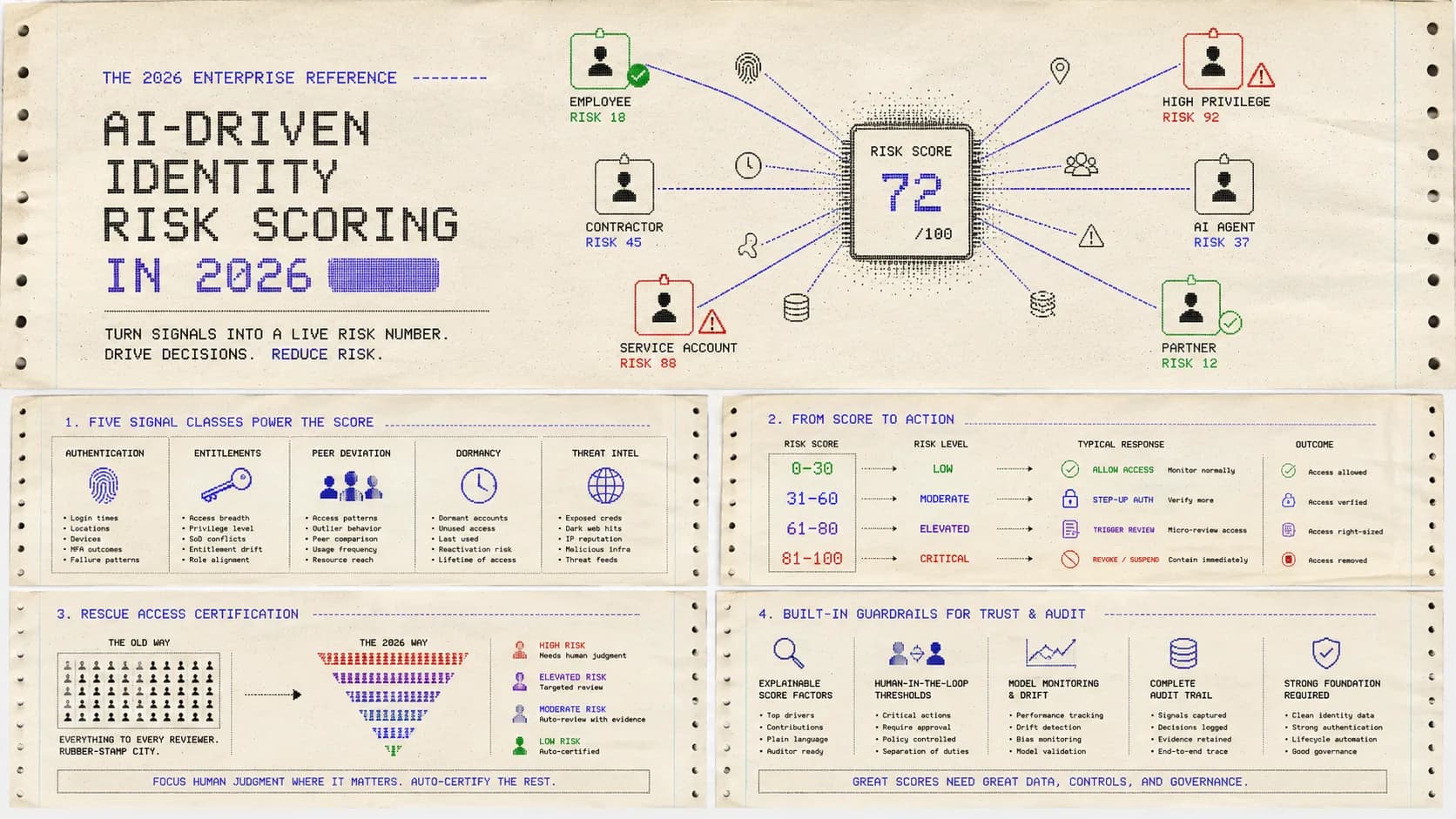
AI-driven identity risk scoring turns authentication, entitlement, and behavior signals into a live per-identity risk number that drives step-up auth, reviews, and revocation. The 2026 reference.
- AI-driven identity risk scoring computes a continuously updated risk number for every identity — human and non-human — from signals like authentication anomalies, entitlement drift, peer-group deviation, dormancy, and external threat intelligence, then uses that number to drive access decisions instead of leaving them to calendar-based review cycles.
- The score is only as good as its signal pipeline. Five signal classes matter most: authentication behavior, entitlement accumulation relative to role, deviation from peer-group access patterns, dormant-but-live access, and threat intelligence about the identity's credentials appearing where they should not.
- A score that never changes a decision is a dashboard, not a control. The defensible pattern wires scores to graduated responses — step-up authentication at moderate risk, triggered micro-reviews at elevated risk, and automated suspension of clearly compromised or policy-violating access — each with evidence captured.
- Risk scoring is what rescues access certification from rubber-stamping: it shrinks reviewer queues to the items where judgment matters, auto-certifies the low-risk repeat tail with evidenced logic, and turns quarterly attestation theater into targeted verification.
- Guardrails are not optional. Explainable score factors, human-in-the-loop thresholds for consequential actions, model drift monitoring, and a complete audit trail are the difference between a risk engine auditors accept and one they write findings about — and scoring does not fix broken identity data, weak authentication, or missing lifecycle automation.
AI-driven identity risk scoring is the practice of computing a continuously updated risk number for every identity in the enterprise — employee, contractor, service account, AI agent — from correlated signals: authentication behavior, entitlement drift, peer-group deviation, dormancy, and external threat intelligence. The score then drives decisions that used to wait for a calendar: step-up authentication now, a targeted access review today, an automated suspension the moment compromise indicators converge. If you are evaluating tools that provide AI-driven risk scoring for identities, the short answer is that the capability ships in four converging categories — IGA platforms, ITDR tools, ISPM tools, and adaptive access management — and the FAQ below breaks down how to tell them apart.
This piece is the 2026 update of our original article on risk scoring and AI-driven user and access risk assessment, rewritten for the current landscape: non-human identities that outnumber people, AI agents entering the identity population, auditors who now probe how AI-assisted decisions are evidenced, and a vendor market that has learned to put "AI risk scoring" on everything. The update also removes the borrowed statistics — this is a reference on how the mechanism works and where it fails, and the mechanism is more convincing than the numbers ever were.
Why identity risk went unscored for so long
Every identity program has always had an implicit risk model. The domain admin got more scrutiny than the intern; the finance system got a quarterly review while the cafeteria menu app got none. The problem was never that enterprises ignored identity risk — it was that the model lived in people's heads, got applied at quarterly intervals, and evaluated each fact in isolation.
That worked, barely, when identities numbered in the low thousands and lived in one directory. It stopped working when three things compounded. Cloud sprawl multiplied the entitlement surface across hundreds of SaaS and infrastructure permission models, so no human could hold the access map in their head. Credential-driven attacks became the dominant intrusion pattern — the modern breach opens with a legitimate login, not an exploit, which means the difference between an attacker and an employee is behavioral, not binary. And non-human identities became the majority population: service accounts and workload identities that never change jobs, never leave through HR, and have no manager watching them.
Manual review at quarterly cadence cannot evaluate behavioral risk across that population. A static rule engine cannot either — rules fire on single conditions, and real risk is a correlation problem. An impossible-travel login is noise on its own. An impossible-travel login by a dormant account that recently gained a privileged entitlement no peer holds is a signal worth acting on within minutes. Evaluating that kind of conjunction, continuously, across every identity, is precisely the shape of problem machine learning is good at — which is why risk scoring is the load-bearing pattern in any serious effort at integrating AI into an IAM strategy, not a feature bolted on afterward.
What feeds the score: five signal classes
A risk score is a claim about an identity, and the claim is only as good as its evidence. Before evaluating any scoring engine, ask what it ingests. Five signal classes carry most of the weight in production systems.
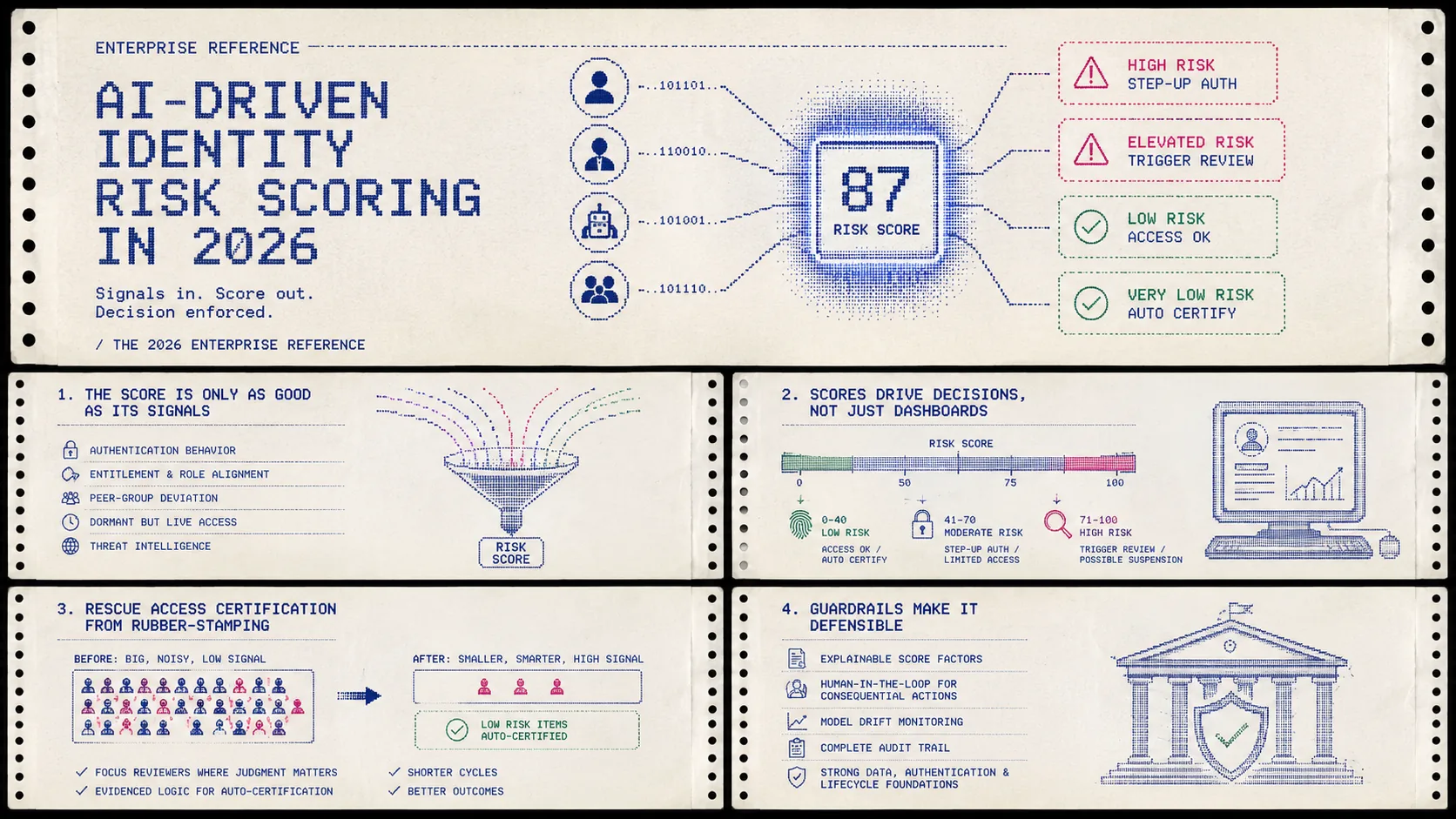 Signals in, score out, decision enforced — the whole pipeline on one page, from input classes through routing bands to the guardrails.
Authentication signals. Login times, source networks, device posture, geographic velocity, MFA outcomes, failure-then-success sequences — evaluated against the identity's own learned baseline, not a global rule. The analyst who logs in from a new country is an anomaly; the sales engineer who does it weekly is not.
Entitlement signals. What the identity can touch, how privileged those grants are, and how far the accumulated set has drifted from what the current role requires. Entitlement drift is the slow-motion risk: every mover event that adds without removing ratchets effective privilege upward, and drift is invisible to any system that looks at logins alone.
Peer-group signals. How the identity's access and behavior compare to colleagues with similar roles. The outlier grant — the entitlement nobody else on the team holds — is one of the strongest single indicators in the discipline, because it is exactly what both over-provisioning and privilege escalation look like from the outside.
Activity and dormancy signals. Access held but never exercised, usage at anomalous hours or volumes, sudden interest in resources the identity never touched. Dormant-but-live privileged access is the classic pre-breach condition: nobody is watching an account nobody uses.
External signals. Threat intelligence indicating the identity's credentials have surfaced in breach corpora, or that its behavior matches known attack technique patterns. This is the class that connects the identity estate to the wider threat landscape rather than treating the enterprise as a closed system.
The engineering substance is in the correlation, and correlation requires a unified signal pipeline — the same foundation described in our piece on AI analytics for identity monitoring. A scoring engine reading only the IdP's login events is scoring a fraction of the evidence and will be confidently wrong in both directions.
How the models turn signals into a score
Under the vendor vocabulary, most production scoring engines combine three model behaviors.
Baselining. The system learns what normal looks like — per identity and per peer group — across temporal patterns, geography, resource usage, and request behavior. Baselines are what let the engine treat the same raw event differently for different identities, which is the entire advance over static rules.
Contextual weighting. Not all anomalies are equal, and not all identities are equal. The same deviation scores higher on an identity with privileged entitlements, access to regulated data, or a role in the payment path. Resource sensitivity, privilege level, and business context multiply the behavioral signal. This is where scoring differs most from detection: detection asks whether an event is anomalous, scoring asks how much the anomaly matters here.
Feedback learning. Reviewer decisions, investigation outcomes, and confirmed incidents flow back into the model. A flag that analysts repeatedly dismiss should score lower next time; a pattern that preceded a confirmed compromise should score higher. Without the feedback loop, false-positive rates stay flat and the operations team learns to ignore the engine — the failure mode that killed a generation of SIEM correlation rules.
Two honest caveats belong here rather than in the fine print. First, baselines learned during abnormal periods encode the abnormality as normal — a model trained during a reorganization will treat churn as baseline. Second, an attacker who moves slowly and mimics peer behavior can stay under a behavioral model's threshold. Scoring raises the cost of intrusion; it does not make intrusion impossible. That is one reason scoring complements rather than replaces the containment discipline covered in our piece on identity threat detection and response.
The decision loop: what a score is allowed to do
A score that never changes a decision is a dashboard. The value of the number is entirely in the loop it drives, and the defensible loop is graduated — proportional responses at defined thresholds, with evidence captured at every step.
Low band: monitor and streamline. Most identities, most of the time. Access continues, sessions run at normal lifetimes, and — this half is routinely forgotten — low risk should reduce friction: auto-approval of routine requests, auto-certification in campaigns. A risk engine that only ever adds friction is a tax; one that removes friction where evidence supports it pays for its own adoption.
Middle band: add friction and context. Step-up authentication, shortened sessions, an owner notification, a just-in-time check before a sensitive grant is exercised. Step-up deserves design attention of its own: for workforce segments without managed phones, the step-up ceremony needs a deviceless path — deviceless FIDO2 via Identity Challenge Card is the pattern we ship for exactly this gap — or the risk response silently becomes a lockout for the least-provisioned users.
Elevated band: trigger human review. A score spike opens a targeted micro-review of the specific anomalous access, routed to the entitlement owner, due in days — not filed for the next quarterly campaign. This is the event-driven certification pattern, and it is where scoring visibly changes governance outcomes: review effort lands where risk is, when it is there.
Top band: contain automatically. High-confidence compromise indicators or unambiguous policy violations justify automated suspension or privilege reduction — with a named notification, a fast reinstatement path, and the full signal evidence attached. Reserve automation for this band deliberately. A false-positive revocation of a production service account is an outage, and two of them are the end of the program's political capital.
The loop closes by feeding outcomes back into the score, and its aggregate view rolls up into posture: the same per-identity scores, aggregated across the estate, are the raw material of identity security posture management — standing privilege, dormant access, and misconfiguration measured as a population property rather than one identity at a time.
The certification rescue: where scoring proves itself first
If you want the single highest-return deployment of identity risk scoring, it is access certification. The traditional campaign fails architecturally: hundreds of undifferentiated line items per manager, no context, a real deadline, approve-all one click away. The certification completes at 98% and verifies nothing.
Scoring restructures the queue. The low-risk tail — previously certified, actively used, in-policy, peer-normal — is auto-certified with the logic evidenced for audit. Usage context and score factors are surfaced next to every remaining line. The reviewer gets a short, prioritized queue of items where judgment genuinely matters, reviewable in minutes. And between campaigns, score spikes open micro-reviews instead of waiting for the calendar.
The auditor conversation changes shape at the same time. Instead of sampling attestations and finding rubber stamps, the program can show why each auto-certification happened, which items were escalated to humans and why, and what got revoked as a result. That evidentiary story — not the AI itself — is what makes the pattern audit-defensible, and the preconditions are covered in depth in our piece on AI access certification campaigns.
Guardrails: what keeps the engine defensible
Every capability in this piece is also a liability if deployed without controls. Four guardrails separate a scoring engine that survives its first audit and its first bad week from one that does not.
Explainability. Every score must decompose into named, human-readable factors: dormant 94 days, privileged entitlement outside peer group, MFA failures from a new network. This is not a nice-to-have — reviewers cannot make real decisions on an opaque number, and auditors will not accept one. If the vendor cannot show you the factor breakdown for an arbitrary identity, the demo is over.
Human-in-the-loop thresholds. Define, as written policy, which actions the engine may take alone and which require a named human decision. The threshold placement is a business judgment — an outage-averse organization gates more; a breach-scarred one automates more — but the existence of a documented threshold is non-negotiable. "The model decided" is not an accountability answer.
Drift monitoring. Organizations change; models trained on last year's workforce quietly degrade. Track score distributions, false-positive rates, and outcome accuracy over time, and schedule recalibration as an operational routine rather than an emergency. A scoring engine is a production system with a maintenance budget, not an appliance.
Audit trail. Signals in, score out, action taken, human involved — recorded for every decision the system influences. The test is replayability: can you reconstruct, months later, exactly why an access was suspended or an entitlement auto-certified? If yes, the engine is a control. If no, it is a finding waiting for a fieldwork date.
Rollout sequencing is a guardrail in its own right. The programs that stick run the engine in observe-only mode first — scores computed and logged, no actions taken — long enough to validate factor quality against what analysts already know about the environment. Then they wire the middle band (step-up, triggered reviews), and only after the false-positive rate has earned trust do they enable top-band automation, starting with the identity populations where a wrong suspension is cheapest. Inverting that order — automation first, calibration later — is how organizations produce the outage that becomes the reason the engine is permanently set to observe-only.
There is a sixth, quieter guardrail: data quality. Scores computed over a stale entitlement catalog, wrong ownership mappings, or an HR feed that lags reality are precise measurements of fiction. Identity data hygiene is upstream of every model in this piece, and no amount of model sophistication compensates for it.
What Avatier ships toward this pattern
Avatier's position on risk scoring is that the score is connective tissue, not a product surface — it should show up as better decisions in the flows people already use, not as another dashboard nobody owns. Avatier Identity Anywhere ships AI-assisted access intelligence that baselines access patterns across peer groups, flags outlier grants and dormant privileged access, and drives risk-scored certification campaigns built around short contextual reviewer queues with an evidenced auto-certification tail. Self-service access requests pass policy and risk checks at request time rather than discovering violations a quarter later, and lifecycle automation converts mover and leaver events into immediate governance actions. Throughout, the scoring logic is surfaced — reviewers see why an item is in their queue, and auditors see why it was not.
The compliance posture behind the platform is public at the Avatier Trust Center: SOC 2 Type II audited with zero exceptions noted, ISO/IEC 27001:2022 certified, PCI DSS v4.0.1 compliant, CSA STAR Level 1 attestation, NIST 800-53 Rev. 5 aligned, and a CISA Secure-by-Design Pledge signatory. That is the same evidence-first standard this piece argues your risk engine should meet: claims are cheap, and audit artifacts are not.
ABOUT THE AUTHOR

More from IAM & Identity Governance

Industries That Need Identity Management Most in 2026
Eight industries carry regulatory or operational pressure that makes identity governance non-optional — and manufacturing has quietly become the hardest of them. The 2026 refresh maps each sector's identity problem, its frameworks, and the state-level mandates (TX-RAMP, StateRAMP, privacy acts) now underneath all of them.
Access Governance in 2026: The Definitive Enterprise Reference
Access governance is the discipline that answers one question continuously: does every identity in the enterprise hold exactly the access it should, right now? The 2026 reference on the five control surfaces, the access governance vs. IGA distinction, and where reviews collapse into rubber-stamping.
Measuring Security Culture: The KPIs That Matter in 2026
How organizations measure and improve security culture in 2026: leading vs. lagging indicators, behavioral KPIs, identity hygiene signals, survey instruments, and how to actually move the numbers.