DNS as Identity Infrastructure: A 2026 Reference
DNS resolution, DNSSEC integrity, and DNS poisoning as a credential-harvesting vector — the 2026 reference on treating DNS as identity infrastructure, not network plumbing.

DNS resolution, DNSSEC integrity, and DNS poisoning as a credential-harvesting vector — the 2026 reference on treating DNS as identity infrastructure, not network plumbing.
- DNS resolution sits ahead of every authentication protocol in the login path — it decides which server a client actually talks to before any credential, token, or certificate is evaluated, which makes it part of the identity and access-management control plane, not a separate networking layer.
- Federated SSO and OIDC/SAML discovery depend on DNS records (SRV, TXT, well-known endpoint hostnames) resolving to the correct identity provider; a manipulated or stale record silently redirects the discovery step to the wrong endpoint.
- DNSSEC adds cryptographic signing to DNS responses so a resolver can verify a record hasn't been forged in transit, which matters directly for authentication integrity when the record in question points at an identity provider, a federation metadata endpoint, or a password-reset domain.
- DNS cache poisoning and lookalike-domain redirection remain a practical credential-harvesting vector: an attacker who controls what a DNS query resolves to can present a convincing fake login page without touching the identity provider itself.
- DNS-over-HTTPS (DoH) improves query privacy for end users but removes the plaintext DNS visibility that security teams have historically used for detection — enterprises adopting DoH need an explicit plan for regaining that signal, not an assumption that existing DNS monitoring still works.
DNS resolution decides which server a login request actually reaches — before any credential, token, or certificate gets evaluated. That makes DNS part of the identity and access-management control plane, not a separate networking concern: SSO service-discovery records tell a client where its identity provider lives, DNSSEC provides a cryptographic integrity check on those records, and a poisoned DNS response can redirect a login form to an attacker-controlled server before a single authentication protocol runs. Treat DNS as IAM infrastructure and it becomes another layer to govern; treat it as plumbing and it becomes the layer nobody governs.
This is the 2026 update of Avatier's original DNS piece, published August 2025. That piece framed DNS broadly as a general pros-and-cons topic for IT infrastructure; this update narrows the scope deliberately to DNS's specific role in identity and access management — service discovery for SSO, DNSSEC as authentication-chain integrity, DNS poisoning as a credential-harvesting vector, and DNS-over-HTTPS as a visibility tradeoff for security teams — because that's the intersection most IAM programs still don't formally own.
DNS resolution is identity infrastructure, not network plumbing
Every authentication flow — password-based, federated SSO, OIDC, SAML — starts with a hostname that has to resolve before anything else can happen. A client application doesn't connect to "the identity provider"; it connects to whatever IP address DNS returns for the identity provider's hostname at that moment. That single fact is why DNS deserves a place in identity architecture reviews rather than being treated as a network-operations detail that IAM teams don't need to look at.
Service discovery is the specific mechanism at work. Historically, SRV records told clients where to find LDAP or Kerberos services on a network — a client would query _ldap._tcp.example.com and get back the hostname and port of an available directory server, without that address being hardcoded anywhere. Modern federated SSO uses a conceptually similar pattern: an OIDC relying party fetches a well-known configuration document (/.well-known/openid-configuration) from the identity provider's hostname, and a SAML service provider resolves a federation metadata URL to learn the identity provider's endpoints and signing certificate. In both cases, DNS resolution is the step that has to succeed correctly before the rest of the federation handshake means anything.
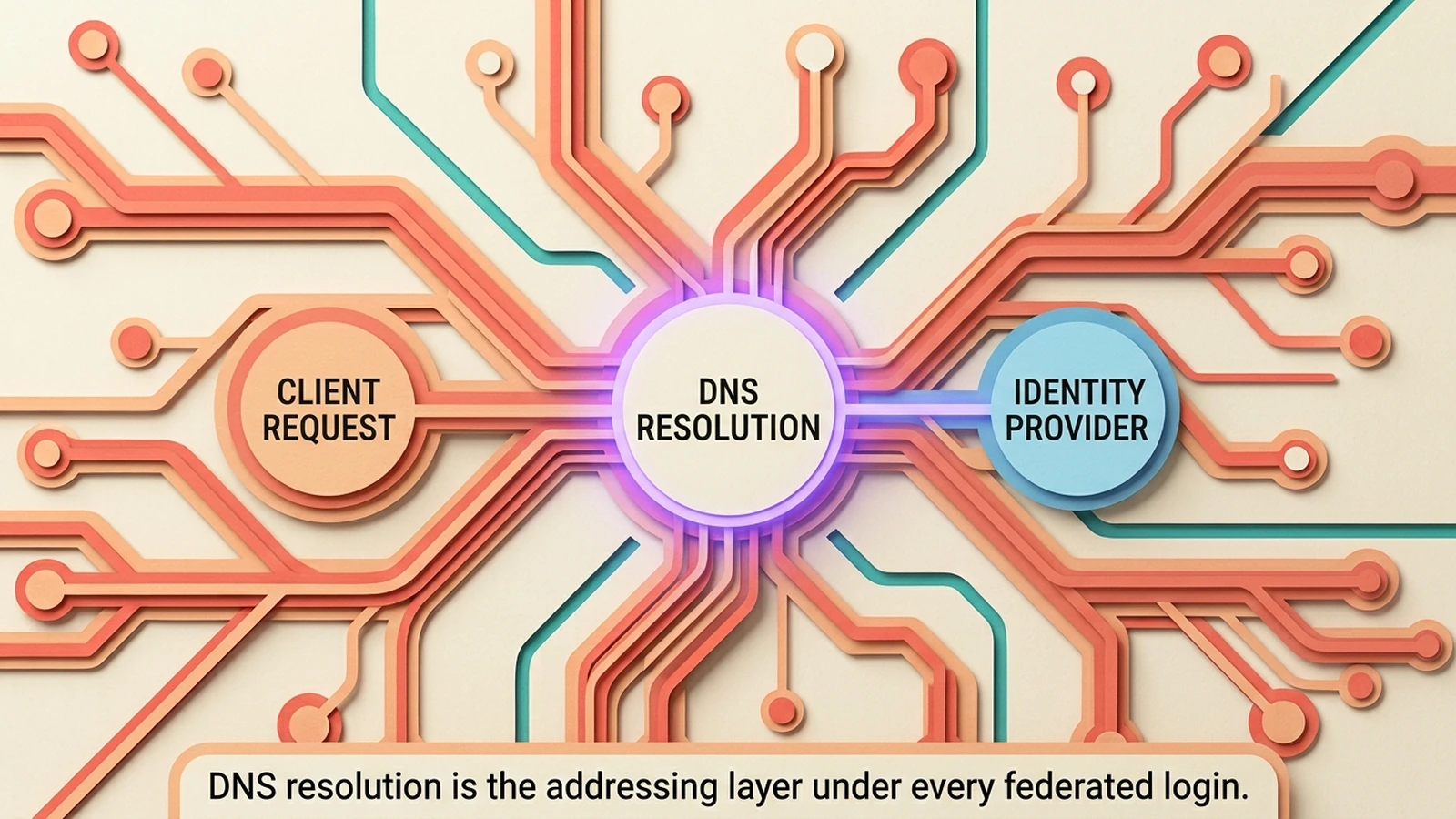 DNS resolution is the step that happens before SSO does — a client can't reach the right identity provider if DNS points it somewhere else first.
The practical consequence for IAM teams is that a DNS misconfiguration — a stale record left over from a migration, a TTL set too long after a legitimate endpoint change, a subdomain delegation that quietly expired — produces symptoms that look like SSO failures. Help desk tickets describe login pages that won't load or federation handshakes that time out, and the investigation often lands on the identity provider's configuration before anyone checks whether the hostname resolved correctly in the first place. Building DNS resolution checks into SSO health monitoring, rather than treating it as a separate network-team concern, closes that diagnostic gap. The SSO troubleshooting reference covers the broader set of failure modes this sits alongside.
DNSSEC and the integrity of the authentication chain
DNS in its original design has no authentication of its own. A resolver asks a question and accepts whatever answer comes back, with no cryptographic way to confirm the answer came from the domain's actual authoritative nameserver rather than from an attacker who managed to inject a forged response into the resolution path. That gap is what DNS Security Extensions (DNSSEC) closes: DNSSEC adds a chain of digital signatures from the root zone down through each delegated domain, so a validating resolver can cryptographically confirm that a DNS answer is authentic and unaltered before using it.
For identity infrastructure specifically, DNSSEC validation matters most on the hostnames that authentication depends on — an identity provider's login endpoint, a federation metadata URL, a password-reset domain. If those records are DNSSEC-signed and the client's resolver validates the signature chain, an attacker without control of the authoritative nameserver can't forge a response that redirects the client somewhere else. That's a narrower guarantee than it sounds — DNSSEC says nothing about whether the authoritative answer itself is trustworthy if the nameserver operator's account or infrastructure is compromised — but it removes an entire class of on-path and cache-poisoning attacks that don't require compromising the identity provider at all.
DNSSEC adoption for the domains that carry authentication traffic is one of the more overlooked items in an IAM security review, largely because DNS zone signing is typically owned by a network or infrastructure team that isn't in the room when identity architecture decisions get made. Confirming DNSSEC is enabled and validating on the specific domains an SSO or federation deployment depends on is a low-effort, high-leverage check that most identity teams have simply never asked for.
DNS poisoning as a credential-harvesting redirect vector
DNS cache poisoning corrupts the records a resolver serves so that a hostname which should point at a legitimate server instead resolves to one the attacker controls. Applied to identity infrastructure, this is a direct credential-harvesting technique: an attacker who successfully poisons the resolution of a login domain, an SSO endpoint, or a password-reset hostname can present a visually identical fake login page, and the user's browser was already directed there by DNS — there's no suspicious link, no unusual URL, no phishing email to flag.
That's what makes DNS poisoning distinct from more familiar phishing patterns. A typical credential-phishing email relies on the user clicking a link that looks slightly wrong, or on a lookalike domain that a trained user might catch. A DNS-poisoning attack instead compromises the resolution step for the correct domain name — the address bar can show the legitimate hostname while the underlying connection goes to the attacker's server, depending on how deep the poisoning reaches into the resolution path. The identity provider itself is never touched; only the addressing layer in front of it is manipulated. Detection depends on catching the anomaly in the resolution behavior itself — an unexpected IP address for a known hostname, a certificate mismatch on an otherwise-trusted domain, or DNSSEC validation failing where it previously succeeded.
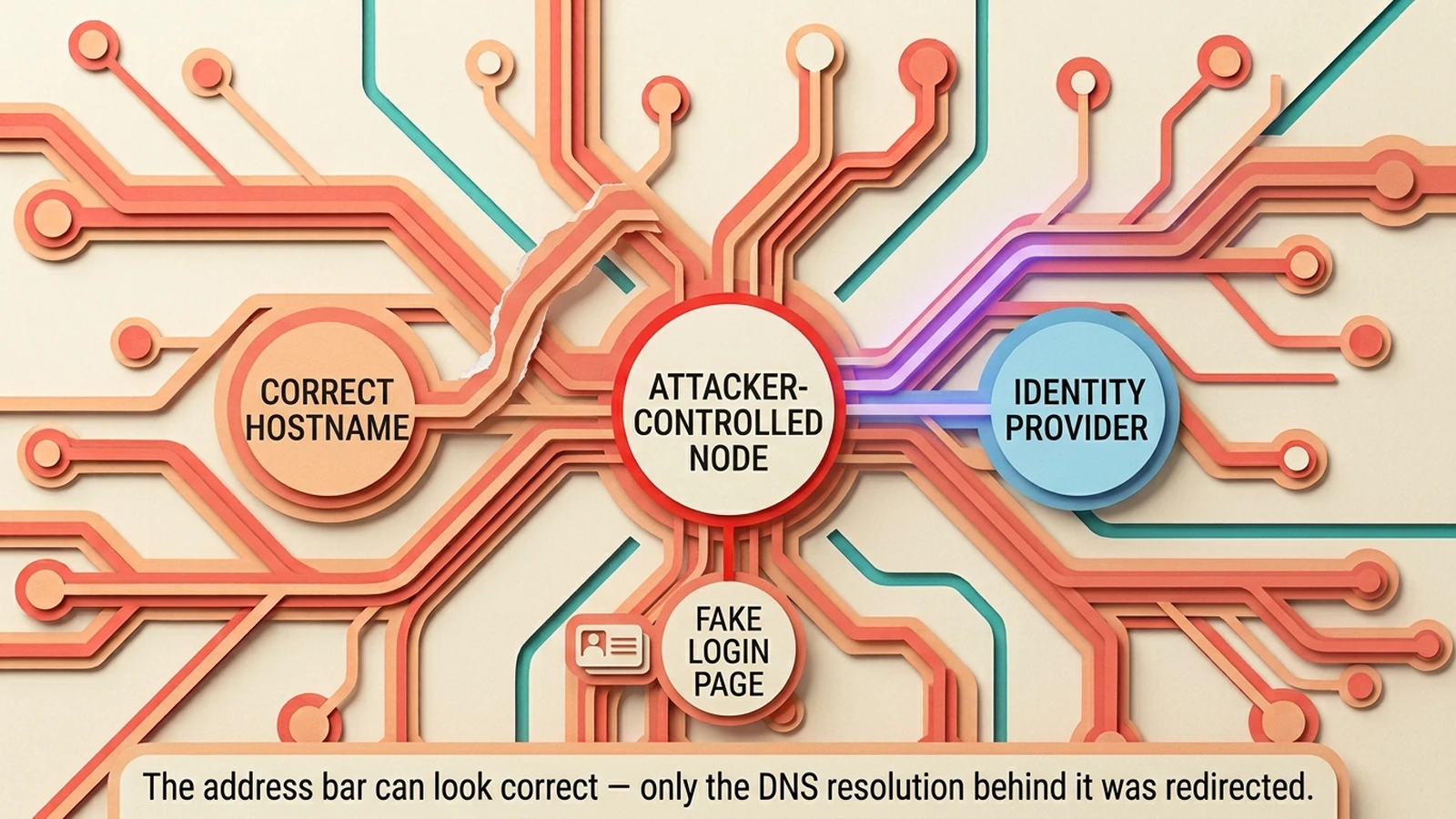 A poisoned DNS record can redirect a correctly-typed hostname to a fake login page — the identity provider is never touched, only the address in front of it.
Lookalike-domain registration is the adjacent and more common variant: an attacker registers a domain that visually resembles a real identity-provider or corporate SSO hostname and relies on typos, autofill errors, or targeted phishing to get users there, rather than poisoning DNS caches directly. Both attack patterns land on the same defensive gap — DNS resolution is an unauthenticated, largely unmonitored step that sits ahead of a well-defended identity provider, and attackers who can't break the identity provider's authentication logic often don't need to; they just need to control what the client resolves before authentication starts.
DNS-over-HTTPS and the enterprise visibility tradeoff
DNS-over-HTTPS (DoH) encrypts DNS queries inside standard HTTPS traffic, which prevents a network-path observer — an ISP, a public Wi-Fi operator, an on-path attacker — from seeing which hostnames a device is resolving. Browsers and operating systems have increasingly turned DoH on by default for end-user privacy, and that's a legitimate improvement for individuals on untrusted networks.
For enterprise security teams, DoH creates a visibility problem that isn't optional to ignore. Plaintext DNS query logs have historically been one of the cheapest, highest-signal detection sources available — beaconing malware calling out to command-and-control domains, lookalike-domain resolution tied to credential-harvesting campaigns, and anomalous query volume all show up clearly in DNS logs long before they'd show up anywhere else. When client devices route DNS queries through an encrypted, often third-party DoH resolver instead of the enterprise's own DNS infrastructure, that log source goes dark. The security team isn't just missing a nice-to-have; it's losing a detection layer that DNS-poisoning and credential-harvesting monitoring specifically depends on.
The practical response isn't to prohibit DoH — that fights a default that's increasingly built into the browser and OS layer — but to bring it inside the enterprise's own visibility boundary: deploying an enterprise-controlled DoH resolver that managed devices are configured to use, so encrypted queries still terminate somewhere the security team can log and analyze them, rather than at an external resolver the enterprise has no visibility into. Enterprises that skip this step typically don't notice the gap until an incident investigation runs into a DNS log that simply isn't there.
DNS as a continuous zero-trust signal
Zero-trust access models are built around the idea that trust is continuously reevaluated rather than granted once at login and left standing for the life of a session. Device posture, behavioral anomalies, and network context all feed that continuous evaluation in a mature zero-trust deployment — and DNS resolution behavior is a source of signal that fits naturally into the same model but is rarely wired into it.
A device that starts resolving hostnames it has never queried before, resolution requests for domains registered within the last few days, or an identity-provider hostname resolving through an unexpected path relative to its established baseline are all indicators worth feeding into a continuous access-evaluation engine alongside more conventional zero-trust signals. DNSSEC validation status is itself a form of continuous verification rather than a one-time gate: a client that successfully validates the DNSSEC chain for its identity provider's hostname on every resolution has a standing integrity guarantee that a login-time-only check doesn't provide, because the validation happens on every query, not just the first one.
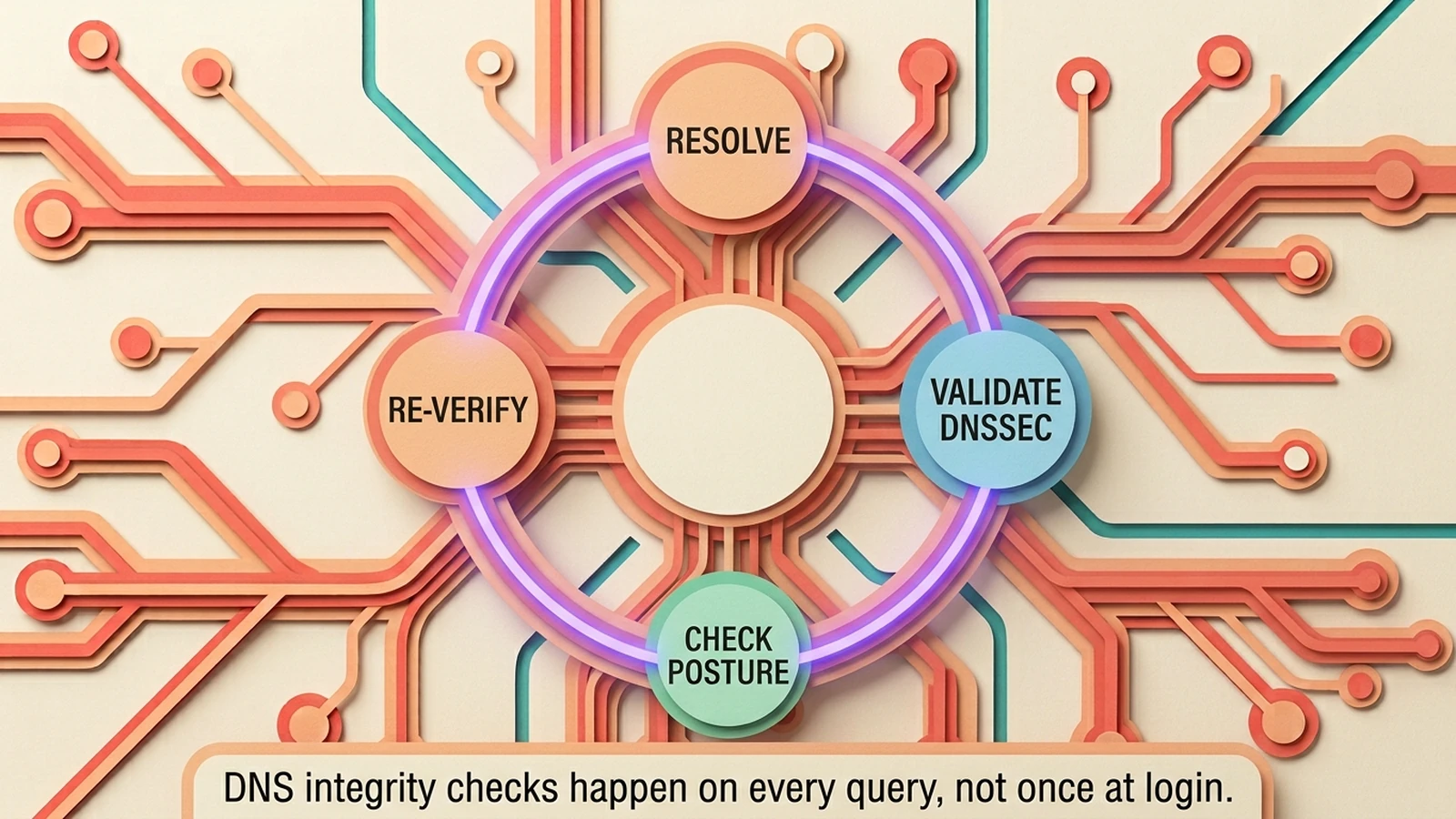 DNSSEC validation and DNS resolution telemetry are continuous checks by nature — a signal source most zero-trust deployments have available but haven't wired in.
The obstacle to actually using DNS this way is organizational more than technical: DNS infrastructure, zero-trust policy engines, and identity governance typically report through different teams with different tooling, so the telemetry that would make DNS-as-a-zero-trust-signal practical often exists in a network operations dashboard nobody on the identity or security-operations side has access to. Closing that gap is mostly a matter of routing DNS logs and DNSSEC validation status into the same SIEM or access-evaluation pipeline that already ingests device and behavioral signals, rather than building new DNS-specific tooling from scratch.
Operational practices for treating DNS as IAM infrastructure
A handful of concrete practices move DNS from an unowned gap to a governed layer of identity infrastructure:
Inventory the DNS dependencies of every federation and SSO integration. Most identity teams can list their SSO integrations but can't list the specific hostnames each one depends on resolving correctly — identity-provider endpoints, metadata URLs, password-reset domains. That inventory is the prerequisite for everything else on this list.
Require DNSSEC on identity-critical domains, and validate it's actually being checked. Enabling DNSSEC signing on the authoritative side is necessary but not sufficient — the resolvers clients actually use also have to perform validation, which isn't universal by default across every enterprise DNS resolver configuration.
Route DoH traffic from managed devices through an enterprise-controlled resolver. This preserves the DNS log visibility that credential-harvesting and beaconing detection depends on, without fighting the browser-level DoH default directly.
Monitor DNS resolution anomalies as an identity security signal, not just a network-operations metric. Unexpected resolution paths, TTL anomalies, and validation failures on identity-critical hostnames belong in the same alerting pipeline as failed logins and impossible-travel flags.
Include DNS in incident-response runbooks for credential-compromise scenarios. When a credential-harvesting incident is investigated, checking DNS resolution history for the affected login flow should be a standard step, not an afterthought reached only after the identity provider's own logs turn up nothing.
None of these require replacing existing DNS infrastructure. They require the identity and security teams to formally claim ownership of a layer that's historically been left to network operations by default, and to build the handful of checks above into existing SSO health monitoring, DNSSEC deployment, and incident-response processes. The cross-platform identity management piece covers the broader pattern of infrastructure layers that fall between team boundaries in enterprise IAM programs.
What Avatier ships toward this pattern
Avatier's Identity Anywhere platform runs alongside the enterprise's own DNS infrastructure, where DNS resolution, zone signing, and DNSSEC deployment sit with the network team. Avatier's SSO and federation architecture is built to minimize what a DNS-layer compromise can actually steal once it happens. FIDO2-compatible authentication binds a credential to the specific origin it was registered against, so a browser won't offer a passkey to a lookalike or DNS-poisoned domain even if resolution has been manipulated — the credential simply doesn't work against the wrong origin, which removes the payoff from the specific attack pattern described above for passkey-enrolled users.
Federation and SSO health monitoring in Avatier's deployment guidance treats endpoint resolution as part of the integration's operational surface, so DNS-driven outages surface as DNS issues during troubleshooting rather than being misdiagnosed as identity-provider failures. Audit logging captures authentication events with the resolved endpoint context needed to investigate a credential-compromise incident, which is the practical hook for including DNS resolution history in the incident-response step described above. This works alongside enterprise DNS security practice — DNSSEC deployment, DoH visibility strategy, and DNS monitoring — so the identity layer adds no blind spot of its own on top of whatever gap exists at the DNS layer. Avatier's own security posture is published at the Avatier Trust Center — SOC 2 Type II with zero exceptions, ISO/IEC 27001:2022 certified, NIST 800-53 Rev. 5 aligned, and a CISA Secure-by-Design Pledge signatory.
ABOUT THE AUTHOR

More from Access Management

Password Hash Synchronization in 2026: Hybrid AD to Entra ID
Password hash synchronization keeps on-prem Active Directory and Microsoft Entra ID authoritative together — how the sync cycle works, its security tradeoffs, and where it fits against federation.

Cloud Infrastructure PAM: Vaulting and Sessions in 2026
Cloud infrastructure PAM controls privileged sessions into AWS, Azure, and GCP — vaulting root credentials and enforcing just-in-time elevation instead of standing admin roles.

PIM vs PAM vs PUM: Privileged Access Defined for 2026
PIM, PAM, and PUM get used interchangeably and mean three different things. PIM manages who holds privileged identity and which roles carry it. PAM controls how privilege is exercised through vaulting, session control, and just-in-time elevation. PUM manages the shared privileged accounts nobody personally owns. The 2026 reference on distinguishing the three terms, where they overlap, and where to start.