PCI-DSS v4.0.1 Access Control Requirements: The 2026 Enterprise Reference
PCI-DSS v4.0.1 became mandatory for assessments on March 31, 2025 — and it's the largest expansion of IAM requirements in the standard's history. The 2026 enterprise reference on Requirements 7, 8, and 10, the MFA-everywhere expansion in 8.3, the service account tightening in 8.6, and the architecture that maps to each.
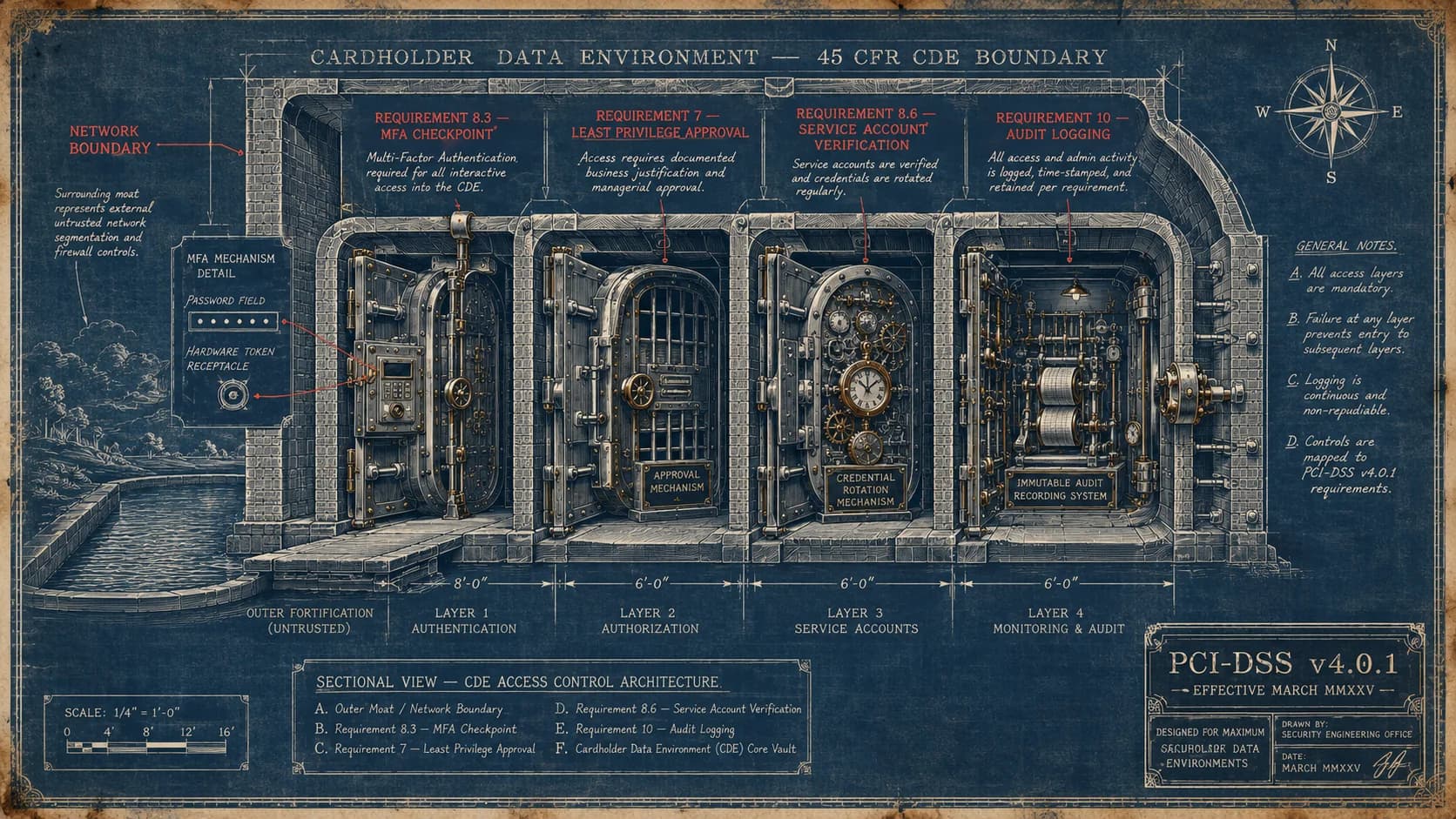
PCI-DSS v4.0.1 became mandatory for assessments on March 31, 2025 — and it's the largest expansion of IAM requirements in the standard's history. The 2026 enterprise reference on Requirements 7, 8, and 10, the MFA-everywhere expansion in 8.3, the service account tightening in 8.6, and the architecture that maps to each.
- PCI-DSS v4.0.1 became mandatory for assessments on March 31, 2025. It's the largest expansion of IAM requirements in the standard's history, driven by real-world attack patterns (credential compromise, MFA gaps, service-account abuse, insufficient logging) that dominated 2020-2024 payment-card breach reports.
- Requirement 7 (least privilege for CDE access) tightens the documented business need-to-know standard — every entitlement in the cardholder data environment must have a documented justification, an owner, and periodic recertification.
- Requirement 8 with the 8.3 MFA-everywhere expansion is the most operationally significant change — MFA is now required for ALL access into the CDE, not just remote or administrative access. This is a substantial expansion from v3.2.1 and closes the credential-compromise attack path that produced most 2020-2024 breaches.
- Requirement 8.6 tightens service account and application account handling — v4.0.1 explicitly requires that accounts used for automated processes have their credentials rotated, their activities monitored, and their access reviewed with the same discipline as human accounts.
- Avatier maintains PCI DSS v4.0.1 compliance — the current posture is published at the Avatier Trust Center. Customer CDE programs benefit from an IGA + MFA vendor whose own PCI posture is current under the new normative.
PCI-DSS v4.0.1 became mandatory for new assessments on March 31, 2025 — the largest expansion of IAM requirements in the Payment Card Industry Data Security Standard's history. Merchants, payment processors, and service providers with cardholder data environments (CDEs) that were operationally comfortable under v3.2.1 are discovering that v4.0.1 asks fundamentally more of the IAM architecture: MFA extended from remote/admin access to all non-console access into the CDE, service accounts brought into the same governance envelope as human accounts, entitlement justification tightened from "role membership implies access" to "documented business need," and logging requirements expanded to reach parts of the identity infrastructure that v3.2.1 didn't touch.
The changes weren't arbitrary. PCI-DSS v4.0 (released March 2022, minor-revised to v4.0.1 in June 2024) responded to real-world payment-card breach patterns from 2020-2024. Credential compromise on internal-network CDE access. Service accounts with never-rotated passwords used by attackers who found them. Insufficient logging that made incident investigation impossible. Standing administrative access to payment systems that got exploited when the administrative account was compromised. Every headline change in v4.0.1 maps to a specific attack pattern the standard is trying to close.
This piece is the 2026 enterprise reference on PCI-DSS v4.0.1 access controls — Requirements 7, 8, and 10, the specific tightening in 8.3 and 8.6, and the architecture that maps to each. The companion pieces cover adjacent compliance regimes: the SOX Compliance piece covers §404 access controls for financial reporting; the HIPAA §164.312 piece covers healthcare-specific requirements; the Access Review Auditor Wants piece covers the horizontal review discipline. The underlying IAM architecture is the same across all four regimes; the audit surface differs.
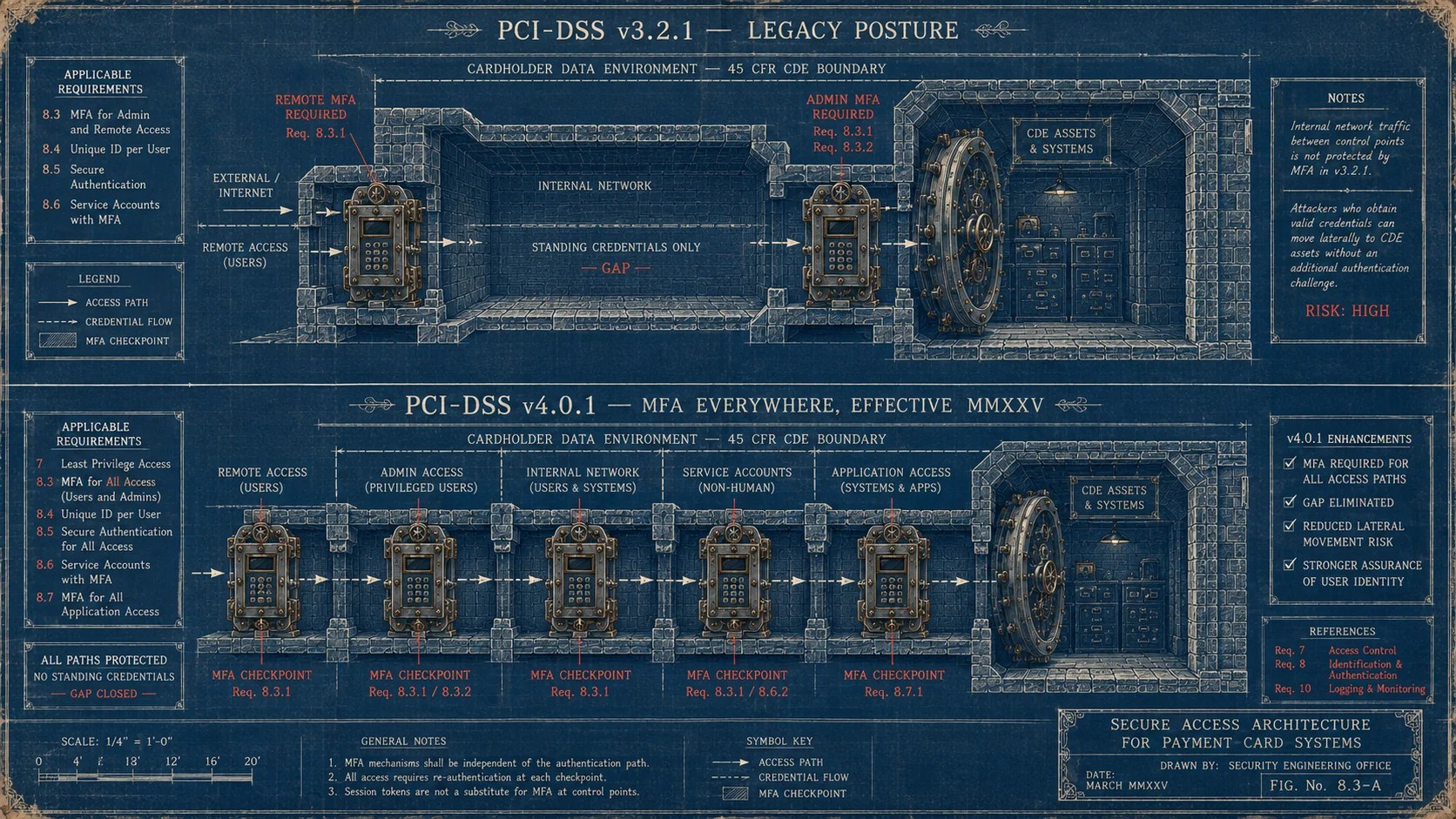 The Requirement 8.3 architectural shift. Under v3.2.1 the gatekeepers only checked the second factor for remote or administrative travelers; under v4.0.1 they check it for every entrant regardless of origin.
What v4.0.1 actually changed for IAM
PCI-DSS v4.0.1 modified 51 requirements from v3.2.1 and added 20 new ones. The IAM-relevant changes cluster in three requirement families. Understanding what each changed operationally matters more than counting the requirement numbers.
Requirement 7 — Restrict access to system components and cardholder data by business need to know. v3.2.1 required documented business justification and role-based access. v4.0.1 tightened the standard around what "documented business justification" actually means — the business need must be current, the justification must be documented per user (not just per role), and the assignment must be periodically reviewed (Requirement 7.2.4 mandates access reviews at least once every 6 months for CDE-scoped access, tightened from the previous once-per-year cadence for most controls).
Requirement 8 — Identify users and authenticate access to system components. Multiple headline changes. Requirement 8.3.1 expanded the MFA mandate (detailed below). Requirement 8.6 introduced explicit application-account controls (detailed below). Requirement 8.2.2 tightened password policies (12+ characters, strong composition, tested against known-compromised password lists). Requirement 8.4 clarified user identification uniqueness — every user (human or non-human) must be uniquely identifiable in log records.
Requirement 10 — Log and monitor all access to system components and cardholder data. Requirement 10.4 expanded log content requirements — every log entry must include user identification, event type, date/time, success or failure, origin, and affected data or resource identity. Requirement 10.7 tightened log retention (at least 12 months, with at least 3 months immediately available for investigation).
The three requirement families compose. Requirement 7 governs what access is granted. Requirement 8 governs how that access is authenticated. Requirement 10 governs how the authentication and use are logged. Weakness in any one produces attack paths the other two can't close.
Requirement 8.3.1: the MFA-everywhere expansion
The most operationally consequential change in v4.0.1. Under v3.2.1, MFA was required for two specific access patterns: remote access into the CDE (users connecting from outside the corporate network) and administrative access into the CDE (privileged users, regardless of location). Users on the corporate network who accessed CDE systems with standing credentials could authenticate with just those credentials — no MFA required.
The 2020-2024 breach data made the gap visible. Attackers who obtained credentials through phishing, keylogger malware, credential stuffing, or purchased credential dumps had free access to CDE systems if they could authenticate as a legitimate user on the internal network. The MFA control was structurally not present for the attack pattern.
Requirement 8.3.1 in v4.0.1 closes the gap: MFA is required for all non-console access into the CDE. "Non-console access" means any access that isn't a locally-attached keyboard-and-monitor session on a physical CDE server — which effectively means every remote, network, and network-of-networks session. In practice, every user session (human or service account with interactive login) that lands on a CDE system must include an MFA event in the authentication chain.
The architectural implementation options:
- MFA at the IdP — the federated identity provider (Microsoft Entra ID, Okta, Ping, Duo, Avatier Identity Anywhere) requires MFA at sign-in; downstream CDE systems trust the IdP token and don't re-prompt
- MFA at the resource — each CDE system requires its own MFA check on the session
- MFA at the network boundary — a network-boundary control (VPN gateway, ZTNA broker, PAM system) requires MFA before granting network access to the CDE
The mature 2026 pattern combines MFA at the IdP (for the vast majority of federated resources) with MFA at the network boundary (for PAM-mediated privileged access) and MFA at the resource for legacy systems that can't federate. The SSO Architecture piece on ICC covers the federation architecture; the Phishing-Resistant MFA piece covers the credential class Requirement 8.3.1 rewards.
Deviceless workforce segments — manufacturing operators, healthcare clinicians at bedside, defense workforces in classified environments, contact-center agents at shared workstations — pose an implementation challenge because smartphone-based MFA isn't operationally available. The Avatier Identity Challenge Card provides deviceless FIDO2 authentication that satisfies Requirement 8.3.1 without requiring smartphones.
Requirement 7.2.4 and 7.2.5: the access review cadence tightening
v3.2.1 required periodic access review but was vague on cadence for most environments. v4.0.1's Requirement 7.2.4 requires access reviews at least once every 6 months for all user accounts and access privileges in the CDE. Requirement 7.2.5 specifically addresses application and system accounts (service accounts) with the same 6-month cadence.
Operationally, this means CDE-scoped access must go through two certification cycles per year, each with reviewer engagement, disposition records, and evidence that the review actually happened. The AI-augmented certification pattern (covered in the AI Access Certification piece) becomes especially valuable at this cadence — the 6-month interval means reviewers see certification campaigns twice a year, which increases fatigue risk. Pre-stratification, reviewer engagement enforcement, and behavioral attestation make the doubled cadence operationally sustainable.
The Access Review Auditor Wants piece covers the reviewer discipline that PCI-DSS v4.0.1's tightened cadence rewards.
Requirement 8.6: the service account tightening
v4.0.1's Requirement 8.6.1 through 8.6.3 explicitly extends access-control discipline to accounts used by systems, applications, and automated processes. The three sub-requirements collectively require:
- 8.6.1 — Service and application accounts must have documented business justification, an owner, and a defined purpose
- 8.6.2 — Interactive login capability must be disabled for accounts that don't require interactive access (most service accounts don't); the account must be prevented from being used for interactive sign-in
- 8.6.3 — Passwords or credentials used by application and system accounts must be changed periodically (v4 guidance: at least every 12 months, or upon indication of compromise), and must be complex per Requirement 8.2.2
The tightening responds to a specific attack pattern: service accounts with standing credentials that were created during system integrations, never rotated, sometimes with high privilege, forgotten by everyone in the organization, and eventually discovered by attackers who found them through credential dumps, insider knowledge, or network reconnaissance. Requirement 8.6 forces service accounts into the same governance envelope as human accounts.
The Service Account Governance / NHI piece covers the architectural pattern for non-human identity governance that satisfies Requirement 8.6. The catalog, credential rotation, and activity monitoring layers described there map directly to the sub-requirements.
Requirement 10: the logging expansion
Requirement 10 in v4.0.1 expanded log content requirements substantially. Every log entry for CDE-scoped access must capture:
| Log element | v4.0.1 requirement |
|---|---|
| User identification | Uniquely identify the user (human or non-human) |
| Type of event | What action was attempted or performed |
| Date and time | Timestamp with sufficient precision for correlation |
| Success or failure | Outcome of the action |
| Origination | Source system, IP, or channel of the action |
| Identity or name of affected data, resource, or component | What was accessed or modified |
Requirement 10.7 tightened retention: at least 12 months of log history, with at least 3 months immediately available for investigation without requiring restore from archive.
Operationally, the requirement means log pipelines must capture the six log elements for every access event, retention infrastructure must support the tiered availability requirement, and log content must be sufficient for forensic reconstruction of an incident. The ITDR pattern (covered in the ITDR piece) provides the behavioral-detection layer that consumes the enriched logs; the log content requirements support both the detection layer and the audit-evidence layer.
The mapping: v4.0.1 requirements to IAM architecture
| PCI-DSS v4.0.1 Requirement | IAM architecture layer | Companion piece |
|---|---|---|
| 7.2.1-7.2.3 (documented business need) | IGA workflow + catalog | Best IGA Solutions |
| 7.2.4 (6-month access review) | AI-augmented certification | AI Access Certification |
| 7.2.5 (6-month service-account review) | NHI governance + certification | Service Account Governance / NHI |
| 8.2.2 (password policy) | IdP password policy + Avatier Password Bouncer | (avatier.com Password Bouncer post) |
| 8.3.1 (MFA for non-console access) | Phishing-resistant MFA at IdP boundary | Phishing-Resistant MFA (ICC) |
| 8.4 (unique identification) | Identity catalog + IGA | Best IGA Solutions |
| 8.6.1-8.6.3 (application accounts) | NHI governance | Service Account Governance / NHI |
| 10.4 (log content) | ITDR + IdP audit log | ITDR |
| 10.7 (log retention) | Log infrastructure (SIEM, cloud log) | (out of scope for this piece) |
Every requirement family maps to a specific architectural layer. Full v4.0.1 IAM compliance is the composition of the layers, not any single layer alone.
The Avatier compliance posture matters for customer CDE programs
PCI-DSS v4.0.1 assessments increasingly extend to vendor supply chain. Customers running Avatier Identity Anywhere as their IGA + MFA platform for CDE access — where Avatier's platform is load-bearing for Requirements 7, 8, and 10 — will be asked about Avatier's own PCI posture during the assessment.
Avatier maintains PCI DSS v4.0.1 compliance. The current posture is published at the Avatier Trust Center, which also publishes:
- SOC 2 Type II with zero exceptions — the general control-environment attestation
- ISO/IEC 27001:2022 — the international standard for information security management
- CSA STAR Level 1 — cloud security posture
- NIST 800-53 Rev. 5 aligned — federal control framework alignment
- CISA Secure-by-Design Pledge signatory — the 2024 secure-by-design commitment
The third-party security-grades view (SecurityScorecard) is at trust.avatier.com/?itemName=security_grades — customer assessors can review Avatier's independent security grade without requiring a procurement questionnaire.
Customer PCI QSAs (Qualified Security Assessors) evaluating Avatier as a service provider in the CDE scope can be pointed directly at the Trust Center. This shortens the vendor-management artifact-gathering cycle from weeks to minutes.
The 2026 reference path
Treat PCI-DSS v4.0.1 as the design target for CDE-scoped IAM, not as an audit-cycle response. The requirements are prescriptive enough that the architectural pattern is nearly deterministic once the operational discipline is in place.
Compose the six IAM layers that map to the requirements. HRIS-driven lifecycle keeps CDE-scoped entitlements current with role changes. IGA workflow captures the documented business justification Requirement 7 expects. Phishing-resistant MFA at the IdP boundary satisfies Requirement 8.3.1 for the vast majority of CDE access. NHI governance handles Requirement 8.6's application-account discipline. AI-augmented certification makes the 6-month review cadence operationally sustainable. ITDR + enriched IdP audit logs support Requirement 10.
Deploy deviceless MFA where operationally necessary. Manufacturing floors, healthcare bedside stations, contact centers, shared workstations, defense classified environments — these workforce segments need PCI-compliant MFA without smartphone dependency. The Avatier Identity Challenge Card provides deviceless FIDO2 authentication that satisfies Requirement 8.3.1.
Point QSAs at the Trust Center for Avatier's own PCI posture. Vendor-management artifact gathering shortens dramatically when the artifacts are public and current — the Avatier Trust Center with the SecurityScorecard grade view is the answer.
PCI-DSS v4.0.1 will govern payment-card access controls through the late 2020s. Future revisions will layer on additional requirements as attack patterns evolve, but the v4.0.1 baseline is now operationally normative for every organization with a CDE. Build the architecture deliberately; the QSAs of 2027 and 2028 will reward the choice.
ABOUT THE AUTHOR

More from Compliance & Audit

HIPAA §164.312 Access Controls: What Healthcare IT Actually Owes Auditors 2026
HIPAA §164.312 defines five technical safeguards for ePHI — access control, audit controls, integrity, person or entity authentication, and transmission security. The 2026 enterprise reference on what each standard actually requires from IAM, the addressable-vs-required distinction that trips up healthcare IT programs, and the architecture that produces defensible evidence at audit.

The Access Review Your Auditor Wants vs What You're Running 2026
Most enterprise access reviews are checkbox exercises that pass IAM policy but fail audit scrutiny. The 2026 enterprise reference on the three questions auditors ask that checkbox reviews can't answer, the risk-weighted review architecture that produces defensible evidence across SOX, PCI-DSS, HIPAA, and SOC 2 simultaneously, and the operational patterns that make the shift sustainable.

SOX Compliance Without the Spreadsheet: What Auditors Actually Want to See in IAM 2026
SOX §404 requires access controls that produce evidence, not policy documents that describe them. The 2026 enterprise reference on the four IAM access-control domains SOX auditors probe, the five reports they'll ask for, and the architecture that generates them on-demand rather than in the quarter-end scramble.