Avatier vs Okta: The 2026 Enterprise Pricing Model Comparison
Enterprise IAM buyers evaluating Avatier against Okta are comparing two fundamentally different pricing philosophies — all-inclusive licensing that bundles IGA workforce lifecycle and identity governance into base pricing versus a workforce IdP with tiered pricing where governance capability is priced as premium modules above the federation baseline. The 2026 enterprise reference on the structural pricing differences, the specific modules that produce Okta cost variance at scale, and the buyer discipline for defensible vendor selection.
Enterprise IAM buyers evaluating Avatier against Okta are comparing two fundamentally different pricing philosophies — all-inclusive licensing that bundles IGA workforce lifecycle and identity governance into base pricing versus a workforce IdP with tiered pricing where governance capability is priced as premium modules above the federation baseline. The 2026 enterprise reference on the structural pricing differences, the specific modules that produce Okta cost variance at scale, and the buyer discipline for defensible vendor selection.
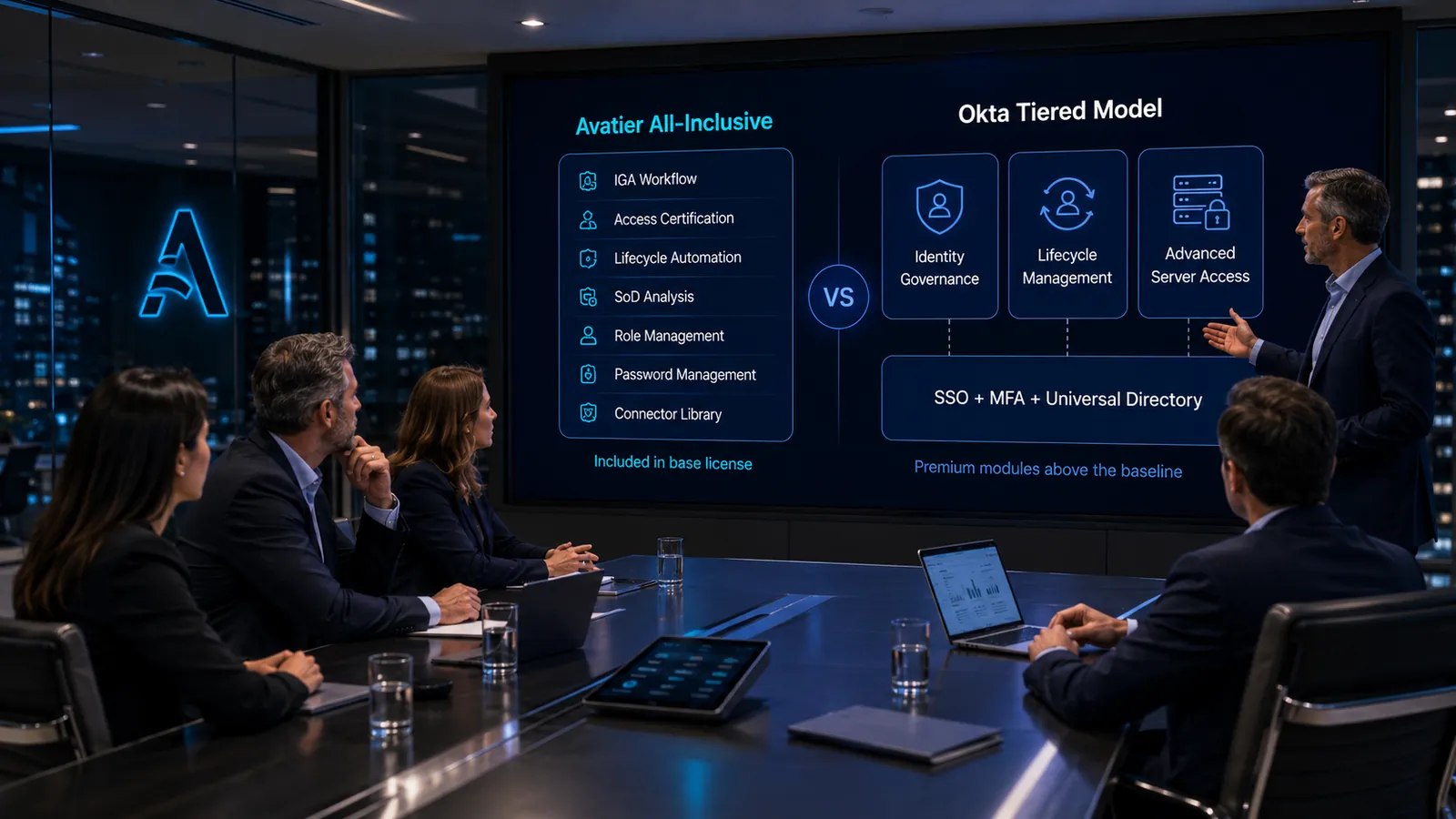
- Avatier and Okta represent two fundamentally different enterprise IAM pricing philosophies. Avatier's all-inclusive model bundles the equivalent enterprise IAM capability set — IGA workflow, access certification, lifecycle automation, SoD analysis, role management, password management, and the connector library — into the base license. Okta's model prices workforce IdP capability (SSO, MFA, adaptive authentication) at friendly base tiers, then prices Identity Governance (governance capability) and Workforce Identity Cloud lifecycle modules as premium capabilities above the federation baseline.
- The Okta pricing model produces friendly base pricing for organizations that primarily need federation and MFA — the SSO and MFA modules run $2-$6 per user per month at typical enterprise tiers. The cost pattern shifts at scale as governance and lifecycle capabilities are added — Identity Governance and Workforce Identity Cloud add-ons push the effective per-user cost toward enterprise IGA vendor pricing while the base workforce IdP remains at the friendly tier.
- Three specific Okta modules recur in enterprise cost surprises. Identity Governance — Okta's IGA module for certification campaigns, SoD analysis, access request workflow. Workforce Identity Cloud Lifecycle Management — automated joiner-mover-leaver provisioning workflow. Advanced Server Access — privileged access management for cloud infrastructure. Well-scoped Okta contracts price the full expected module set at contract time; deployments that add modules as governance scope expands produce the cost-surprise pattern covered in the [SailPoint vs Avatier Pricing Comparison piece](/en/blog/sailpoint-vs-avatier-pricing-comparison-2026/).
- The Avatier all-inclusive model produces different economics. The full enterprise IGA capability set is folded into base licensing at contract time — governance capability is available from day one without procurement friction as the deployment matures. Legacy environment connectors (RACF, iSeries, mainframe) are included without per-connector premium pricing. The deployment scope expansion doesn't produce additional module procurement cycles.
- The six-criterion buyer discipline produces defensible Avatier vs Okta vendor selection. Enumerate capability set anticipated over the three-year horizon. Price both vendors on the specific capability set (not base tier alone). Include connector economics for the specific target-system portfolio including legacy environments. Use the three-year TCO frame from the [Enterprise IAM Cost Comparison piece](/en/blog/enterprise-iam-solutions-cost-comparison-2026/). Include the professional-services burden for the specific integration surface. Validate against reference customers with similar environment complexity.
Enterprise IAM buyers evaluating Avatier against Okta are comparing two fundamentally different pricing philosophies. Avatier bundles the enterprise IAM capability set into all-inclusive base licensing. Okta prices workforce IdP capability (SSO, MFA, adaptive authentication) at friendly base tiers and prices Identity Governance and Lifecycle Management as premium modules above the federation baseline. Both approaches are legitimate market positions; they optimize for different buyer profiles and produce different TCO outcomes at different deployment scopes.
This piece is the 2026 enterprise reference on the Avatier vs Okta pricing comparison. The structural pricing-model difference, the specific Okta modules that recur in enterprise cost variance, the connector economics that compound module economics, and the buyer discipline for defensible vendor selection. Companion pieces cover adjacent layers — the SailPoint vs Avatier Pricing Comparison piece covers the SailPoint competitive comparison with the same buyer-discipline framework; the Enterprise IAM Cost Comparison piece covers the five-driver TCO frame; the Best IGA Solutions piece covers the broader vendor-landscape comparison.
The two pricing philosophies
The structural difference between the Avatier and Okta pricing models is the granularity at which capabilities are licensed.
Avatier's all-inclusive model. Avatier Identity Anywhere bundles the enterprise IAM capability set:
- IGA workflow and access request
- Access certification with AI-augmentation (AI Access Certification piece)
- Lifecycle automation with HRIS integration (HRIS-Driven Lifecycle piece)
- SoD analysis and violation remediation
- Role management with role mining and lifecycle
- Password management, self-service reset, and password governance
- Connector library including legacy environments (RACF, iSeries, mainframe), HRIS platforms, cloud environments, and mainstream SaaS
into the base license. There are no per-module upsells for the standard governance capability set.
Okta's workforce IdP + premium module model. Okta Workforce Identity Cloud prices the workforce IdP capability at friendly base tiers:
- Single sign-on (SSO) with SAML 2.0 and OpenID Connect federation
- Multi-factor authentication (MFA) with adaptive risk-based composition
- Universal Directory for identity storage
- API Access Management for developer-facing OAuth 2.0 workflows
Typical enterprise pricing runs $2-$6 per user per month for the SSO + MFA + Universal Directory bundle.
Identity Governance capability (Okta Identity Governance module) and Lifecycle Management (Workforce Identity Cloud Lifecycle Management) are priced as premium modules above the federation baseline. Additional line items include Advanced Server Access for cloud infrastructure PAM, enterprise-tier SLA options, dedicated tenant options for compliance-regulated environments, and premium support tiers.
Why the philosophies exist. Okta's model optimizes for buyers who start with federation and MFA scope and add governance capability as their program matures — the initial contract prices the workforce IdP baseline, and additional modules are added as the scope expands. Avatier's model optimizes for buyers who anticipate broader IGA + lifecycle scope from day one — the capabilities are available from day one without procurement friction as the deployment matures. Neither philosophy is inherently better; the fit depends on the specific buyer profile and deployment trajectory.
The three Okta modules that produce cost variance
Three specific Okta modules recur in buyer post-mortems as drivers of the "our Okta TCO is meaningfully above what we projected at contract" pattern.
Module 1: Okta Identity Governance. Okta's IGA module for certification campaigns, SoD analysis, access request workflow, and governance reporting. Typically added when governance scope expands beyond federation into IGA capability. Buyer signal to anticipate: your environment has SOX §404 scope requiring documented access certification, regulatory requirements for SoD analysis, or IGA workflow needs that basic federation doesn't cover. The Access Governance × Lifecycle piece covers the composition depth this module tries to address.
Module 2: Workforce Identity Cloud Lifecycle Management. Automated joiner-mover-leaver provisioning workflow. Typically added when organizations move beyond ticket-driven provisioning to HRIS-driven lifecycle. Buyer signal to anticipate: you're operating a HRIS-driven lifecycle architecture with SuccessFactors, Workday, ADP, or equivalent, and need automated provisioning propagation. The HRIS-Driven Lifecycle piece covers the architecture depth.
Module 3: Advanced Server Access. Privileged access management for cloud infrastructure. Typically added when PAM scope expands to cloud environments. Buyer signal to anticipate: your organization has cloud infrastructure (AWS, Azure, Google Cloud) with substantial privileged-access surface. The PAM piece covers PAM architecture depth.
The three modules together typically double or triple the base workforce IdP subscription cost when full IGA + lifecycle + cloud PAM scope is added. Well-scoped Okta contracts anticipate this expansion at contract time; deployments that add modules over 18-24 months produce the cost-surprise pattern.
The connector economics
Both vendors provide extensive connector libraries; the pricing structure and coverage depth differ meaningfully in specific segments.
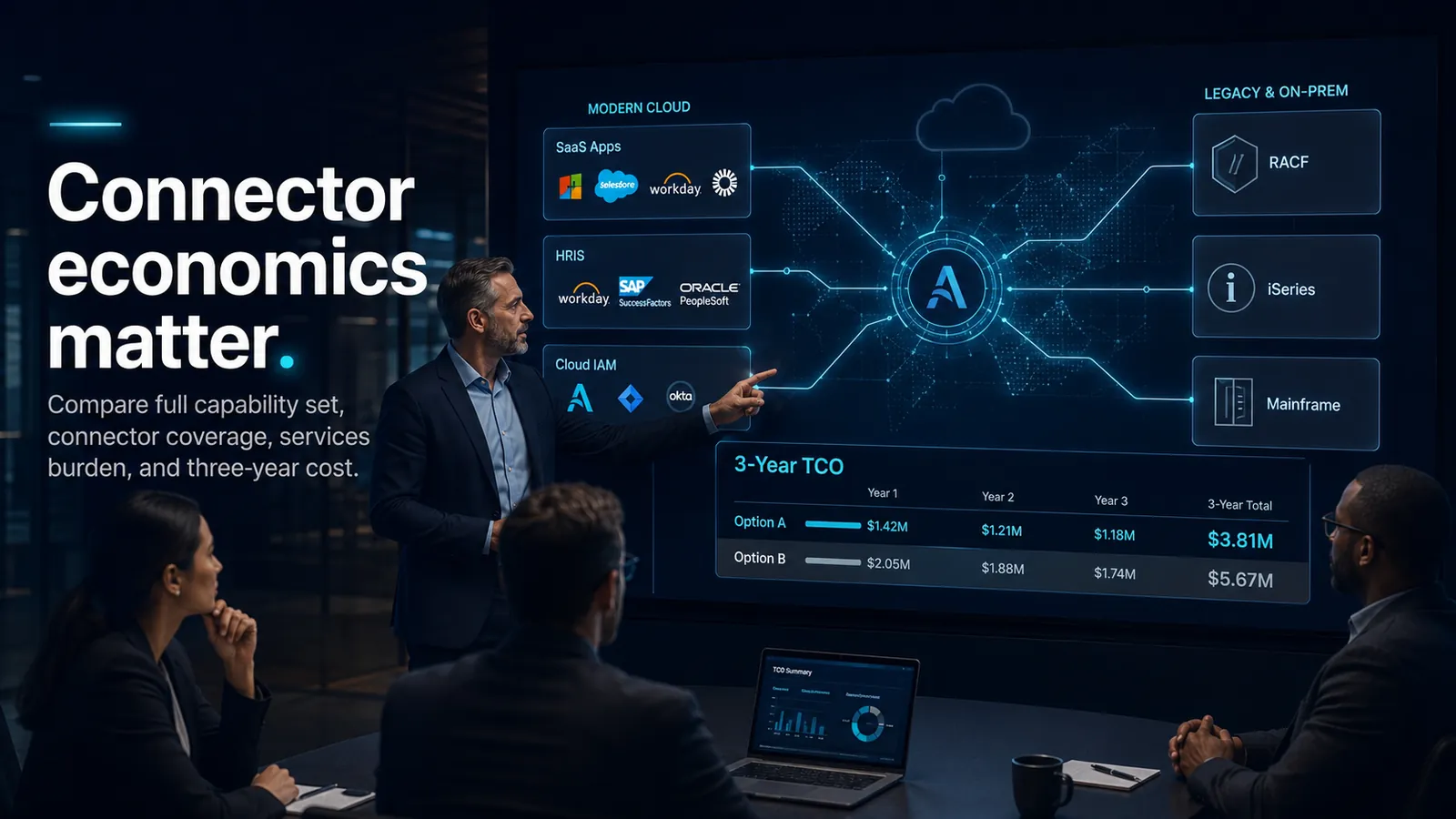
Okta's connector library. Deep coverage of the mainstream SaaS estate — Salesforce, ServiceNow, Workday, SAP SuccessFactors, Microsoft 365, Google Workspace, plus hundreds of other standard SaaS applications. Typically no per-connector charges at enterprise tiers for mainstream SaaS. Cloud IAM (AWS, Azure, Google Cloud) integrates through workforce federation.
Where Okta coverage thins. Legacy environments (IBM RACF, CA ACF2, iSeries / AS400 mainframe security systems). Industry-specific systems (specific healthcare EHR platforms, financial-services trading systems, government-specific applications). Non-standard SaaS applications with limited standard integration paths. Coverage in these categories often requires higher-tier subscriptions or professional-services builds.
Avatier's connector library. Same mainstream SaaS coverage plus deeper coverage of legacy environments (RACF, iSeries, mainframe) without per-connector charges. This reflects Avatier's deep regulated-industry and legacy-environment adjacency. The RACF User Access Control piece covers the RACF integration depth; the Troubleshooting iSeries piece covers iSeries; the Playbook Legacy IAM to Modern piece covers legacy modernization architecture.
Why connector economics matter for specific buyer profiles. Enterprises with all-modern-SaaS footprints see less connector impact regardless of vendor. Enterprises with substantial legacy footprints, regulated-industry posture, or industry-specific target systems see meaningful connector-economics differences.
The buyer-side discipline
Six discipline elements produce apples-to-apples Avatier vs Okta vendor comparison.
Discipline 1: Enumerate the capability set anticipated over the three-year horizon. Not just year 1 scope. Federation + MFA baseline. IGA workflow. Access certification. Lifecycle automation. SoD analysis. Role management. Password management. PAM integration. Non-employee lifecycle. Industry-specific compliance modules. Anticipate the deployment horizon, not the initial contract scope.
Discipline 2: Price both vendors on the specific capability set. For Okta, enumerate the module list (Identity Governance, Lifecycle Management, Advanced Server Access, industry modules) and price each. For Avatier, confirm the capabilities are folded into the base license. Compare total capability-set price, not base-tier list price.
Discipline 3: Include connector economics for the specific target-system portfolio. SaaS + HRIS + cloud + on-premises + legacy (RACF, iSeries, mainframe) + industry-specific systems. Price connector coverage per vendor.
Discipline 4: Use the three-year TCO frame. Apply the Enterprise IAM Cost Comparison piece five-driver model — infrastructure, implementation, ongoing operations, integrations, and hidden compliance surface. Total three-year TCO is the honest comparison; list-price-per-user comparison misleads.
Discipline 5: Include the professional-services burden. Some integrations are turnkey with either vendor; others require substantial engineering. Estimate professional-services cost per vendor for the specific integrations your deployment requires.
Discipline 6: Validate against reference customers. Both vendors have reference customer programs. Prioritize references with your specific environment complexity — workforce size, application portfolio, regulatory posture, legacy footprint. Generic references don't validate your specific business case.
Where each pricing model fits
Different buyer profiles produce different pricing-model fit outcomes.
Where the Okta model fits best. Enterprises that primarily need workforce federation and MFA with governance capability added as the program matures. Cloud-native environments without substantial legacy footprint. Organizations that value the initial-tier discount that federation-first pricing sometimes produces at narrow initial scope. Buyers with sophisticated procurement capable of anticipating the full module set at contract time.
Where the Avatier all-inclusive model fits best. Enterprises with broad IGA + lifecycle scope anticipated from day one. Environments with substantial legacy footprint (RACF, iSeries, mainframe), regulated-industry posture, or heterogeneous target-system portfolios. Organizations with workforce segments needing deviceless authentication (Identity Challenge Card for healthcare bedside, manufacturing floor, contact center shared workstations, defense classified environments). Buyers who value pricing predictability and no per-module procurement friction.
Where both models produce similar TCO. Mid-market enterprises with moderate scope, cloud-first footprints, and mainstream target-system portfolios. The delta between the two models at this profile is often smaller than the delta between good and bad implementation partners.
The 2026 reference path
Understand the structural pricing-model difference. Okta's workforce IdP + premium module model and Avatier's all-inclusive model are legitimate market positions that optimize for different buyer profiles.
Apply the six-element buyer-side discipline. Enumerate capability set. Price full set on the specific model. Include connector economics. Use three-year TCO frame. Include professional-services burden. Validate against similar reference customers.
Consider the connector economics if your environment has substantial legacy footprint. This is where the pricing-model difference produces meaningful TCO delta between Avatier and Okta.
Consider the governance and lifecycle expansion trajectory. Deployments that will add IGA + Lifecycle Management + PAM capability over the three-year horizon face different TCO on the two pricing models.
Compare against the SailPoint vs Avatier Pricing Comparison piece if you're also evaluating SailPoint. The three-way comparison (Avatier, Okta, SailPoint) is the mainstream enterprise IAM vendor comparison.
Point auditors at the Trust Center for Avatier's own posture. The Avatier Trust Center with the SecurityScorecard grade view — SOC 2 Type II with zero exceptions, ISO/IEC 27001:2022, PCI DSS v4.0.1, CSA STAR Level 1, NIST 800-53 Rev. 5 aligned, CISA Secure-by-Design Pledge signatory.
ABOUT THE AUTHOR

More from Buyer's Guides
The Hidden Costs of Identity Management: The 2026 Enterprise Reference
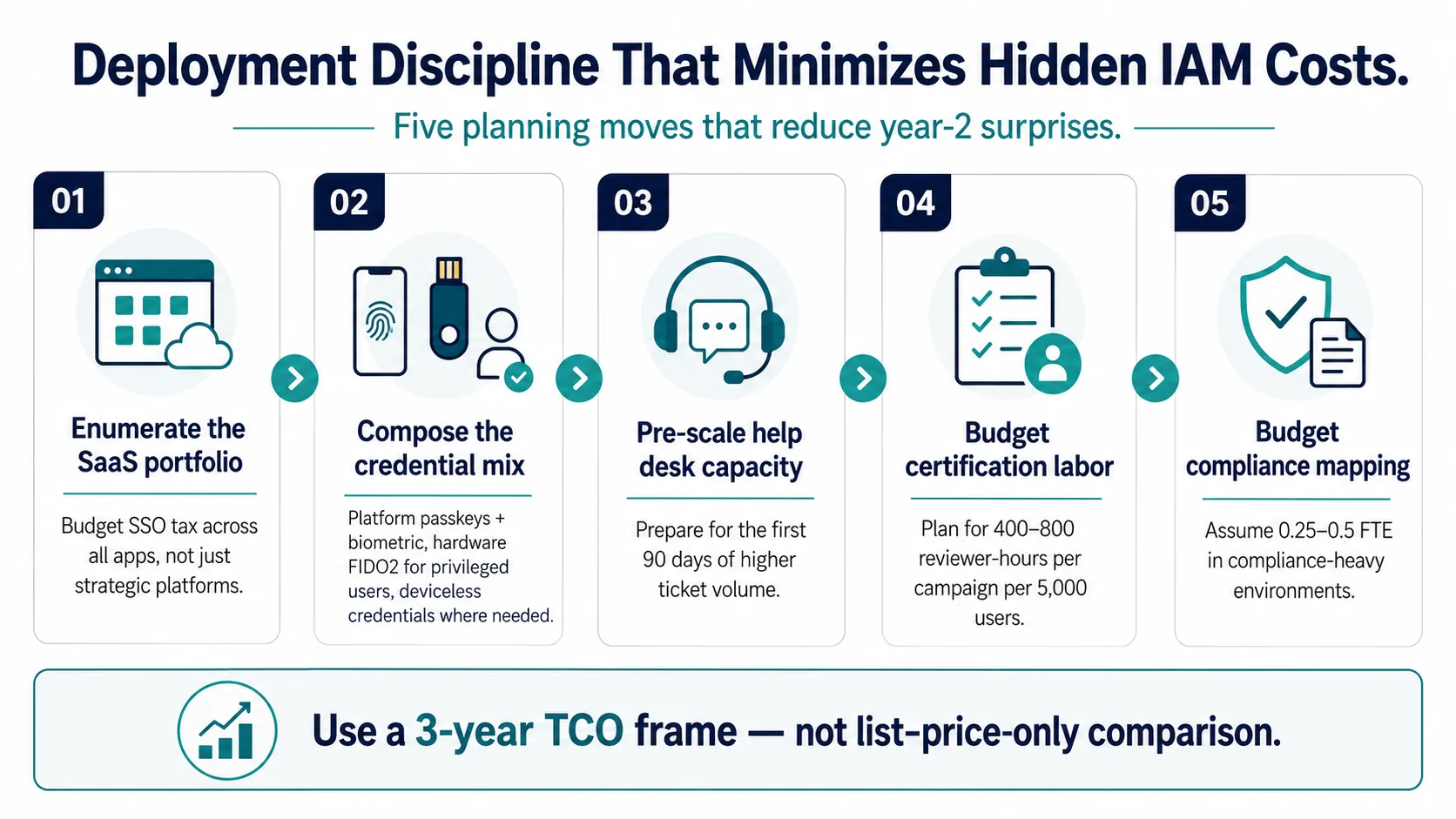
Enterprise IAM has five hidden cost categories that auditors surface and buyers systematically undercount — the SSO integration tax per SaaS application, MFA credential distribution and refresh, help desk rollout volume, certification-campaign labor, and the ongoing compliance-mapping work that keeps audit-ready posture defensible. The 2026 enterprise reference on what each hidden cost actually costs at scale, why they surface only in year 2, and the deployment discipline that minimizes them.
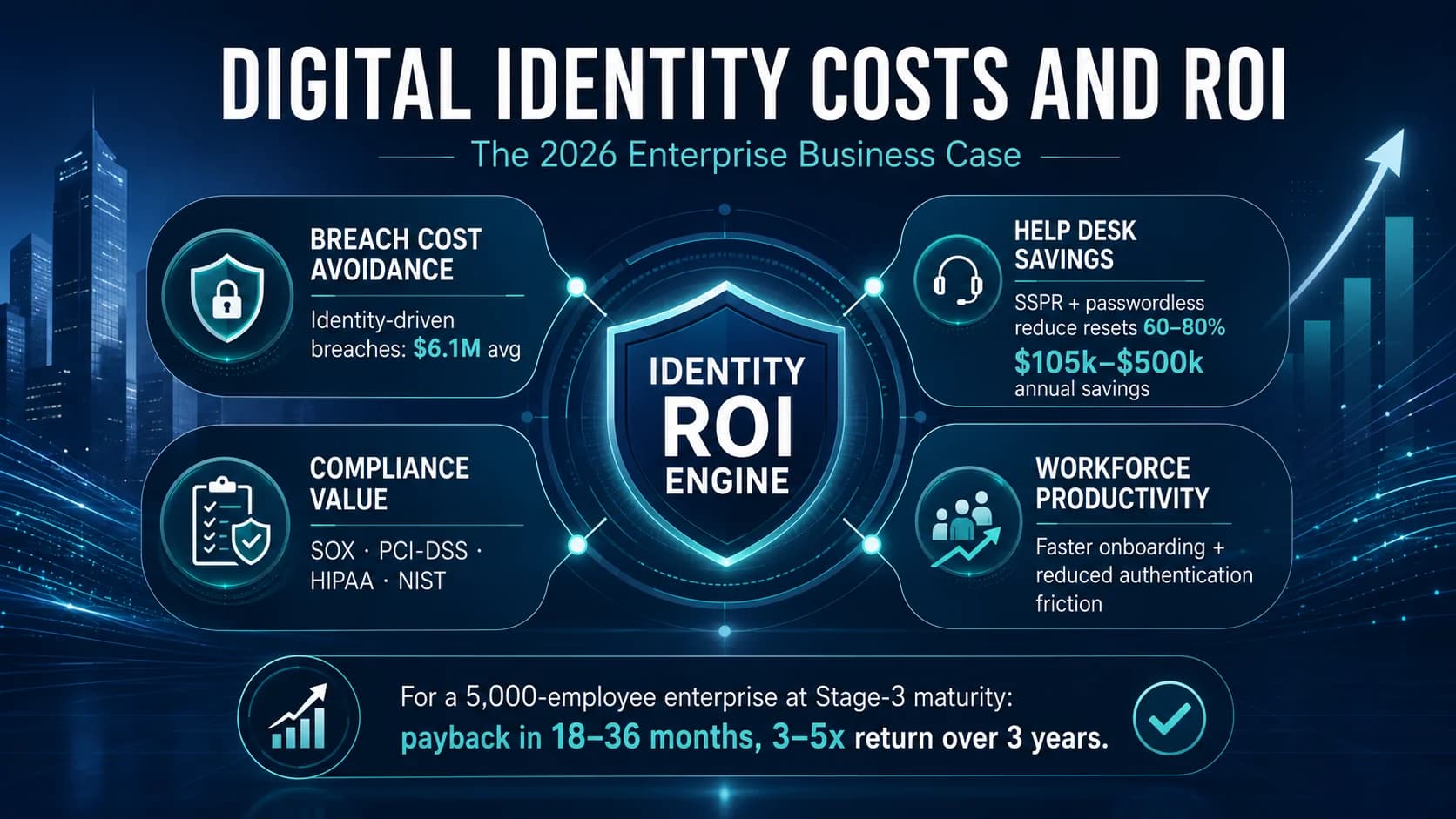
Digital Identity Costs and ROI: The 2026 Enterprise Business Case
Enterprise IAM investment isn't a cost center — it's a four-category ROI generator that returns breach cost avoidance, help desk savings, compliance value, and workforce productivity gains. The 2026 enterprise reference on what each ROI category actually returns at scale, the maturity-ladder curve that shows where returns compound, the common ROI framing mistakes that make IAM look worse on paper than in reality, and the business case that produces defensible funding for enterprise identity programs.

Login Reset Licensing Models: The 2026 Enterprise Cost Structure Reference
Enterprise password reset licensing has three fundamentally different pricing models — per-user subscription, per-reset-event consumption, and modular capability-based licensing — and the fit between model and buyer profile determines whether TCO tracks the vendor's list-price projection or surprises 18-24 months into deployment. The 2026 enterprise reference on the three licensing models, the specific line items that drive cost variance, and the buyer discipline that produces defensible reset-workflow vendor selection.