What Identity-Management Failure Actually Costs (2026)
The cost of identity-management failure is not a single line item — it is a breach that starts with a compromised or over-provisioned credential, the downtime while responders lock the environment down, the compliance penalties that follow inadequate access controls, and the customer and market trust that erodes long after the incident closes. This 2026 reference separates the cost of IAM failure from the cost of the IAM program, gives extractable answers to how each failure channel becomes real money, and covers the controls that lower the risk without ever eliminating it.

The cost of identity-management failure is not a single line item — it is a breach that starts with a compromised or over-provisioned credential, the downtime while responders lock the environment down, the compliance penalties that follow inadequate access controls, and the customer and market trust that erodes long after the incident closes. This 2026 reference separates the cost of IAM failure from the cost of the IAM program, gives extractable answers to how each failure channel becomes real money, and covers the controls that lower the risk without ever eliminating it.
- Identity-management failure costs across four channels: a data breach that begins with a compromised or over-provisioned credential, operational downtime while responders contain and rebuild, compliance penalties for inadequate access controls, and lost trust from customers, partners, and the market. The channels compound — one identity failure rarely produces one cost.
- This is the cost of NOT doing identity well. It is a separate question from the cost of the IAM program itself. For the cost of the solution — SSO tax, credential logistics, help desk rollout, certification labor, compliance mapping — see the companion piece on the hidden costs of identity management. This piece is about what the failure costs.
- The largest breach costs are not the forensics invoice. They are the downtime, the regulatory response, the notification and remediation obligations, and the multi-quarter erosion of customer trust — the costs that keep accruing after the incident is technically closed.
- Most identity-management failures are governance failures, not authentication failures. Over-provisioned standing access, orphaned accounts after employees leave, unreviewed entitlements, and forgotten non-human identities are the conditions that turn a single compromised credential into an enterprise-wide breach.
- No control eliminates identity risk. Least privilege, automated joiner/mover/leaver lifecycle, continuous access certification, phishing-resistant authentication, and just-in-time elevation lower the probability and the blast radius of failure. The goal is a smaller, shorter, cheaper failure — not a guarantee against one.
Identity-management failure costs an enterprise across four channels at once: a data breach that begins with a compromised or over-provisioned credential, the operational downtime while responders contain and rebuild the environment, the compliance penalties that follow inadequate access controls, and the customer and market trust that erodes long after the incident is technically closed. It is rarely one cost. A single failed identity control — a login that should have been deprovisioned, a privileged role that should have been time-boxed, an entitlement nobody reviewed — is what lets a routine compromise become an enterprise event, and each of those four channels bills separately. The forensics invoice arrives first and dominates the early conversation, but it is usually the smallest of the four.
This piece is the 2026 update to our earlier post on the costs of identity management failure; it strips the borrowed vendor statistics from the original and reframes the cost around directional, defensible mechanics. Before going further, one clarification that matters for scoping. There are two different "cost" questions in identity management, and they are frequently confused. One is the cost of the program — what it costs to buy, deploy, and run identity management well. The other is the cost of failure — what it costs when identity management is absent, incomplete, or poorly governed and something breaks. This piece is about the second. For the first, the companion reference on the hidden costs of identity management covers the SSO tax, credential logistics, help desk rollout, certification labor, and compliance-mapping work that make up the true cost of the solution. Read together, the two pieces bound the decision: what doing it costs, and what not doing it costs.
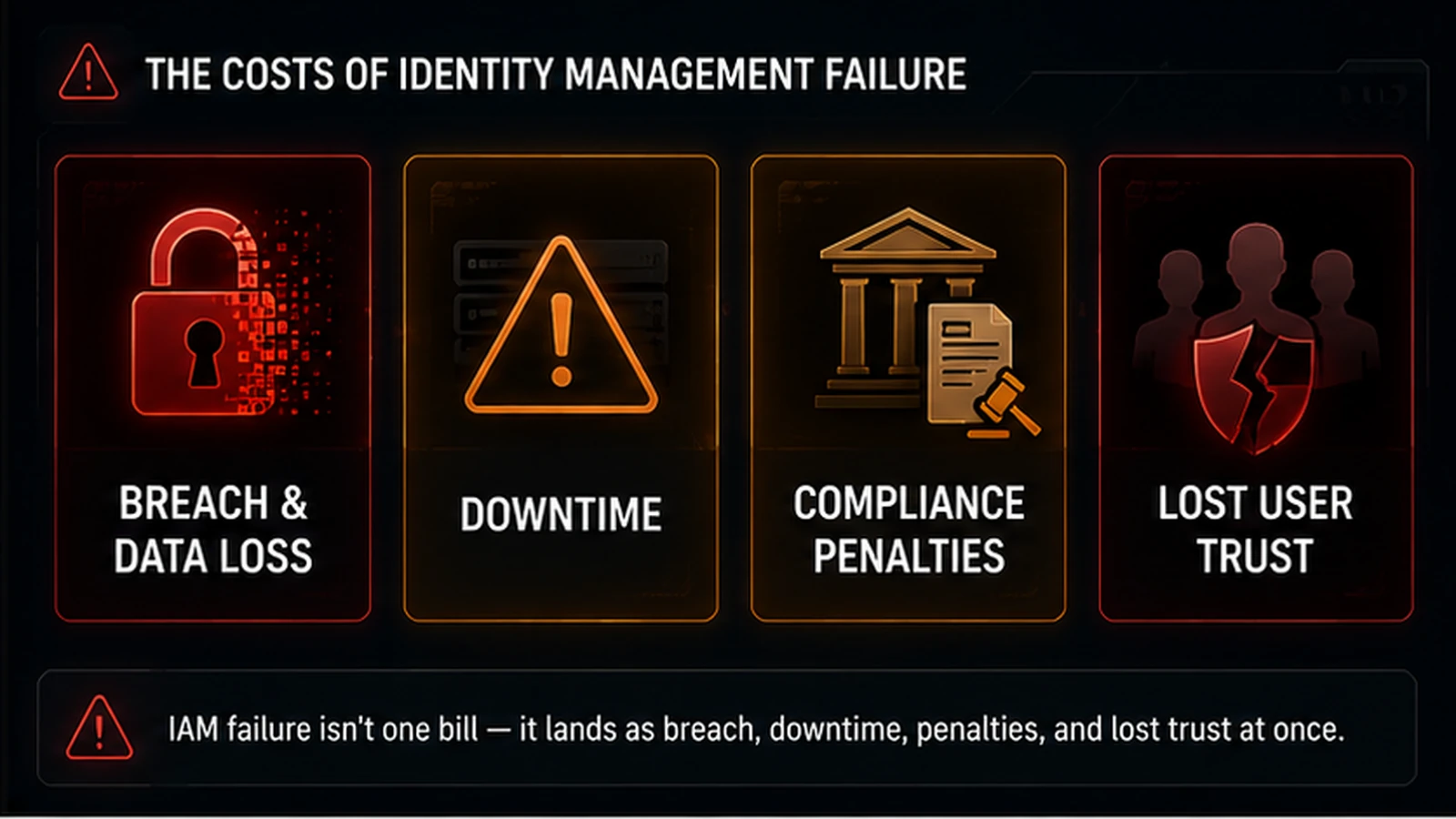 The four cost channels of identity-management failure. A single failed identity control feeds all four, and they accrue on different timelines — forensics first, downtime next, penalties over the regulatory cycle, and lost trust over multiple quarters.
The four channels: how identity failure becomes cost
Identity-management failure does not produce a bill labeled "identity failure." It produces four separate cost streams, each on its own timeline, and the total is the sum. Understanding them as distinct channels is what makes the cost estimable rather than mysterious.
Breach cost is the direct expense of the compromise itself — incident response, forensics, containment labor, emergency credential resets, and the eventual data-exposure remediation. This channel is the one the security press quantifies, and it is real, but it is the visible tip.
Downtime cost is the revenue and productivity lost while the environment is contained, rebuilt, and revalidated. When responders lock down an identity plane, they are also locking out the legitimate workforce. Operations degrade or halt. This channel scales with how central the compromised systems are to revenue.
Compliance-penalty cost is the regulatory and legal consequence of a breach that reveals inadequate access controls — fines, breach-notification obligations, legal defense, and the remediation programs regulators require. Access control is a named requirement in every major framework, so an identity failure is frequently also a compliance failure.
Lost-trust cost is the erosion of customer, partner, and market confidence — churn, higher customer-acquisition cost, partner re-diligence, and elevated insurance premiums. It is the slowest channel to bill and the longest to run, and it is often the largest.
These channels compound. A breach causes downtime; the downtime and breach together trigger the compliance response; and all three feed the trust erosion. One identity failure rarely produces one cost — it produces a cascade, which is why the whole is consistently more expensive than any single channel alone.
Direct cost versus hidden cost: the identity-failure iceberg
The most common mistake in estimating the cost of an identity failure is to count only the direct, invoice-generating expenses — the incident-response retainer, the forensics engagement, the overtime. Those are the part of the iceberg above the waterline. The larger mass is below it.
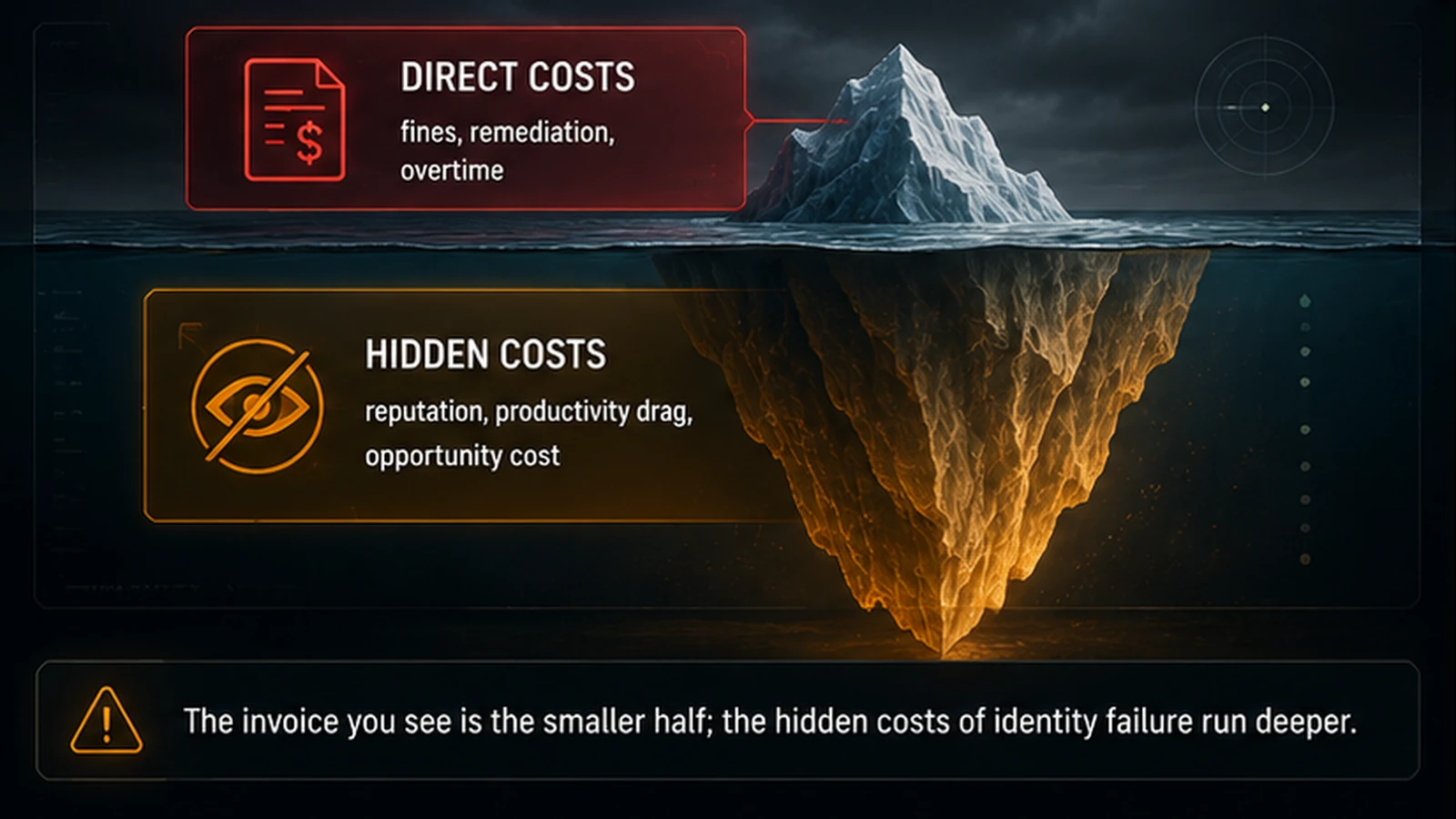 Direct costs are the visible tip — response, forensics, resets. The hidden mass below the waterline is downtime, regulatory exposure, legal defense, insurance repricing, and multi-quarter trust erosion. Estimates that count only the tip understate the true cost of identity failure by a wide margin.
Below the waterline sit the costs that do not arrive as a single invoice: productivity lost across a workforce that could not work during containment, multi-quarter customer churn that shows up as slower renewals rather than a labeled line item, the elevated cyber-insurance premium at the next renewal, and engineering teams rebuilding instead of shipping. None of these appear in the incident-response statement of work, and all of them are real. An estimate that stops at the direct costs — the tip — systematically understates what identity failure actually costs. This is the same structural point the digital identity costs and ROI analysis makes about valuing identity programs: the honest number is the fully-loaded one, not the visible one.
What a data breach from identity failure actually costs
Published breach-cost benchmarks vary widely by industry, region, data sensitivity, and organization size — which is precisely why this piece does not quote a single dollar figure. Any one number is either an average that fits almost no specific enterprise or a borrowed statistic dressed up as a fact. The defensible framing is mechanical: an identity-driven breach costs more than a typical breach because of two variables — dwell time and blast radius — and identity failure inflates both.
Dwell time is how long the attacker operates before detection. When the intruder holds legitimate credentials, their activity blends with normal operations — no malware signature to catch, just a valid identity doing things a valid identity is allowed to do. That camouflage extends dwell time, and every additional day is more data exposed, more systems touched, and more cost.
Blast radius is how far the attacker can reach once inside. This is where over-provisioning does its damage. A compromised identity that holds only the access its job requires is contained by design — the attacker inherits a narrow footprint. A compromised identity that holds years of accumulated standing privilege inherits the keys to the estate. The same initial compromise produces a small incident or an enterprise breach depending entirely on how much the identity was allowed to reach.
Longer dwell time multiplied by wider blast radius is the cost function of an identity breach: more systems touched means more forensics, more rebuild, more regulatory scope, and more notification obligation. This is why identity governance — reducing standing privilege and shortening the time access stays inappropriate — targets the exact two variables that most determine what a breach costs. The ITDR analysis covers the runtime-detection layer that shortens dwell time once an identity is compromised; governance is the layer that shrinks the blast radius before the compromise happens.
Downtime and operational disruption
The breach channel gets the headlines, but downtime is frequently the channel that hits the P&L hardest and fastest. When an identity plane is compromised, containment is not surgical. Responders reset credentials at scale, revoke sessions, quarantine systems, and rebuild trust from the ground up — and while they do, the legitimate workforce is locked out alongside the attacker.
For an organization whose revenue depends on systems the compromised identity could reach, downtime converts directly to lost revenue per hour. For everyone else, it converts to lost productivity across every worker who cannot authenticate or reach the applications they need. Recovery is not instantaneous either: rebuilding a compromised identity environment means re-establishing trust in every credential, which is slow and labor-intensive precisely when the organization can least afford the delay.
The downtime cost scales with three things: how central the affected systems are to revenue, how much standing access the compromised identity held (which determines how much has to be contained and rebuilt), and how mature the recovery playbook is. An enterprise that has practiced identity recovery, can deprovision and re-provision at scale through automation, and has segmented privilege so containment is targeted rather than total spends far less time down. This is one more reason the blast-radius variable matters: a smaller blast radius is also a faster, cheaper recovery.
Compliance penalties and the regulatory response
Access control is not an optional best practice in regulated industries — it is a named, audited requirement. SOX §404 requires controls over access to financial-reporting systems. PCI DSS v4.0.1 Requirements 7, 8, and 10 govern access to cardholder data and the logging of that access. HIPAA §164.312 mandates access controls for protected health information. ISO 27001 and NIST 800-53 both carry substantial access-control families. When an identity failure produces a breach, regulators do not only ask what happened — they ask whether the access controls the framework requires were actually in place and operating.
This is where identity failure becomes compliance cost. A breach that traces back to over-provisioned access, missing certification evidence, orphaned accounts, or standing privilege that should have been time-boxed is not just a breach — it is evidence that required controls were absent. That transforms the regulatory posture from "we were attacked despite adequate controls" to "we were attacked because our controls were inadequate," and the second posture carries penalties, mandated remediation programs, and extended oversight that the first does not.
The corollary is the defensive one: audit-ready governance evidence lowers this exposure even when a breach occurs. An organization that can demonstrate least privilege, produce certification records showing entitlements were reviewed on schedule, and show that access was deprovisioned promptly at every departure is in a materially different regulatory position than one that cannot. The compliance cost of identity failure is partly the breach and partly the demonstrated absence of controls — and the second part is the part governance discipline directly reduces. The IAM costs and investment-readiness analysis covers how boards weigh this exposure when funding identity programs.
Lost trust: the cost that outlasts the incident
The three channels above eventually close. Forensics concludes, systems come back online, regulators settle. The trust channel does not close on the same schedule. It is the cost that keeps billing after the incident is technically over.
Customers who learn their data was exposed through an identity failure do not all leave, but enough do to show up as elevated churn and slower renewals for multiple quarters. Prospects who were mid-evaluation pause or walk, raising customer-acquisition cost as the pipeline thins. Partners who share data or integrations trigger their own re-diligence, adding friction to every relationship that depends on trust in the organization's controls. Cyber-insurance underwriters reprice at renewal, and the higher premium persists for years.
Lost trust is the hardest channel to quantify precisely, which is exactly why it is so often left out of the cost estimate — and why leaving it out understates the true cost so badly. It is frequently the largest of the four channels over the full lifecycle of an incident, and it is the one that proactive identity governance is cheapest to buy insurance against. Preventing the breach preserves the trust; there is no remediation program that buys it back at the same price.
The identity and access management risks that translate to cost
Underneath the four cost channels sit the specific identity and access management risks — the failure conditions that turn a routine compromise into an expensive one. Naming them precisely is what makes the cost preventable rather than merely regrettable.
Over-provisioned standing access. Users and roles holding more privilege than the job requires. This is the single largest amplifier of blast radius, and blast radius is a primary cost variable. Standing privilege that never expires is standing risk that never expires.
Orphaned and stale accounts. Access that outlives the employee, contractor, or application it belonged to. Every account that should have been deprovisioned and was not is unwatched attack surface — a valid credential with no legitimate owner monitoring it. The human error in breaches analysis covers how manual deprovisioning reliably leaves these behind.
Unreviewed entitlements. Access that was appropriate when granted and drifted out of appropriateness with no recertification. Entitlement drift is silent — nothing breaks when access becomes inappropriate, it simply becomes risk that no control is watching.
Weak or phishable authentication on privileged paths. The lower the cost of the initial compromise for an attacker, the more attempts they make and the more succeed. Phishing-resistant authentication on privileged access raises the attacker's cost, which lowers the frequency of the failures that start the whole cascade. The Storm-2949 governance analysis is a detailed case study of how a single credential compromise became a cloud-wide breach because the governance behind the login was absent.
Forgotten non-human identities. Service accounts and machine identities that nobody owns, rotates, or decertifies. They drift faster than human identities because there is no person to notice, and they hold precisely the kind of programmatic access attackers seek.
Each is a failure mode that raises either the probability of a breach or its blast radius — which, as the breach-cost section established, is the same thing as raising its cost. The risks are the mechanism; the four channels are the bill.
Controls that lower the risk
If the risks above are the mechanism by which identity failure becomes cost, then the controls that address those risks are how an organization lowers its expected cost of failure. None of them eliminate risk. Each of them shrinks it.
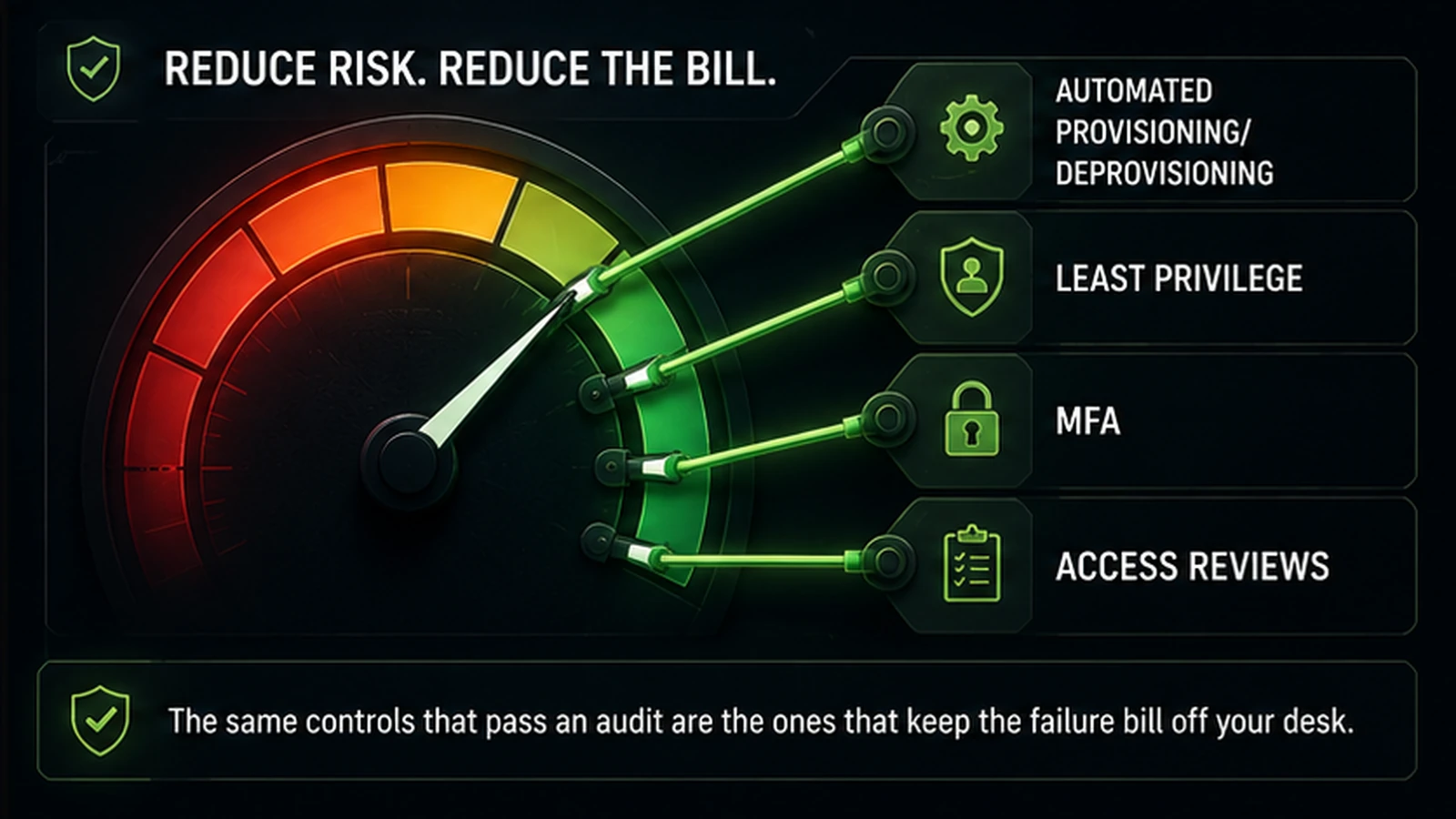 The controls that lower identity-failure risk map directly to the risks that drive cost. Least privilege and JIT elevation shrink blast radius; automated lifecycle and certification close orphaned and drifted access; phishing-resistant authentication raises the cost of the initial compromise.
Least privilege directly attacks blast radius. When identities hold only the access their role requires, a compromise inherits a narrow footprint by design. This is the highest-leverage control against breach cost because blast radius is the variable that separates a contained incident from an enterprise event.
Automated joiner/mover/leaver lifecycle closes the orphaned-account risk. When provisioning and deprovisioning are driven automatically from the authoritative HR source, access ends the moment the employment or engagement ends — no manual step to forget, no stale credential left behind. Automation removes the human-error window that manual lifecycle management leaves open.
Continuous access certification addresses entitlement drift. Reviewing entitlements on a schedule keeps access appropriate over time and produces the certification evidence that lowers compliance-penalty exposure. AI-augmented certification focuses reviewer attention on the anomalous and high-risk entitlements rather than the routine ones, which raises certification quality while keeping the labor sustainable.
Phishing-resistant authentication on privileged paths raises the attacker's cost of the initial compromise. FIDO2-compatible credentials bound to the legitimate origin defeat the phishing and social-engineering techniques that produce most credential compromises. This control lowers the frequency of the failures that start the cascade.
Just-in-time elevation removes standing privilege from the attack surface entirely. When no human holds a standing administrative role — when elevation must be requested, time-boxed, and expired — the privilege an attacker most wants is simply not there to inherit at the moment of compromise.
The pattern across all five is consistent: they either shrink the blast radius, close an unwatched surface, or raise the cost of the initial compromise. Together they do not promise that no failure occurs; they make the failures that do occur smaller, shorter, and cheaper.
What Avatier ships toward this pattern
Avatier Identity Anywhere is built on the assumption that standing privilege is the wrong default and that access should be governed continuously rather than reviewed once a year. The platform automates joiner/mover/leaver lifecycle from authoritative HR sources so access ends when engagement ends, closing the orphaned-account risk that manual deprovisioning leaves open. It runs continuous access-certification campaigns — AI-augmented to focus reviewers on anomalous and high-risk entitlements — so drift is caught on schedule and the evidence exists when auditors ask. It enforces least privilege and supports just-in-time elevation so the blast radius of any single compromise stays narrow. And it supports phishing-resistant, FIDO2-compatible authentication, with the Identity Challenge Card providing deviceless credentials for workforce segments where smartphones are not operationally available.
The point is not to promise that failure never happens — no honest platform promises that. It is to move every cost variable in the favorable direction: smaller blast radius, shorter dwell time, fewer unwatched surfaces, higher attacker cost, and audit-ready evidence that lowers regulatory exposure when an incident does occur. Avatier publishes its own security posture at the Avatier Trust Center — SOC 2 Type II with zero exceptions, ISO/IEC 27001:2022, PCI DSS v4.0.1, CSA STAR Level 1, NIST 800-53 Rev. 5 aligned, FedRAMP-aligned, CISA Secure-by-Design Pledge signatory — because the discipline the platform sells is the discipline it holds itself to.
The honest closing
No tool eliminates the risk of identity-management failure. Any vendor that tells you otherwise is quoting a number they cannot measure or making a promise they cannot keep. Credentials will be compromised, users will be social-engineered, and configurations will drift no matter how good the platform. The realistic and worthwhile goal is not a guarantee against failure — it is a failure that is smaller, shorter, and cheaper than it would otherwise have been.
That is what disciplined identity governance buys. It shrinks the blast radius so a compromise reaches less, shortens dwell time so it runs for less time, closes the orphaned and drifted access that turns routine incidents into enterprise events, produces the evidence that lowers regulatory exposure, and raises the attacker's cost so fewer failures start at all. The cost of identity-management failure is real across all four channels — breach, downtime, penalties, and lost trust — and the cost of governing identity well is smaller than the cost of the failure it prevents. That is the entire economic case, and it does not require a fabricated statistic to make. Plan for containment and resilience, not for perfection, and the math works in your favor.
ABOUT THE AUTHOR

More from IAM & Identity Governance

What Is Pay Per Identity Action™? Outcome-Based Identity, Explained
Pay Per Identity Action™ is Avatier's outcome-based identity pricing model: you pay only for completed, verified, policy-compliant identity outcomes, not for seats, modules, or services hours.

What Is Agentic Identity? Governing AI Agents as Identities
Agentic identity is the governed identity an AI agent acts under. How it differs from human and machine identity, how delegated authority works, and the lifecycle that keeps agents accountable.

MCP Identity Governance: Securing AI-Agent Actions in 2026
MCP identity governance controls which identity, through which AI assistant, may invoke which identity tool, under what policy, and with what evidence. How it works and how to put it in place.