AI Agent Audit Trail: How Avatier Ledger Records Identity Actions
An AI agent audit trail proves which identity acted, who asked, under whose authority, and what policy allowed it. What the record should hold, why logs fall short, and how Avatier Ledger works.

An AI agent audit trail proves which identity acted, who asked, under whose authority, and what policy allowed it. What the record should hold, why logs fall short, and how Avatier Ledger works.
- An AI agent audit trail is the record that proves, for each identity action an assistant or agent takes, which identity was involved, who or what initiated it, under what authority, which policy applied, what ran, and how it ended.
- Auditors have moved past asking whether MFA exists. They now ask which human or AI identity touched a regulated system, what authority it used, what policy was enforced, and where the evidence is.
- Traditional logs struggle to answer that because the evidence is scattered across systems, rarely tied to the requesting identity or the governing policy, and usually reconstructed after the fact.
- Avatier Ledger, an MCP connector, records who asked, what ran, under whose authority, and what policy allowed it for human-initiated and agent-assisted actions, then answers questions through Persona Briefings for the CISO, CFO, and security team.
- Ledger helps support SOX, HIPAA, and NIST evidence needs for actions that run through Avatier. It does not replace a SIEM, cover actions outside Avatier, or set your retention policy for you.
An AI agent audit trail is the record that proves, for every identity action an AI assistant or agent takes, which identity was involved, who or what initiated it, under what authority, which policy allowed it, what ran, and how it ended. It is the difference between knowing an agent did something and being able to show an auditor that the agent was allowed to do it. As assistants move from answering questions to resetting passwords, removing access, and approving requests, that record becomes the control that keeps delegated work accountable.
Enterprises are connecting assistants such as Claude and Microsoft Copilot to identity systems through the Model Context Protocol, and every connection creates identity events someone will have to explain. Avatier's CISO puts it plainly in the Avatier Identity Anywhere 2027™ launch materials: "If an organization cannot audit an AI-initiated identity action, it does not fully control it."
This piece is a practitioner reference on audit evidence for AI agents. It covers what auditors now ask for, what a complete identity-action record contains, why traditional logging misses it, and how Avatier Ledger approaches the problem. It sits in the MCP Actions series alongside the hub explainer What Is Pay Per Identity Action™, the governance view in MCP identity governance, and the identity model behind agents in What Is Agentic Identity.
Why auditors now ask who touched the system, not whether MFA exists
For years, identity controls were audited as configurations. Does the organization enforce MFA? Is there a quarterly access review? A yes and a screenshot were often enough.
That posture is shifting. Dr. Sam Wertheim, Avatier's CISO, describes it this way: auditors are moving beyond asking whether an organization has MFA. They want to know which human or AI identity touched a regulated system, what authority it used, what policy was enforced, and where the evidence is. Those are four distinct questions, and a configuration screenshot answers none of them.
Agents sharpen each one:
- Which identity? When an assistant performs an action for an employee, there are at least two identities in play: the person who asked and the agent that acted. If your records only capture one, you lose either accountability or attribution.
- What authority? An agent should act under the requester's delegated authority, not a broad standing credential. The record has to show which one it used.
- What policy? Approvals, role checks, and separation-of-duties rules exist so that sensitive actions are governed. The evidence needs to name the policy that allowed the action, not just show that it happened.
- Where is the evidence? If proving any of this means pulling data from four systems and a chat transcript, the evidence exists in theory but not in a form an auditor can sample.
Wertheim's September framing extends the point: every action an assistant takes on a person's behalf is an identity event, and identity events need evidence. As agents join the workforce, the organizations that pass audits will be the ones that can produce that evidence on demand, for every action, whether a human or an agent started it. For the broader shift in what auditors test, see the access review your auditor actually wants.
What an identity-action audit record should contain
A usable audit record for an identity action answers a fixed set of questions. Avatier's August launch of Identity Anywhere 2027 defines the fields each Secure Outcome records, and the September launch of Avatier Ledger describes the same idea as four questions. Put together, they form a clear standard for what a record should hold.
The six fields from the Identity Anywhere 2027 launch:
| Field | What it proves |
|---|---|
| Identity involved | Whose account, access, or credential was affected |
| Initiating agent or experience | Whether the action came from a person at a portal, a help-desk agent, an AI assistant, or another channel |
| Authorization context | The authority the action ran under, such as the requester's delegated rights |
| Policy applied | The rule, approval, or control that permitted the action |
| Action taken | What actually ran against the target system |
| Final result | Whether the action completed, and in what state it left the identity |
Ledger's four questions map directly onto those fields. Who asked covers the identity and the initiating agent or experience. What ran is the action taken and its result. Under whose authority is the authorization context. What policy allowed it is the policy applied. The fields are the structure; the questions are how an auditor or executive will actually interrogate them.
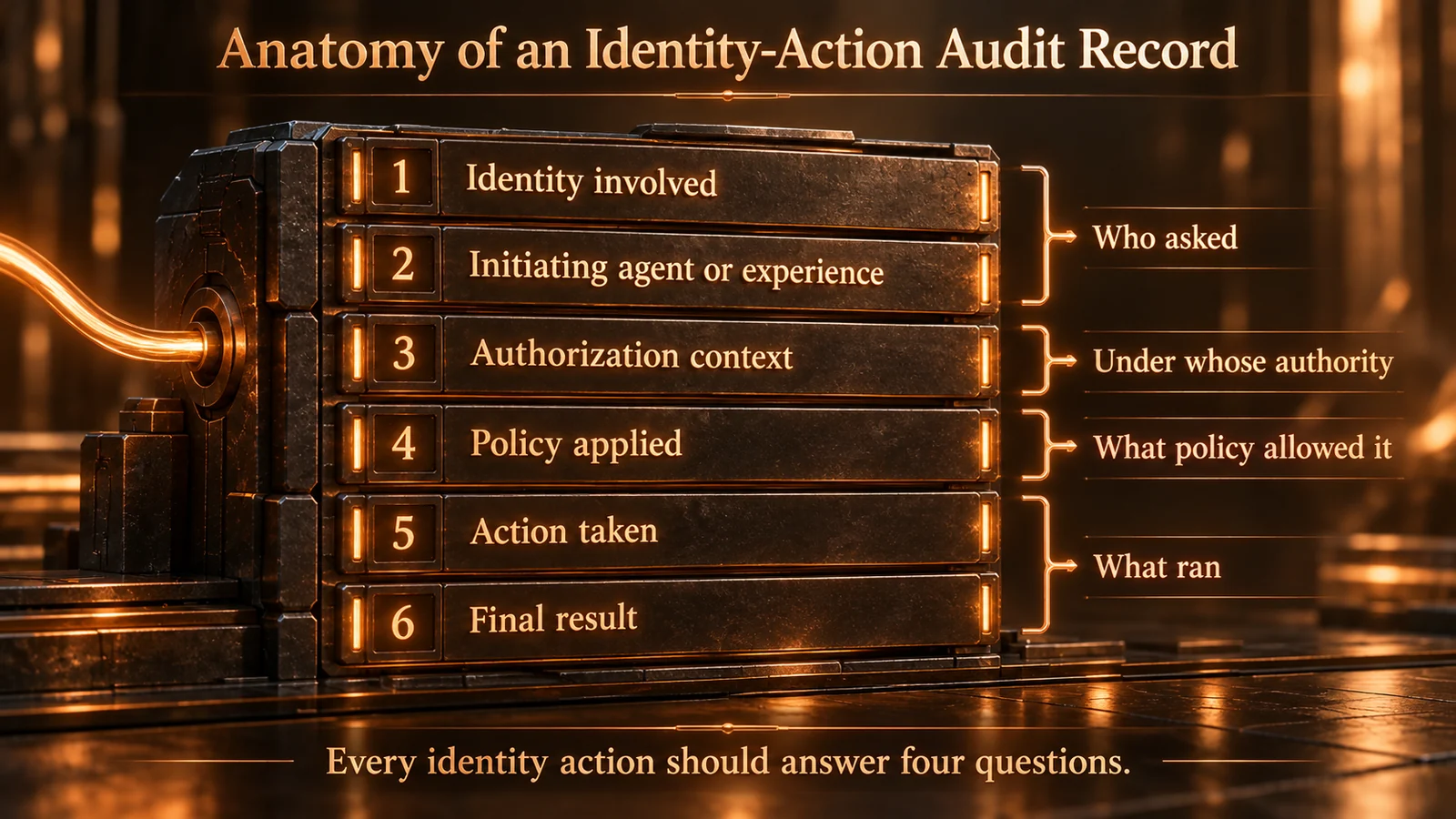 Six fields, four questions: a complete identity-action record answers who asked, what ran, under whose authority, and what policy allowed it.
A worked example makes it concrete. Avatier's public demonstration shows a termination executed by asking an assistant, with the audit evidence printing at the end. In plain language, the evidence for a request like that tells the story end to end: the departing employee's identity; the manager who asked, through which assistant; the manager's authority to request the change; the offboarding policy and any approvals it required; the access that was removed; and confirmation that the removal completed. Nothing in that account requires someone to go find it later. It exists because the action ran.
One caution: these are the fields Avatier describes, not a published schema, so do not assume field names, formats, or attributes beyond them. And a record is only as complete as the path the action took.
Where traditional logs fall short
Most organizations already log identity activity. Directories record changes, identity providers record sign-ins, ticketing systems record requests, and chat platforms record conversations. The problem is not a lack of data. It is that the data was never designed to answer the auditor's four questions together.
Three gaps show up again and again.
The evidence is scattered. A single access removal might leave a request in the ticketing system, an approval in email, a change event in Active Directory, and a conversation in a chat tool. Each system holds a fragment. None holds the story.
It is not tied to identity or policy. A directory log shows that an account changed a group membership. It usually does not show which person asked for it, what authority they had, or which policy allowed it. When an agent performs the change through an integration, the log often shows only the integration's service account. The human requester and the governing policy disappear from the record. This is the same attribution problem that plagues ungoverned non-human accounts, covered in depth in service account governance and non-human identity.
It is reconstructed after the fact. When audit season arrives, analysts assemble evidence by hand: exporting logs, matching ticket numbers to change events, capturing screenshots, and writing narratives to fill gaps. The result can pass, but it is slow, expensive, and fragile. Every gap in the reconstruction is a finding waiting to happen.
| Traditional logging | Evidence created with the action | |
|---|---|---|
| Where it lives | Spread across directory, IdP, ticketing, email, and chat | Attached to the completed outcome |
| Who is recorded | Often a service account or integration | The requester, the initiating agent or experience, and the identity affected |
| Policy link | Usually absent or inferred | The policy that allowed the action is part of the record |
| When it is assembled | After the fact, during audit prep | When the action runs |
| Agent-assisted actions | Collapse into generic integration activity | Recorded under the same pattern as human-initiated actions |
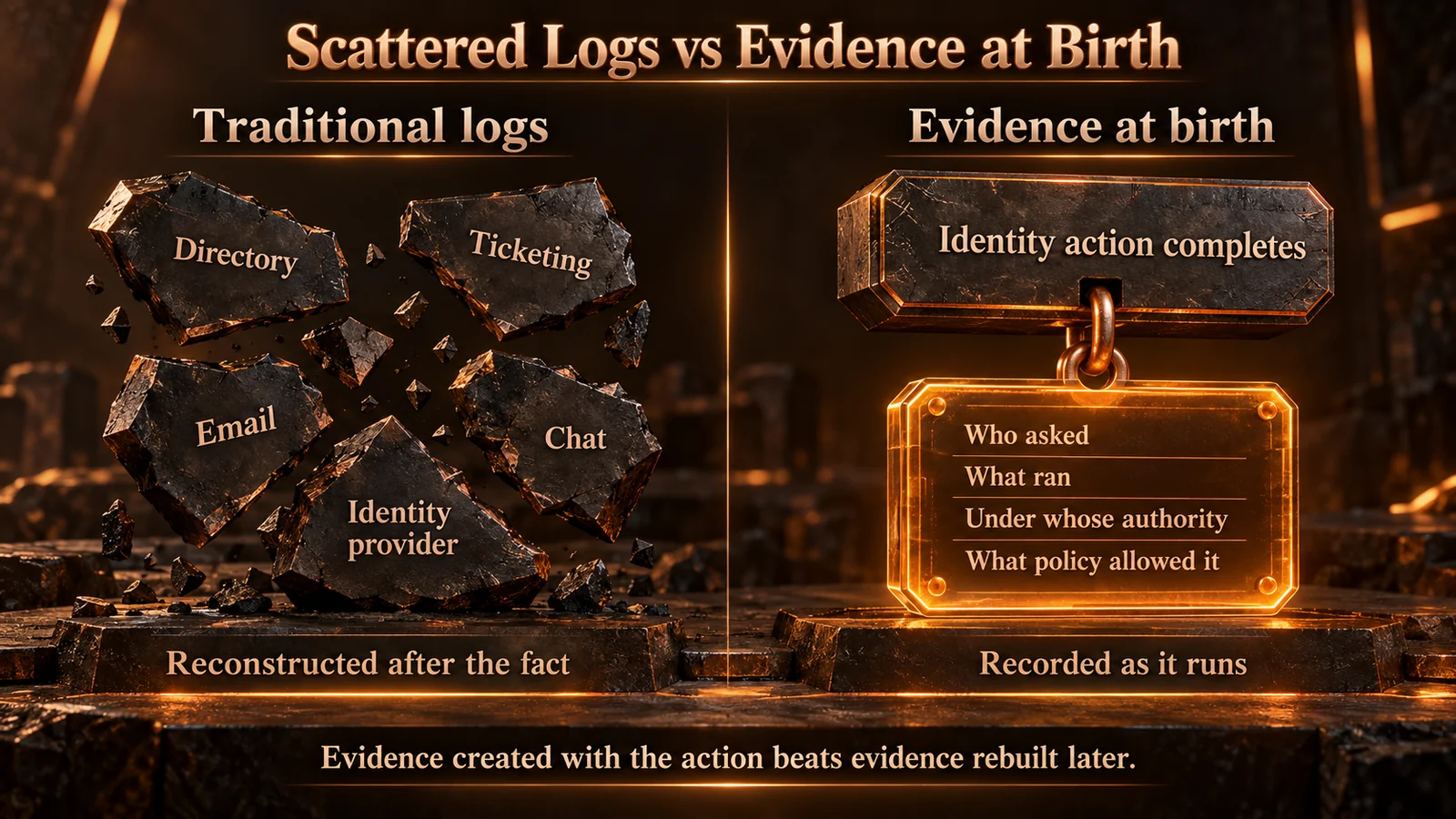 Logs describe fragments after the fact. Evidence created with the action carries the whole story from the moment it runs.
How Avatier Ledger works
Avatier Ledger is a Model Context Protocol connector that turns every identity outcome into evidence and every report into a question. It works alongside Avatier Actions, a separate MCP connector. They are two distinct products.
The two connectors divide the job cleanly.
- Avatier Actions runs the outcome. Actions exposes more than 50 identity outcomes as MCP tools across eight modules: Password Management, Help Desk, Lifecycle Management, User Management, Group Management, Access Governance, Workflow Approval, and Reports. An employee or manager asks in Teams, Outlook, Claude, or Copilot, and the request runs through the customer's existing policies, approvals, and roles. The assistant is the interface, never the authority.
- Governance decides. Under the Identity Anywhere 2027 model, AI assistants do not receive unrestricted access. Every request must invoke an approved Avatier capability and remains subject to authentication, authorization, delegated authority, policy enforcement, and audit controls. Avatier determines whether the identity action is permitted.
- The outcome is born with its evidence. When the action completes, it already carries its record. Ledger records who asked, what ran, under whose authority, and what policy allowed it, for human-initiated and agent-assisted actions alike.
- Reports become questions. Instead of exporting a report and handing it to an analyst, a stakeholder asks a question in their assistant and gets an answer drawn from that evidence.
The fourth step is the one that changes day-to-day work. A compliance lead can ask something like the following inside an MCP-compatible assistant. This is an illustrative prompt, not a documented API call:
Illustrative prompt only (not the real Avatier API schema):

"Show every access removal for employees who left the finance
department last quarter. For each one, who asked, what ran,
under whose authority, and what policy allowed it?"
The answer comes from records created when each action ran, not from a spreadsheet someone built last week.
Because the assistant is only the interface, this pattern fits the general guidance for any MCP deployment: least privilege, scoped tokens, allow-listed tools, human approval for sensitive actions, logging, and awareness of prompt injection and tool poisoning. Those practices are covered in how to secure MCP servers. Ledger addresses the logging and evidence piece; it does not substitute for the rest.
Persona Briefings: one evidence set, three audiences
The same identity evidence means different things to different people. A CISO needs control coverage. A CFO needs cost. A security team needs exposure. Traditionally, turning one data set into three reports takes weeks of analyst time. Persona Briefings tailor the answer to the person asking instead.
According to the Avatier Ledger announcement, the three briefings focus as follows:
| Briefing | What it focuses on |
|---|---|
| CISO | Every applicable compliance framework blended with the organization's identity and password statistics. Remediation is highlighted in 0–30, 30–90, and 90-plus-day windows, formatted to the evidence templates and language of the organization's own IT auditors. |
| CFO | The same data focused solely on cost and breach prevention. Identity spend is reconciled to completed actions, with year-over-year cost projections modeled from the organization's own churn and identity data combined with regional labor and technology-stack benchmarks. |
| Security team | Exposure, dormant and orphaned access, privileged activity, and the vishing surface at the help desk. |
The security briefing lines up with two of the most persistent identity risks. Dormant and orphaned accounts are a classic source of findings, and orphaned and dormant accounts covers how to find and fix them. The vishing surface at the help desk is where social engineers target password resets and account unlocks; Avatier's Assisted Reset pillar addresses the verification side of that problem.
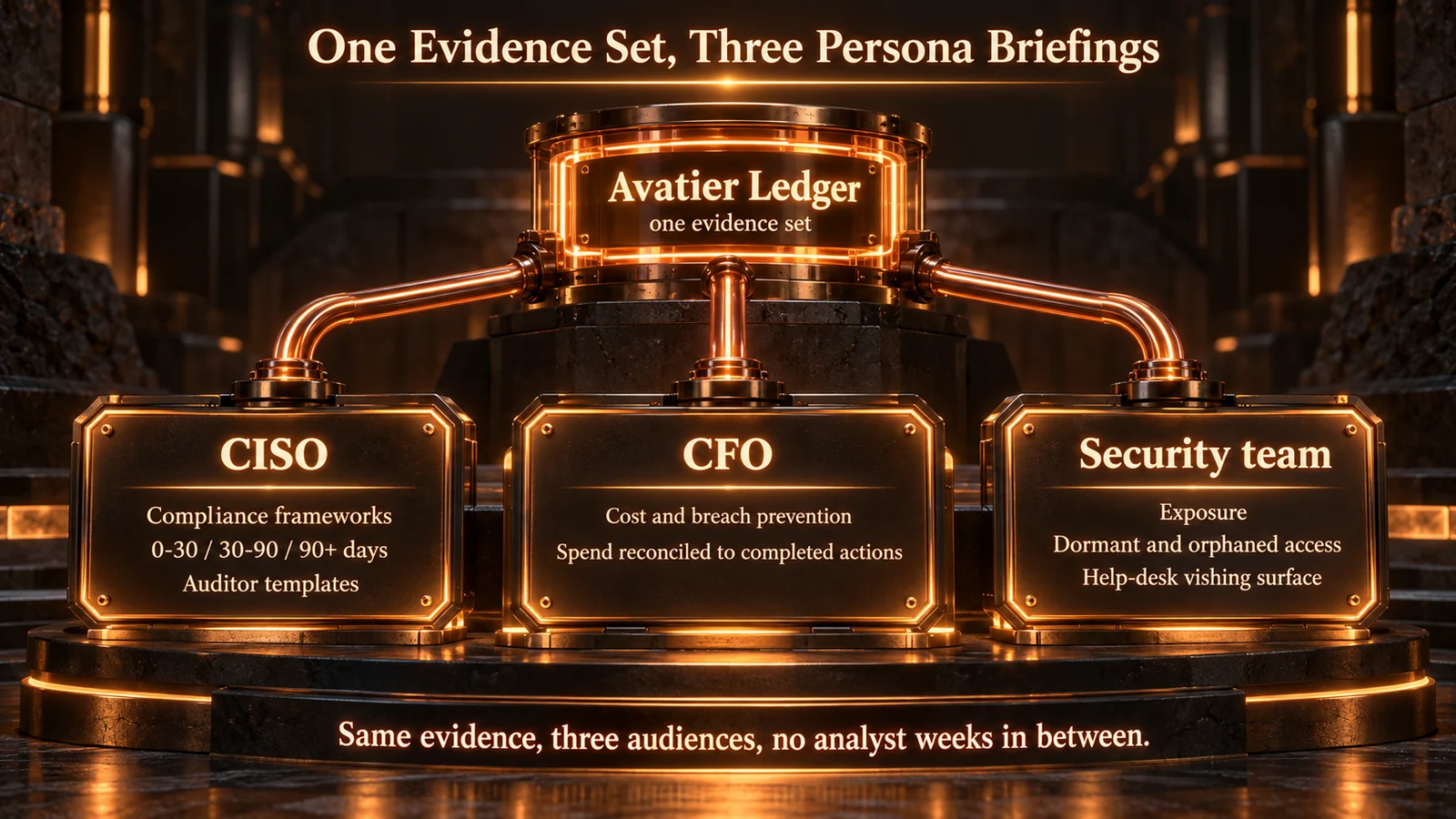 Same evidence, three audiences: the CISO, CFO, and security team each get the answer in their own terms, with no analyst weeks in between.
Because all three briefings draw on one set of records, the CISO, CFO, and security views start from the same evidence rather than three separate exports.
Where Pay Per Identity Action™ fits
Pay Per Identity Action™ is Avatier's pricing model in which customers pay only for completed, verified, policy-compliant identity outcomes. The audit trail and the pricing model are two views of the same record.
The Ledger announcement makes the link explicit: under Pay Per Identity Action, every charge is an outcome that completed, and every completed outcome already carries its receipt. That has three consequences for an audit-minded reader.
- Billing and evidence reconcile by design. If you pay for an outcome, the outcome's evidence exists. A charge without a record, or a record without a completed outcome, is a discrepancy you can see.
- The CFO briefing has something real to reconcile. Identity spend reconciled to completed actions is only possible when each action is recorded as a completed outcome with its evidence.
- The final result matters commercially, not just for audit. The model charges for completed, verified, policy-compliant outcomes, and every record carries the final result, so the same field an auditor reads is the one that separates a billable outcome from an action that did not complete.
Getting started is free, deployment services are included, and a 45-day money-back guarantee applies. Full commercial terms go to qualified organizations in the invitation-only preview. For the full pricing model, read the hub: What Is Pay Per Identity Action™.
How it helps support SOX, HIPAA, and NIST evidence needs
No tool makes an organization compliant. What an identity audit trail can do is make the evidence behind identity controls easier to produce and easier to trust. Avatier Ledger helps support SOX, HIPAA, and NIST evidence needs for identity actions that run through Avatier.
SOX. IT general controls over financial systems depend on showing that access changes were requested, approved, and completed as recorded, and that terminated users lost access on time. A record that ties each change to a requester, an authority, and a policy is exactly what auditors sample. For the full picture of SOX expectations on identity teams, see SOX compliance for identity teams.
HIPAA. Healthcare organizations have to show who accessed systems holding protected health information and that access was appropriate. Evidence that names the identity, the initiating experience, and the policy applied helps support access audits. HIPAA access audits for healthcare identity teams covers the audit side in detail. Avatier's own launch notes that a healthcare organization with more than 100,000 identities is running the platform.
NIST. NIST frameworks emphasize accountability, account management, and audit records that tie actions to identities. Evidence created with each identity action helps support those expectations, though NIST alignment is always a program-level judgment, not a product property.
For CISOs, the useful part is the format. The CISO briefing is built to the evidence templates and language of the organization's own IT auditors, which shortens the translation step between what the platform records and what the audit team asks for.
What Avatier ships toward this pattern
Avatier's approach rests on two MCP connectors announced on September 24, 2026, available through Avatier Identity Anywhere 2027.
- Avatier Actions exposes more than 50 identity outcomes as MCP tools across eight modules: Password Management, Help Desk, Lifecycle Management, User Management, Group Management, Access Governance, Workflow Approval, and Reports. Nothing bypasses the customer's existing policies, approvals, and roles.
- Avatier Ledger turns every outcome into evidence and every report into a question. It records who asked, what ran, under whose authority, and what policy allowed it for human-initiated and agent-assisted actions, and delivers Persona Briefings for the CISO, CFO, and security team.
- Where it runs. Both work inside Claude, Claude Code, Microsoft Copilot, Avabot, and any MCP-compatible assistant.
- Setup. Setup is one administrator connection. Permissions are inherited from the identity platforms customers already run, including Microsoft Entra ID, Active Directory, Okta, and Ping. There is no per-user setup and no new permissions model.
- Alongside, not instead of. Avatier runs alongside existing platforms, including SailPoint, Saviynt, ServiceNow, and Moveworks, rather than replacing them.
On its own security posture, Avatier is SOC 2 Type II audited with zero exceptions noted, ISO/IEC 27001:2022 certified, PCI DSS v4.0.1 compliant, CSA STAR Level 1, NIST 800-53 Rev. 5 aligned, FedRAMP-aligned, and a CISA Secure-by-Design Pledge signatory. Details are on the Avatier Trust Center. The company was founded in 1997 in Pleasanton, California, and has sold over 15 million licenses. For how agents fit into identity programs more broadly, see the Ai4 perspective in why identity security is the conversation the AI industry needs and, on the authentication side, identity for AI agents and agentic authentication.
What an AI agent audit trail does not solve
An audit trail is a control for evidence, not a complete security program. It is worth being exact about its limits.
It does not replace your SIEM. A SIEM correlates events across your whole estate for detection and response. Ledger records the evidence for identity actions. They serve different purposes, and most organizations will want both.
It covers actions that run through Avatier. If an agent holds its own credentials to a system and acts directly, or if a change happens in a system Avatier does not govern, Ledger will not see it. The trail is complete only for the paths you route through it. Closing the side doors, by removing standing agent credentials and sending identity actions through a governed layer, is your job.
You still need retention policies. How long evidence is kept, where it is exported, who can read it, and how it is protected are decisions for your records and security teams. The sources describe what Ledger records, not a retention period, and you should not assume one. Treat the integrity and retention of identity evidence as part of your own records program, as you would for any audit data.
It records whether policy was followed, not whether policy is right. If an approval rule is too loose, the evidence will faithfully show actions approved under a loose rule. Policy design, role definitions, and separation-of-duties rules still need their own review.
It does not make an agent trustworthy. An audit trail shows what an agent did and under what authority. It does not stop a poorly scoped agent, a prompt-injected request, or a poisoned tool from attempting something harmful. Least privilege, human approval for sensitive actions, and vetting of MCP servers remain the preventive layer.
The honest summary is this: an AI agent audit trail answers the auditor's four questions for the actions it covers, and it answers them without weeks of reconstruction. That is a meaningful change in how identity evidence is produced. It works best as one layer in a program that also governs how agents authenticate, what they can reach, and how long the evidence of their work is kept.
ABOUT THE AUTHOR

More from Compliance & Audit

Certificate Lifecycle Management in 2026: Issue, Renew, Revoke
Certificate lifecycle management is the discipline of issuing, deploying, monitoring, renewing, and revoking TLS and PKI certificates before any of them expires unnoticed. The 2026 reference on running certificates at enterprise scale — and where automation stops.

Separation of Duties (SoD): The 2026 Reference
Separation of duties is the control that says no single person may hold every step of a risky transaction — the requester can never also be the approver. This is the 2026 reference on SoD in identity and access management: toxic entitlement combinations, preventive versus detective enforcement, and how the control ties to SOX, RBAC, and least privilege.

CIA Triad Security Costs: A 2026 Risk Framework
The CIA triad — confidentiality, integrity, availability — is a practical cost framework for identity programs, not just theory. Here's what neglecting each pillar actually costs.