Separation of Duties (SoD): The 2026 Reference
Separation of duties is the control that says no single person may hold every step of a risky transaction — the requester can never also be the approver. This is the 2026 reference on SoD in identity and access management: toxic entitlement combinations, preventive versus detective enforcement, and how the control ties to SOX, RBAC, and least privilege.

Separation of duties is the control that says no single person may hold every step of a risky transaction — the requester can never also be the approver. This is the 2026 reference on SoD in identity and access management: toxic entitlement combinations, preventive versus detective enforcement, and how the control ties to SOX, RBAC, and least privilege.
- Separation of duties (SoD) is the control that splits a sensitive transaction across at least two people, so no single identity can complete it end to end. The canonical case is that whoever requests access can never be the same identity that approves it — the request and the approval are structurally different hands.
- SoD is enforced against toxic entitlement combinations: pairs of permissions that are each reasonable alone but dangerous together. Create-vendor plus pay-vendor enables a fake supplier paid to yourself; write-code plus deploy-to-production lets unreviewed changes reach customers; grant-access plus audit-access lets someone provision privilege and then erase the evidence.
- There are two enforcement modes. Preventive SoD blocks the conflicting grant at request time — the system refuses to give someone an entitlement that would collide with one they already hold. Detective SoD catches violations after the fact, during an access review or a continuous scan, and forces remediation.
- SoD is a load-bearing control for SOX and most financial-and-regulatory regimes, because those frameworks treat 'one person controlling a whole financial process' as a material weakness. Auditors look for both the policy and the evidence that it was enforced and monitored.
- SoD is not a standalone product. It rides on top of role-based access control and least privilege: RBAC gives you the roles to write conflict rules against, least privilege keeps the entitlement set small enough to reason about, and SoD adds the rule that certain roles can never coexist on one identity.
Separation of duties is the control that says no single person may hold every step of a transaction that could cause harm if it were abused — the person who requests access can never be the same person who approves it. Split the steps across at least two hands, and a fraud or a mistake now requires either collusion or a second reviewer catching it, rather than one individual acting alone and unobserved. It is one of the oldest ideas in operational control, older than computing, and it survives into modern identity and access management almost unchanged in principle: certain powers must not accumulate on one identity, no matter how convenient that would be.
The reason SoD keeps mattering is that access naturally concentrates. People change roles and keep their old entitlements. Emergency access gets granted and never revoked. Mergers merge two directories that each made sense alone. Over time, without a control that actively resists it, a single identity drifts toward holding both halves of a dangerous pair. Separation of duties is the discipline that keeps pulling those halves back apart — and, done well, refuses to let them come together in the first place.
What separation of duties actually is
At its core, SoD is a rule about who is allowed to do what in relation to whom else. A single duty — request a payment, provision an account, ship a code change — is rarely dangerous by itself, because it is only one step. The danger appears when one identity controls the whole chain: the step that acts, and the step that reviews, approves, or conceals the action. SoD breaks that chain deliberately. It designates that the acting step and the checking step must belong to different people, so the second person functions as a live control on the first.
The canonical form is the requester-versus-approver split. Whoever asks for access, initiates a transaction, or submits a change is structurally barred from being the one who signs off on it. This is not a matter of trust in the individual — it is a design choice that removes the opportunity for unilateral action regardless of intent. A well-meaning person makes fewer mistakes when a second person reviews their work; a malicious person cannot act alone at all. The same rule handles both cases without having to know which one it is dealing with.
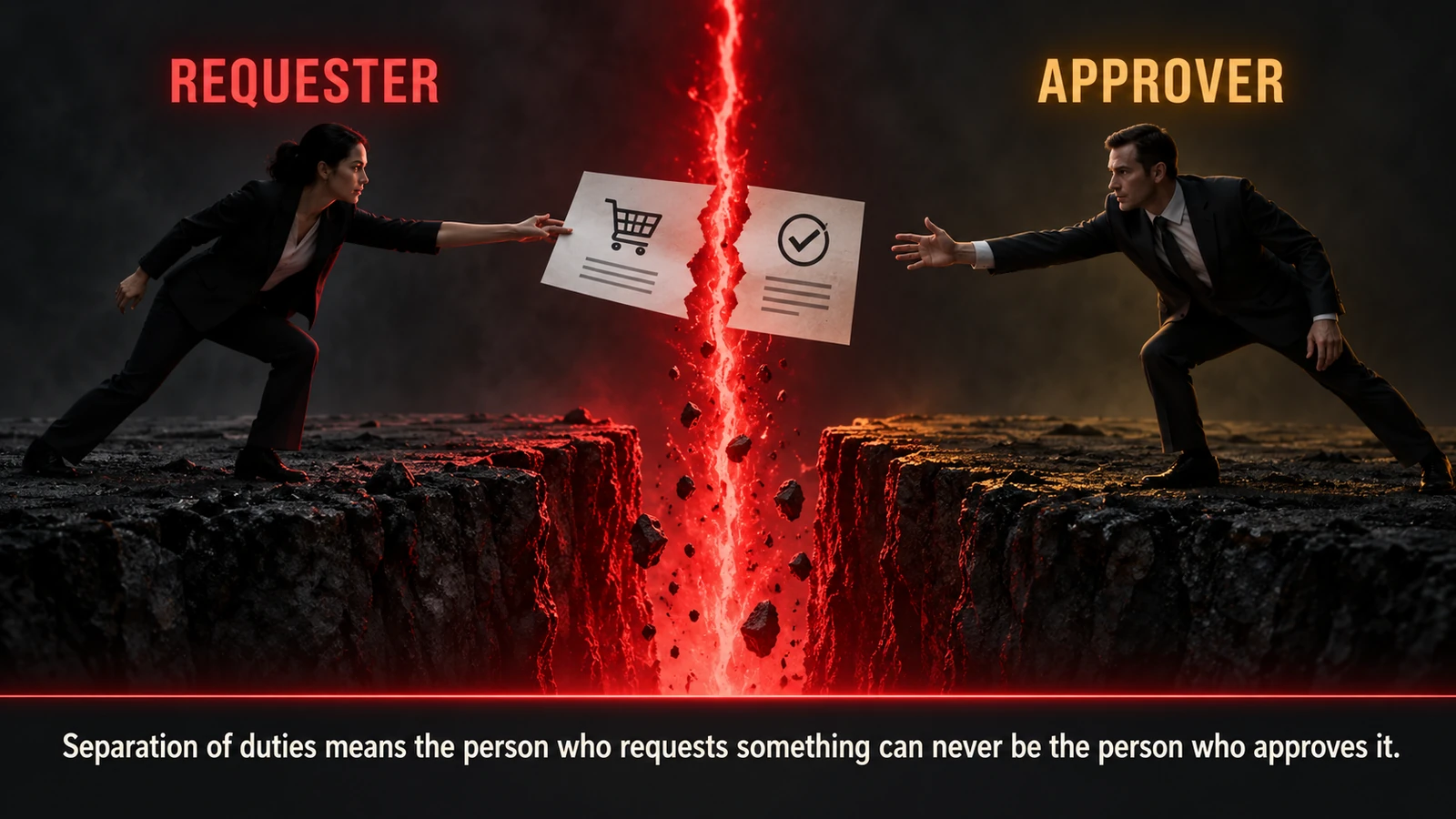 The foundational rule: the hand that requests and the hand that approves are never the same hand.
In identity terms, this all reduces to entitlements. An entitlement is a specific grant of access — the ability to create a vendor record, to deploy to production, to approve a request. SoD is therefore expressed as rules about which entitlements may coexist on one identity. That is what makes it a governable, automatable control rather than a matter of policy prose: once you can name the entitlements, you can name the forbidden pairings, and once you can name the pairings, a system can enforce them.
Toxic entitlement combinations
The unit of SoD enforcement is the toxic combination: a set of entitlements that are each reasonable in isolation but hazardous together. The word "toxic" is precise — neither permission is a problem on its own, and stripping either one would be over-restrictive. The risk exists only in the pairing, which is exactly why it is easy to miss. Least-privilege reviews look at each permission and find it justified. Only a control that reasons about combinations catches the danger.
Three examples recur in nearly every enterprise. The first is financial: the ability to create a vendor plus the ability to pay a vendor. Each is a normal accounts-payable function. Together, one person can register a supplier they secretly control and then approve payments to it — a classic fraud that SoD exists specifically to prevent. The second is engineering: the ability to write code plus the ability to deploy to production. A developer needs to write code, and someone needs to deploy; but when the same identity holds both, an unreviewed change can go straight to customers with no second set of eyes. The third is meta, and the most dangerous of all: the ability to grant access plus the ability to audit access. An administrator who can both provision privilege and curate the logs that would reveal it can hide their own tracks — the control that is supposed to catch abuse is now controlled by the potential abuser.
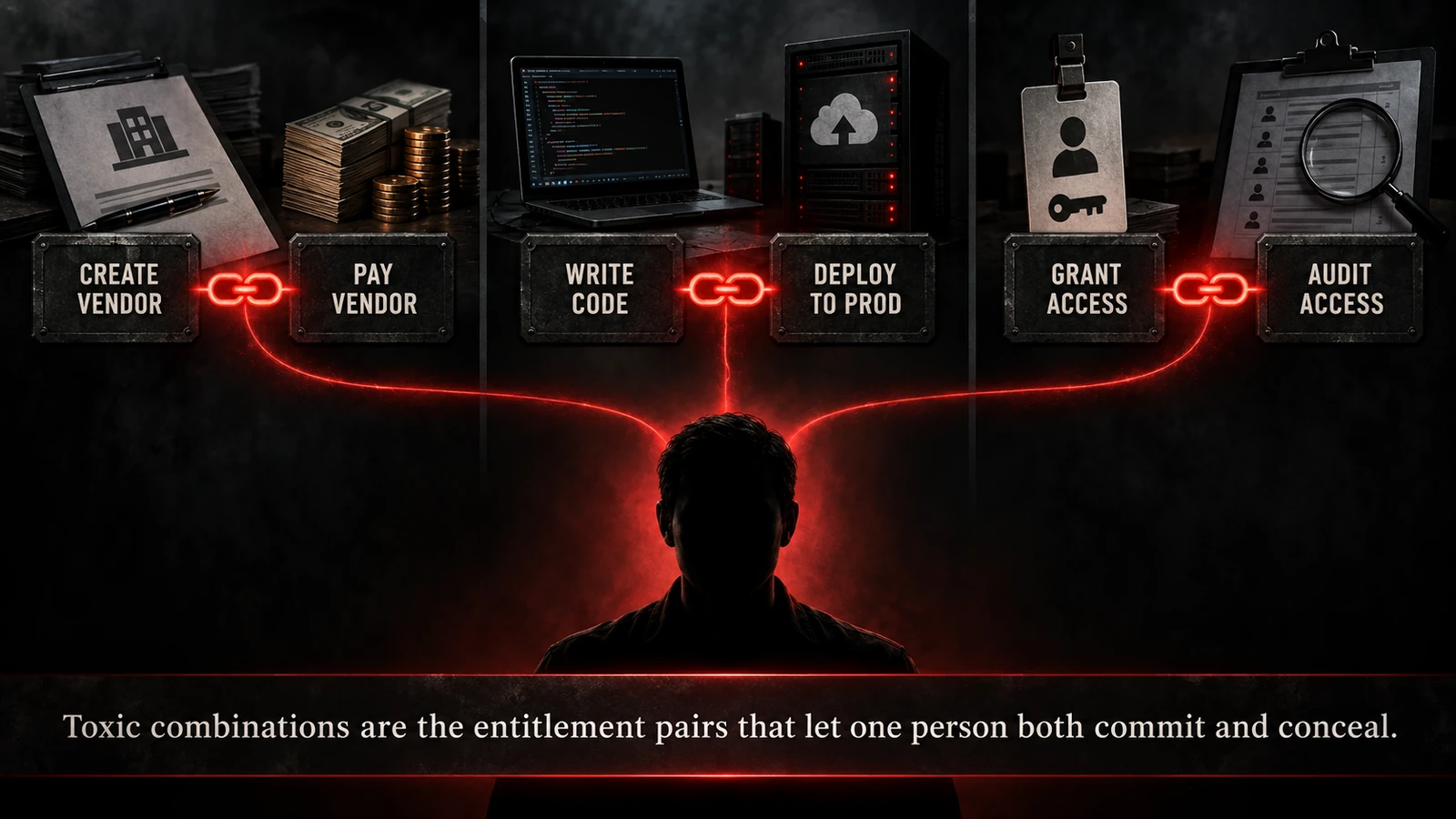 Each permission is defensible alone. The risk lives entirely in the pairing — which is why combination-aware rules, not per-permission review, catch it.
A working SoD program maintains an explicit, versioned catalog of these combinations — a conflict matrix. It is not generic; it is specific to how a given organization actually runs its financial, engineering, and administrative processes. Building that catalog is the real work, and it is a business exercise as much as a technical one, because deciding what counts as toxic is a risk judgment. Once the catalog exists, the enforcement mechanics are comparatively mechanical.
The catalog also has to account for indirect conflicts, which are where SoD programs most often quietly fail. A pairing rarely lands on one identity as two neatly labeled entitlements; more often it accumulates through nested group memberships, inherited role hierarchies, or a rarely-used administrative permission that silently confers a second one. Someone whose role bundles "manage vendors" may not realize it also carries payment approval three layers down. A useful conflict matrix therefore reasons about effective access — the full set of permissions an identity actually resolves to, not just the roles named on its profile — because the toxic pair is dangerous whether it arrived directly or by inheritance. This is precisely the kind of resolution that manual, spreadsheet-driven SoD cannot do reliably at scale, and it is a large part of why the control migrated into identity platforms in the first place.
Preventive versus detective enforcement
There are two ways to enforce a conflict catalog, and mature programs run both. The distinction is simply when the control acts.
Preventive SoD acts at request time. When a user asks for a new entitlement — through a self-service portal, an automated provisioning workflow, or an administrator's grant — the system checks the requested access against everything the user already holds and against the conflict catalog. If the new grant would create a toxic pairing, the system blocks it outright or routes it to a formal exception-approval path. The violation never comes into existence. This is the cleaner mode, because it stops the problem at the source and never lets a dangerous state exist even briefly.
Detective SoD acts after the fact. It assumes, correctly, that some conflicts will slip past prevention — through emergency "break-glass" access that bypassed the normal workflow, through a role redefinition that quietly added a permission, through a merger that fused two entitlement models, or simply through a gap in the preventive ruleset. Detective enforcement runs periodic access reviews and continuous scans against the same conflict catalog, surfaces the violations that exist right now, and forces remediation: revoke one side of the pair, or formally document a compensating control. It is the safety net for everything prevention did not anticipate.
 Prevention is a gate at request time; detection is a magnifier over what already exists. Programs that skip either one leave a predictable gap.
Neither mode is sufficient alone. A prevention-only program is blind to conflicts that entered through channels the gate does not cover, and every real environment has such channels. A detection-only program tolerates windows — sometimes long ones — in which a toxic pairing exists and could be exploited before the next review catches it. The right posture is prevention as the default that keeps the common case clean, and detection as the periodic sweep that assumes prevention is imperfect. This is also why SoD lives so close to the access-review function: the detective half of SoD is a specialized access review, focused on combinations rather than on whether each individual grant is still needed. Our reference on what auditors actually want from an access review covers how to make that review evidentiary rather than performative.
How SoD ties to SOX and compliance
Separation of duties is one of the most heavily scrutinized controls in financial and regulatory audit, and the reason is structural. The Sarbanes-Oxley Act makes public-company leadership accountable for the integrity of financial reporting, and the internal controls over financial systems are part of that accountability. A single person who can both initiate and approve a financial transaction is, in audit language, a material weakness — a gap large enough that it could plausibly lead to a material misstatement. SoD is the control that closes it.
For SOX purposes, an organization has to demonstrate three distinct things, and demonstrating any two of them is not enough. First, it must define the conflicts that matter for its financial systems — the conflict catalog again, scoped to whatever touches financial reporting. Second, it must enforce that those conflicts do not occur, through preventive controls, detective controls, or both. Third, and this is the part that trips up otherwise well-run programs, it must produce evidence that the enforcement and monitoring actually happened over the audit period. An auditor does not accept a verbal assurance that SoD is enforced; they want the policy, the technical control, and the review trail, and they want the trail to be continuous rather than reconstructed the week before the audit.
This evidentiary burden is the practical reason SoD tooling exists. The controls could, in principle, be run by hand — a spreadsheet of conflicts, a manual check on every grant, a quarterly review — but the evidence such a process produces is thin and the process itself is fragile. Automated SoD makes the evidence a byproduct of operations: every blocked request, every exception approval, every review cycle is logged as it happens. The audit stops being a fire drill and becomes a report. SoD is far from a SOX-only concern — it appears in PCI DSS, in healthcare and government frameworks, and in any regime that cares about who can unilaterally move money or data — but SOX is where it is most visible, because SOX is where the accountability is personal.
SoD, RBAC, and least privilege
Separation of duties is not a standalone product and does not work in isolation. It rides on top of two other access-control disciplines, and understanding the division of labor is what keeps a program coherent.
Role-based access control provides the vocabulary. In RBAC, access is granted through roles rather than one permission at a time, which means SoD rules can be written as constraints between roles rather than between thousands of individual permissions. Static separation of duties says two conflicting roles may never be assigned to the same user — the assignment itself is refused. Dynamic separation of duties says a user may hold both roles but may not exercise both within the same transaction. Static SoD is the more common enterprise pattern because it is simpler to enforce and easier to evidence. Either way, because roles bundle many permissions, a single role-level rule can prevent dozens of underlying toxic entitlement pairings at once — which is why SoD and RBAC are almost always deployed together, and why role design quality directly determines SoD quality. Our RBAC guide covers the underlying model in depth.
Least privilege provides the tractability. It keeps each identity's entitlement set as small as the job allows, which matters for SoD because a smaller, cleaner entitlement footprint is one you can actually reason about. When identities are over-provisioned, the conflict catalog has to contend with an enormous surface of accumulated access, and toxic combinations hide in the noise. Least privilege shrinks that surface first; SoD then reasons about the combinations that remain. The two answer different questions — least privilege asks whether a permission is needed at all, SoD asks whether two needed permissions are safe together — and a program needs both. Our least privilege reference covers the sizing discipline that SoD depends on. All three together roll up into the broader oversight function described in our access governance reference.
What Avatier ships toward this pattern
Avatier approaches separation of duties as an enforcement-and-evidence problem layered on top of governed roles, not as a bolt-on scanner. Because access flows through role-based provisioning and self-service requests, conflict rules can be evaluated at request time — the preventive half of SoD — so a grant that would create a toxic pairing is blocked or routed for exception approval before it ever lands on an identity. The same conflict catalog then drives the detective half through recurring access certification campaigns, which surface any violations that entered through emergency access, role changes, or acquisitions, and force a decision: revoke one side, or attach a documented compensating control. AI-assisted certification, described in our access certification campaigns reference, narrows what reviewers have to look at by focusing attention on the changed and the anomalous, so combination review stays feasible at workforce scale rather than collapsing into rubber-stamping.
Underneath the functionality sits the compliance posture that makes the evidence credible. Avatier is SOC 2 Type II audited with zero exceptions noted, ISO/IEC 27001:2022 certified, PCI DSS v4.0.1 compliant, and a CISA Secure-by-Design Pledge signatory; the current, authoritative list lives at the Avatier Trust Center. The point of running SoD on a platform with that posture is that the enforcement and the audit trail are produced continuously and stored as operational records, so a SOX or PCI review becomes a report you pull rather than a reconstruction you assemble.
ABOUT THE AUTHOR

More from Compliance & Audit

CIA Triad Security Costs: A 2026 Risk Framework
The CIA triad — confidentiality, integrity, availability — is a practical cost framework for identity programs, not just theory. Here's what neglecting each pillar actually costs.

Why FISMA Compliance Programs Still Fail in 2026
Federal agencies pass FISMA audits every year and still get breached — the identity governance gaps assessors keep missing are the same ones attackers exploit.

Certificate Lifecycle Management in 2026: Issue, Renew, Revoke
Certificate lifecycle management is the discipline of issuing, deploying, monitoring, renewing, and revoking TLS and PKI certificates before any of them expires unnoticed. The 2026 reference on running certificates at enterprise scale — and where automation stops.