Automated User Provisioning: How It Works and Implementation (2026)
Automated user provisioning creates, updates, and revokes access from a single source of truth as identity events happen. What it is, how it works, and how to implement it.
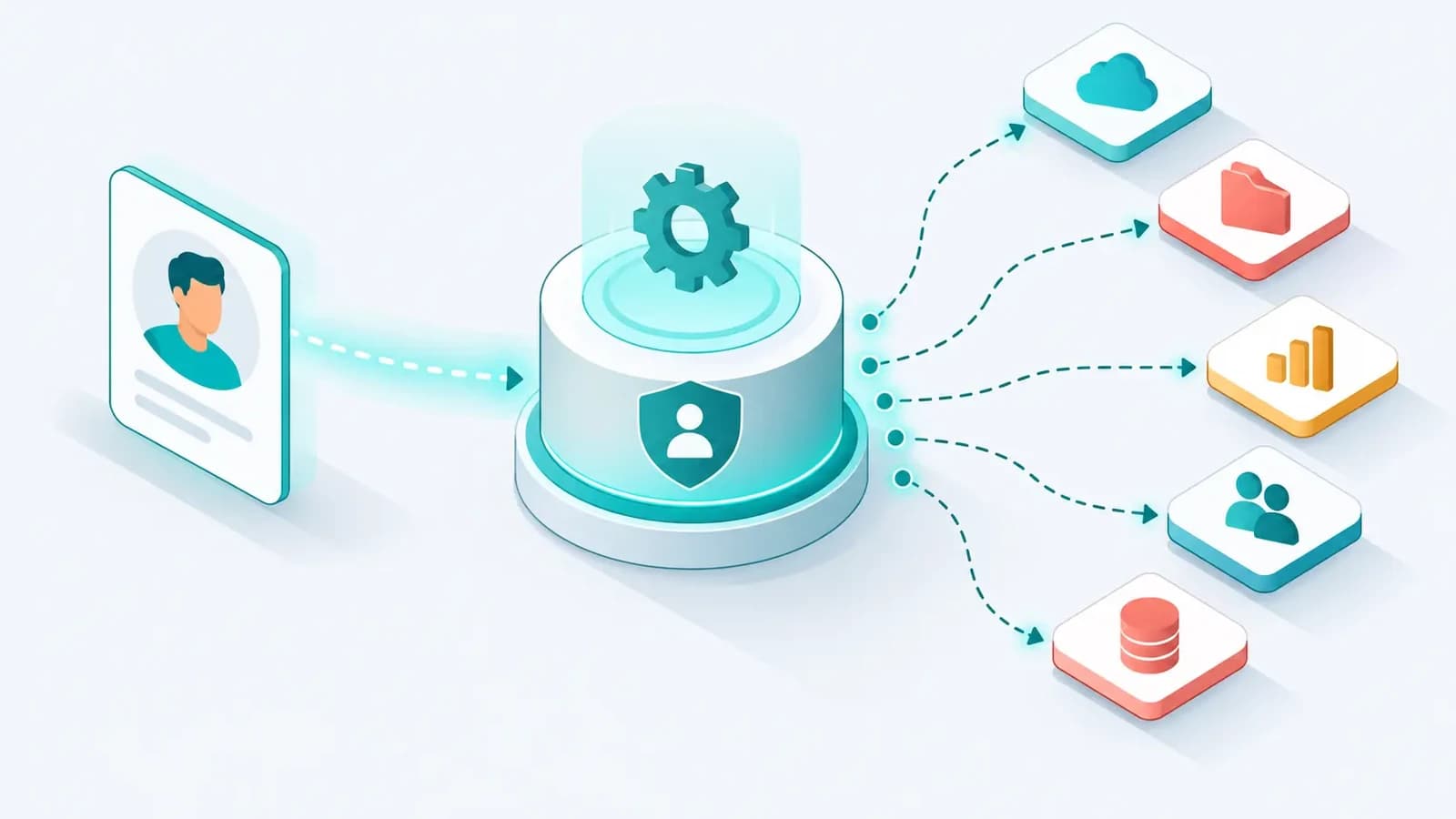
Automated user provisioning creates, updates, and revokes access from a single source of truth as identity events happen. What it is, how it works, and how to implement it.
- Automated user provisioning is the practice of creating, updating, and revoking user accounts across every connected application directly from a single authoritative source of truth — usually an HRIS or identity provider — the moment an identity event happens, instead of an administrator opening a ticket and building accounts application by application.
- It is best understood through the joiner-mover-leaver lifecycle: grant access on hire, adjust it on a role change, and revoke it on exit — with the leaver case being where automation delivers its clearest, most auditable security value by closing the orphaned-account window.
- Implementation is a sequenced program, not a switch: establish the authoritative source, define roles and access policy, inventory and prioritize target applications, pilot on a narrow scope, then expand — with a deliberate plan for the legacy systems that will never speak a modern provisioning protocol.
- Provisioning is the execution layer, not the decision layer. It carries out access decisions fast and consistently once they have been made upstream in governance; it does not itself decide who should have access, run approvals, or catch an over-privileged role.
- Done well, automated provisioning shrinks the standing attack surface, produces a consistent audit trail as a byproduct, and lets identity scale with headcount — but it amplifies whatever policy sits above it, so the quality of the governance decisions feeding it determines the quality of the outcome.
Automated user provisioning works by connecting a single authoritative source of truth — usually an HRIS or an identity provider synchronized from HR data — to every application that needs user accounts, so that when an identity event happens at the source, the accounts and entitlements it implies are created, updated, or revoked across all connected systems automatically, without an administrator building them one at a time. A new hire appears in the HR system; within minutes their accounts, group memberships, and baseline access exist in the applications their role requires. Someone changes departments; their access shifts to match. Someone leaves; their access disappears everywhere at once. The mechanism underneath is unglamorous — a source system pushes standardized actions, target systems apply them — but the operational difference between that and a queue of manual tickets is the difference between identity that scales with headcount and identity that quietly falls behind it.
This is the 2026 update to our foundational guide on user provisioning, first published in January 2018 (previously at https://www.avatier.com/blog/user-provisioning-implement/, now redirected here). The original laid out the case for provisioning and a step-by-step rollout; this version keeps that practical, how-to spine, updates it for a portfolio that is now mostly SaaS with a stubborn legacy remainder, and is deliberately scoped as the hub of the topic — the definitional, how-it-works, how-to-implement piece that links out to the deeper pieces on the standards, the AI layer, the mainframe case, and the failure modes.
What User Provisioning Actually Is
User provisioning is the creation, maintenance, and eventual removal of a user's accounts and access rights across the systems they need to do their job. Every account a person uses — email, the CRM, the HR portal, cloud storage, a finance application, a mainframe logon — has to be created at some point, kept accurate as the person's role evolves, and disabled when they leave or no longer need it. Provisioning is the discipline that governs all of that: not just the initial account creation people tend to picture, but the full arc of an identity's access over its lifetime in the organization.
Automated user provisioning is that same discipline executed by the identity system rather than by hand. The distinction matters because the manual version does not fail loudly. It drifts: accounts created a little late, access left behind after a transfer, a departed employee's logon that nobody remembered to disable. Each lapse looks minor, but across hundreds of applications and thousands of identity events a year they compound into the two most common findings in any identity audit — orphaned accounts and excessive privilege. Automation exists to remove the dependency on human follow-through that produces that drift.
Provisioning serves three durable goals, unchanged since the first version of this guide. Security, because access granted only when needed and removed the moment it is not is a smaller attack surface than access that accumulates and lingers. Productivity, because a new hire who can work on day one, and a manager who is not shepherding access requests through a ticket queue, are both direct returns on automation. And internal controls, because consistent, policy-driven provisioning is what lets an organization demonstrate segregation of duties and answer the auditor's question — who has access to what, and why — with a record rather than a shrug.
How Automated Provisioning Works
The architecture has three parts: a source of truth, an identity engine, and the connected applications. The source of truth is the authoritative record of who is in the organization and what their core attributes are — almost always the HRIS, sometimes an identity provider that has already synchronized from it. It is the system that knows, first and most reliably, when someone is hired, changes role, or leaves. Everything downstream keys off it, which is why establishing a single, trusted source is the foundation of the entire pattern: if two systems disagree about someone's status, the automation has no unambiguous signal to act on.
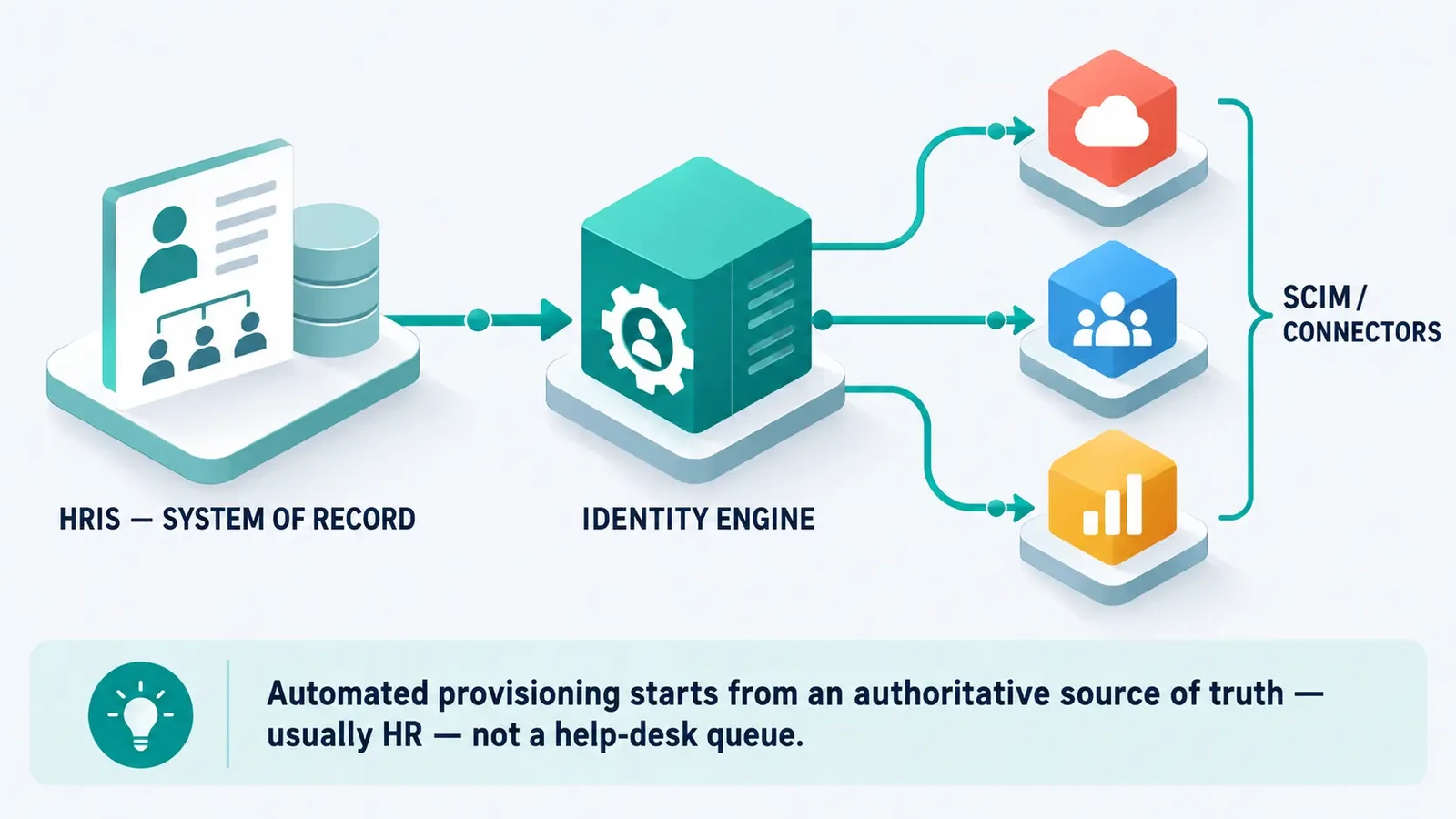 One authoritative source drives the engine; the engine drives every app — via SCIM where it exists, native connectors where it does not.
The identity engine sits between the source and the applications. When an event occurs at the source — a record is added, an attribute changes, a status flips to terminated — the engine interprets it against the organization's access policy and translates it into concrete actions for each connected application: create this account, set these group memberships, update this attribute, deactivate this login. It then delivers those actions through whatever channel each application supports. For most modern SaaS that channel is SCIM, the open provisioning standard, which lets one integration pattern work across any application that implements the specification. For systems that do not speak SCIM — legacy on-premises software, mainframe environments, industry-specific tools — the engine uses purpose-built native connectors that speak each system's own account-management interface.
The key property of this design is that the source system needs no application-specific logic. It emits one event; the engine fans it out to every connected target in the appropriate format. That is what lets provisioning scale: adding the hundredth application means connecting one more target to the engine, not building one more bespoke integration that will break on its own schedule. It is also what makes the system auditable — because every action flows through the engine, every create, update, and revoke is a structured, timestamped record rather than a note in a ticket.
The Joiner-Mover-Leaver Lifecycle
The clearest way to understand what automated provisioning is for is the joiner-mover-leaver (JML) model. Almost every identity event an enterprise handles is one of these three, and provisioning automation is the execution layer that makes each propagate consistently across the portfolio.
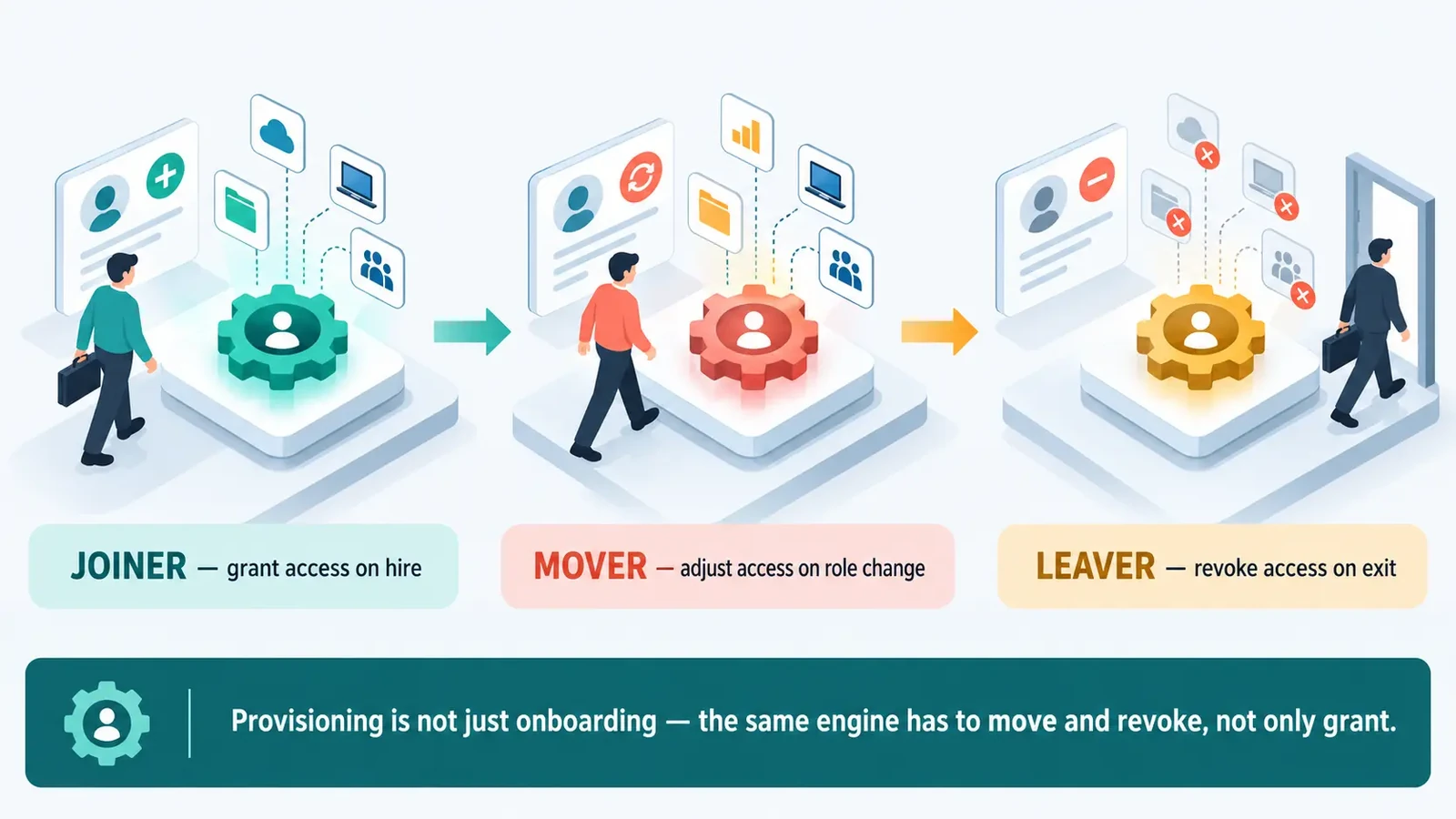 Grant on hire, adjust on role change, revoke on exit — and the leaver event is where automation earns its keep.
Joiner. When a new hire is added to the source of truth — often driven by an HRIS-based lifecycle trigger — the engine provisions the accounts and baseline entitlements their role requires, across every connected application, without a per-application setup checklist. Done well, this is the difference between a new employee who is productive on their first morning and one who spends their first week filing access requests.
Mover. When someone changes role, team, or department, the source record updates and the engine pushes the corresponding adjustments downstream. This is the event manual processes handle worst. A transfer usually means adding the access the new role needs and removing the access the old role required — and manual workflows reliably complete the "add" while skipping the "remove," which is precisely how privilege creep accumulates. Automation tied to a role model handles both halves as one operation.
Leaver. When someone is terminated in the source system, the engine revokes access across every connected application at once. This is where provisioning automation delivers its most concrete and most defensible value. Manual, per-application offboarding depends on a person remembering to disable an account in every system a departing employee touched, and the systems that get missed — days or weeks later, if ever — are exactly where orphaned accounts persist as standing, unmonitored credentials. Automated deprovisioning closes that window at the moment the source record changes, not whenever someone gets to the ticket. Attackers actively look for exactly these gaps; our analysis of how attackers exploit provisioning weaknesses walks through why the leaver case is a security control and not just an operational nicety.
Manual vs. Automated Provisioning
It is worth making the contrast concrete, because the case for automation is easy to nod along to and easy to underestimate. Manual provisioning — an administrator working through a ticket queue, or a periodic CSV export re-uploaded into each target — depends on a person executing the same account steps correctly and promptly, application by application, every time an event occurs.
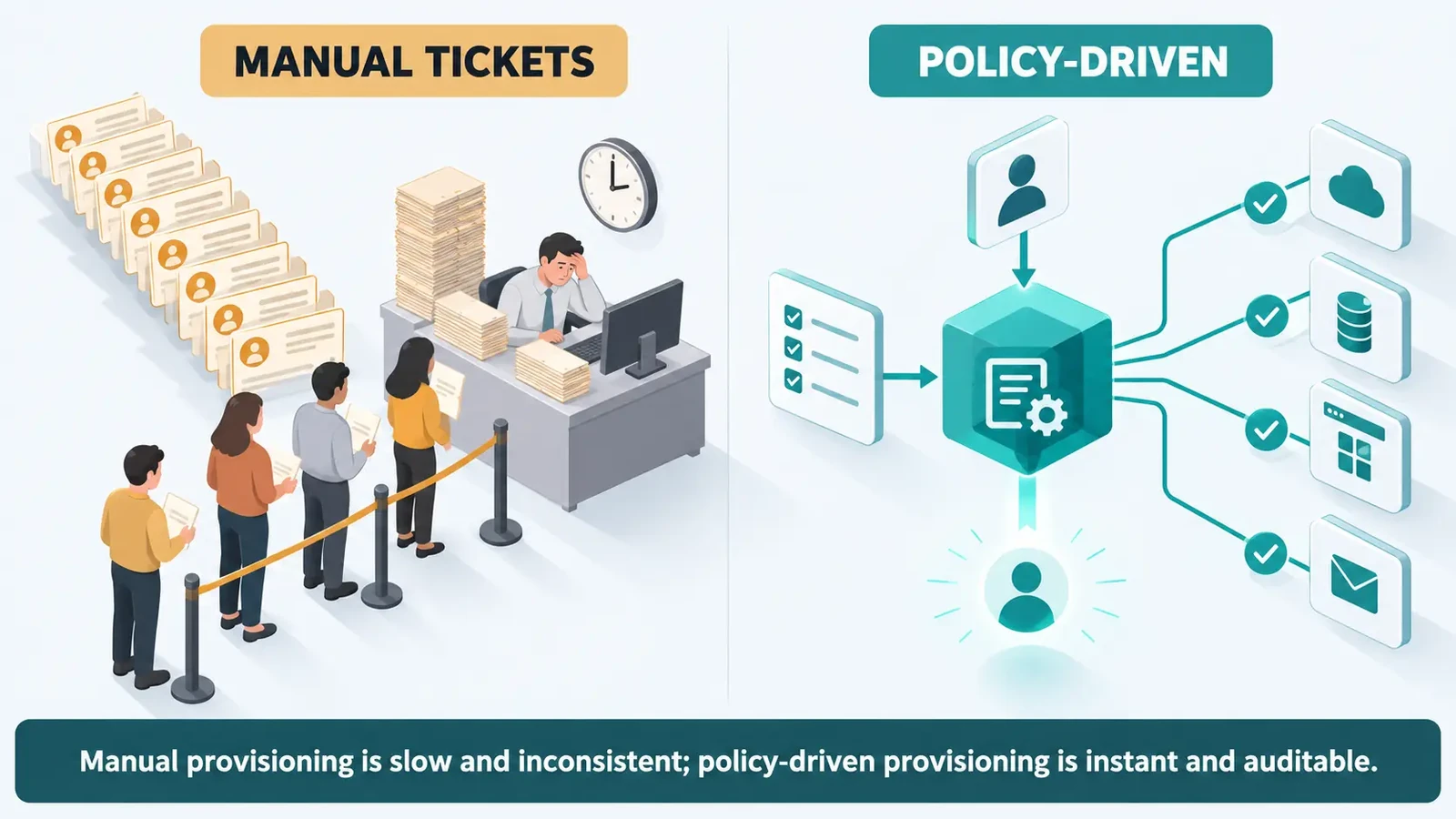 Manual provisioning drifts by design; policy-driven automation keeps the source and every downstream app continuously in sync.
That dependency produces predictable failure modes. Account creation lags actual start dates, so new hires wait. Deprovisioning lags actual departure dates — often badly — because disabling accounts is rarely anyone's most urgent task. A CSV export reflects the source only at the instant it was generated and goes stale the moment the next hire, transfer, or termination lands. And because each application is touched by hand, there is no consistent, machine-generated record of what changed, when, and why; the audit trail is whatever the administrator wrote in the ticket.
Automated provisioning replaces that dependency with standardized actions triggered directly by the identity event itself. There is no export-and-reupload cycle, because the sync happens as events occur; no per-application step to forget, because the same event reaches every connected application through the engine; and the audit trail is a byproduct of the mechanism rather than a separate chore. The point is not merely that automation is faster — it is that manual provisioning drifts by design, and automation is architected specifically so that drift cannot accumulate between the source and its targets. As portfolios grow past a few dozen applications, that structural property, not raw speed, is what makes the difference.
How to Implement Automated User Provisioning
Implementation is a sequenced program, not a single switch, and the sequence matters because each step depends on the one before it. The rollout below updates the step-by-step approach from the original guide for a modern, mostly-SaaS estate.
1. Establish a single authoritative source of truth. Before any automation, decide which system is the definitive record of who is in the organization and what their core attributes are. For workforce identity this is almost always the HRIS. If the source is ambiguous or fragmented across systems that disagree, fix that first — automation built on a shaky source propagates the shakiness everywhere.
2. Define roles and access policy. Automation executes rules, so there must be rules to execute. Decide what access a given role, department, or attribute combination should confer. This does not require a perfect enterprise role model on day one — a coarse baseline that covers the common cases, refined over time, is far more useful than an exhaustive model that never ships. This is also the boundary where provisioning meets governance: the policy is a governance decision, and provisioning is what carries it out.
3. Inventory and prioritize the application portfolio. Catalog the applications that need provisioning and sort them by volume and risk. Note which speak SCIM natively, which need connectors, and — critically — which will never support automated provisioning at all. That inventory is the map for everything that follows.
4. Pilot on a narrow scope. Start with a small set of well-understood, high-value applications and a defined user population. Validate that attribute mapping is correct, that joiner, mover, and leaver events all behave as expected, and that edge cases surface while the blast radius is still small. A phased pilot reveals the handful of mapping and schema issues that a full-portfolio cutover would surface all at once, at a scale that is far harder to unwind.
5. Expand in phases, with a deliberate plan for legacy. Roll out to the rest of the portfolio in waves, carrying forward what the pilot taught. The systems that will never support a modern protocol — legacy on-premises applications, mainframe environments — need an explicit, governed provisioning path of their own, whether through native connectors or a controlled semi-automated process. The failure to avoid is silent: a legacy application that quietly sits outside the lifecycle automation, becoming the one place orphaned accounts and stale access accumulate unwatched.
6. Monitor and recertify continuously. Provisioning is not "done" at go-live. Track the operational signals that reveal whether it is working — provisioning and deprovisioning latency, help-desk access-request volume, and audit findings — and feed provisioning data into periodic access recertification so the entitlements the engine maintains are reviewed against what people actually still need.
Where Provisioning Connects to the Rest of Identity
Automated provisioning is one layer in a larger identity stack, and it is most useful to understand it by its neighbors. Above it sits governance — the policy, approvals, and certifications that decide what access should exist; provisioning executes those decisions but does not make them. Beside it sit the mechanisms it uses: SCIM as the open standard for modern SaaS, and native connectors for everything that predates or ignores it, including the RACF and mainframe estate that most large enterprises still run.
Two adjacent developments are worth tracking as you build. The first is the growing role of AI in the provisioning decision itself — using access patterns to suggest role definitions, flag anomalous grants, and tighten the policy that feeds the engine; our piece on AI-driven provisioning for enterprise security covers where that helps and where it is still hype. The second is adversarial: provisioning gaps are an attack surface, not just an operational inconvenience, and understanding how attackers bypass provisioning controls sharpens the case for closing the leaver window fast. This guide is the hub; those pieces are the spokes that go deeper on each.
What Avatier Ships Toward This Pattern
Avatier Identity Anywhere Lifecycle Management implements this architecture directly: an authoritative source of truth drives a policy engine, and the engine executes joiner, mover, and leaver events across the application portfolio through both SCIM and native connectors. The connector library covers the major SCIM-native SaaS applications out of the box while also maintaining native, non-SCIM connectors for the legacy and mainframe-adjacent systems — including RACF, ACF2, and Top Secret environments — that never adopted the standard and are unlikely to.
That combination is what matters in practice, because real enterprise portfolios are mixed: a majority of modern SaaS that provisions cleanly, alongside a meaningful minority of legacy systems that do not. Treating those as one governed lifecycle — rather than an automated majority and an ungoverned legacy exception — is what keeps the joiner-mover-leaver arc complete instead of leaving gaps at exactly the systems most likely to be missed. The same access requests, approvals, and lifecycle triggers drive create, update, and revoke events across both connector types, so the leaver event closes access everywhere, not only in the apps that support the modern standard.
The Avatier Trust Center publishes the compliance posture behind the platform, including SOC 2 Type II audited with zero exceptions noted, ISO/IEC 27001:2022 certification, PCI DSS v4.0.1 compliance, and CSA STAR Level 1 attestation. As always, the architectural pattern — pairing a single source of truth with a policy-driven engine that reaches both modern and legacy systems — is what determines outcomes, independent of vendor; the point here is the pattern, not a product pitch.
ABOUT THE AUTHOR

More from IAM & Identity Governance

Automated Deprovisioning: Closing Access When People Leave 2026
Deprovisioning is the revoke side of the identity lifecycle: a leaver event that cascades revocation across every connected system so no active account, live session, or token outlives the person.

Account Takeover Prevention: A 2026 Defender's Guide
Most account takeovers don't start with a new exploit — they start with a password the attacker already has, which is exactly why the preventive controls that work look nothing like the ones most programs invest in first.

Identity Fabric and Converged Identity: The 2026 Architecture
An identity fabric unifies fragmented IAM, IGA, PAM, and directories into one system with unified policy and observability. Its building blocks, and what Avatier ships toward the pattern.