What AI-Driven Provisioning Actually Does in Enterprise IAM (2026)
AI-driven provisioning replaces manual tickets and static rules with policy-based access grants triggered by HRIS and identity-graph signals — but only inside guardrails a human still has to own.
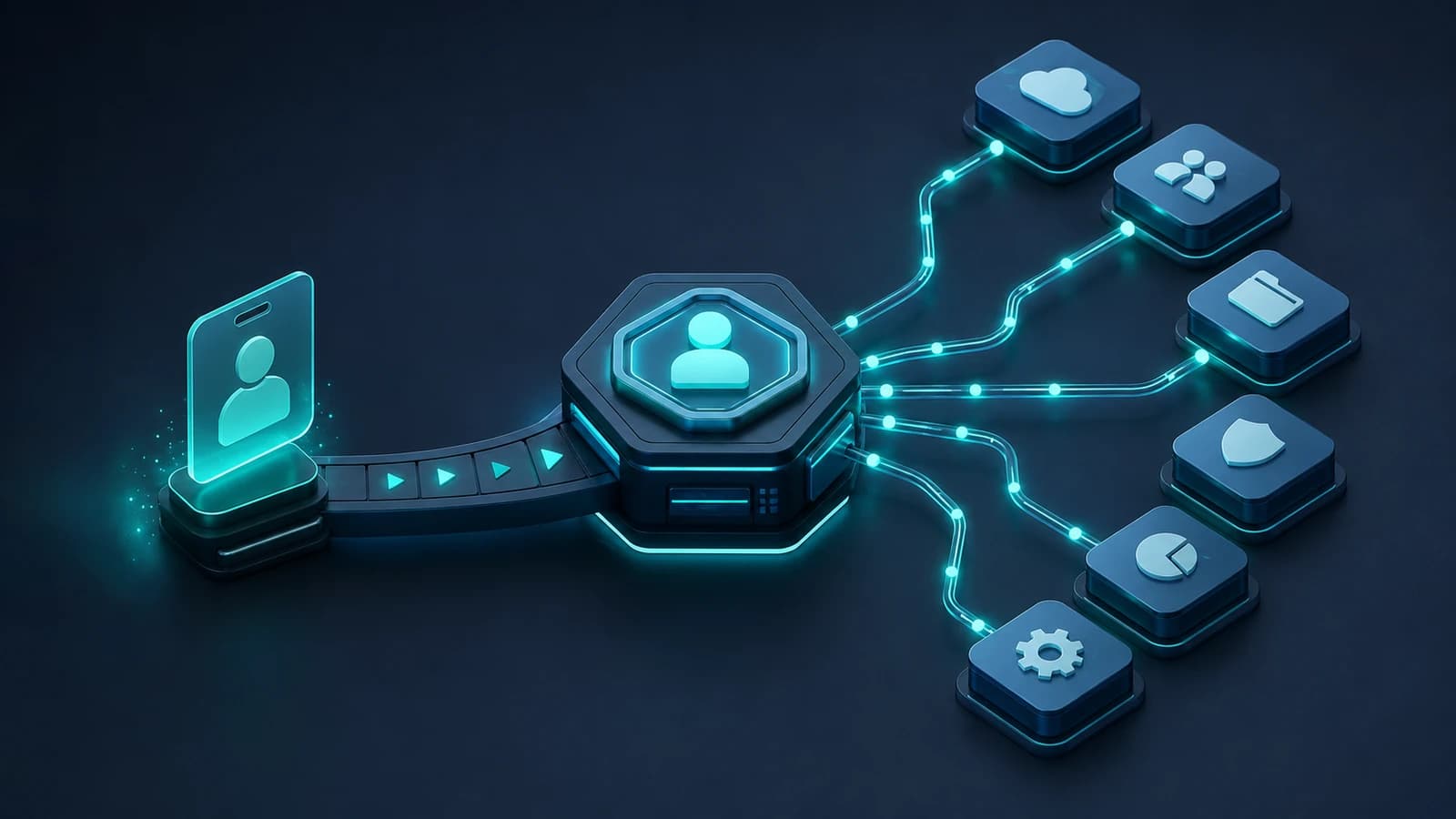
AI-driven provisioning replaces manual tickets and static rules with policy-based access grants triggered by HRIS and identity-graph signals — but only inside guardrails a human still has to own.
- AI-driven provisioning is policy-based, signal-triggered access automation: a hire date, a role change, or a termination event fires a decision evaluated against policy, not a person filling out a ticket.
- It differs from static rules-based provisioning in what it reads — rules-based systems match a fixed condition to a fixed grant; AI-driven systems weigh multiple contextual signals (peer access patterns, risk posture, entitlement history) before deciding.
- HRIS and identity-graph data are the trigger layer. Provisioning is only as trustworthy as the authoritative source feeding it — a dirty HRIS produces confident, fast, wrong grants.
- Autonomy needs guardrails, not blind trust: policy checks before any grant fires, approval gates for high-risk entitlements, least-privilege defaults, and a full audit trail on every decision, automated or not.
- It does not replace access certification, role design, or governance ownership — it changes what a human reviews, not whether one needs to.
AI-driven user provisioning is the automated granting, adjustment, and revocation of system access based on real-time signals — an HRIS hire event, a role change, a termination flag, identity-graph context — evaluated against policy instead of routed through a manual access-request ticket. It works in three steps: a trigger fires from an authoritative source, a policy engine checks the resulting access need against least-privilege rules and risk thresholds, and the system either grants automatically, routes to a human approval gate for higher-risk entitlements, or declines outright — with every decision logged for audit. Access changes in minutes instead of the days a ticket queue usually takes, because the automation is reading the exact signal a human reviewer would otherwise be waiting for someone to notice.
This is the 2026 update to our original piece on AI-driven provisioning, rewritten around the mechanics practitioners actually need to evaluate — what the automation triggers on, where its autonomy needs a leash, and where a person has to stay in the loop — rather than the vendor-report statistics that dated the first version. Provisioning automation has matured enough since then that the interesting questions have shifted from "does this work" to "what does it actually automate, and what does it still need from a governance program to be trustworthy in production."
What AI-driven provisioning actually automates
Strip away the marketing language and AI-driven provisioning automates one thing: the decision of who gets what access, made at the moment a lifecycle event happens instead of days or weeks later when someone files a ticket. The three events that matter are joiner (a new hire needs baseline access on day one), mover (a role change, promotion, or department transfer needs the entitlement set to shift with it), and leaver (a termination needs every credential revoked, not just the badge deactivated).
Each event maps to a policy-driven grant rather than a person manually assembling an access list. A new hire's HRIS record specifies department, manager, and job title; the policy engine resolves that into a birthright entitlement set — the applications and systems everyone in that role gets by default — and provisions it without a ticket ever being opened. A mover event triggers a delta calculation: what the old role had that the new role shouldn't, and what the new role needs that wasn't there before, with the removal happening as reliably as the addition. That symmetry is the part manual processes chronically get wrong — grants happen because someone remembers to ask, revocations happen because someone remembers to notice, and the second one gets forgotten far more often than the first.
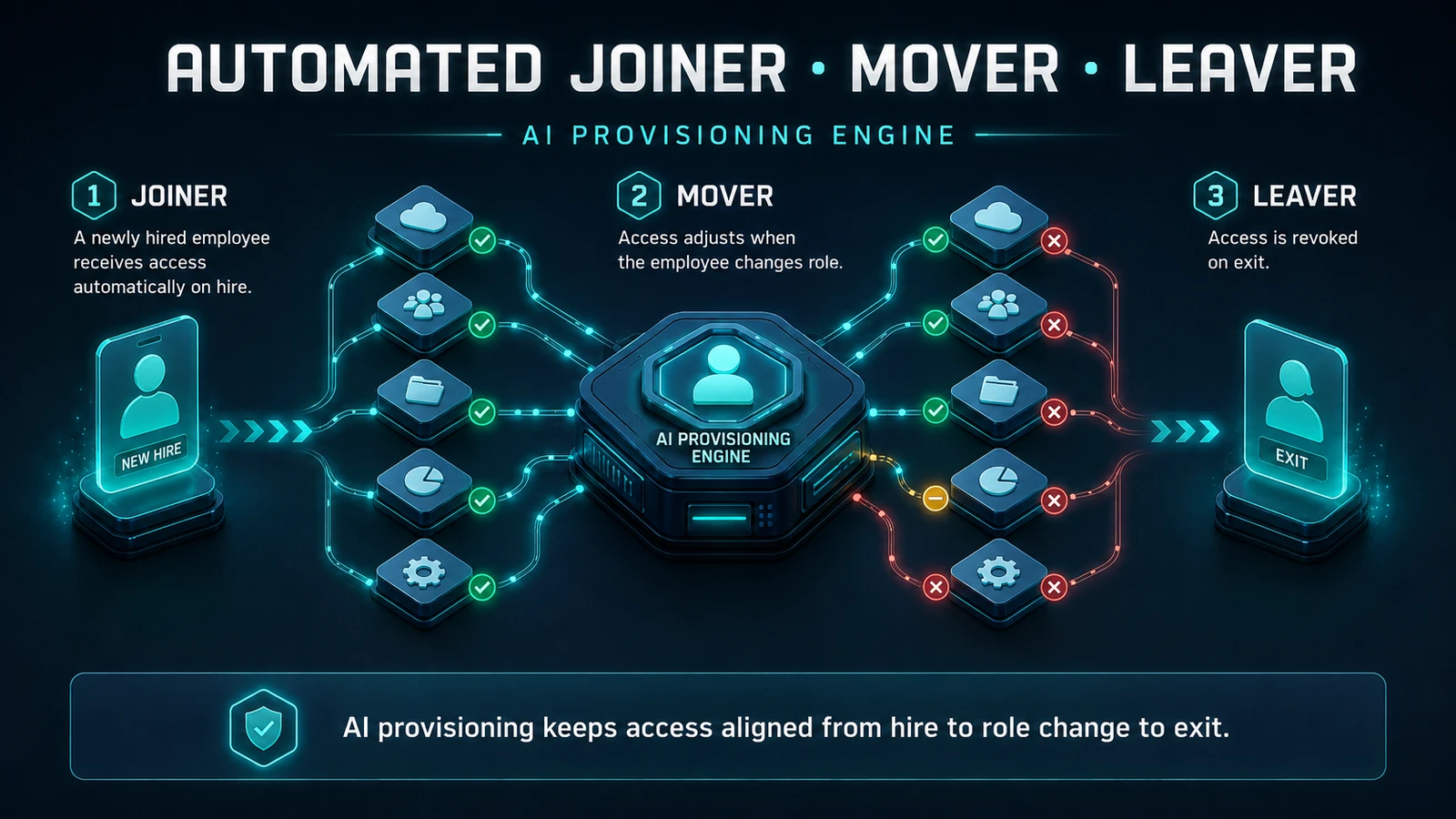 The same policy engine handles all three lifecycle events — grant, adjust, revoke — from one authoritative HRIS signal.
The leaver event is where the automation earns its keep most visibly. A termination processed through HRIS integration deprovisions across every connected system in the same operational window, instead of the pattern manual processes fall into: IT disables the primary directory account promptly and a long tail of SaaS applications, VPN access, and shared credentials stay live for days or weeks because nobody owns the full inventory of where that person had access. Directional pattern, not a headline number: the gap between "account disabled" and "every credential actually revoked" is where a meaningful share of post-termination access incidents originate, and it's a gap automated leaver processing closes structurally rather than through a checklist someone has to remember to run.
Policy-based grants vs. the manual ticket queue
The comparison that actually matters for a CIO evaluating this isn't AI versus no-AI — it's policy-based automation versus the ticket queue most enterprises still run for anything outside a handful of pre-built birthright roles. A manual request goes to a queue, sits until someone with the right approval authority reviews it, gets approved or kicked back for clarification, and then gets manually provisioned in each target system it touches. Every step in that chain is a place where the request waits on a person's availability rather than the urgency of the business need.
Policy-based automation collapses that chain for anything the policy already covers. The request evaluates against the same rule set a human approver would apply — does this role typically get this entitlement, does it cross a separation-of-duties boundary, does it exceed a risk threshold that requires escalation — and a decision comes back in the time it takes to execute the check, not the time it takes to find an approver with room on their calendar. The requests that don't clear automatically don't disappear into a black box; they route to the same approval gate a manual process would use, just faster and with the policy evaluation already done for the reviewer.
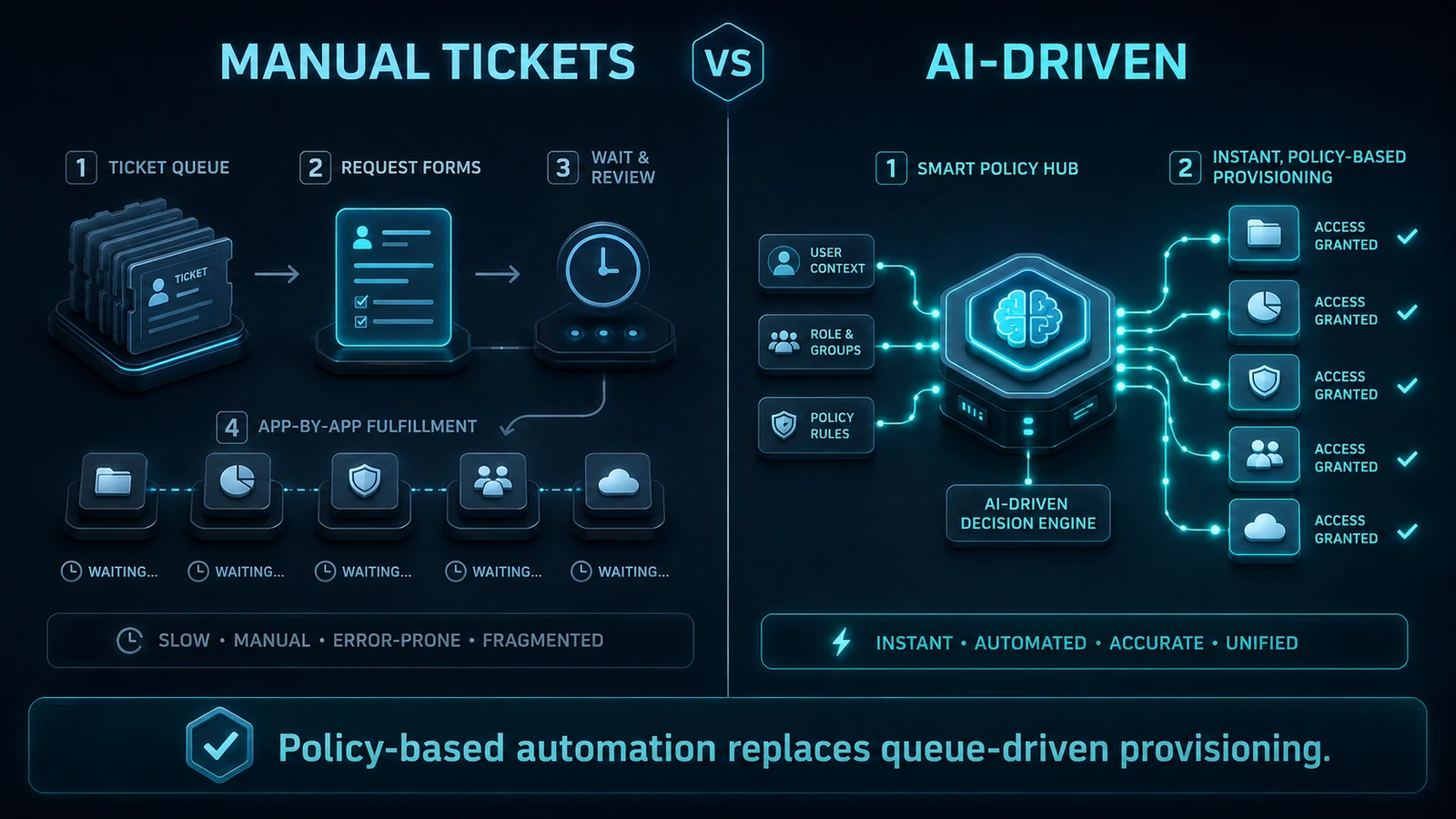 Same policy, same approval bar — the difference is whether a person has to be available before access can move.
The honest caveat: this only works as well as the policy it's automating. A policy engine encoding a stale or overly broad rule set will grant stale or overly broad access faster, which is worse than the ticket queue, not better — the ticket queue at least gave a human a chance to notice the rule had gone wrong. Automation is a multiplier on whatever policy quality already exists, not a fix for bad policy.
How this differs from static, rules-based provisioning
Rules-based provisioning isn't new — "if department equals Finance, grant the Finance application role" has been standard IGA practice for two decades. It's deterministic, easy to audit, and it fails in a very specific, very common way: real employees don't sort cleanly into the categories the rule table anticipated. A hybrid role split across two departments, a temporary cross-functional assignment, a promotion that hasn't been formally reclassified yet in HRIS — a static rule set either denies access the person legitimately needs or, more often, someone with approval authority grants a manual exception that never gets cleaned up.
AI-driven provisioning adds a weighing step in front of the grant decision rather than replacing the rule set outright. It looks at what similar employees — same department, same manager, same peer group — actually hold in production, and uses that pattern to resolve the cases a static rule table handles poorly: recommending the entitlement set a genuinely hybrid role needs, flagging when a requested grant is unusually broad relative to peers even if it technically satisfies the written rule, catching the promotion that HRIS hasn't caught up to yet by comparing observed responsibilities against title. The policy still sets the outer boundary — a peer-pattern recommendation that would violate a hard policy constraint doesn't override that constraint — but it resolves ambiguity a fixed rule table has no mechanism to resolve at all.
The trade-off worth naming honestly: rules-based provisioning's determinism is also its main audit advantage — the same input always produces the same output, and an auditor can trace exactly why. Peer-pattern weighting introduces a layer that has to be explainable in the same way, or it becomes a black box a SOX reviewer won't accept. Any AI-driven system worth deploying needs to show its work — which peers, which pattern, which policy constraint bounded the final decision — not just the final grant.
HRIS and identity-graph signals: the trigger layer
Provisioning automation is only as trustworthy as the signal that triggers it, and that makes the trigger layer the actual determinant of whether the system works, more than any model sophistication downstream of it. HRIS data is the backbone signal because it's the closest thing most enterprises have to ground truth about who works there, in what role, reporting to whom, as of what date. A hire event, a transfer, a termination flag — these are authoritative in a way that inferred signals aren't, which is why they should drive the automated grant path and inferred signals shouldn't.
Identity-graph signals sit on top of the HRIS layer and add context the HR record alone doesn't carry: what entitlements the person's actual peer group holds in production (not what the org chart implies they should hold), which access has gone dormant long enough to be a revocation candidate, which combination of grants a person is accumulating that would cross a separation-of-duties line if the final piece got added. That graph is what lets a provisioning decision reflect operational reality instead of only organizational structure.
The failure mode worth being explicit about: a dirty HRIS produces confident, fast, wrong grants. If the authoritative source has stale department codes, employees who transferred months ago still showing their old role, or contractors mixed into the same feed as employees without a status flag distinguishing them, the automation faithfully provisions against that bad data at automation speed — which is a worse outcome than a manual process would have produced, because a human reviewer might have caught the discrepancy and a policy engine won't unless it's specifically built to flag confidence gaps in its own input. Fixing the identity source of truth is not optional infrastructure work that happens someday after the AI project ships; it's the precondition the AI project depends on.
Guardrails an autonomous system needs
Autonomy in provisioning is valuable specifically because it's bounded, and the boundaries are what make it defensible in front of an auditor rather than merely fast. Four guardrails do the actual work.
Policy checks run before the grant, not after. Every automated decision evaluates against least-privilege rules and separation-of-duties constraints prior to provisioning, not on a post-hoc review cycle. A system that grants first and reconciles later is a faster version of the exact problem access certification exists to catch — excess entitlement accumulating quietly between review cycles — just accumulating it automatically instead of manually.
Approval gates hold for high-risk entitlements. Anything touching financial systems, production infrastructure, privileged administrative access, or regulated data routes to a named human approver regardless of how confident the automation is in its own recommendation. This is the line between automating the routine and automating the consequential — the routine (a standard birthright grant matching a well-established peer pattern) can clear automatically; the consequential needs an accountable name attached to the decision, the same way autonomous access decisions generally do.
Least-privilege defaults, expansion by exception. The system grants the minimum viable scope for the role and requires a deliberate additional request to expand beyond it — never the reverse pattern of granting broad access by default and trimming later, which is how over-provisioning accumulates in every environment that runs that way. Just-in-time access and zero standing privilege is the sharper end of this same principle: granting elevated access only for the duration of the task that needs it, rather than provisioning it as a standing entitlement at all.
A full audit trail on every decision. What signal fired the trigger, what policy it matched, who or what approved it, when it was granted and when it was revoked — logged for every grant, automated or manual, because "the system approved it" doesn't satisfy a SOX or HIPAA reviewer any more than "the manager approved it" does without a record of what the manager actually saw.
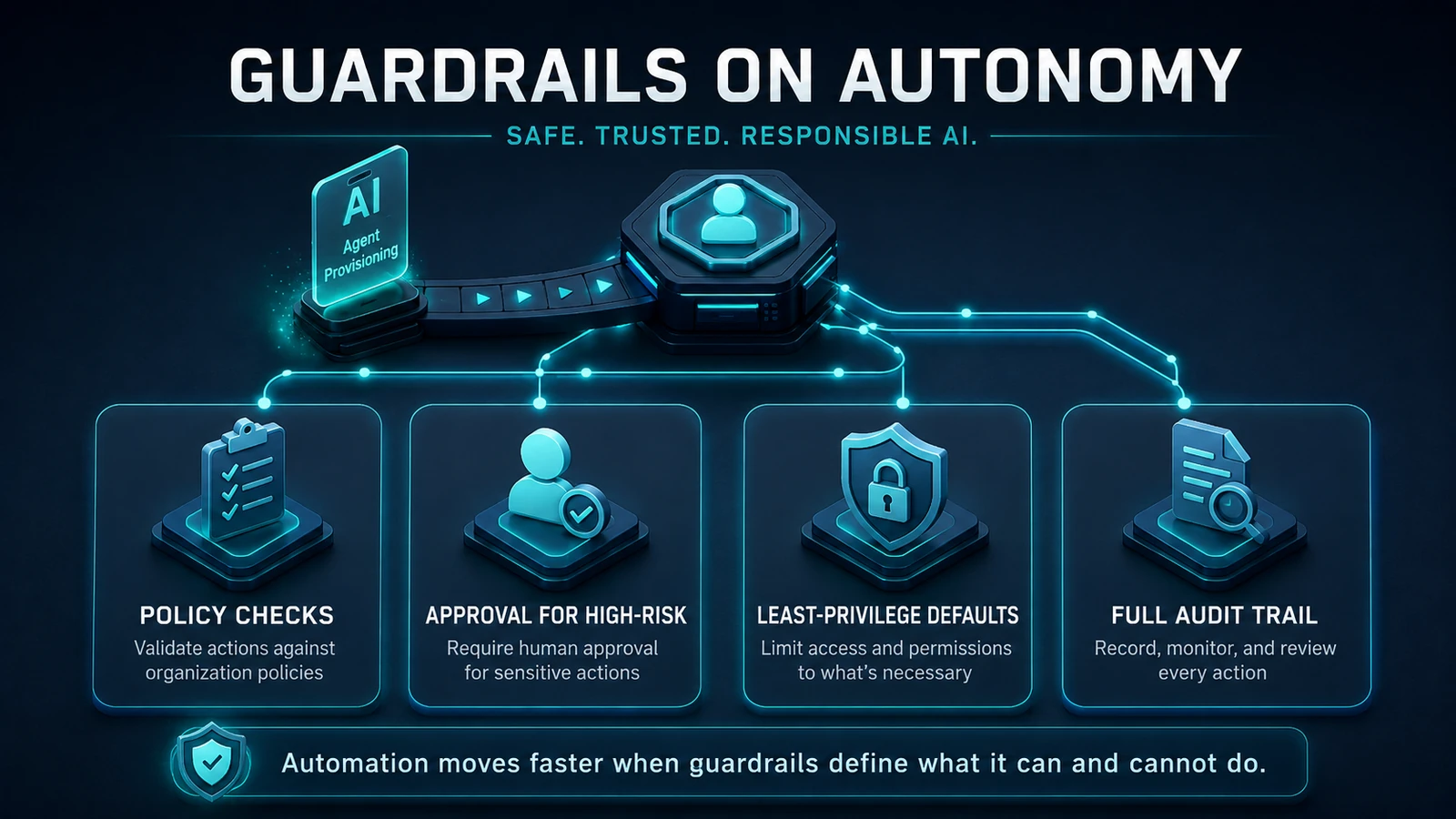 None of these guardrails slow down the routine ninety percent of grants — they exist for the ten percent that shouldn't clear without a person looking at them.
Where AI-driven provisioning still needs a human
The failure modes worth planning for aren't exotic. The most common one is stale or incomplete HRIS data producing confidently wrong automated grants — a person provisioned into the wrong department's entitlement set because a transfer hadn't propagated, provisioned with a contractor's narrower access because a status flag was missing, or left fully provisioned past a termination date because the HRIS feed lagged the actual last day. None of these are AI failures in the model-accuracy sense; they're data-quality failures the automation faithfully executes.
The second failure mode is genuinely novel roles — a newly created position, a reorg that doesn't map cleanly to any existing peer group, an acquisition integrating employees whose HRIS record doesn't yet reflect the acquiring company's role taxonomy. Peer-pattern matching has nothing to match against in these cases, and a system that forces a recommendation anyway rather than flagging "no confident match, route to human" is producing a guess dressed up as a decision. The right behavior is an explicit low-confidence flag, not a best-effort grant.
The third is drift between what a role's entitlements should be and what a policy engine still believes they are — role definitions age, applications get retired or replaced, and a policy encoding last year's correct answer produces this year's wrong one unless someone owns keeping it current. This is squarely a governance responsibility, not something the automation self-corrects, which is the same argument our AI analytics for identity monitoring piece makes about detection systems generally: the model surfaces the anomaly, a person with domain judgment decides what it means.
The throughline across all three: AI-driven provisioning needs a human in the loop specifically at the points where confidence should be low — novel situations, stale inputs, aging policy — and needs to know how to recognize those points itself rather than assuming every input is as clean as the training data it was tuned on.
Integration patterns: SCIM and directory sync
None of the decision logic above matters if the provisioning engine can't actually execute the grant across the applications an enterprise runs, which is an integration problem before it's an AI problem. SCIM (System for Cross-domain Identity Management) is the standard most modern AI-driven provisioning systems lean on for execution — the policy engine decides on a grant, and a SCIM call creates, updates, or deactivates the corresponding account in every downstream application that speaks the protocol. Our SCIM provisioning standard piece covers the protocol mechanics in depth; the relevant point here is that SCIM is what lets a single HRIS trigger fan out consistently to dozens of applications instead of requiring a manual step per app.
Not every system in a real enterprise estate speaks SCIM, though — legacy and mainframe environments in particular often don't, and directory synchronization fills that gap through scheduled or event-driven sync against Active Directory, LDAP, or a platform-specific connector rather than a real-time API call. That's slower than SCIM's near-instant execution, but it's the difference between automating 80% of an environment and automating the parts that were already easy — mainframe estates are the clearest example, where the identity system driving the automated decision and the target system executing it are often a generation apart in protocol support.
Agent identities are the newer integration wrinkle worth naming even though this piece is scoped to human provisioning: as AI agents increasingly act on enterprise systems under their own credentials, the same provisioning discipline — HRIS-adjacent trigger, policy check, least-privilege default, audit trail — has to extend to non-human identities too, and most enterprises haven't built that extension yet. Related patterns for agent authentication specifically are covered in the Identity for AI Agents piece on ICC; it's an adjacent problem, not one this piece resolves.
What Avatier ships toward this pattern
Avatier Identity Anywhere provisions access from HRIS-driven joiner-mover-leaver events against a policy engine that enforces least-privilege defaults by design, with approval workflows gating higher-risk entitlements and a complete audit trail attached to every grant — automated or manually approved. SCIM and directory-sync connectors handle the downstream execution across both modern SaaS applications and legacy or mainframe estates, so a single HRIS trigger can provision consistently across an environment with a genuinely mixed protocol footprint rather than only the newest 80% of it.
Conversational self-service and agentic password-reset workflows extend the same policy-before-autonomy pattern to the request side of provisioning — a user asking for access through a chat interface gets evaluated against the identical policy engine a ticket would have used, with the same approval gates for anything the policy flags as high-risk. None of this is presented as a fully autonomous system that removes governance from the loop; it's automation bounded by the guardrails this piece describes, with a certification program and a role-design owner still sitting above it. The Avatier Trust Center publishes the compliance posture behind the platform — SOC 2 Type II audited with zero exceptions noted, ISO/IEC 27001:2022 certified, PCI DSS v4.0.1 compliant, CSA STAR Level 1 attestation, and NIST 800-53 Rev. 5 aligned — for teams that need to verify that posture before a deployment decision rather than take a vendor's word for it.
What AI-driven provisioning doesn't solve is worth stating as plainly as what it does. It doesn't replace access certification — periodic re-validation of whether access still makes sense is a different problem than granting it correctly at the moment of need, and a well-tuned provisioning system changes what a certification reviewer looks at, not whether certification still has to happen. It doesn't eliminate the need for role design — a policy engine automates decisions against a role model, it doesn't build a good role model on its own, and a bad one automated faithfully just produces bad access faster. And it doesn't remove the governance owner from the org chart — every guardrail described here (the policy thresholds, the approval-gate criteria, the audit review cadence) is a decision someone has to own and periodically revisit, not a setting that stays correct once configured. Automation changes where the manual effort in identity governance goes. It doesn't remove the need for the discipline underneath it.
ABOUT THE AUTHOR

More from IAM & Identity Governance

Translating Security Risk Into Business Language in 2026
Boards don't fund CVE counts — they fund dollar exposure. A practical framework for turning access sprawl, orphaned accounts, and audit findings into risk language executives actually act on.

The Help-Desk Call That Cost $100M: 2026 Lessons
A single impersonation call to a help desk — not a firewall failure — triggered a 2023 casino-industry breach that cost roughly $100 million, and the fix is verification discipline, not new firewalls.

Identity Management's Biggest Breaches: Lessons for 2026
The governance lessons enterprises should draw from major identity breaches — not the attack mechanics, but the structural gaps that let one credential become a headline.