Translating Security Risk Into Business Language in 2026
Boards don't fund CVE counts — they fund dollar exposure. A practical framework for turning access sprawl, orphaned accounts, and audit findings into risk language executives actually act on.

Boards don't fund CVE counts — they fund dollar exposure. A practical framework for turning access sprawl, orphaned accounts, and audit findings into risk language executives actually act on.
- Executives don't ignore security risk because they don't care — they ignore it because it arrives in a vocabulary that doesn't map to anything on their own scorecard. A CVE count or an orphaned-account tally has no unit executives can weigh against a marketing budget or a product launch.
- The translation framework has three moves: identify the business asset the technical finding actually touches (a system, a process, a customer relationship), estimate financial exposure as likelihood times impact rather than a single number, and state the decision the executive needs to make — approve, defer, or accept the exposure.
- Vocabulary matters more than most security teams admit. 'Orphaned accounts' means nothing to a CFO. 'Unmonitored access to the general ledger from accounts nobody is tracking' is a sentence a CFO can act on. The words are the translation, not decoration on top of it.
- An executive risk scorecard reports four things per finding: what's exposed, which direction the exposure is trending, what it costs to fix, and what decision is being asked of the reader — never a raw technical detail count with no business referent attached.
- A scorecard is a communication tool, not a control. It does not replace continuous monitoring, access certification, or the underlying governance program — a well-translated risk that nobody remediates is still a risk, just one that's easier to explain in the post-incident review.
Security risk fails to land with executives for a structural reason, not a communication-skills one: it arrives in a vocabulary built for engineers, and gets reported to people who allocate capital against competing claims measured in dollars, time, and probability. A finding like "312 accounts flagged in the Q3 access review" is accurate and, to the board, unusable — it has no unit that compares against a plant expansion, a product launch, or a competitor's earnings call. The fix isn't simplifying the finding. It's re-expressing it in the currency the room actually trades in.
This is a 2026 update to a topic Avatier's blog first covered in 2024 (see the original piece for the earlier framing). The core problem hasn't changed — technical risk and business risk still speak different languages — but the practice of translating between them has matured enough by 2026 to warrant a sharper, more specific framework than "know your audience." What follows is that framework, built for identity and access risk specifically: access sprawl, orphaned accounts, excessive privilege, and audit findings, and how to state each one in terms a CFO or board member can act on without a security background.
Why technical risk framing fails with executives
A CVE severity score, a certification-campaign exception count, or a privileged-access audit finding is written for an audience that already shares the vocabulary — an analyst, an auditor, another engineer. It assumes the reader knows what "orphaned service account" implies about attack surface, or why "role explosion" in an RBAC model matters. Executives and board members don't share that assumption, and reasonably so — it isn't their job to.
What executives do share is a decision-making structure: every request for attention competes against every other claim on budget, headcount, and risk tolerance, and the only way to compare across categories is a common unit. Finance speaks in dollars and quarters. Boards speak in fiduciary exposure and reputational consequence. Neither speaks in patch levels or MFA coverage percentages. When a security report shows up denominated in the wrong unit, it doesn't get rejected — it gets set aside, because there's no way to weigh it against the marketing budget increase on the same agenda. That's not executive indifference to security. It's the predictable result of handing a decision-maker a number they have no way to compare.
The deeper issue is that technical risk framing often skips the step that would make it comparable: it reports what is true (accounts exist, a patch is missing, a review lapsed) without reporting what it costs if it goes wrong and how likely that is. Those two additions — cost and likelihood — are the entire translation. Everything else in this piece is detail on how to do that translation well.
A framework for translating access risk into dollar exposure
Four steps convert a technical identity finding into something an executive can act on.
1. Name the business asset, not the technical object. Don't report "the finance file share." Report "the system holding unreleased quarterly earnings data." Don't report "347 Active Directory accounts flagged." Report "347 active credentials with access to systems nobody is currently monitoring, nine of which reach the general ledger." The technical object is a means; the business asset is what the board actually cares about protecting.
2. Estimate likelihood and impact as separate ranges. Likelihood should be grounded in something observable — how many paths are exposed, how long the exposure has existed, whether it's been flagged in a prior audit cycle without remediation. Impact should account for the realistic cost categories: incident response, regulatory penalty exposure, operational downtime, contract or customer loss. Keep the two separate before combining them; collapsing straight to a single number hides the reasoning an executive would want to interrogate.
3. Combine into an expected-loss range, not a point estimate. "$400K-$1.2M in expected exposure over the next 12 months" is a defensible sentence. "$687,412" is not — it invites a follow-up question about where the number came from, and most technical risk estimates can't survive that question with a single figure. A range signals honest uncertainty and is, counterintuitively, more credible than false precision.
4. Attach a decision, every time. Fund the remediation. Formally accept the exposure at this board's own risk tolerance. Or defer, with a named review date. A translated risk finding without an attached decision is a status update, not a business case — and status updates get skimmed, not acted on.
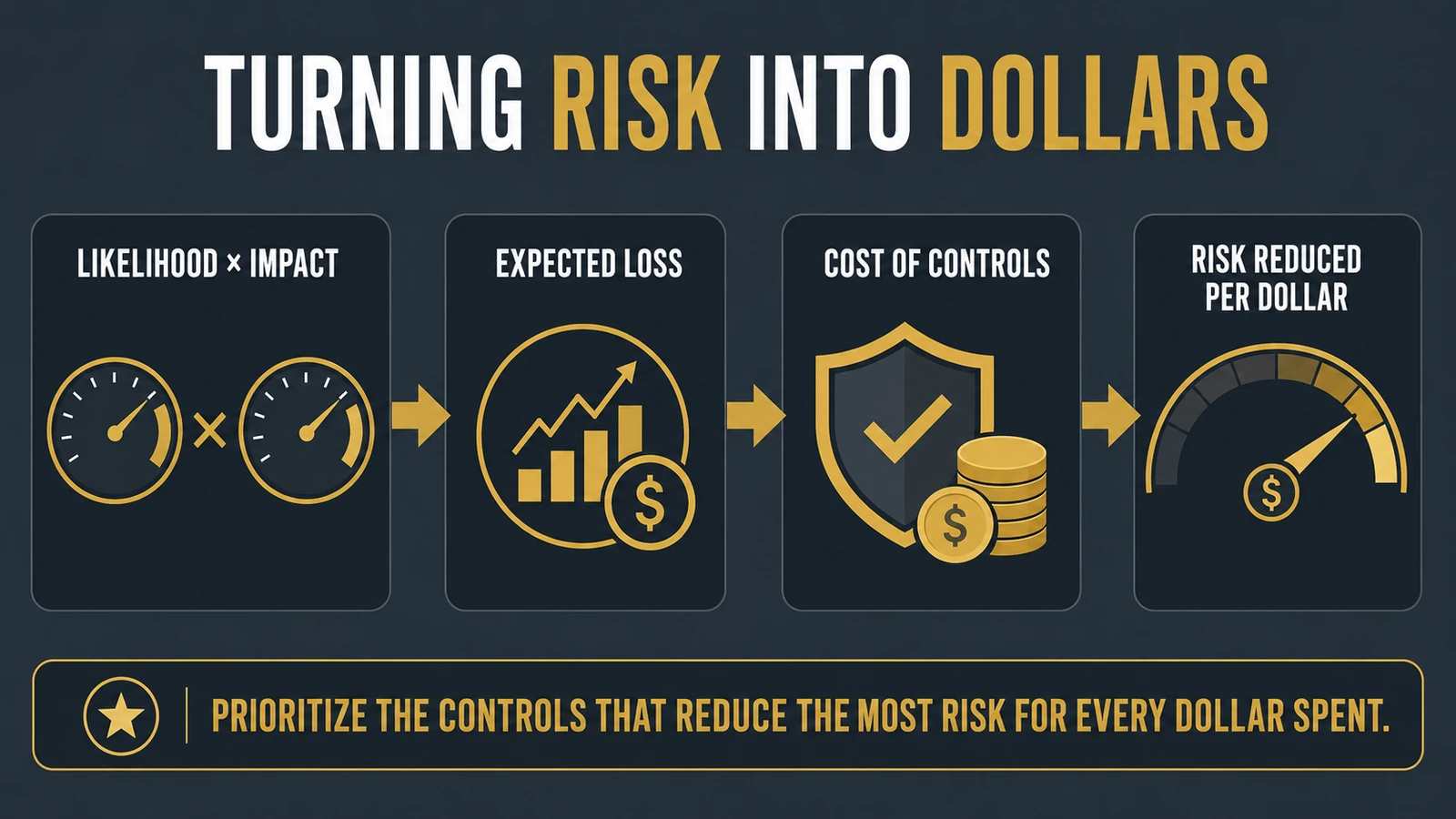 The four-step conversion from a technical finding to a fundable decision: likelihood times impact, expected loss, cost of controls, and the risk-reduced-per-dollar comparison that ranks competing findings against each other.
This is also the sequencing logic that determines which findings get board time at all — a low-likelihood, low-impact finding on an unmonitored test system doesn't clear the bar for a quarterly briefing even if it's technically real; a moderate-likelihood finding on a system with regulatory exposure does, even if the raw technical severity score is lower.
Building the executive risk scorecard
Once individual findings are translated, they need a reporting structure that scales across a quarter's worth of certification cycles, audit findings, and access-review results without turning into a technical appendix. The scorecard format that holds up under repeated use has four columns, deliberately narrow:
- Top exposures — the handful of findings that clear the materiality bar this cycle, each named as a business asset with a rough exposure range, not a full inventory of every finding the security team produced.
- Trend — is each exposure growing, shrinking, or flat since the last report. Direction matters more to a board than an absolute number does, because direction is what tells them whether the program is working.
- Cost to fix — a rough remediation estimate for each top exposure, because a board evaluates risk against the price of closing it, not against an abstract severity scale.
- Decision needed — the specific ask attached to each line: fund, accept, or defer with a date.
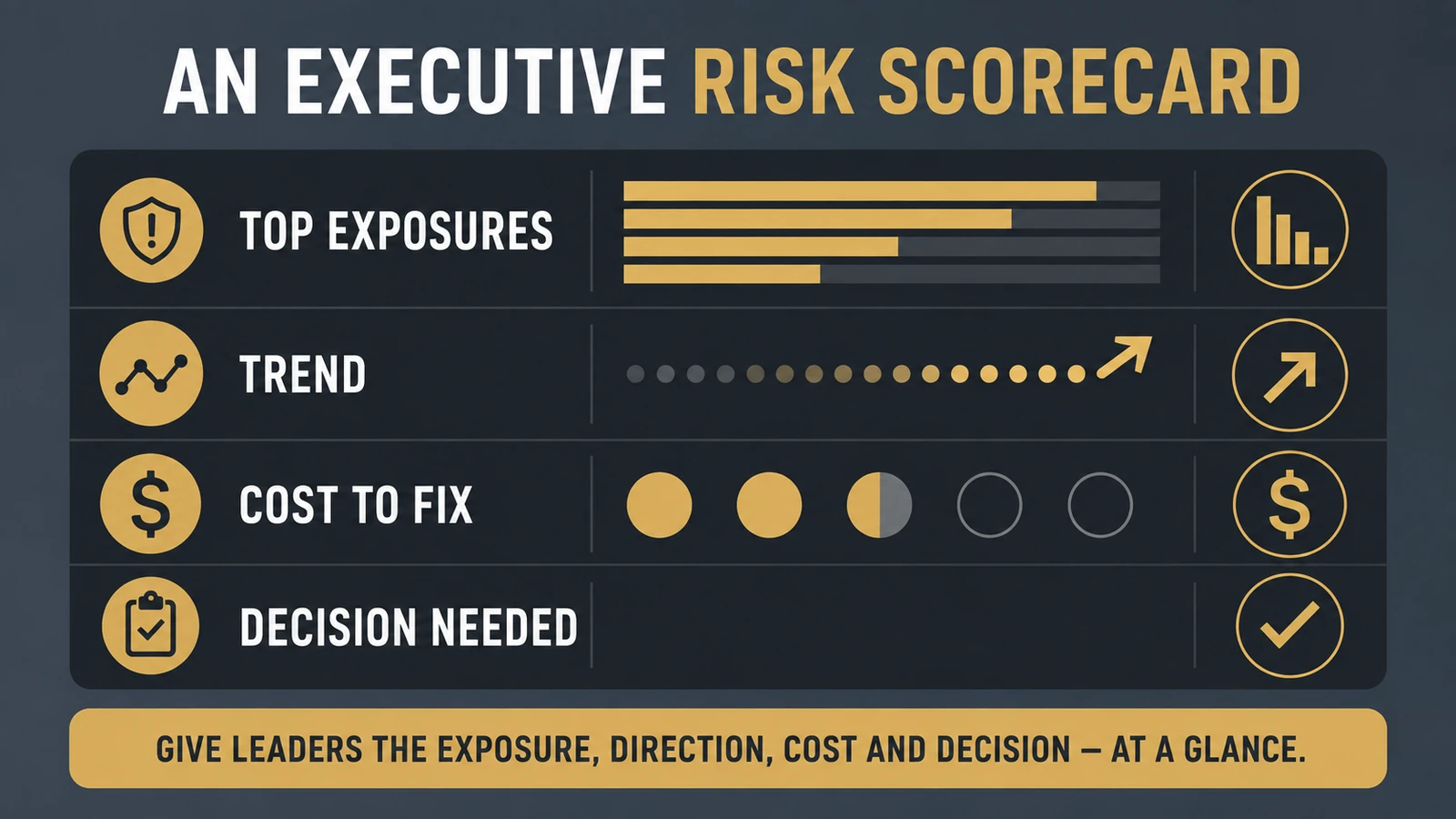 The scorecard format that scales: four columns per finding — exposure, trend, cost to fix, decision needed — resisting the pull toward a full technical appendix that would lose the board by slide three.
The discipline this format enforces is as valuable as the format itself. Anything that doesn't fit cleanly into "here's what's exposed, here's the direction, here's the cost, here's the decision" is probably a working-level finding that belongs in the security team's own review, not the board deck. That filter alone eliminates the most common failure of executive security reporting: burying three fundable decisions inside forty slides of technical detail nobody in the room can evaluate.
The vocabulary shift: from technical nouns to business consequences
Every step of the framework above depends on a vocabulary substitution that's easy to state and surprisingly hard to practice consistently under deadline pressure. The substitution is: replace the technical noun with the business consequence it produces, and attach it to a named system rather than leaving it abstract.
- "Orphaned accounts" becomes "active login credentials nobody is monitoring — several with standing access to financial or customer systems."
- "Excessive privilege" becomes "employees who can approve their own expense reports, or reach systems outside their job function, without anyone noticing."
- "Failed access certification" becomes "we currently cannot prove who has access to [named regulated system] — which is the first question an auditor or regulator asks."
- "Unpatched CVE" becomes "a known entry point into [named system] that has been open for [time period]."
- "Role explosion in RBAC" becomes "access grants that no longer map to anyone's actual job, making it impossible to answer 'why does this person have this' during an audit."
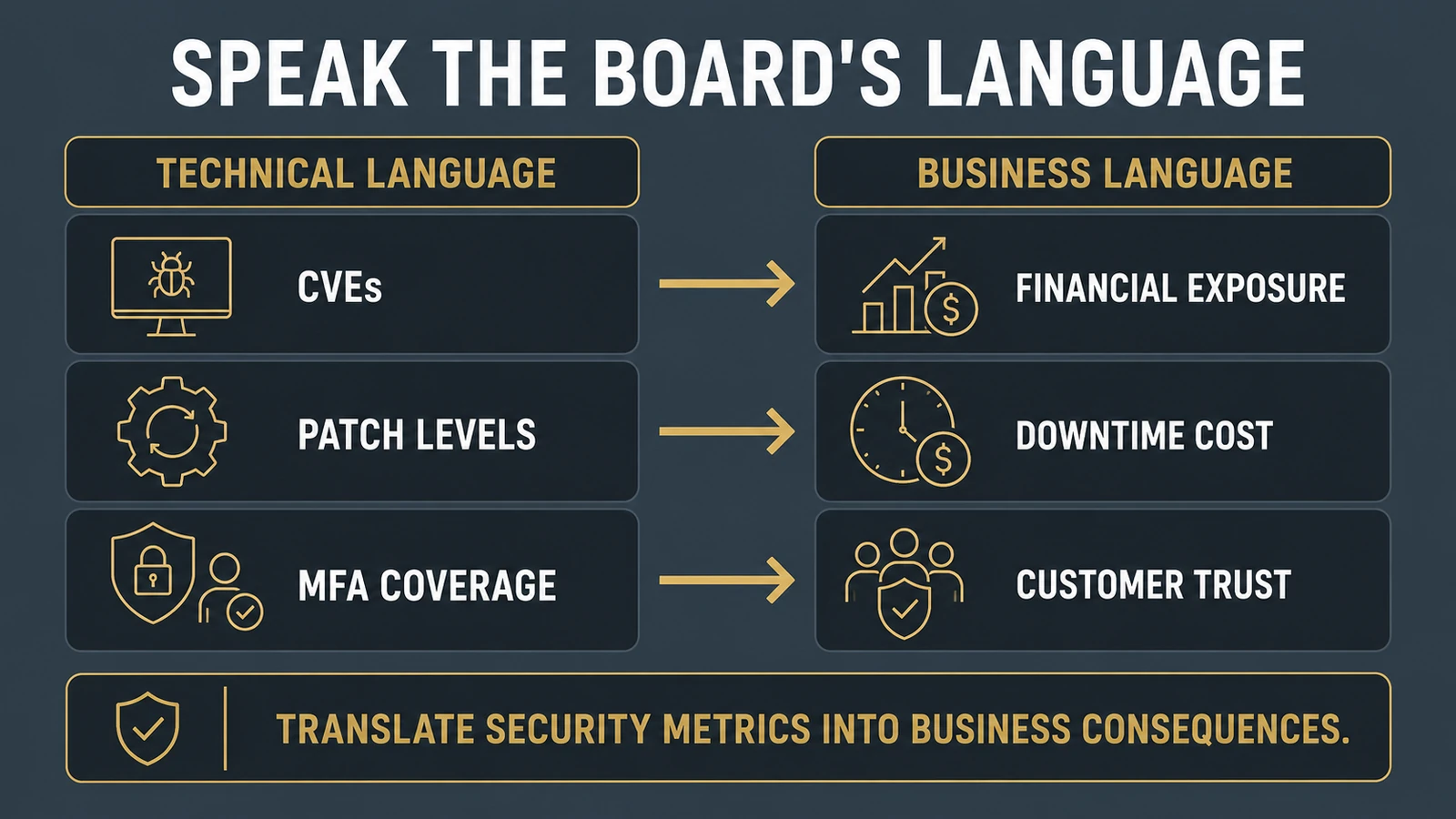 The vocabulary substitution pattern: every technical term on the left has a business-consequence equivalent on the right — the translation work is finding that pairing and naming the specific system it applies to.
Notice the pattern across every example: the business-language version is longer and more specific than the technical-language version, not shorter. Translation is not simplification for a less-technical audience — it's attaching the missing context (which system, what consequence, how long) that the technical term assumed the reader already had.
Board-reporting cadence and what belongs in it
Quarterly reporting is the standard cadence for most enterprises, aligned with regular board meetings and giving the scorecard's trend column enough time between cycles to show a real direction rather than noise. Reserve out-of-cycle briefings for anything that would change a near-term decision on its own — an active incident, a newly discovered regulatory exposure, or a finding severe enough that waiting for the scheduled meeting would itself be a governance lapse.
What should stay stable across cycles is the scorecard's structure. Boards build pattern recognition against a consistent format the same way they do with financial statements — a scorecard that gets reorganized every quarter forces the board to relearn how to read it instead of tracking whether risk is trending up or down. What should change each cycle is the content within that stable structure: new findings that clear the materiality bar get added, resolved findings get retired with a short note on what changed, and the trend column updates to reflect the direction since last quarter.
This is also where the connection to the identity governance program becomes concrete — the Access Review piece covers what the underlying certification process needs to produce trustworthy inputs for a scorecard like this, and the Zero Trust Metrics piece covers the operational metrics that feed the trend column between reporting cycles.
Common translation mistakes
Two mistakes recur, sitting at opposite ends of the same underlying error.
Fear-mongering. Leading with worst-case industry breach scenarios and generalized dread instead of this organization's actual, specific exposure. It works exactly once. By the second or third cycle, executives recognize the pattern and start discounting security reporting as alarmist — which is the opposite of the credibility a translation effort is supposed to build.
False precision. Presenting a single, confident dollar figure derived from assumptions that don't survive a follow-up question. A number like "$687,412 in annual exposure" sounds more rigorous than a range, but it invites exactly the scrutiny it can't withstand, and one exposed guess undermines every report that follows it. A stated range with the reasoning behind it — "$400K-$1.2M, based on nine accounts with general-ledger access unreviewed for six months" — survives the same question comfortably.
Both mistakes share a root cause: treating the report as a persuasion exercise rather than a decision-support exercise. The version that actually persuades over multiple cycles is neither the scare story nor the precise-sounding guess — it's the bounded range, the honest trend line, and the clearly stated ask, delivered consistently enough that the board trusts the format even when a given quarter's news is bad. The same discipline of honest, consistent measurement over manufactured urgency is what separates a scorecard that earns long-term board trust from one that gets discounted after two rough quarters.
A practical checklist
Before a finding goes into a board or CFO conversation, run it through this list:
- Named asset. Does the finding reference a specific business system or process, not a generic technical category?
- Bounded exposure. Is the dollar impact expressed as a range with stated assumptions, not a single unexplained number?
- Direction. Does the report say whether this exposure is growing, shrinking, or flat since last cycle?
- Cost to close. Is there a rough remediation estimate attached, so the exposure can be weighed against the price of fixing it?
- Explicit decision. Is there a clear ask — fund, accept, or defer with a date — rather than a status update with no action attached?
- Consistent format. Does this report use the same scorecard structure as last quarter, so the board is tracking trend rather than relearning a new layout?
- No fear, no false precision. Does the framing avoid both industry-wide dread and unearned decimal-point confidence?
A finding that clears all seven is ready for the board. A finding that doesn't belongs in the working-level security review until it does.
What Avatier ships toward this pattern
None of this framework requires a specific vendor, but the underlying data discipline it depends on — knowing who has access to what, how that access changed, and whether it's been reviewed — has to come from somewhere trustworthy, and that's the governance layer Avatier's platform is built around. Identity Anywhere's access certification workflows produce the kind of structured, timestamped review history that turns "we think access is under control" into "here's the audit trail proving it," which is the raw material a credible scorecard's exposure and trend columns are built from. Automated reporting and continuous certification reduce the manual spreadsheet reconstruction that otherwise eats the time security teams should be spending on the translation work itself, and the compliance posture published at the Avatier Trust Center — including SOC 2 Type II with zero exceptions, ISO/IEC 27001:2022 certification, PCI DSS v4.0.1 compliance, and NIST 800-53 Rev. 5 alignment — is itself an example of the same translation principle: a governance claim stated in a form a customer's own auditors and board can verify directly, rather than taken on faith. The Hidden Costs of Identity Management piece covers the adjacent discipline of surfacing costs that don't show up until an audit finds them, which is the same instinct this piece applies to risk communication.
What a scorecard does not replace
A well-built executive risk scorecard is a communication layer, not a control. It does not monitor access, does not revoke a credential, and does not remediate a finding — it gets the right decision made at the right level, by the person who can actually fund, accept, or defer the exposure. The certification campaigns, lifecycle management, monitoring, and remediation work that reduce the underlying risk have to keep running between board meetings regardless of what's on any given quarter's slide deck.
A risk that's been translated beautifully and then not remediated is still a risk. The scorecard just makes it a well-documented one — which helps in a post-incident review and does nothing at all to prevent the incident. Treat the scorecard as what it is: the interface between the security program and the people who fund it, not a substitute for the program itself. Get that distinction right, and the rest of the framework — the vocabulary, the dollar ranges, the cadence — does exactly what it's supposed to: turn a security team's hardest-won findings into decisions the business actually makes.
ABOUT THE AUTHOR

More from IAM & Identity Governance

The Help-Desk Call That Cost $100M: 2026 Lessons
A single impersonation call to a help desk — not a firewall failure — triggered a 2023 casino-industry breach that cost roughly $100 million, and the fix is verification discipline, not new firewalls.

Identity Management's Biggest Breaches: Lessons for 2026
The governance lessons enterprises should draw from major identity breaches — not the attack mechanics, but the structural gaps that let one credential become a headline.

IaaS Identity Management: The 2026 Deployment Challenges Reference
Infrastructure-as-a-Service breaks identity models built for one directory. The 2026 reference on multi-cloud fragmentation, compliance auditability, and provisioning automation at IaaS scale.