The Help-Desk Call That Cost $100M: 2026 Lessons
A single impersonation call to a help desk — not a firewall failure — triggered a 2023 casino-industry breach that cost roughly $100 million, and the fix is verification discipline, not new firewalls.

A single impersonation call to a help desk — not a firewall failure — triggered a 2023 casino-industry breach that cost roughly $100 million, and the fix is verification discipline, not new firewalls.
- The 2023 casino-industry breach that cost roughly $100 million didn't start with malware or a zero-day — it started with a phone call to the help desk, an attacker impersonating a real employee, and a password/MFA reset granted on the strength of that impersonation alone.
- Help-desk reset workflows are a structurally weak link because they're optimized for speed and empathy under pressure, and the identity signals typically used to verify a caller — name, employee ID, department, a callback number the caller supplies — are all things a well-researched attacker can obtain or fake.
- Hardening patterns that actually close the gap share one trait: they verify identity through a channel the attacker doesn't control — out-of-band callback to a number already on file, manager attestation for high-risk resets, and risk-based step-up that treats an MFA-reset request as a privileged action, not a routine one.
- No technical control fully defeats a sufficiently patient, well-resourced social engineer — a determined attacker who impersonates a manager, compromises a second internal contact, or exploits a genuine process exception will still find a seam. Verification hardening raises the cost and narrows the window; it doesn't guarantee zero.
- Technology closes the mechanical gap — it doesn't replace a trained, empowered help-desk analyst who's allowed to say no to a stressed-sounding caller without fear of a bad CSAT score, and that cultural permission is the piece organizations skip most often.
A help desk is the front door most enterprises never think to lock. In a 2023 breach that has since become the reference case for this failure mode, an attacker didn't exploit a vulnerability, crack a password, or bypass a firewall — they called the IT help desk, described themselves convincingly as a real employee, and asked for a credential and MFA reset. The help desk granted it. That single reset gave the attacker a foothold in an Okta-based identity environment, and from there the intrusion spread into reservation systems, slot machines, and point-of-sale terminals, producing an incident publicly reported at roughly $100 million in cost and days of visible operational disruption. Nothing about the initial compromise required advanced tooling. It required a phone call and a help-desk process that trusted the caller's story over any independent verification of who was actually on the line.
This is the 2026 update to our original piece on the incident, and it's deliberately narrower than that original. Two other posts on this blog already cover the broader landscape of identity-driven breaches in depth — our post-mortem guide to data breaches and IAM failures and our roundup of the biggest identity-management breaches — and this piece doesn't re-tread that ground. Its entire scope is the help-desk social-engineering vector specifically: how the verification gap at the reset counter gets exploited, and what actually closes it.
How the Social Engineering Attack Actually Worked
Public reporting — SEC disclosures, incident response write-ups, and extensive news coverage attributing the intrusion to the group known as Scattered Spider — describes a technically unremarkable but procedurally effective sequence. The attacker first gathered information about a real employee from public sources: LinkedIn, corporate directories, conference materials, anywhere a name, title, department, and enough personal detail to sound credible could be assembled without ever touching the target's network. Armed with that profile, they called the IT help desk and asked for a password reset and an MFA re-enrollment, presenting themselves as the locked-out employee.
The help desk's job at that moment was to resolve a legitimate-sounding, moderately urgent request from someone who knew enough real details to pass a casual identity check. It did — the reset was granted, and the new MFA enrollment was tied to a device the attacker controlled, not the real employee. From that point forward, every subsequent authentication looked, to the identity provider, like the legitimate employee logging in normally. The attacker used that access to explore the identity environment, escalate toward more privileged accounts, and move into systems well beyond what a single help-desk ticket should ever have been able to unlock — a lateral-movement pattern consistent with the broader breach chain our data breaches and IAM piece walks through stage by stage.
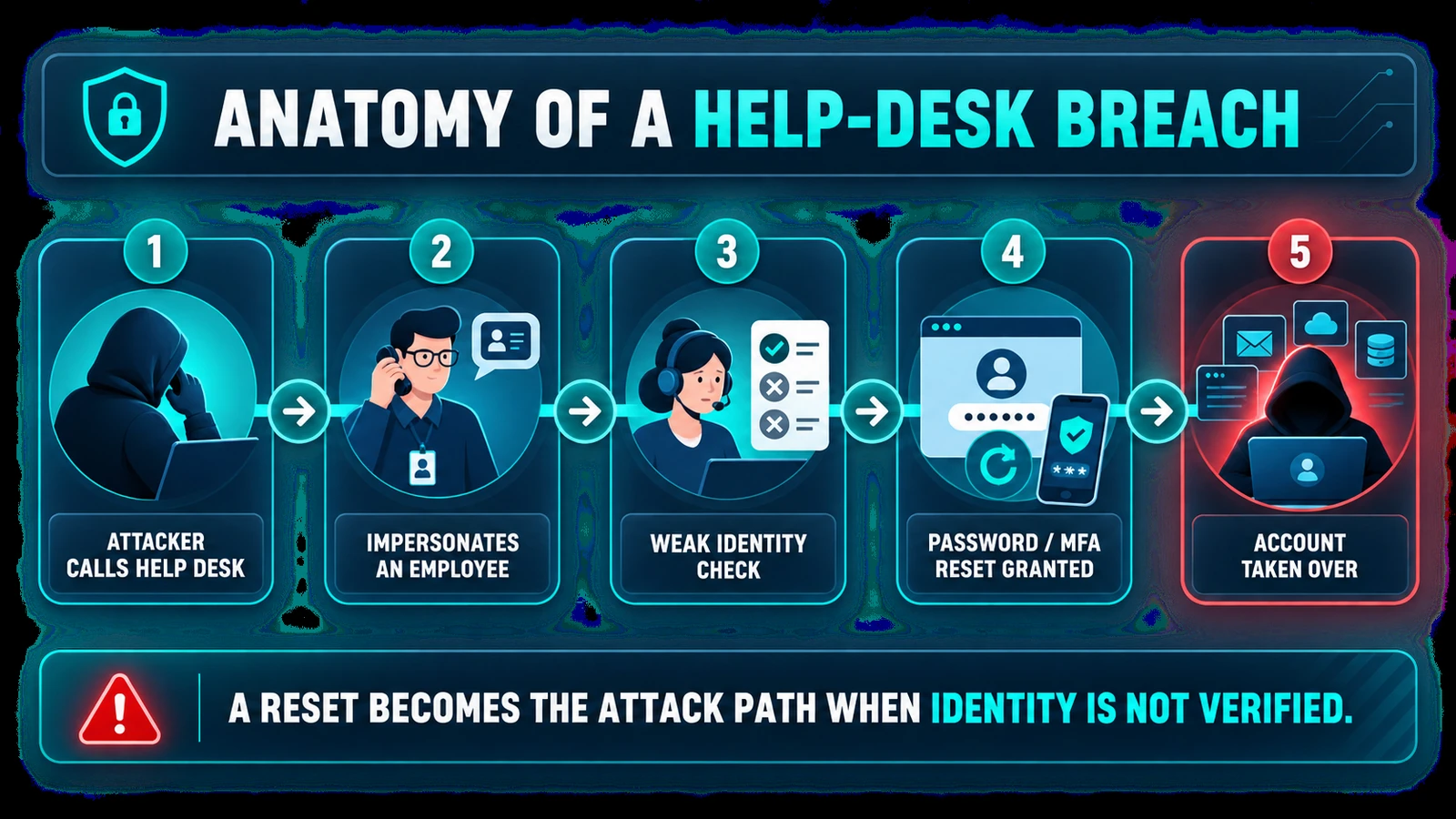 Every link in this chain is procedural, not technical — which is exactly why a firewall or endpoint tool was never going to catch it.
What makes this sequence worth studying in 2026 rather than treating as a closed 2023 case file is that nothing about the underlying weakness has changed. Help desks still exist to resolve access problems quickly. Employees are still discoverable in public sources. And MFA re-enrollment — arguably the single highest-leverage action a help desk can take, since it hands an attacker a durable second factor rather than just a one-time password — is still, at many organizations, requested and granted over the same phone call as a routine password reset, with no additional scrutiny attached to the fact that it's a fundamentally different, higher-risk action.
Why Help-Desk Password and MFA Resets Are the Weak Link
Enterprises spend heavily on perimeter defenses, endpoint detection, and network segmentation, and comparatively little on hardening the one workflow that routinely, by design, bypasses all of it: a human being on the phone asking another human being to grant access. That asymmetry exists for a structural reason, not a negligent one. The help desk's success metrics — average handle time, first-call resolution, customer satisfaction — all reward speed and a smooth interaction. Every additional verification step an analyst is asked to perform shows up as friction against those exact metrics, and an analyst who escalates or delays a plausible-sounding request pays a real cost in their own performance numbers even when escalating was the right call.
The verification methods most help desks default to compound the problem because they're built on facts rather than independently-verified channels. Knowledge-based questions — employee ID, department, manager's name, last four digits of a badge number — assume the answers are secret. For most employees at most companies, they aren't; they're discoverable through an org chart, a public LinkedIn profile, a conference bio, or a previous, unrelated data breach that already leaked exactly this kind of directory information. A caller who has done ten minutes of research can answer these questions as convincingly as the real employee, because the questions test whether the caller did research, not whether the caller is who they claim to be.
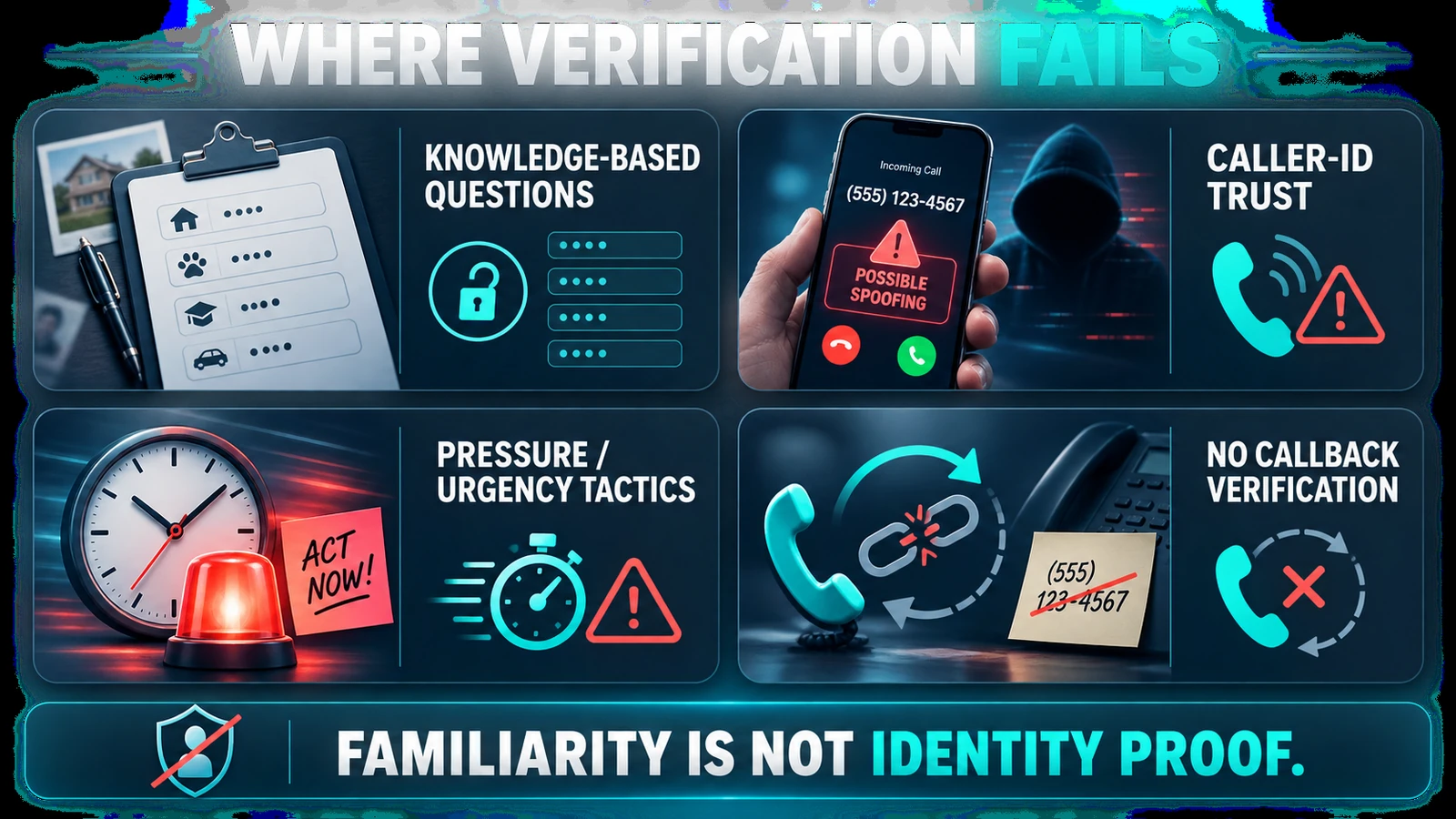 Four failure modes, one root cause: every one of these signals can be supplied or faked by the caller themselves, which means none of them independently confirm anything.
Caller-ID trust and urgency tactics make the gap worse rather than better. Caller ID is trivially spoofed, so a number that appears to originate internally proves nothing about who is actually speaking. And a caller who applies mild pressure — "I'm about to walk into a board meeting," "I'm locked out and my team is waiting on me" — is exploiting the analyst's own incentive to resolve the call quickly, turning the help desk's core performance goal into an attack surface. None of this requires the attacker to be a skilled hacker. It requires them to sound like a stressed, ordinary employee, which is a low bar deliberately, because the help desk exists to serve stressed, ordinary employees.
Identity-Verification Hardening Patterns That Close the Gap
The hardening patterns that actually work share a single underlying principle: verify identity through a channel or party the caller on the line does not control, rather than through information the caller can simply state. Four patterns do most of the work.
Out-of-band callback verification. Rather than continuing to verify identity on the inbound call, the analyst ends that call and calls back a number already on file in the HR or directory system — never a number the caller supplies during the interaction. An impersonator can sustain a convincing story for the length of one phone call; they generally cannot also be reachable at the real employee's registered device. This single change breaks the single-channel trust the entire attack depends on, and it's the pattern our assisted password reset guide treats as close to non-negotiable for any reset that touches MFA.
Manager or system-owner attestation for high-risk resets. Not every reset needs this step — applying it universally would recreate the friction the help desk exists to avoid, for no added security on the low-risk majority of requests. But a small, well-chosen set of actions — MFA re-enrollment, privileged-account resets, resets requested at unusual hours or from unusual patterns for that employee — should route to a manager or system owner for a quick confirmation before the reset completes. This adds a second, independent human check without slowing down the routine volume that doesn't need it.
Risk-based step-up. The core insight is that not all reset requests carry the same blast radius, and treating a routine password reset and an MFA re-enrollment on an executive account as the same-weight request is itself the vulnerability. Risk-based step-up scores each request — account privilege level, request timing, device and location signals, whether MFA itself is being touched — and automatically routes higher-risk requests to stronger verification, while leaving low-risk requests fast. This is the mechanism that makes the other three patterns sustainable rather than a blanket tax on every call.
Assume caller-ID and stated facts prove nothing. This isn't a workflow step so much as a standing policy: no verification decision should ever rest solely on caller ID matching an internal number, or on the caller correctly stating information that's realistically discoverable outside the organization. Both are useful supporting signals; neither is sufficient on its own.
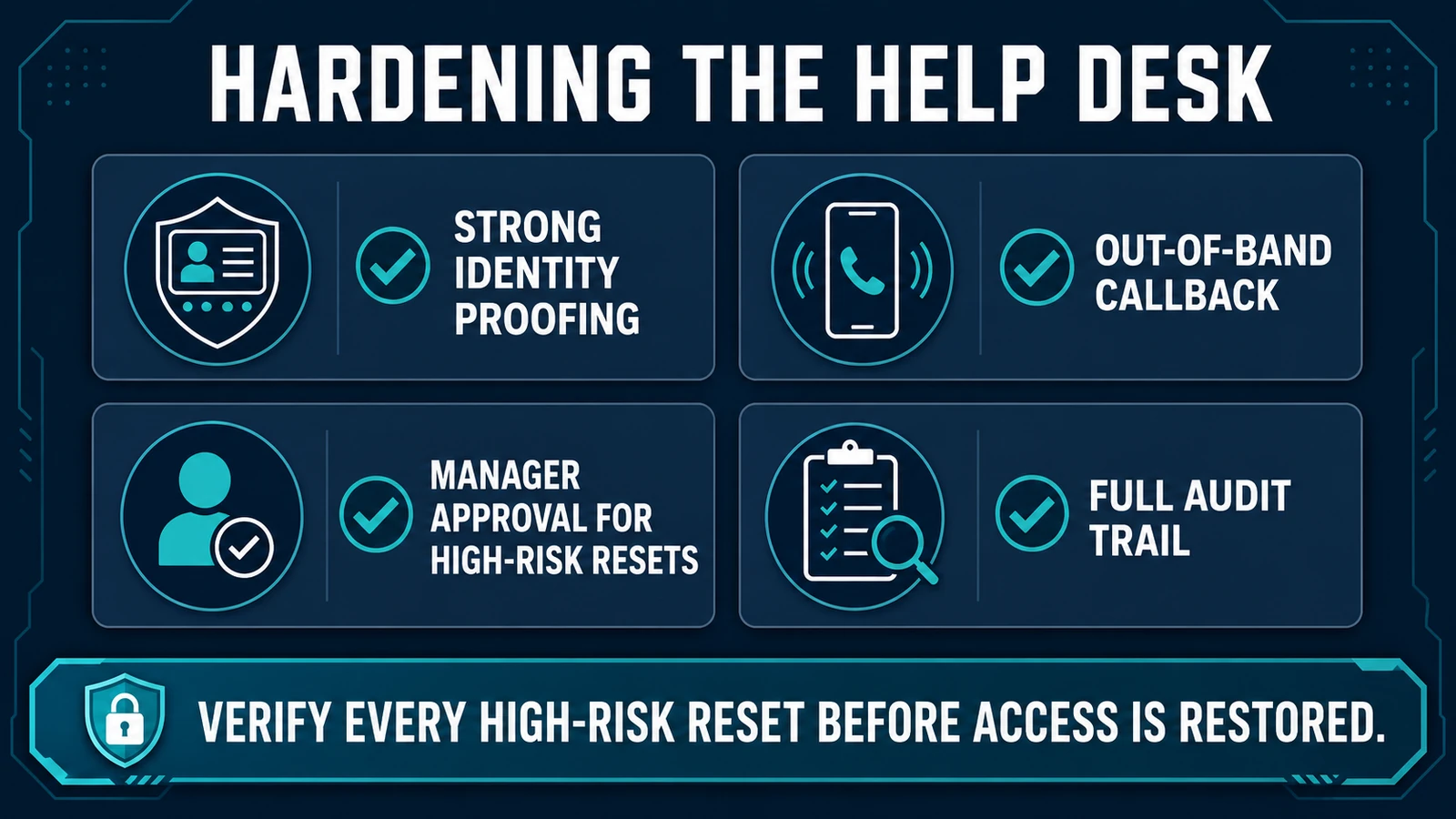 None of these four controls is exotic technology — they're workflow and policy decisions that most identity platforms already support and most help desks simply haven't turned on for the requests that need them.
The pattern that ties these together is risk-proportionate friction: most resets stay fast because most resets are low-risk, and the friction budget gets spent specifically on the requests where a wrong decision has outsized consequences. An MFA-fatigue-style approval prompt sent to a device the attacker already controls defeats the same trust assumption from a different angle — ICC's piece on MFA fatigue attack patterns covers that specific mechanic in more depth than fits here, but it's worth noting that a hardened help-desk reset workflow and phishing-resistant MFA enrollment are complementary controls, not substitutes for each other.
What Avatier's Assisted-Reset Workflow Does Differently
The structural problem with most help-desk reset processes is that verification lives in the analyst's head as a judgment call made under time pressure, rather than existing as enforced policy the analyst simply follows. Avatier's assisted-reset workflow is built around removing that judgment call from the moment of highest pressure.
In practice, that means the workflow — not the individual analyst — decides which resets are routine and which are high-risk, based on account privilege, request context, and whether MFA itself is part of the request. Routine, low-risk resets can complete through self-service entirely, without a phone call, which has the secondary benefit of shrinking the total number of live calls where an impersonation attempt is even possible in the first place; our self-service password reset guide covers that deflection path directly. Requests the workflow flags as high-risk — MFA re-enrollment, privileged accounts, unusual timing or pattern — are automatically routed to out-of-band confirmation or manager attestation before completing, rather than left to an analyst's discretion mid-call. Every step of that path, and every reason a request was flagged or approved, is captured in an audit trail, which matters both for after-the-fact investigation and for closing the loop when a policy needs to be tightened based on what an attempted intrusion revealed.
This workflow removes the specific failure mode where a busy, empathetic analyst has to independently invent adequate verification under pressure, and replaces it with policy that applies consistently regardless of how convincing any individual caller sounds.
A Practical Checklist for CISOs and Service-Desk Leaders
A few concrete, low-cost changes close most of the gap this incident exposed, roughly in order of how quickly they can be implemented:
- Separate MFA re-enrollment from routine password reset as a distinct, higher-risk action with its own verification path, rather than bundling both into the same call and the same trust decision.
- Move callback verification off caller-supplied numbers entirely — the only acceptable callback number is one already on file in the HR or directory system, looked up independently by the analyst, never one stated by the caller.
- Define a short, explicit list of high-risk conditions — privileged accounts, MFA changes, off-hours requests, unusual location or device signals — that automatically trigger manager attestation or out-of-band confirmation, so the decision isn't left to individual analyst judgment.
- Give analysts explicit permission and cover to escalate or decline a request that doesn't clear verification, and measure that behavior as a success, not a failure, in performance reviews — the incentive structure has to change alongside the process.
- Run social-engineering tabletop exercises against the help desk specifically, not just against end users, since the help desk is the team most directly targeted by this vector and least often included in phishing-style security training.
- Audit MFA re-enrollment logs for pattern anomalies — an unusual spike in resets tied to executive or privileged accounts, or resets followed quickly by new-device logins, are the kind of signal that a governed, centralized identity platform surfaces faster than scattered per-system logs ever will.
- Cross-train against the adjacent human-error patterns, since help-desk social engineering is one specific case of a broader category our human-error-in-breaches piece covers more fully — the same pressure-and-plausibility dynamic shows up in phishing susceptibility generally, not just at the reset counter.
What Avatier Ships Toward This Pattern
Avatier's contribution to closing this specific gap is the assisted-reset and self-service password workflows described above, built to enforce risk-based verification as policy rather than leave it to an analyst's real-time judgment — routing high-risk resets to out-of-band confirmation and manager attestation automatically, logging every decision for audit, and deflecting the routine, low-risk volume away from live calls entirely so there are simply fewer moments where a phone-based impersonation attempt can happen at all. This isn't positioned as a complete answer to social engineering; it's the governed workflow layer that makes consistent verification possible at help-desk scale, which a policy document alone can't guarantee. Our real cost of help-desk password resets analysis covers the operational and financial case for this shift in more depth.
The Avatier Trust Center publishes the compliance posture behind the platform this workflow runs on: SOC 2 Type II audited with zero exceptions noted, ISO/IEC 27001:2022 certified, PCI DSS v4.0.1 compliant, CSA STAR Level 1 attestation, NIST 800-53 Rev. 5 aligned, and a CISA Secure-by-Design Pledge signatory.
ABOUT THE AUTHOR

More from IAM & Identity Governance

Identity Management's Biggest Breaches: Lessons for 2026
The governance lessons enterprises should draw from major identity breaches — not the attack mechanics, but the structural gaps that let one credential become a headline.

Identity and Access Management for Enterprise Security (2026)
Identity and access management is the control layer that decides who and what can reach enterprise systems — and in 2026 it functions as the security program itself, not a supporting utility underneath it.

Translating Security Risk Into Business Language in 2026
Boards don't fund CVE counts — they fund dollar exposure. A practical framework for turning access sprawl, orphaned accounts, and audit findings into risk language executives actually act on.