Data Breaches and IAM Failures: A 2026 Post-Mortem Guide
Most identity-driven breaches follow the same chain — stolen credential, no MFA, lateral movement, exfiltration — and the controls that break that chain are well understood, if rarely fully deployed.

Most identity-driven breaches follow the same chain — stolen credential, no MFA, lateral movement, exfiltration — and the controls that break that chain are well understood, if rarely fully deployed.
- Identity-driven breaches follow a recognizable chain, not a random event: a credential is compromised, it's used to log in without a second factor, the attacker moves laterally and escalates privilege, then exfiltrates data. Every stage in that chain is a place a specific IAM control can interrupt the sequence — the question worth asking after any incident is which stage actually failed.
- Four failure patterns show up in breach post-mortems more than any others: over-privileged accounts that grant far more than the job requires, stale entitlements left over from a role change or project that ended, weak or reused credentials, and deprovisioning lag between when someone leaves and when their access is actually revoked. None of these are exotic; all of them are governance gaps.
- Governance controls — least privilege by default, periodic access certification, automated lifecycle deprovisioning — are what prevent the initial failure from existing in the first place. MFA, privileged access management, and anomaly detection are what limit the blast radius after a credential is already compromised. Treating these as the same control is why some programs feel secure and still get breached.
- Breach cost and timeline compound the longer an intrusion goes undetected: initial intrusion, an extended dwell-time window, detection, containment, and an aftermath of notification and remediation costs that grow at every stage. The honest reality is that identity controls change how far along that curve an incident gets before it's stopped — they rarely stop the curve from starting at all.
- IAM controls have real limits worth naming plainly: they don't stop zero-day exploits, they don't replace security awareness training, and no single control is sufficient on its own. Defense-in-depth — governance plus authentication plus monitoring plus response — is what actually closes the gap identity failures open.
Most data breaches that trace back to identity don't start with a novel exploit — they start with a credential that should never have worked, an account that should never have had that much access, or a login that should have required a second factor and didn't. The pattern repeats across enough public post-mortems that it's less a mystery than a checklist: stolen or reused credential, authentication with no meaningful friction, lateral movement into systems the compromised account was over-provisioned to reach, then exfiltration. This piece walks through that chain stage by stage, the specific IAM failures that let each stage happen, and the controls — governance, least privilege, access certification, MFA, PAM, anomaly detection — that block or contain it.
This is the 2026 update of our original piece on data breaches and IAM. The original leaned on borrowed statistics from third-party breach reports to make its case; this version drops the fabricated precision and stays with what's actually defensible — the mechanics of how identity failures show up in real breaches, and which controls interrupt them. If you're specifically looking for the human-error angle on breach causation, our human-error piece covers that ground directly rather than being re-trodden here.
The Anatomy of an Identity-Driven Breach
Strip away the specifics of any given incident and a surprisingly consistent shape emerges. An attacker obtains a working credential — through phishing, a credential-stuffing attempt against a reused password, or a purchased dump from an unrelated breach. That credential is used to authenticate, and if there's no second factor, or a second factor an attacker can bypass, the login succeeds without raising any alarm because it looks, technically, like a real user logging in. From there, the attacker doesn't stay put. They move laterally, probing what the compromised identity can reach, and if that identity carries more privilege than its actual job requires, the reach is far larger than it should be — sometimes reaching genuinely privileged systems the original account was never meant to touch. Only at the end does data actually leave: the exfiltration stage, the part that shows up in headlines, but the last link in a chain that started several steps earlier.
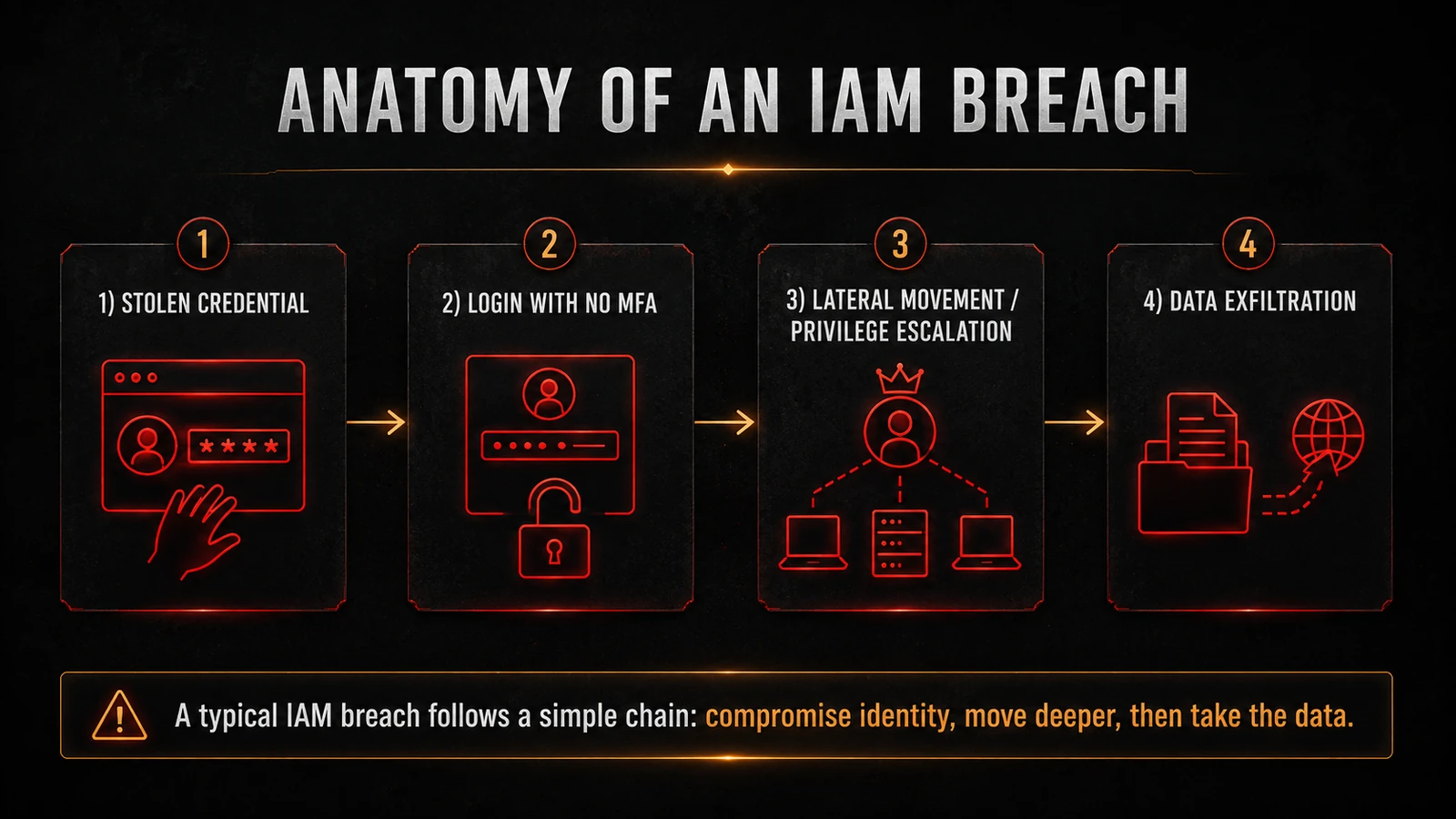 A typical IAM breach follows a simple chain: compromise identity, move deeper, then take the data — and each link is a place a specific control can break the sequence.
This is why breach post-mortems that stop at "attacker used stolen credentials" are incomplete. The credential theft explains the first link. It doesn't explain why the login succeeded without friction, why the compromised account could reach systems well beyond its actual job function, or why nobody noticed the access pattern change before data left. Those are three separate governance questions, and a mature post-mortem answers all three — because the fix for each is different, and a program that only addresses credential hygiene while ignoring privilege scope and monitoring has closed one door while leaving two others open.
Storm-2949, the identity-governance failure Microsoft disclosed, is a useful real-world illustration of this same shape playing out at the service-principal and RBAC layer rather than the human-login layer — our breakdown of what it actually broke shows the same pattern of standing privilege and missing lifecycle attestation, just in a machine-identity context instead of a workforce one.
The Failure Patterns That Show Up Again and Again
Four specific identity failures account for most of what turns a single compromised credential into a material breach, and none of them are exotic.
Over-privileged accounts. Access provisioned more broadly than the role requires, often because a role template was built for the most demanding use case in that job family and applied uniformly, or because a one-time exception granted for a specific project never got scoped back down. An over-privileged account doesn't cause the initial compromise, but it determines how much damage that compromise can do — the difference between an attacker who can read one system and an attacker who can read a dozen.
Stale entitlements. Access that was legitimate once and never got revoked when the reason for it ended — a completed project, a prior role, a system the person hasn't touched in a year. Stale entitlements accumulate quietly because removing access is rarely anyone's proactive job; it's the thing that happens during a certification cycle, if a certification cycle happens at all, and the gap between cycles is exactly where risk sits unmonitored.
Weak or reused credentials. Passwords reused across personal and work accounts, or weak enough to fall to a targeted guessing attempt, remain a reliable entry point precisely because they don't require an attacker to breach the target organization at all — a credential exposed in an unrelated third-party breach often works, unmodified, against a completely different system.
Deprovisioning lag. The gap between when someone's access should end — termination, role change, contract expiration — and when it actually does. Manual, ticket-driven offboarding is the most common cause: an access removal that depends on a person filing a request and another person acting on it will lag by however long that human chain takes, and every day of lag is a live, unmonitored credential.
These four categories overlap with, but aren't identical to, the broader human-error causes of breaches — phishing susceptibility, misconfiguration, mis-delivered data — that our human-error piece covers in full. The scope here is narrower and more mechanical: these are specifically the access-and-entitlement failures that determine how far a compromise reaches once it starts, not the full universe of ways a breach can begin.
How IAM Controls Interrupt the Breach Chain
Mapped against the anatomy above, a small set of IAM controls does almost all of the interrupting — some blocking the initial failure from happening, others limiting what a successful compromise can do.
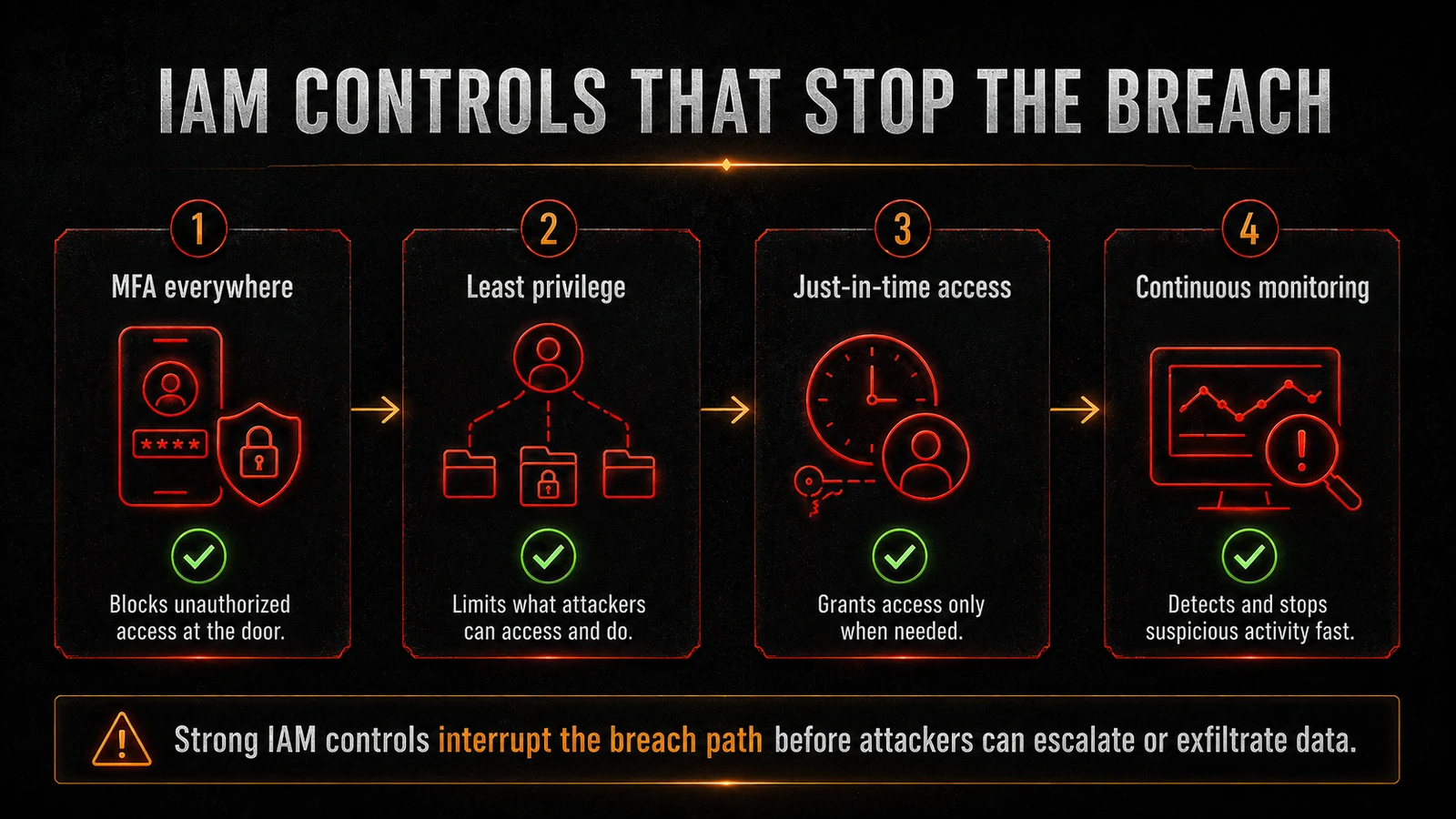 Strong IAM controls interrupt the breach path at different links in the chain — MFA and least privilege at the front, just-in-time access and monitoring once something is already moving.
MFA sits at the authentication link, blocking the large majority of attempts that rely on a working password alone. Least privilege and just-in-time access sit at the lateral-movement link, shrinking what a compromised identity can reach even if the login succeeds. Continuous monitoring sits across every later link, watching for the access-pattern deviation that flags an intrusion already in progress before it reaches exfiltration. None of these four controls is a substitute for the others — a program strong on MFA but weak on least privilege still hands a successful intruder broad reach; a program strong on monitoring but weak on MFA still generates the alert only after the door was already open.
Stopping the Initial Failure: Governance, Least Privilege, and Access Certification
The controls that prevent the first two links of the chain — credential compromise turning into a consequential login, and a login turning into broad lateral reach — are governance controls, and they're the least glamorous part of an identity program precisely because their job is to make nothing interesting happen.
Least-privilege provisioning starts at the role-design stage: access templates scoped to what a job function actually requires rather than the broadest plausible interpretation of it, with exceptions tracked as exceptions rather than folded permanently into the template. This is a design discipline more than a technology purchase — the best access-governance platform in the world can't fix a role template that was over-scoped from the start, though it can make the over-scoping visible and reviewable rather than invisible.
Access certification is the recurring mechanism that catches what design alone misses: periodic review campaigns where a manager or system owner has to affirmatively confirm that a given person still needs a given entitlement, rather than access persisting by default until someone objects. Certification is where stale entitlements actually get caught, and its effectiveness depends almost entirely on whether reviewers can make an informed decision quickly — a certification campaign that dumps an unreadable spreadsheet of raw permissions on a manager produces rubber-stamped approvals, not real review. Risk-scored, role-contextualized certification queues are what make the difference between a compliance exercise and an actual control.
Automated lifecycle deprovisioning closes the deprovisioning-lag gap directly by tying access removal to an authoritative HR event — termination, role change — rather than to a manual ticket someone has to remember to file. This is the single highest-leverage fix for one of the four failure patterns above, because it removes the human chain that lag depends on entirely.
Limiting the Blast Radius: MFA, PAM, and Anomaly Detection After Compromise
Governance controls assume they'll sometimes fail — a phishing message convincing enough to work, a credential leaked somewhere outside the organization's control — and the next layer of controls exists specifically for that failure case, limiting what a compromise that does happen can actually do.
MFA is the first blast-radius control, sitting directly at the authentication step. Phishing-resistant factors — passkeys and FIDO2-compatible hardware keys in particular — close the gap that weaker MFA implementations leave open, including MFA-fatigue prompt-bombing attacks that rely on a user approving a push notification out of habit rather than scrutiny; ICC's piece on MFA fatigue attack patterns covers the specific mechanics of that bypass technique in more depth than fits here.
Privileged access management addresses the population of identities where a successful compromise does the most damage — domain admins, database administrators, financial-system controllers, and the service accounts that often carry more standing privilege than anyone remembers granting. Just-in-time elevation, session recording, and credential vaulting mean that even a compromised privileged account is time-boxed and watched rather than a permanent, silent master key. Our PAM for Enterprise piece goes deep on where this discipline overlaps with, and diverges from, identity governance more broadly.
Anomaly detection and identity threat detection and response are the controls that catch a compromise already past authentication — the lateral movement and access-pattern deviation that a credential check alone can't see, because the attacker is, by that point, using valid credentials to do something a real user's history says is unusual. Our ITDR piece covers the response side of that discipline — containment, session revocation, investigation — and our anomaly detection piece covers the modeling mechanics underneath it, including the honest limits of what a baseline can and can't catch.
The Honest Cost and Timeline of Breach Response
The financial and operational cost of an identity-driven breach isn't a single number at the moment of compromise — it's a curve that compounds the longer the intrusion goes unaddressed, and understanding the shape of that curve matters more than any single headline figure.
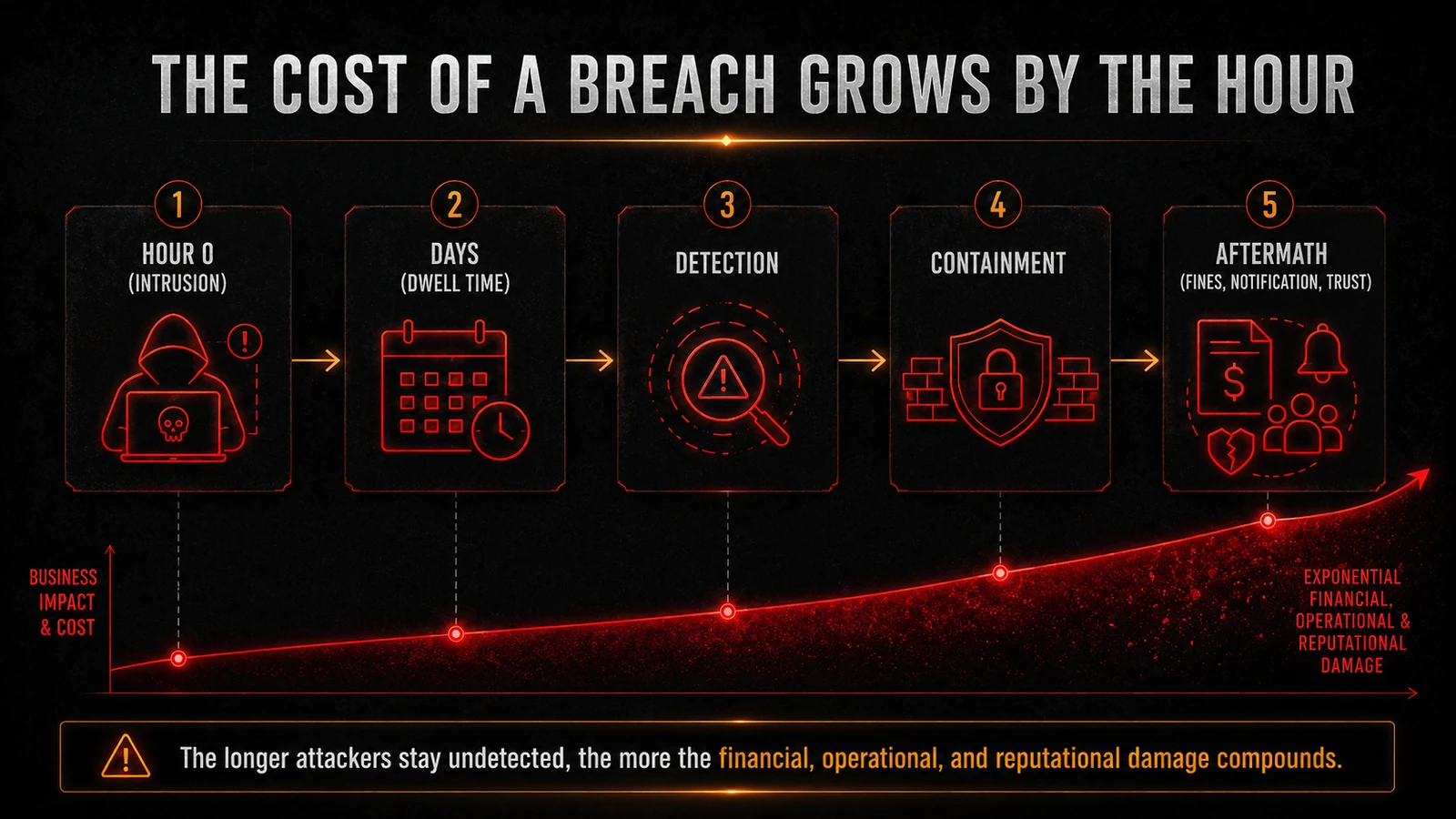 The cost curve isn't linear. Every stage an intrusion moves through undetected — dwell time especially — adds financial, operational, and reputational cost that the next stage compounds rather than resets.
Intrusion itself is rarely the expensive moment; dwell time is. The interval between initial access and detection is where an attacker has the most freedom to move laterally, escalate privilege, and stage data for exfiltration without resistance, and identity-based intrusions in particular tend to sit in this window longer than malware-based ones, because valid credentials don't trigger the same automated defenses a malicious binary does. Detection ends the freest part of the timeline but doesn't end the cost — containment still has to happen, which for identity-driven incidents means revoking access across every system the compromised identity touched, not just the one where the intrusion was first noticed. That revocation is fastest when access is centrally governed and slowest when it has to be chased system by system, which is itself a governance-maturity signal as much as a security one.
The aftermath stage — notification, regulatory exposure, remediation, and the harder-to-quantify cost to customer and partner trust — is where the compounding becomes most visible, and it scales with how much data left and how long the organization took to notice and disclose, not with the sophistication of the original entry point. This is the part of the curve identity controls influence most directly: not whether an intrusion attempt happens at all, but how early it's caught and how narrow the blast radius is by the time it's contained.
What Avatier Ships Toward This Pattern
Avatier's position in this chain is specific rather than expansive: Identity Anywhere is not positioned as a standalone detection, PAM, or SIEM product, and this piece isn't an argument that it should be. What the platform addresses directly is the governance layer that determines how much damage a compromise can do before any detection or containment control ever engages.
That means least-privilege provisioning built on role templates scoped to actual job function rather than broadest plausible access, risk-scored access certification campaigns that give reviewers enough context to make a real decision instead of rubber-stamping a spreadsheet, and HRIS-driven lifecycle automation that closes the deprovisioning-lag window the moment a termination or role-change event fires rather than whenever a ticket gets worked. On the authentication side, the platform supports FIDO2-compatible passwordless login, closing the weakest-link gap that password-only MFA implementations still leave open.
The honest framing matters here as much as the feature list: Avatier's contribution is the governed identity foundation that PAM, anomaly detection, and ITDR tooling — Avatier's own or a partner's — depend on to know what normal access looks like and to revoke it quickly when it isn't. The Avatier Trust Center publishes the compliance posture behind that foundation: SOC 2 Type II audited with zero exceptions noted, ISO/IEC 27001:2022 certified, PCI DSS v4.0.1 compliant, CSA STAR Level 1 attestation, NIST 800-53 Rev. 5 aligned, and a CISA Secure-by-Design Pledge signatory.
What IAM Controls Do Not Solve
An honest post-mortem framework ends with the boundaries, because identity controls sold as a complete answer get blamed for gaps they were never built to close.
They don't stop zero-day exploits. A vulnerability an attacker can use to gain access without ever touching a credential — an unpatched service, an exposed API, a supply-chain dependency — bypasses identity controls entirely, because there's no login event and no entitlement to over-scope. Identity governance narrows what happens after that kind of access is gained, if the compromised system or account intersects with the identity plane at all, but it doesn't prevent the initial exploit.
They don't replace security awareness training. A convincing phishing message still gets clicked regardless of how tight the entitlement model is. Phishing-resistant MFA limits what a successful deception yields — an attacker with a password but no passkey still can't authenticate — but it doesn't change whether the deception works on the person targeted. Awareness training and identity governance address different halves of the same problem, and dropping either one leaves the other doing work it wasn't designed to do alone.
They don't fix misconfiguration outside the identity plane. An open storage bucket, a permissive firewall rule, or a default credential left in place on a device are configuration failures identity governance has no direct authority over, even when they end up exposing the same kind of data an identity breach would.
No single control is sufficient alone. MFA without least privilege still hands a successful login broad reach. Least privilege without monitoring still misses the slow, patient compromise that stays within its scoped access but shouldn't be there. Defense-in-depth — governance, authentication, privileged access controls, and monitoring working together rather than any one of them standing in for the rest — is what actually closes the gap identity failures open, and it's the honest conclusion any breach post-mortem should reach.
ABOUT THE AUTHOR

More from IAM & Identity Governance

Translating Security Risk Into Business Language in 2026
Boards don't fund CVE counts — they fund dollar exposure. A practical framework for turning access sprawl, orphaned accounts, and audit findings into risk language executives actually act on.

The Help-Desk Call That Cost $100M: 2026 Lessons
A single impersonation call to a help desk — not a firewall failure — triggered a 2023 casino-industry breach that cost roughly $100 million, and the fix is verification discipline, not new firewalls.

Identity Management's Biggest Breaches: Lessons for 2026
The governance lessons enterprises should draw from major identity breaches — not the attack mechanics, but the structural gaps that let one credential become a headline.