How ML Anomaly Detection Works for Identity: A 2026 Technical Guide
A technical walkthrough of how machine learning models actually detect identity anomalies — baselining, feature signals, unsupervised versus supervised approaches, and false-positive tuning.

A technical walkthrough of how machine learning models actually detect identity anomalies — baselining, feature signals, unsupervised versus supervised approaches, and false-positive tuning.
- This is the mechanism piece, not the monitoring overview or the response playbook. It answers one question: how does a model decide that a specific identity event is abnormal? Baselining, feature engineering, and false-positive tuning are the whole story — what to do once a model fires lives elsewhere.
- A baseline is a statistical model of what normal looks like for an identity or a peer group, built across time, geography, device, and access-pattern dimensions. Every downstream detection is a distance measurement from that baseline, so the baseline's quality — not the algorithm's sophistication — sets the ceiling on detection quality.
- Unsupervised methods (clustering, density-based outlier detection) carry most of the weight at go-live because labeled identity-compromise incidents are rare. Supervised classification becomes viable only after enough adjudicated true and false positives accumulate to train against — and most programs underestimate how long that takes.
- False-positive tuning is a modeling discipline with its own techniques — threshold calibration, ensemble voting, contextual suppression, feedback-loop retraining — not an afterthought bolted onto a working detector. Get it wrong and the model is technically accurate and operationally ignored.
- The honest limits matter: cold-start populations have no baseline to deviate from, models drift as the organization changes, a patient adversary can stay under threshold, and none of this replaces least-privilege governance — a model trained on over-entitled access baselines the over-entitlement as normal.
Machine learning detects identity anomalies by learning a statistical baseline of normal behavior — per identity, per peer group, or both — and scoring new events by how far they deviate from that baseline across features like login timing, location, device, and access pattern. The score is a distance measurement, not a verdict, and everything about whether the technique works in production comes down to two things: what the baseline is built from, and how the model decides a deviation is worth anyone's attention.
That's the scope of this piece, and it's worth being explicit about the boundary up front. This is the "how the detection model works" piece — the mechanics of baselining, feature engineering, and model selection. It is not a program-level overview of identity monitoring (that's our AI analytics for identity monitoring piece), and it is not about what happens after a model fires — investigation, containment, session revocation (that's our ITDR piece). Those two pieces assume a working detector and build outward from it. This piece is what's underneath: how that detector gets built.
This is also the 2026 update of our earlier article on anomaly detection and machine learning for security pattern recognition. The update narrows the scope deliberately — the original ranged across general security pattern recognition and leaned on borrowed industry statistics to make its case. This version drops the borrowed numbers and stays inside identity, where the mechanism is concrete enough to describe without them.
Baselining: the whole detection problem in one concept
Every anomaly detection system, regardless of the specific algorithm underneath, does the same three things: build a model of normal, measure how far a new event sits from that model, and convert the distance into a score. The algorithm choice matters far less than most vendor material implies. The baseline is where the real engineering happens.
A baseline is not a single number. It's a multidimensional statistical model — typically a distribution or a set of learned clusters — spanning the identity's history across time, location, device, resource access, and volume. "Normal" for a specific analyst might mean logins between 8am and 7pm, from two consistent geographies, on a managed laptop, touching a stable set of about a dozen systems. The model doesn't store that as a rule; it learns the distribution from months of observed events and treats anything statistically far from it as a candidate anomaly.
The critical design decision is the unit of comparison, and there are two defensible choices that behave very differently. Self-baselining compares an identity only to its own history. It catches genuine individual change but flags all of it — a promotion, a new project, a return from leave all look identical to a compromise from inside a self-only model, because all of them are departures from that one person's prior pattern. Peer-group baselining compares an identity to others with a similar role, department, and entitlement profile, asking a sharper question: is this person doing something people functionally identical to them never do? Peer grouping catches the individual whose behavior has drifted from their cohort even when it hasn't drifted from their own recent history — the slow privilege creep that never looks abnormal one day at a time.
Peer-group baselining has a hard dependency that gets underweighted in most build-versus-buy conversations: it only works if the underlying identity data correctly says who is actually a peer. That's an HR and lifecycle data quality problem before it's a modeling problem, and it's the same dependency our risk scoring piece describes for peer-group risk signals — the model inherits the org chart's accuracy, for better or worse.
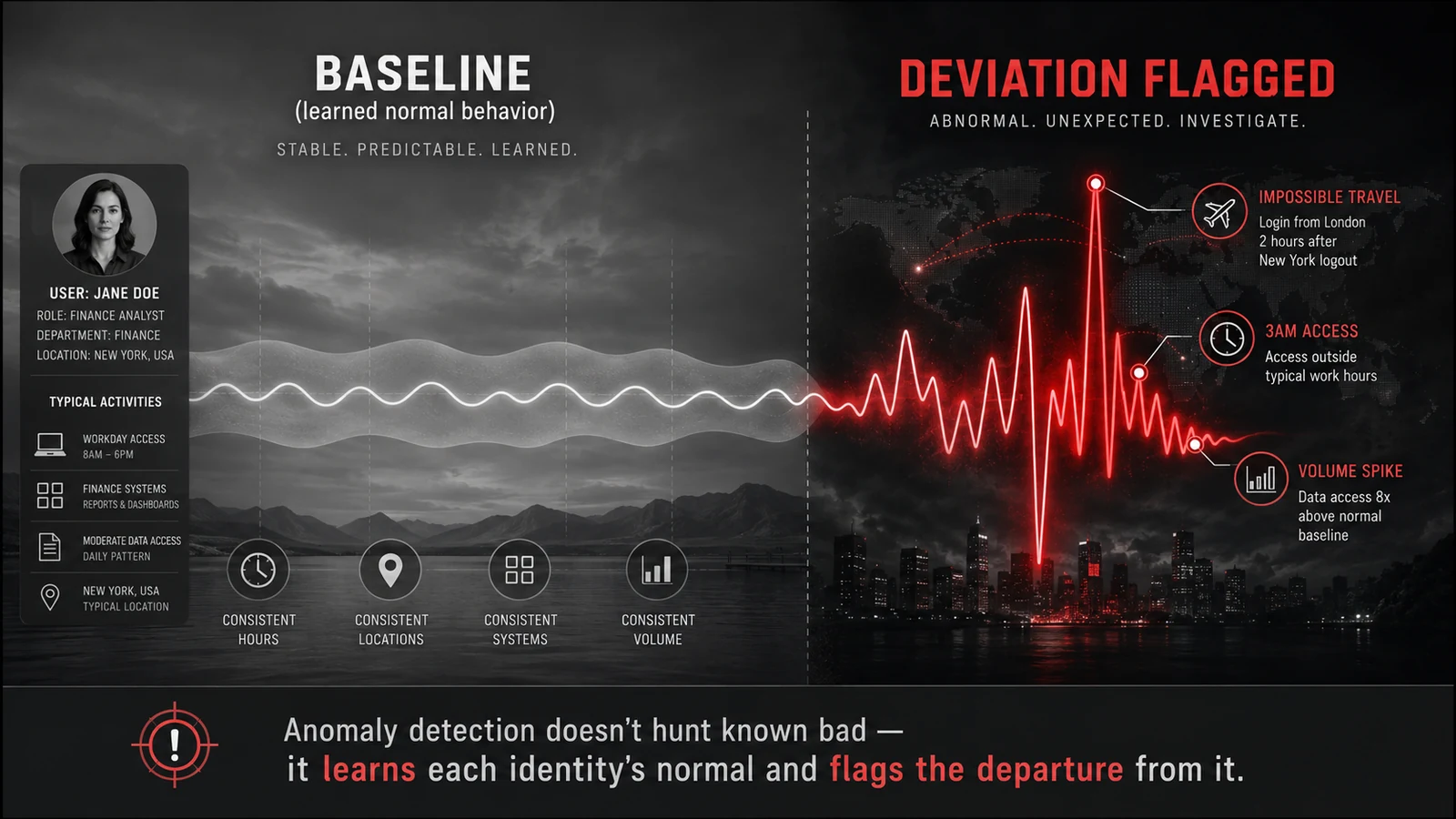 The mechanism in one picture: a learned envelope of normal, a new event measured against it, and a distance score in place of a rule match.
Mature deployments run both self and peer-group baselines simultaneously and weight the outputs rather than choosing one. A self-baseline deviation with no peer-group deviation often means legitimate individual change; a peer-group deviation with no self-baseline deviation often means the individual's job quietly changed without a lifecycle event recording it — which is itself worth flagging, just not as a security incident.
The feature signals the model actually consumes
A baseline is only as good as what feeds it. Four categories of feature signal carry most of the weight in production identity anomaly models, and a gap in any one produces a model that's confidently wrong rather than usefully uncertain.
Login geography, timing, and device velocity. The oldest and easiest signal to collect: where a login originates, when, from what device, and how quickly consecutive logins imply travel that isn't physically plausible. Velocity is the feature that turns two individually unremarkable logins — one from Chicago, one from Warsaw four hours later — into a strong signal, because the physical impossibility is the anomaly, not either login on its own. This signal is cheap, fast, and explainable to a non-technical reviewer, which is exactly why it's necessary and not sufficient on its own.
Access-pattern drift. Which systems and resources an identity touches, and how that set changes shape over time. Drift is a trajectory feature, not a point-in-time feature — a single new system accessed once is noise; a steadily widening resource footprint over eight weeks is a pattern a point-in-time rule cannot see at all, because no single day in that sequence crosses any reasonable threshold.
Entitlement usage anomalies. What an identity is authorized to touch, cross-referenced against what it actually touches. This is the signal most anomaly models underweight because it requires clean entitlement data most organizations don't have. Two identical-looking access events mean very different things depending on entitlement context: a user accessing a system they're provisioned for but have never used before an entitlement change is a weak signal; the same access from a user with no provisioning record for that system at all is a strong one. Without entitlement state, the model can't tell these apart.
Volume and sequence signals. Not just how much data an identity touches but in what order and rhythm. Exfiltration patterns typically don't look like an abnormal volume of access to a normal set of resources — they look like a normal volume of access spread across an abnormally wide breadth of resources, in a sequence the identity's history never shows.
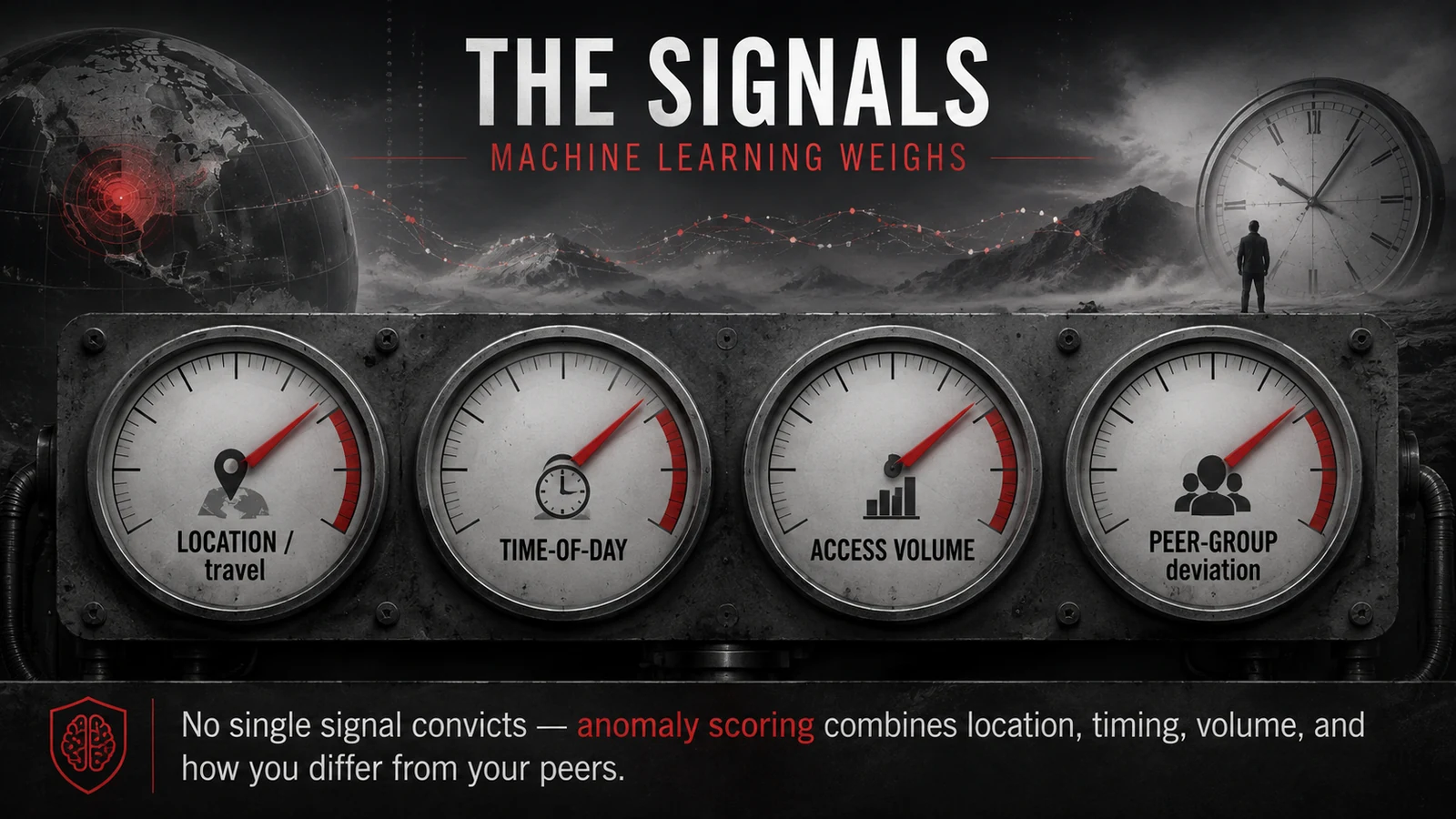 Four signal families, one score. A gap in entitlement data specifically is the one that most often turns a good model into a noisy one.
The honest takeaway across all four: authentication-only telemetry, which is what many organizations start with because it's the easiest to instrument, is the least informative of the four categories on its own. It tells the model a door opened, not what happened on the other side of it.
Unsupervised approaches: clustering and outlier detection
At deployment, almost every identity anomaly detection system starts unsupervised, and there's a structural reason for that rather than a preference. Supervised learning needs labeled examples of confirmed anomalies to train against, and confirmed identity compromises are — correctly — rare. A detection program that waited for enough labeled incidents to train a supervised classifier before shipping anything would never ship.
Unsupervised methods sidestep that requirement by finding structure in unlabeled data. Two families dominate in practice:
Density-based outlier detection models the "normal" region of the feature space as a region of high event density and flags points that fall in low-density regions — events statistically far from where most activity clusters. This is a natural fit for identity because most legitimate behavior really does cluster tightly (people are creatures of habit at scale) while genuine anomalies really do sit apart from it.
Clustering groups identities or events into cohorts based on behavioral similarity without being told in advance what the cohorts should be. This is how peer groups get discovered rather than assumed — instead of trusting an HR job title to define a peer group, clustering can surface that a subset of "Sales Engineer" title-holders actually behaves like a distinct operational cohort, which is often a more honest peer group than the org chart provides.
The trade-off with unsupervised methods is that "statistically unusual" and "actually risky" are not the same property, and the model has no way to distinguish them on its own. A legitimate but rare event — the annual access an auditor needs once a year — looks identical to a genuine anomaly from the model's perspective, because both are, correctly, statistically rare. This is precisely why unsupervised output should feed a scoring and review pipeline rather than an automated action, at least until enough adjudicated history exists to calibrate it.
Supervised approaches: classification once labels exist
Supervised classification becomes viable once a program has accumulated enough labeled history — confirmed compromises, confirmed false positives from analyst adjudication, confirmed benign explanations for flagged events — to train a model that predicts the label directly rather than inferring it from statistical rarity alone.
The advantage is precision on known attack shapes. A supervised model trained on confirmed account-takeover patterns learns the specific feature combinations that preceded real incidents, and it can weight those combinations more heavily than an unsupervised model's undifferentiated distance score would. If credential-stuffing account takeovers in your environment reliably show a specific sequence — a burst of failed logins, then a success from a new device, then an immediate entitlement-boundary access — a supervised classifier trained on that history recognizes the sequence with far more confidence than a general-purpose outlier score.
The trade-off is exactly the dependency that made unsupervised methods necessary in the first place: supervised models only recognize patterns that resemble their training labels. A genuinely novel attack pattern — the one nobody has confirmed yet because it hasn't happened yet, or happened and was never correctly attributed — looks like nothing in the training set and may not score highly even though it's real. This is why mature programs run supervised and unsupervised models together rather than migrating from one to the other: unsupervised methods for breadth and novelty coverage, supervised methods for precision on the attack patterns the organization has already confirmed. Neither replaces the other, and a program that drops unsupervised scoring once it has enough labels to go supervised has traded coverage for confidence in exactly the population where confidence is least warranted — the attack nobody has seen yet.
The false-positive tuning problem
This is where most identity anomaly detection programs actually fail, and it's rarely a modeling failure in the strict sense — the model is often technically doing what it was built to do. The failure is economic: identity event volume is enormous, genuine anomalies are rare, and even a low false-positive rate against a large event volume produces an alert queue no team can adjudicate.
The predictable sequence: a model ships with reasonable-looking precision in testing, goes live, and produces far more flagged events than any analyst team can review in the enterprise's real event volume. Analysts triage the obvious noise for a few weeks, start pattern-matching "this alert type is usually nothing," and eventually stop opening that alert type at all. The model keeps running and keeps scoring events correctly by its own internal logic. Nobody acts on the output. The organization has a dashboard, not a detector.
Four tuning techniques address this directly, and none of them is simply raising the score threshold, which trades false positives for false negatives without addressing why the model is noisy in the first place:
Ensemble voting. Require agreement across multiple independent signal families — not just one feature crossing a threshold — before an event scores high enough to surface. A login from a new location alone is weak; a login from a new location combined with unusual entitlement usage and an access-pattern departure is a different claim entirely.
Contextual suppression. Encode known-benign explanations directly into the scoring path — a calendared travel event, an approved role change, a confirmed project assignment — so the model doesn't repeatedly re-flag activity a human has already explained. This requires wiring the anomaly model to lifecycle and HR systems rather than running it on identity telemetry alone.
Peer-group recalibration. As covered above, comparing against a peer cohort rather than only self-history filters out the "everyone's behavior changed this quarter" noise that a self-only baseline treats as universally suspicious, because a peer-group shift usually means the organization changed, not that any individual did something wrong.
Feedback-loop retraining. Every analyst adjudication — confirmed true positive, confirmed false positive, unresolved — should flow back into the model as a label. A detection type that has produced zero true positives across months of adjudicated review is not a safety net; it's a standing tax on analyst attention, and the feedback loop is what surfaces that fact instead of hiding it behind an unreviewed alert count.
Programs that treat false-positive tuning as a one-time calibration step before launch, rather than an ongoing modeling discipline with its own metrics, are the ones whose detector goes quiet from disuse within two quarters. Our false-positive reduction piece covers the broader architecture this feeds into, including the workflow and UX side of the problem alongside the modeling side.
Where human review fits
No responsible deployment routes model output directly to an automated consequential action without a review layer somewhere in the loop, and the right place for that layer scales with the model's confidence and the action's reversibility.
At the low-confidence end, model output should inform a ranked queue, not trigger anything — an analyst's attention goes first to the highest-scored items, but a human decides what happens next. At the middle band, model output can trigger low-cost, reversible friction automatically — a step-up authentication challenge, a shortened session — while a human adjudicates the underlying event on a normal timeline rather than an emergency one. Deviceless step-up for workforce segments without a managed phone is its own design problem, and the Adaptive Authentication and Risk-Based MFA piece on ICC covers how a computed risk score becomes the trigger for exactly that kind of graduated response. Only at the highest-confidence band — where the model's precision has been validated against real adjudicated history over a meaningful period — does automated containment without a human in the loop become defensible, and even then it needs a fast reinstatement path for the inevitable wrong call.
The sequencing matters as much as the bands themselves. Programs that wire automated action to a model before it has an adjudicated track record are the ones that produce the outage or the wrongful lockout that gets the entire detection program set to observation-only, sometimes permanently. Running purely in observation mode — scores computed and logged, nothing actioned automatically — for a full seasonality cycle before enabling any automated response is the discipline that separates programs analysts still trust in year two from the ones quietly ignored by month four.
What Avatier ships toward this pattern
Avatier's position here is specific rather than expansive: the platform is not positioned as a standalone machine learning anomaly detection product, and this piece isn't a pitch for one. What Avatier Identity Anywhere ships is the governed foundation any anomaly detection layer — Avatier's own AI-assisted access intelligence, or a partner ITDR/UEBA tool consuming Avatier's identity data — actually depends on to produce a usable signal.
That foundation is two things this piece has argued matter more than algorithm choice. First, clean, current entitlement state, resolved through a single policy engine, so "this identity accessed something outside its normal pattern" can be cross-referenced against what the identity was actually authorized to do rather than guessed at. Second, accurate lifecycle events — HRIS-driven joiner-mover-leaver automation that turns role changes into labeled events a model can learn from, instead of the unexplained behavioral cliffs that get misread as anomalies. AI-assisted access intelligence within the platform baselines access patterns across peer groups built from that lifecycle data and feeds risk-scored queues into certification campaigns, applying the same baselining discipline to governance review that this piece describes for detection.
The Avatier Trust Center publishes the compliance posture behind the platform: SOC 2 Type II audited with zero exceptions noted, ISO/IEC 27001:2022 certified, PCI DSS v4.0.1 compliant, CSA STAR Level 1 attestation, NIST 800-53 Rev. 5 aligned, and a CISA Secure-by-Design Pledge signatory.
What ML anomaly detection does not solve
An honest technical reference ends with the boundaries, because a modeling technique sold as a complete answer gets blamed for gaps it was never built to close.
It does not replace least-privilege governance. A model baselines whatever access pattern exists, including an over-entitled one. If an identity has standing access it shouldn't have, the model learns that access as normal and will not flag its use — anomaly detection catches deviation from the baseline, not the baseline being wrong in the first place. Posture management, not detection, is the layer that catches standing over-entitlement as a finding in its own right, which is why the two disciplines are complementary rather than substitutable — our ISPM piece covers that standing-state layer.
Models drift and need retraining. An organization's normal changes continuously — reorganizations, new systems, workforce composition shifts, seasonal cycles — and a model trained on last year's patterns quietly degrades against this year's reality without necessarily failing loudly. Drift monitoring and scheduled recalibration are operational requirements, not optional maintenance.
The cold-start problem is structural, not a tuning gap. New employees, newly onboarded systems, and freshly provisioned service accounts have no history to baseline against, so detection coverage on genuinely new populations is inherently weaker for as long as that history is being built. More compute or a better algorithm doesn't compress that timeline — only time and, in the interim, a heavier reliance on rules and human review for the specific population that's cold.
A patient adversary can evade the model. Behavior that stays inside the statistical envelope a compromised identity's peers exhibit — deliberately slow, deliberately unremarkable — can remain under threshold for a meaningful window. Anomaly detection raises the cost of an intrusion and shrinks average dwell time; it does not make intrusion structurally impossible, which is exactly why it sits inside a layered stack with authentication, entitlement, and posture controls rather than standing in for all of them.
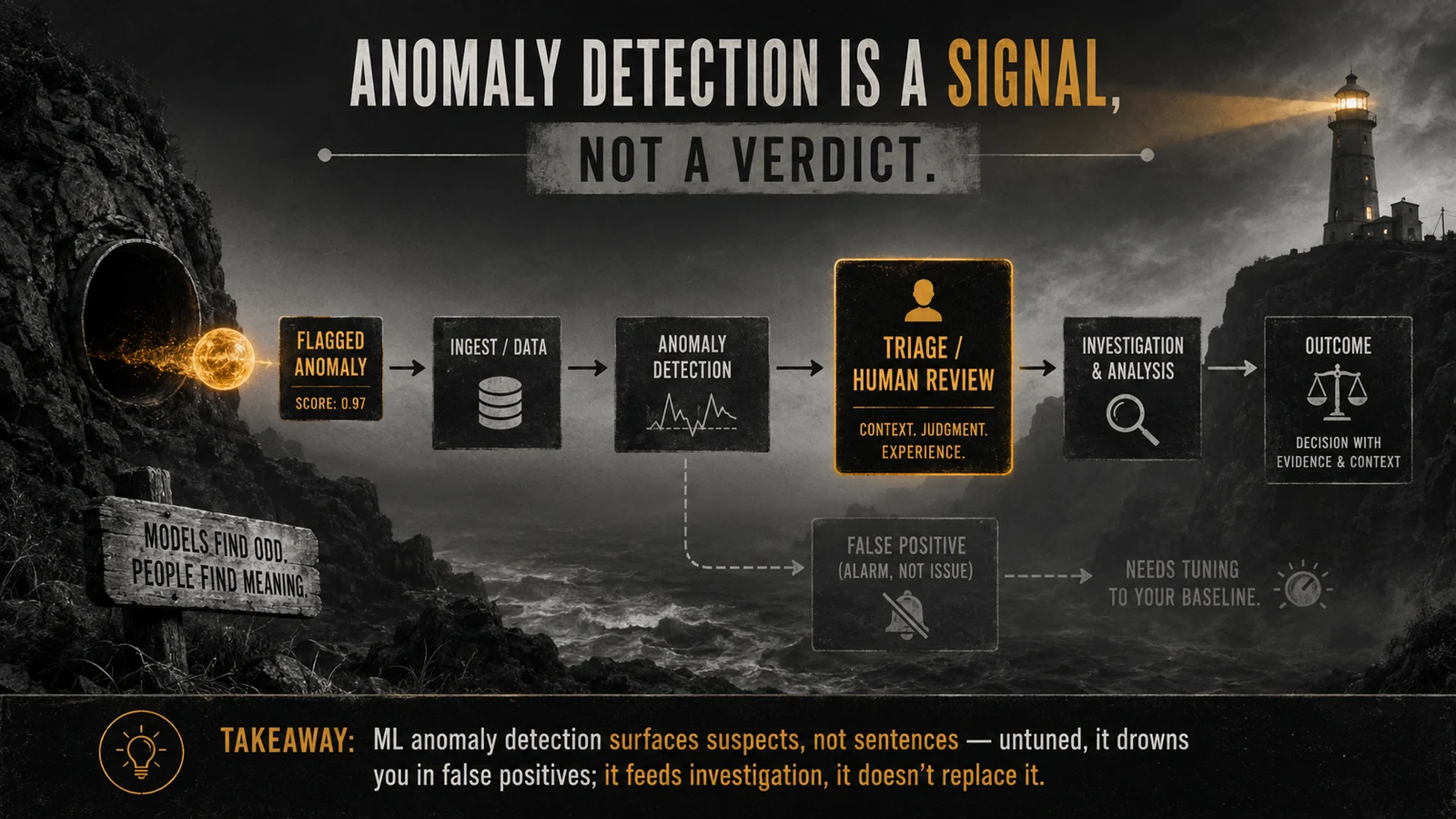 What the model can't do: absorb a governance failure, stay accurate without retraining, cover a population with no history, or catch an adversary patient enough to stay inside the envelope.
None of this is an argument against the technique — it's an argument for scoping it correctly. Machine learning anomaly detection is a genuinely capable layer for the specific problem it's built to solve: finding the identity event that's statistically wrong given everything the model has learned about normal. It is not a substitute for the governance work that determines what "normal" should have been in the first place, and the programs that treat it as connective tissue over a governed identity foundation get more out of it than the ones that buy it as a fix for a foundation they haven't built yet.
ABOUT THE AUTHOR

More from IAM & Identity Governance

Translating Security Risk Into Business Language in 2026
Boards don't fund CVE counts — they fund dollar exposure. A practical framework for turning access sprawl, orphaned accounts, and audit findings into risk language executives actually act on.

The Help-Desk Call That Cost $100M: 2026 Lessons
A single impersonation call to a help desk — not a firewall failure — triggered a 2023 casino-industry breach that cost roughly $100 million, and the fix is verification discipline, not new firewalls.

Identity Management's Biggest Breaches: Lessons for 2026
The governance lessons enterprises should draw from major identity breaches — not the attack mechanics, but the structural gaps that let one credential become a headline.