Identity and Access Management for Enterprise Security (2026)
Identity and access management is the control layer that decides who and what can reach enterprise systems — and in 2026 it functions as the security program itself, not a supporting utility underneath it.

Identity and access management is the control layer that decides who and what can reach enterprise systems — and in 2026 it functions as the security program itself, not a supporting utility underneath it.
- Identity and access management has moved from a supporting IT utility to the primary control plane for enterprise security, because the perimeter that used to carry that job no longer exists in any durable form for hybrid, cloud, and remote-first organizations.
- IAM in 2026 covers four functional pillars — authentication, authorization, governance, and audit — and every enterprise IAM program has to operate all four continuously, not just the ones that are easiest to automate.
- The identity lifecycle (provision, authenticate, authorize, review, deprovision) is where most enterprise access risk actually lives, because access decays after the moment it's granted and most breaches trace back to a stage of that lifecycle that ran manually or late rather than to a novel attack technique.
- IAM's position in the architecture matters as much as its feature set — it has to sit between the directory, the identity provider, every application, and the policy engine, functioning as connective infrastructure rather than a bolt-on product.
- IAM reduces the attack surface and shortens the window a compromised identity stays useful, but it does not replace endpoint security, network segmentation, or a security culture that treats access requests as things to justify rather than default to — it's a necessary layer, not a complete security program by itself.
Identity and access management is the set of systems and controls that determine who — or what, since service accounts and AI agents now authenticate too — can reach enterprise resources, and what they're authorized to do once they're in. In 2026, IAM isn't a supporting IT function anymore; it functions as the primary control plane for enterprise security, because the network perimeter that used to do this job no longer exists in any durable form for organizations running hybrid infrastructure, distributed SaaS estates, and remote or contractor workforces. When there's no reliable network boundary separating trusted from untrusted traffic, identity is the one control point that's still consistently in place, and enterprise security programs are built and budgeted around that reality.
This piece is the 2026 update of Avatier's original IAM enterprise security coverage. The core argument hasn't changed — IAM is a security program, not a login screen — but the shape of what an enterprise IAM architecture has to cover has gotten more specific since that piece published. Non-human identities now routinely outnumber human ones inside a typical enterprise. Access certification has moved from an annual audit checkbox toward a continuous discipline. And the conversation has shifted from "which vendor" to "which layers, integrated how" — the composition question, not the product question. This overview stays at that composition level; for the full seven-layer architectural breakdown, see the complete enterprise IAM guide, and for the mechanics of connecting IAM to the applications you already run, see the legacy and existing-application integration piece.
What IAM actually covers
IAM gets described loosely enough in vendor marketing that it's worth being precise about what the term covers and what it doesn't. Four functional pillars recur across every mature enterprise program, and a security posture that's strong on one or two of them while weak on the others has a structural gap, not just a maturity gap.
Authentication answers "who is this" — verifying a claimed identity through a credential. In 2026, that increasingly means phishing-resistant methods (passkeys, FIDO2-compatible hardware keys, certificate-based authentication) rather than passwords alone, because password-based authentication has been the weakest and most consistently exploited link in the chain for as long as it's existed.
Authorization answers a separate question that only makes sense after authentication succeeds — "what is this now-verified identity allowed to do." This is where least privilege lives: access should map to what the current role requires, not to whatever's accumulated over a person's tenure. The Principle of Least Privilege piece covers the mechanics of keeping that mapping tight as roles change.
Governance is the lifecycle and policy layer — provisioning, role changes, access certification, deprovisioning, and separation-of-duties enforcement. Governance is what keeps authentication and authorization honest over time instead of just at the moment access was first granted.
Audit is the continuous, structured record of who accessed what, when, and under whose approval. Audit isn't a report generated for a compliance deadline — in a well-run program, it's a byproduct of the other three pillars operating correctly, which is what makes it defensible rather than reconstructed after the fact.
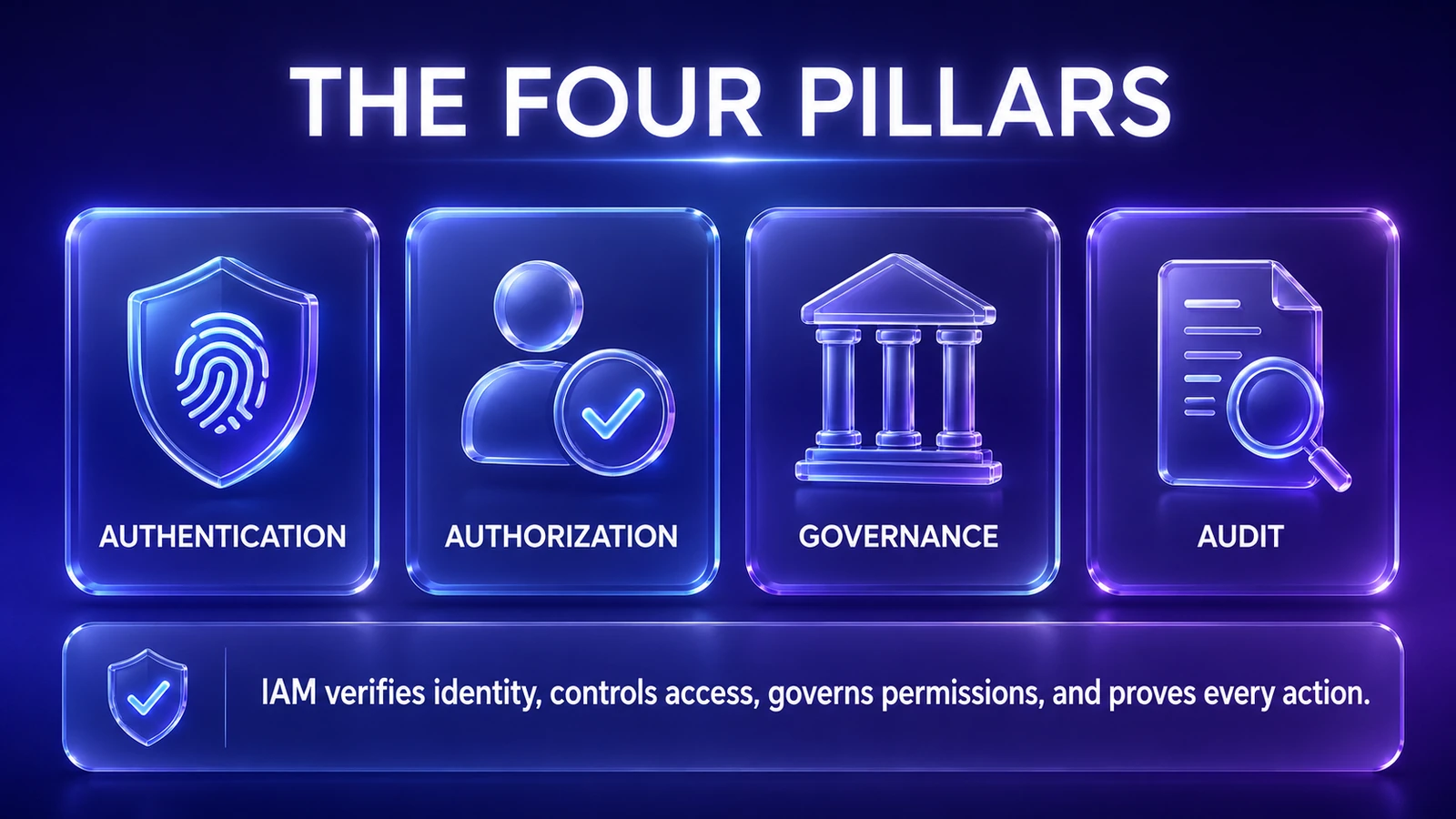 The four functional pillars every enterprise IAM program has to run continuously — a program strong on one or two while weak on the rest has a structural gap.
Why the perimeter no longer does this job
Perimeter security was built to answer a narrower question than the one enterprise security teams face now: is this traffic coming from inside the trust boundary or outside it. That question worked reasonably well when most employees sat on a corporate network behind a firewall, most applications ran on-premises, and remote access was the exception rather than the default.
None of those conditions hold for a typical enterprise in 2026. Employees authenticate from home networks and personal devices. Applications live across a mix of on-premises systems and dozens or hundreds of SaaS platforms with no shared network boundary. Contractors and partners need scoped access without ever touching the corporate network directly. Machine identities — service accounts, API integrations, AI agents operating on a user's behalf — authenticate constantly and in volumes that now regularly exceed the human workforce they support.
In that environment, a firewall has no concept of "this user's role doesn't include the finance database," and no amount of network segmentation substitutes for that judgment. Identity is the one control point that's still consistently present regardless of where a request originates or which network it crosses, which is why enterprise security architecture has recentered around it rather than around the network edge.
The identity population itself has shifted too, and it changes what "IAM" has to cover. Service accounts, API integrations, automation scripts, and AI agents acting on a user's behalf now routinely outnumber human identities in a typical enterprise, and most of them carry standing access with no person behind them to notice when something looks wrong. A human identity has a behavioral baseline — typical hours, a manager who might flag unusual conduct. A service account authenticates on a fixed schedule against the same systems indefinitely, which makes an unrotated credential or an over-scoped grant effectively invisible to any program still designed around watching people. An enterprise IAM architecture that only accounts for human identities is, by 2026, only accounting for a shrinking share of what actually needs governing.
The identity lifecycle: where the risk actually accumulates
Most enterprise access risk isn't created at the moment access is granted. It accumulates in the gaps between lifecycle stages that don't run on schedule, and those gaps are where a disproportionate share of breach investigations and audit findings ultimately trace back to.
The lifecycle runs in five stages. Provisioning creates the account and grants initial access, ideally scoped to role rather than copied from a convenient template. Authentication verifies the identity at each access attempt. Authorization evaluates whether the specific action being attempted is permitted for this identity right now. Review — access certification — periodically checks whether standing entitlements still match the role that justified them. Deprovisioning revokes access when the role or the relationship ends.
The failure mode isn't usually a broken step — it's a slow one. A new hire provisioned with excess access inherited from a departing peer's profile carries that excess for the life of their employment unless a certification cycle catches it. A role change that adds access without removing what the old role required leaves the identity with more standing entitlement than either role justifies on its own. A termination processed through a manual ticket that sits in a queue for days or weeks leaves a valid, unused credential live during exactly the window it's most likely to be misused, whether by a disgruntled former employee or by whoever gets hold of that credential after the fact.
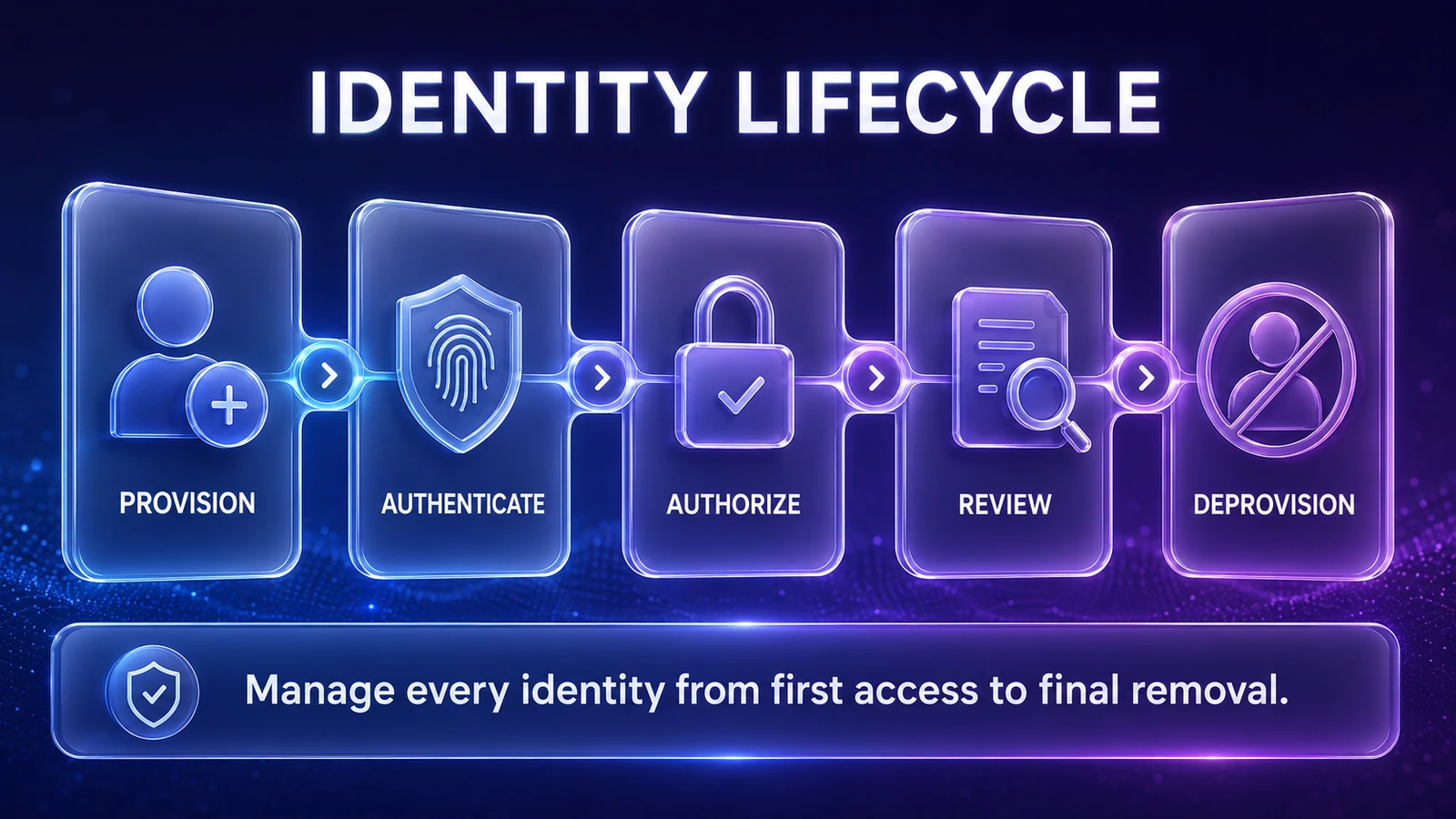 Access decays after the moment it's granted — most lifecycle risk lives in the gaps between these five stages running late or manually rather than on schedule.
Closing those gaps is a governance problem before it's a technology problem: automated provisioning tied to an authoritative HR source, deprovisioning triggered by the same source rather than a separate manual process, and certification cycles frequent enough — and routed to reviewers with enough context — to catch drift before it becomes permanent.
Where IAM sits in the architecture
IAM's value depends as much on its position in the stack as on its individual features. It has to function as connective infrastructure, sitting between the directory, the identity provider, every application the enterprise runs, and the policy engine that actually evaluates authorization decisions.
The directory is the authoritative store of identity records — who exists, in what state, with what attributes. The identity provider handles authentication and federates single sign-on across applications so users aren't managing separate credentials per system. Applications are the enforcement points, where an authorization decision actually gets applied to a specific action. The policy engine is what evaluates whether a given identity, in a given context, should be allowed to take a given action — the logic that turns "who is this" and "what's their role" into an actual allow-or-deny decision.
None of these four pieces functions as a security control in isolation. A directory with no policy engine behind it can authenticate people but can't make a scoped authorization decision. A policy engine with no lifecycle governance behind it enforces policy against entitlement data that goes stale the moment a role changes. This is also why HR system integration matters architecturally, not just operationally — the HR system is usually the most reliable source of truth for who should currently have access to what, and IAM architecture that treats it as an afterthought ends up governing against manually maintained data that drifts from reality within weeks.
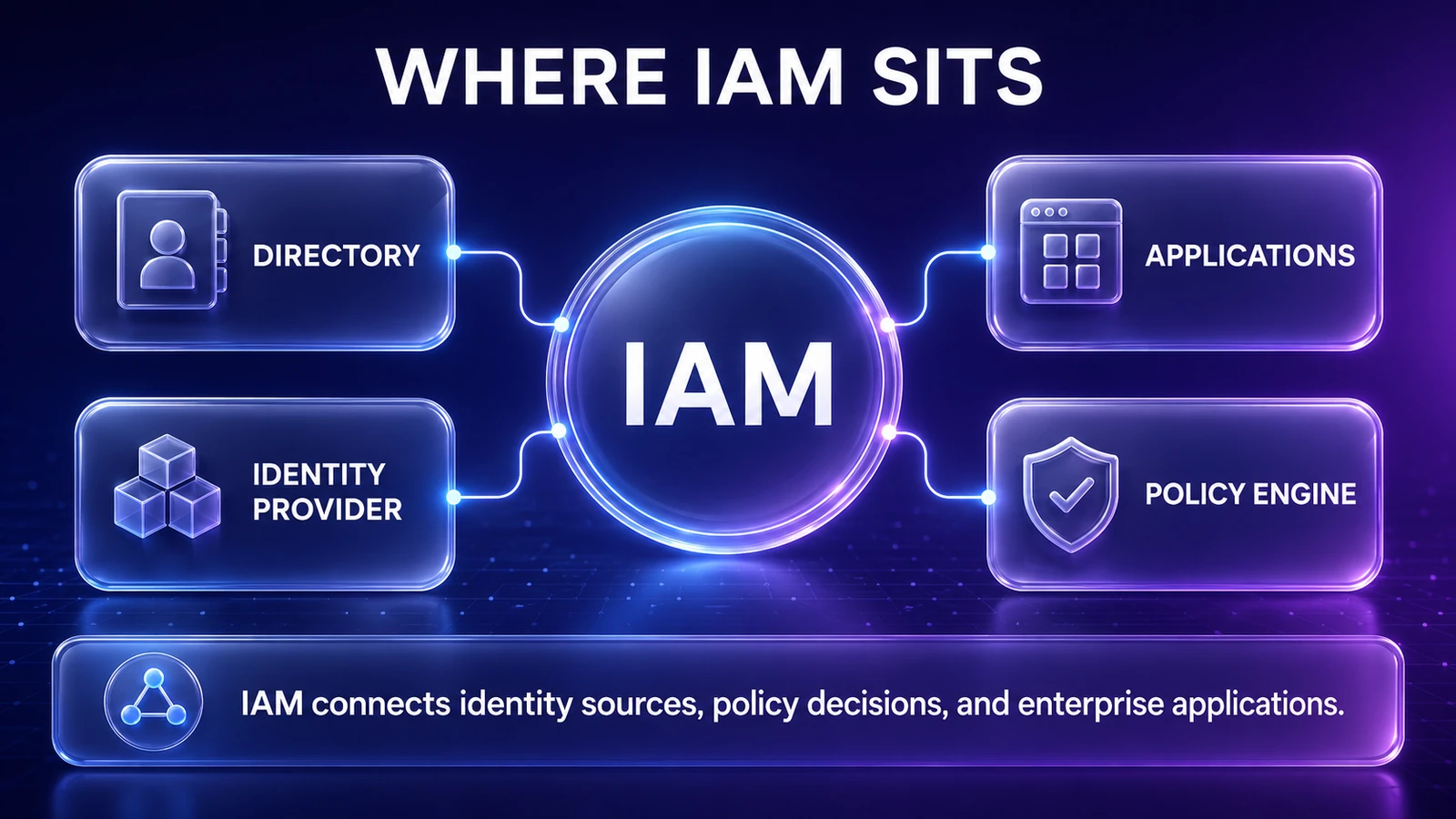 IAM's security value depends on its position as connective infrastructure between the directory, identity provider, applications, and policy engine — not on any one component in isolation.
For enterprises with legacy or mainframe systems in the mix — RACF, ACF2, and similar stacks that predate modern federation protocols — this architectural picture gets more complicated, not less relevant. Those systems still hold real access decisions and real audit obligations; the integration piece on connecting IAM to existing and legacy applications covers the connector patterns that bring them into the same governance model instead of leaving them as a permanent manual exception.
Governance as the control that keeps the rest honest
Authentication and authorization are point-in-time decisions. Governance is what keeps those decisions accurate as time passes, roles change, and organizations restructure — and it's the pillar most often underbuilt relative to its actual security weight.
Access certification is the recurring mechanism that catches entitlement drift. Done well, it's risk-weighted — privileged and sensitive access gets certified more frequently than low-risk access — and it routes to reviewers who actually have the context to answer the question, typically the resource owner rather than a line manager working from a long list they don't have time to actually evaluate. A certification program that routes every review to the same manager regardless of what's being certified tends to converge on rubber-stamp approval, which satisfies an audit checkbox without doing anything for actual security posture.
Separation of duties is the governance control that specifically targets misuse by a single identity acting alone — no one person should be able to both create a vendor and approve payment to it, or both request access and grant it to themselves. This is a design constraint enforced at the role and workflow level, not a monitoring control applied after the fact.
For organizations trying to figure out where they actually stand on this maturity curve — versus where they think they stand — the Identity Maturity Model piece maps the stages from manual, reactive access management through to a continuously governed, largely automated posture, and gives a framework for locating a specific program on that ladder.
Measuring whether it's actually working
An IAM program that isn't measured tends to be assumed effective right up until an audit or an incident proves otherwise. Enterprise security teams increasingly track a specific set of operational metrics rather than relying on a static architecture diagram as evidence the program works: time-to-deprovision after a termination or role change, the percentage of access certifications completed on schedule versus lapsed, the rate of standing privileged access versus just-in-time elevation, and the volume of access-request approvals that route through an actual policy check versus informal approval outside the workflow.
These operational metrics matter more than headline claims about the architecture, because they're the numbers that show up in an incident postmortem or an auditor's sample. A well-designed authorization model that takes three weeks to actually revoke a terminated employee's access has a governance failure sitting right next to a well-designed control, and the metric is what surfaces that gap before it becomes an incident. The Zero Trust Metrics piece goes deeper into which of these numbers correlate with actual risk reduction versus which ones just look good in a board deck.
What Avatier ships toward this pattern
Avatier Identity Anywhere is built around the position that IAM functions as connective infrastructure rather than a standalone product, and the platform's design choices follow from that. Provisioning and deprovisioning tie to HRIS role-of-record as the authoritative source, so a termination or role-change event triggers access changes the same day rather than through a manual ticket that can sit in a queue. Authentication supports FIDO2-compatible passkeys and hardware keys alongside the deviceless Identity Challenge Card, so phishing-resistant authentication doesn't depend on every user carrying a hardware token.
Access certification campaigns route to resource owners with risk-weighted frequency rather than defaulting every review to a line manager, and a "no" answer on a certification triggers automated revocation instead of another ticket that can stall in a queue. Separation-of-duties policy is enforced at the workflow level, blocking a conflicting request-and-approve pairing before the grant happens rather than catching it after the fact in an audit sample. The platform's connector layer — including support for mainframe systems like RACF and ACF2 — is built specifically so legacy applications join the same governance model as modern SaaS rather than sitting outside it as a permanent manual exception.
The Avatier Trust Center publishes the compliance posture behind the platform: SOC 2 Type II audited with zero exceptions noted, ISO/IEC 27001:2022 certified, PCI DSS v4.0.1 compliant, CSA STAR Level 1 attestation, NIST 800-53 Rev. 5 aligned, and a CISA Secure-by-Design Pledge signatory.
IAM in a defense-in-depth posture
IAM controls who and what can reach a resource and scopes what they're authorized to do once inside, and it sits alongside endpoint detection, network segmentation, and behavioral monitoring in a defense-in-depth posture. What turns a well-designed IAM architecture into an actual reduction in risk is operation: governance that runs on schedule, certification that gets real scrutiny instead of rubber-stamp approval, and deprovisioning that happens same-day rather than eventually.
ABOUT THE AUTHOR

More from IAM & Identity Governance

How Hackers Bypass Provisioning Gaps to Get In (2026)
Attackers rarely break provisioning systems outright — they walk through orphaned accounts, standing privilege, and unrevoked access left behind, and identity governance is what closes it.

Insider Threat Red Flags: Indicators to Watch in 2026
Malicious, negligent, and compromised insiders each leave distinct behavioral and access-pattern red flags — and identity governance, not perimeter security, is what actually contains the resulting blast radius.

Identity Management's Biggest Breaches: Lessons for 2026
The governance lessons enterprises should draw from major identity breaches — not the attack mechanics, but the structural gaps that let one credential become a headline.