How Hackers Bypass Provisioning Gaps to Get In (2026)
Attackers rarely break provisioning systems outright — they walk through orphaned accounts, standing privilege, and unrevoked access left behind, and identity governance is what closes it.

Attackers rarely break provisioning systems outright — they walk through orphaned accounts, standing privilege, and unrevoked access left behind, and identity governance is what closes it.
- Attackers almost never defeat provisioning technology directly — they exploit the gaps provisioning processes leave behind, because a valid but forgotten account requires no exploit at all, just a login.
- Four gaps account for most of the exposure: dormant accounts left active after departure, standing privilege that persists whether or not it's used, access that survives a role change, and service accounts with no owner tracking their credentials.
- Deprovisioning is where the model breaks down operationally: when access removal depends on a manual ticket following an HR event, the gap between the event and the revocation is exactly the window an attacker or a stale credential can exploit.
- MFA and perimeter controls do not address this exposure, because the account being misused is a real, valid identity that passes authentication checks — the attack surface lives downstream of login, in what the identity is still entitled to do.
- Automated, HRIS-driven deprovisioning, least privilege, just-in-time access, and continuous access review close most of the exposure, but they don't eliminate the operational discipline required to keep source-of-truth data accurate in the first place.
The fastest way into most enterprise environments isn't a zero-day. It's a dormant account with credentials nobody revoked, a standing admin privilege nobody scoped down, or a service account nobody owns — access that a provisioning process granted correctly at some point and a deprovisioning process failed to remove. Attackers who exploit provisioning gaps aren't defeating identity technology; they're using access the organization already handed out and never took back. That distinction — attacking the gap, not the system — is the throughline of every real-world provisioning breach worth studying, and it's the reason provisioning security has to be evaluated on the removal half of the lifecycle, not just the grant half.
This piece is the 2026 update of Avatier's original coverage of provisioning-based attacks. The specific attack techniques referenced in identity security discussions have shifted since that piece published — non-human identities and service accounts now represent a much larger share of the exposure than they did, and attackers have gotten more systematic about targeting the deprovisioning gap specifically rather than credential theft alone. What hasn't changed is the core finding: provisioning gaps are an identity governance failure before they're a technical one, and the fix runs through the access lifecycle, not the login screen.
Why the login screen isn't where this attack happens
Most security investment concentrates on the point of authentication — stronger passwords, MFA, phishing-resistant credentials, risk-based step-up. All of that matters, and none of it addresses the exposure this piece is about, because provisioning-gap attacks don't need to defeat authentication. They need a valid identity with access nobody's watching. A dormant account that still has an active password and current MFA enrollment authenticates exactly like the legitimate user it once represented, because as far as the identity provider is concerned, it is that valid, unrevoked account.
This is the same structural blind spot that makes insider threats hard to catch with perimeter tools: the account behaving badly is, by every technical measure, an authorized one. Firewalls and network segmentation answer "is this traffic from inside or outside the trust boundary." They have no concept of "this account belongs to someone who left four months ago" or "this service account has never had its API key rotated." That's an identity-and-access question, and it requires visibility into entitlement history and account status that lives in the identity governance layer, not the network layer.
Where the provisioning chain actually breaks down
Provisioning-to-deprovisioning is a chain of steps, and attackers consistently go after the weakest link rather than trying to break every link at once. In the pattern that shows up most often across breach analyses, the chain looks roughly like this: an account goes dormant but stays active, MFA either was never enforced on it or lapsed unnoticed, the account (or the identity behind it) carries more privilege than its current role justifies, and nobody reviews the access again until something else forces the question. Excess privilege is consistently the weakest link in that chain — not because the other three steps don't matter, but because excess privilege is what turns a single compromised or forgotten account into a high-impact incident rather than a contained one.
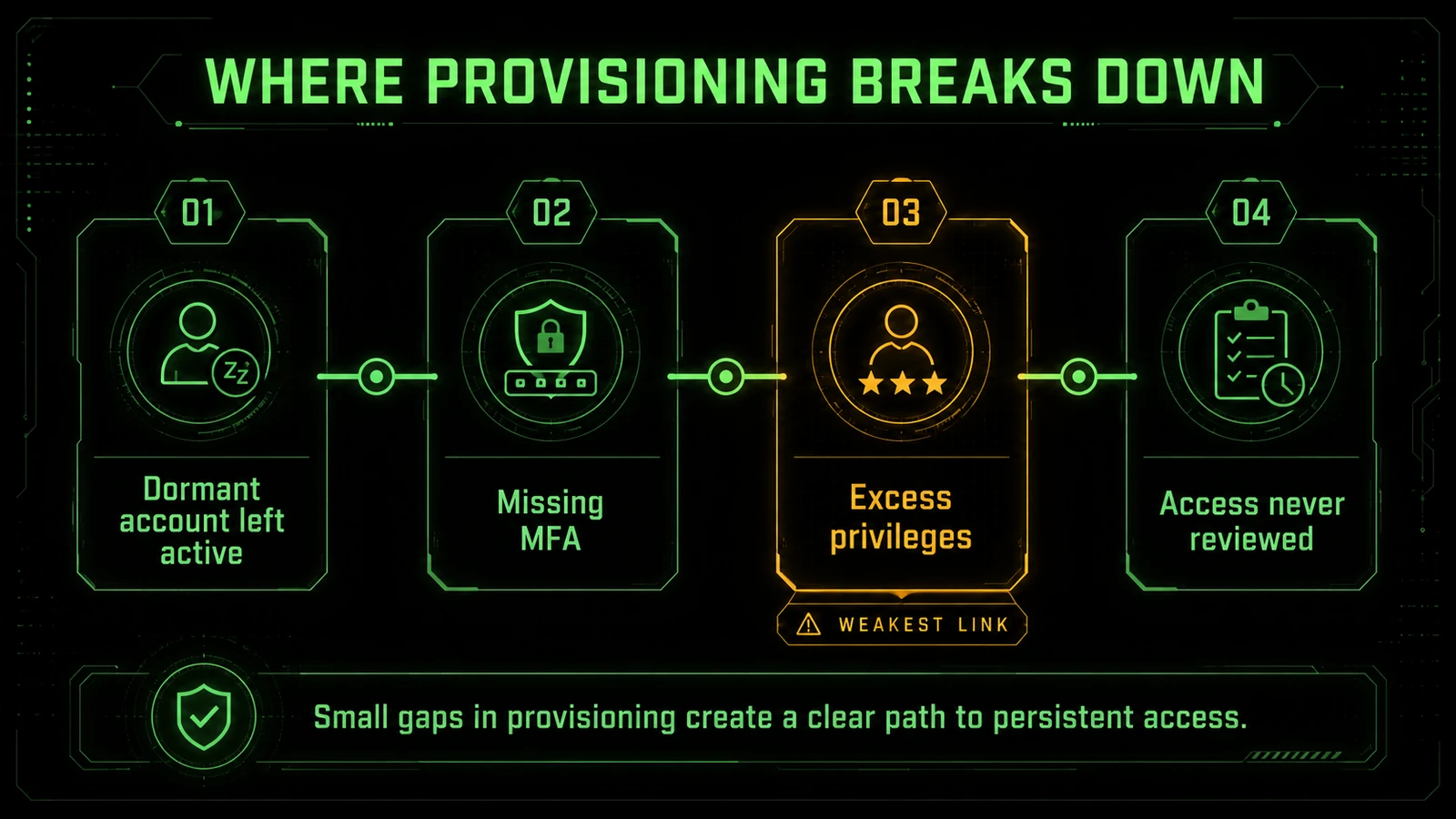 The four-step pattern behind most provisioning-based breaches — and why excess privilege, not the initial entry point, is consistently the weakest link.
Notice what the chain does not start with: a sophisticated exploit. It starts with an account that should have been deactivated and wasn't. Every subsequent step compounds that first failure — missing MFA makes the account easier to use if credentials leak, excess privilege makes it more valuable once accessed, and the absence of review means none of it gets caught until it's an incident rather than a finding. Breaking the chain early, at step one, is disproportionately more effective than trying to catch it at step four.
The provisioning gaps attackers exploit most often
Four specific gaps recur across the incidents worth learning from, and they map directly to failures in the identity lifecycle rather than failures in any single security product.
Orphaned accounts. These are credentials with no active person or business process behind them — a departed employee whose account was never disabled, a contractor account left open after the engagement ended, a test account created for a project that shipped a year ago. Orphaned accounts are attractive precisely because they're unremarkable: no one is watching for unusual behavior on an account no one remembers exists.
Standing privilege. Access that persists whether or not it's actively being used is a standing liability. An administrator with permanent elevated rights, rather than rights granted for the duration of a specific task, is a bigger target than one whose elevation expires automatically — compromise the identity and the attacker inherits everything it's permanently entitled to, immediately.
Access not revoked after role changes. Entitlements accumulate as people move between roles, join projects, and pick up one-off grants that outlive their purpose. Nobody's job is explicitly "remove what the old role needed" the way onboarding's job is "grant what the new role needs" — so access creep is the default outcome absent a deliberate control to counter it.
Unmanaged service accounts. Non-human identities — API keys, automation credentials, integration accounts — routinely carry broad access with no owner tracking their credential hygiene, rotation schedule, or continued business need. A service account is a particularly efficient target because it has no behavioral baseline: there's no person to notice it's acting strangely.
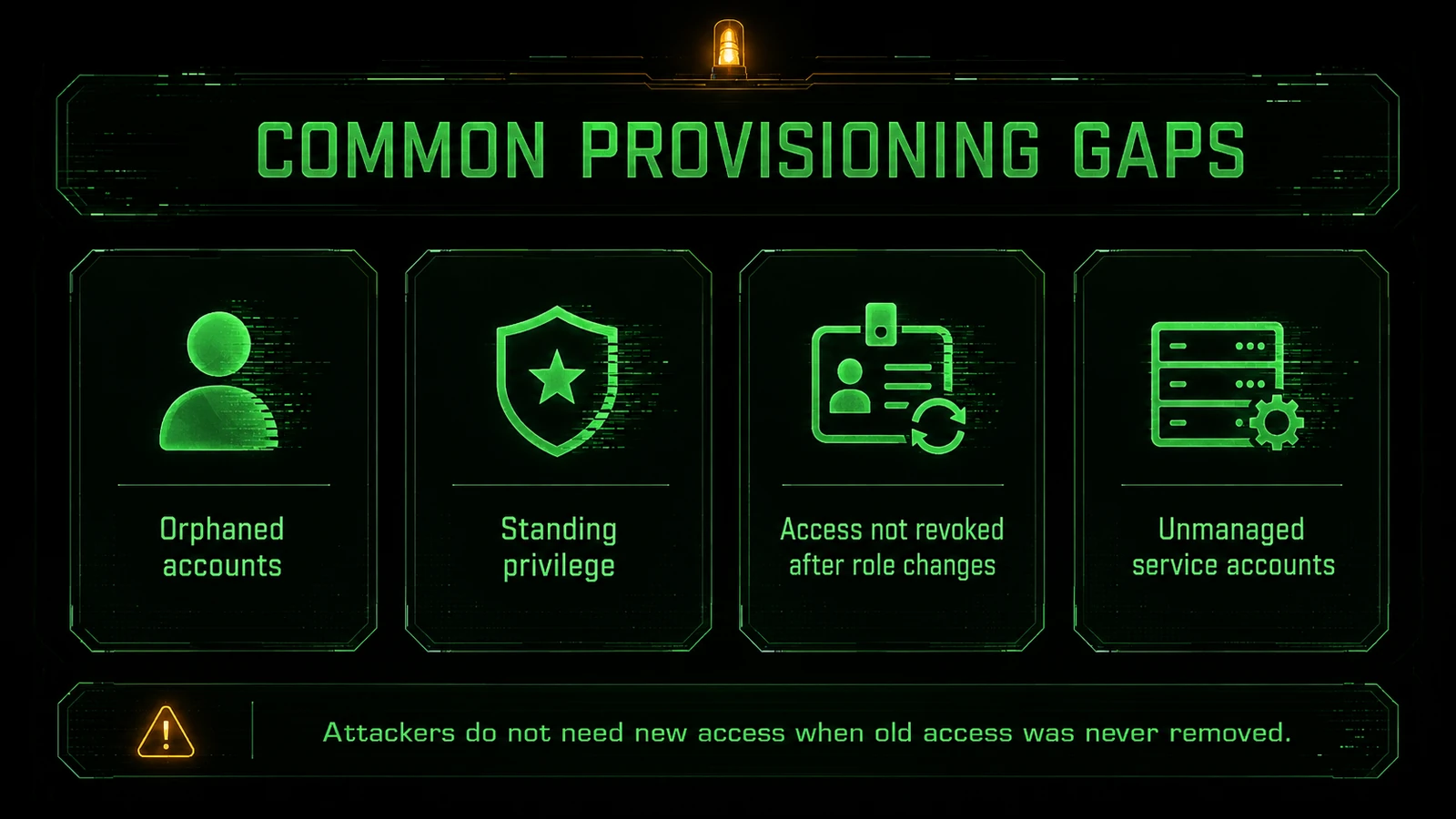 The four provisioning gaps that show up most consistently in real attacks — none of them require breaking anything, only finding what was never removed.
Orphaned accounts: the path of least resistance
Of the four, orphaned accounts deserve a closer look because they represent the purest version of the attacker's advantage: zero technical effort for maximum access. An attacker doesn't need to phish, brute-force, or exploit anything if they can obtain or guess credentials for an account that's still active but unmonitored. Credential-stuffing attacks — reusing username/password pairs leaked from unrelated breaches — are effective against orphaned accounts specifically because a departed employee's password from an old breach still works if the account itself was never disabled.
The operational root cause is almost always a broken or missing trigger. Deprovisioning that depends on IT noticing a termination email, or a manager remembering to file a ticket, has a human failure point built into every single removal. Deprovisioning that triggers automatically off the HRIS record — the authoritative source of truth for employment status — removes that failure point entirely, because the account gets disabled the same day the employment status changes, with no ticket, no queue, and no window for a departed employee's credentials to sit active and unmonitored.
Standing privilege turns one compromised account into an incident
The reason standing privilege gets called out as the weakest link in the attack chain is that it's a multiplier, not an entry point on its own. A dormant, low-privilege account that gets compromised is a contained problem. The same compromise against an account that carries standing administrative rights, unrestricted database access, or broad cross-system entitlements turns a single credential failure into full domain compromise.
The architectural fix is a shift from access that exists permanently to access that's provisioned for a defined window and expires automatically — zero standing privilege. Our Just-in-Time Access and Zero Standing Privilege piece covers the reference architecture for this pattern in depth: nobody holds permanent privileged access, and elevated rights are granted at the moment of need and revoked automatically when the task completes. Applied consistently, it shrinks the window in which a compromised privileged identity is actually privileged, which is the exact window an attacker depends on.
Why deprovisioning is where the model actually fails
Provisioning — granting new access — has a natural trigger and a motivated owner: a new hire needs access to do their job, so IT and the hiring manager have an immediate incentive to get it right and get it fast. Deprovisioning has neither. Removing access produces no visible benefit to anyone in the short term, has no natural champion, and depends on someone noticing an event (a termination, a role change, a contract end) and acting on it through a process that's frequently manual and ticket-driven.
That asymmetry is exactly why access review programs discover far more over-provisioned and stale accounts than under-provisioned ones. Ticket-driven access, more broadly, tends to bypass governance discipline in the same way shadow IT does — a request comes in through a channel outside the formal IGA workflow, gets approved quickly to unblock someone's work, and never gets tracked for removal the way it would if it had gone through a governed provisioning path. Our Shadow IT Provisioning piece covers how much enterprise access actually flows through these ungoverned side channels rather than the platform of record, and it's the same structural gap that leaves deprovisioning incomplete: access nobody tracked in a governed system is access nobody remembers to remove.
Standardized, automated protocols close part of this gap by making deprovisioning a system-to-system event rather than a manual step. The SCIM Provisioning piece covers how the same RESTful standard that automates account creation also automates the deprovisioning call to downstream applications — when SCIM is wired correctly, a status change in the source of truth propagates as a real-time deactivation to every connected app, instead of requiring someone to remember which dozen systems a departing employee had access to.
Legacy and non-human identity gaps deserve separate attention
Two categories of access consistently fall outside modern provisioning security programs, and both are disproportionately represented in successful provisioning-gap attacks. The first is legacy and mainframe access, where account lifecycle is often managed by a separate team on a separate cadence from the modern IGA platform, and where deprovisioning delays are common precisely because the system predates the automation built for everything else. Our RACF Provisioning piece covers how tying mainframe account lifecycle directly to HR events closes that specific gap rather than leaving it as a manual exception process.
The second is non-human identity — service accounts, automation credentials, and increasingly AI agents acting with delegated access. Broader provisioning automation strategies increasingly need to treat machine identities with the same lifecycle discipline as human ones; the AI-Driven Provisioning piece covers how policy-based, signal-driven provisioning extends to these identities specifically, which matters because a non-human identity with standing privilege and no owner is functionally the same exposure as an orphaned human account, just with a longer average dwell time before anyone notices.
It's also worth being precise about what MFA does and doesn't cover here. Strong, phishing-resistant authentication makes it materially harder for an attacker to obtain a valid credential in the first place — but it says nothing about an account that's already valid and already unmonitored. The CGov MFA vs IGA piece on ICC covers this exact boundary: authentication controls and authorization/lifecycle controls solve different halves of the problem, and provisioning-gap attacks live squarely in the half MFA doesn't reach.
Closing the gaps that actually get exploited
The controls that close the exposure covered above aren't exotic — they're the same four patterns that show up in every serious identity governance program, applied consistently rather than as a one-time cleanup project. Automated deprovisioning ties account removal to the authoritative HR event instead of a manual ticket, closing the dormant-account window at its source. Least privilege scopes every identity, human or machine, to what its current role actually requires, so a compromised account has less to inherit. Just-in-time access replaces standing privilege with access that's granted for a task and expires automatically. Continuous access review catches the drift that accumulates between those point-in-time controls — the entitlements a role change or a stale project grant left behind.
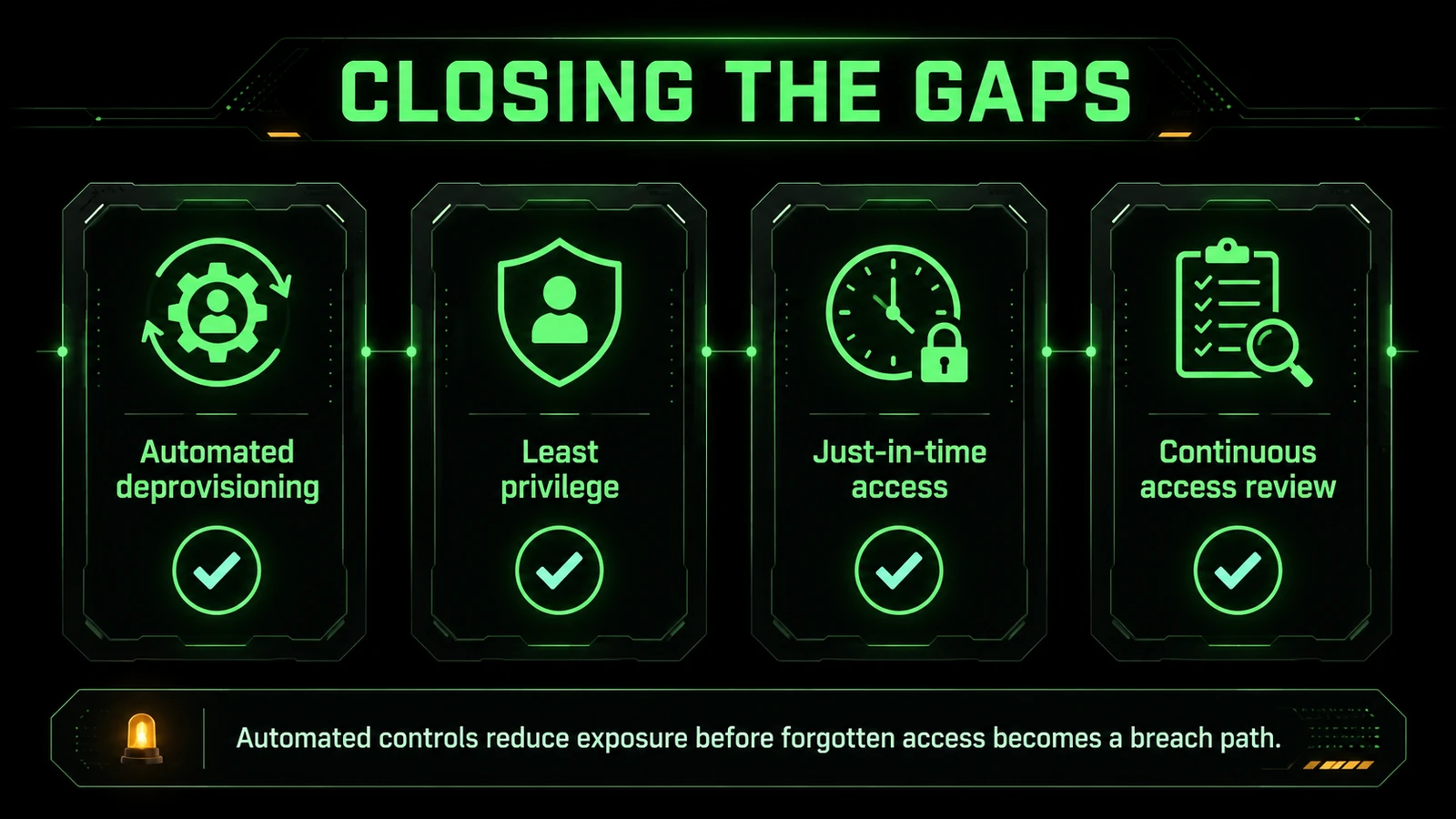 The four controls that map directly onto the gaps attackers exploit — deprovisioning, privilege scope, access duration, and review cadence, addressed as a system rather than a one-time audit.
None of these four controls is effective in isolation. Automated deprovisioning without least privilege still leaves standing access for however long an account stays active. Least privilege without continuous review decays back into access creep the moment roles start changing. The pattern only holds when all four run together as platform behavior, continuously, rather than as separate initiatives owned by different teams on different schedules.
What Avatier ships toward this pattern
Avatier Identity Anywhere implements these four controls as automated platform behavior rather than policy documents that depend on manual follow-through. Deprovisioning runs off the same HRIS event stream that drives onboarding — a termination or role-change event triggers revocation the same day across connected systems, rather than waiting on a ticket to reach the front of a queue. Access requests are scoped against role-based birthright entitlements tied to current role of record, so grants reflect what the role needs now rather than accumulating every entitlement a person has ever held.
Just-in-time elevation replaces standing privileged access for administrative and sensitive workflows, with time-bound grants that expire automatically when the task window closes. Access certification campaigns route to resource owners on a risk-weighted schedule, and a "no" answer on a certification triggers automated revocation instead of another ticket that can stall in a queue. Service accounts and other non-human identities are brought under the same ownership and review discipline as human accounts, closing the specific blind spot where unmanaged machine credentials tend to persist longest.
The Avatier Trust Center publishes the compliance posture behind the platform: SOC 2 Type II audited with zero exceptions noted, ISO/IEC 27001:2022 certified, PCI DSS v4.0.1 compliant, CSA STAR Level 1 attestation, NIST 800-53 Rev. 5 aligned, and a CISA Secure-by-Design Pledge signatory.
ABOUT THE AUTHOR

More from IAM & Identity Governance

Insider Threat Red Flags: Indicators to Watch in 2026
Malicious, negligent, and compromised insiders each leave distinct behavioral and access-pattern red flags — and identity governance, not perimeter security, is what actually contains the resulting blast radius.
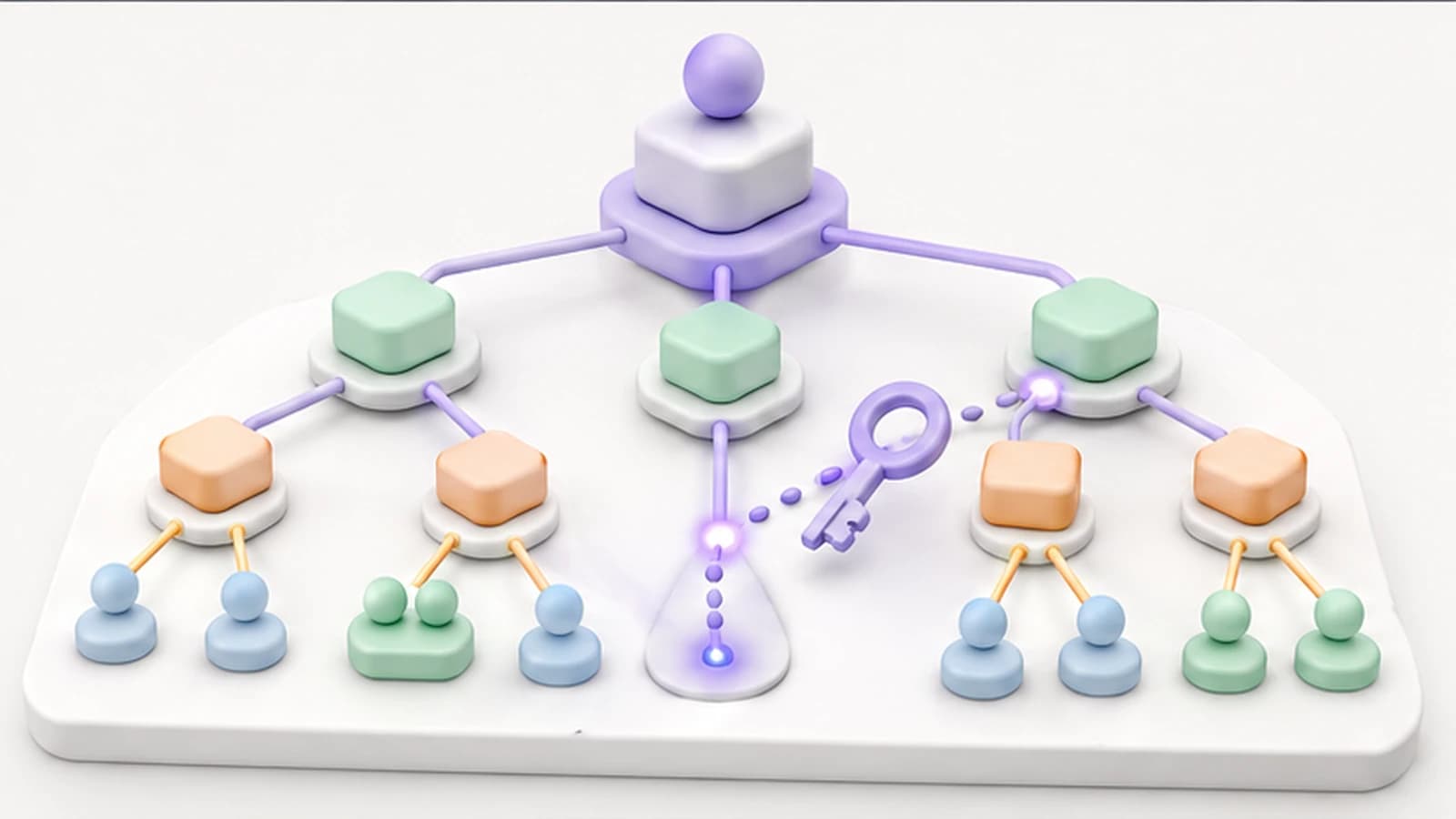
LDAP Implementation for Identity Management: The 2026 Reference
LDAP is the read-optimized directory protocol still sitting under most enterprise IAM stacks — here is how its structure, bind and search, LDAPS, replication, and schema actually work in production.

Identity and Access Management for Enterprise Security (2026)
Identity and access management is the control layer that decides who and what can reach enterprise systems — and in 2026 it functions as the security program itself, not a supporting utility underneath it.