Automating RACF Provisioning from HR Events: A 2026 Guide
RACF user provisioning becomes reliable when create, entitle, and deprovision actions trigger directly off HR events instead of tickets — here's how that pattern actually works on the mainframe.

RACF user provisioning becomes reliable when create, entitle, and deprovision actions trigger directly off HR events instead of tickets — here's how that pattern actually works on the mainframe.
- This piece is narrowly scoped to one pattern: driving RACF account create, entitlement, and deprovision directly off HR events (new hire, transfer, termination) instead of manual TSO commands or ticket-driven requests. It is not a RACF primer or a RACF-versus-ACF2 comparison — those live elsewhere on this blog.
- "Automated" in a RACF context rarely means a single real-time API call. It usually means a layered combination of scheduled batch connectors, event-triggered jobs fired off an HRIS feed, and periodic reconciliation sweeps that catch what the event stream missed — because RACF predates SCIM and REST by decades and most shops integrate through what the platform actually exposes.
- Ticket-driven provisioning fails in three specific, recurring ways on mainframe estates: orphaned accounts that outlive the employee, termination lag between an HR system update and the RACF REVOKE command, and entitlement drift where access accumulates from role changes but is never pruned back down.
- HRIS-to-RACF integration is a data-quality problem before it's an automation problem — the HR system has to be the authoritative, timely source of truth for employment status, and the mapping from job code to RACF group has to be maintained deliberately, or automation just enforces bad data faster.
- Automation raises the floor on provisioning speed and consistency, but it does not fix a bad role model, does not replace periodic access certification, and mainframe environments still need a human in the loop for the exception cases — a contractor extension, a break-glass access grant, an ambiguous transfer — that a rules engine shouldn't be trusted to resolve alone.
RACF user provisioning automation means one specific thing in production: the create, entitle, and deprovision actions on a mainframe user ID are triggered by an HR event — a new-hire record activating, a transfer changing a job code, a termination date landing in the system of record — instead of by a manually filed ticket or a hand-typed TSO command. The pattern replaces the gap between "HR knows someone left" and "RACF actually revoked their access" with a pipeline that closes that gap automatically, and it replaces the inconsistency of manual account creation with a repeatable, auditable sequence tied to the same event every time.
This is the 2026 update of Avatier's earlier piece on RACF user provisioning automation. The scope here is deliberately narrower than the original: this blog already covers RACF fundamentals and the RACF-versus-ACF2 decision in dedicated posts, so this update strips out the general primer material and stays entirely inside the HR-event-driven lifecycle pattern — what triggers it, what "automated" concretely means when the target system is RACF, and where the pattern's limits actually are.
The lifecycle pattern: create, entitle, deprovision
Every RACF account lifecycle reduces to three transitions, and the pattern that matters is which event triggers each one.
Create happens when an HR system activates a new employment record with a start date and a role. In a manual shop, this becomes a ticket that sits in a queue until an administrator has time to run ADDUSER, connect the ID to the right groups, and set initial password or PassTicket state. In an event-driven shop, the HR activation itself is the trigger — the identity platform picks up the new-hire event, resolves the role to a defined RACF group set, and issues the account creation sequence without a person translating "Alex Carter, Finance, Analyst" into RACF syntax by hand.
Entitle is the step most manual processes get wrong first, because it's rarely a single event. A transfer, a promotion, a department change, or a project assignment all change what a RACF ID should be connected to, and each of those is a distinct HR event that should independently trigger a corresponding entitlement change — adding the new group, and just as importantly, removing the old one. This is where the pattern diverges most sharply from ticket-driven provisioning: a ticket usually asks for an addition, rarely a removal, and the removal is the half of entitlement management that manual processes systematically skip.
Deprovision is triggered by a termination date, and it's the transition where automation delivers the most measurable risk reduction, because the cost of delay compounds every day the account stays live. The image below shows the pattern end to end: an HR or identity provider event creates the RACF user with the correct profile segments, connects it to the groups its role requires, and — on the same event path, not a separate one — disables the account, strips its group connections, and revokes access the moment a leave event fires.
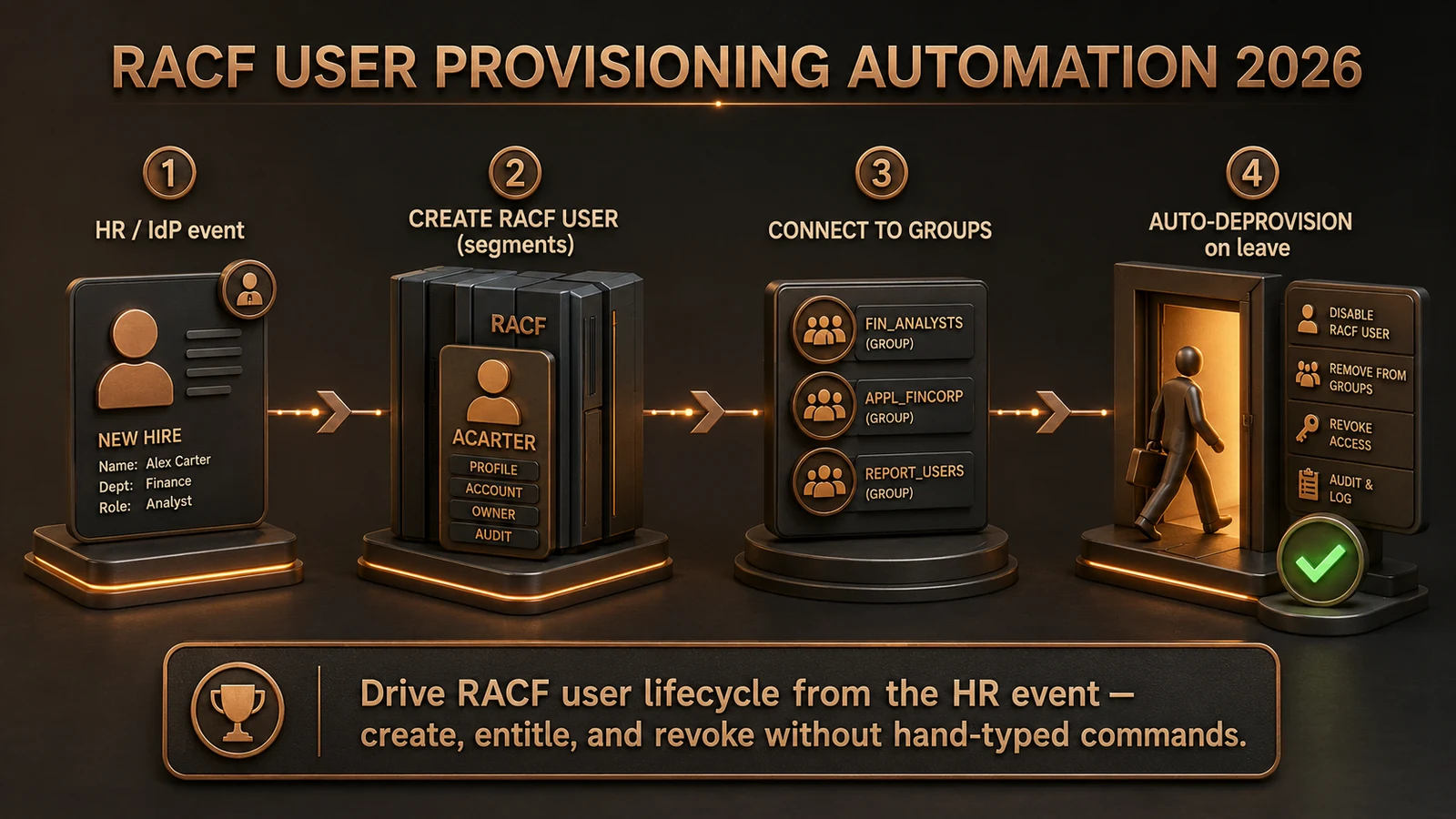 The same event path runs both directions: the HR record that creates access is the same record that revokes it — no separate ticket required on either end.
The pattern only works if all three transitions are wired to the same event source. A shop that automates create and entitle but leaves deprovision as a manual, ticket-triggered step has automated the easy half of the lifecycle and left the highest-risk half exactly where it was.
How an HRIS feed actually reaches RACF
RACF was never built to consume an HR feed directly, so every implementation of this pattern has an identity platform sitting between the HRIS and the mainframe, translating one into the other. The mechanics matter because they determine how much lag the pipeline introduces and where it can silently break.
The HRIS — Workday, SuccessFactors, or an equivalent system of record — publishes employee lifecycle events, either as a change feed a connector polls on a schedule or, in more modern deployments, as near-real-time events pushed to the identity platform as they're recorded. Our HRIS-driven identity lifecycle piece covers that ingestion layer in depth; this piece picks up from the point where the identity platform already has a clean, current employee record and has to decide what that record means for a specific RACF user ID.
That translation step is where role-to-entitlement mapping lives: a defined table or policy that says a Finance Analyst job code maps to a specific set of RACF groups, dataset profiles, and resource class permissions. This mapping is maintained deliberately — it's a governance artifact, not a one-time setup task — because an HRIS field renamed or a new job code introduced without a corresponding RACF mapping update means new hires in that role either get no access or get provisioned against a stale, incorrect mapping. The identity platform is only as good as this table; a perfectly reliable event pipeline feeding an outdated mapping table produces confidently wrong access every time.
Once the mapping resolves, the platform issues the actual RACF commands — through a mainframe connector, an automation library, or a batch job submitted to the LPAR — to execute the create, connect, or revoke. This is the step that has no SCIM equivalent to lean on, because RACF exposes a command interface and a database, not a REST endpoint, so the connector logic is purpose-built rather than a standard client against a standard protocol.
The failure modes this pattern replaces
The reason this pattern exists is that ticket-driven, manually executed RACF provisioning fails in specific, recurring, and well-documented ways once an organization's mainframe user population grows past what a small admin team can track by memory.
Orphaned accounts are RACF user IDs that remain active after the person they belonged to has left, been transferred elsewhere, or never should have had standing access in the first place. They accumulate because account creation is easy to remember — someone needs access to start their job — and account removal has no equivalent forcing function. A termination doesn't automatically generate a RACF ticket; it generates an HR event that has to be manually routed to whoever owns mainframe access, and that routing step is exactly where orphaned accounts are born.
Termination lag is the measurable gap between the date HR records an exit and the date the RACF account is actually revoked. In a ticket-driven process, that gap is the sum of every manual handoff in between: HR processes the termination, someone notices and files a ticket, the ticket sits in a queue, an administrator with RACF authority eventually executes the REVOKE. Each handoff adds hours or days, and every hour the account stays active after employment ends is exposure with no corresponding business justification.
Entitlement drift is the slow accumulation of access a RACF ID was never supposed to keep. It happens because entitlement changes driven by transfers and role changes are almost always additive in practice — a new group connection gets added for the new role, and the old connection is left in place because removing it wasn't part of anyone's checklist. Multiply that across a multi-year tenure with several role changes and the resulting account has a footprint that reflects the person's entire employment history rather than their current job.
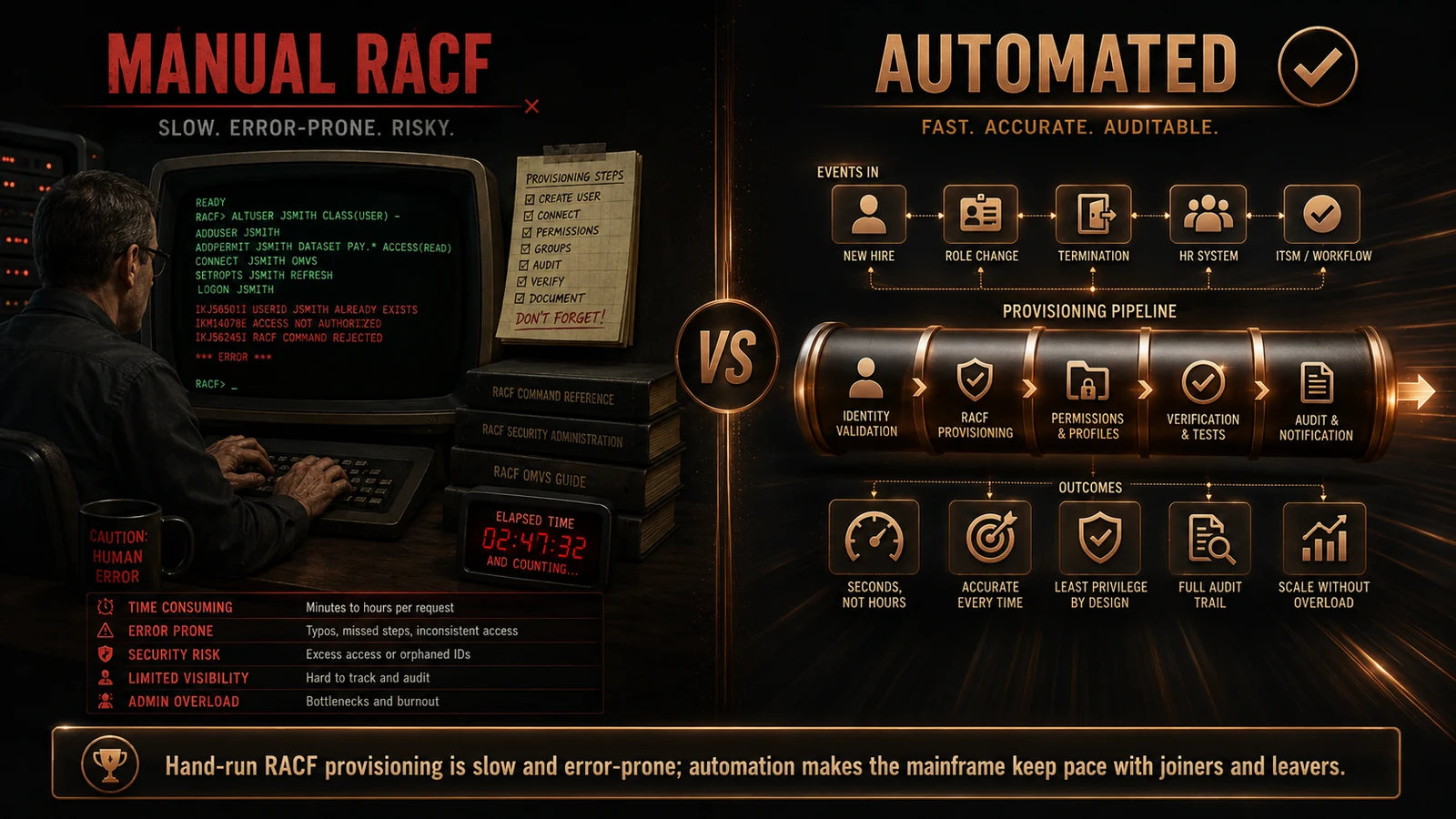 Same underlying task, two different failure surfaces: manual provisioning fails through missed steps and delay, automated provisioning fails through bad mapping data — which is why the mapping table needs its own governance.
All three failure modes share a root cause: they're not RACF problems, they're pipeline problems. RACF executes exactly what it's told with precision; the gap is entirely in how reliably and how quickly the "what to tell it" gets generated from an HR change.
What "automated" concretely means for RACF
It's worth being precise about this because "automation" gets used loosely enough in vendor material to mean almost anything. For a RACF environment specifically, automation is a layered combination of three mechanisms, not one.
Batch connectors execute a defined set of RACF commands generated from upstream data, submitted as a job rather than typed interactively. This is the oldest and most mainframe-native form of the pattern — RACF has supported command automation via batch and REXX scripting for decades, long before any modern identity platform existed, and most production implementations still route at least part of their provisioning through this layer because it's the most direct path to the RACF database.
Event triggers fire a provisioning action the moment a qualifying change appears in the HRIS feed, rather than waiting for the next scheduled run. This is the mechanism that closes termination lag specifically, because a scheduled-only approach means the fastest a termination can ever be actioned is "next scheduled run," which for a nightly batch means up to 24 hours of unnecessary exposure.
Scheduled reconciliation runs independently of any single event and compares the current state of RACF against the current state of the HR system of record, flagging or correcting mismatches. This is the backstop layer, and it exists because event pipelines fail silently — a connector outage, a malformed record, a mapping table gap — and a program that trusts event triggers alone with no periodic reconciliation has no way of knowing when the event path went quiet.
Mature RACF automation runs all three together: batch and event triggers for day-to-day provisioning speed, reconciliation as the safety net that catches what the event-driven path missed. A program built on only one of the three has a gap the other two exist specifically to close.
Governance and audit implications
Every RACF command issued through this pattern is an audit event, and that's a meaningfully different audit posture than a manually executed change. A manual provisioning action is auditable only to the extent someone documented it — the ticket, the change record, the administrator's notes. An automated action is auditable by construction: the triggering HR event, the resolved role-to-entitlement mapping, and the resulting RACF commands form a continuous, timestamped chain that an auditor can trace without depending on anyone's documentation discipline.
This matters most for two governance questions auditors consistently ask about mainframe access: can you demonstrate that access was granted based on a documented business need, and can you demonstrate that access was removed promptly when that need ended. Automated, event-triggered provisioning answers both with the pipeline's own logs rather than a reconstructed narrative. Segregation of duties is enforced the same way — the policy engine that resolves an HR event into a RACF group connection can encode which role combinations are mutually exclusive, catching a conflict before the PERMIT is issued rather than during a periodic review months later.
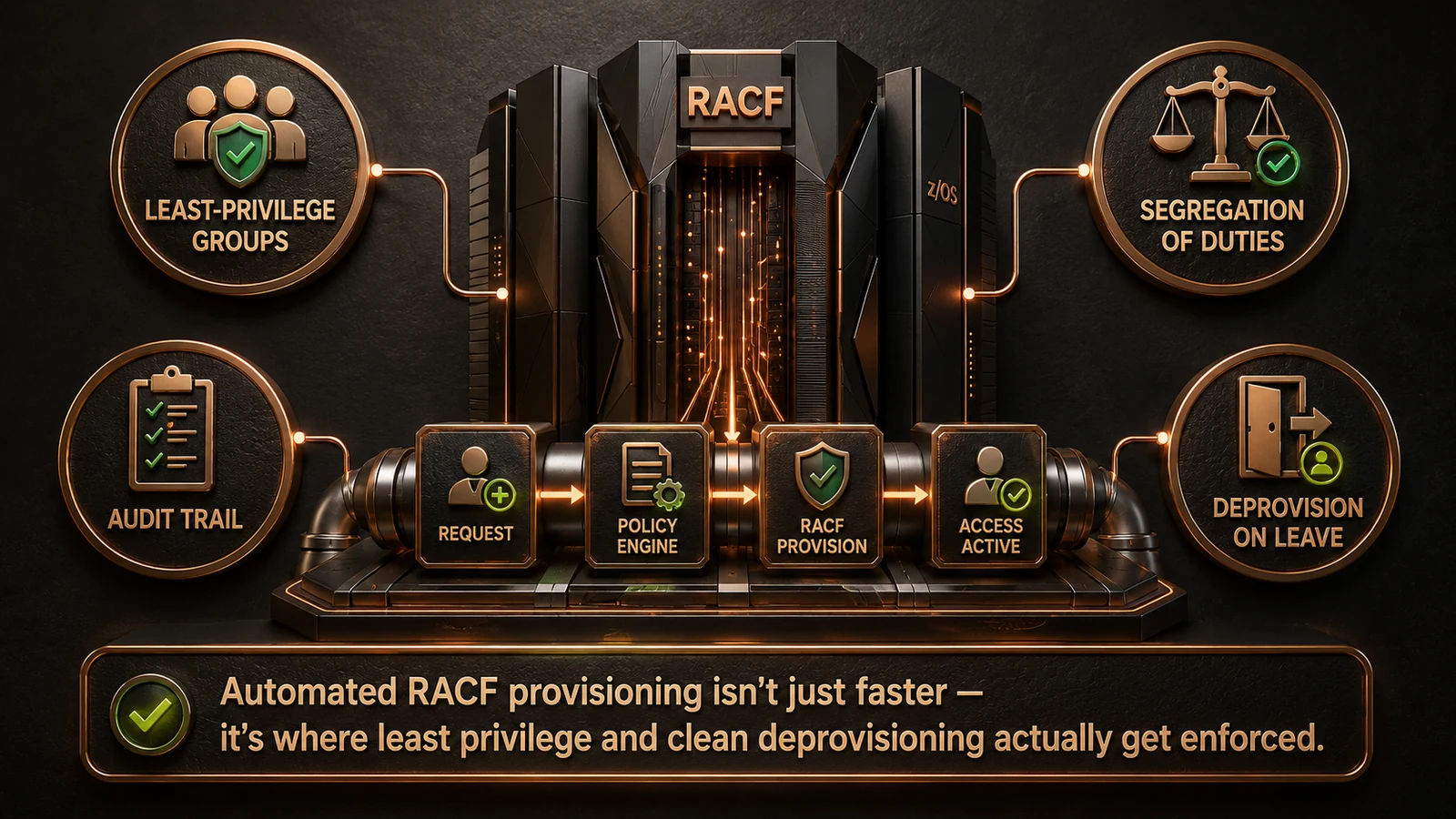 Least privilege and clean deprovisioning aren't separate initiatives from provisioning automation — they're what the same pipeline enforces by default when it's built correctly.
None of this replaces the audit trail RACF itself already produces through SMF logging — automation adds a second, complementary layer: not just a record of what changed in RACF, but a record of why, traced back to the HR event that justified it.
Implementation patterns that hold up in production
Organizations that get this pattern working reliably tend to converge on a similar sequencing, regardless of which identity platform or mainframe connector they use.
Start with deprovisioning, not creation. It's counterintuitive because creation is the more visible, more frequently requested transition, but deprovisioning is where the risk concentrates and where automation delivers the fastest measurable improvement — closing termination lag from days to minutes changes the exposure profile immediately, while account creation being slightly slower is an inconvenience, not a security gap.
Build the role-to-entitlement mapping as a governed artifact with an owner, not a one-time migration task. The mapping table is the single point where a correct event pipeline can still produce wrong access, so it needs the same change-control discipline as the RACF groups it maps to — a new job code or a restructured department should trigger a mapping review, not get silently absorbed by a "closest match" default.
Run event-triggered and scheduled reconciliation in parallel from day one rather than treating reconciliation as a later maturity step. A program that ships event triggers alone and adds reconciliation only after an incident has already accepted a period of unmonitored risk it didn't need to accept.
Keep a defined, scoped exception path for access that genuinely doesn't fit the standard lifecycle — contractor extensions, break-glass grants, cross-functional project access. Trying to force every access request through the automated lifecycle engine either produces overly broad rules to accommodate edge cases or a rules engine nobody trusts enough to rely on.
What Avatier ships toward this pattern
Avatier Identity Anywhere's contribution to this pattern is the connective layer between the HRIS and the mainframe: ingesting joiner-mover-leaver events from systems like Workday and SuccessFactors, resolving them against a governed role-to-entitlement mapping, and issuing the corresponding RACF provisioning, entitlement, and revocation actions through a mainframe connector — instead of an administrator manually translating an HR change into TSO commands. Deprovisioning runs on the identical event path as provisioning, which is the specific design choice that closes termination lag: the same HR record that triggers account creation on day one triggers account revocation on the last day, with no separate ticket required in either direction. Scheduled reconciliation runs alongside the event-triggered path as a backstop, comparing current RACF state against the current HR system of record and surfacing mismatches the event pipeline might have missed.
The platform doesn't position this as a replacement for RACF's own security model — RACF still owns the actual access decision and audit record. What Avatier adds is the reliable, auditable bridge from a distributed HR system of record to a mainframe access-control system that was never designed to consume one directly. The Avatier Trust Center publishes the compliance posture behind the platform: SOC 2 Type II audited with zero exceptions noted, ISO/IEC 27001:2022 certified, PCI DSS v4.0.1 compliant, CSA STAR Level 1 attestation, NIST 800-53 Rev. 5 aligned, and a CISA Secure-by-Design Pledge signatory.
What this pattern does not solve
An honest account of this pattern has to be clear about its edges, because HR-event-driven automation gets oversold as a complete access-governance solution when it's actually one specific, valuable layer inside a larger discipline.
It does not fix a bad role model. If the role-to-entitlement mapping grants a Finance Analyst broader access than the role actually needs, automating that mapping just delivers the over-provisioned access faster and more consistently. The pattern enforces whatever mapping it's given; it has no way to independently judge whether the mapping itself reflects least privilege. Readers building or auditing that mapping from scratch should start with the fundamentals in our RACF beginner's guide, and readers reconsidering RACF's role in a broader zero-trust architecture should see our mainframe identity modernization piece.
It does not replace periodic access review. Event-driven provisioning keeps an account's baseline synchronized with the current HR record. It does not independently notice that an entitlement granted three role changes ago should have been removed two role changes ago — that's exactly the accumulated-drift problem a periodic, human-adjudicated certification exists to catch, and automating provisioning without also running certification just means the drift accumulates on top of a faster-moving baseline.
It still needs human oversight for exceptions. Contractor extensions, break-glass grants during an incident, cross-functional project access that doesn't map cleanly to a single role — none of these fit a rules engine built around standard lifecycle events, and trying to force them in produces either dangerously broad default rules or a system administrators route around anyway. The pattern's value is narrowing the ticket queue down to genuine exceptions, not eliminating human judgment from mainframe access decisions entirely.
The programs that get durable value from this pattern treat it as what it is: the layer that keeps routine, high-volume, predictable lifecycle events off a ticket queue and out of manual TSO sessions, freeing the humans in the loop to focus on the access decisions that actually require judgment.
ABOUT THE AUTHOR

More from RACF & Mainframe
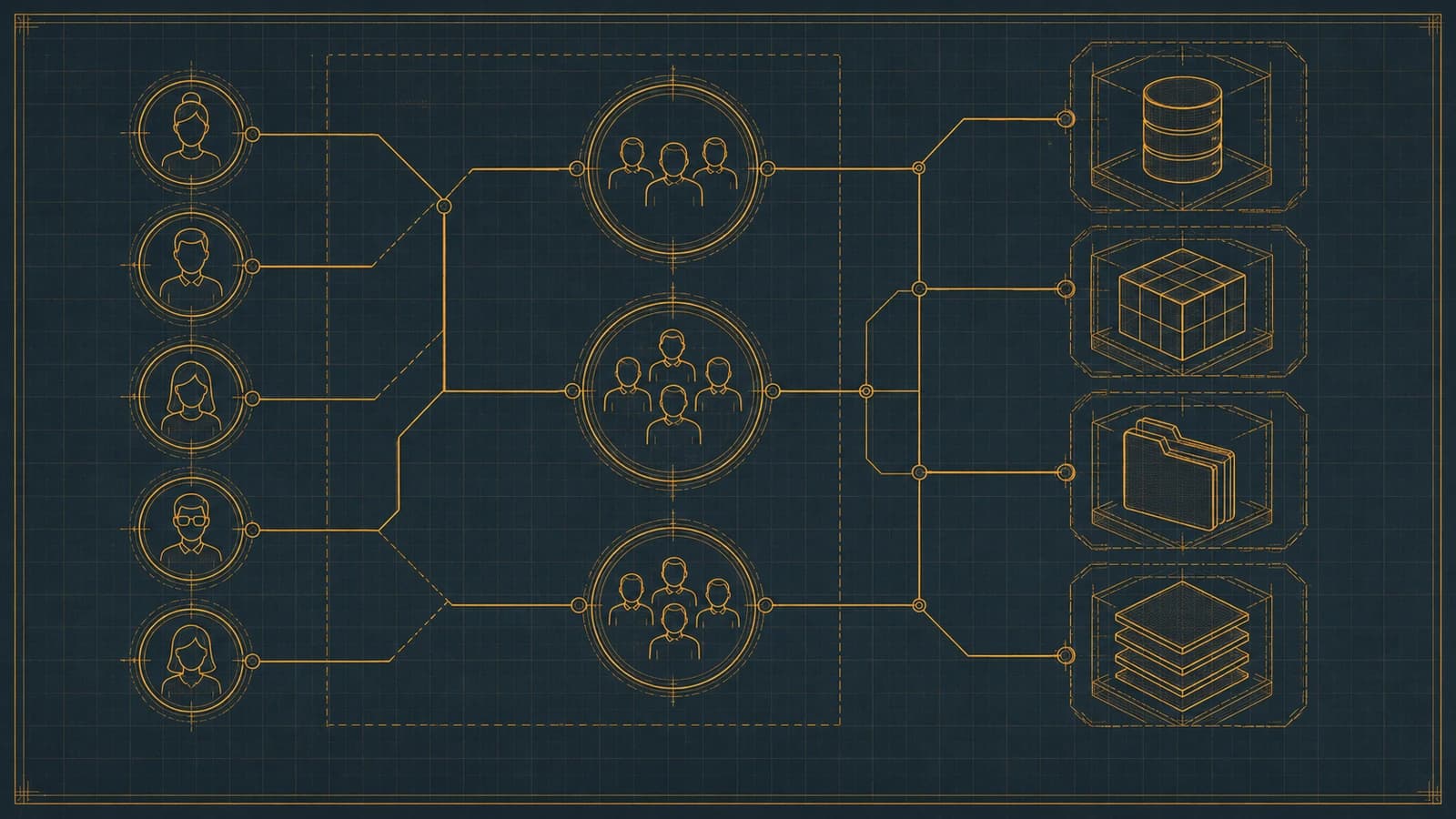
Mastering RACF User-Group Assignments & Permissions 2026
RACF grants access through groups, not users: ADDGROUP builds it, CONNECT enrolls the user, PERMIT binds it to a resource. How assignments, nested membership, and access decisions resolve in 2026.

RACF Password Complexity & Expiration Rules 2026 (SETROPTS)
RACF enforces password complexity, expiration, history, and lockout through SETROPTS PASSWORD suboperands — RULEn, INTERVAL, HISTORY, and REVOKE. The 2026 reference on the exact syntax, why PCI-DSS and SOX still mandate it even as NIST 800-63B moves the industry away from rotation and composition rules, and where RACF-level enforcement alone stops being enough.
Troubleshooting AS/400 and iSeries Access Issues: When Reset Helps and When It Doesn't 2026
iSeries (IBM i, AS/400) access issues concentrate in six diagnostic categories — password expiry, disabled user profiles, object authority, special authority, QSECOFR operations, and federation-integration friction. The 2026 reference on the diagnostic pattern for each, when reset is the right answer, and how federation-first architecture reduces recurrence.