RACF Password Complexity & Expiration Rules 2026 (SETROPTS)
RACF enforces password complexity, expiration, history, and lockout through SETROPTS PASSWORD suboperands — RULEn, INTERVAL, HISTORY, and REVOKE. The 2026 reference on the exact syntax, why PCI-DSS and SOX still mandate it even as NIST 800-63B moves the industry away from rotation and composition rules, and where RACF-level enforcement alone stops being enough.

RACF enforces password complexity, expiration, history, and lockout through SETROPTS PASSWORD suboperands — RULEn, INTERVAL, HISTORY, and REVOKE. The 2026 reference on the exact syntax, why PCI-DSS and SOX still mandate it even as NIST 800-63B moves the industry away from rotation and composition rules, and where RACF-level enforcement alone stops being enough.
- RACF enforces password complexity, expiration, history depth, and account lockout through four SETROPTS PASSWORD suboperands: RULEn (and the related MIXEDCASE/SPECIALCHARS switches) for composition, INTERVAL for expiration, HISTORY for reuse prevention, and REVOKE for lockout after repeated failed attempts. All four are configured at the SETROPTS level, so they apply system-wide rather than per application.
- z/OS RACF has supported mixed-case and special-character passwords since the MIXEDCASE and SPECIALCHARS SETROPTS suboperands were introduced in later z/OS releases — earlier RACF environments were effectively uppercase-only and alphanumeric, which is a meaningful gap if you're auditing an older LPAR against a 2026 compliance checklist.
- NIST 800-63B Rev. 4 tells the industry to stop forcing periodic rotation and character-composition rules on memorized secrets. That guidance is aimed at general enterprise authentication, not at the compliance frameworks — PCI-DSS, SOX-driven internal controls, banking regulator exam requirements — that still explicitly reference password complexity and expiration as controls examiners check for on regulated mainframe systems. The two positions coexist uncomfortably, and RACF administrators are the ones who have to reconcile them in practice.
- SETROPTS-level enforcement is necessary but not sufficient. It doesn't stop the same person from reusing a RACF-compliant password on a distributed system with no complexity rules, doesn't replace MFA or passwordless authentication at the RACF logon prompt, and the operational cost of forced rotation — help desk reset volume, written-down passwords — is real and worth weighing against what rotation actually buys you at the RACF layer specifically.
- Modern IAM platforms increasingly manage RACF password policy as one governed target among many rather than a system an administrator configures once and audits by hand — the same policy engine that enforces breach-corpus screening on a cloud app can push equivalent discipline (within RACF's own constraints) to the mainframe, and can compose RACF password state with MFA at the access-broker layer instead of asking RACF's 1970s-era password model to carry security alone.
RACF enforces password complexity, expiration, history, and lockout rules through the SETROPTS PASSWORD command and its suboperands — RULEn for composition, INTERVAL for expiration, HISTORY for reuse prevention, and REVOKE for lockout after failed attempts — all configured system-wide at the RACF database level rather than per application. These four controls are the actual mechanism behind "strong password policy" on any z/OS mainframe, and getting the syntax and the interaction between them right is the difference between a policy that reads well in a compliance document and one that's actually enforced at logon.
This is the 2026 update of Avatier's earlier piece on mastering password security with RACF. The original covered the concepts — complexity, expiration, history — in general terms without SETROPTS syntax. This version replaces that with the actual command-level detail administrators need, adds the mixed-case and special-character history that changed what RACF passwords can even look like, and addresses something the original couldn't: the tension between where NIST guidance has moved on password policy generally and where mainframe compliance frameworks still stand on RACF specifically.
Setting complexity rules: SETROPTS PASSWORD(RULEn), MIXEDCASE, and SPECIALCHARS
Password complexity in RACF is governed by the RULEn family of SETROPTS PASSWORD suboperands — up to eight rule slots, RULE1 through RULE8, each defining a required password length and the character class allowed or required at each position within that length. A minimal example: SETROPTS PASSWORD(RULE1(LENGTH(8:8) MIXEDALL(1:8))) establishes an eight-character rule where every position accepts any mixed-case alphanumeric character. Administrators typically define several RULEn entries covering a range of acceptable lengths, so a password satisfying any one of the active rules is accepted — RACF evaluates the candidate password against the full set and passes it if it matches any defined rule.
Two switches gate what RULEn can actually require. SETROPTS PASSWORD(MIXEDCASE) enables mixed-case password support system-wide; without it, RULEn's case-related content types have nothing to enforce because RACF is still folding passwords to a single case internally. SETROPTS PASSWORD(SPECIALCHARS) permits special characters to appear in password rules at all — an LPAR without SPECIALCHARS enabled can specify the strictest length and alphanumeric rules imaginable and still never require a symbol, because the character class RULEn needs to reference isn't available to it.
This matters more than it looks like on paper: MIXEDCASE and SPECIALCHARS were both introduced well after RACF's original design, which assumed uppercase-only, alphanumeric, eight-character passwords — a holdover from mainframe terminal conventions that predate the idea of a password manager or even lowercase-sensitive login prompts. An LPAR running on an older configuration baseline can have RULEn definitions that look rigorous while the underlying character set is still the 1970s original. Checking whether MIXEDCASE and SPECIALCHARS are actually active is one of the first things worth verifying on any environment inherited rather than built fresh.
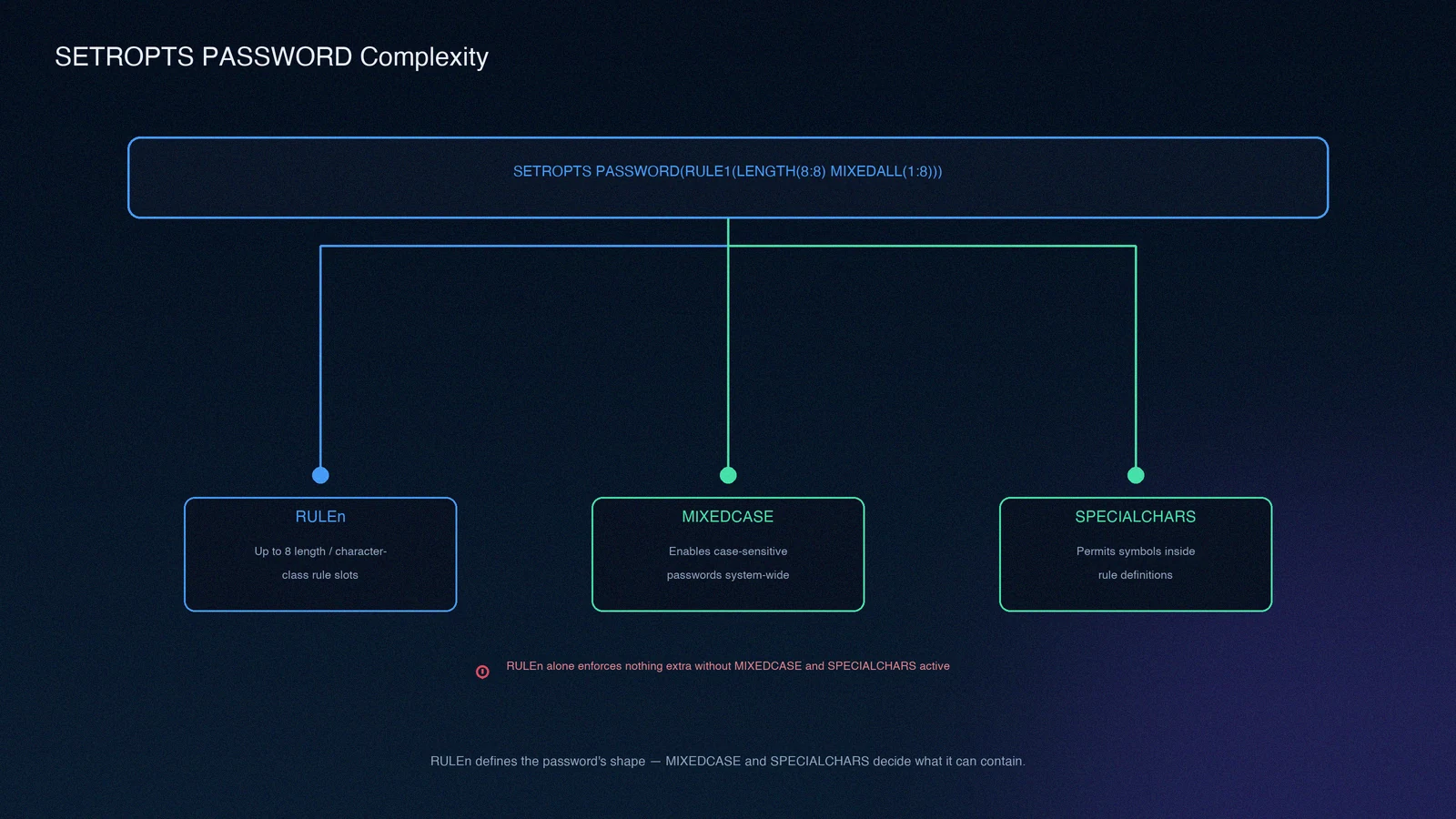 RULEn defines the shape of an acceptable password; MIXEDCASE and SPECIALCHARS decide whether that shape can include case and symbols at all.
Expiration intervals and grace-period warnings: SETROPTS PASSWORD(INTERVAL)
Expiration is set with SETROPTS PASSWORD(INTERVAL(nnn)), where nnn is the number of days — a value from 1 to 254 — a password stays valid before RACF forces a change at the next successful logon. RACF's system default, if INTERVAL isn't explicitly set, is 30 days. Most regulated environments configure something in the 60-to-90-day range as a baseline, with shorter intervals reserved for privileged IDs and longer intervals sometimes justified for service accounts where a forced expiration would break batch processing rather than improve security — a distinction that matters more than the raw interval number itself.
INTERVAL works alongside a warning mechanism that alerts a user before their password actually lapses, rather than letting expiration land as a surprise at logon that turns into a help-desk call. Getting the warning window right is an underrated lever on service-desk volume: too short a warning period and users still get surprised at the prompt; too long and the warning becomes background noise nobody reads. The expiration interval and the warning window should be treated as a pair configured together, not two settings someone sets once and never revisits as the user population's behavior around password changes becomes clear.
It's worth being precise about what INTERVAL actually protects against: it limits how long a compromised-but-undetected password remains usable, not the likelihood of compromise in the first place. A password captured by a keylogger or exposed in a phishing page is exploitable for the full length of the interval unless something else — anomaly detection, MFA, a breach-corpus check — catches it sooner. Expiration is a backstop against silent, undetected compromise, not a substitute for detecting compromise directly.
Blocking reuse and brute-force: SETROPTS PASSWORD(HISTORY) and PASSWORD(REVOKE)
History and revoke are the two counter-based controls that close the gaps complexity and expiration leave open on their own. SETROPTS PASSWORD(HISTORY(nnn)) tells RACF to retain a record of an account's previous nnn passwords and reject any new password matching one already on that list. Without HISTORY configured, INTERVAL forces a change but does nothing to stop a user from immediately re-entering the same password they just had — the expiration event happens, but nothing about the actual credential changes. Regulated environments commonly configure history depth in the low-to-mid twenties, deep enough that a user can't realistically cycle between two or three memorized passwords to defeat the intent of expiration.
SETROPTS PASSWORD(REVOKE(nnn)) sets the number of consecutive incorrect password attempts — up to 255 — RACF tolerates before it automatically revokes the user ID. This is RACF's native brute-force defense: an attacker guessing passwords against a known or guessed user ID hits a hard lockout after nnn failures instead of an unlimited attempt budget. The number has a real operational tradeoff attached to it. Set it too high and it barely functions as a control; set it too low and legitimate users locking themselves out through ordinary typos becomes a measurable share of service-desk ticket volume, which is exactly the kind of self-inflicted friction that makes password-related controls unpopular with the people who have to live with them daily.
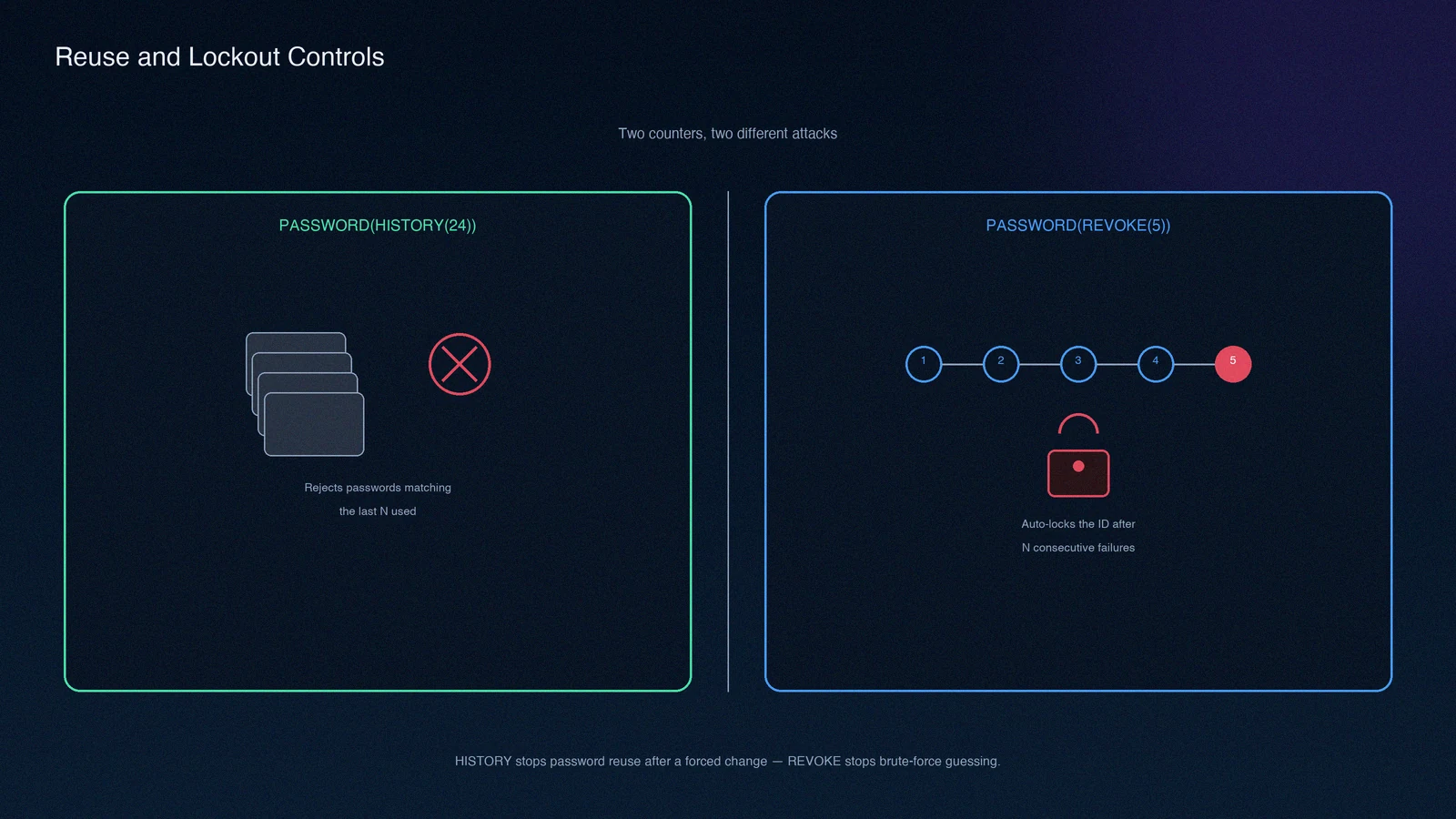 HISTORY stops password reuse after a forced change; REVOKE stops an attacker from guessing indefinitely. Neither substitutes for the other.
Why PCI-DSS, SOX, and banking regulators still mandate this layer
The frameworks that actually govern most RACF-protected systems haven't moved away from complexity and expiration requirements the way general authentication guidance has. PCI-DSS v4.0.1 requires strong authentication controls — including password complexity and change requirements — on any system that stores, processes, or transmits cardholder data, and mainframe LPARs running payment authorization, settlement, or card-data batch workloads are directly in scope. A PCI assessor reviewing a mainframe environment checks the live SETROPTS PASSWORD configuration, not a policy document describing what the organization intends to enforce.
SOX doesn't reference RACF or SETROPTS by name, but the internal-controls framework most organizations build to satisfy SOX auditors over financially material systems — general ledger, revenue recognition, financial close processes that still run on mainframe batch jobs at plenty of large enterprises — routinely codifies password complexity, expiration, history, and access-revocation as named control objectives, and a mainframe hosting those workloads inherits the requirement by extension. Banking regulators apply an equivalent expectation during safety-and-soundness examinations, often citing password and access controls as a specific line item.
None of these frameworks are written with RACF's SETROPTS syntax in mind — they describe control objectives in framework-neutral language and leave the implementation to whatever system is actually running the regulated workload. RACF is that system for a large share of banking, insurance, airline, and government infrastructure still in production in 2026, which is why the SETROPTS-level detail matters to an auditor even though no compliance document ever mentions RULEn or REVOKE by name.
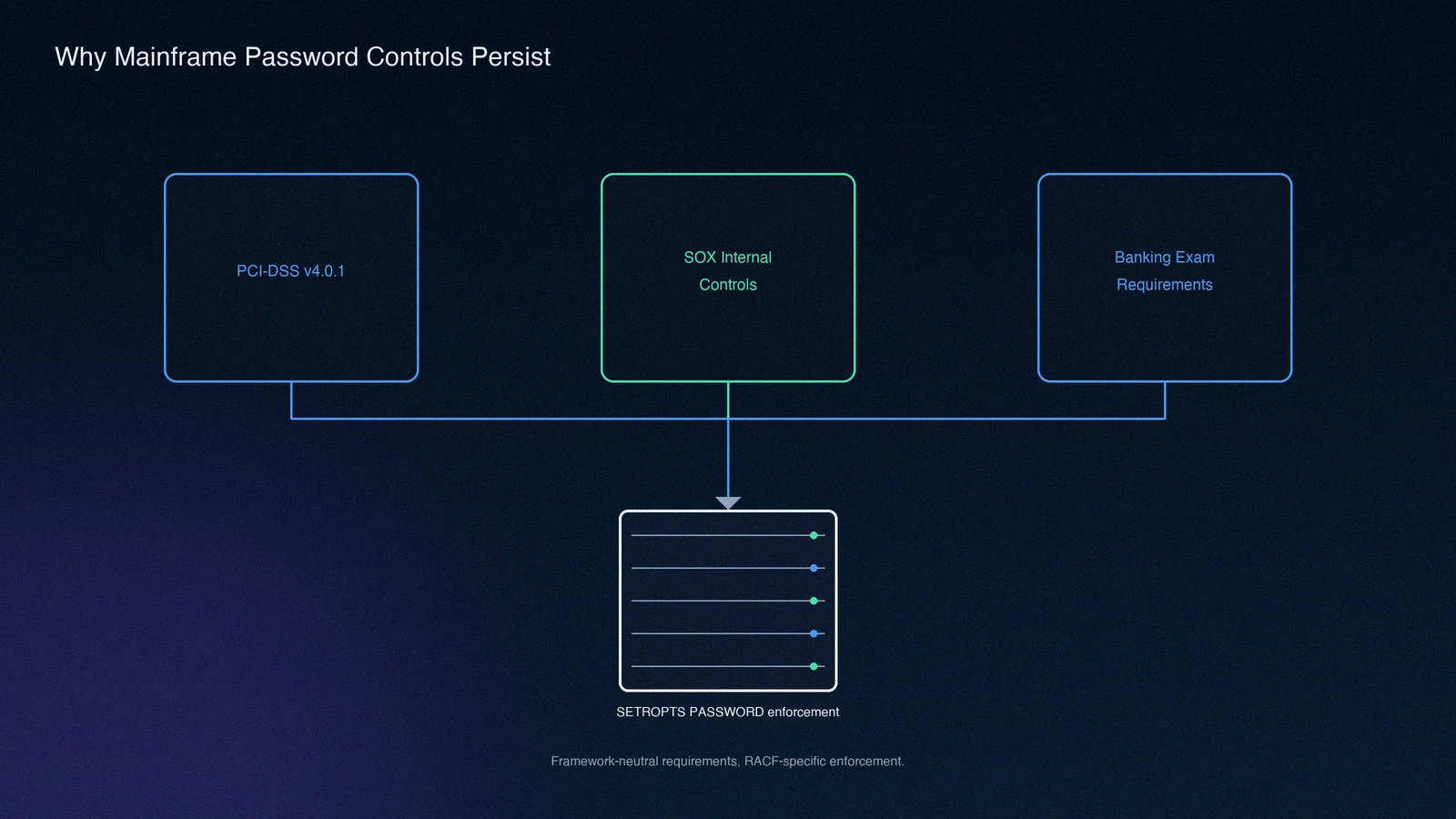 Three different governance bodies, one enforcement point: whatever the framework says in the abstract still has to land as a SETROPTS command on the LPAR.
The NIST 800-63B tension
CGov's enterprise password policy piece covers NIST 800-63B Rev. 4's position in depth: length over composition rules, breach-corpus screening at set-time, and no forced periodic rotation absent evidence of compromise. That guidance reflects two decades of research showing that composition rules and calendar-driven rotation push users toward predictable patterns rather than genuine entropy, and it's reshaping how modern authentication systems are built.
RACF sits on the other side of an uncomfortable gap. Nothing about NIST 800-63B Rev. 4 is binding on a PCI assessor, a SOX auditor, or a banking examiner, and none of those parties have updated their expectations to match it. An organization can be fully NIST-aligned on its SSO and cloud-application authentication layer — long passphrases, breach screening, no forced rotation — while still being required, by a completely separate compliance obligation, to keep SETROPTS PASSWORD(INTERVAL) and RULEn actively enforcing composition and expiration on the mainframe underneath it. That's not the organization being inconsistent; it's two governance regimes that haven't converged, and until PCI-DSS or the internal-controls frameworks banks build for SOX explicitly adopt something closer to NIST's current position, RACF administrators are stuck satisfying both.
The practical answer isn't to pick a side. It's to keep RACF-level SETROPTS enforcement configured to whatever the applicable compliance framework requires — because that's the audit an assessor actually performs — while treating rotation and composition rules as a compliance-driven control at the RACF layer specifically, not a belief that forced rotation is still the best security practice in the abstract. The two positions can be true at the same time: NIST is right that composition rules and blind rotation aren't the strongest generic control, and PCI-DSS is still the standard a mainframe holding cardholder data actually gets measured against.
Modern IAM-layer integration patterns that reduce the operational burden
Managing RACF password policy purely through direct SETROPTS administration doesn't scale well past a handful of LPARs, and it puts the entire burden — configuration, drift detection, exception handling, unlock tickets — on whoever holds RACF SPECIAL authority. The pattern that reduces that burden without changing what RACF itself enforces is treating SETROPTS PASSWORD configuration as a governed policy artifact managed from the identity platform layer rather than tribal knowledge held by an administrator.
Concretely, that means three things working together. First, the RACF password policy an environment is supposed to carry — its INTERVAL, HISTORY, REVOKE, and RULEn values — is documented as a versioned baseline rather than inferred from whatever the live SETROPTS output happens to show. Second, the identity platform periodically compares that baseline against the actual, live configuration and flags drift before an auditor finds it, since SETROPTS values can be changed by anyone holding sufficient authority without a corresponding change-control record unless something is watching for it. Third, and most consequential for the ops-burden side of this: RACF password state gets composed with MFA and adaptive risk signals at the access-broker layer, so the RACF password prompt stops being the single control an attacker has to defeat, and unlock/reset volume tied to REVOKE lockouts routes through a self-service or assisted-reset flow instead of a manual RACF administrator action every time.
None of this changes what RACF is capable of enforcing on its own — SETROPTS PASSWORD still has the same suboperands, the same limits, the same eight-character legacy assumptions baked into parts of its design. What changes is who's watching the configuration and how much of the day-to-day burden — resets, drift checks, exception approvals — gets absorbed by a platform instead of landing entirely on a mainframe security team that's usually smaller than the workload justifies.
What Avatier ships toward this pattern
Avatier Identity Anywhere treats RACF's SETROPTS PASSWORD configuration as a governed policy target rather than a system administered purely by hand: it tracks the complexity, expiration, history, and revoke settings a given environment is supposed to carry against a documented baseline, surfaces drift when the live configuration diverges from that baseline, and routes REVOKE-triggered lockouts through an assisted or self-service reset flow instead of requiring a RACF administrator to intervene on every unlock. On the authentication side, the platform composes RACF password state with MFA and adaptive risk signals at the access-broker layer, so the password prompt at RACF logon isn't standing alone as the only control between a stolen credential and access to the mainframe.
The platform doesn't change what RACF itself enforces — SETROPTS still owns the actual composition and lockout logic, and the SMF audit trail underneath it is unchanged. What Avatier adds is governance and composition: a documented, auditable policy baseline instead of institutional memory, and MFA layered on top instead of RACF's password model carrying the full weight of authentication assurance by itself. The Avatier Trust Center publishes the compliance posture behind the platform: SOC 2 Type II audited with zero exceptions noted, ISO/IEC 27001:2022 certified, PCI DSS v4.0.1 compliant, CSA STAR Level 1 attestation, NIST 800-53 Rev. 5 aligned, and a CISA Secure-by-Design Pledge signatory.
ABOUT THE AUTHOR

More from RACF & Mainframe

Automating RACF Provisioning from HR Events: A 2026 Guide
RACF user provisioning becomes reliable when create, entitle, and deprovision actions trigger directly off HR events instead of tickets — here's how that pattern actually works on the mainframe.
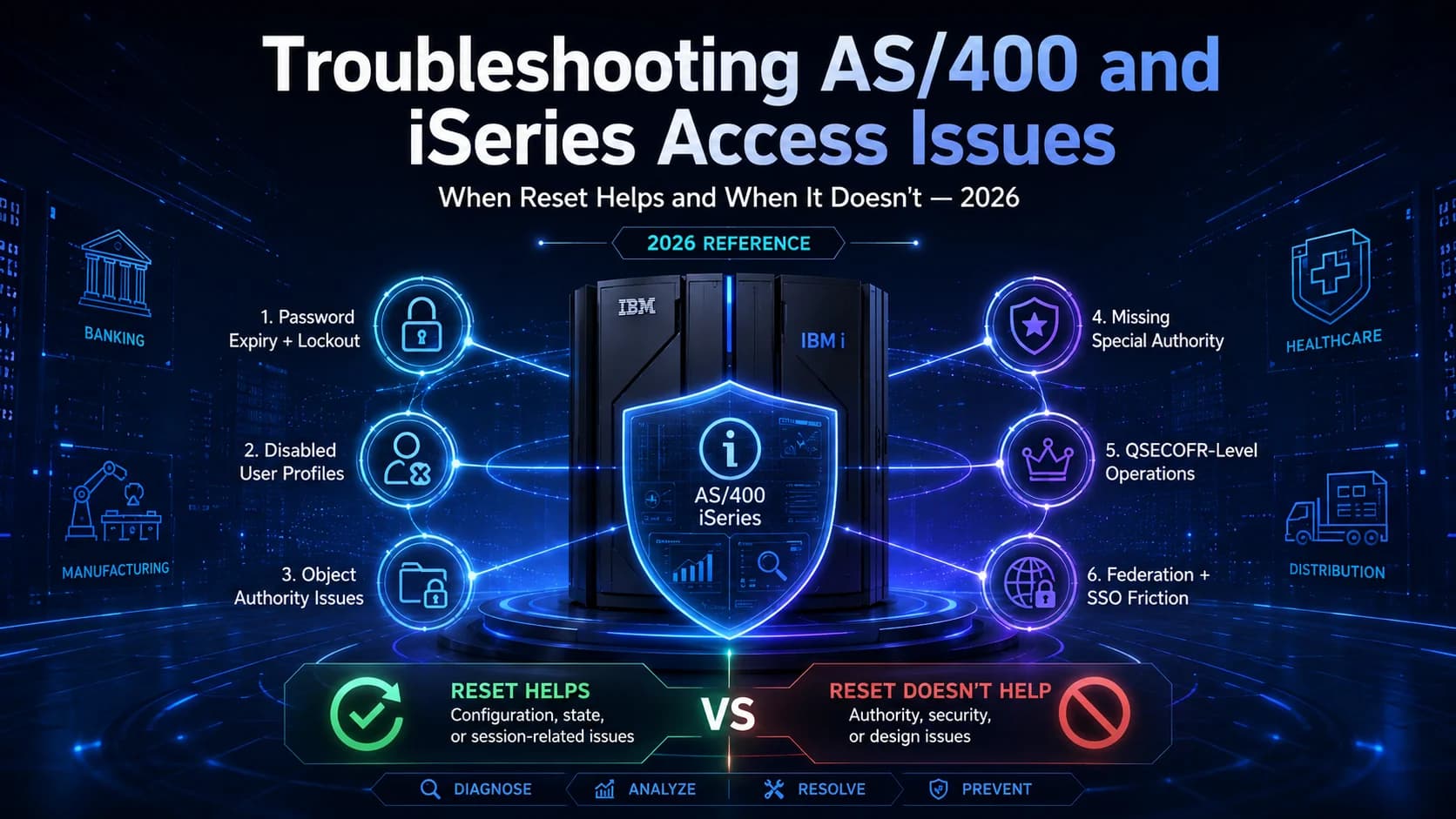
Troubleshooting AS/400 and iSeries Access Issues: When Reset Helps and When It Doesn't 2026
iSeries (IBM i, AS/400) access issues concentrate in six diagnostic categories — password expiry, disabled user profiles, object authority, special authority, QSECOFR operations, and federation-integration friction. The 2026 reference on the diagnostic pattern for each, when reset is the right answer, and how federation-first architecture reduces recurrence.
Mastering RACF User-Group Assignments & Permissions 2026
RACF grants access through groups, not users: ADDGROUP builds it, CONNECT enrolls the user, PERMIT binds it to a resource. How assignments, nested membership, and access decisions resolve in 2026.