Identity Management's Biggest Breaches: Lessons for 2026
The governance lessons enterprises should draw from major identity breaches — not the attack mechanics, but the structural gaps that let one credential become a headline.

The governance lessons enterprises should draw from major identity breaches — not the attack mechanics, but the structural gaps that let one credential become a headline.
- The biggest identity-related breaches don't share an industry or an attacker — they share a governance shape: a credential or account that was stale, over-privileged, or unowned long before anyone exploited it.
- The exploit that makes headlines (phishing, ransomware, a leaked credential dump) is rarely the root cause. The root cause is almost always a structural gap that existed months or years earlier — an orphaned account, a weak recovery path, a shared secret, or an entitlement nobody was watching.
- The same governance failures recur across unrelated industries because the underlying causes are organizational, not technical: certification treated as a checkbox, entitlement ownership that sits with IT instead of resource owners, and deprovisioning that depends on someone remembering to file a ticket.
- The fix isn't a single control — it's a small set of governance disciplines (least privilege by default, risk-weighted certification, automated offboarding, hardened recovery) that shrink the population of stale, unowned access before an attacker ever needs to find it.
- Identity governance changes how far a breach gets and how fast it's caught — it doesn't prevent every intrusion attempt, replace security awareness training, or substitute for detection and response tooling. Programs that treat it as a complete answer are set up to be surprised.
The biggest identity-related breaches of the last several years don't share an attacker, an industry, or even an entry point. What they share is a shape: a credential or account that was stale, over-privileged, or unmonitored, sitting that way for months before anyone exploited it. The technical mechanics of how that credential gets stolen and turned into lateral movement are well documented elsewhere. Less examined, and more useful for a program trying not to repeat the pattern, is the governance layer underneath — the handful of structural gaps that show up again and again across breaches that otherwise look nothing alike. This piece is about those lessons, not the exploit chain.
This is the 2026 update of Avatier's original piece on identity management's biggest breaches. The original leaned on a handful of borrowed figures — a headline breach-cost number, a vendor-sourced MFA effectiveness statistic, a market-research projection about identity-first security adoption — to make its case. Those numbers don't hold up well enough under sourcing scrutiny to repeat here, so this version drops them and stays with what's actually defensible: the governance patterns visible across public breach post-mortems, and the lessons a program can act on regardless of which vendor's report you trust. For the attack-chain mechanics — how a stolen credential actually becomes lateral movement and exfiltration, stage by stage — see our companion piece on data breaches and IAM failures, which owns that ground rather than repeating it here.
What the Biggest Identity Breaches Have in Common
Strip away industry, attacker sophistication, and headline dollar figures, and a consistent set of conditions shows up across the incidents that get studied as cautionary tales. Credentials that worked when they shouldn't have — because they were reused, weak, or simply never rotated after being exposed elsewhere. Authentication with no meaningful second factor, or a second factor weak enough that an attacker with a working password could get past it anyway. Access broader than the compromised identity's actual job required, so a single foothold reached far more than it should have. And detection that lagged the intrusion by long enough for the attacker to move, escalate, and stage data before anyone noticed the pattern had changed.
None of these four conditions is exotic or hard to name. What's harder is admitting that most enterprise identity programs have at least one of them present somewhere in their environment right now — not as a hypothetical, but as an already-existing account, entitlement, or gap that simply hasn't been found yet.
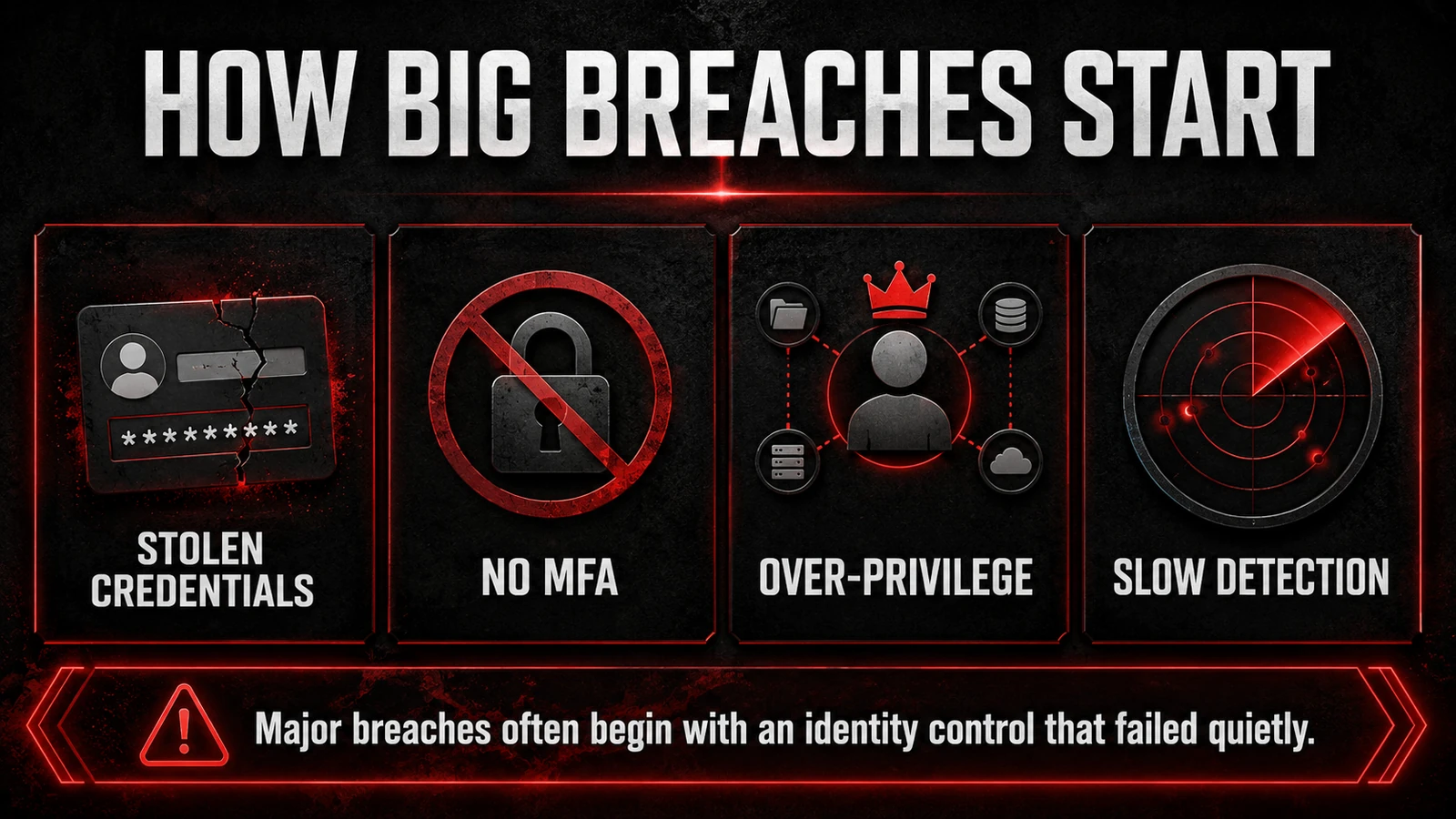 Four conditions, not four incidents — the same combination shows up across breaches with nothing else in common.
The lesson isn't "fix all four at once," which is an unrealistic ask for most programs. It's that these four conditions compound: a stolen credential without MFA is a contained annoyance if the account is narrowly scoped and monitored, and a serious incident if it isn't. Programs that treat each condition as an independent line item on a checklist miss that the real risk lives in the combination.
Three Composite Patterns Worth Studying
The following aren't single incidents — they're composite patterns drawn from the recurring shape multiple public breach post-mortems take, stripped of any company-identifying specifics, because the pattern is the useful part, not the brand attached to it.
The dormant-admin pattern. A former administrator's account — sometimes an employee who left, sometimes a contractor whose engagement ended — stays active with elevated privilege long after the reason for that privilege expired. Nobody notices because nobody is actively watching an account that isn't supposed to be in use; the absence of activity is mistaken for the absence of risk, when it's actually the opposite. Eventually the credential surfaces in a leak, gets guessed, or gets phished from a personal account the same person reused it on, and the org discovers a working admin login it forgot existed. The lesson here isn't about the phishing or the leak — it's that the account should never have still been live.
The recovery-path pattern. An attacker doesn't need to steal a working password at all if the account-recovery flow is weaker than the login flow protecting it — a security question with a guessable or publicly available answer, a reset link sent to an already-compromised secondary channel, or a help-desk process that verifies identity with information an attacker can obtain elsewhere. This pattern shows up disproportionately in incidents involving sensitive regulated data, because those environments often invested heavily in front-door authentication while leaving the side door — password reset and account recovery — governed by an older, weaker standard.
The over-privileged third-party pattern. A vendor, contractor, or partner integration is granted access broader than the specific task requires, because scoping access precisely takes more setup work than granting a standing, generic role. Months later, that third-party credential is the entry point for an attacker who never had to touch the primary organization's own authentication stack at all — they came in through a trusted relationship carrying more privilege than the relationship justified. Detection lags further in this pattern than in the other two, because the activity looks like normal vendor traffic until the volume or destination changes.
All three patterns share a structural feature worth naming directly: none of them required a sophisticated exploit. Each one required an identity governance gap that existed well before the attacker showed up.
The Root Cause Is Never the Headline
Press coverage of a breach describes the exploit — the phishing email, the ransomware strain, the leaked credential dump — because the exploit is the visible, nameable event. It is almost never the root cause. The root cause is the condition that made the exploit consequential instead of contained, and that condition is nearly always sitting quietly in the identity layer: a misconfigured trust relationship between systems, an orphaned account nobody remembered to close, a recovery flow weaker than the primary login, or a shared secret used across more systems than it should have trusted.
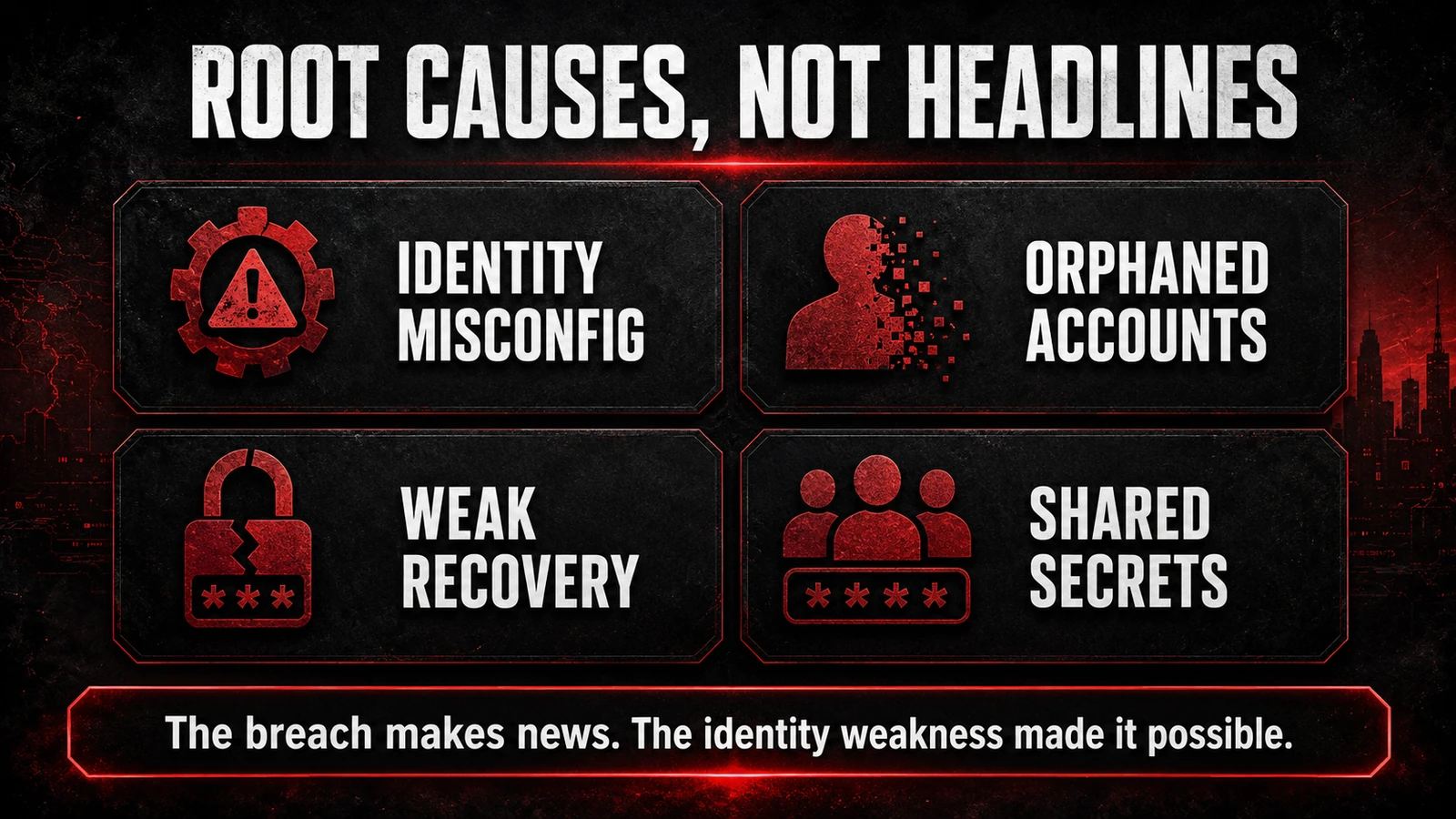 The exploit is what gets reported. The identity weakness underneath it is what actually gets fixed — when it gets fixed at all.
This distinction matters practically because it determines what a post-incident remediation actually targets. An organization that responds to "we got phished" by tightening email filtering and running another round of security-awareness training has addressed the trigger and left the root cause untouched — the next phishing attempt that succeeds will find the same orphaned account, the same over-privileged role, the same weak recovery path waiting. A mature post-mortem asks a second question after identifying the exploit: what condition in our identity environment let this exploit reach as far as it did, and would it have reached that far regardless of which exploit technique the attacker used. If the answer is yes, the root cause is structural, not technique-specific, and the fix has to be structural too.
Why the Same Governance Failures Recur Across Industries
Healthcare, financial services, retail, and technology companies have little in common operationally, yet their breach post-mortems converge on nearly identical governance gaps. That convergence is itself the lesson: these failures aren't industry-specific technical problems, they're organizational problems that show up wherever the same incentive structure exists.
Certification becomes a checkbox when the reviewer lacks the context to make a real decision. A manager asked to certify a long list of raw entitlements they don't fully understand will approve most of them, not because the access is justified, but because rejecting it risks breaking something the manager can't evaluate and the safe answer is always "yes." That single dynamic — under-informed reviewers defaulting to approval — is present in nearly every environment that runs certification as an annual compliance exercise rather than a genuine access review, regardless of sector.
Deprovisioning lags because it's rarely anyone's full-time, incentivized job. Provisioning access has an obvious owner: someone needs the access to do their work, so someone requests it and someone approves it. Removing access has no equivalent forcing function — nobody's daily work depends on an ex-employee's account being closed, so it waits for a ticket, and the ticket waits for someone with bandwidth. This is an organizational design gap, not a technology gap, which is why buying better tooling without fixing the ownership question rarely closes it. The same dynamic underlies a meaningful share of the insider-adjacent risk our insider threat indicators piece covers — access creep and orphaned entitlements are symptoms of the same missing forcing function, whether the eventual actor is a malicious insider, a negligent one, or an external attacker who simply found the gap first.
And unowned privilege — the account, role, or service credential nobody can name a responsible party for — persists because ownership was never assigned at provisioning time in the first place. Storm-2949, the identity-governance failure Microsoft disclosed at the service-principal and RBAC layer, is a machine-identity illustration of exactly this gap: standing privilege with no lifecycle attestation behind it. Our breakdown of what Storm-2949 actually broke shows the same missing-ownership pattern playing out without a single human login involved.
Lessons for a Governance Program That Doesn't Repeat Them
Reading enough breach post-mortems produces a short, unglamorous list of governance disciplines that show up, again and again, as the thing that was missing.
Scope access to role, not to convenience. Least privilege has to start at role-template design — building access grants around what a job function actually requires rather than the broadest plausible interpretation of it — because no amount of downstream monitoring fully compensates for a role that was over-scoped from day one.
Assign ownership, not just approval. Every entitlement, every privileged account, and every service credential needs a named business owner who can answer "does this still need to exist" with real context — not a default approver who's really just a compliance formality. Certification quality tracks almost perfectly with reviewer context.
Automate the removal, not just the grant. Deprovisioning tied to an authoritative HR or system-of-record event — a termination, a role change, a contract expiration — closes the lag window that manual, ticket-dependent offboarding leaves open by design. This is consistently the single highest-leverage fix across the patterns above, because it removes a human dependency entirely rather than asking people to be more diligent.
Harden recovery to the same standard as login. An account-recovery flow is only as strong as its weakest verification step, and a strong primary authentication method sitting behind a weak recovery path is a false sense of security. Recovery deserves the same design scrutiny as login, not a legacy fallback nobody has revisited since it was built.
Wire monitoring to identity ground truth. Anomaly detection is only as good as its baseline, and the identity layer — current role, current entitlements, expected access pattern — is the only source with an authoritative answer to "is this normal for this specific identity." Our ITDR piece covers the detection and response side of this discipline in depth; the governance lesson here is narrower — detection tooling bought without governed identity data underneath it has nothing reliable to compare against.
Human error remains a contributing factor across nearly every pattern above — a person clicked, a person misconfigured, a person reused a password — and no governance control eliminates that entirely. Our human-error piece covers that dimension directly; the point worth making here is that governance and human-error reduction are complementary, not substitutes for each other.
The Executive Lesson: Identity Debt Compounds Silently
For a CISO or CIO, the most useful reframe from studying breach post-mortems isn't a new control — it's a new way of tracking risk. Identity debt behaves like technical debt: it accumulates quietly through normal operational activity (a role change here, a one-off exception there), doesn't show up on a dashboard by default, and produces no visible cost until the day it does, at which point the bill is much larger than it would have been if paid down incrementally.
That means the right executive-level question isn't "did we have a breach this year" — that's a lagging, binary, and largely lucky indicator. The better questions are leading ones: how old is the average entitlement in our environment before it's reviewed. How long does deprovisioning actually take from event to revocation, measured, not assumed. What percentage of privileged accounts have a named business owner versus none. What does our certification approval rate look like, and if it's close to 100%, is that because access is genuinely well-scoped or because reviewers are rubber-stamping. None of these numbers predicts a specific incident, but a program where they're trending the wrong direction is accumulating exactly the exposure that shows up in the patterns above — quietly, and well before any headline forces the conversation.
What Avatier Ships Toward This Pattern
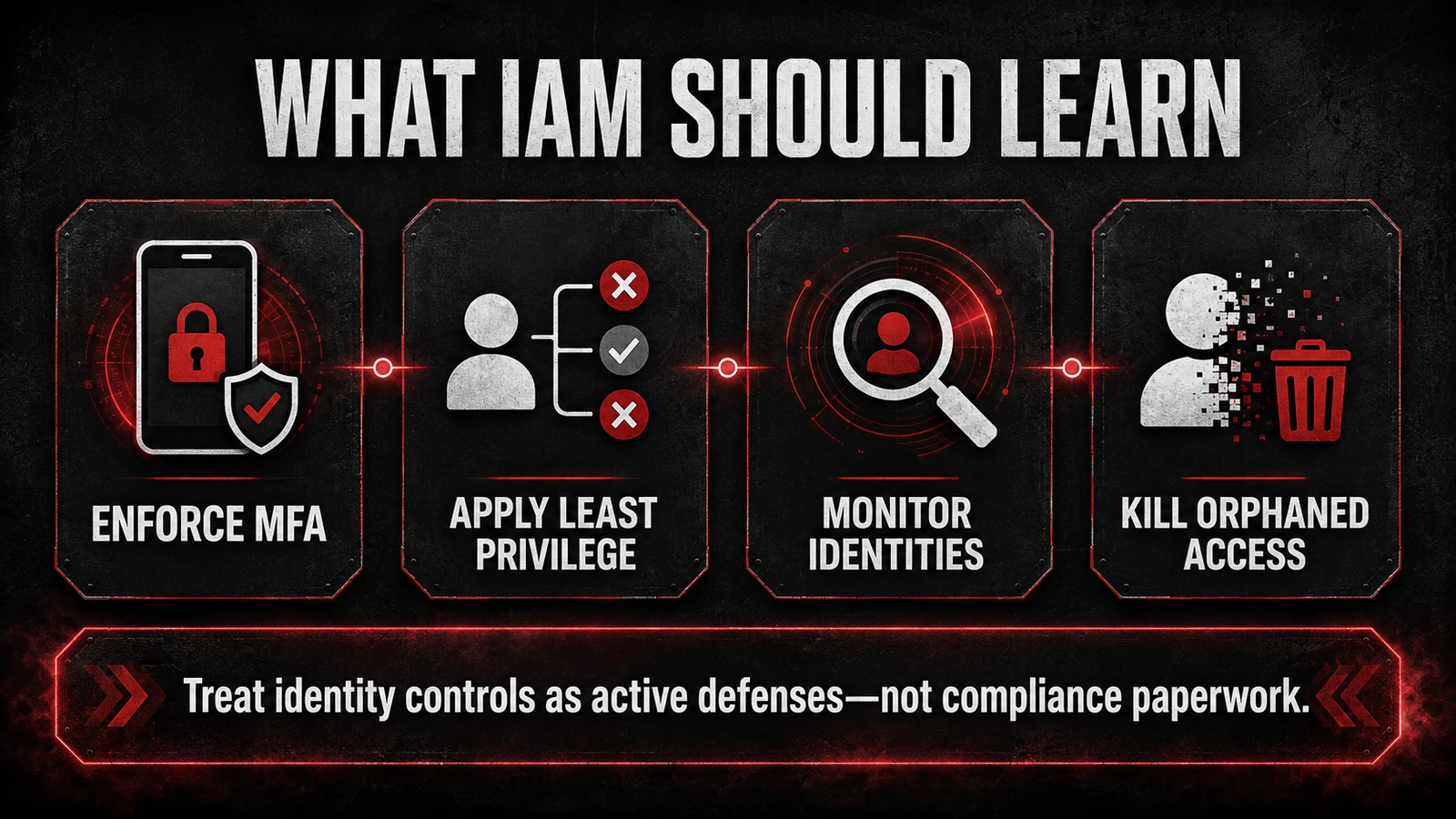 The four lessons that recur across breach post-mortems, restated as things a program actually does rather than things it merely documents.
Avatier Identity Anywhere is built around the governance layer these lessons point back to, not around detection or response. Role-based birthright provisioning scopes access to current role-of-record rather than accumulated history, which is the least-privilege discipline the patterns above show missing again and again. HRIS-driven lifecycle automation ties deprovisioning to the authoritative termination or role-change event itself, closing the lag window that manual, ticket-dependent offboarding leaves open — directly addressing the dormant-admin pattern described earlier. Access certification campaigns route to resource owners with risk-weighted frequency rather than defaulting to a single manager's rubber stamp, and a "no" answer triggers automated revocation instead of a follow-up ticket that can stall indefinitely.
The platform doesn't claim to be the detection or response layer — that's deliberately out of scope, and the ITDR piece covers where that discipline picks up. What Avatier's governance layer does is reduce the number of stale, unowned, over-privileged conditions available for an attacker or an incident to find in the first place. The Avatier Trust Center publishes the compliance posture behind the platform: SOC 2 Type II audited with zero exceptions noted, ISO/IEC 27001:2022 certified, PCI DSS v4.0.1 compliant, CSA STAR Level 1 attestation, NIST 800-53 Rev. 5 aligned, and a CISA Secure-by-Design Pledge signatory. On the authentication side, FIDO2-compatible passwordless login closes the weak-credential gap the first pattern in this piece describes — a companion discipline covered in more depth in ICC's piece on phishing-resistant MFA.
The Honest Closing
None of this makes a breach impossible, and any program sold on that promise should be treated skeptically. Identity governance shrinks the population of stale, over-privileged, and unowned access an attacker can find — it doesn't stop a genuine zero-day exploit that never touches a credential at all, it doesn't replace security awareness training against a well-crafted phishing message, and it doesn't substitute for the detection and response tooling that catches an intrusion already underway. A well-governed identity program still gets phished; the difference is what the phished credential can reach, and how quickly the anomaly gets noticed once it starts behaving abnormally.
The lesson worth carrying out of every breach post-mortem in this piece is the same one, restated four different ways: the exploit is rarely the interesting part. It's the condition that let the exploit matter — the account that should have been closed, the access that should have been narrower, the recovery path that should have been as strong as the front door — that determines whether an intrusion becomes a contained incident or a headline. Studying the biggest breaches isn't really about the attackers. It's about recognizing which of those same conditions might already be sitting, quietly, in your own environment.
ABOUT THE AUTHOR

More from IAM & Identity Governance

Translating Security Risk Into Business Language in 2026
Boards don't fund CVE counts — they fund dollar exposure. A practical framework for turning access sprawl, orphaned accounts, and audit findings into risk language executives actually act on.

The Help-Desk Call That Cost $100M: 2026 Lessons
A single impersonation call to a help desk — not a firewall failure — triggered a 2023 casino-industry breach that cost roughly $100 million, and the fix is verification discipline, not new firewalls.

Identity and Access Management for Enterprise Security (2026)
Identity and access management is the control layer that decides who and what can reach enterprise systems — and in 2026 it functions as the security program itself, not a supporting utility underneath it.