Insider Threat Red Flags: Indicators to Watch in 2026
Malicious, negligent, and compromised insiders each leave distinct behavioral and access-pattern red flags — and identity governance, not perimeter security, is what actually contains the resulting blast radius.

Malicious, negligent, and compromised insiders each leave distinct behavioral and access-pattern red flags — and identity governance, not perimeter security, is what actually contains the resulting blast radius.
- Insider threats fall into three categories with different red flags — malicious (intentional harm), negligent (careless policy violation), and compromised (an outsider operating through a stolen internal identity) — and treating them as one problem produces the wrong controls.
- The highest-signal indicators are access-pattern anomalies, not personality judgments: off-hours mass downloads, unexplained access creep, unusual privilege requests, and activity that diverges from a person's role-of-record.
- Perimeter security is structurally blind to insider risk because the insider is already authenticated and already inside the trust boundary the perimeter was built to defend.
- Least privilege, continuous activity monitoring, fast offboarding, and separation of duties are the identity governance controls that turn insider indicators into contained incidents instead of open-ended exposure.
- Identity controls reduce blast radius and shorten detection time — they do not eliminate human intent, and no governance program should be sold or bought as if it does.
Insider threats sort into three categories, and the sorting matters because each one leaves a different trail. A malicious insider misuses access on purpose. A negligent insider causes damage without intent, through carelessness or a shortcut around policy. A compromised insider isn't really an insider at all — it's an external attacker operating through a legitimate employee's stolen credentials, which makes the activity look identical to insider behavior to any system that trusts authentication as proof of who's behind the keyboard. Identifying which category you're looking at starts with red flags and indicators: the behavioral signals and, more reliably, the access-pattern anomalies that show up in logs before they show up in a headline.
This piece is the 2026 update of Avatier's original insider threat coverage. The industry conversation has moved since that piece published — non-human identities now outnumber human ones in most enterprises, hybrid work has widened what "normal" access looks like, and the compromised-insider category has grown relative to the classically malicious one. What hasn't changed is the underlying fix: insider risk is an identity governance problem before it's a personnel problem, and the controls that contain it are the same ones that keep any access model defensible under audit.
The three kinds of insider threat
Treating "insider threat" as one problem produces the wrong controls, because the three categories fail differently and get caught by different mechanisms.
Malicious insiders act with intent — theft of intellectual property, sabotage of systems or data, unauthorized disclosure to a competitor or the press, or fraud committed using access the person legitimately holds. The defining trait isn't the access itself; it's that the access is being used outside its authorized purpose, deliberately. Malicious insider activity is caught by monitoring that looks for intent-adjacent patterns: data movement that doesn't match job function, timing that correlates with a resignation or a grievance, and attempts to cover tracks by disabling logging or using unmonitored channels.
Negligent insiders cause damage without meaning to. This is the largest category by volume in most environments — a misconfigured sharing permission that exposes a customer database, a password reused across a compromised third-party service, a well-meaning employee who moves sensitive files to a personal cloud drive to work from home over the weekend. Negligent risk is addressed less by monitoring for malice and more by reducing the number of ways a careless action can cause serious damage: least privilege limits blast radius, and default-secure configuration limits the number of decisions a user has to get right.
Compromised insiders are the category most often missed by programs designed around the other two, because the account behaving badly belongs to a real, trusted employee — the employee just isn't the one operating it. An attacker who has stolen valid credentials, hijacked an active session, or defeated weak MFA is now indistinguishable from the legitimate user to any system that only checks "is this a valid, authenticated identity." Catching this category depends on behavioral and contextual signals layered on top of authentication — the same kind of anomaly detection that a identity threat detection and response (ITDR) piece covers in depth, and on phishing-resistant authentication that makes credential theft materially harder in the first place, covered in the Phishing-Resistant MFA piece on ICC.
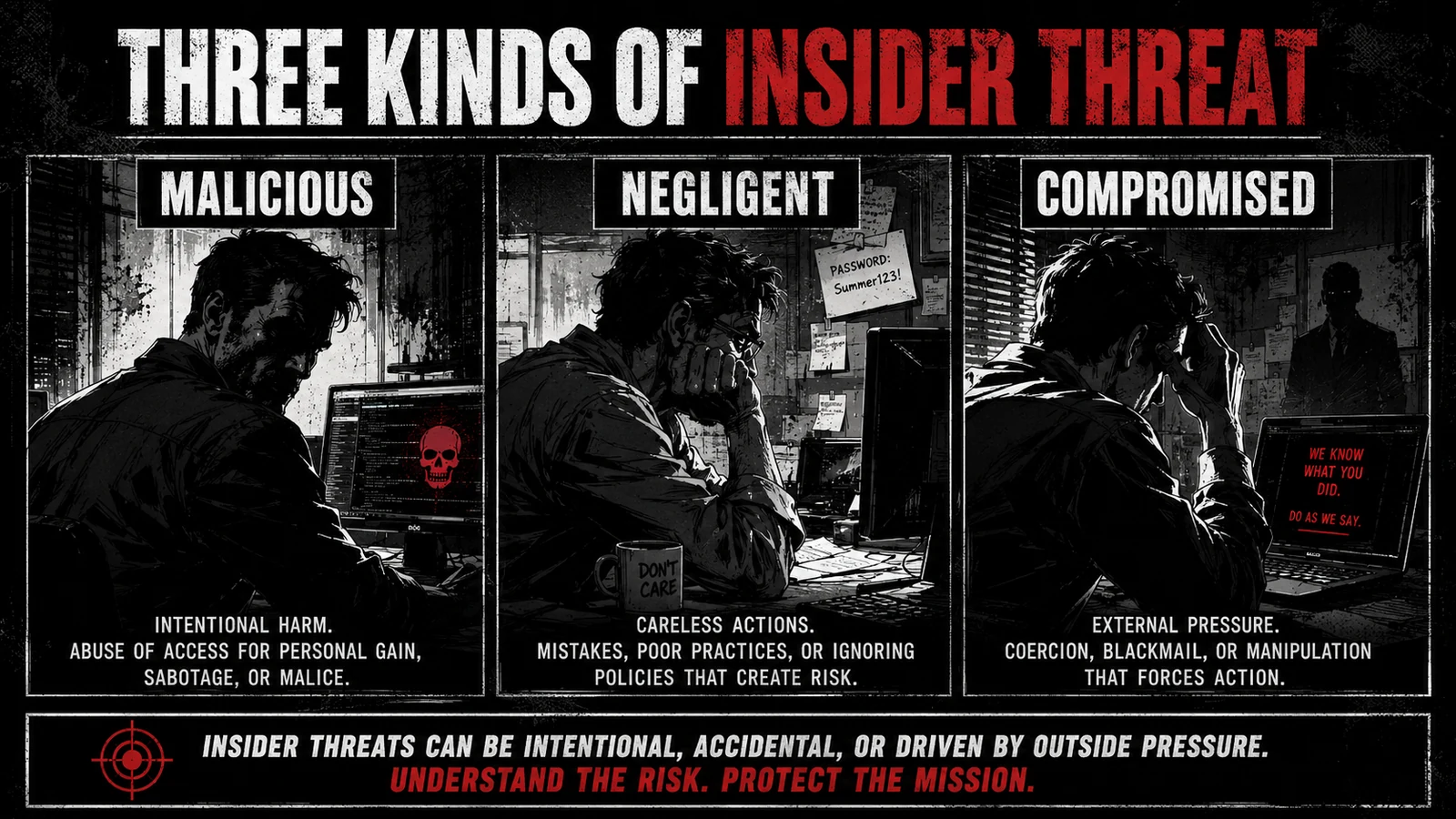 Three categories, three different trails to look for — intent-driven misuse, carelessness, and a stolen identity operated by someone else entirely.
Malicious insider threat red flags: the behavioral and access indicators
The question security teams actually ask is narrower than "who might be a threat" — it's "what are the potential insider threat indicators we should be watching for right now." Four categories cover most of what shows up in practice.
Off-hours mass downloads. A user who normally accesses a handful of documents a day suddenly pulls down a large volume of files, often outside business hours when review is less likely and the action is less likely to be noticed in real time. The signal isn't the off-hours timing alone — plenty of legitimate work happens at odd hours in a distributed workforce — it's the combination of volume and timing diverging from that specific user's established baseline.
Access creep. Entitlements accumulate as people change roles, join projects, and get one-off grants that outlive their purpose. Access creep is a slow-moving red flag: no single grant looks alarming, but the cumulative entitlement profile drifts further from what the current role actually requires, and every entitlement in that gap is exposure with no offsetting business justification. This is why the Principle of Least Privilege piece treats entitlement minimization as a continuous discipline rather than a one-time provisioning decision.
Disgruntlement signals. Expressed grievance, a documented disciplinary action, a pending termination or resignation, or a sudden change in engagement are behavioral indicators — real, but subjective and legally sensitive to act on in isolation. The defensible pattern is to treat disgruntlement signals as a trigger for tighter access review, not as grounds for restriction on their own. Pairing a behavioral signal with an access-pattern signal — a resignation notice followed by an unusual download spike — is materially higher-confidence than either alone.
Unusual privilege requests. A request for access that doesn't map to the requester's role, that routes around the normal approval workflow, or that asks for standing access where temporary access would do the job is a structural red flag independent of who's asking. This is the exact gap that just-in-time access and zero standing privilege is designed to close — access exists only for the window it's needed, which shrinks the population of "unusual privilege request" incidents that can even occur.
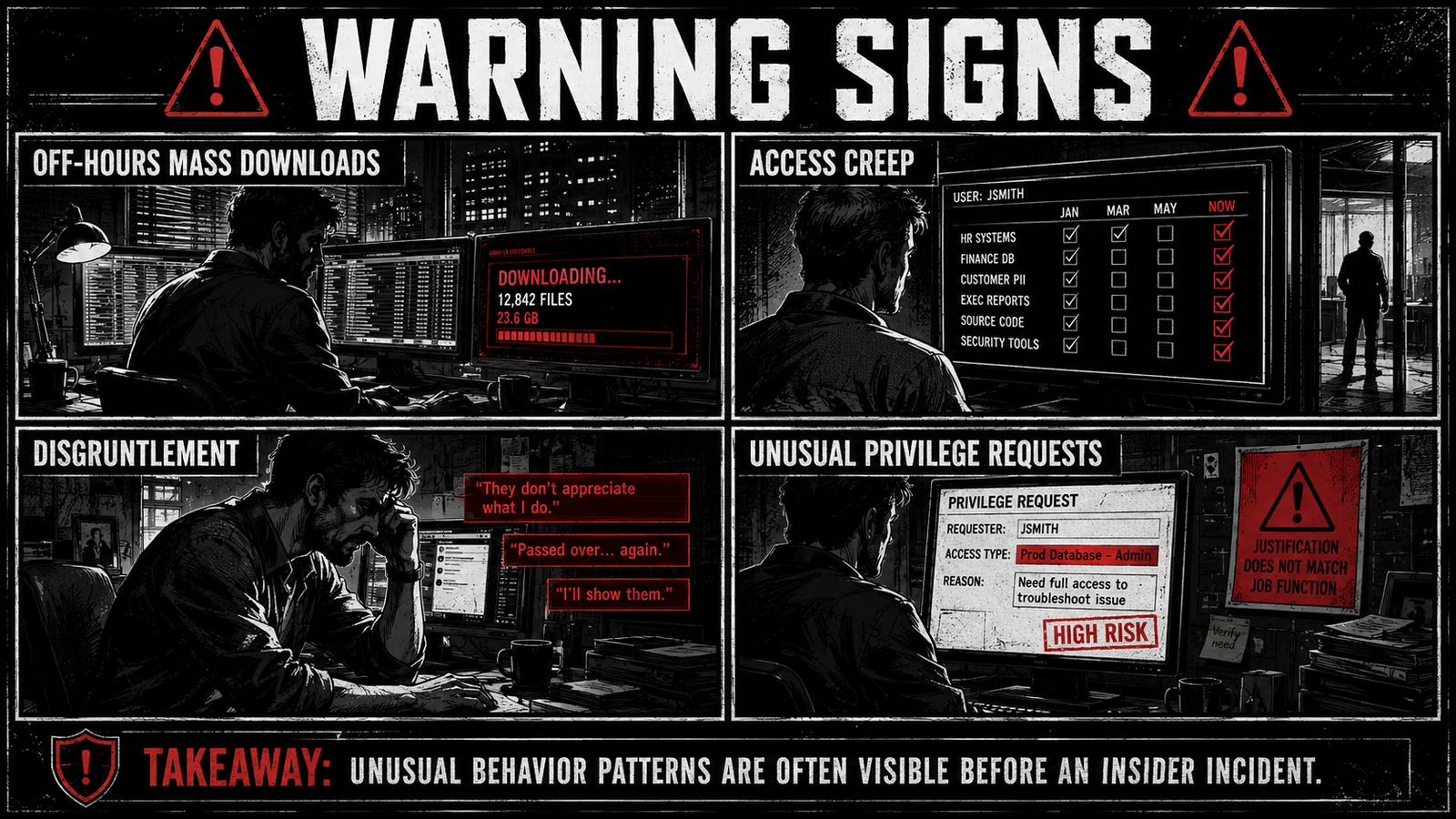 Four indicator categories, none of them conclusive alone — access-pattern anomalies are what turn a behavioral hunch into a defensible, auditable trigger for review.
Why perimeter security misses insiders
Perimeter security — firewalls, network segmentation, intrusion detection at the network edge — was built to answer one question: is this traffic coming from inside the trust boundary or outside it. An insider, by definition, is already inside. The malicious insider has a valid badge and a valid login. The negligent insider is doing their actual job when the mistake happens. The compromised insider has authenticated with real, stolen credentials that pass every check the perimeter is designed to run.
None of the classic perimeter controls are built to ask the question that actually matters for insider risk: is this specific action, from this specific identity, consistent with what this identity is supposed to be doing. That's an identity-and-access question, not a network question, and it requires visibility into entitlements, role-of-record, and behavioral baseline — none of which live at the network edge. A firewall has no concept of "this user's role doesn't include finance database access." An IGA platform does.
This is also why insider threat programs that bolt monitoring onto a perimeter-first security stack tend to underperform: the monitoring has no authoritative source of truth for what "normal" looks like per identity. Effective insider detection needs the identity layer providing ground truth — current role, current entitlements, expected access patterns — for the anomaly detection to have anything meaningful to compare against.
The zero trust conversation gets this half right and then stops short. "Never trust, always verify" is the correct instinct for authentication — verify the login, verify the device, verify the session. But verification at the point of login says nothing about whether the verified identity's subsequent actions match its role. An insider passes every zero trust authentication check by definition; the risk shows up downstream, in what the already-verified identity does with the access it was correctly granted. Zero trust architecture without an identity governance layer behind it authenticates insiders correctly and then has nothing left to say about them.
How identity governance controls contain the risk
Identity governance doesn't prevent human intent. What it does is shrink the space in which intent, carelessness, or a stolen credential can cause damage, and it does that through four control patterns.
Least privilege limits every identity — human or machine — to the access its current role actually requires, nothing more. Every entitlement beyond that is unmonitored exposure. Least privilege is the single highest-leverage control against all three insider categories: it caps the malicious insider's reach, limits the blast radius of a negligent mistake, and reduces what a compromised identity can do even after an attacker gets in.
Activity monitoring turns access into an auditable trail instead of a silent grant. Continuous monitoring — rather than point-in-time review — is what catches the off-hours download spike or the unusual privilege request while it's still an anomaly worth investigating, not a forensic artifact discovered after the fact.
Fast offboarding closes the highest-risk window in the entire identity lifecycle: the gap between a person's last day (or a role change) and the day their access is actually revoked. Manual, ticket-driven deprovisioning routinely leaves that gap open for days or weeks. Workflow-driven offboarding tied to HRIS events collapses it to hours.
Separation of duties ensures no single identity can both initiate and approve a sensitive action — creating a vendor and approving its payment, requesting access and granting it to themselves, modifying a financial record and closing the audit trail on it. Separation of duties is the control that specifically targets malicious misuse by a single legitimate identity, which is the scenario least-privilege and monitoring alone don't fully close.
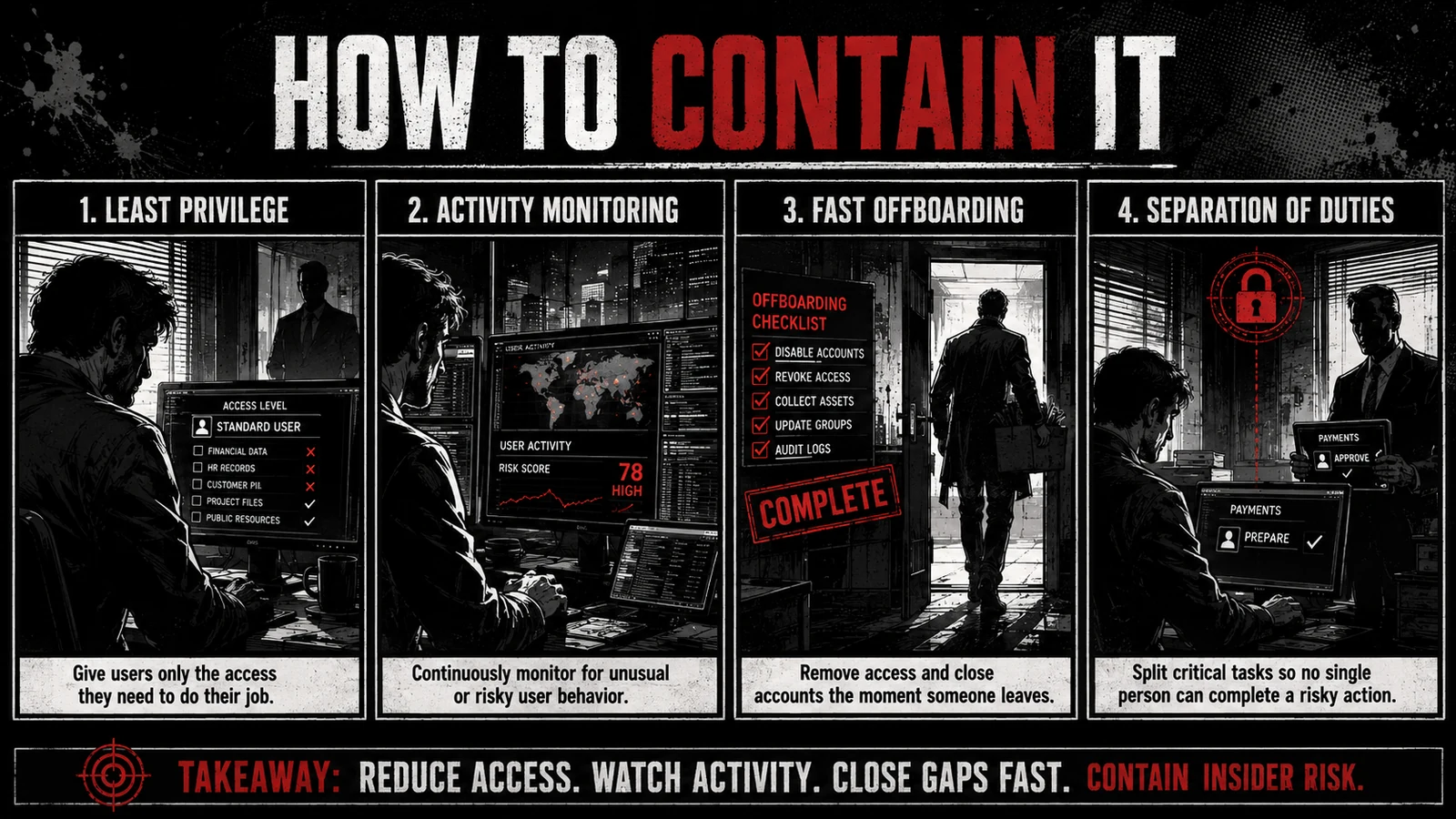 The four identity governance controls that consistently show up in defensible insider threat programs — none of them require guessing at intent.
Access certification and review cycles
Point-in-time controls decay. A least-privilege grant made correctly on day one is, by definition, a snapshot — roles change, projects end, people move teams, and the entitlement doesn't automatically shrink back down when the need for it goes away. Recurring access certification is what catches that decay before it becomes the access-creep vulnerability discussed above.
An effective certification cycle isn't a rubber-stamp exercise where a manager clicks "approve" on a long list without reading it — that pattern satisfies an audit checkbox and does nothing for insider risk. The cycles that actually catch drift are risk-weighted: privileged and sensitive entitlements get certified more frequently than low-risk ones, certifications route to the person who actually knows whether the access is still needed (usually the resource owner, not just the line manager), and revocation on a "no" answer is automated rather than another ticket that sits in a queue. Certification cadence and depth are themselves insider threat indicators worth tracking at the program level — a security culture that treats certification as a real control, not paperwork, correlates with faster detection when something does go wrong, a relationship covered in more depth in the Security Culture KPIs piece.
Certification quality also depends on who's answering the question. A line manager asked "does this person still need this access" is answering from limited visibility — they may not know what a given entitlement actually does or whether it's load-bearing for the person's current project. Routing certification to the resource or data owner produces a materially better answer, because that person knows what the entitlement grants and can weigh the operational cost of revoking it against the risk of leaving it in place. Programs that route every certification to the same manager regardless of resource sensitivity tend to converge on rubber-stamp approval simply because the reviewer lacks the context to do anything else.
Privileged and service-account exposure
Privileged accounts and service accounts deserve separate treatment because they break the assumptions most insider threat monitoring is built on. A human insider has a behavioral baseline — typical hours, typical access patterns, a manager who might notice a personality change. A service account has none of that. It authenticates on a schedule, touches the same systems every time, and has no one watching for disgruntlement because there's no person to be disgruntled.
That makes service accounts and other non-human identities a uniquely attractive vector for both malicious misuse and credential compromise: a service account with standing privileged access, no clear owner of record, and a credential that rarely rotates is functionally invisible to any insider threat program built around watching people. The Service Account Governance piece covers the ownership, rotation, and entitlement-scoping controls this category needs specifically.
Privileged human accounts carry a related but distinct risk: they're the accounts where a malicious insider or a compromised identity does the most damage per action, because the access itself is broad by design. Session recording, credential checkout with time-bound expiry, and just-in-time elevation instead of standing privileged access are the controls that matter most here — the Privileged Access Management piece covers the architecture in depth. The pattern across both categories is the same: standing, unowned, unmonitored privilege is the vulnerability, regardless of whether a human or a machine holds it.
The underlying fix for both privileged human accounts and service accounts is the same architectural shift: move away from standing access that exists whether or not it's being used, toward access that's provisioned for a defined window and expires automatically. A privileged credential that only exists for the duration of an approved task has a dramatically smaller window in which it can be misused, stolen, or simply forgotten about with excess rights attached. That shift is the core of zero standing privilege, and it applies as cleanly to a service account's database credential as it does to a human administrator's break-glass access.
What Avatier ships toward this pattern
Avatier Identity Anywhere implements the four containment controls as platform behavior rather than policy documents that assume manual follow-through. Least privilege is enforced through role-based birthright provisioning tied to HRIS role-of-record, so entitlements are scoped to current role rather than accumulated history. Fast offboarding runs off the same HRIS event stream — a termination or role-change event in the source-of-truth system triggers automated revocation the same day, closing the highest-risk window in the lifecycle rather than leaving it to a manual ticket.
Access certification campaigns route to resource owners with risk-weighted frequency, and a "no" answer on a certification triggers automated revocation rather than a follow-up task that can stall. Separation-of-duties policy is enforced at the workflow level — a request-and-approve conflict is blocked before the grant happens, not caught after the fact in an audit. The platform's audit trail is structured to feed downstream ITDR and SIEM tooling for the behavioral and access-pattern monitoring layer, so the governance layer and the detection layer share the same ground truth about who's supposed to have what.
The Avatier Trust Center publishes the compliance posture behind the platform: SOC 2 Type II audited with zero exceptions noted, ISO/IEC 27001:2022 certified, PCI DSS v4.0.1 compliant, CSA STAR Level 1 attestation, NIST 800-53 Rev. 5 aligned, and a CISA Secure-by-Design Pledge signatory.
The honest closing
None of this eliminates insider risk, and any program sold on that promise should be treated skeptically. Identity governance controls reduce the blast radius of a malicious act, catch a negligent mistake before it compounds, and shorten the window a compromised credential stays useful to an attacker. What they don't do is reach into a person's motivations and prevent someone determined to cause harm from trying. Least privilege, monitoring, fast offboarding, and separation of duties make malicious action harder to execute and faster to catch — they don't make the human decision to attempt it go away.
That distinction matters for how a program gets built and evaluated. The right target for an insider threat program isn't zero incidents — that's not an achievable or honest goal. The right target is fast detection, contained impact, and a defensible audit trail showing the access model itself wasn't the reason an incident got as far as it did. Red flags and indicators are the early-warning layer; identity governance is the containment layer underneath them. Neither one, alone, is the whole answer — but together they're the difference between an insider incident that gets caught in hours and one that gets discovered in a headline.
ABOUT THE AUTHOR

More from IAM & Identity Governance

Translating Security Risk Into Business Language in 2026
Boards don't fund CVE counts — they fund dollar exposure. A practical framework for turning access sprawl, orphaned accounts, and audit findings into risk language executives actually act on.

The Help-Desk Call That Cost $100M: 2026 Lessons
A single impersonation call to a help desk — not a firewall failure — triggered a 2023 casino-industry breach that cost roughly $100 million, and the fix is verification discipline, not new firewalls.

Identity Management's Biggest Breaches: Lessons for 2026
The governance lessons enterprises should draw from major identity breaches — not the attack mechanics, but the structural gaps that let one credential become a headline.