Automated Deprovisioning: Closing Access When People Leave 2026
Deprovisioning is the revoke side of the identity lifecycle: a leaver event that cascades revocation across every connected system so no active account, live session, or token outlives the person.

Deprovisioning is the revoke side of the identity lifecycle: a leaver event that cascades revocation across every connected system so no active account, live session, or token outlives the person.
- Deprovisioning is the revoke half of the identity lifecycle, and it fails differently than provisioning. When onboarding is slow, someone complains and it gets fixed; when offboarding is incomplete, nothing complains — the access just sits there, active and unwatched, until an attacker or an auditor finds it. Orphaned access is the default outcome of manual offboarding, not the exception.
- Orphaned access is not one thing. It is active accounts that still authenticate, live SSO sessions that survive long after the password is changed, API tokens and personal access tokens that never expire on their own, and standing access to shared drives and repositories. Disabling the primary directory account addresses the first of these and leaves the other three wide open.
- Checklist offboarding fails because it is manual, serial, and dependent on human memory across dozens of disconnected systems. The list is only as complete as whoever wrote it, it runs only as fast as the help desk can work through it, and the systems that get missed are precisely the ones nobody remembered granting access to in the first place.
- The reliable pattern is event-driven: the HR system of record marks a worker terminated, that single event fires into the identity platform, and the platform cascades revocation to every connected system automatically — disabling authentication, killing tokens and sessions, reassigning owned data, and removing group memberships without waiting for a ticket.
- Automation closes the account-level gaps fast and consistently, but it does not decide what data a departing person owned, resolve who should inherit it, or govern access in systems that were never connected to the identity fabric. It makes the mechanical revocation instant and auditable; the judgment calls still belong to people.
Deprovisioning is the process of withdrawing a person's access when they leave — and offboarding leaves access open because, unlike onboarding, its failures are silent. When provisioning is slow, someone can't do their job and files a ticket; the gap gets closed. When deprovisioning is incomplete, nothing breaks and no one complains, because the leftover access keeps working perfectly for whoever holds it next. That asymmetry is the whole problem. The account that still authenticates, the session still riding a valid token, the API key that never expired, the shared-drive membership nobody remembered — these are the default residue of a departure handled by hand, and they persist precisely because their existence generates no signal. This is the 2026 reference on the revoke side of the identity lifecycle: what orphaned access actually is, why manual offboarding reliably leaves it behind, and how a single leaver event should cascade revocation across every connected system so nothing outlives the person.
This piece deliberately scopes away from the grant side of the lifecycle. Provisioning — how access is requested, approved, and granted on a joiner or mover event — is its own discipline, covered elsewhere. Here the focus is exit: the moment employment ends and the organization needs every door the person could open to close, quickly, completely, and with a record of what was shut. The mechanics of that are more specific than "delete the account," and getting them right is what separates an offboarding process you can defend to an auditor from one that quietly accumulates risk with every departure.
What orphaned access actually is
Orphaned access is access that outlives the person or purpose it was granted for. The phrase gets used loosely, but it is worth being precise, because the different forms of it fail in different ways and a process that catches one can miss the rest. There are four that matter most, and disabling the primary directory account — the step almost every offboarding process gets right — addresses only the first.
The first is active accounts. These are user accounts that still authenticate: the directory account, yes, but also the local accounts, the application-specific logins, and the accounts in systems that were never federated to the central directory. Disabling the main account does nothing to a standalone login in a niche SaaS tool that a team adopted on its own.
The second is live SSO sessions. Single sign-on issues a session when a user authenticates, and that session has its own lifetime independent of the account behind it. Disabling the account stops new logins; it does not necessarily terminate a session that is already active. A person who was signed in at the moment their account was disabled can keep working inside that session until it expires on its own — sometimes hours, sometimes longer.
The third is API tokens. OAuth access and refresh tokens, personal access tokens, API keys, and app passwords are all credentials that were issued once and keep working until they are explicitly revoked or hit an expiry that may be far in the future or may not exist at all. These are the most dangerous form of orphaned access because they are invisible to anyone looking at the account: the account can be disabled and the token still authenticates to the API.
The fourth is shared-drive access, and more broadly standing access to shared resources — file shares, document repositories, code repositories, wikis, and databases where the person had access through direct grants or through membership in a group. This is the access most likely to be forgotten, because it was often granted informally and never tracked against the individual.
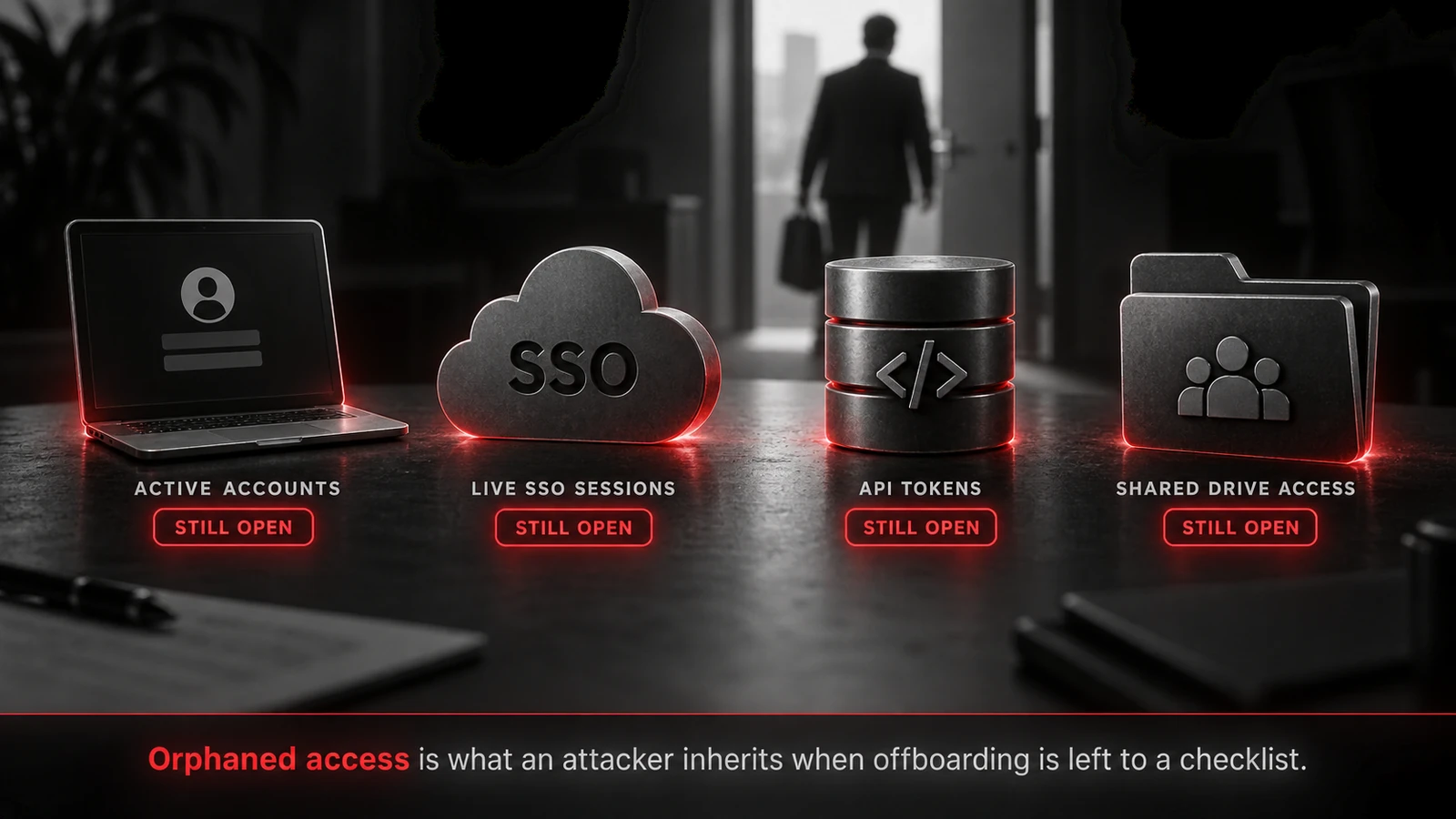 Disabling the primary account closes one of these four doors — live sessions, standing tokens, and shared-resource access routinely survive an offboarding that stops at the directory.
What makes all four dangerous is the same thing: they generate no signal. An enabled-but-unused account, a valid session, an unrevoked token, a lingering group membership — none of them raise an alarm by existing. They sit quietly until something acts on them, and the something is rarely benign. It is a former employee who kept a token, an attacker who finds a dormant account that no one monitors because no one remembers it, or an auditor who asks why a departed person's credentials are still live. The cost of orphaned access is not that it fails; it is that it works, for the wrong person, at a time of their choosing.
Why manual and checklist offboarding fails
The intuitive fix for orphaned access is a good checklist — enumerate every system, and have the help desk revoke access in each one when someone leaves. In practice this fails for reasons that are structural rather than a matter of diligence, and understanding why is the argument for automation.
The checklist is only as complete as whoever wrote it. Enterprise application estates grow continuously and often without central coordination. Every tool a team adopts on its own, every integration wired up for a project, every third-party portal a vendor set up — each is a system that grants access and each is a system the master offboarding checklist does not know exists. The access most likely to be orphaned is, by definition, the access nobody remembered granting, which means it is also the access nobody thinks to revoke.
The process is serial and slow. A human works through systems one at a time. Even a disciplined help desk moving quickly takes time to touch every system, and every hour between the person's departure and the final revocation is a window in which the doors are still open. When the departure is involuntary or contentious, that window is exactly when the risk is highest, and it is precisely when a manual process is slowest — because it depends on someone being told to start, having the checklist, and having time to work it.
It depends on human memory across disconnected systems. Manual offboarding assumes that the person running it knows every place the departing person had access. But access accumulates over a tenure — a role change here, a project there, a temporary grant that was never removed — and no single person holds the complete picture. The systems that get missed are not random; they are the ones where access was granted informally, tracked nowhere, and remembered by no one.
The through-line is that manual offboarding inherits every weakness of manual provisioning. If access was granted through scattered tickets and informal requests with no central record, there is no central record to revoke against when the person leaves. The exit is only as clean as the entry was governed, which is why the revoke side and the grant side are ultimately the same system viewed from opposite ends. Where governance is missing on the way in, manual and ticket-driven access on the grant side becomes orphaned access on the way out.
The automated flow: one event, revocation everywhere
The reliable alternative replaces the checklist with an event. The organization already maintains an authoritative record of who works there and in what status — the HR system of record, whether Workday, SuccessFactors, or another HRIS. That system knows, before anyone else does, when a person's employment ends. Automated deprovisioning makes that knowledge the trigger.
When a worker is marked terminated in the HR system, that status change becomes an event that fires into the identity platform. The platform treats the event as authoritative and cascades revocation to every system the person was provisioned into — using the same connectors that granted the access originally. There is no ticket to open, no checklist to work, and no dependence on someone remembering the niche tool in the corner. The event says "this person is gone," and the platform acts on every connected system at once.
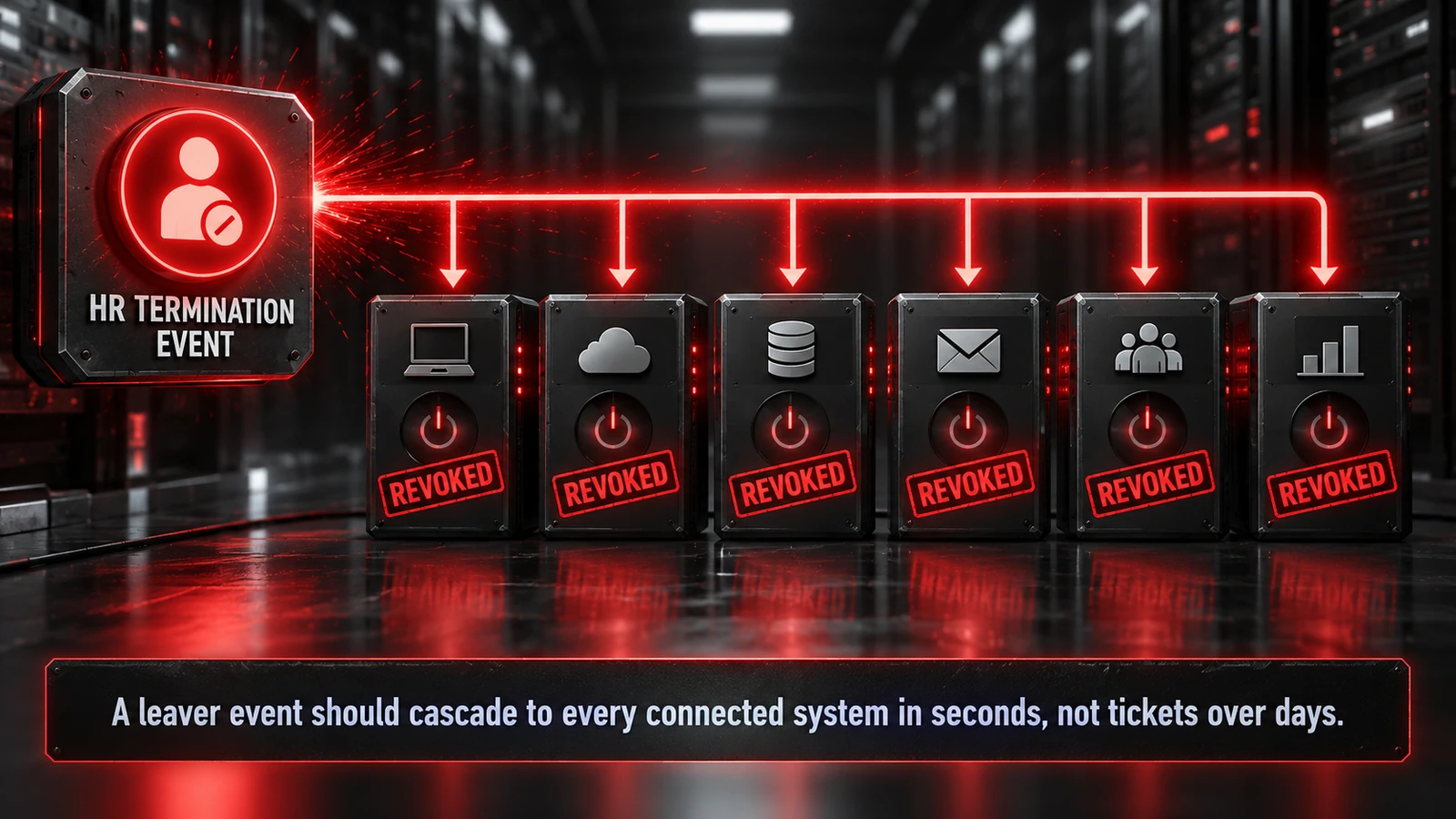 One authoritative HR event fans out through the identity platform's connectors and revokes access everywhere at once — no ticket, no queue, no system left to memory.
Two properties of this model are what make it work. The first is that it is single-sourced: the HR system is the one authoritative statement of employment status, so revocation happens on the organization's real timeline — the moment the person leaves — rather than whenever a ticket reaches the front of a queue. The second is that it is complete by construction: because the platform revokes through the same connector fabric it used to provision, the set of systems it can revoke from is exactly the set it granted into. What was provisioned is what gets deprovisioned. That symmetry is the structural fix for orphaned access — the leftover access accumulates when grant and revoke run through different, disconnected processes, and it stops accumulating when they run through one.
This is the exit-side mirror of joiner and mover automation. The same HR-driven pipeline that creates and adjusts access from SuccessFactors and Workday events on the way in is what withdraws it on the way out. Treating the full user lifecycle as one integrated governance flow — rather than provisioning as automation and deprovisioning as a manual afterthought — is what closes the gap that manual offboarding leaves open.
The real deprovisioning steps
"Revoke everywhere" is the goal; the mechanics are more specific. Four steps carry most of the risk, and each addresses one of the forms of orphaned access described earlier. Doing them in the right way — and in a sensible order — is what makes an automated offboarding both safe and complete.
Disable authentication. The first move is to disable the person's ability to sign in, starting with the primary directory account and any federated authentication that depends on it. Critically, the standard is to disable, not delete. A disabled account can no longer authenticate, so the immediate security objective is met the moment it is disabled — but the account object still exists, which preserves the audit trail, keeps data-ownership associations intact until reassignment, and avoids the identifier-reuse problems that outright deletion causes. Deletion, when it happens at all, is a scheduled cleanup on a retention timeline, never the front-line revocation.
Revoke tokens and sessions. Disabling the account is not enough on its own, because sessions and tokens have lives of their own. Active SSO sessions must be explicitly terminated so that anyone signed in at the moment of disablement cannot keep working inside a session that is still valid. OAuth access and refresh tokens, personal access tokens, API keys, and app passwords must be invalidated, because each is a credential that keeps authenticating to its API regardless of the state of the account that created it. This is the step manual offboarding most often skips entirely, and it is the one that closes the most invisible of the doors.
Reassign owned data. People own things — mailboxes, files in personal drives, documents, code repositories, records where they are the designated owner. If those are stranded when the account is disabled, the organization loses access to its own information, or the data sits in an ownerless state that is its own governance problem. Deprovisioning has to route ownership of these assets to a manager or successor as part of the exit, which is why disable-don't-delete matters: the associations have to survive long enough to be transferred cleanly.
Remove group membership. Much access is granted not to the individual directly but through membership in groups and roles — a security group that confers access to a file share, a role that grants an application entitlement, a distribution or access group tied to a resource. If the person is only disabled at the account level but left in the groups, the membership can still carry meaning in systems that evaluate it, and it certainly clutters the access model with entitlements that no longer map to a real person. Removing the memberships is what ensures no entitlement survives indirectly.
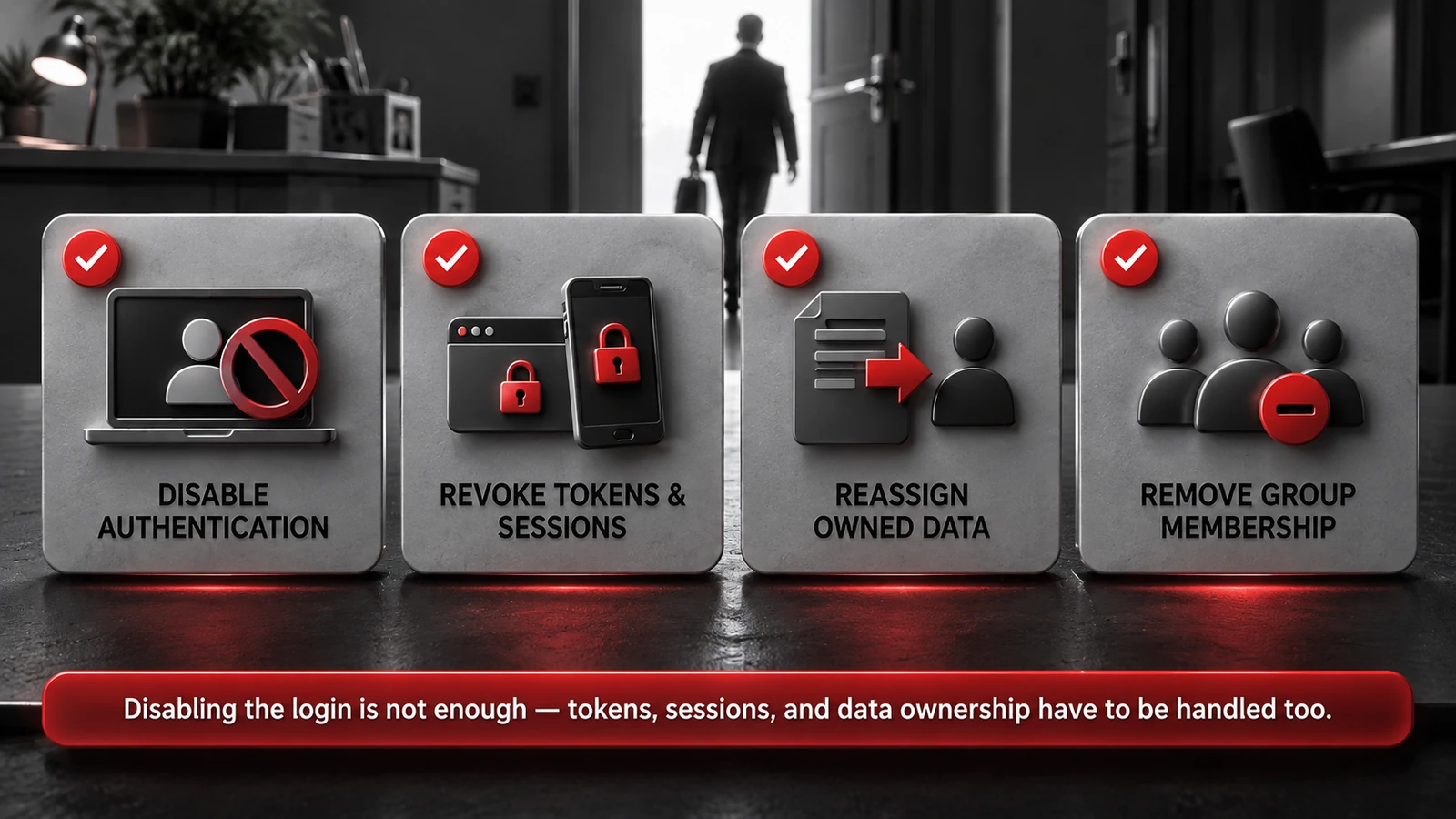 Complete deprovisioning is four coordinated actions, not one — disabling the account without killing tokens, reassigning data, and clearing memberships leaves three of the four doors open.
The order matters. Disable authentication first to stop the bleeding, then kill sessions and tokens so nothing already-issued survives, then reassign owned data while the associations still exist, and remove group memberships as part of the same coordinated pass. An automated platform performs these as a sequence against every connected system and records each action, which is what turns offboarding from an unverifiable manual effort into an auditable event with a beginning, an end, and evidence in between.
Contractors, service accounts, and the identities that don't "leave"
The HR termination event handles employees cleanly, but a meaningful share of access belongs to identities that never trigger it. Two categories need explicit handling.
Contractors and temporary workers often have a defined end date rather than a termination in the employee sense. The right pattern is to treat the contract end date as a first-class deprovisioning event — the platform revokes on that date automatically, the same way it would on a termination, rather than relying on anyone to remember that a contractor's engagement ended. Access that is time-bound at grant is access that expires on its own, which is the cleanest form of deprovisioning there is.
Service accounts and other non-human identities are harder, because they do not leave — but their human owners do. When the person who created or owned a service account departs, the account keeps running with credentials that nobody is now responsible for rotating or reviewing, which is one of the most common ways a privileged non-human identity becomes orphaned. The discipline is to require a named human owner for every service account and to make an owner's departure force a decision: reassign the ownership or decommission the account. That is a distinct governance problem with its own mechanics, covered in the service-account and non-human identity guide. The unifying principle across employees, contractors, and service accounts is the same: access should expire on an event the system already knows about, and no identity should be exempt from having such an event.
What Avatier ships toward this pattern
Avatier Identity Anywhere treats the leaver event as part of one governed lifecycle rather than a separate manual chore bolted onto the end. It ingests worker status from the HR system of record and, when a person is marked terminated — or when a contract end date arrives — treats that as the authoritative trigger to cascade revocation across the connected estate. It does so through the same connector fabric it uses to provision, which is the point: the systems it can revoke from are the systems it granted into, so what was provisioned is what gets deprovisioned.
Mechanically, the platform disables authentication, terminates sessions and revokes tokens where the target system exposes that capability, routes owned-data reassignment to the appropriate approver, and removes group and role memberships — recording each action so the offboarding produces an audit trail instead of a hope. Because provisioning, movement, and deprovisioning run through one platform, access reviews and recertification operate against the same model, so entitlements that should have been removed surface for review rather than lingering unseen. This is the exit-side expression of running the user lifecycle as one integrated governance flow, and it is the same platform discipline described across Avatier's lifecycle work, including the identity lifecycle management overview.
The compliance posture behind the platform is published on the Avatier Trust Center: SOC 2 Type II audited with zero exceptions noted, ISO/IEC 27001:2022 certified, PCI DSS v4.0.1 compliant, CSA STAR Level 1 attestation, NIST 800-53 Rev. 5 aligned, and a CISA Secure-by-Design Pledge signatory.
ABOUT THE AUTHOR

More from IAM & Identity Governance

Account Takeover Prevention: A 2026 Defender's Guide
Most account takeovers don't start with a new exploit — they start with a password the attacker already has, which is exactly why the preventive controls that work look nothing like the ones most programs invest in first.

Identity Management and Digital Transformation in 2026
Every major transformation initiative — cloud migration, remote and hybrid work, mergers and acquisitions — eventually stalls on the same question: who gets access to what, and who decided? The 2026 strategy reference on identity management as the enabler and the bottleneck of digital transformation, the business case executives actually fund, and what modernization does not fix.
Automated User Provisioning: How It Works and Implementation (2026)
Automated user provisioning creates, updates, and revokes access from a single source of truth as identity events happen. What it is, how it works, and how to implement it.