Account Takeover Prevention: A 2026 Defender's Guide
Most account takeovers don't start with a new exploit — they start with a password the attacker already has, which is exactly why the preventive controls that work look nothing like the ones most programs invest in first.

Most account takeovers don't start with a new exploit — they start with a password the attacker already has, which is exactly why the preventive controls that work look nothing like the ones most programs invest in first.
- Most account takeovers begin with a credential the attacker already possesses — phished, reused, sprayed, or bought from an unrelated breach — not with a novel technical exploit. That single fact reorders the entire prevention priority list: the controls that matter most are the ones that make a valid-looking credential insufficient on its own, not the ones that harden against exotic attacks that are rarer than the fundamentals.
- The common attack vectors are a short, well-understood set: credential stuffing that replays leaked username-password pairs at scale, phishing that harvests credentials and live sessions, password spraying that tries a few common passwords across many accounts to stay under lockout thresholds, and MFA fatigue that bombs a user with push prompts until one is approved out of habit.
- The warning signs of a compromised account are equally recognizable once you know the pattern: impossible travel between two logins too far apart in time and space, authentication from a new or unknown device, a sudden burst of password resets, and unusual privilege use where an account starts reaching systems its history says it never touches.
- The controls that actually stop takeover cluster into four: phishing-resistant MFA that a relayed session or prompt-bomb can't defeat, breached-password screening that rejects credentials already known to be compromised, anomaly detection that flags a valid-credential login behaving abnormally, and session and token controls that limit how long and how far a stolen session stays useful.
- Account takeover prevention shrinks the attack surface and raises the cost of compromise, and it works best layered with detection and response so each control covers the next.
Account takeover is what happens when an attacker gains control of a legitimate user's account by authenticating as that user — and the uncomfortable reality is that most of the time, they do it with a password you already issued, not with an exploit nobody's seen before. The login succeeds because it's technically correct: a real username, a working credential, presented to a system that has no way to know the hands on the keyboard aren't the ones it belongs to. That single fact is the organizing principle of everything that follows. If you internalize that most takeovers start with a credential the attacker already has, the prevention priority list reorders itself — the controls that matter most become the ones that make a valid-looking credential insufficient on its own, and the exotic-attack hardening that dominates a lot of security spend drops down the list where the actual threat frequency puts it.
This piece is the preventive counterpart to our identity threat detection and response guide. Where that piece covers what to do once a takeover is underway — detection, containment, session revocation, recovery — this one stays deliberately upstream: the attack vectors attackers actually use, the warning signs that tell you a login has gone wrong, and the specific controls that stop a takeover before or at the moment of authentication. The two disciplines are complementary, and keeping them scoped apart is what lets each one go deep instead of shallow across both.
How Attackers Actually Take Over Accounts
The takeover playbook is short, and it hasn't changed as much as vendor marketing implies. Four vectors account for the overwhelming majority of account takeovers, and every one of them exploits credentials and human behavior rather than a software vulnerability. Understanding them isn't academic — the vector determines the control. You can't defend against something you've mischaracterized, and a program built to stop clever exploits while the front door falls to a leaked password list is defending the wrong wall.
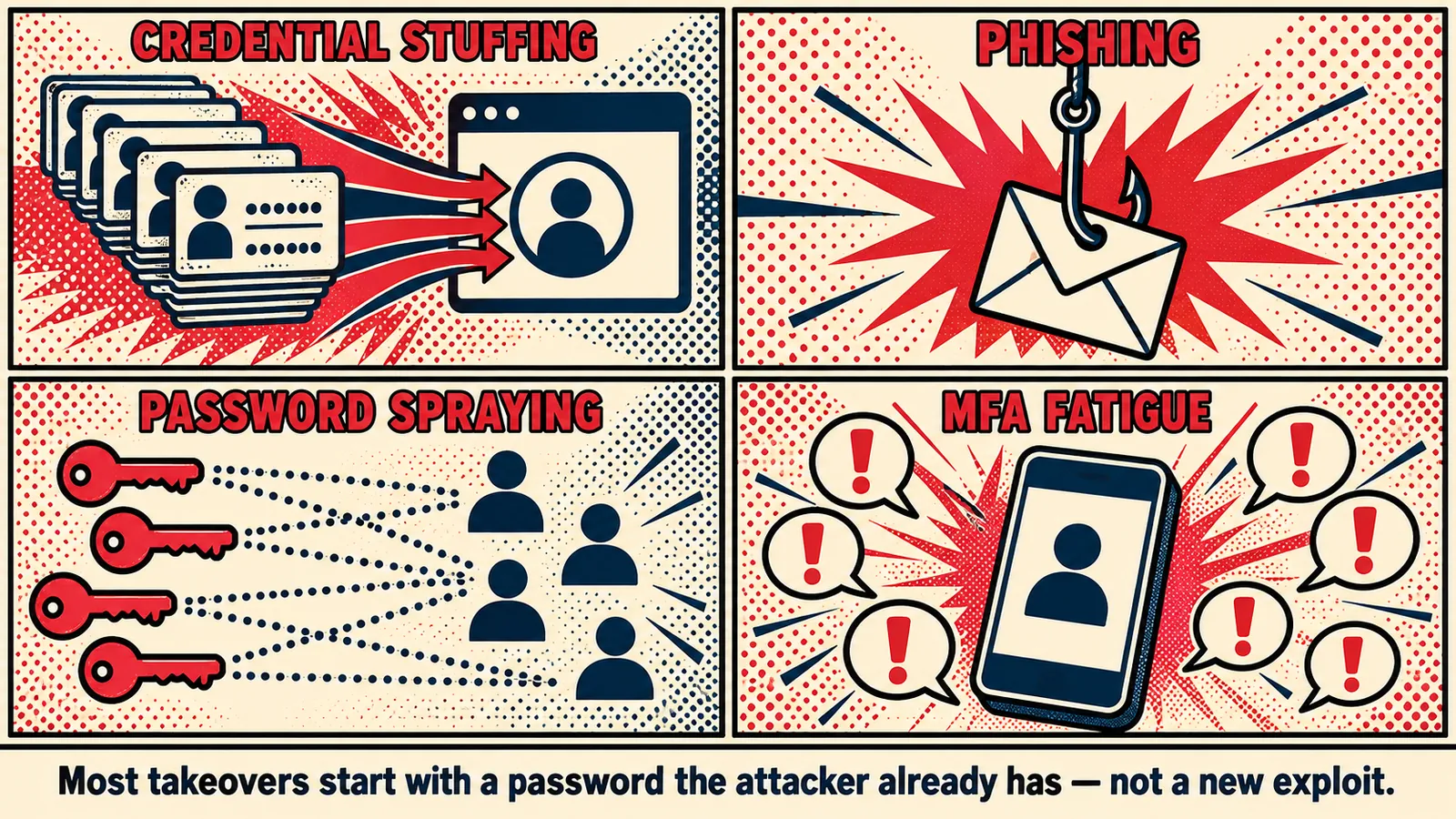 The four vectors that drive most takeovers all exploit credentials and human behavior — not novel exploits, which is exactly why credential-level controls matter more than exotic hardening.
Credential stuffing is the industrial-scale version of the reuse problem. Attackers take enormous lists of username-password pairs leaked from unrelated breaches and replay them, often through automated tooling, against a target's login endpoint. The bet is simple and depressingly reliable: enough people reuse the same password across sites that some fraction of any large leaked list will work somewhere it was never meant to. Credential stuffing requires no skill against the target itself — the work was done by whoever breached the original site — which is why it's so common and why breached-password screening is such a direct counter.
Phishing harvests the credential straight from the user. Classic phishing captures a username and password entered on a lookalike page; the more dangerous modern variant, adversary-in-the-middle phishing, relays the victim's session in real time, capturing not just the password but a live authenticated session that sails past many second factors. Phishing is the vector that makes MFA implementation choices matter so much, because a relayed session defeats the weaker factors while phishing-resistant ones hold.
Password spraying inverts the brute-force model to evade lockout. Instead of trying many passwords against one account — which trips lockout thresholds fast — spraying tries a small set of very common passwords across a large number of accounts, staying under the per-account attempt limit by spreading wide rather than deep. It's patient and quiet, and it works precisely against the population of accounts still protected by a guessable password and nothing else.
MFA fatigue, or prompt bombing, targets the human at the second factor. Once an attacker has a working password, they trigger authentication repeatedly, flooding the legitimate user with push-approval prompts until one is approved — out of confusion, annoyance, or the assumption that the system is malfunctioning. It's a social attack wearing a technical costume, and it specifically defeats simple push-based MFA while leaving number-matching and phishing-resistant factors intact.
What ties these four together operationally is that none of them requires the attacker to be present in your environment before the login — the reconnaissance and the raw material are gathered elsewhere and cheaply. A leaked credential list is bought, a phishing kit is rented, a spraying tool runs from anywhere. That economics matters for prioritization: the vectors with the lowest cost and highest reuse across targets are the ones you will face most often, which is why the fundamentals of credential hygiene and factor strength consistently outperform investment in defenses against rarer, more bespoke attacks. A program that measures its maturity by how well it stops sophisticated adversaries, while a leaked password from an unrelated breach still opens the front door, has optimized for the exception and neglected the rule.
The Warning Signs of a Compromised Account
Because a takeover login is technically valid, you can't catch it by asking "was this credential correct?" — it was. You catch it by asking "does this behavior match what this account actually does?" The warning signs of compromise are behavioral, and the good news is that the reliable ones are recognizable and, at scale, learnable. The challenge is that any one signal in isolation produces false positives; the art is in correlating them and weighting by risk.
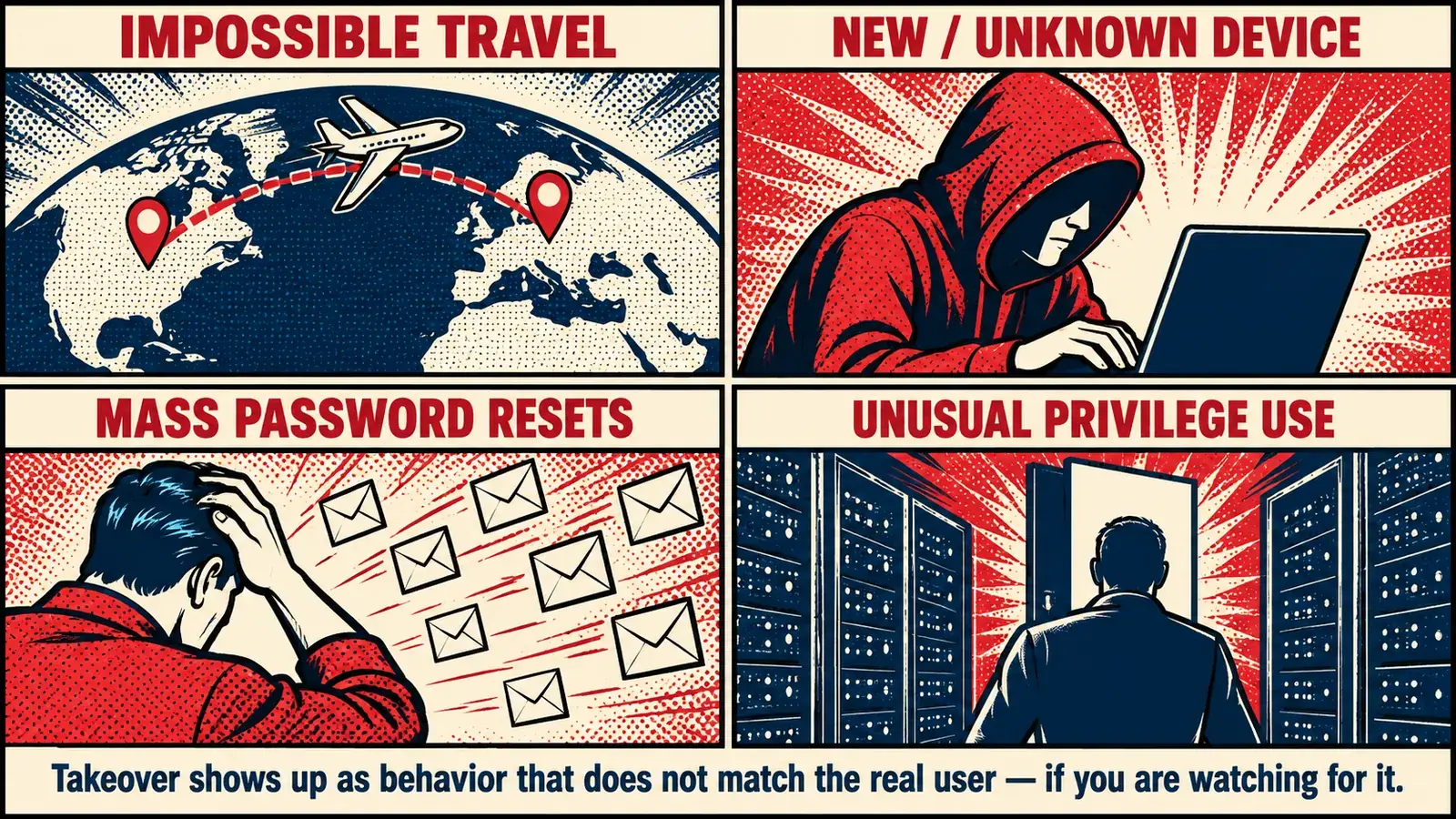 A takeover login is technically valid, so the signal is never the credential — it's the behavior around it: where, from what, how often, and reaching for what.
Impossible travel is the classic geographic tell: two authentications from the same account originating in locations too far apart to physically bridge in the time between them. A login from one continent followed twenty minutes later by a login from another isn't a fast traveler — it's two different people, and one of them isn't the account owner. It's not foolproof, since VPNs and mobile networks muddy geolocation, but as one signal among several it's a strong one.
Authentication from a new or unknown device matters most in combination with what happens next. A first-time device that immediately reaches for sensitive data or administrative functions behaves nothing like a genuine new laptop being set up by its owner, who typically eases in with routine activity. Device novelty on its own is noise; device novelty followed by anomalous reach is signal.
Mass password resets cut two ways. A burst of reset requests against a single account can signal an attacker trying to seize control by locking the real user out. A burst of resets across many accounts at once can signal either a broad takeover campaign in progress or reconnaissance probing which accounts exist. Either pattern deserves a look, because legitimate password resets don't usually arrive in clusters.
Unusual privilege use is often the clearest and most consequential sign. When an account that has never touched a financial system, an admin console, or a sensitive data store suddenly starts reaching for exactly those things, the credential is very likely in the wrong hands. This is also where a takeover turns from a login problem into a breach, which is why anomaly detection weights privilege-scope deviation so heavily — and why the governance question of how much any account can reach, covered in our data breaches and IAM guide, determines how bad a missed signal gets.
The discipline that separates a useful alerting posture from a noisy one is correlation. Impossible travel alone flags road-warriors on VPNs; a new device alone flags an ordinary hardware refresh; a password reset alone flags a forgetful Monday. But a new device authenticating from an improbable location, then immediately requesting a reset and reaching for a system the account has never used, is a coherent story with one plausible ending. Risk-based authentication systems are built on exactly this logic — they hold each individual signal at a low weight and escalate only when several stack up in the same session, which is how a program keeps false positives survivable while still catching the pattern that actually matters. The goal is not to alert on every anomaly; it's to alert on the anomalies that co-occur.
The Controls That Actually Stop Account Takeover
Mapped against those vectors and signals, a focused set of preventive controls does almost all of the real work. The pattern that connects them is worth stating directly: each one attacks the "valid credential is enough" assumption from a different angle — by making the credential insufficient, by keeping known-bad credentials out, by catching valid credentials behaving wrong, or by limiting what a captured session is worth.
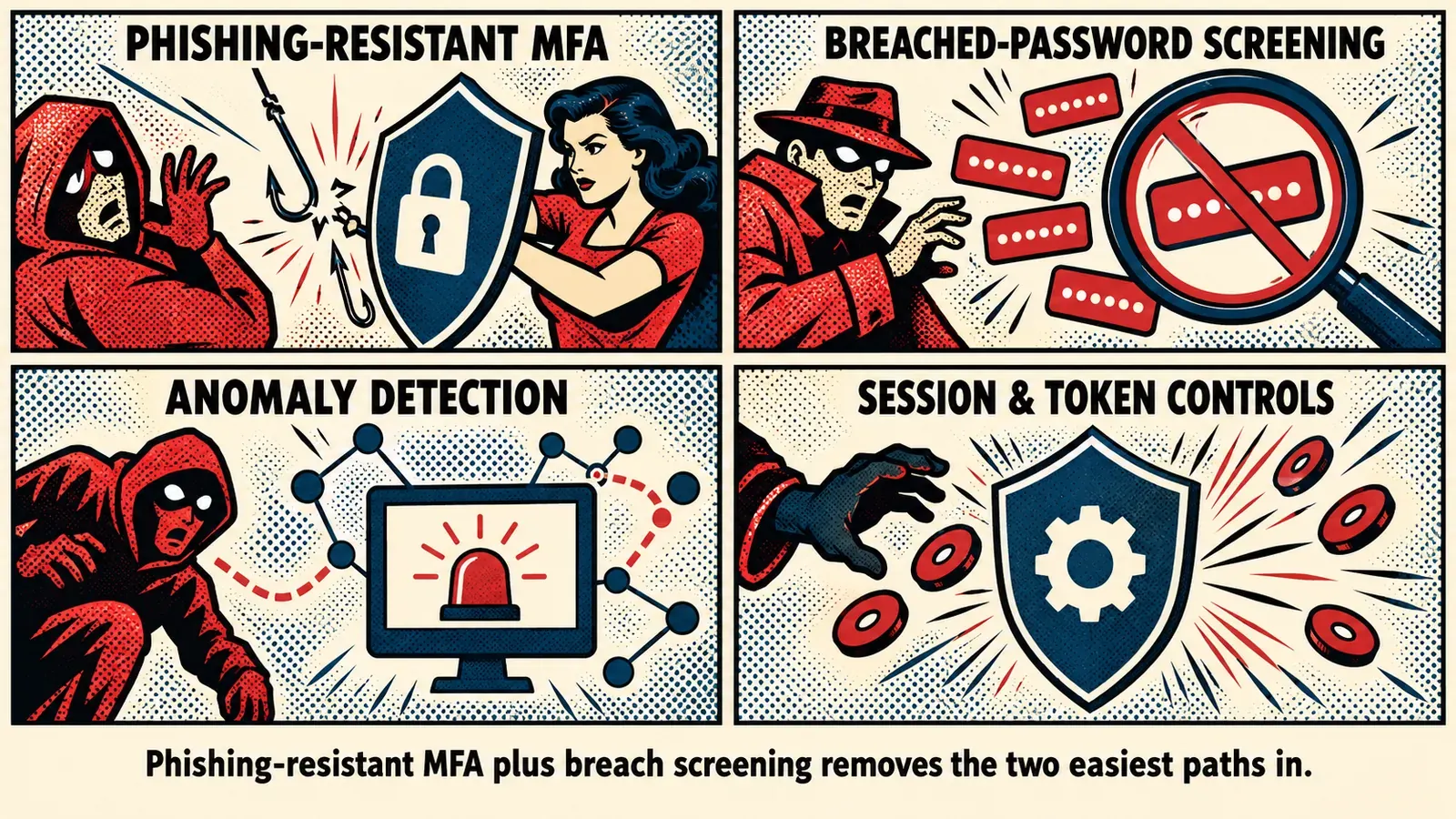 Each preventive control attacks the same flawed assumption from a different angle — that a valid-looking credential should be enough to grant access.
Phishing-resistant MFA is the highest-leverage single control against the phishing and MFA-fatigue vectors. The distinction between basic and phishing-resistant MFA is not pedantic — it's the difference between a factor that survives an adversary-in-the-middle relay and one that doesn't. Passkeys, FIDO2-compatible hardware security keys, and certificate-based authentication bind the authentication cryptographically to the legitimate origin, so a relayed session or a lookalike page has nothing usable to capture, and there's no push prompt to fatigue a user into approving. Where a full move to phishing-resistant factors isn't yet possible, number-matching and additional context on push prompts meaningfully raise the bar against prompt bombing in the interim.
Breached-password screening directly severs the credential-stuffing and reuse chain. By checking every password — at creation, at change, and ideally on a recurring basis — against corpora of credentials known to be exposed, and rejecting any match, screening ensures that a password already circulating in a criminal dump never becomes a valid credential in the first place. It's unusually high-leverage because it targets the exact mechanism the most common vectors depend on: the reused, already-leaked password. Where it fits in a modern policy — alongside dropping counterproductive complexity theater and forced rotation — is the subject of our enterprise password policy piece.
Anomaly detection is the control that catches what authentication can't, because it evaluates behavior rather than credentials. It's what turns the warning signs above — impossible travel, device novelty, privilege-scope deviation — from things a human might notice into things a system flags in real time, by building a baseline of an identity's normal behavior and scoring how far a given event falls outside it. Anomaly detection is inherently probabilistic, which means tuning it is a real discipline with real tradeoffs between missed detections and alert fatigue; our identity anomaly detection piece covers the modeling mechanics and how to tune a baseline for the threats that matter.
Session and token controls limit the value of a credential or session that does get captured. Reasonable session lifetimes, re-authentication requirements for sensitive actions, token binding, and prompt revocation on risk signals mean that a hijacked session is useful for minutes rather than days, and that stepping up to a high-value action forces a fresh, phishing-resistant proof. This layer matters specifically because it's the one that still helps after another control has already failed — it assumes a session will sometimes be stolen and shrinks the window in which that theft pays off.
The reason this layer is easy to under-invest in is that it fights a threat the other three are supposed to have already stopped, and stopping something twice feels redundant until the first control is the one that fails. Adversary-in-the-middle phishing is the clearest case: the attacker's whole objective is a live session token, not the password, precisely because the token is what remains valid after a successful MFA challenge. Against that, factor strength at the login is only half the answer — token binding that ties the session to the device it was issued on, and revocation that fires the moment a risk signal appears, are what deny the stolen token its worth. Treat session lifetime, re-authentication triggers, and revocation speed as first-class controls rather than defaults you inherited from a framework, because they are the ones that determine whether a bypass elsewhere becomes a contained event or a free-roaming one.
What Avatier Ships Toward This Pattern
Avatier Identity Anywhere contributes to account takeover prevention at the layers where governed identity and authentication meet. On the authentication side, the platform supports FIDO2-compatible passwordless authentication — the phishing-resistant factor category that closes the adversary-in-the-middle and MFA-fatigue gaps that defeat weaker MFA, and that removes the password entirely from the accounts where it's deployed, taking credential stuffing and spraying off the table for those identities by construction. On the credential-hygiene side, the platform's password governance capabilities screen against breached-credential exposure so that a password already known to be compromised doesn't become a working one.
Just as important is the layer Avatier is built around: the governed identity foundation that determines what "normal" looks like and how far any single compromised account can reach. Least-privilege provisioning, access certification, and HRIS-driven lifecycle deprovisioning don't stop the initial login — but they set the blast radius, which is what turns a contained takeover into a material breach or keeps it from becoming one. Anomaly detection can only flag unusual privilege use against a baseline of governed, well-scoped access; when everyone is over-provisioned, "unusual" loses its meaning.
Avatier's contribution is the preventive and governance layers that make takeover harder to start and less rewarding when it does, complementing the ITDR discipline. The compliance posture behind the platform is published on the Avatier Trust Center: SOC 2 Type II audited with zero exceptions noted, ISO/IEC 27001:2022 certified, PCI DSS v4.0.1 compliant, CSA STAR Level 1 attestation, NIST 800-53 Rev. 5 aligned, and a CISA Secure-by-Design Pledge signatory.
ABOUT THE AUTHOR

More from IAM & Identity Governance

Identity Management and Digital Transformation in 2026
Every major transformation initiative — cloud migration, remote and hybrid work, mergers and acquisitions — eventually stalls on the same question: who gets access to what, and who decided? The 2026 strategy reference on identity management as the enabler and the bottleneck of digital transformation, the business case executives actually fund, and what modernization does not fix.

AI and Behavioral Analytics for Identity Monitoring: The 2026 Enterprise Reference
Static identity rules catch the attacks that announce themselves. They miss the ones that log in with valid credentials and behave almost normally. The 2026 reference on AI-driven identity monitoring — what behavioral analytics actually detects, the four telemetry sources that make or break the model, and the false-positive economics nobody budgets for.

Automated Deprovisioning: Closing Access When People Leave 2026
Deprovisioning is the revoke side of the identity lifecycle: a leaver event that cascades revocation across every connected system so no active account, live session, or token outlives the person.