Real-Time Regulatory Monitoring: How It Actually Works in 2026
Real-time regulatory monitoring replaces the quarterly compliance scramble with a continuous detect-assess-remediate loop, but only if the identity data underneath it is accurate to begin with.

Real-time regulatory monitoring replaces the quarterly compliance scramble with a continuous detect-assess-remediate loop, but only if the identity data underneath it is accurate to begin with.
- Real-time regulatory monitoring is a continuous detect-assess-remediate-reverify loop built on live access and entitlement signals, not a faster version of the same periodic audit — the mechanical difference is that findings surface while they're still open instead of at the next scheduled review.
- The signals that make it possible already exist inside most identity infrastructure: access logs, entitlement changes, policy-versus-reality drift, and configuration changes. The gap most organizations have isn't missing data, it's that the signals aren't wired into a single continuous pipeline.
- AI genuinely helps with pattern detection and alert triage — surfacing the handful of meaningful signals out of a high-volume stream — but it does not decide whether an ambiguous access grant is a violation; that judgment call still belongs to a compliance analyst.
- Periodic and real-time monitoring are not competing philosophies so much as different sampling rates over the same underlying reality; the practical question is how long a policy violation is allowed to stay open before someone notices it.
- Continuous monitoring does not replace a compliance program, does not remove the need for human judgment on ambiguous findings, and is only as trustworthy as the identity data feeding it — a real-time system built on stale entitlement records just produces confidently wrong alerts faster.
Real-time regulatory tracking works by pulling compliance-relevant signals — access events, entitlement changes, policy drift, configuration changes — directly from the systems that generate them, evaluating those signals continuously against the control language a given regulation expects, and routing anything that looks like a divergence to a human reviewer before it has a chance to sit unnoticed for weeks. That's the mechanical core of it. The rest of this piece is about what feeds that loop, what actually breaks down when organizations try to build it, and where AI genuinely earns its keep versus where the marketing gets ahead of the engineering.
This is the 2026 update to an earlier Avatier piece on real-time regulatory monitoring, which covered similar ground at a higher level. This version narrows the focus and drops every claim that couldn't be sourced to something other than a press release: no manufactured percentage reductions in audit findings, no invented per-day counts of new regulations, no unattributed vendor-comparison numbers. What's left is the part that holds up under scrutiny — how the loop actually works, what feeds it, and what it doesn't do.
What real-time regulatory monitoring actually means
The term gets used loosely enough that it's worth being precise. Real-time regulatory monitoring is not simply "compliance software with a dashboard" — plenty of periodic-audit tooling has a dashboard. The distinguishing feature is the evaluation cadence: a real-time system assesses compliance-relevant state continuously, as events happen, rather than reconstructing that state from a point-in-time snapshot pulled before a scheduled review.
Periodic, manual compliance checking has a specific and well-understood failure mode. A compliance analyst, ahead of a quarterly certification or an annual audit, exports current access data, HR records, and configuration state, and reconciles all of it by hand against documented policy. Anything that diverged from policy between the last review and this one only surfaces if it happens to still be visible at the moment of the snapshot. A termination that should have triggered deprovisioning ninety days ago but didn't will show up in this review — but the same class of gap that opened and closed between two review cycles, invisibly, never gets caught at all. The periodic model isn't wrong, exactly; it's sampling reality at a rate too slow to catch everything that matters.
Real-time monitoring changes the sampling rate to something closer to continuous. It doesn't replace the judgment work of a compliance program — deciding what a control should require, interpreting a regulation's intent, negotiating a remediation timeline with an examiner — it changes how quickly a divergence between documented policy and actual system state gets noticed. The access review piece covers the review discipline this composes with in more depth; this piece stays focused on the monitoring layer that runs between those formal reviews.
The signal sources that feed a real-time monitoring system
Nothing about real-time monitoring requires exotic data most organizations don't already have. Four signal categories do almost all of the work, and all four are typically already generated somewhere inside an enterprise's identity and access infrastructure — the gap is usually that they aren't unified into one continuously evaluated pipeline.
Access logs capture who authenticated to what system, when, from where, and under what session context. On their own they're a record of activity, not a compliance verdict — but patterns in access logs (a service account authenticating from an unexpected location, a login outside normal hours to a financial system) are often the first signal that something worth investigating happened.
Entitlement changes capture grants, revocations, and role modifications as they occur, ideally with the approval record attached at the moment of the change rather than reconstructed later. This is the category that most directly maps to control language auditors care about — who has access to what, and was it approved.
Policy-versus-reality drift compares the access policy an organization has documented against the entitlement state the identity system actually shows right now. This is arguably the single highest-value signal category, because most audit findings originate exactly here: not in the absence of a written policy, but in the gap between what the policy says and what's actually true. An account that should have been disabled at termination but wasn't. A role grant that expanded past its approved scope and was never rolled back.
Configuration changes capture modifications to the controls themselves — an MFA enforcement rule quietly disabled, an approval workflow step bypassed, a logging setting turned down. This category matters because it catches erosion of the monitoring and enforcement layer itself, not just erosion of the access state the layer is supposed to be watching.
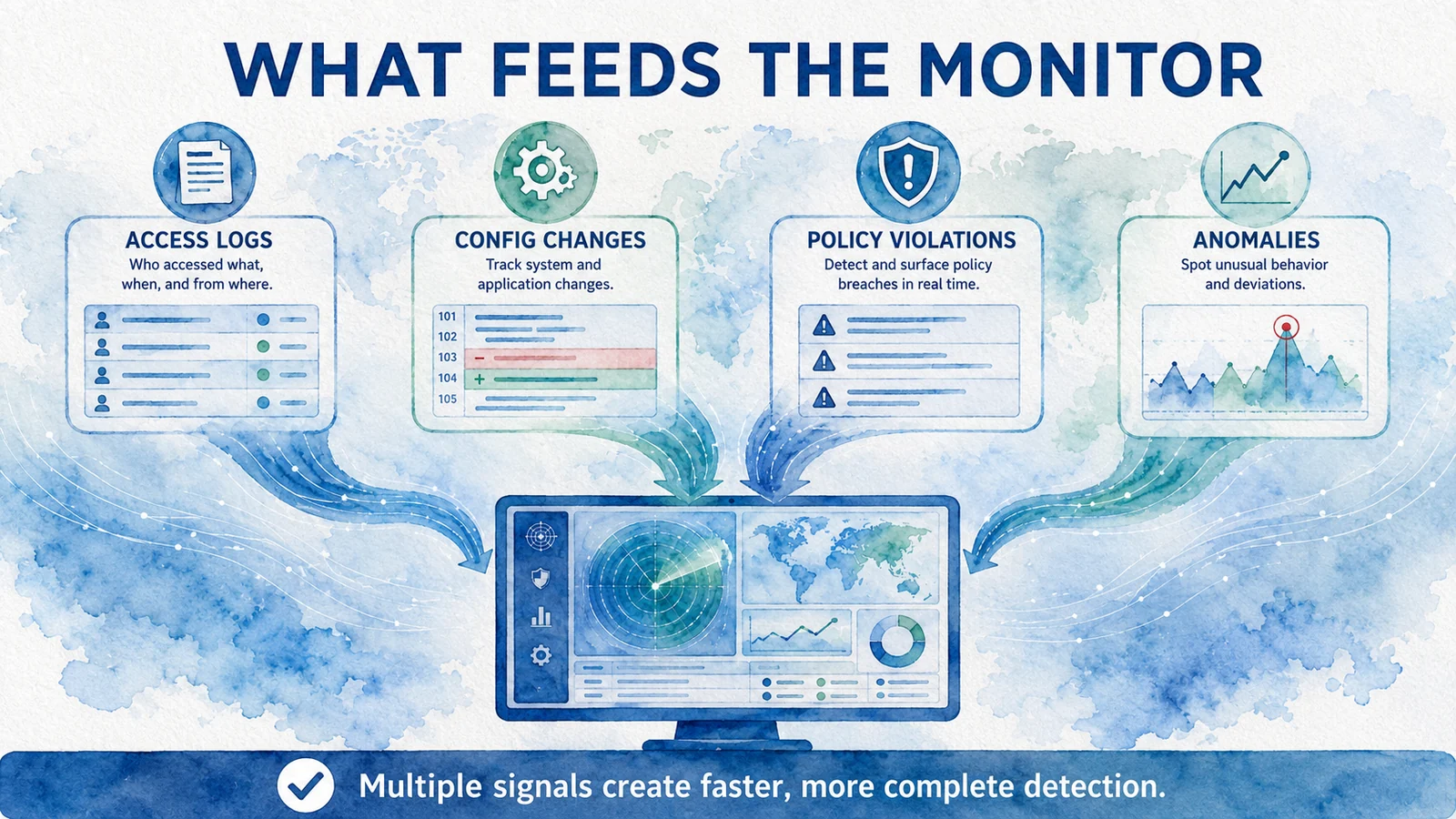 Four signal categories, one pipeline — access logs, entitlement changes, policy drift, and configuration changes feed the same continuous monitoring loop rather than four separate review processes.
Most organizations that struggle with real-time monitoring aren't missing these signals; they're generating all four somewhere but never wired them into a single evaluated stream, so each one gets reviewed on its own schedule by a different team, if it gets reviewed at all.
The detect-assess-remediate-reverify loop
Once the signal sources are unified, real-time monitoring is best understood as a loop rather than a one-time check. Detect is the continuous evaluation step — a signal arrives, gets compared against documented policy and control language, and either matches expected behavior or gets flagged as a candidate divergence. Assess is where a flagged item gets context: is this actually a violation, or an approved exception that just looks unusual in isolation? This is the step that still requires human judgment on anything ambiguous, and it's the step most vendor pitches for this category quietly skip over. Remediate is the corrective action — revoking an entitlement that shouldn't exist, re-enabling a control that was disabled, closing the gap the detect step surfaced. Re-verify closes the loop: confirming the remediation actually took effect in the underlying system, not just that a ticket was marked resolved.
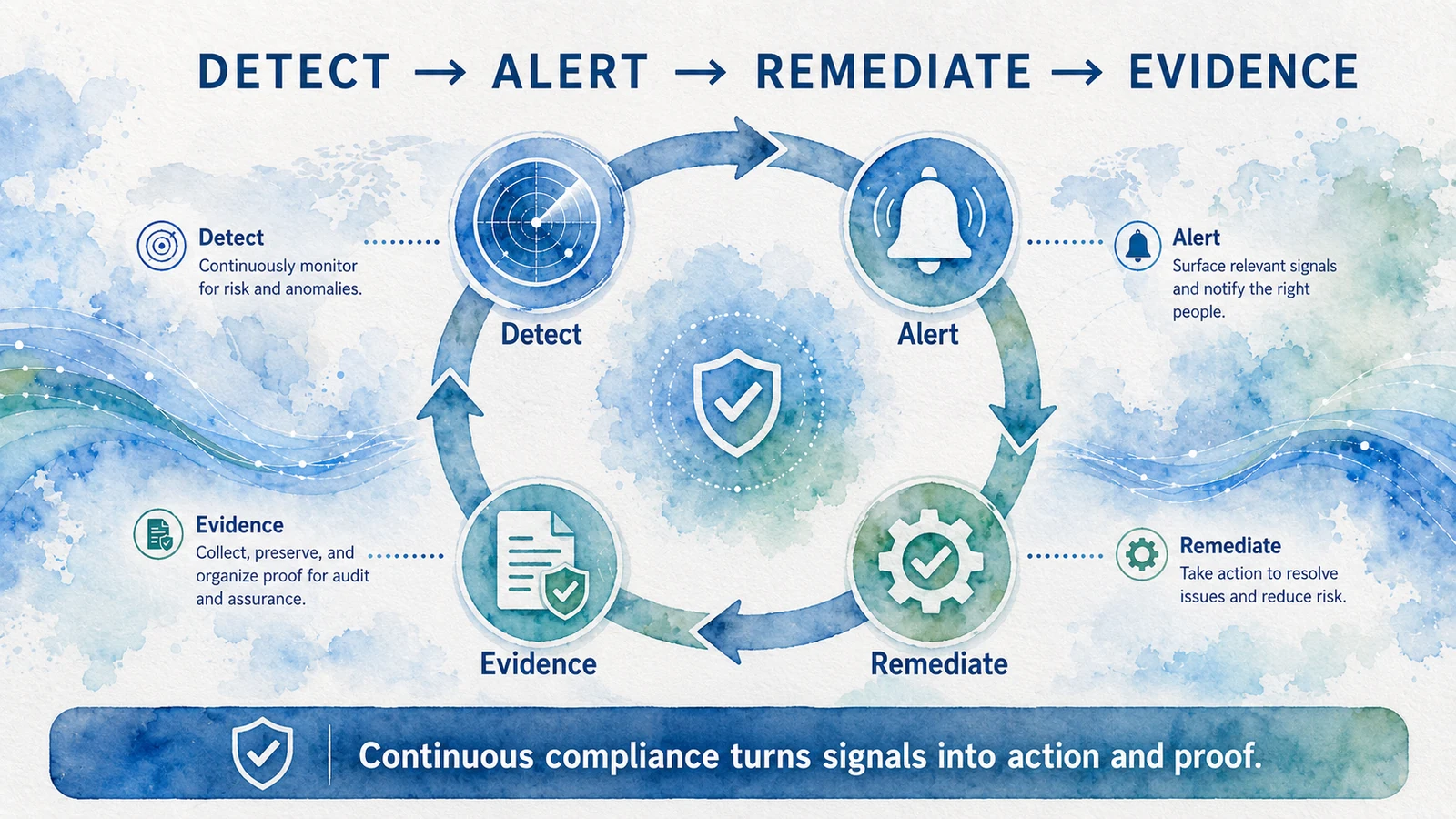 Detect, assess, remediate, re-verify — real-time monitoring is a loop, not a checklist; a finding that isn't re-verified after remediation is a finding that can silently reopen.
That last step — re-verification — is easy to skip and expensive to skip. A remediation ticket marked "resolved" is not the same claim as "the entitlement is actually gone from the target system." Real-time monitoring earns its name by closing that loop continuously rather than treating remediation as the end of the process.
Real-time vs. periodic: what actually changes
It's worth being concrete about the practical difference, because "real-time" can sound like marketing shorthand for "faster" without saying faster at what. The honest comparison isn't real-time versus periodic as competing philosophies — it's a difference in how long a policy violation is allowed to remain open before someone notices.
Under a purely periodic model, a violation's maximum lifespan is bounded by the review cycle: if certifications run quarterly, a divergence that opens the day after a review closes can persist, undetected, for up to ninety days. Under a real-time model, the same divergence is bounded by the evaluation latency of the monitoring pipeline — typically hours, sometimes minutes, depending on how the signal sources are wired in. The underlying regulatory requirement doesn't change between the two models. What changes is the size of the exposure window before someone acts on it.
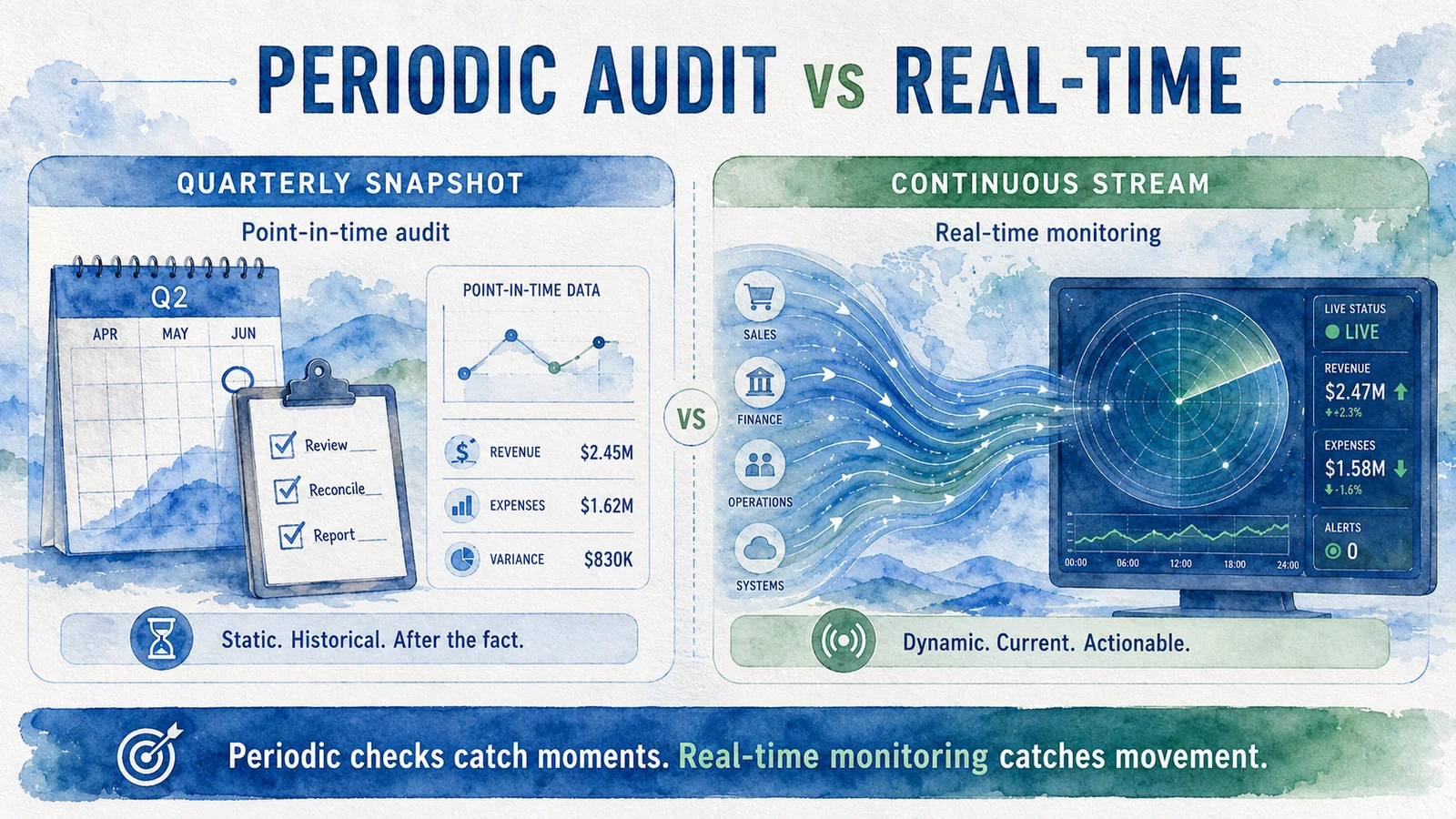 Same violation, two exposure windows — periodic review catches it at the next scheduled checkpoint; continuous monitoring catches it while it's still open.
This is also where the "isn't a faster audit the same thing" objection breaks down. A faster periodic audit still samples reality at discrete intervals; it just shortens the interval. A real-time system removes the interval as the limiting factor and instead limits exposure by evaluation latency, which is a materially different and generally smaller number. Neither model replaces the other's institutional role — the periodic audit still produces the formal, attested opinion an auditor signs off on — but the exposure window during the gaps between audits is the thing real-time monitoring is actually built to shrink.
There's a second, less obvious difference worth naming: what each model can honestly claim after the fact. A periodic audit can only assert what the system showed on the day it was checked — a defensible claim, but a narrow one. A real-time model, because it evaluated the same population of accounts continuously across the entire assessment window, can assert something stronger: that no undetected divergence existed at any point in the period, or if one did, exactly when it opened and how long it took to close. That second claim is the one auditors are increasingly asking for as continuous-monitoring expectations tighten across frameworks, and it's simply not available from a point-in-time snapshot no matter how often the snapshot is retaken.
Where AI genuinely helps, and where it's overhyped
AI's real contribution to this pattern is narrower than a lot of vendor messaging implies, and it's worth separating the two jobs it's actually good at from the one it isn't.
Pattern detection is the first job, and it's a legitimate one. Once signal volume crosses a threshold no team of analysts could review manually — which is quickly, for any enterprise of meaningful size — a model that's learned what normal entitlement-change and access-pattern behavior looks like for a given role can flag statistical outliers faster and more consistently than a manual review process. It's the same category of capability covered from the reporting side in the AI-driven regulatory reporting piece: pulling structured signal out of a high-volume stream is squarely in AI's strike zone.
Alert triage is the second legitimate job. Not every flagged divergence deserves equal attention, and a triage layer that ranks flagged items by risk and business context — a privileged account on a financial system outranks a low-risk entitlement on an internal wiki — makes the human review step tractable instead of a backlog nobody works through.
Where the overhype starts is treating AI as the thing that decides whether an ambiguous flag is actually a violation. A model can surface that an entitlement grant looks unusual relative to a role's typical pattern; it cannot reliably determine whether that grant reflects a legitimate, documented business exception, a temporary project assignment nobody updated the role definition for, or an actual policy violation. That's a judgment call that depends on organizational context a pattern-matching system doesn't have — and getting it wrong in either direction (a false positive that burns reviewer time, or a false negative that lets a real violation through because it resembled an approved pattern) has real cost. The honest framing: AI narrows the queue and orders it; a compliance analyst still works the queue.
What Avatier ships toward this pattern
Avatier Identity Anywhere Lifecycle Management generates the underlying data this pattern depends on as a normal part of governed access workflow — entitlement changes with approver records, certification-campaign results, and access-request approval trails captured at the moment they happen rather than reconstructed from logs after the fact. Between formal certification cycles, continuous posture evaluation compares documented access policy against actual current entitlement state and surfaces drift as it opens, which is the specific mechanism behind the detect step of the loop described above.
Access certification and policy enforcement are where the assess and remediate steps live operationally: certification campaigns give reviewers a structured, evidence-backed queue rather than an unfiltered export, and policy enforcement acts on confirmed violations rather than leaving remediation as a manual follow-up task tracked in a separate system. Audit trails tie the whole loop together — every detected divergence, every reviewer decision, and every remediation action is recorded in a form an auditor can review directly, which is the same evidence discipline covered in more depth in the SOX access controls piece and the HIPAA access audits piece from the regulation-specific side.
Avatier's platform is the identity governance layer that generates accurate signal, structures it for review, and closes the loop on remediation, which is the precondition for real-time monitoring working at all rather than producing noise.
ABOUT THE AUTHOR

More from Compliance & Audit

AI-Driven Regulatory Reporting: The 2026 Automation Playbook
AI now assembles, drafts, and maintains the compliance evidence auditors ask for across SOX, HIPAA, PCI, and FISMA — but it still needs a human to attest before anything gets filed.
SOX Compliance Without the Spreadsheet: What Auditors Actually Want to See in IAM 2026
SOX §404 requires access controls that produce evidence, not policy documents that describe them. The 2026 enterprise reference on the four IAM access-control domains SOX auditors probe, the five reports they'll ask for, and the architecture that generates them on-demand rather than in the quarter-end scramble.

Why FISMA Compliance Programs Still Fail in 2026
Federal agencies pass FISMA audits every year and still get breached — the identity governance gaps assessors keep missing are the same ones attackers exploit.