AI-Driven Regulatory Reporting: The 2026 Automation Playbook
AI now assembles, drafts, and maintains the compliance evidence auditors ask for across SOX, HIPAA, PCI, and FISMA — but it still needs a human to attest before anything gets filed.

AI now assembles, drafts, and maintains the compliance evidence auditors ask for across SOX, HIPAA, PCI, and FISMA — but it still needs a human to attest before anything gets filed.
- AI-driven regulatory reporting automation is a layer that sits across specific regulations — it continuously collects access evidence, maps it to a given framework's control language, and drafts auditor-ready documentation, rather than replacing the work of understanding any single regulation.
- The core mechanical shift is from point-in-time evidence gathering (a compliance analyst manually pulling exports before an audit) to a continuous feed that's already structured against control language by the time the audit window opens.
- Drift detection — the gap between what a written access policy says and what the entitlement system actually shows — is the most consequential capability, because that gap is where most audit findings originate, not in undocumented policy.
- AI should draft; humans should attest. Every generated report needs a named reviewer who checks the underlying evidence before it goes to an auditor, because hallucination and misclassification risk in generated compliance narrative is real and the cost of an unreviewed error in a filed report is high.
- AI reporting automation does not replace an auditor's judgment, does not fix inaccurate underlying access data, and does not substitute for an organization's own control-selection and authorization decisions — it makes the evidence faster to assemble and harder to falsify, nothing more.
AI-driven regulatory reporting automation works by continuously pulling access and identity evidence directly from the systems that generate it, mapping that evidence to the control language of whichever regulatory framework applies, flagging where documented policy and actual system state have diverged, and drafting the narrative report a human reviewer checks before it goes to an auditor. It replaces the manual scramble of exporting logs and hand-assembling spreadsheets in the weeks before an audit with a feed that's already structured by the time the audit window opens. It does not replace the auditor's judgment, and it does not fix underlying access data that's wrong to begin with — it makes accurate evidence faster to assemble and harder to misrepresent.
This is the 2026 update to an earlier Avatier piece on AI and regulatory reporting, which covered similar automation themes at a higher level. This version narrows the scope deliberately: rather than re-explaining any single regulation, it focuses on the automation layer that sits across SOX, HIPAA, PCI DSS, FISMA, and every other access-control-driven compliance regime a mid-sized or larger enterprise is likely juggling at once — the mechanics of how AI actually assembles, drafts, and maintains the evidence those regulations require, and where a human still has to sign off before anything ships.
What "regulatory reporting automation" actually means
It's worth being precise about scope, because the term gets used loosely enough to cause real confusion. Regulatory reporting automation is not a substitute for understanding what a specific regulation requires — that's still the domain of pieces like the SOX §404 access controls guide, the HIPAA access audits piece, the PCI DSS v4.0.1 requirements piece, and the FISMA reference. Those pieces answer "what does this specific regulation require of an identity program." This piece answers a different question: once an organization knows what a regulation requires, how does the evidence that proves compliance with it actually get assembled, kept current, and turned into something an auditor can review — and how much of that mechanical work can AI reasonably take on.
The honest answer is: a lot of the assembly and drafting, very little of the judgment. AI is well-suited to pulling structured data from access systems, recognizing patterns that indicate policy-versus-reality drift, and generating narrative text that explains what the evidence shows in the vocabulary a given framework expects. AI is poorly suited to deciding whether a specific control design actually satisfies a regulation's intent, negotiating an acceptable remediation timeline with an examiner, or making the judgment call about whether an exception is material. Reporting automation earns its keep in the first category and should stay out of the second.
Evidence collection: from scattered logs to a continuous feed
The traditional evidence-gathering model is point-in-time and manual: a compliance analyst, weeks before an audit, requests exports from the identity system, the HR system, the ticketing system, and whatever spreadsheet is tracking exceptions, then reconciles all of it by hand into whatever format the auditor's request list specifies. Every step in that chain is an opportunity for staleness (the export reflects last month's state, not today's), inconsistency (two exports pulled a week apart use different field definitions), and simple human error in reconciliation.
AI-driven evidence collection replaces the point-in-time pull with a continuous feed. Certification campaign results, access-request approvals, entitlement changes, and deprovisioning events get captured as they happen, tagged against the control framework they're relevant to, and stored in a form that's already structured for reporting rather than needing to be reconstructed from raw logs later. The practical effect isn't just speed — a continuous feed means the evidence an auditor eventually sees reflects the system's actual behavior across the whole assessment period, not a snapshot reconstructed after the fact from whatever records happened to survive.
Control mapping: translating access data into the language auditors read
Raw access data — a list of who has what entitlement, when it was granted, who approved it — doesn't mean anything to an auditor until it's expressed in the specific control language their assessment is built around. The same underlying evidence (a quarterly certification campaign, say) has to be described differently depending on whether it's supporting a SOX §404 assertion, a HIPAA §164.312 technical-safeguards review, or a NIST 800-53 AC-2 account-management control — different vocabulary, different emphasis, sometimes different level of granularity.
Control mapping is the automation layer that does this translation without re-collecting the evidence for each framework separately. One evidence source gets tagged against however many control frameworks apply to the organization, and the reporting system generates the framework-appropriate narrative for each from that single source. This matters most for organizations managing more than one regulatory regime simultaneously — a healthcare payer that's also a public company, a financial-services firm with federal contracts — where collecting the same underlying access evidence three or four separate times for three or four separate audits is a genuinely large and avoidable cost.
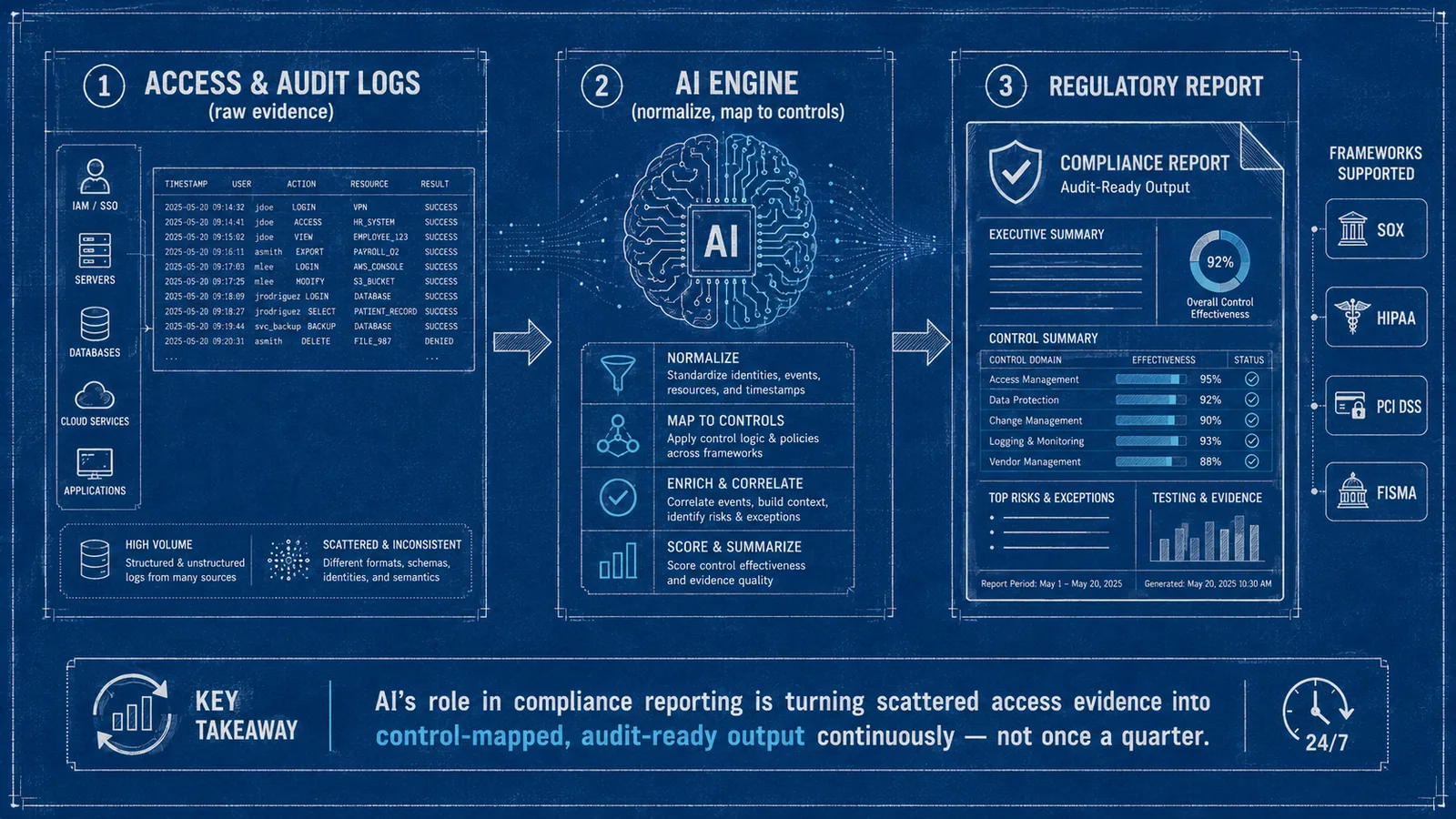 One evidence pipeline, mapped to multiple regulatory vocabularies — the same certification result becomes a SOX control narrative and a HIPAA safeguard narrative without a second data pull.
Drift detection: catching the gap between policy and reality
Most audit findings don't originate from an organization lacking a documented policy — they originate from the gap between what the policy says and what the access system actually shows. A termination policy that requires account disablement within 24 hours means little if the entitlement records show accounts still active 40 days after the HR system recorded a departure. A least-privilege policy means little if a role grant expanded past its approved scope six months ago and nobody noticed.
Drift detection is the capability that catches this gap continuously rather than at the next scheduled review. It compares the documented policy state — who should have access to what, under what conditions — against the actual, current entitlement state, and flags divergence as it opens rather than waiting for a periodic certification campaign to surface it months later. This is the same posture-monitoring discipline covered from the governance side in the ISPM piece: reporting automation and continuous posture monitoring are two views of the same underlying capability, one oriented toward what an auditor eventually reviews and one oriented toward closing the gap before it becomes a finding at all.
The value of drift detection compounds specifically because it changes what a report is capable of claiming. A report built entirely from a point-in-time snapshot can only say "this is what the system showed on the day we checked." A report built from continuous drift monitoring can say "this is what the system showed continuously across the assessment period, and here's every divergence that opened and how quickly it closed" — a materially stronger evidentiary claim, and the one auditors are increasingly asking for as continuous-monitoring expectations tighten across frameworks.
Manual vs. AI-assisted reporting: what actually changes
It's worth being concrete about what actually changes between a manual reporting process and an AI-assisted one, because the difference isn't just speed — it's where human effort gets spent. In the manual model, most of a compliance analyst's time before an audit goes to assembly: pulling exports, reconciling formats, chasing down missing evidence, and formatting the result into whatever the auditor's request list specifies. Review — actually checking whether the evidence supports the claim being made — gets whatever time is left over, often not much, especially under deadline pressure.
In the AI-assisted model, assembly happens continuously and largely unattended: the system pulls evidence, maps it to control language, flags drift, and produces a draft report on request rather than under deadline pressure. That reallocates the analyst's time toward review — checking the draft against source evidence, deciding how to characterize any flagged exceptions, and making the judgment calls that shouldn't be automated in the first place. The report doesn't get better because AI writes better prose than a compliance analyst; it gets more defensible because a larger share of the available time goes to scrutiny rather than assembly.
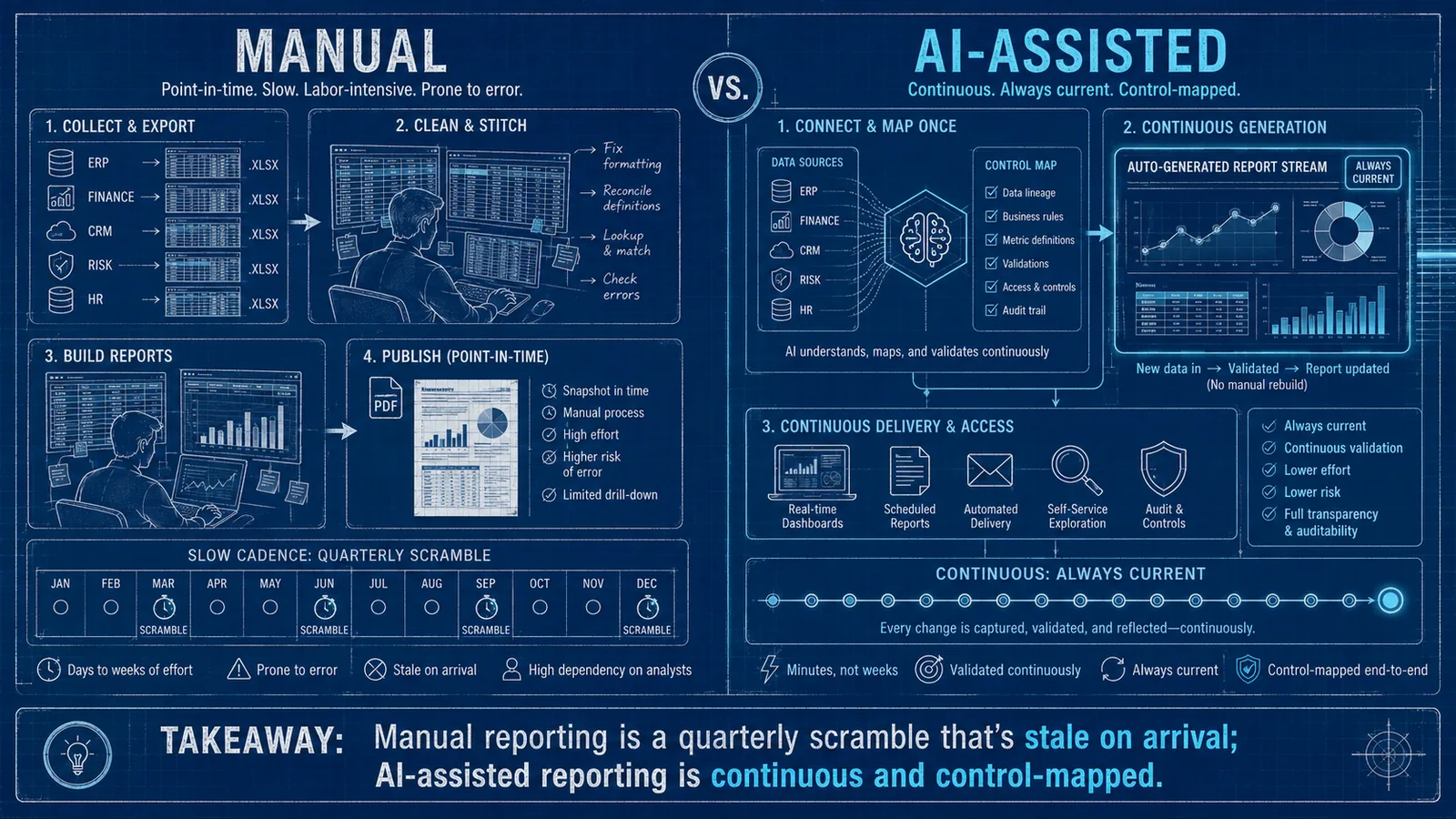 The difference isn't less human effort — it's where that effort goes: from manual assembly under deadline pressure to structured review with time actually built in for scrutiny.
Human review checkpoints: AI drafts, humans attest
None of the above is a case for letting a generated report go to an auditor unreviewed. The operating principle that should govern every AI reporting workflow is simple: AI drafts, humans attest. A language model assembling a compliance narrative can misclassify an exception, smooth over a gap that should be flagged prominently, or generate control language that sounds right but doesn't actually match what the underlying evidence supports. Because a regulatory report is a representation made to an external party, an unreviewed error in it carries real consequence in a way an internal draft doesn't.
A defensible workflow builds the review checkpoint in as a hard gate, not an optional step: every AI-drafted report has a named human reviewer, that reviewer checks the draft's specific claims against the underlying evidence (not just a read-through of the prose), and nothing gets filed or presented to an auditor without that sign-off recorded. This also has a practical side benefit — the review-and-attestation record itself becomes part of the evidence trail, demonstrating that the organization's compliance process includes human oversight of automated output, which is increasingly something auditors and regulators ask about directly as AI-assisted reporting becomes common.
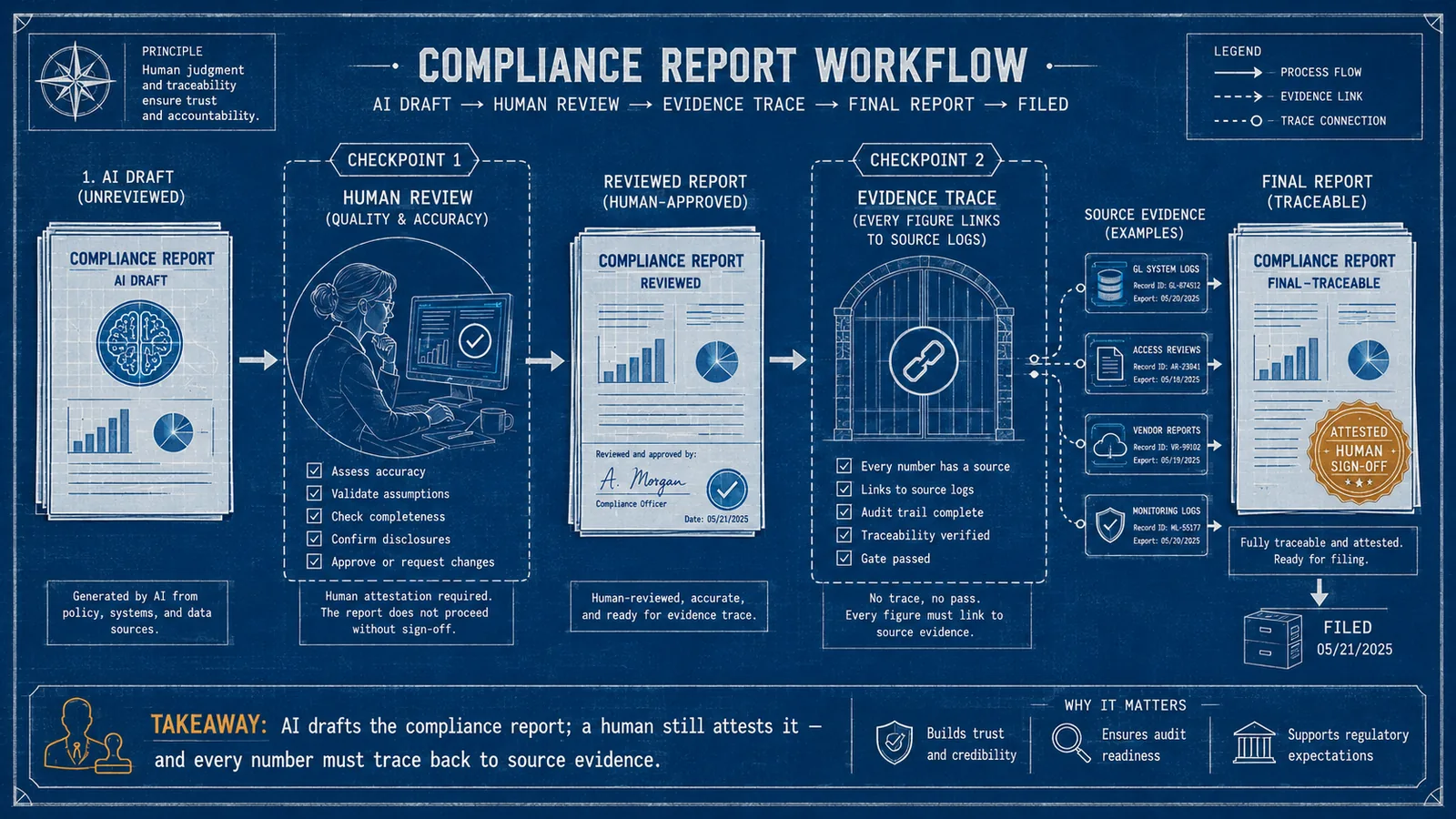 Every AI-drafted report routes through named human checkpoints before it reaches an auditor — the guardrail is the attestation record, not the prose quality.
What Avatier ships toward this pattern
Avatier Identity Anywhere Lifecycle Management generates the underlying evidence this pattern depends on: certification-campaign results, entitlement change history with approver records, and access-request approval trails, captured as part of normal IGA workflow rather than reconstructed after the fact. Between formal review cycles, Identity Security Posture Management continuously evaluates entitlement state against documented policy and surfaces drift as it opens, which is the mechanism behind the continuous-monitoring claims covered above and in more depth in the ISPM piece. The same evidence architecture supports the control-mapping approach described earlier — one certification result, reusable across the frameworks an organization is actually subject to — rather than requiring separate evidence collection per regulation, which is the pattern covered from the regulation side in the access review piece.
Avatier's own compliance posture is published at the Avatier Trust Center: SOC 2 Type II audited with zero exceptions noted, ISO/IEC 27001:2022 certified, PCI DSS v4.0.1 compliant, CSA STAR Level 1 attestation, NIST 800-53 Rev. 5 aligned, FedRAMP-aligned, and a CISA Secure-by-Design Pledge signatory. That posture is itself an example of the evidence discipline this piece describes — a documented, continuously maintained control environment that an assessor or auditor can review directly, rather than a claim reconstructed under deadline pressure once a year.
ABOUT THE AUTHOR

More from Compliance & Audit
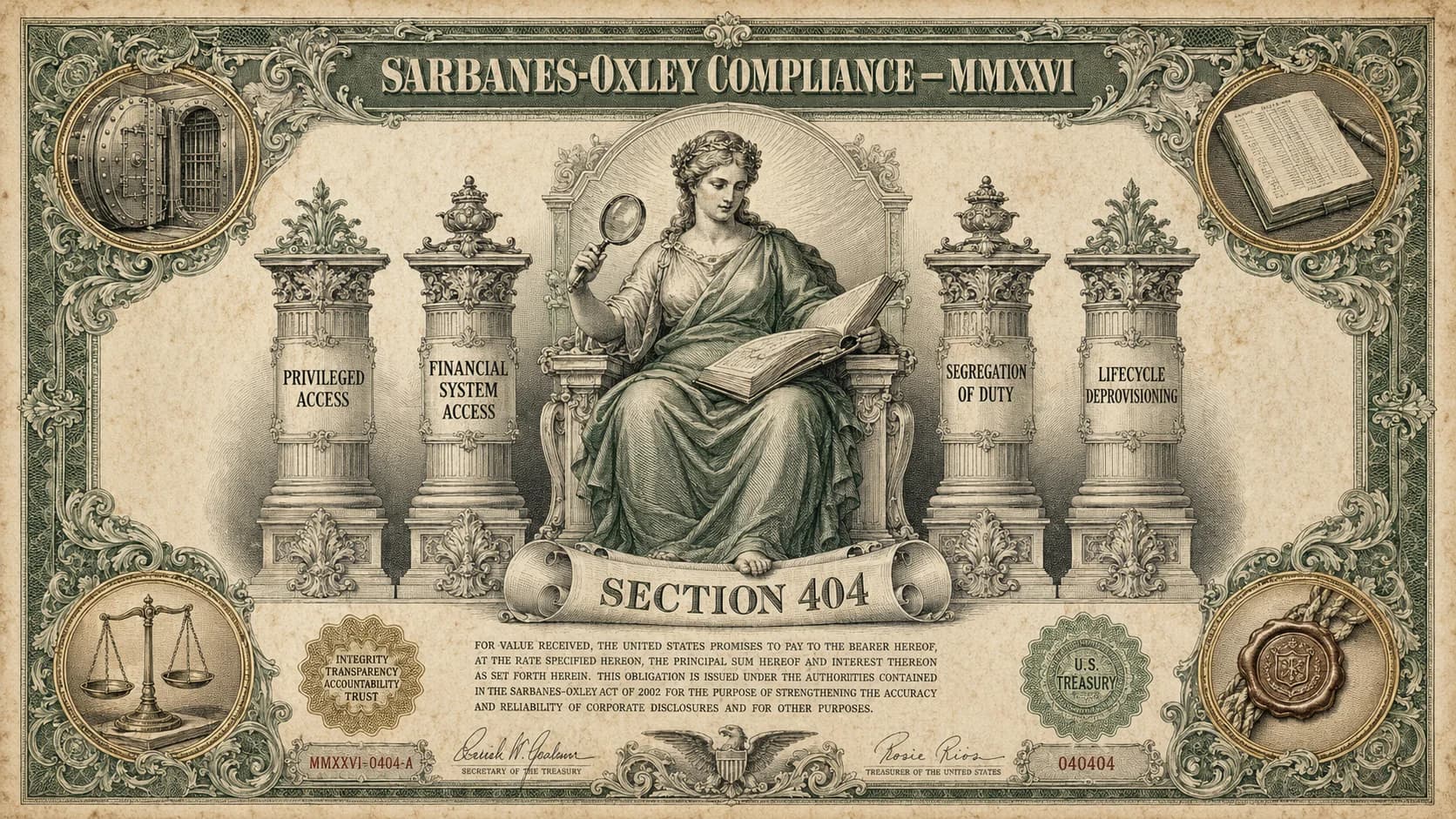
SOX Compliance Without the Spreadsheet: What Auditors Actually Want to See in IAM 2026
SOX §404 requires access controls that produce evidence, not policy documents that describe them. The 2026 enterprise reference on the four IAM access-control domains SOX auditors probe, the five reports they'll ask for, and the architecture that generates them on-demand rather than in the quarter-end scramble.
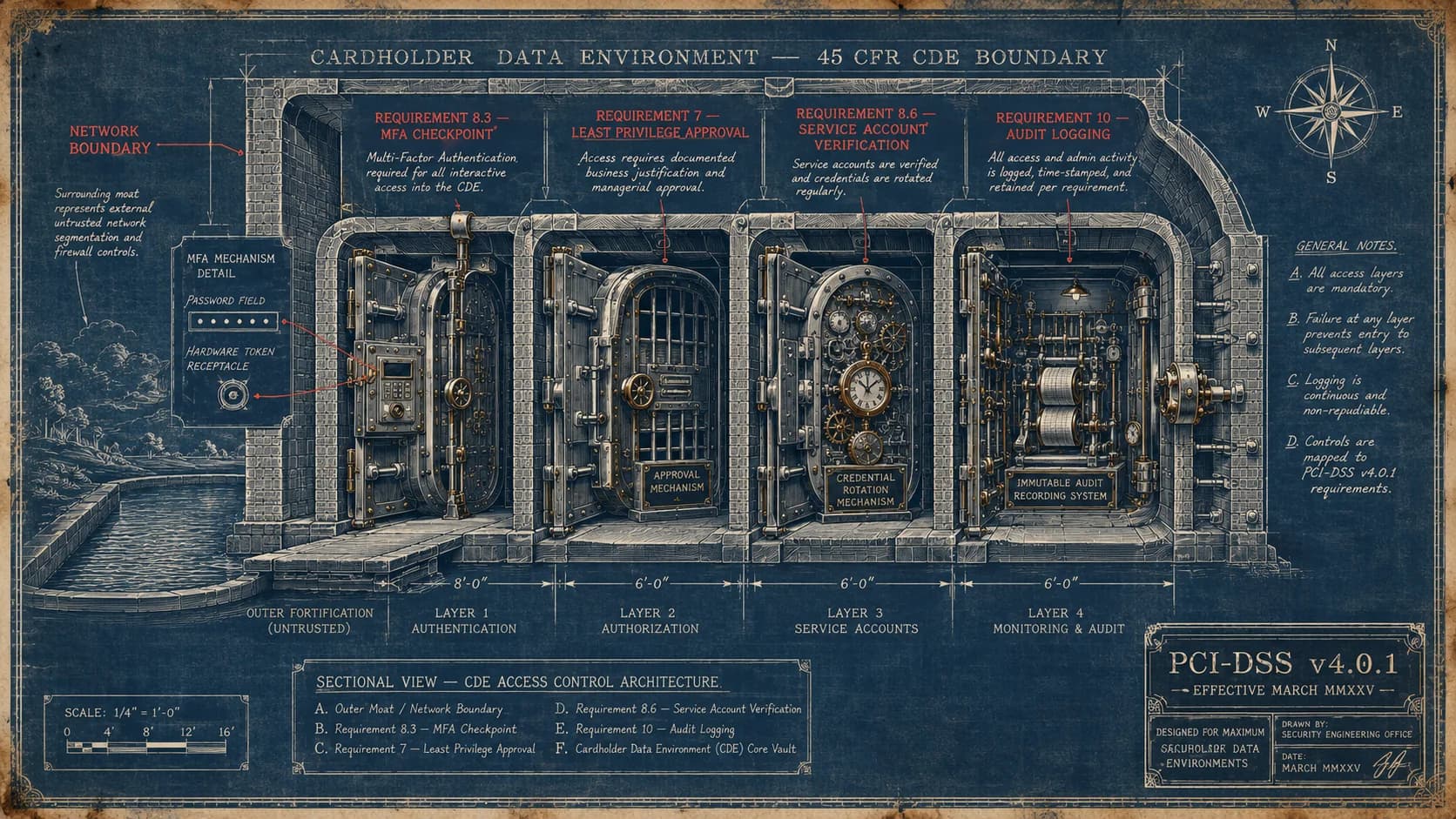
PCI-DSS v4.0.1 Access Control Requirements: The 2026 Enterprise Reference
PCI-DSS v4.0.1 became mandatory for assessments on March 31, 2025 — and it's the largest expansion of IAM requirements in the standard's history. The 2026 enterprise reference on Requirements 7, 8, and 10, the MFA-everywhere expansion in 8.3, the service account tightening in 8.6, and the architecture that maps to each.

Real-Time Regulatory Monitoring: How It Actually Works in 2026
Real-time regulatory monitoring replaces the quarterly compliance scramble with a continuous detect-assess-remediate loop, but only if the identity data underneath it is accurate to begin with.