Certificate Lifecycle Management in 2026: Issue, Renew, Revoke
Certificate lifecycle management is the discipline of issuing, deploying, monitoring, renewing, and revoking TLS and PKI certificates before any of them expires unnoticed. The 2026 reference on running certificates at enterprise scale — and where automation stops.

Certificate lifecycle management is the discipline of issuing, deploying, monitoring, renewing, and revoking TLS and PKI certificates before any of them expires unnoticed. The 2026 reference on running certificates at enterprise scale — and where automation stops.
- Certificate lifecycle management (CLM) is the operational discipline of issuing, deploying, monitoring, renewing, and revoking TLS and PKI certificates across every system that presents one — so that no certificate expires unnoticed and no unknown certificate goes ungoverned.
- The single most common and most avoidable failure is the expired-certificate outage: a certificate no one was watching lapses, and a public site, an internal API, or a machine-to-machine integration goes dark until someone traces the failure back to a date field.
- You cannot renew what you cannot see. Discovery — network scanning and CT-log monitoring to find every certificate, including the shadow certs issued outside the sanctioned process — is the foundation the rest of the lifecycle stands on.
- Shortening certificate validity (the industry is moving toward ~47-day maximums by 2029) makes manual, spreadsheet-tracked renewal untenable and forces automation — ACME issuance and renewal — from a nice-to-have to a requirement.
- CLM is a machine-identity governance problem, not just a crypto problem: every certificate has an owner, a purpose, and an expiry, and the hard part is keeping those three facts accurate as systems change — not the mathematics of the key underneath.
A certificate lifecycle management program is the operational discipline that issues, deploys, monitors, renews, and revokes every TLS and PKI certificate in your environment so that none of them expires unnoticed and none of them operates outside your control. It exists because of one recurring failure: a certificate no one was watching reaches its expiry date, and the moment the clock rolls over, the site, API, or machine-to-machine integration it protected stops working — no grace period, just an immediate wall of security errors until someone traces the outage back to a date field. Expired-certificate outages remain one of the most common self-inflicted incidents in enterprise infrastructure, and the cause is almost never the cryptography. It is the process — a certificate with no owner, no monitoring, and no renewal.
This piece is the 2026 practitioner reference on running certificates at scale. It treats a certificate as what it actually is — a machine identity with an owner, a purpose, and an expiry — and walks the full lifecycle from request to revocation, the failure modes at each stage, and the automation that has moved from optional to mandatory as validity periods collapse. It is written for the CISO who owns the risk, the CIO who owns the uptime, and the analyst who has to build the inventory. Certificate lifecycle management is a governance problem wearing a cryptography costume, and the sections below keep that distinction in view.
The certificate lifecycle, stage by stage
Every certificate passes through the same six stages, and a mature program has a defined, accountable process for each one rather than treating issuance as the finish line.
Request. Someone — a person or, increasingly, an automated system — needs a certificate for a hostname, service, or device. The request should carry the one fact that most programs lose immediately: who owns this, and for what purpose. A request without a recorded owner is a future orphan.
Issue. A certificate authority validates the request and issues the certificate. For public TLS this is a publicly trusted CA; for internal machine-to-machine trust it is often a private CA you run. Issuance is where policy should bite — key strength, allowed algorithms, validity period, and permitted use — because it is far easier to refuse a weak certificate at issuance than to hunt it down in production later.
Deploy. The certificate and its private key are installed onto the servers, load balancers, containers, or devices that will present it. Deployment is where certificates fragment: the same logical service may present a certificate from a dozen edge nodes, each of which is a place the certificate has to be renewed later.
Monitor. From the moment it is live, the certificate needs continuous watching — for approaching expiry, for the private key's integrity, and for any sign it is being presented somewhere it should not be. Monitoring is the stage that turns a silent expiry into an alert with days of lead time.
Renew. Before expiry, the certificate is replaced with a fresh one — ideally while the old one is still valid, so there is no window where the service has no valid certificate at all. Renewal is where automation earns its keep, and where manual processes fail most often.
Revoke. When a private key is compromised, a system is decommissioned, or a certificate was mis-issued, it must be invalidated before its natural expiry through the revocation infrastructure (CRLs and OCSP). Revocation is the stage most programs handle worst, because it is the one that only matters in a crisis.
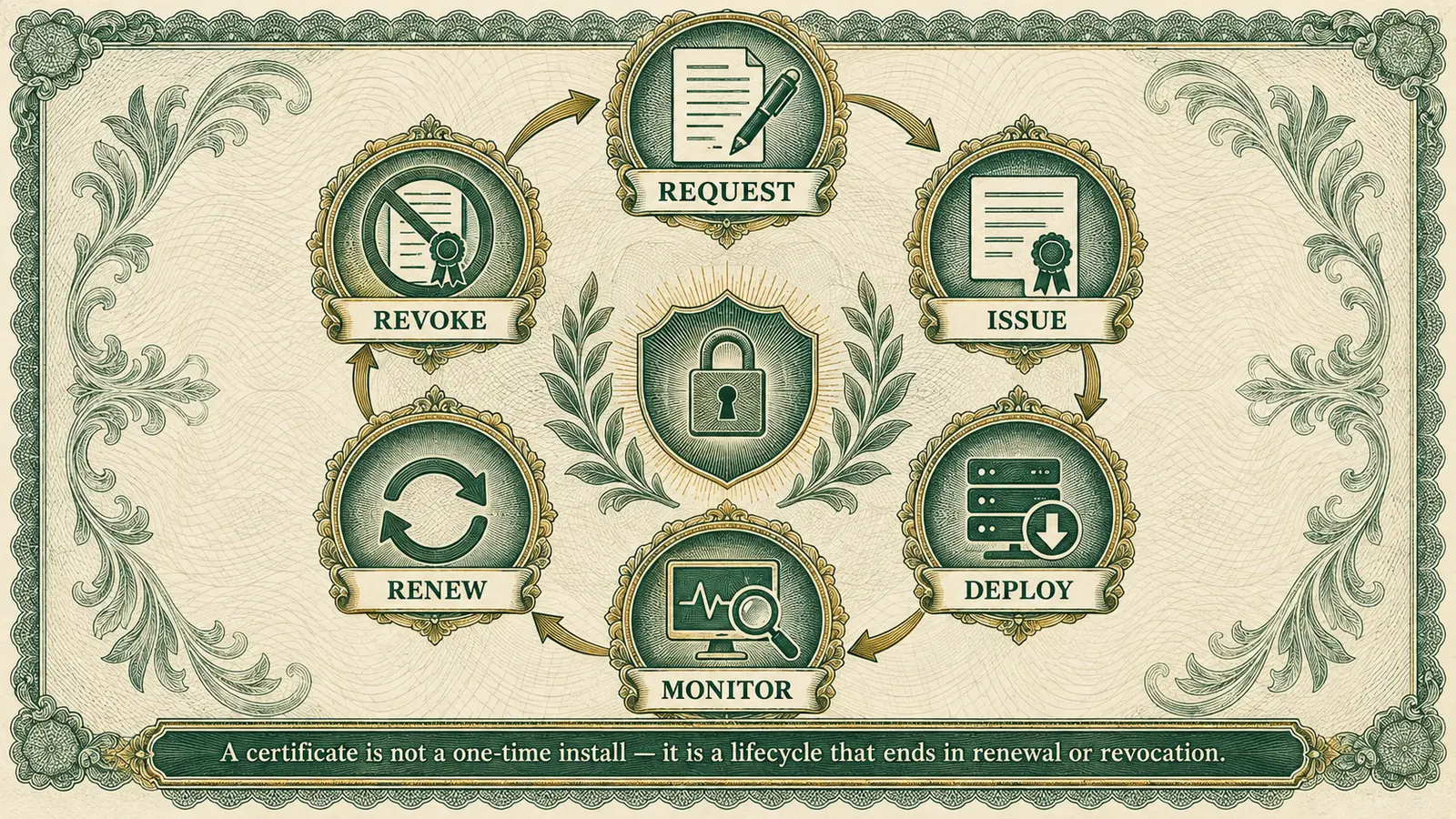 The lifecycle is a loop, not a line — the work is not issuing a certificate once, but keeping every certificate accountable across a cycle that never stops repeating.
The discipline is not in any single stage. It is in never losing a certificate between stages — the request whose owner left, the deployment that renewal never reached, the decommissioned service whose certificate was never revoked. Each gap between stages is where an outage or an exposure hides.
Discovery: you cannot renew what you cannot see
The foundational stage that most programs skip is the one that precedes the entire lifecycle: knowing what certificates you actually have. A certificate inventory built only from what your issuance process recorded is guaranteed to be incomplete, because the certificates that cause outages are precisely the ones your process never touched.
Discovery is the practice of finding every certificate operating in your environment regardless of how it got there, and it runs on two complementary techniques. Active network scanning walks your address space and your known services, connecting to each TLS endpoint and recording the certificate it presents — its issuer, subject, key strength, algorithm, and expiry. Certificate Transparency (CT) log monitoring watches the public append-only logs that every publicly trusted CA is required to write to, alerting you whenever a certificate is issued for any domain you own — including certificates issued by someone in your organization, or against your brand by someone who should not have been able to.
The two techniques catch different failures. Network scanning finds the certificate that is deployed but was never registered; CT monitoring finds the one that was issued but you have not yet found deployed — or that was issued fraudulently. Together they close the gap between what you think you have and what is actually presenting certificates to the world.
Discovery is not a one-time exercise. New certificates appear constantly — from deployments, from SaaS integrations that provision their own, from developers, from acquisitions that bring an entire unknown estate with them. Discovery has to run continuously, and its output — a live, authoritative inventory — is the substrate every other stage depends on. This is the same principle that governs machine identity more broadly, which is why certificate discovery belongs in the same conversation as service account governance and non-human identity: a certificate is a non-human identity, and an untracked one is exactly as dangerous as an orphaned service account.
The risks: what goes wrong without lifecycle management
The consequences of running certificates without a lifecycle discipline are predictable, and they cluster into four failure modes.
The first and most visible is the expired-certificate outage. A certificate lapses because no one was monitoring its expiry, and every client that validates it — browser, API consumer, downstream service — refuses the connection instantly. The outage is total, and its blast radius is whatever depended on that endpoint. These incidents are notable precisely because they are so avoidable: the failure was scheduled, in plain text, in the certificate itself.
The second is shadow and unknown certificates — the certificates operating outside your process. Each one is two problems at once: a latent outage, because it will expire on a date you are not watching, and a latent security gap, because you have never checked its key strength, its algorithm, or whether its private key is sound. You cannot renew, monitor, or revoke what you do not know exists.
The third is manual, spreadsheet-based tracking — the well-intentioned control that fails silently. A spreadsheet of certificates and expiry dates is only as good as the discipline maintaining it, and it decays the moment a certificate is added without an entry, an owner changes without an update, or the person who curated it moves on. Manual tracking creates the illusion of control without its substance, which is more dangerous than no tracking at all because it suppresses the urgency to build something real.
The fourth is weak keys and deprecated algorithms lingering in the estate — 1024-bit RSA keys that should have been retired, certificates on algorithms no longer considered safe, keys reused across systems. Without a lifecycle process that inspects and enforces cryptographic policy at issuance and on renewal, these accumulate, and each is a certificate that is technically valid and cryptographically inadequate.
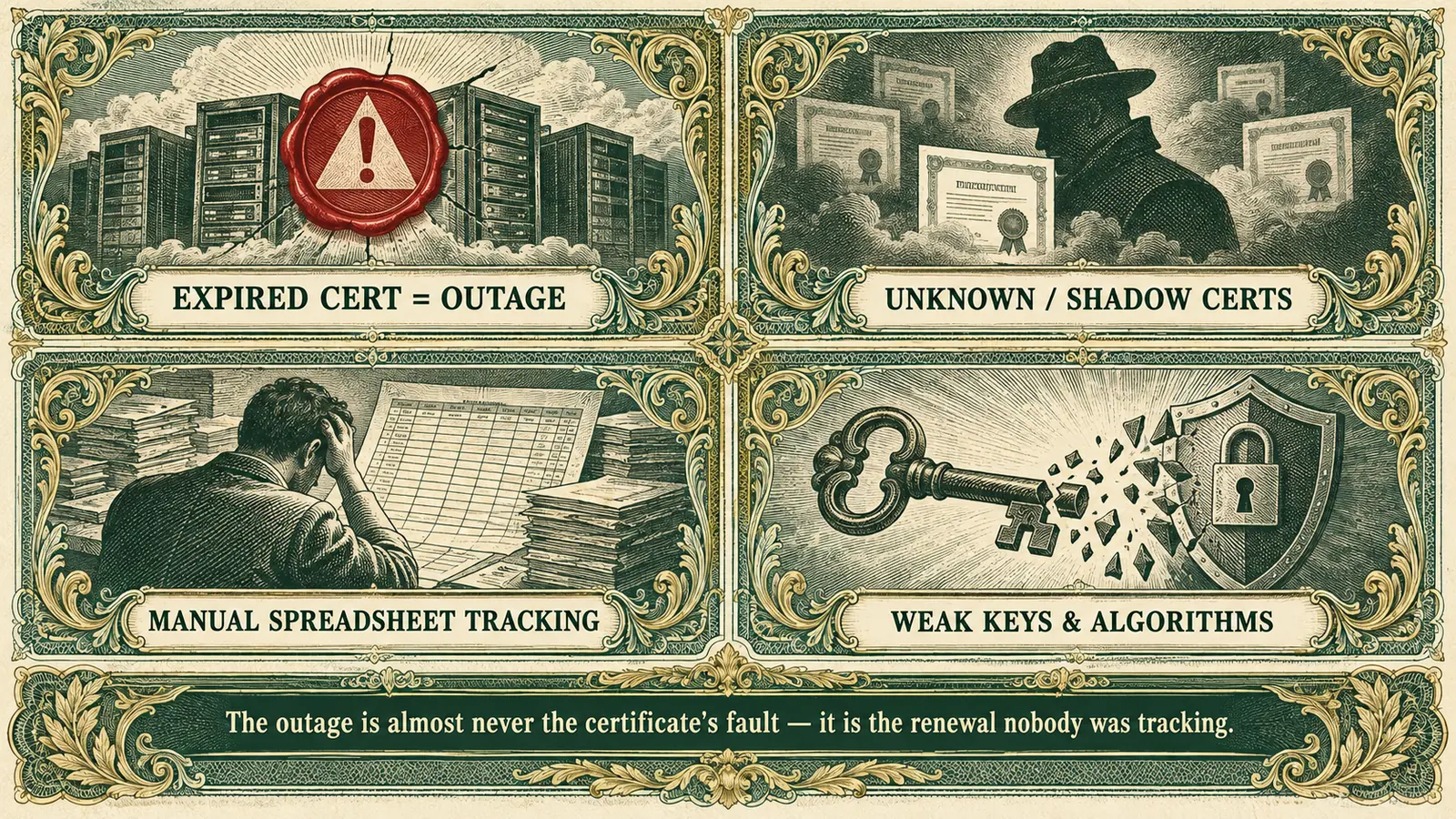 Every one of these failures is a governance failure, not a cryptographic one — the math held; the process did not.
What unites all four is that they are process failures, not technology failures. The cryptography did exactly what it was designed to do; the organization simply lost track of the certificate, and lost track is a lifecycle problem.
Ownership, purpose, and expiry: the three facts that decay
If a certificate is a machine identity, then governing it means keeping three facts accurate for its entire life: who owns it, what it is for, and when it expires. The expiry is stamped into the certificate and never lies. The other two decay constantly, and their decay is the quiet root of most incidents.
Ownership decays because people move on. The engineer who requested a certificate changes teams, leaves, or simply forgets, and when the renewal alert fires months later it routes to a mailbox no one reads — a certificate with no owner is a certificate no one will renew. This is the same orphaned-identity problem that plagues human and service accounts, and it responds to the same fix: ownership has to be a maintained attribute, reassigned when people move, not a name captured once at issuance and never revisited.
Purpose decays because systems change. A certificate issued for one service gets reused for another, a hostname gets repurposed, and the recorded reason for its existence drifts from what it is actually doing. When purpose is unclear, no one can safely decide whether a certificate can be revoked or must be preserved — so it is preserved by default, and the estate accretes certificates no one dares to touch.
Keeping these facts current is governance work, and it is the same governance work that keeps least-privilege access from eroding. The principle of least privilege applies to certificates as directly as it applies to human entitlements: a certificate should have the narrowest scope and shortest validity consistent with its purpose, and it should not outlive the reason it was issued. A certificate estate governed this way is smaller, more accountable, and far less likely to hide the orphan that becomes next quarter's outage.
Automation: why shortening validity forces the issue
For most of PKI's history, the operational cost of managing certificates by hand was tolerable because a certificate lasted a year or more, and renewing something once a year is a task a human calendar can hold. That era is ending. The maximum validity of a publicly trusted TLS certificate has fallen from years to 398 days, and the industry is on a defined path toward roughly 47-day maximums by 2029. When a certificate must be renewed roughly eight times a year instead of once, manual renewal is no longer merely inefficient — it is impossible to sustain across a real estate.
The answer is protocol-driven automation, and the protocol is ACME (Automated Certificate Management Environment, RFC 8555). Under ACME, an agent on the server proves control of the domain to the certificate authority through an automated challenge, the CA issues the certificate, and the agent installs it and reloads the service without a human ever generating a certificate signing request or touching a key file. Renewal runs on a schedule that fires well before expiry, replacing the certificate while the current one is still valid, so there is never a moment when the service has no valid certificate. The reliability gain is the point: automation removes the missed calendar entry, the departed owner, and the stale spreadsheet — the three ingredients present in nearly every expired-certificate outage.
Automation without discovery, though, only manages the certificates you already know about. The mature pattern composes the two: continuous discovery keeps the inventory complete, clear ownership keeps every certificate accountable, automated renewal keeps every known certificate current, and expiry alerting catches the exceptions that automation cannot reach — the appliance that does not speak ACME, the certificate on a system where an agent cannot run. Alerting is the safety net under the automation, not a substitute for it.
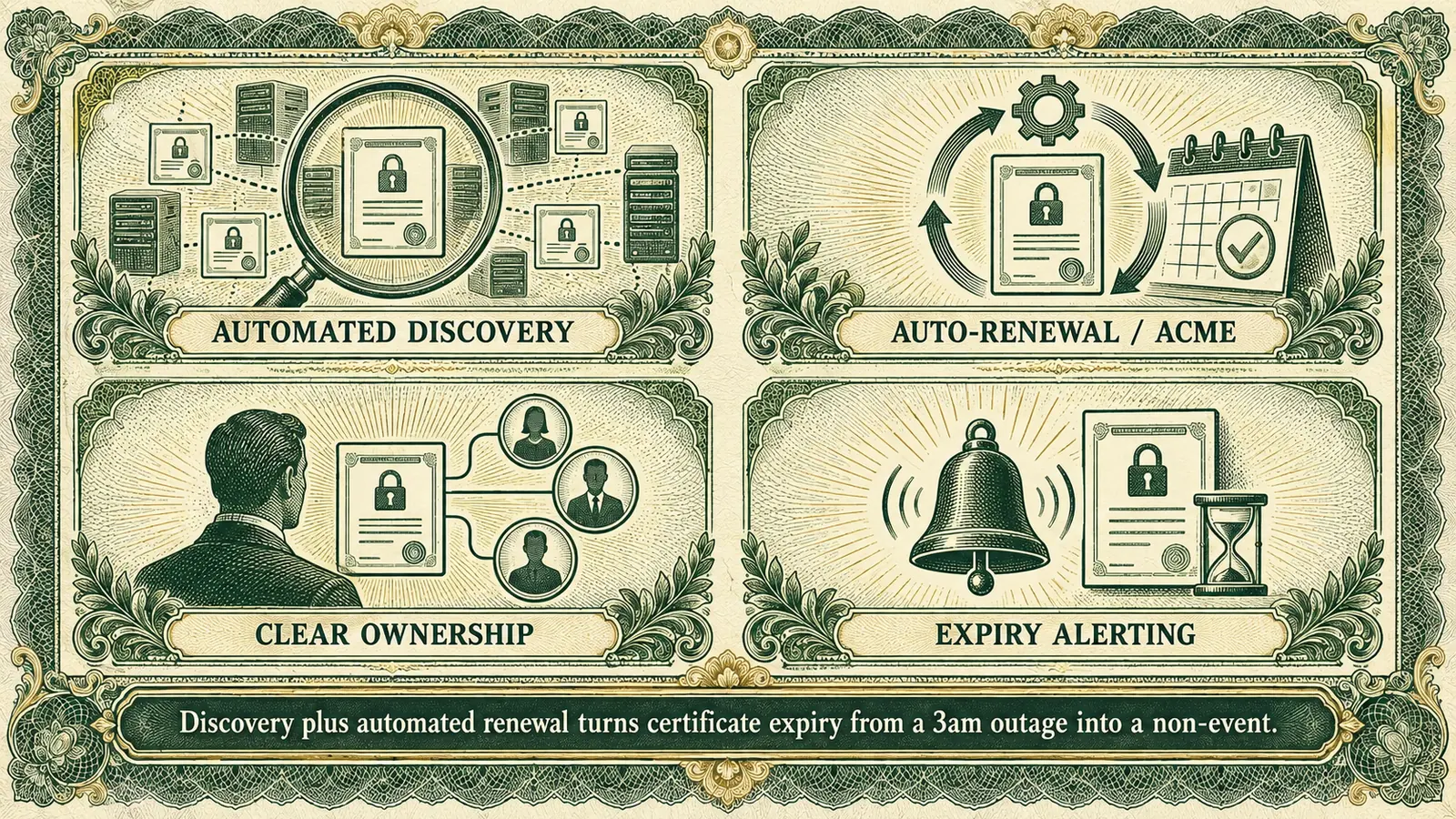 Automation is not the absence of control — it is control expressed as a running system instead of a human obligation, with alerting as the net beneath it.
The organizations that navigate the shortening-validity transition well treat automation as infrastructure and build it before they are forced to. The ones that wait discover that a 47-day certificate they forgot to automate expires six times faster than the annual one they used to track by hand.
Where certificate management meets identity governance
Certificate lifecycle management is often filed under network security or PKI, but it belongs squarely inside identity governance, because a certificate is an identity — a non-human one — and it obeys the same lifecycle laws as every other identity in the enterprise. It is provisioned when a system comes into being, deprovisioned when that system is retired, its scope governed, its ownership maintained, and its activity watched — precisely the disciplines that govern human and service-account identities.
The join-move-leave logic that governs user accounts has a direct analog for certificates. When a service is commissioned, its certificate is provisioned; when the service changes, the certificate's scope and ownership should follow; when the service is decommissioned, the certificate should be revoked, not left to expire quietly while its private key sits on a retired disk. This is the machine-identity mirror of the automated user provisioning lifecycle, and organizations that have solved provisioning for people have most of the apparatus they need to solve it for certificates.
Monitoring, likewise, is shared territory. A certificate presenting from an unexpected location, a private key appearing where it should not, a certificate used for a service it was never issued for — these are identity-threat signals, and they belong in the same detection layer that watches the rest of your identity estate. The identity threat detection and response discipline is the natural home for certificate-anomaly detection too, because the question is the same in every case: is this identity being used the way it is supposed to be.
And the whole apparatus produces evidence. A certificate inventory with owners, issuance records, renewal history, and revocation logs is exactly the audit artifact compliance frameworks increasingly expect. The AI-assisted regulatory compliance reporting that assembles evidence for auditors treats certificate lifecycle records as first-class control evidence — proof that trust in your systems is governed, not assumed.
What Avatier ships toward this pattern
Avatier's contribution to certificate lifecycle management is the governance layer. The platform runs alongside your CA and your ACME tooling and treats certificates as the machine identities they are and brings them under the same lifecycle governance that Avatier applies to human and service-account identities — ownership, request-and-approval workflow, lifecycle-driven provisioning and deprovisioning, access certification, and audit-grade evidence.
That means a certificate can be requested through the same governed workflow as any other entitlement, with an owner and a purpose recorded at issuance and an approval trail behind it. It means ownership is a maintained attribute that follows people when they move, so a renewal alert never routes to a departed employee's mailbox. It means the same certification cycles that put human entitlements in front of owners can put certificate inventories in front of the teams responsible for them, catching the orphan and the shadow cert before they become an outage. And the record of all of it — who owns what, issued when, renewed when, revoked when — is captured as evidence rather than reconstructed under audit pressure.
The compliance posture behind the platform is published at the Avatier Trust Center: SOC 2 Type II audited with zero exceptions noted, ISO/IEC 27001:2022 certified, PCI DSS v4.0.1 compliant, CSA STAR Level 1 attestation, NIST 800-53 Rev. 5 aligned, FedRAMP-aligned, a CISA Secure-by-Design Pledge signatory, and FIDO2-compatible. That posture exists for the same reason this piece argues for evidence-first certificate governance: trust that cannot be shown is trust that cannot be audited, and a certificate estate you cannot inventory is a control you cannot prove.
ABOUT THE AUTHOR

More from Compliance & Audit

Separation of Duties (SoD): The 2026 Reference
Separation of duties is the control that says no single person may hold every step of a risky transaction — the requester can never also be the approver. This is the 2026 reference on SoD in identity and access management: toxic entitlement combinations, preventive versus detective enforcement, and how the control ties to SOX, RBAC, and least privilege.

CIA Triad Security Costs: A 2026 Risk Framework
The CIA triad — confidentiality, integrity, availability — is a practical cost framework for identity programs, not just theory. Here's what neglecting each pillar actually costs.

AI Agent Audit Trail: How Avatier Ledger Records Identity Actions
An AI agent audit trail proves which identity acted, who asked, under whose authority, and what policy allowed it. What the record should hold, why logs fall short, and how Avatier Ledger works.