Machine Identity Management for Enterprise Workloads 2026
Machine identity management is the discipline of issuing, governing, and retiring the credentials that workloads, services, APIs, and machines use to authenticate — a population that now outnumbers human users by an order of magnitude. What it is, why machines need managed identities, where the risk concentrates, and the controls that bring workload credentials under lifecycle discipline.

Machine identity management is the discipline of issuing, governing, and retiring the credentials that workloads, services, APIs, and machines use to authenticate — a population that now outnumbers human users by an order of magnitude. What it is, why machines need managed identities, where the risk concentrates, and the controls that bring workload credentials under lifecycle discipline.
- Machine identity management governs the credentials that non-human actors — workloads, services, APIs, and machines — use to authenticate, a population that outnumbers human users 10× or more in most 2026 enterprises.
- The distinct risk profile comes from scale, short or absent lifespans, credential types (keys, tokens, certificates, secrets) that live in config files and pipelines, and ownership that evaporates when the engineer who created the credential leaves.
- The failure pattern is consistent: a hardcoded secret nobody rotated, on an over-privileged workload nobody owned, still valid long after the service it served was decommissioned.
- The controls that work are discovery and inventory, short-lived platform-issued credentials, least privilege at the workload scope, explicit ownership, and automated rotation for the secrets that remain.
- Machine identity management does not eliminate secrets, replace a secrets manager or PAM vault, or govern what a compromised-but-authorized workload is allowed to do — it governs the identities, not the runtime behavior.
Machine identity management is the discipline of issuing, governing, rotating, and retiring the credentials that non-human actors — workloads, services, APIs, and machines — use to authenticate. Machines need managed identities for the same reason people do: authentication has to be provable, access has to be scoped, and credentials have to be revocable. The difference is scale and invisibility. A single 5,000-person enterprise in 2026 typically runs tens of thousands to hundreds of thousands of machine identities — a container calling a database, a Lambda function assuming a role, a CI/CD pipeline deploying to production, a service mesh presenting a certificate — and each of them authenticates constantly, silently, with credentials no human ever types. Left unmanaged, that population becomes the largest and least-governed part of the identity attack surface.
The strategic problem is a mismatch between where the identities are and where the governance is. Enterprises have spent two decades building discipline around human identities — provisioning workflows, access certifications, least-privilege roles, offboarding — and almost none of it transfers to machines. A workload has no HRIS record, no manager, no job function, and frequently no living human who remembers it exists. So machine credentials have been treated as infrastructure to configure rather than identities to govern, and the failure modes have been surfacing in the breach corpus for years: hardcoded keys in source repositories, service credentials that never rotate, over-privileged automation accounts, and API keys still valid long after the integration they served was retired.
This piece is the 2026 reference on machine identity management as a broad discipline spanning workloads, APIs, and machines. It is deliberately wider than service-account governance specifically — the service-account governance and non-human identity reference covers that subtype in depth, and this piece sits one level up, covering the full machine population and the credential types that authenticate it.
What a machine identity actually is
A machine identity is the identity a non-human actor presents to authenticate and prove authorization. The actor spans a spectrum. At one end are long-lived physical and virtual machines — servers, network appliances, IoT and OT devices — that authenticate to management planes and to each other. In the middle are services and workloads — microservices, containers, serverless functions, scheduled jobs, background processes — that authenticate to databases, message queues, and APIs. At the other end are API clients and integration components — internal service-to-service callers, third-party SaaS integrations, webhook senders — that authenticate across trust boundaries.
What unifies them is that the credential is not a password a person memorizes and types. It is a key, a token, a certificate, or a stored secret that a machine reads and presents programmatically. That single property drives most of the governance differences. There is no human in the authentication loop to challenge with MFA, no login event that a person can recognize as suspicious, and no natural forcing function — like a password reset or a manager review — that periodically brings the credential back under human attention. The credential authenticates thousands of times a day and is looked at by a human approximately never.
The scale is the second defining property. In cloud-native environments the ratio of machine to human identities runs from 10× in conservative estimates to 30–50× in heavy-microservices or container-orchestrated architectures. Every pod, every function, every pipeline run, every service-mesh sidecar carries an identity. The population is not just large; it is dynamic, churning as deployments roll and autoscalers expand and contract. Governance that assumes a stable, enumerable, slowly-changing set of identities — the assumption human IGA is built on — breaks against a machine population that can turn over faster than a quarterly certification cycle can observe it.
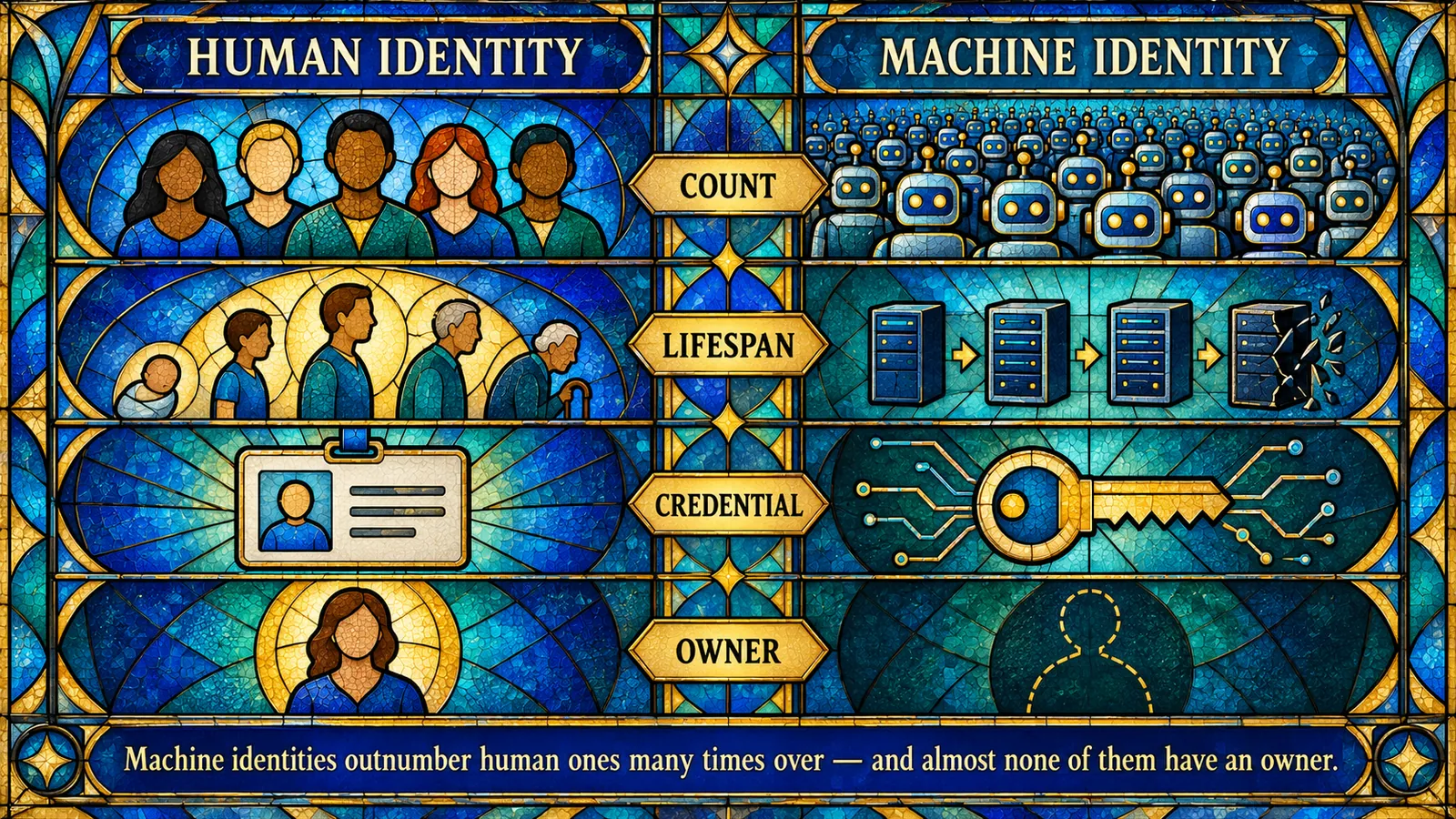 Humans and machines differ on every governance axis — scale, lifespan, credential type, ownership — which is why human IGA patterns don't transfer to machines.
Why machines need managed identities
The case for managing machine identities is not abstract. It is the direct consequence of what happens when you do not. An unmanaged machine credential is a standing, high-value target: it authenticates something with real access, it rarely changes, and it is often stored somewhere an attacker can reach. When it is compromised, there is no unusual login to detect because the workload authenticates with that credential all day. The attacker simply inherits the workload's access and uses it exactly the way the workload does.
Managed machine identity changes the economics on every axis. Discovery makes the population enumerable, so the enterprise knows what it is defending instead of finding out during an incident. Short-lived, platform-issued credentials shrink the window in which a stolen credential is useful from indefinite to minutes. Least-privilege scope limits what a compromised identity can reach, so a single stolen credential is not a skeleton key. Explicit ownership means that when a credential needs to rotate or be revoked, a named team can act instead of a change-freeze born of nobody knowing what will break. Lifecycle binding means a decommissioned workload takes its credentials with it rather than leaving them behind as orphaned access.
There is also a compliance and audit dimension that has hardened in 2026. Frameworks increasingly expect that non-human access is governed with the same rigor as human access — inventoried, scoped, rotated, and revoked. An access review that certifies human entitlements but ignores the machine population that outnumbers it 10× is an incomplete review, and auditors have started saying so. Managing machine identity is what lets an enterprise answer, credibly, the question every mature program eventually faces: can you produce a complete inventory of the non-human identities in your environment, name an owner for each, show the scope each holds, and demonstrate that they rotate and retire?
The credential types you are actually governing
Machine identity management is easier to reason about when you name the credential types, because the governance pattern differs by type. Five categories cover most of the population.
API keys are the workhorse of service-to-service and third-party integration. They are simple, which is their appeal and their problem: a single opaque string that authenticates a caller, usually long-lived, frequently pasted into a config file or a CI/CD variable. The governance concerns are enumeration (how many are outstanding), rotation (when they change and who refreshes them), and scope (what each one authorizes).
Tokens are the OAuth client credentials, JWTs, bearer tokens, and platform session tokens that dominate modern architectures. Many are short-lived by design, which is good, but the credentials that mint them — the OAuth client secrets, the refresh tokens — are long-lived and high-value. Governance focuses on the minting credential and on the scope encoded in the token.
TLS certificates are machine identities in their own right — a certificate binds a key to an identity a service presents. In service meshes they are issued in enormous volume with short lifetimes; in internal PKI they proliferate with an owner and inventory problem. The failure modes are expiry (an unrotated cert takes a service down) and sprawl (thousands of certs from an internal CA with no central record).
SSH keys authenticate automation, deployment, and administrative access to hosts. They are notorious for accumulating: keys added over years, rarely inventoried, rarely rotated, often with no record of which key opens which door.
Stored secrets are the catch-all — database passwords, connection strings, HMAC signing keys, and everything else a workload reads to authenticate. Disciplined shops keep them in a secrets manager; undisciplined ones keep them in environment variables, config files, and source control. This is where the hardcoded-secret breaches originate.
Where the risk concentrates
The risk in machine identity is not evenly distributed. It clusters in four recurring failure modes, and nearly every machine-credential breach traces back to one or more of them.
Hardcoded and embedded secrets. The oldest and most common failure. A credential is pasted into source code, a Dockerfile, a Kubernetes manifest, an environment variable, or a CI/CD pipeline definition, and then it is committed, copied, and cached in a dozen places. Secret scanning finds these constantly; the ones it misses are the ones in the breach reports. The root cause is that embedding a secret is the path of least resistance and nothing structural stops it.
No rotation. A credential that never changes is a credential an attacker can use forever once stolen. Long-lived API keys, service passwords set once and forgotten, TLS certs with multi-year lifetimes, SSH keys added years ago — all of them extend the useful life of a compromise from minutes to indefinite. Rotation is operationally hard precisely because nobody is sure what will break when the credential changes, which is itself a symptom of the next failure.
Over-privileged machine identities. Scope drift is as real for machines as for humans, and faster. A workload is created with the access it needs; an engineer adds a permission for a new use case; another adds another; a year later the identity holds far more access than its workload uses. The standing surface for whoever compromises the credential is the accumulated scope, not the working scope.
No clear owner. A credential created by an engineer who has since left, depended on by systems nobody has mapped, is a credential nobody will rotate and nobody will revoke, because nobody knows what happens if they do. Ownership ambiguity is the meta-failure: it is what turns the other three failures from fixable into frozen.
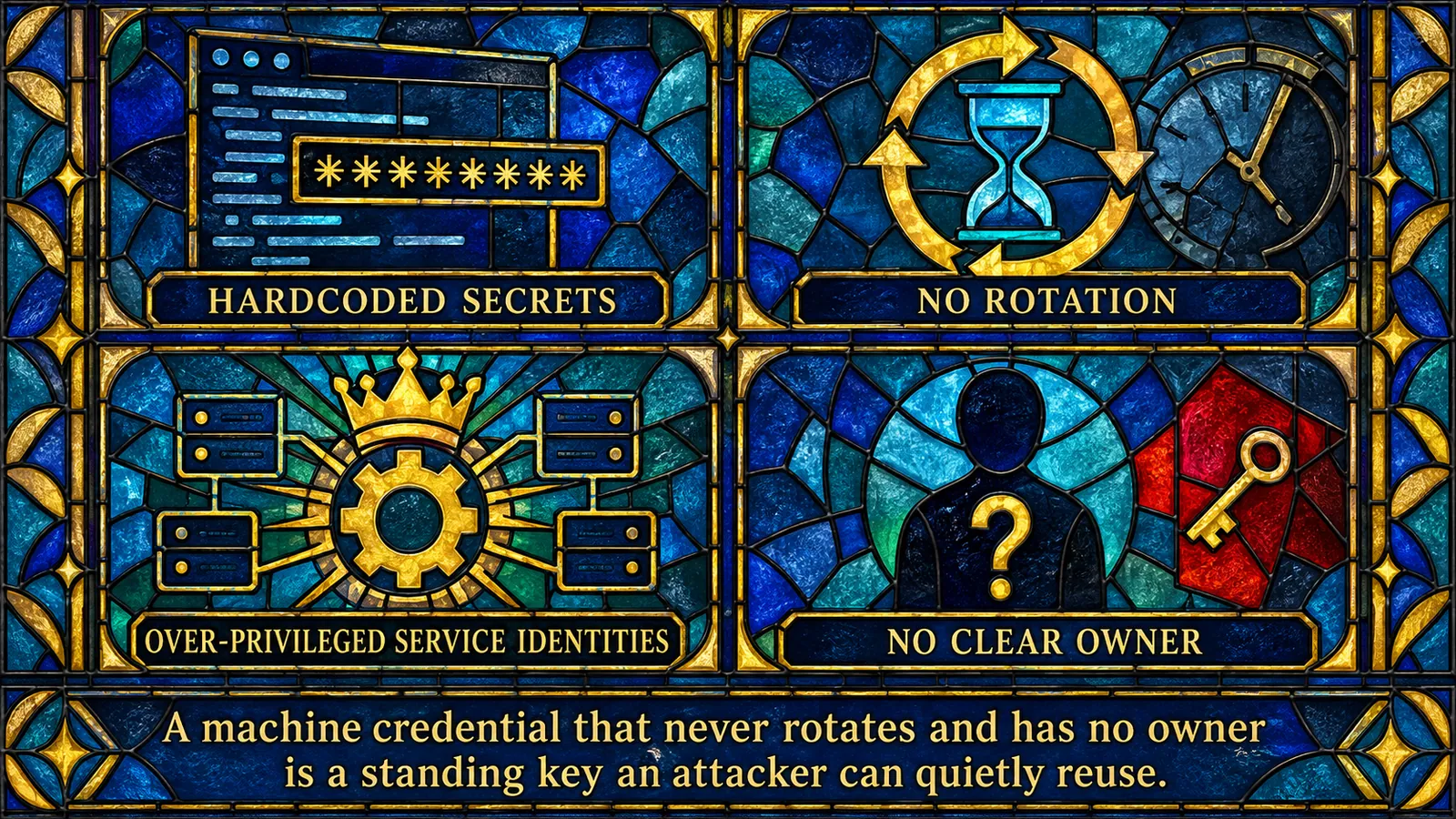 Four failure modes, one breach pattern: a hardcoded secret nobody rotated, on an over-privileged identity nobody owned, still valid after its workload was gone.
Workload identity: the strongest answer for cloud-native systems
For cloud-native workloads, the strongest available answer to the hardcoded-secret and no-rotation failures is workload identity — authenticating a workload as itself, with a short-lived credential the platform issues based on what and where the workload is, instead of a long-lived secret it stores. The pattern has converged across the major platforms.
Kubernetes service account tokens bind a pod to a service account at deployment; the pod receives a short-lived JWT issued by the cluster, typically valid for an hour, and downstream services verify it against the cluster's issuer. Governance happens at the binding and the RoleBindings, not at a stored password.
AWS IAM roles assumed by EC2, Lambda, ECS, or EKS give the compute resource short-lived credentials via STS, rotated automatically. Governance happens at which resources can assume which roles and what policies those roles carry; IAM Access Analyzer surfaces unused permissions.
Azure managed identities attach an identity to an Azure resource that authenticates through the platform metadata endpoint with no secret to store or rotate. Governance happens at the identity-to-resource binding and the RBAC assignments.
GCP service accounts with workload identity federation let workloads authenticate as service accounts, and let external workloads — Kubernetes, AWS, on-prem — federate their native identity into GCP credentials without holding long-lived GCP keys, which matters increasingly in multi-cloud estates.
The shared property is that short-lived, platform-issued credentials replace long-lived stored secrets, so governance shifts from rotating passwords to controlling the binding and the scope. The 2026 pattern is to standardize on workload identity for anything that supports it and retain stored long-lived secrets only for the legacy applications that cannot participate — then vault and rotate those aggressively. This is also where machine identity management meets cloud infrastructure entitlement management: CIEM analyzes and right-sizes the entitlements those workload identities hold across cloud platforms, and the two disciplines are strongest deployed together.
The controls that bring machine identity under discipline
The controls that work compose into a program, not a product. Five properties separate an enterprise that has governed its machine population from one that has merely audited its IAM console.
Discovery and inventory. Continuous, authoritative enumeration of every machine identity — from cloud provider IAM, secrets managers, CI/CD secret stores, service catalogs, internal PKI and service-mesh issuers, and code-repository scanning for embedded credentials. The inventory will have gaps on the first pass; discovery exists to surface them. You cannot govern what you cannot enumerate, and machine-identity discovery consistently finds more than teams expect.
Short-lived credentials. Wherever a platform supports workload identity, use it, so there is no standing secret to steal. Where long-lived secrets are unavoidable, keep their lifetimes short and their storage vaulted. Shortening credential lifetime is the single highest-leverage control because it collapses the value of a stolen credential.
Least privilege at the workload scope. Every machine identity holds only the access its workload actually uses, reviewed against real usage rather than granted defensively. This is the principle of least privilege applied to non-human actors, and it is where over-privilege gets reined back. Cloud-native analyzers that report unused permissions make this tractable at machine scale.
Explicit ownership. Every identity carries a named owner — usually a team — propagated from the deployment manifest or service registry, with automatic escalation when the owner leaves or reorganizes. Ownership is what makes rotation and revocation possible instead of frozen.
Automated rotation and lifecycle binding. The long-lived secrets that remain rotate on a schedule without human choreography, and every identity's lifecycle is tied to its workload's — when a service is decommissioned or a pipeline archived, its credentials revoke or expire automatically. Rotation that depends on someone remembering does not happen; rotation that is automated does. This is the same lifecycle discipline that automated user provisioning brought to human identities, applied to machines with deployment artifacts as the source-of-truth instead of HRIS.
Behavioral monitoring sits alongside these five as the detection backstop: per-identity baselines on what each machine identity normally does, so anomalous use — an unusual API pattern, an unexpected source, an atypical scope — raises a signal even when the credential itself was valid. Identity anomaly detection with machine learning covers that layer, and it is what catches the compromise that the preventive controls did not.
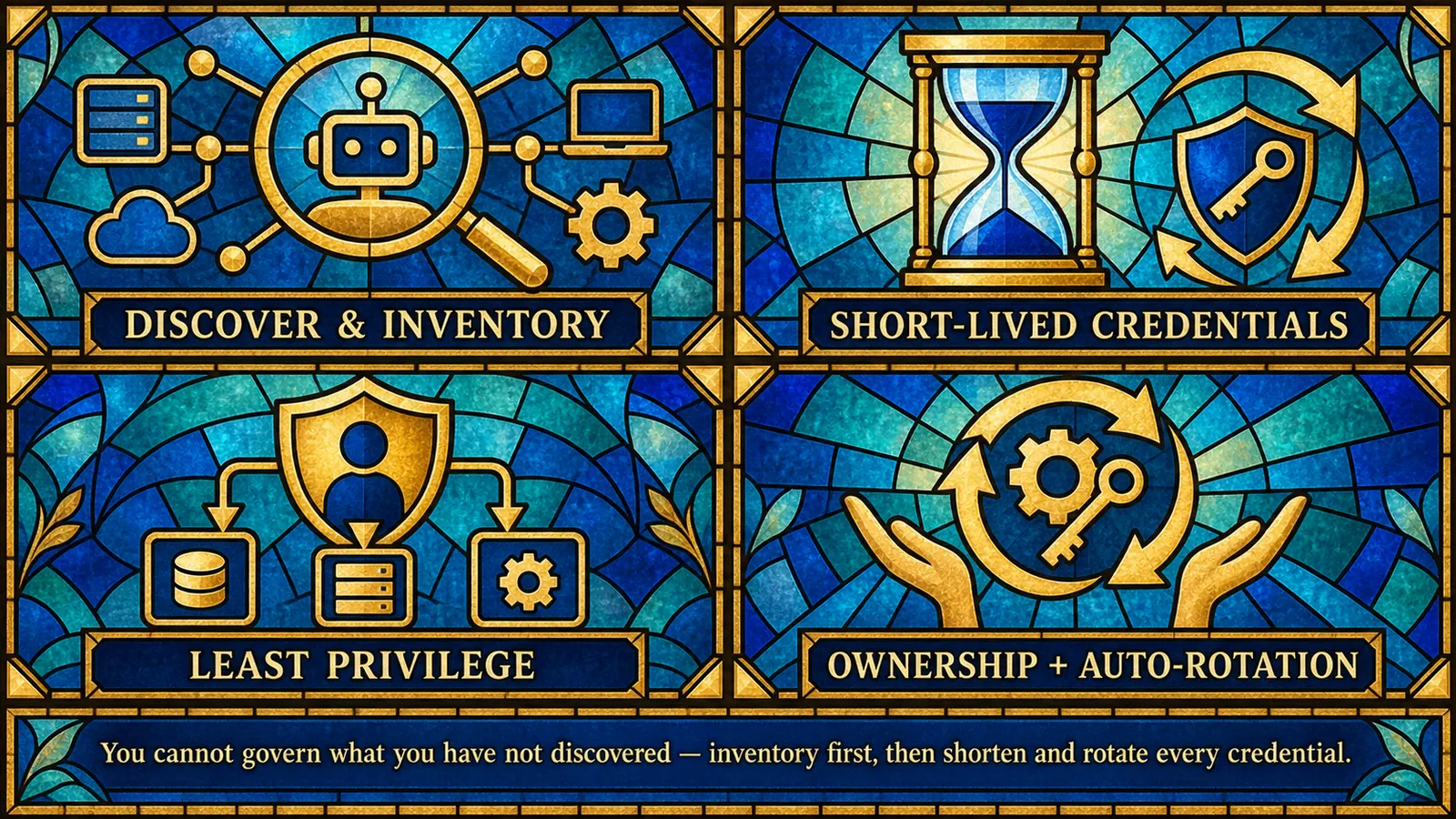 Five controls compose into a program: discover the population, shorten credential lifetimes, right-size scope, assign owners, then automate rotation.
What Avatier ships toward this pattern
Avatier Identity Anywhere Lifecycle Management treats machine identities as first-class workloads alongside human identities, which is the architectural precondition for governing them under one discipline rather than two disconnected ones. Provisioning workflows derive source-of-truth from deployment manifests, service registries, and infrastructure-as-code artifacts rather than from HRIS, so a machine identity's lifecycle tracks its workload's lifecycle — created on deployment, retired on decommission — instead of drifting free.
Certification and scope review are configured for the cadence machine identities actually need, which is shorter than the annual human cycle because machine scope drifts faster, and routed to the owning engineering teams rather than to people-managers who have no basis to certify a workload's access. Ownership is a required attribute on the identity record, propagated from the deployment source and escalated automatically when it goes stale, which is what turns rotation and revocation from a frozen risk into a routine operation.
For the long-lived secrets that legacy systems still require, integration with major PAM and secrets platforms — CyberArk, BeyondTrust, Delinea, HashiCorp Vault — covers the vaulting and runtime protection while the Avatier governance layer drives the lifecycle decisions: who owns the credential, what scope it should hold, when it rotates, and when it is revoked. For mainframe estates, native RACF, ACF2, and Top Secret connectors bring the historical machine and service-account population on z/OS under the same governance as modern-stack identities — a population most cloud-native tools never reach.
The Avatier Trust Center publishes the compliance posture that underwrites this — SOC 2 Type II with zero exceptions, ISO/IEC 27001:2022 certified, PCI DSS v4.0.1 compliant, CSA STAR Level 1, NIST 800-53 Rev. 5 aligned, FedRAMP-aligned, and a signatory to CISA's Secure-by-Design Pledge, with FIDO2-compatible authentication in the platform. The pattern works regardless of vendor; the point of this piece is not that you have to buy Avatier. It is that the integrated combination — discovery, short-lived credentials, least-privilege scope, explicit ownership, and automated rotation tied to the workload lifecycle — is what separates an enterprise that has governed its machine identity surface from one that has merely enumerated a fraction of it.
ABOUT THE AUTHOR

More from IAM & Identity Governance

Identity Fabric and Converged Identity: The 2026 Architecture
An identity fabric unifies fragmented IAM, IGA, PAM, and directories into one system with unified policy and observability. Its building blocks, and what Avatier ships toward the pattern.
Automated User Provisioning: How It Works and Implementation (2026)
Automated user provisioning creates, updates, and revokes access from a single source of truth as identity events happen. What it is, how it works, and how to implement it.

Hybrid Active Directory and Entra ID: Governing Both as One
Most enterprises run on-premises Active Directory and Microsoft Entra ID at the same time, bridged by identity synchronization. This is the 2026 reference on why the hybrid estate exists, where the sync bridge fails — duplicate identities, sync gaps, conflicting policy, password and hash drift — and the path to inventorying both directories, syncing or federating them, unifying policy, and governing the whole estate as one.