Identity Fabric and Converged Identity: The 2026 Architecture
An identity fabric unifies fragmented IAM, IGA, PAM, and directories into one system with unified policy and observability. Its building blocks, and what Avatier ships toward the pattern.
An identity fabric unifies fragmented IAM, IGA, PAM, and directories into one system with unified policy and observability. Its building blocks, and what Avatier ships toward the pattern.
- An identity fabric is not a product you rip in to replace your stack — it is the integration and orchestration layer that sits over your existing IAM, IGA, PAM, and directories and makes them behave as one system, with unified policy and unified observability across all of them.
- Converged identity is the outcome the fabric produces: one place to reason about who has access to what, one policy model that spans human and non-human identities, and one audit surface, instead of N disconnected tools each answering a fraction of the question.
- A fabric differs from stitched-together point tools the way woven cloth differs from taped-together patches. Point-to-point integrations create seams — the gaps where deprovisioning stalls, where policy diverges, and where audit evidence goes missing. The fabric removes the seams by making integration and orchestration first-class.
- The building blocks are connectors and integrations, an orchestration engine, a unified policy layer, and an observability layer. Miss any one and you have a partial fabric that still leaves the failure the pattern was meant to close.
- An identity fabric does not fix bad identity data, does not eliminate your existing tools, and is not a compliance shortcut. It makes a fragmented estate coherent — it does not make a broken data foundation correct.
Ask a security leader a simple question — "who has access to this production system, and why?" — and in most enterprises the honest answer is a research project. An identity fabric is the architecture that turns that research project back into a single answerable question. It is the integration and orchestration layer that sits over your existing identity tools — directories, identity provider, identity governance and administration (IGA), privileged access management (PAM), and the application estate — and makes them behave as one system, with unified policy and unified observability across all of them. Converged identity is the outcome that layer produces: authentication, lifecycle, governance, and privileged access reasoning over one coherent surface instead of a dozen disconnected consoles. Crucially, a fabric is not a product you rip in to replace the stack you own. It is the weave that makes the threads you already have act like cloth.
This piece is the 2026 enterprise reference on the identity fabric and converged identity. What the pattern actually is and where the term came from, how a fabric differs from the point-to-point integration most enterprises already have, the four building blocks that make it work, how it handles human and non-human identity in one model, and what Avatier ships toward the pattern. Companion pieces cover the adjacent layers: access governance as the oversight discipline, the multi-cloud identity architecture a fabric has to span, and the automated provisioning that lifecycle orchestration runs on.
What an identity fabric actually is
The term "identity fabric" borrows a metaphor worth taking seriously, because the metaphor is the architecture. Cloth is strong not because any single thread is strong but because of how the threads interlace — the weave distributes load, closes gaps, and turns loose strands into one continuous surface. An identity fabric does the same thing to an identity estate. Directories, IdP, IGA, PAM, HRIS, and thousands of applications are the threads. On their own they are strands, each doing real work in isolation. The fabric is the weave: the integration and orchestration layer that interlaces them into one surface you can reason about, govern, and audit as a whole.
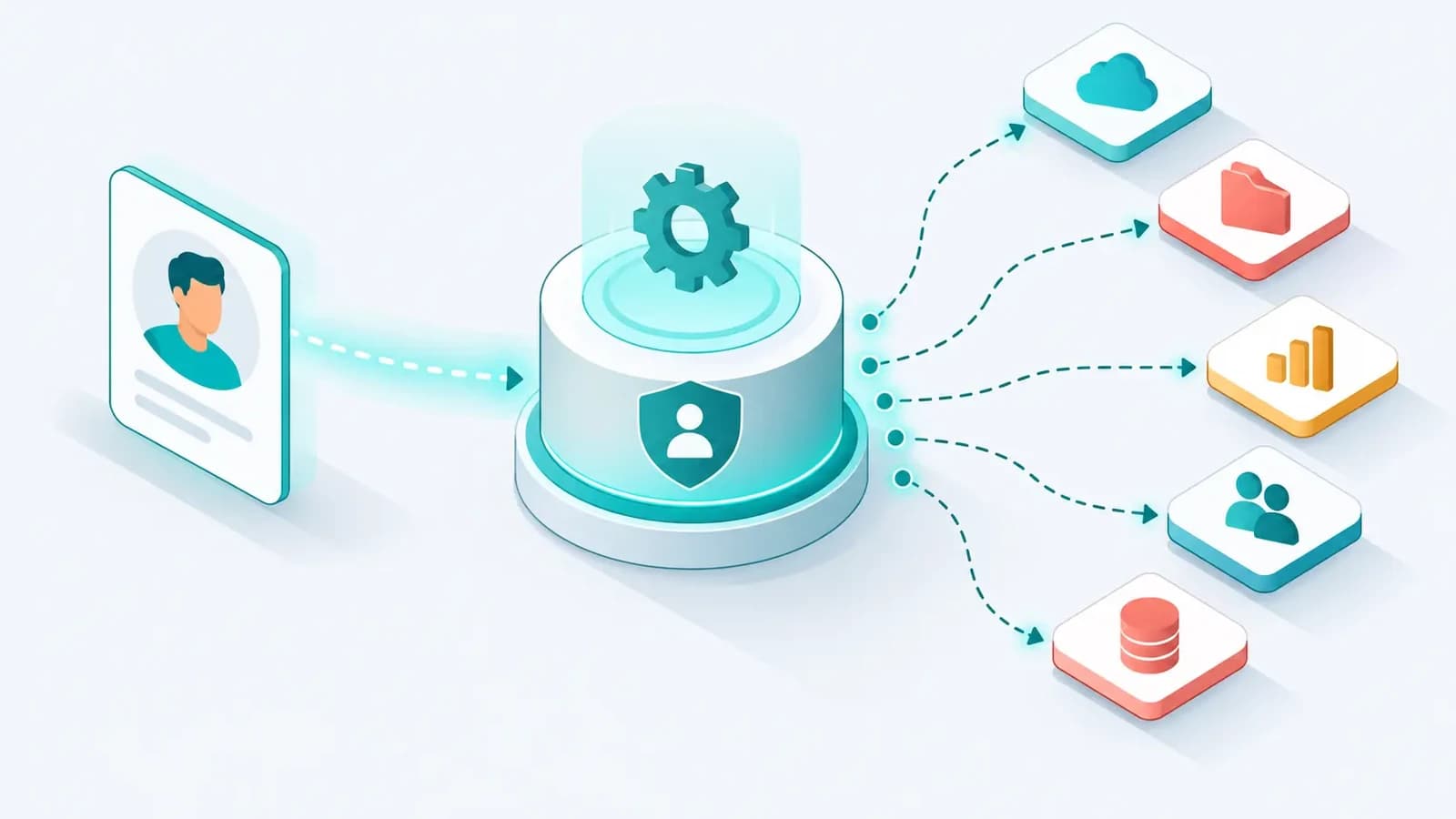
Concretely, an identity fabric does four things at once. It integrates — it connects to every identity system and application in the estate rather than expecting them to connect to each other. It orchestrates — it sequences identity events and access decisions across those connected systems so a single trigger propagates coherently everywhere. It unifies policy — access, separation-of-duties, and lifecycle rules are defined once and enforced across the whole estate instead of re-encoded per tool. And it observes — every identity event and access decision lands in one queryable surface, so audit and operations look at one picture rather than reassembling many.
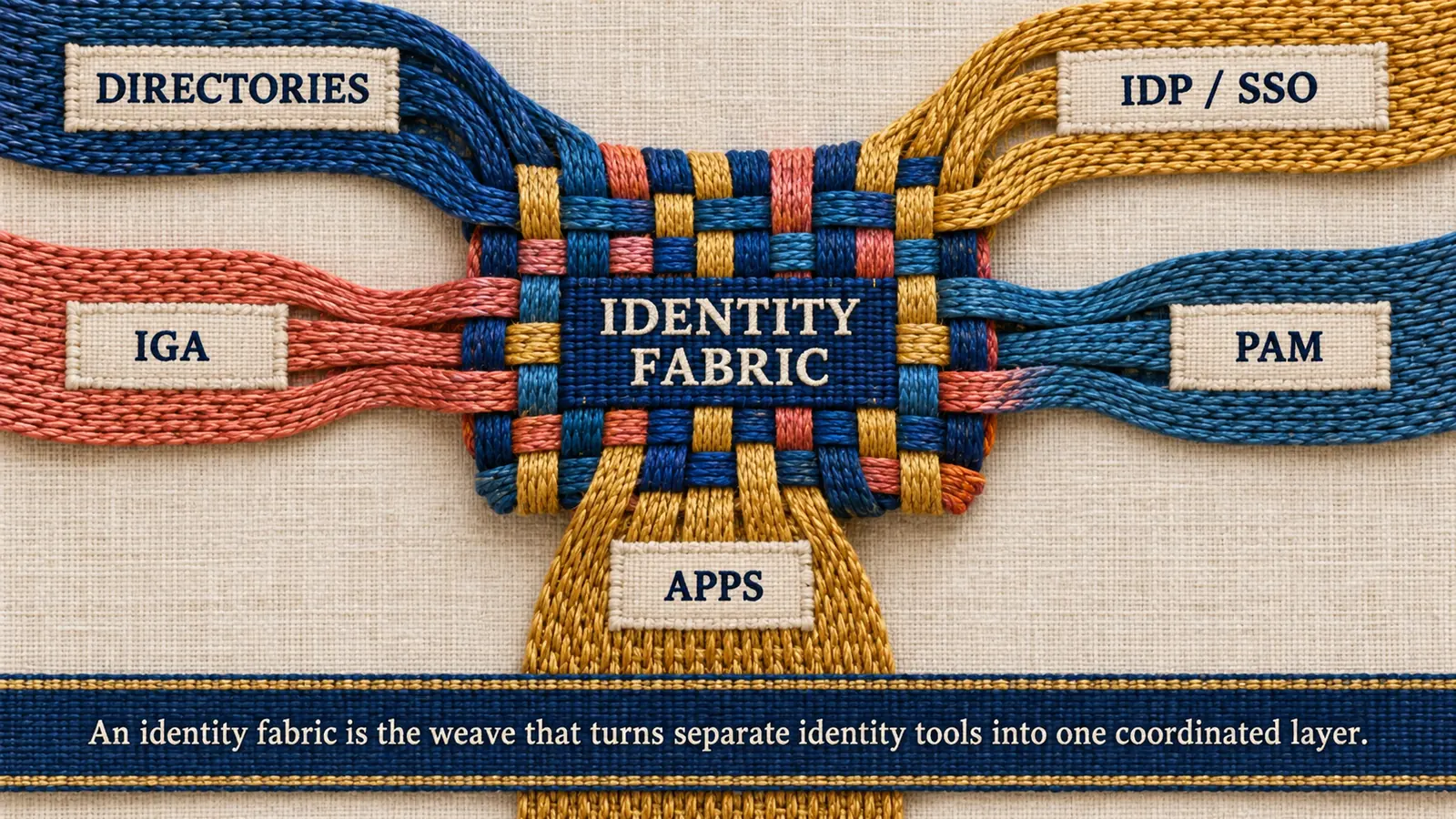 The fabric connects to every system once, then weaves them into one surface that carries policy and observability across the whole estate — the strength is in the weave, not any single thread.
Converged identity is the word for what that weave produces. In a converged estate, a joiner event from HR does not have to be re-entered in five consoles; it enters the fabric once and propagates through orchestration into every downstream system. A certification campaign does not run separately per tool; it reasons over entitlements gathered from every connected system at once. Privileged access is not a parallel universe with its own policy and its own audit trail; it sits inside the same policy model and the same observability surface as standard access. Convergence is a property of how the estate behaves, not a count of how many vendors are in it — which is exactly why you can reach convergence over a deliberately heterogeneous stack.
Why identity fragmented in the first place
No enterprise set out to build a fragmented identity estate. Fragmentation is the accumulated residue of a decade of rational point decisions. The organization bought a directory when it was a Windows shop, added an IdP when SaaS adoption made single sign-on non-negotiable, bought an IGA platform when the first audit demanded access certification, added PAM after a privileged-credential scare, and acquired companies that each brought their own directories and IdP. Every one of those purchases solved a real problem. Collectively they produced an estate where any cross-cutting question — who has access to what, is this person fully deprovisioned, does this access violate separation of duties — lives in fragments across systems that were never designed to answer it together.
The 2026 pressure that makes fragmentation untenable is a collision of three trends. Identity became the primary attack surface — credential misuse features in a majority of breach reports per current industry consensus, and attackers exploit precisely the seams between disconnected identity tools. Non-human identities exploded — service accounts, workload identities, API keys, and AI agents now outnumber human identities in most enterprises, and mostly sit outside the tools built for human lifecycle. And regulators sharpened their evidence demands — auditors under SOX, HIPAA, PCI DSS v4.0.1, and NIST SP 800-53 Rev. 5 want continuous, coherent proof of access control, not a quarterly reconstruction. Each trend punishes fragmentation specifically. The fabric is the architectural response.
Fabric versus stitched-together point tools
The most common objection to the identity fabric is that enterprises already integrate their identity tools, so the fabric is just a rebrand of work already done. The objection misreads what integration means in practice. What most enterprises have is point-to-point integration: the IdP wired to the directory, the IGA platform wired to the IdP, PAM wired to the directory, each application wired to the IdP one at a time. Every connection is bespoke, owned by a different team, and encodes its own copy of the rules. The estate is not a fabric — it is a set of patches taped over the gaps between tools.
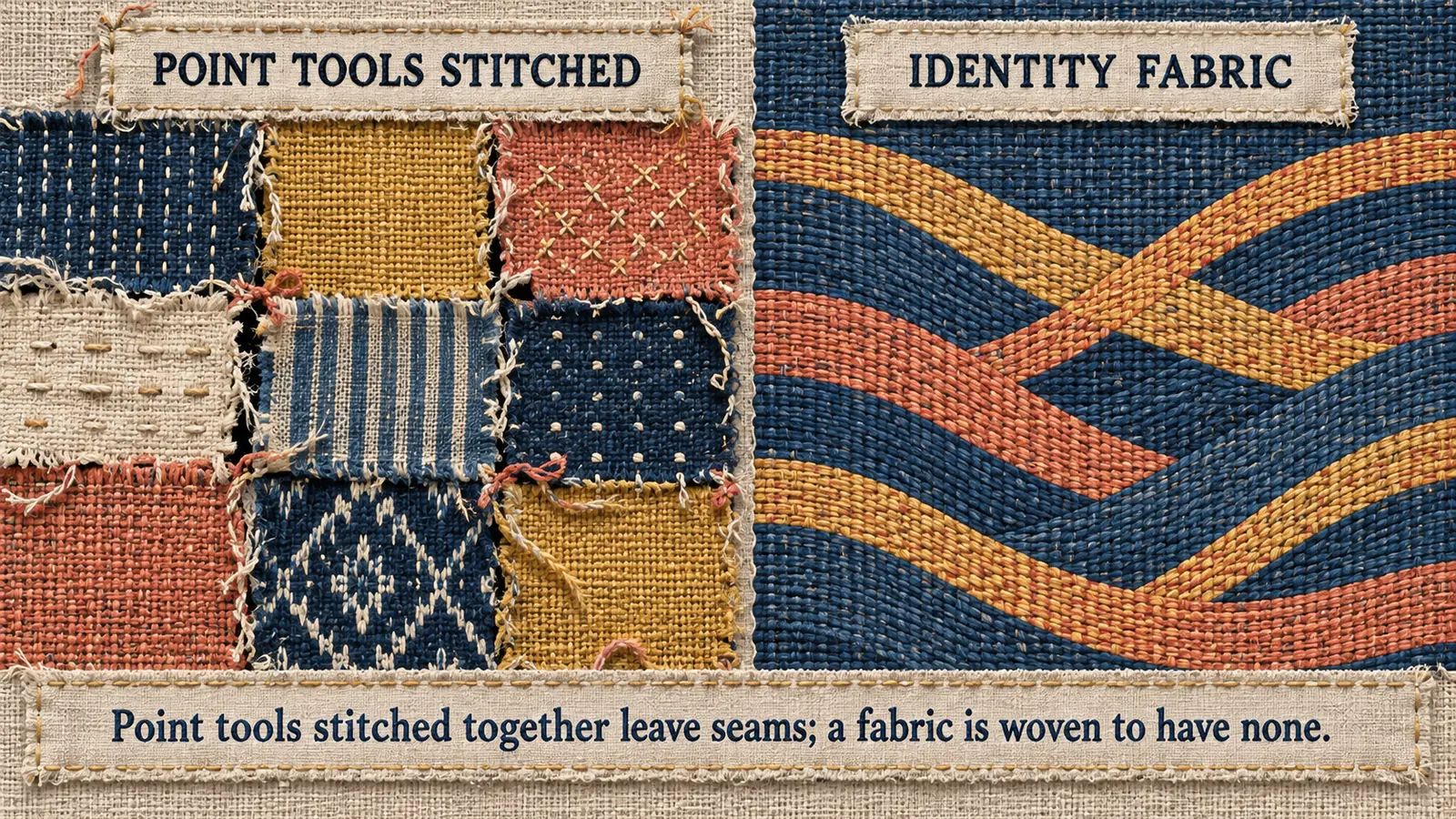 Point tools taped together fail at the seams — that is where deprovisioning stalls, policy drifts, and audit evidence disappears. A fabric has no seams because integration and orchestration are the surface, not the afterthought.
The seams are not a cosmetic complaint; they are where identity actually fails. Deprovisioning is the canonical example: a leaver event fires in the directory, but the pairwise integration to a SaaS application was built two reorganizations ago by someone who has left, and it silently stops firing — so the account lingers, unowned and unaudited, exactly the orphaned-access pattern that shows up in breach reports. Policy drift is the second seam: because each integration carries its own encoding of the rules, "privileged access requires MFA and approval" is true in three tools and quietly false in the fourth. Audit fragmentation is the third: proving who approved a given access means correlating logs from the IdP, the IGA platform, and PAM, each with its own schema and clock.
A fabric closes the seams by inverting the topology. Instead of N-times-N pairwise connections that every team maintains, every system connects once to the fabric, and the fabric owns the orchestration between them. Policy is defined in one layer and enforced everywhere through that layer, so drift has nowhere to originate. Audit evidence lands in one observability surface, so the correlation work disappears. The difference between this and point-to-point integration is not that the fabric integrates more — it is that integration and orchestration become first-class architecture instead of a maintenance burden distributed across teams who each own one thread.
The building blocks of an identity fabric
A fabric is made of four layers, and the discipline is that all four have to be present. A deployment with connectors and orchestration but no unified policy is an automation tool that moves identity faster without governing it. One with policy and observability but weak connectors is a governance model that cannot reach half the estate. The four layers are load-bearing together.
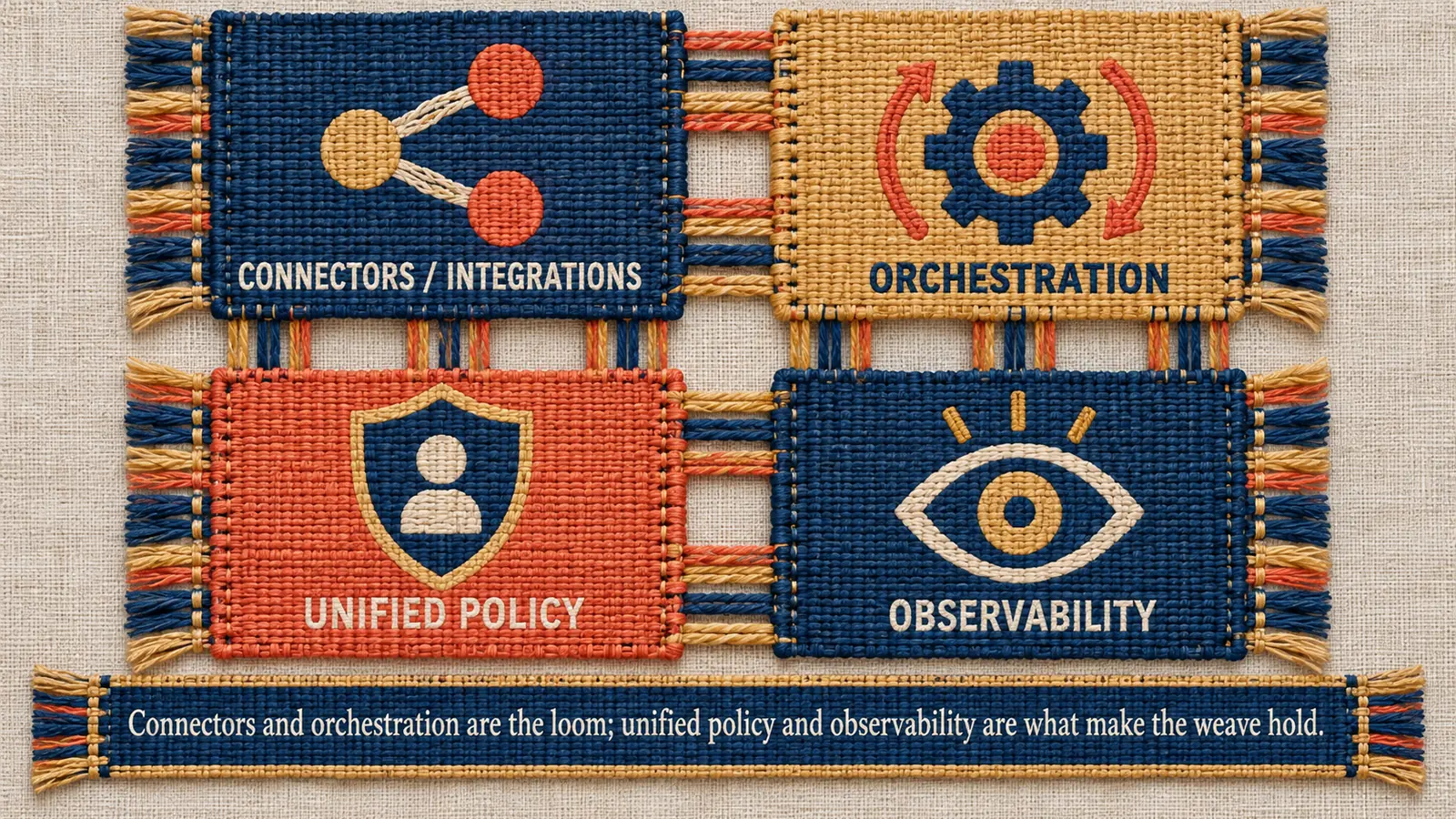 Connectors reach every system, orchestration sequences every event, unified policy is defined once and enforced everywhere, and observability records it all in one place — miss any single layer and the fabric has a hole where the failure it was built to close leaks back in.
Connectors and integrations are the reach of the fabric. They are the adapters that let it read from and write to every directory, IdP, IGA platform, PAM system, HRIS, and application in the estate — via SCIM where the target supports it and native connectors where it does not. The breadth and depth of the connector layer sets the ceiling on everything above it: the fabric can only orchestrate, govern, and observe the systems it can actually reach. A connector catalog that covers the modern SaaS estate but not the mainframe, or the cloud IAM primitives but not the legacy on-premises applications, produces a fabric with a blind spot exactly where the oldest and riskiest access often lives.
The orchestration engine is the movement of the fabric. It sequences identity events and access decisions across the connected systems: routing a joiner-mover-leaver event from HRIS through provisioning into every downstream target, coordinating a multi-step access request through approval and fulfillment, running a certification campaign that gathers entitlements from every tool and routes decisions back, brokering an authentication flow across providers. Orchestration is where the joiner-mover-leaver lifecycle stops being a per-system manual process and becomes one coherent flow — the leaver event that fires everywhere at once instead of stalling at a forgotten seam.
The unified policy layer is the governance of the fabric. Access rules, separation-of-duties constraints, birthright entitlements, and lifecycle triggers are defined once, in one model, and enforced across the whole estate through orchestration. This is the layer that ends policy drift, because there is only one place the rules live. It is also where human and non-human identity converge into one governable model rather than two disconnected regimes — the same policy language that governs an employee's access governs a service account's, so the non-human population stops being the ungoverned majority.
The observability layer is the memory of the fabric. Every identity event and access decision — provisioned, approved, denied, elevated, revoked, certified — lands in one queryable, audit-ready surface. This is what makes "who had access to what, when, and who approved it" a one-query answer instead of a cross-console reconstruction. It is also the operational nerve center: dormant credentials, over-provisioned entitlements, and access anomalies are visible in one place because every thread reports to the same ledger. Observability is what turns the fabric from a faster way to move identity into a way to actually see it.
Human and non-human identity in one model
The building block that matters most in 2026 is the one the older tools handle worst: non-human identity. Service accounts, workload identities, API keys, CI/CD pipelines, and AI agents now dominate the identity population by count, hold standing and often privileged access, and sit almost entirely outside the manager-based lifecycle model that human identity governance was built around. No manager owns a service account. No joiner-mover-leaver event describes a Kubernetes workload. The tools built for human lifecycle simply do not have a native slot for these identities, which is why they accumulate unreviewed, unrotated, and unowned — and why they feature so heavily in credential-compromise breach reports.
A fabric's advantage here is structural. Because policy lives in one unified layer rather than inside each human-centric tool, the same governance discipline — ownership, least privilege, scoped credentials, revocation, certification — can be extended to non-human identities without bolting on a separate product with its own parallel policy and audit surface. The orchestration engine handles deployment-and-retirement events for workloads the way it handles joiner-and-leaver events for people. The observability layer records machine-attributed access next to human-attributed access. Convergence, in the sense that matters most, is exactly this: the human and non-human identity populations governed under one model instead of two, with the majority population no longer invisible.
This is also where privileged access converges. In the fragmented estate, PAM is an island — its own vault, its own policy, its own logs, correlated with the rest of identity only during incident response. Understanding where privileged identity management ends and PAM begins matters precisely because a fabric brings both inside the unified policy and observability model, so a privileged elevation is governed and audited in the same surface as a standard access grant rather than in a separate world.
What Avatier ships toward this pattern
Avatier Identity Anywhere is built as an integration and orchestration layer over a heterogeneous identity estate, which is the fabric pattern rather than a single-product consolidation play. The platform connects to the systems an enterprise already runs — corporate directories, Microsoft Entra ID or Okta as the IdP, the application estate via SCIM and a broad native connector catalog, HRIS as the authoritative source — and orchestrates identity across all of them rather than asking the enterprise to abandon what works. Lifecycle events propagate through one orchestration path: an HRIS joiner-mover-leaver event drives provisioning, access changes, and deprovisioning across the connected estate instead of stalling at a bespoke seam.
The unified layers are the point. Access policy, separation-of-duties constraints, and self-service access requests are defined and enforced in one model, spanning human and non-human identities, with access governance and certification reasoning over entitlements from across the connected systems rather than one tool at a time. The observability surface is designed to answer the audit question directly — who has access, who approved it, when it changed — in one place. And because the estate the fabric spans is increasingly multi-cloud, the platform is architected to consume federated identity and coordinate governance across the multi-cloud identity surface rather than treating each cloud as an island. For enterprises comparing approaches, our reference on the best identity governance administration solutions sets out the evaluation criteria the fabric pattern implies.
The compliance posture behind the platform is published at the Avatier Trust Center: SOC 2 Type II audited with zero exceptions noted, ISO/IEC 27001:2022 certified, PCI DSS v4.0.1 compliant, CSA STAR Level 1 attestation, NIST 800-53 Rev. 5 aligned, FedRAMP-aligned, FIDO2-compatible authentication, and signatory to the CISA Secure-by-Design Pledge. The design position throughout is that a fabric earns its place by making a fragmented estate coherent without demanding the enterprise tear that estate down first.
ABOUT THE AUTHOR

More from IAM & Identity Governance
Automated User Provisioning: How It Works and Implementation (2026)
Automated user provisioning creates, updates, and revokes access from a single source of truth as identity events happen. What it is, how it works, and how to implement it.

Automated Deprovisioning: Closing Access When People Leave 2026
Deprovisioning is the revoke side of the identity lifecycle: a leaver event that cascades revocation across every connected system so no active account, live session, or token outlives the person.

Machine Identity Management for Enterprise Workloads 2026
Machine identity management is the discipline of issuing, governing, and retiring the credentials that workloads, services, APIs, and machines use to authenticate — a population that now outnumbers human users by an order of magnitude. What it is, why machines need managed identities, where the risk concentrates, and the controls that bring workload credentials under lifecycle discipline.