Identity Sprawl and Consolidation: The 2026 Enterprise Reference
Every enterprise accumulates identity sprawl — the same person represented as a dozen accounts across a dozen directories, SaaS tenants, cloud IAM systems, and acquired-company domains, with no single authority reconciling them. The 2026 reference on why sprawl happens, what it actually costs, and the consolidation path that pulls fragmented identities back under one governed source of truth without a rip-and-replace program.
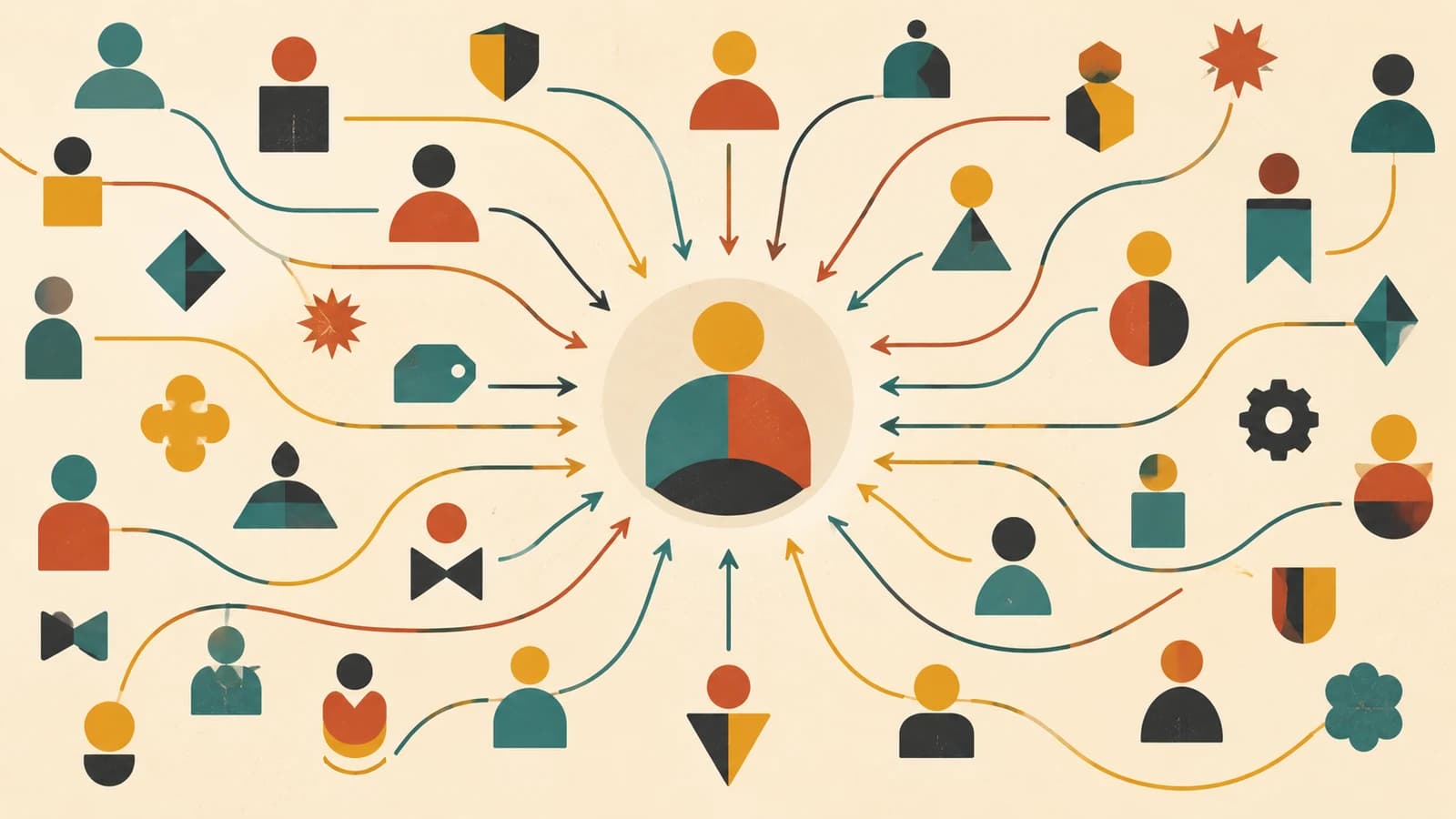
Every enterprise accumulates identity sprawl — the same person represented as a dozen accounts across a dozen directories, SaaS tenants, cloud IAM systems, and acquired-company domains, with no single authority reconciling them. The 2026 reference on why sprawl happens, what it actually costs, and the consolidation path that pulls fragmented identities back under one governed source of truth without a rip-and-replace program.
- Identity sprawl is the accumulation of multiple, unreconciled representations of the same person and machine across many directories, SaaS tenants, cloud IAM systems, and acquired-company domains — driven by SaaS growth, shadow IT, mergers and acquisitions, multiple parallel directories, and orphaned accounts that no lifecycle process ever cleaned up.
- The cost of sprawl is concrete: an expanded attack surface (every duplicate account is a login that can be phished or brute-forced), audit blind spots (no single system can answer who has access to what), license waste (paying for duplicate and orphaned seats), and orphaned access that survives offboarding because the leaver's identity was never fully mapped.
- Consolidation is a five-stage path, not a single project: discover and inventory every identity source, consolidate redundant directories, federate what can't be merged, govern access through one policy layer, and deprovision the duplicates and orphans that discovery surfaced.
- The mature 2026 approach treats consolidation as continuous rather than one-time — sprawl re-accumulates the moment a new SaaS tool, a new acquisition, or a new shadow directory appears, so the governance layer has to keep reconciling identities against a single authoritative source indefinitely.
- Consolidation does not eliminate the need for multiple systems, does not fix bad data at the source, and does not remove the human judgment in deciding which of two conflicting records is authoritative — it makes the sprawl visible and governable, which is the prerequisite for everything else.
Identity sprawl is the accumulation of many disconnected representations of the same person and machine across an enterprise's identity systems, with no single authority reconciling them. The same employee exists as an Active Directory account, a cloud directory account, a login in forty different SaaS tenants, a cloud provider IAM principal, and — after every acquisition — a second set of all of the above inherited from the acquired company. No system knows the full list. Sprawl happens because enterprises grow, adopt SaaS faster than central IT can integrate it, acquire other companies that each bring their own directories, run several parallel directories that were never reconciled, and leave behind orphaned accounts that no lifecycle process ever cleaned up. It is not a misconfiguration to fix once; it is the structural default state of any enterprise that grows without a governing identity layer continuously mapping every account back to a real person.
The reason sprawl matters is that it defeats the questions security and compliance most need answered: who is this person, how many accounts do they have, which of those accounts still need to exist, and what happens to all of them when the person leaves. When the answer is scattered across systems that do not reconcile, offboarding misses accounts, audits stall, license counts never match headcount, and orphaned logins sit unwatched as an open attack surface. This piece is the 2026 enterprise reference on identity sprawl and consolidation — what drives sprawl, what it actually costs, and the five-stage consolidation path that pulls fragmented identities back under one governed source of truth without a rip-and-replace program.
The companion pieces handle the adjacent territory. The Best Identity Lifecycle Management Solutions buyer guide covers the platforms that reconcile identities against an authoritative source. The Access Governance piece covers the policy and certification layer that governs the consolidated estate. The SCIM Provisioning piece covers the standard that federates systems you cannot merge. The Multi-Cloud Identity Management piece covers sprawl's cloud-native dimension. And the Automated Deprovisioning piece covers the last stage — removing the duplicates and orphans that consolidation surfaces. This piece is the sprawl-and-consolidation layer that ties them together.
What identity sprawl actually is
It helps to be precise, because "sprawl" is used loosely. Identity sprawl is not simply having a lot of users or a lot of applications. It is the condition where a single real subject — one employee, one contractor, one service account, one machine — is represented as multiple independent accounts across multiple systems, with no authoritative layer linking those representations into one identity.
The distinction matters because the fix is not "fewer users" or "fewer apps." The fix is a reconciliation authority. An enterprise can have 10,000 employees and 300 applications and still have low sprawl if one authoritative identity maps cleanly to every account each person holds. The same enterprise has severe sprawl if those 10,000 people are represented by 60,000 accounts that no system reconciles, thousands of which belong to people who left years ago.
Sprawl compounds along two axes: breadth (how many separate systems hold identity data) and depth (how disconnected those systems are from any authoritative source). A large but well-governed estate — many systems, all reconciled against one source of truth — is manageable; a smaller estate where nothing reconciles is not. Consolidation attacks the second axis primarily: it is more about establishing reconciliation than about reducing the raw number of systems, though it often reduces that number as a side effect.
What drives sprawl
Five forces produce identity sprawl, and they operate continuously. Understanding them is the prerequisite to consolidation, because a consolidation program that does not account for the forces that create sprawl will watch it re-accumulate faster than it can be cleaned up.
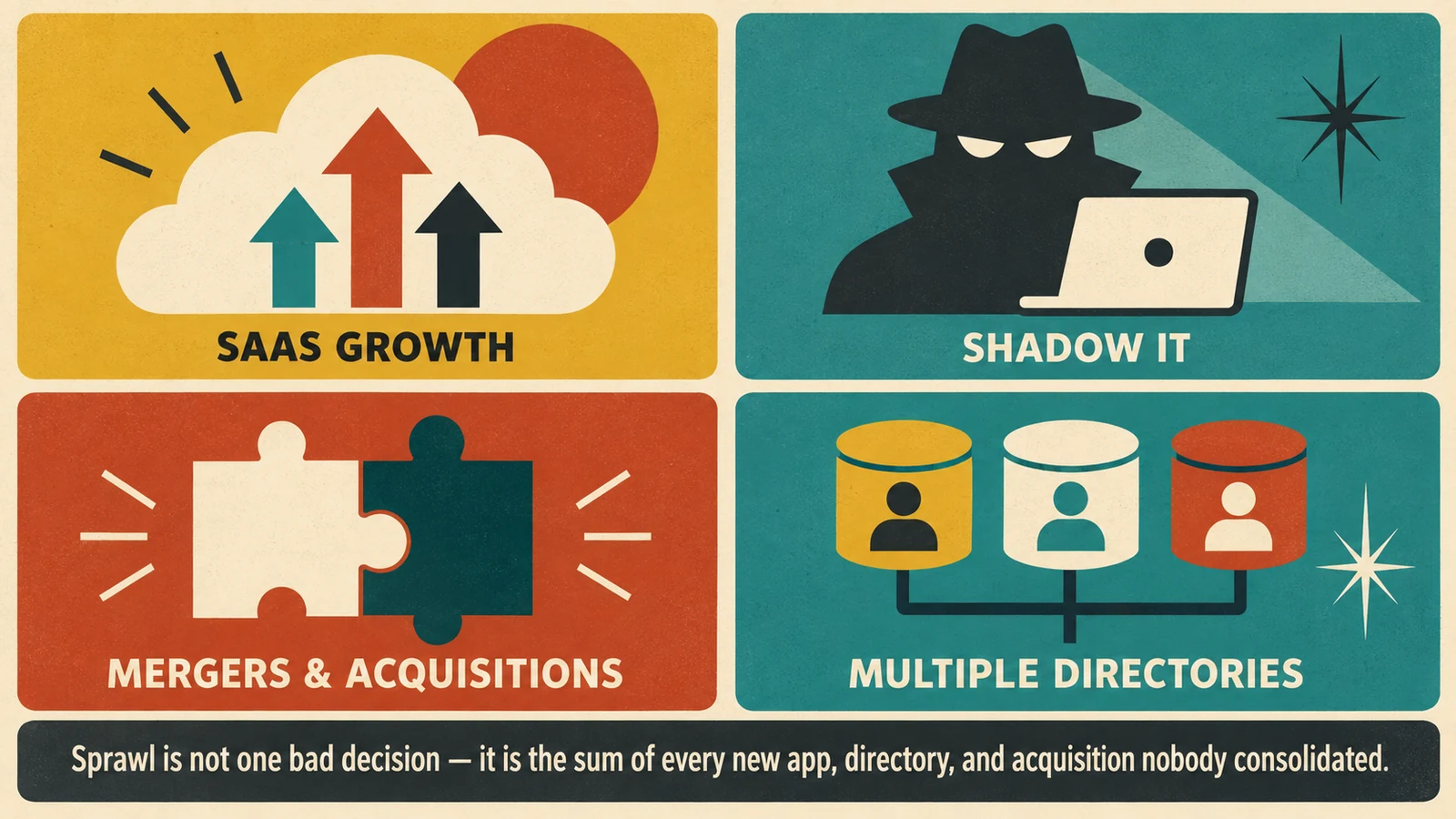 Sprawl is not one problem. It is five forces — SaaS growth, shadow IT, M&A, parallel directories, and orphaned accounts — compounding continuously, which is why consolidation has to be continuous too.
SaaS growth. Every new SaaS application ships with its own user store. Teams adopt applications faster than central identity can integrate them, and each unintegrated application becomes an island of accounts. The modern enterprise runs hundreds of SaaS tools, and the long tail — the tools used by a handful of people, procured on a team budget — is where most of the unreconciled accounts live. This is the single largest source of sprawl in most 2026 environments.
Shadow IT. Adjacent to SaaS growth but distinct: shadow IT is procurement and provisioning that deliberately routes around central identity. A team buys a tool, sets up their own admin, and provisions their own users, and the governance layer never sees the accounts. The Shadow IT Provisioning piece covers the informal provisioning paths in detail; the sprawl consequence is that entire populations of accounts exist that central identity has no record of.
Mergers and acquisitions. Every acquisition arrives with its own complete identity estate — its own Active Directory, its own SaaS tenants, its own conventions for usernames and roles and groups. Integration is slow, often taking years, and in the interim the combined organization runs two or more of everything. Many enterprises never fully complete the integration before the next acquisition arrives, so the estate carries the geological layers of every deal it ever did.
Multiple directories. Most enterprises run several parallel directories that were never fully reconciled: on-prem Active Directory, one or more cloud directories, an HR system that is its own authority on people, LDAP trees behind specific applications, and cloud provider IAM. Each was stood up to solve a specific need; none was ever designated the single source of truth; and the mappings between them drift over time. Multiple directories are both a symptom of sprawl and a multiplier of it.
Orphaned accounts. The residue of incomplete lifecycle processes. Accounts for people who left, contractors whose engagements ended, service accounts for decommissioned systems, test accounts that became production. Orphaned accounts accumulate whenever deprovisioning is manual, incomplete, or scoped to only the systems central identity knows about — which, given the other four forces, is never all of them. Orphaned accounts are the most dangerous form of sprawl because they carry live access with no live owner.
What sprawl actually costs
Sprawl is often tolerated because its costs are diffuse and hard to attribute. Made concrete, they fall into four categories, and each is measurable enough to justify a consolidation program on its own.
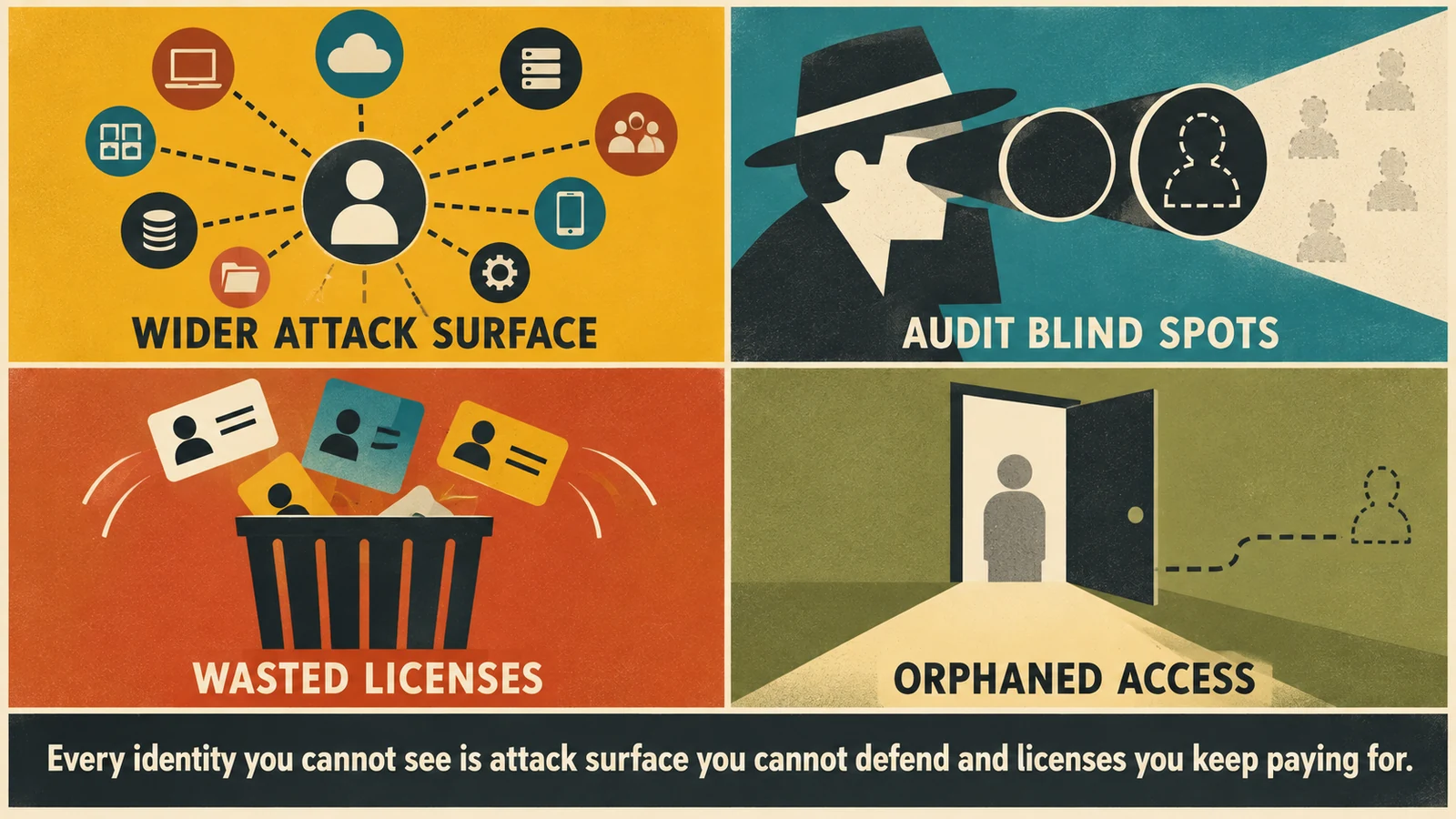 The costs of sprawl are diffuse but concrete: attack surface, audit blind spots, license waste, and orphaned access. Each is measurable enough to justify consolidation on its own.
Expanded attack surface. Every account is a login, and every login is something an attacker can target. A duplicate account in an unwatched SaaS tenant, or an orphaned account for a departed employee, is a credential that can be phished, brute-forced, or purchased on a breach market and used to enter the environment through a door no one is monitoring. The controls that protect the primary account — the conditional access policy, the step-up authentication, the anomaly detection — often do not extend to the accounts central identity does not know exist. Sprawl is, quite literally, a proliferation of unwatched entry points.
Audit blind spots. When one person's access is scattered across systems that do not reconcile, no certification campaign can review the complete picture. Reviewers approve access one directory at a time and never see that the same person holds conflicting entitlements across three others. Segregation-of-duty rules cannot fire on entitlements the governance layer does not see. When an auditor asks "show me everything this person can access," the honest answer under heavy sprawl is "we can show you what these particular systems know about; we cannot promise it is complete." That is an audit finding waiting to happen.
License waste. Duplicate and orphaned accounts frequently consume paid licenses — seats belonging to people who left, duplicate accounts one person holds across redundant systems, and shadow-IT tenants that overlap with centrally licensed tools. License reconciliation is one of the few sprawl costs that shows up directly on a budget line, and it is often large enough to fund the consolidation effort that eliminates it.
Orphaned access surviving offboarding. The compounding cost. When a person leaves and their identity was never fully mapped, offboarding removes the accounts central identity knows about and leaves the rest live. The leaver retains access to the SaaS tools, the acquired-company systems, and the shadow-provisioned tenants that were never linked to their authoritative identity. This is where sprawl becomes a breach vector rather than an inconvenience, and it is the direct motivation for the Automated Deprovisioning piece.
The consolidation path
Consolidation is a five-stage path, sequenced deliberately. The sequence matters as much as the stages: attempting them out of order — deleting before discovering, or merging directories before reconciling identities — produces outages and data loss.
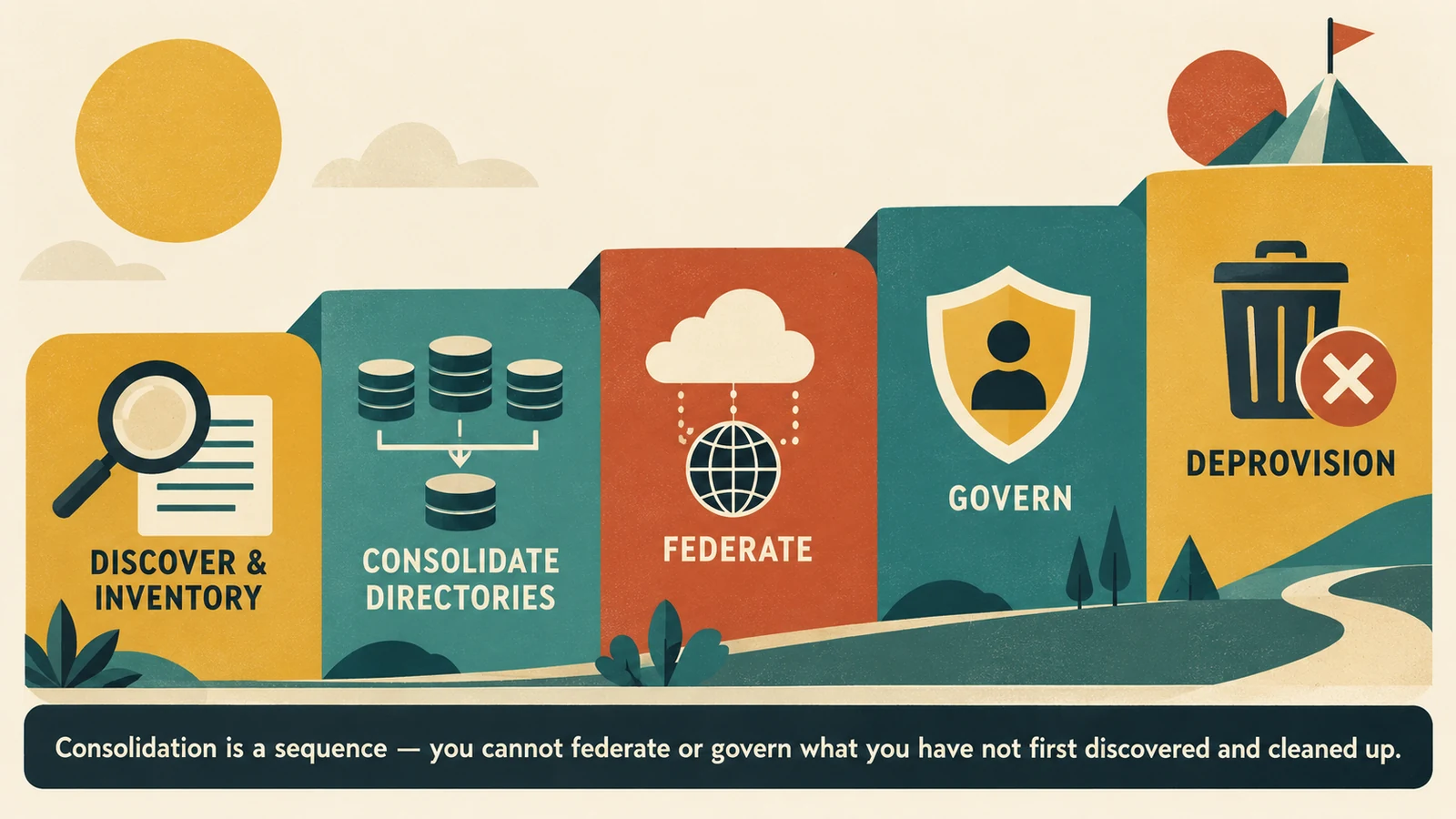 Five stages, in order: discover, consolidate, federate, govern, deprovision. The sequence is not optional — deleting before discovering, or merging before reconciling, is how consolidation programs cause outages.
Stage one: discover and inventory. You cannot consolidate what you cannot see. The first stage is a complete inventory of every identity source — every directory, every SaaS user store, every cloud IAM system — and the reconciliation of accounts to real people. This is the hardest and most valuable stage, because it surfaces the sprawl that was previously invisible: the shadow tenants, the orphaned accounts, the duplicate representations. Discovery is not a one-time scan; it is a capability the governance layer maintains continuously, because sprawl re-accumulates.
Stage two: consolidate directories. With identities reconciled, you decide directory by directory whether to merge. Redundant directories that hold the same population — a duplicate LDAP tree, a legacy domain from a completed acquisition — are candidates to consolidate into the primary directory now that accounts are reconciled and collisions can be resolved deliberately. This stage reduces the raw number of directories, but only where merging is genuinely low-risk. It is never the whole answer, because many systems cannot or should not be merged.
Stage three: federate. The systems you cannot merge — a specialized application's internal store, a partner directory, a cloud provider's native IAM, a SaaS tool with no migration path — come under governance through federation rather than consolidation. Standards-based federation via SAML, OIDC, and SCIM lets one authoritative identity provision, authenticate, and govern these systems without physically merging them. The SCIM Provisioning piece covers the provisioning standard that makes this work, and the Multi-Cloud Identity Management piece covers federation across cloud providers specifically. Federation is what makes consolidation possible without rip-and-replace.
Stage four: govern. With the estate consolidated where possible and federated everywhere else, you place a single access-governance layer over all of it. One policy engine, one certification process, one set of segregation-of-duty rules, operating on the whole picture rather than one directory at a time. The Access Governance piece covers this layer in depth. Governance is what turns a merely-inventoried estate into a governed one — it is the difference between knowing where the accounts are and controlling them.
Stage five: deprovision. The final stage removes the duplicates and orphans that discovery surfaced and governance confirmed are safe to remove. This is deliberately last, because safe deletion depends on everything before it: you have to know whose the account is, what access it carries, whether anything depends on it, and whether removal breaks an integration. Automated, governed deprovisioning — the subject of the Automated Deprovisioning piece — removes the sprawl on a controlled workflow rather than an ad-hoc cleanup that risks outages.
Why consolidation has to be continuous
The single most common way consolidation programs fail is treating them as one-time projects. An enterprise runs a heroic cleanup, reconciles the estate, deletes the orphans, declares victory — and eighteen months later the sprawl is back, because the five forces that create it never stopped operating. A new SaaS tool arrived. A new acquisition closed. A team stood up a new directory for a specific project. A round of departures left new orphans.
The mature 2026 approach treats consolidation as a standing capability rather than a project with an end date. The governance layer continuously reconciles every account against the authoritative source, flags new unreconciled accounts as they appear, provisions and deprovisions through standards-based connectors as people join and move and leave, and surfaces new sprawl the moment it forms. The one-time cleanup gets you to a governed baseline; the continuous capability keeps you there. Anchoring the authoritative source to the HR system of record — the one system that reliably knows who is actually employed — is what makes continuous reconciliation possible, because it gives the governance layer a ground truth to reconcile against.
What Avatier ships toward this pattern
Avatier Identity Anywhere approaches sprawl through discovery, lifecycle governance, and standards-based federation rather than a forced directory migration. Lifecycle management reconciles identities against an authoritative source — typically the HR system of record — and provisions and deprovisions accounts across connected systems through standards-based connectors, so that one authoritative identity maps to every account a person holds and every account traces back to a live person. This is the reconciliation authority that sprawl lacks by default.
Access governance places a single policy and certification layer over the consolidated and federated estate, so certification campaigns and segregation-of-duty rules operate on the whole picture rather than one directory at a time — closing the audit blind spots that sprawl creates. Federation through SAML, OIDC, and SCIM brings systems that cannot or should not be merged under governance without physically consolidating them, which is what makes the federation-first, no-rip-and-replace path viable. Automated deprovisioning removes the duplicates and orphans that discovery surfaces, on a governed workflow that confirms safe removal rather than an ad-hoc cleanup that risks breaking a live integration.
The platform is FIDO2-compatible for the authentication layer, NIST 800-53 Rev. 5 aligned and FedRAMP-aligned for public-sector deployments, and built under Avatier's CISA Secure-by-Design Pledge commitment. The Avatier Trust Center publishes the full compliance posture — SOC 2 Type II with zero exceptions, ISO/IEC 27001:2022 certified, PCI DSS v4.0.1 compliant, and CSA STAR Level 1. The point of naming these is not the badges themselves but what they signal for a consolidation program: the governance layer you are centralizing identity into is itself operated under audited controls, which matters when it becomes the single source of truth for the whole estate.
ABOUT THE AUTHOR

More from Access Management
PIM vs PAM vs PUM: Privileged Access Defined for 2026
PIM, PAM, and PUM get used interchangeably and mean three different things. PIM manages who holds privileged identity and which roles carry it. PAM controls how privilege is exercised through vaulting, session control, and just-in-time elevation. PUM manages the shared privileged accounts nobody personally owns. The 2026 reference on distinguishing the three terms, where they overlap, and where to start.

DNS as Identity Infrastructure: A 2026 Reference
DNS resolution, DNSSEC integrity, and DNS poisoning as a credential-harvesting vector — the 2026 reference on treating DNS as identity infrastructure, not network plumbing.

Device Trust and Posture in Access Decisions 2026
Device trust factors the health of the endpoint — managed vs unmanaged, patch level, disk encryption, EDR status — into every access decision, so that a correct password on a compromised laptop no longer buys the same access as a correct password on a verified device. The 2026 enterprise reference on posture-driven access outcomes: healthy allows, risky limits or steps up, non-compliant blocks.