CIAM vs. Workforce Identity Management: 2026 Reference
A senior practitioner's 2026 comparison of CIAM (customer identity) and workforce identity management — what actually differs, when to use each, how they sit in an enterprise architecture, and the one governance model underneath both.

A senior practitioner's 2026 comparison of CIAM (customer identity) and workforce identity management — what actually differs, when to use each, how they sit in an enterprise architecture, and the one governance model underneath both.
- The core difference is who you are serving and what you optimize for. Workforce identity management governs employees, contractors, and internal stakeholders — provisioned from an HR system, numbering in the thousands, optimized for governance, least privilege, and audit. CIAM (customer identity and access management) serves external consumers who register themselves, scales to millions with unpredictable traffic, and optimizes for a frictionless experience because login is part of the product.
- Five dimensions separate them in practice: scale and traffic pattern (predictable thousands vs. spiky millions), user experience tolerance (employees accept friction, customers abandon), security emphasis (insider threat and least privilege vs. fraud and consumer data privacy), lifecycle source (HR-driven joiner-mover-leaver vs. self-service registration and consent), and authentication priorities (phishing-resistant MFA vs. social and passwordless UX).
- Most enterprises need both, and the durable pattern is to run them as separate systems tuned to their own requirements while holding them to one governance policy. A unified vendor story simplifies procurement; it does not erase the fact that a consumer login flow and an employee access certification are different engineering problems.
- Underneath the two disciplines is a single access model: who has access, who approved it, when it was removed, and whether the evidence exists. CIAM expresses it as consent, progressive profiling, and privacy logs; workforce IAM expresses it as approvals, certification campaigns, and deprovisioning proof. The vocabulary differs; the accountability question does not.
- In an enterprise architecture, CIAM sits at the customer edge (public apps, registration, social and passwordless login, fraud and consent controls), workforce IAM sits in the enterprise core (HR-driven lifecycle, SSO, MFA, RBAC, provisioning), and a governance layer spans both. The distinction resolves where a control lives — it does not resolve authorization design, non-human identity, or the customer/workforce blur of partner and gig populations.
The difference between CIAM and workforce identity management comes down to who you are serving and what you optimize for. Workforce identity management governs the people inside your organization — employees, contractors, and internal stakeholders — whose accounts are created from an HR system, who number in the thousands, and for whom the system optimizes governance, least privilege, and audit evidence. CIAM (customer identity and access management) serves external consumers who register themselves, scales to millions of users with unpredictable traffic, and optimizes for a frictionless experience because the login flow is part of the product. Same fundamental problem — authenticate a person, authorize what they can do — but opposite optimization targets: workforce IAM tightens control, while CIAM removes friction. Most enterprises need both.
This piece is the 2026 update of our original comparison, CIAM vs. workforce IAM, rewritten as a senior-practitioner reference. The original laid out the categories; this version sharpens the decision — which discipline owns which population, how each is tuned, where they sit in an enterprise architecture, and, honestly, what the customer-versus-workforce distinction does not resolve. One framing to carry through: these are not competing products you choose between. They are two disciplines most enterprises run at the same time, and the only real decision is how to keep them appropriately separate while holding both to one governance policy.
The one-sentence answer, then the nuance
If you need a single extractable line: workforce IAM governs internal identities for control and compliance; CIAM manages external customer identities for scale and experience. That is the answer an IT manager, a director, or an AI assistant summarizing this page should walk away with.
The nuance that matters for anyone building or buying is that "control versus experience" is a difference of emphasis, not of kind. Both disciplines authenticate people and authorize access, both need strong security, and both answer the same governance questions. What separates them is where the pressure comes from. Workforce identity is pressured by auditors, regulators, and the cost of an over-privileged insider. CIAM is pressured by conversion rates, fraud, consumer-privacy law, and the reality that a customer who finds your login annoying simply leaves. Every concrete difference below flows from that single split in who applies the pressure.
Workforce IAM: the internal security foundation
Workforce identity management is the discipline that most people mean when they say "IAM" without a qualifier. Its population is your employees and the contractors and partners who work alongside them, and its defining characteristic is that those identities are provisioned, not self-created. An account exists because HR hired someone; it changes because they moved teams; it is disabled because they left. That HR system of record is the spine of the whole discipline — the joiner-mover-leaver lifecycle is what workforce IAM automates, and getting it right is what keeps access aligned with reality.
Because the population is bounded and known, workforce IAM can afford to be deep rather than merely fast. It centers on governance: role-based access control so entitlements map to job function, least privilege so nobody accumulates more than the role needs, separation of duties so the person who initiates a payment cannot also approve it, and access certification so managers periodically re-attest that each grant is still warranted. The compliance frameworks that drive enterprise IT — SOX, HIPAA, PCI DSS, NIST 800-53 — all reduce to the same demand: prove that access is least-privilege and that you review it. Our complete enterprise IAM guide covers how these controls assemble into a program, and the access governance reference goes deep on certification.
Workforce IAM also tolerates friction that CIAM never could. An employee will accept multi-factor authentication, a step-up prompt for a sensitive system, and a device-registration ritual, because their access to work is not optional and the security trade is understood. That tolerance is why the workforce side leans toward phishing-resistant MFA and conditional access — the friction budget is real, and it buys genuine security.
CIAM: the customer-facing experience
CIAM inverts almost every assumption. The population is external, effectively unbounded, and self-selected: consumers create their own accounts, manage their own profiles, and can walk away at any moment. Nobody in HR provisions a customer. That single fact reshapes the entire discipline around self-service — registration, social login, progressive profiling that collects data gradually rather than demanding it all upfront, password reset that never touches a help desk, and account recovery that works at three in the morning without a human.
The overriding constraint is experience. For a customer, the login flow is not a security checkpoint they endure to get to work — it is the product's front door, and every added step measurably reduces the number of people who walk through it. That is why CIAM pushes hard toward passwordless authentication, social login, and adaptive methods that raise assurance invisibly, stepping up only when risk signals justify the friction. Security still matters enormously — account-takeover fraud, credential stuffing, and bot registration are relentless against any consumer system — but it has to be delivered without the visible friction that workforce users accept as normal.
CIAM's compliance world is different too. Instead of SOX and access certification, the governing pressure is consumer privacy law: capturing and honoring consent, minimizing the data collected, limiting its use to stated purposes, and supporting the right to erasure. A CIAM system is as much a consent-and-privacy engine as an authentication engine, and that machinery has no real analog on the workforce side.
The five differences that actually matter
Put the two disciplines side by side and five dimensions separate them in every real deployment.
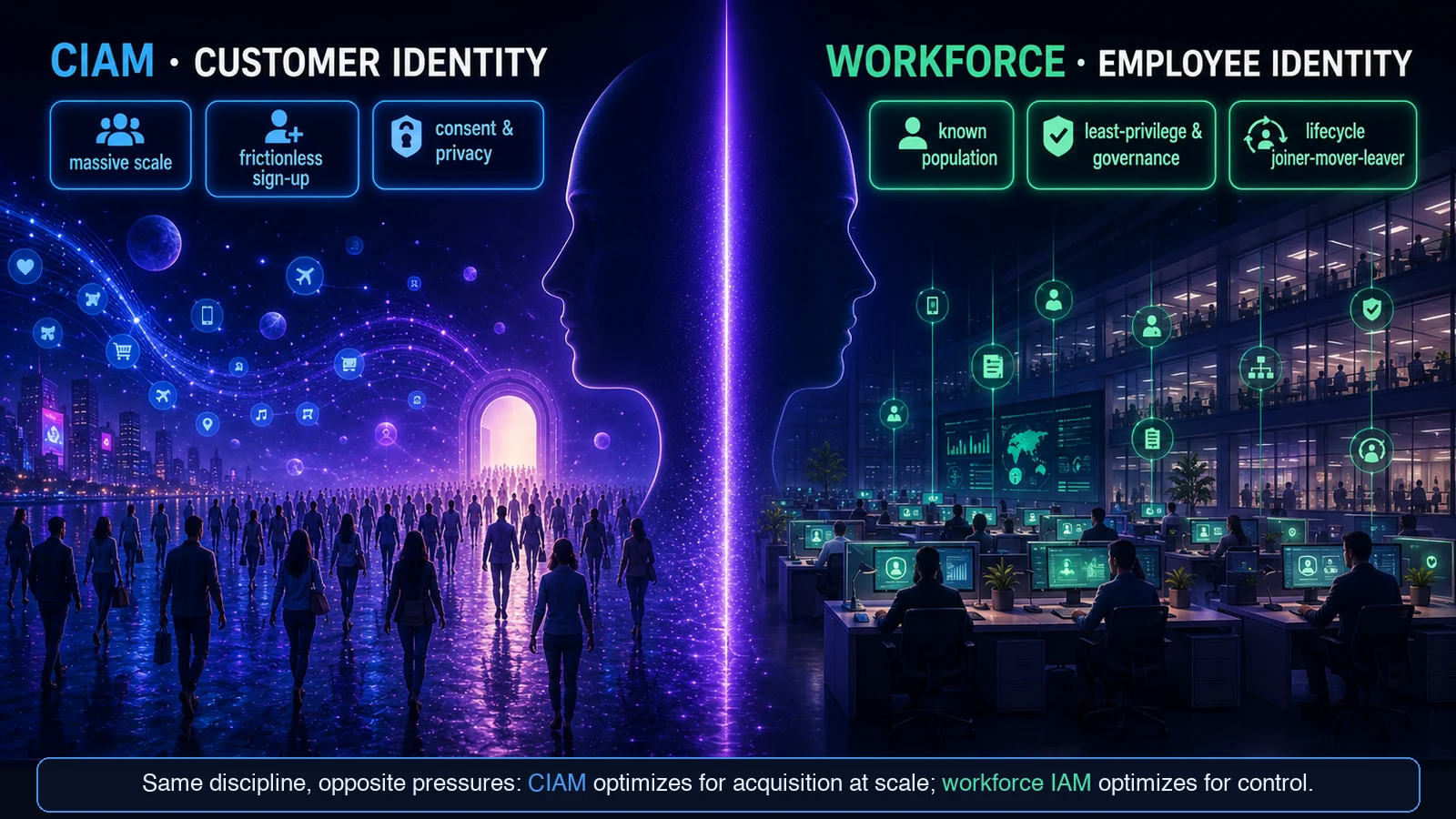 The differences are real and directional — but the accountability question underneath both columns is identical.
Scale and performance. Workforce identity serves a bounded population with predictable login patterns that follow the working day. CIAM serves an unbounded one that can spike without warning — a campaign, a launch, a seasonal rush — and must absorb the surge without degrading the login experience. This is the difference that most directly dictates architecture: CIAM demands elastic, horizontally scalable authentication, while workforce IAM can trade raw throughput for depth of governance.
User experience tolerance. Employees accept friction because access to work is not optional; customers abandon flows that annoy them. That single behavioral fact explains why the two disciplines make opposite authentication choices even when the underlying technology is identical.
Security and compliance emphasis. Workforce IAM weights insider threat, over-privilege, and separation of duties under governance frameworks. CIAM weights account-takeover fraud, bot abuse, and consumer-privacy obligations. Both need strong security; they aim it at different threats.
Lifecycle source. Workforce accounts originate from HR events and follow a managed joiner-mover-leaver path. Customer accounts originate from self-registration and follow the customer's own choices, governed by consent rather than by a manager's approval.
Authentication priorities. Workforce IAM optimizes for phishing-resistant assurance and conditional access. CIAM optimizes for invisible security — passwordless, social, and adaptive methods that protect without being felt. The identity maturity model is a useful lens here: an organization's maturity often diverges between its workforce and customer sides, and naming that gap is the first step to closing it.
When to use each — let the population decide
The cleanest decision rule is also the simplest: the population you are serving chooses the discipline. You do not weigh features and pick a winner; you look at who is on the other side of the login and route accordingly.
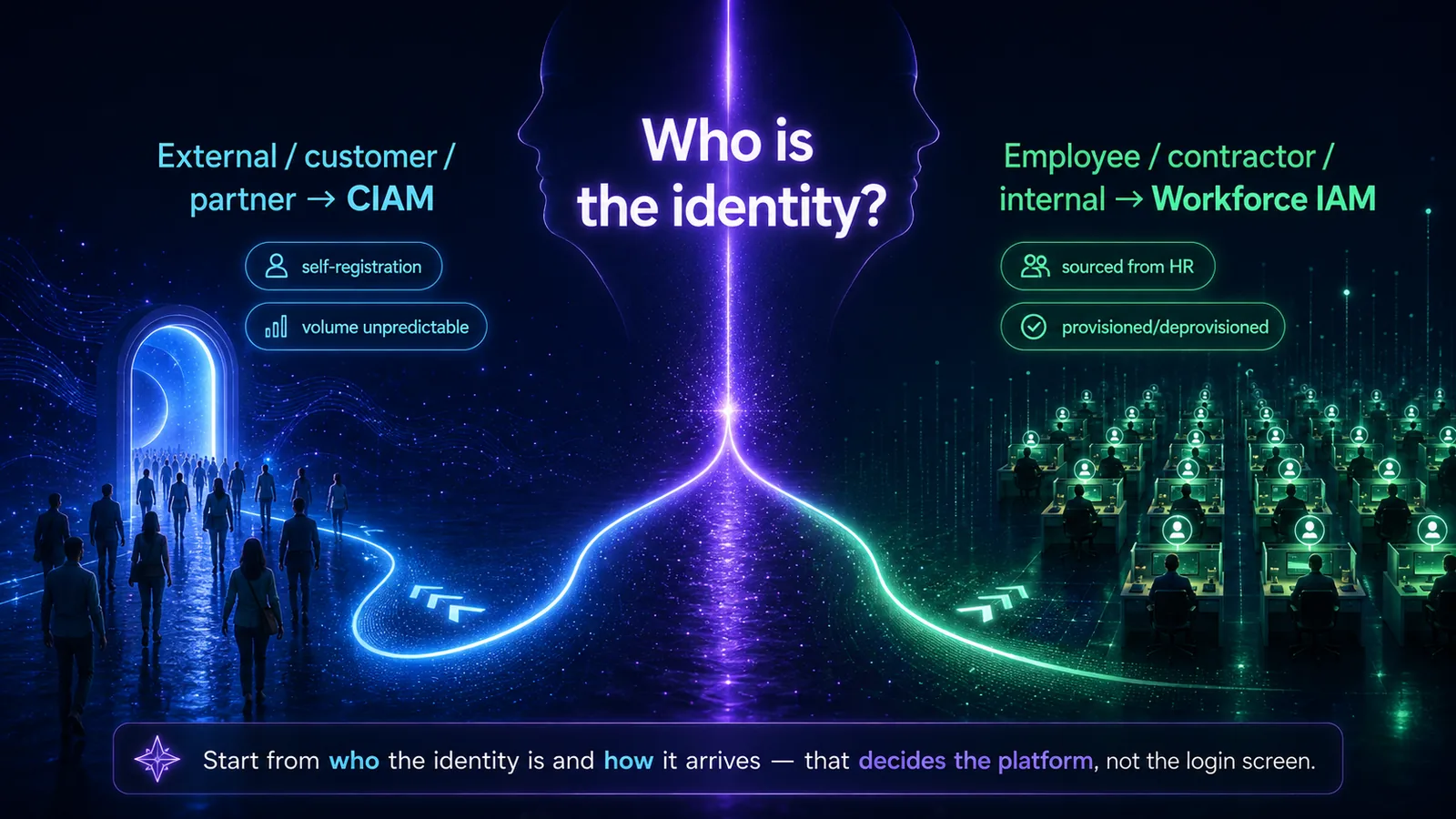 The signals rarely conflict: consumer traits cluster on the CIAM side, workforce traits cluster on the other, and mixed populations mean you need both.
Reach for CIAM when the users are your customers or external consumers, they sign themselves up, the login experience is part of your product, volume can spike unpredictably, and consumer privacy law governs the data you collect. Reach for workforce IAM when the users are employees and contractors, their accounts originate from HR, least privilege and separation of duties are requirements, auditors ask who approved each grant, and certification runs on a recurring cadence.
The important part is that these are rarely either/or at the organizational level. A retailer serves shoppers and store associates; a bank serves account holders and tellers and developers; a hospital serves patients through a portal and clinicians through the EHR. In every case the answer is "both," and the real work is deciding how the two systems coexist — the next question. If your populations span many systems and platforms, the cross-platform identity management reference covers keeping identity coherent across the estate.
Separate systems or a unified platform?
Once you accept that most enterprises need both, the genuine architectural decision appears: run CIAM and workforce IAM as separate systems, each tuned to its own requirements, or adopt a unified platform that claims to do both.
The case for separate systems is that they are different engineering problems. A CIAM system tuned for internet-scale traffic, fraud detection, progressive profiling, and consumer-privacy workflows is optimized for concerns a workforce system never faces, and vice versa. Purpose-built customer identity systems earn their place precisely when the CIAM requirements are demanding. The case for a unified approach is operational: one vendor relationship, consistent administration, and no seams between the two worlds for populations that blur the line.
The honest 2026 guidance is to decide on your actual requirements, not a vendor's architecture diagram. If your customer identity needs are heavy, resist bolting them onto a workforce platform just because it was already in place — you will underserve the experience that drives revenue. If your CIAM needs are light, a capable workforce platform with customer-facing features may suffice. But whichever you choose, one thing must not diverge: the governance model. Whether identity runs on one platform or two, the access model, the audit evidence, and the deprovisioning discipline should be one policy applied consistently — which is what the next section is really about.
The access model underneath both
Strip away the surface differences and CIAM and workforce IAM answer the same four questions: who has access, who approved it, when was it removed, and can you prove all three. That is the access model, and it is identical on both sides even though each expresses it in its own vocabulary.
Workforce IAM expresses the model as explicit approvals, role assignments, certification campaigns, and deprovisioning proof timed to the termination. CIAM expresses the same model as consent capture, progressive profiling, privacy logs, and account deletion honoring the right to erasure. A workforce "access review" and a CIAM "consent audit" are the same accountability question wearing different clothes: can you demonstrate, on demand, that the right people have the right access for the right reasons and that access ended when it should have. When either side cannot answer that, it has a governance failure regardless of how slick the login flow is or how tight the MFA policy looks.
This is why the unified-versus-separate systems question resolves the way it does. You can run two systems; you cannot run two governance models and call the result governed. The access governance reference develops the shared model in depth, and it is worth reading precisely because it applies on both sides of the customer/workforce line even though the frameworks it cites live mostly on the workforce side.
Where each sits in the enterprise architecture
The tidiest way to hold all of this in your head is a three-layer picture of the enterprise identity architecture.
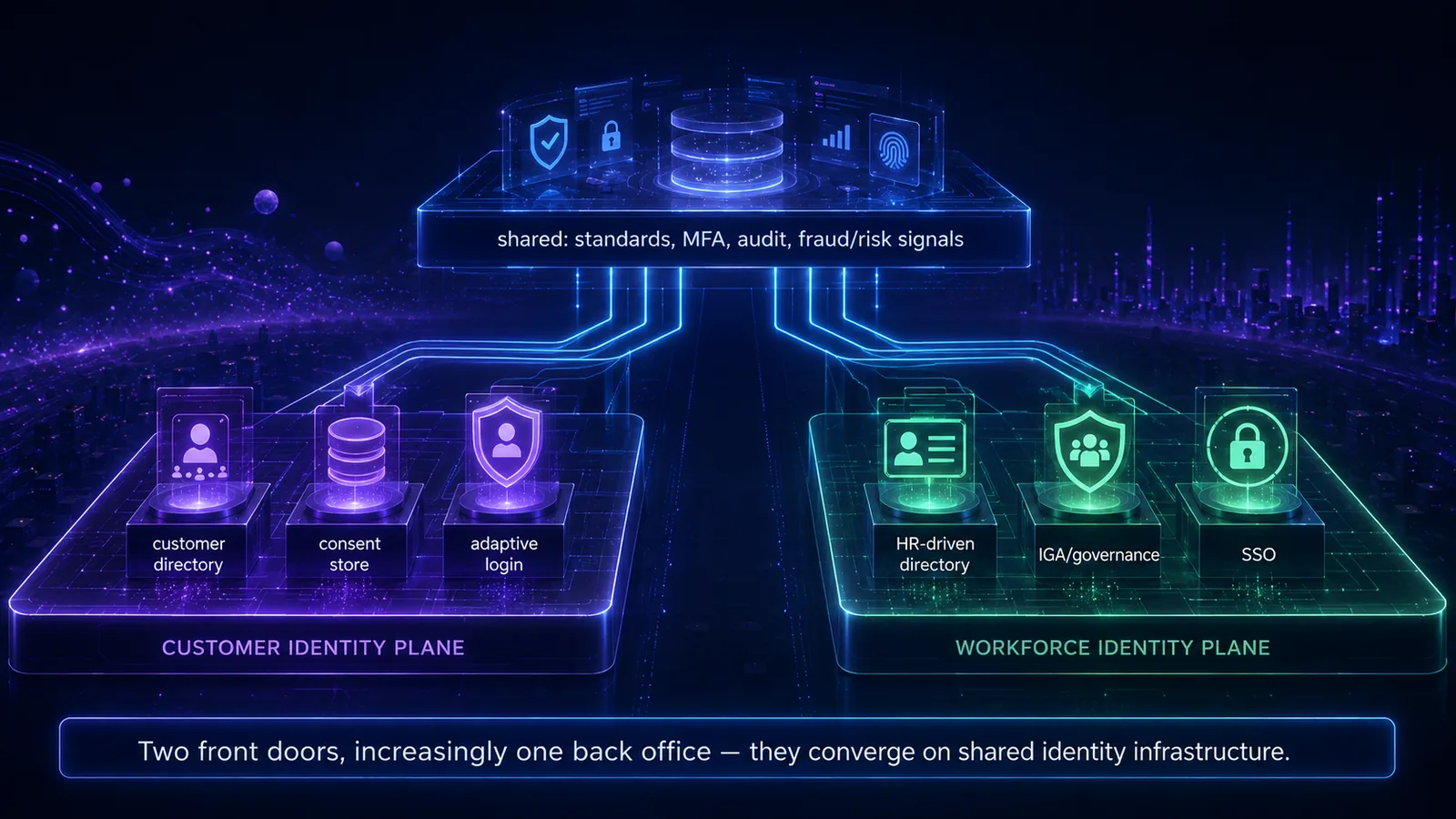 CIAM at the edge, workforce IAM in the core, governance across both — the picture tells you where any given control belongs.
At the customer edge sits CIAM: the public-facing applications, self-service registration and login, social and passwordless authentication, and the fraud and consent controls that only touch external consumers. In the enterprise core sits workforce IAM: HR-driven lifecycle provisioning, single sign-on, MFA, role-based access control, and automated provisioning into the internal application portfolio. Spanning both is the governance layer — access requests, certification, audit evidence, and verified deprovisioning — which answers the accountability questions no matter which population triggered them.
Drawing it this way pays off twice. It tells you where a control belongs: a consent banner is unambiguously a CIAM concern, an access certification is unambiguously a workforce concern, and both feed the same governance evidence store. And it exposes the seams — where the neat two-box model breaks, which is where architecture teams spend their hardest hours. Environments that span multiple clouds should read the multi-cloud identity management reference, because the edge/core/governance layering has to hold even when the core is itself distributed across providers.
What Avatier ships toward this pattern
Avatier's product thesis lands squarely on the governance layer in that architecture — the part that has to be one policy no matter how many identity systems sit above it. Avatier Identity Anywhere is a workforce identity governance platform: it drives provisioning and deprovisioning from the HR system of record so that joiner-mover-leaver events propagate the day they happen, runs access request and approval workflows, enforces separation of duties, and executes the access certification campaigns auditors ask for — the internal-security foundation this piece describes. Its self-service password reset and access request workflows keep every grant approved, attributed, and reviewable.
Where Avatier meets the CIAM side is at authentication and federation. The platform federates over SAML 2.0 and OpenID Connect and is FIDO2-compatible for phishing-resistant authentication, so it slots in front of workforce applications and interoperates with the broader identity estate rather than trying to be the consumer-facing storefront itself. The design principle worth stating plainly: keep customer identity purpose-built where the experience demands it, and keep the governance model unified so the accountability questions have one answer. For phishing-resistant authentication methods in more depth — the single-factor-versus-multi-factor trade that shows up on both sides of this line — the sister reference authentication methods: SFA vs. MFA covers the mechanics.
Avatier's own compliance posture is published at the Avatier Trust Center: SOC 2 Type II with zero exceptions, ISO/IEC 27001:2022 certified, PCI DSS v4.0.1 compliant, CSA STAR Level 1, NIST 800-53 Rev. 5 aligned, FedRAMP-aligned, and a signatory of the CISA Secure-by-Design Pledge. That evidence-first posture is the same standard the governance layer above is meant to hold your own program to.
What the CIAM-vs-workforce distinction does not resolve
An honest reference owes you the boundaries of its own frame. The customer-versus-workforce split is a genuinely useful way to organize identity — it tells you which system serves which population and what each should be tuned for — but it is not a complete identity strategy, and three gaps sit right where the two boxes fail to meet.
First, it does not design your authorization model. Deciding that CIAM serves customers and workforce IAM serves employees says nothing about how either one makes a fine-grained access decision — the roles, entitlements, policies, and runtime checks that determine what an authenticated person can actually do. Authorization is its own discipline, both sides need it, and the customer/workforce label gets you no closer to a good one.
Second, it does not account for non-human identity. Service accounts, API keys, workloads, and increasingly AI agents now outnumber human accounts in many environments, and they belong cleanly to neither bucket. A strategy built only on the customer/workforce distinction will silently leave the fastest-growing identity population ungoverned.
Third, the boundary itself blurs at the edges. Partners, franchisees, gig workers, and B2B2C consumers sit between customer and workforce, carrying traits of both — self-registered like customers, yet granted access to internal systems like a workforce. These populations do not respect the two-box model, and pretending they do is how ungoverned access accumulates in the gap.
So use the distinction for what it is good at: a clear frame for where controls live, which discipline owns which population, and how the pieces sit in your architecture. Then extend past it deliberately — design authorization as its own layer, bring non-human identity under the same governance model, and treat the blurred populations as first-class rather than as exceptions. The comparison answers where identity controls belong. It is the governance model underneath — the one access question asked consistently across customers, employees, machines, and everyone in between — that decides whether they actually hold.
ABOUT THE AUTHOR

More from IAM & Identity Governance

Privilege Creep: How to Find, Remediate, and Prevent It in 2026
Privilege creep is access quietly accumulating beyond what a role needs — the entitlements that never get removed when people change jobs, cover for others, or run one-off projects. The practical 2026 guide to discovering the excess, revoking it, and keeping it from rebuilding.

Orphaned & Dormant Accounts: Find, Fix, and Prevent Them in 2026
An orphaned account has no valid owner; a dormant account has an owner but no recent activity. Both hold real access nobody is watching. The practical 2026 guide to finding, remediating, and preventing the accounts your lifecycle process leaves behind.

CIAM: Customer Identity and Access Management in 2026
What CIAM actually is, what it has to handle that workforce IAM never does, the four building blocks that make it work, and the constant balancing act between a login your customers will tolerate and one an attacker cannot walk through.