Privilege Creep: How to Find, Remediate, and Prevent It in 2026
Privilege creep is access quietly accumulating beyond what a role needs — the entitlements that never get removed when people change jobs, cover for others, or run one-off projects. The practical 2026 guide to discovering the excess, revoking it, and keeping it from rebuilding.

Privilege creep is access quietly accumulating beyond what a role needs — the entitlements that never get removed when people change jobs, cover for others, or run one-off projects. The practical 2026 guide to discovering the excess, revoking it, and keeping it from rebuilding.
- Privilege creep is the gradual accumulation of access rights beyond what a person's current role actually requires, and it is distinct from the principle of least privilege — least privilege is the goal, and privilege creep is the drift that pulls every account away from it over time.
- It arises from ordinary operations rather than malice: role changes that add access without removing the old, temporary grants that are never revoked, coverage for absent colleagues, project work that ends, and broad requests approved because narrow ones are harder to specify.
- The danger is that every excess entitlement enlarges the blast radius of a compromised account, weakens separation of duties, and turns into a recurring audit finding, because over-privileged accounts contradict the least-privilege posture regulators and auditors expect to see enforced.
- Remediation is a repeatable cycle rather than a one-time purge: discover the entitlements each account actually holds, compare them against what the role genuinely needs, revoke the excess safely, and recertify on a schedule so the comparison happens again before drift rebuilds.
- Prevention is a governance discipline built on well-designed roles, time-bound and just-in-time access instead of permanent grants, mover events handled as carefully as leaver events, and access reviews that force owners to justify what they keep.
Privilege creep is what happens when access is always added and rarely taken away. A person joins, gets the access their role needs, and does their job. Then they cover for a colleague on leave and get access to that colleague's systems. They join a project and get access to its tools. They move to a new team and get everything the new role requires — while keeping everything the old role required, because no one removes it. They help troubleshoot an incident and get temporary elevated rights that outlive the incident. None of these grants is wrong in the moment. Each one is a reasonable answer to a real need. But nothing ever reverses them, and over a few years the account accumulates a sediment of access that reflects everything the person has ever done rather than what they do now.
This is not the same thing as the principle of least privilege, though the two are constantly discussed together. Least privilege is the design goal — the standard that says every identity should hold only the access its job requires and nothing more. Privilege creep is the drift that pulls real accounts away from that goal continuously, in the ordinary course of business, even in organizations that sincerely believe in least privilege and have adopted it as policy. The policy governs how access is granted. Creep is about what is never removed. You can do the first perfectly and still fail badly at the second, which is why least privilege as a principle and privilege creep as a discipline are two different conversations. This guide is about the second: the accumulation problem, and the continuous remediation cycle that reverses it.
The reason creep deserves its own treatment is that it is invisible until you look for it. An over-privileged account works fine — better than fine, since it can reach everything its user might conceivably need. Nothing breaks, no one complains, and the excess access sits quietly until the day the account is compromised or an auditor asks why a person in one role can reach systems that belong to three other roles. By then the accumulation has been building for years. The organizations that stay ahead of it are not the ones whose accounts never accumulate excess — every real environment produces creep — but the ones that treat finding and removing it as a routine part of how identity runs.
What privilege creep actually is

Privilege creep is the gradual accumulation of access rights and entitlements beyond what a person's current role actually requires. The key words are gradual, current, and beyond. It is gradual because it happens one reasonable grant at a time, never in a single obviously-wrong decision. It is measured against the current role because access that was perfectly appropriate for a job someone held two years ago becomes excess the moment they move on from that job without the access being removed. And it is defined by what lies beyond need — the delta between what an account can do and what its role genuinely requires.
The clearest way to picture it is to compare two snapshots of the same account. On day one, the account holds a clean, role-based set of entitlements: exactly what the job description implies, granted deliberately, each one justified by the work. Two years later, the same account holds that original set plus the residue of everything that happened in between — the project access from a project that ended, the elevated rights from an incident that closed, the second team's systems from a temporary secondment that became permanent for a while and then reversed, the shared mailbox from covering a parental leave, the reporting tool access requested once for a single quarter's analysis. The role has not necessarily changed. The access has only grown.
What makes creep distinctive among identity problems is that it is not a failure of any individual decision. Compare it to an orphaned account, where the failure is clear: the owner is gone and the account should have been disabled. With creep, every grant was correct when made. The failure is systemic and temporal — it lives in the absence of a reversing force, the fact that grants have a creation event but usually no expiration event. Access flows in through many well-justified channels and has almost no way out except a deliberate act of removal that rarely happens on its own. That asymmetry between easy addition and rare removal is the entire mechanism.
It is worth naming a close relative: entitlement bloat inside roles and groups. Much access is not granted to individuals directly but inherited through group and role memberships, and those bundles tend to accumulate their own excess over time as new permissions are added to a group to satisfy one member's need and then held by everyone in it. A person can suffer privilege creep without a single direct grant, simply by belonging to groups that have themselves crept. This is why remediation has to look at effective access — everything an account can actually do, including what it inherits — and not just at the entitlements assigned to the individual by name.
How privilege creep arises
Privilege creep is produced by ordinary operations working exactly as designed for granting and not at all for removing. A handful of mechanisms account for most of it.
Role changes handled as additions are the largest source. When a person is promoted or moves teams, the access their new role requires is provisioned quickly, because they cannot do the new job without it and the business pressure is to get them productive. The access their old role required, however, is almost never revoked as part of the same change, because no leaver event fires — the person has not left, they have merely moved — and no one owns the cleanup of the prior role. The account ends up as the union of both roles, and if the person moves again, the union grows. Over a career of internal mobility, a long-tenured employee can accumulate the access of half a dozen roles they no longer hold. Handling movers with the same rigor applied to leavers is the single most effective structural fix, a theme explored in automated deprovisioning and offboarding.
Temporary access that never expires is the second major source. Covering for a colleague on leave, joining a short project, responding to an incident, running a one-time analysis — all of these generate grants that are genuinely temporary in intent but permanent in effect, because they are created with urgency and no one circles back to remove them once the need passes. The grant has a clear beginning and no defined end, so it defaults to forever. This is precisely the gap that time-bound and just-in-time access with zero standing privilege is designed to close, by making expiration automatic rather than dependent on someone remembering.
Broad grants standing in for narrow ones contribute steadily. When someone requests access, it is often easier to ask for and approve a wide entitlement than to specify the exact narrow one that is actually needed, especially when neither the requester nor the approver has the detailed knowledge to scope it tightly. A whole application role gets granted when read access to one module would have done; membership in a broad group is added when a single permission was the real requirement. Each over-grant is a small act of convenience that leaves lasting excess.
Group and role bloat compounds all of the above. Because access is largely delivered through group and role memberships, and because those bundles are edited by adding permissions far more often than by removing them, the roles themselves creep. A permission added to a role to satisfy one member is thereafter held by every member. Nested groups multiply the effect, granting access through inheritance chains that no one fully traces. A well-designed role-based access model is the antidote, but roles left unmaintained become creep vectors in their own right.
Why privilege creep is dangerous
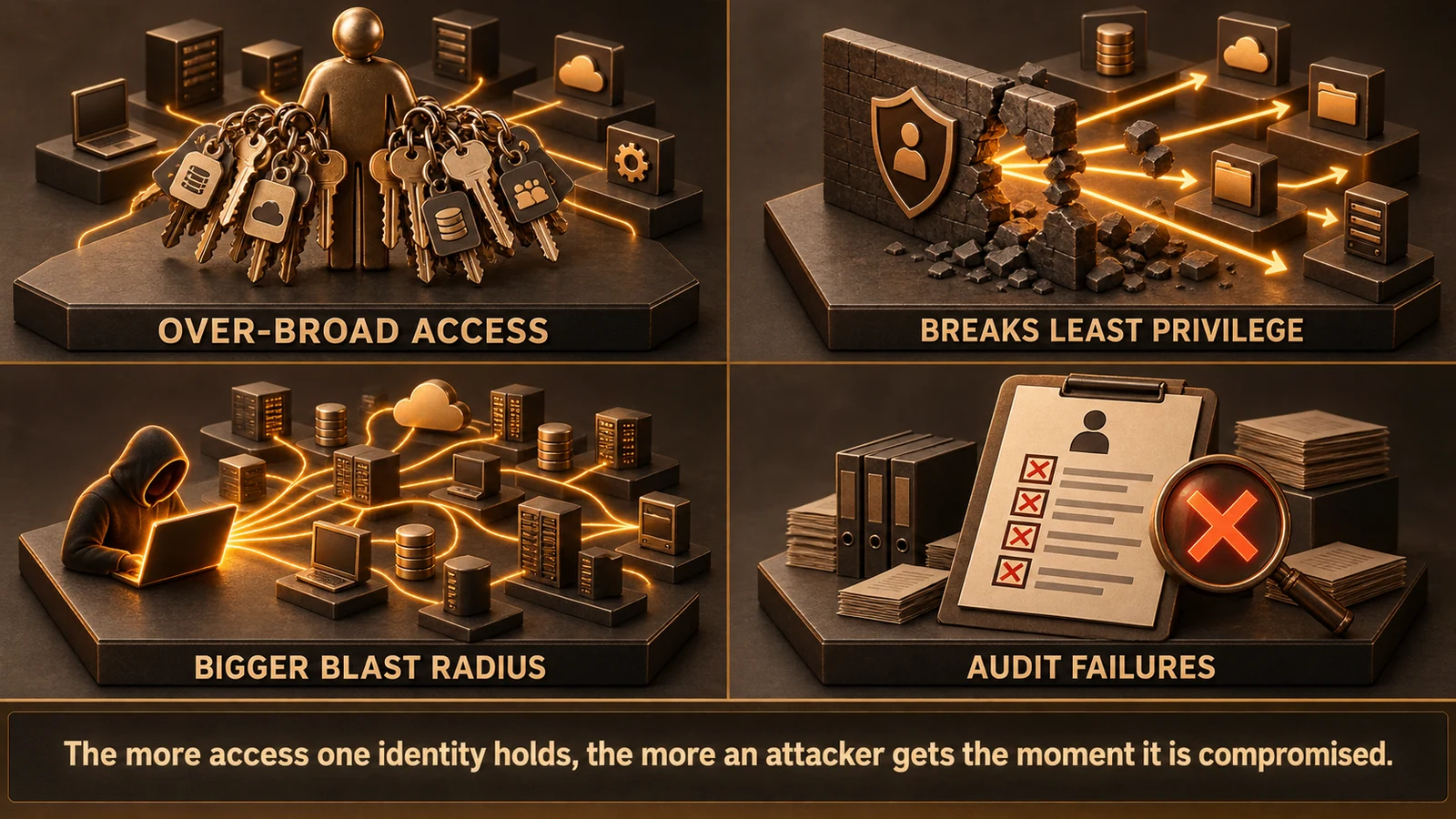
The instinct is that excess access is harmless because it is not being misused — the person is trustworthy and simply holds more than they need. That instinct misses the point entirely. The danger of privilege creep has almost nothing to do with the honesty of the person holding the access and everything to do with what that access becomes in the wrong hands or the wrong combination.
The central risk is blast radius. Every entitlement an account holds beyond what its role needs is another system, another dataset, another capability that an attacker inherits the instant they compromise that account. Account takeover does not care whether the excess access was ever used legitimately; it only cares what the account can reach. An over-privileged account turns what should be a contained incident — an attacker limited to one role's footprint — into a broad one, because the compromised identity can move laterally across everything it accumulated. The same logic that makes least privilege a security control makes creep a security liability: minimizing standing access minimizes what any single compromise can touch, and creep does the reverse. This is why minimizing standing access is inseparable from account-takeover prevention.
Creep also erodes separation of duties. Separation of duties depends on no single person being able to both initiate and approve, or both request and fulfill, the same sensitive action. But a person who has passed through several roles may quietly accumulate the access to do both halves of a controlled transaction, not because anyone granted them that combination deliberately, but because each half arrived with a different role and neither was ever removed. Toxic combinations of this kind are created by accumulation rather than by any single decision, which makes them hard to spot without deliberately analyzing effective access against separation-of-duties rules.
By definition, creep breaks least privilege. An account that holds more than its role needs is, tautologically, not operating under least privilege, and least privilege is not an aspiration — it is the baseline expectation behind most access-control frameworks and regulatory regimes. Every crept entitlement is a small, standing violation of the principle the organization claims to enforce.
Finally, privilege creep is a reliable audit and compliance finding. Auditors look specifically for accounts that can reach more than their role justifies, because over-privilege is such a dependable indicator of weak lifecycle governance. An organization that cannot demonstrate it periodically finds and removes excess access cannot credibly assert that it controls access, and the assurance posture it can stand behind — the kind of claims published at a Trust Center — depends on that removal being real. This is why remediating creep is simultaneously a security task and a compliance one.
How to remediate privilege creep
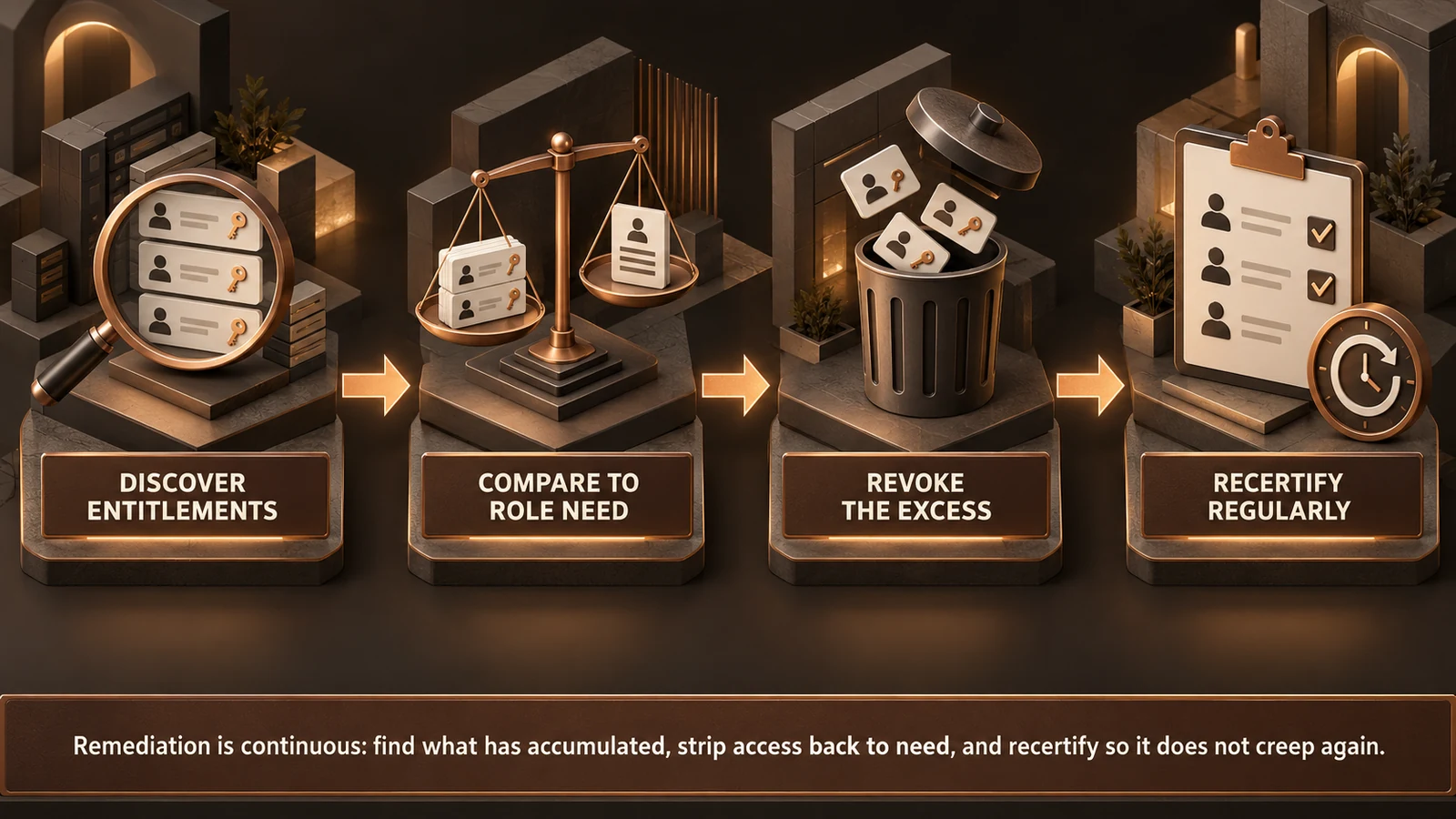
Remediating privilege creep is a cycle, not a purge. A single mass cleanup returns accounts to least privilege for a moment and then watches them drift again, because the mechanisms that produce creep keep running. The reliable approach is a repeatable four-stage cycle, run continuously, that keeps the actual state of access close to what roles genuinely need.
Discover the entitlements each account actually holds. You cannot remediate what you cannot see, and the access that matters most is often the access no one granted directly. Start by inventorying, for every identity, the complete set of entitlements it holds across every directory, application, and cloud platform — and critically, the effective access, including everything inherited through group and role memberships and nested groups, not only what was assigned to the person by name. This breadth is what distinguishes real discovery from a directory dump. The output is a clear picture of what each account can do in practice, which is almost always broader than anyone expects.
Compare to role need. With effective access in hand, measure it against a defined model of what the role actually requires. The gap between the two is the excess — the crept access that is the target of remediation. Where a clean role model exists, this comparison is direct; where it does not, outlier analysis is a powerful substitute, flagging access that a given account holds but that almost no one else in the same role or peer group has, because such outliers are strong candidates for creep. The result is a prioritized list of excess entitlements for owners to confirm, not an automatic verdict, since some outliers are legitimate exceptions that a knowledgeable owner will keep. The rigor an auditor actually expects from this comparison is the subject of what a real access review looks like.
Revoke the excess — carefully. Access confirmed as unneeded gets removed, and the operative word is carefully, because over-revoking causes outages exactly as reliably as under-revoking causes risk. Revoke in reviewed batches with a short observation window, so that anything which turns out to be needed surfaces quickly and can be restored before it disrupts work. Staging removal this way — rather than stripping everything flagged in a single sweep — is what makes remediation safe enough to do routinely instead of once, fearfully, every few years. Keep an audit trail of what was removed, who confirmed the decision, and when, so the work is defensible and repeatable.
Recertify on a schedule. The final stage is what turns a cleanup into a cycle. Recertification runs the comparison again at a defined cadence, before drift has rebuilt the excess, forcing owners to reaffirm that the access each account still holds remains justified. Highly privileged and sensitive access warrants more frequent recertification than routine access, and role changes should trigger targeted recertification immediately rather than waiting for the next scheduled campaign. As the volume of access to certify grows, the campaign itself becomes a scaling problem, which is where the approach in AI-assisted access certification campaigns focuses reviewer attention on the access that genuinely warrants scrutiny instead of everything at once.
Preventing creep from rebuilding
Remediation without prevention is a treadmill. If the only force acting on access is discovery-and-revocation after the fact, the same excess regrows between every cycle, because the granting side keeps outpacing the removing side. Prevention rebalances that asymmetry so that access has a way out by default, not only by exception.
Well-designed roles are the foundation. When roles bundle only what a job genuinely needs, and are maintained rather than allowed to bloat, the baseline grant is tight and the temptation to over-provision through broad group membership fades. Role design is not a one-time modeling exercise but an ongoing discipline of pruning roles as jobs change, so that the roles themselves do not become creep vectors. A maintained role model makes the compare-to-need stage of remediation dramatically easier, because there is a clean definition to compare against.
Time-bound and just-in-time access attacks the largest preventable source: temporary grants that never expire. When elevated or project access is granted for a defined window and expires automatically, the default flips from forever to until no longer needed, and the single most common creep mechanism closes itself without anyone having to remember. Reserving standing privilege for the narrow set of cases that truly require it, and delivering everything else just in time, keeps the accumulated footprint small by construction.
Mover events handled like leaver events closes the role-change gap. A promotion or transfer should trigger the removal of the prior role's access with the same deliberateness applied to granting the new role's access — ideally as a single, reviewed transition rather than an addition that leaves the old access in place. Treating every move as both a grant and a revocation prevents the union-of-all-past-roles accumulation that produces the most entrenched creep in long-tenured employees.
Access reviews as a standing control catch what automation cannot judge. Automated expiration and clean role transitions handle the mechanical cases, but only a human owner can decide whether access that is technically still in use remains justified, or whether an accumulated combination has quietly become a separation-of-duties problem. Periodic, risk-focused reviews force that judgment on a schedule, surfacing the drift that no automated trigger would flag. Together, these four practices convert privilege creep from an unbounded backlog into a bounded, maintained state — roles keep the baseline tight, time-bounding keeps the temporary from becoming permanent, disciplined movers stop accumulation, and reviews catch the residue.
The bottom line
Privilege creep is the predictable consequence of an identity program that is far better at giving access than at taking it away. It is not the failure of any single grant — every entitlement was a reasonable answer to a real need when it was made — but the failure to reverse those grants once the need passes, compounded across role changes, temporary coverage, ended projects, and bloated groups until an account can reach far more than its job could ever justify. That excess is pure risk: it enlarges the blast radius of every compromise, erodes separation of duties, breaks the least-privilege baseline, and shows up as a dependable audit finding, all without any operational benefit in return.
The way through is a cycle, not a one-time cleanup. Discover the effective access each account actually holds, compare it against what the role genuinely needs, revoke the excess carefully in reviewed batches, and recertify before the drift rebuilds. Then close the mechanisms that produce creep — tight and maintained roles, access that expires by default, movers handled as carefully as leavers, and reviews that force owners to justify what they keep. The organizations that keep their actual access close to the least-privilege ideal are not the ones that never accumulate excess. They are the ones that assume they always will, and build the finding, revoking, and recertifying into the normal operation of identity rather than waiting for a breach or an auditor to reveal how much has piled up.
ABOUT THE AUTHOR

More from IAM & Identity Governance

Orphaned & Dormant Accounts: Find, Fix, and Prevent Them in 2026
An orphaned account has no valid owner; a dormant account has an owner but no recent activity. Both hold real access nobody is watching. The practical 2026 guide to finding, remediating, and preventing the accounts your lifecycle process leaves behind.

CIAM: Customer Identity and Access Management in 2026
What CIAM actually is, what it has to handle that workforce IAM never does, the four building blocks that make it work, and the constant balancing act between a login your customers will tolerate and one an attacker cannot walk through.

Zero Trust Identity Architecture: The 2026 Foundational Guide
Zero trust for identity means never trusting a request by default and verifying every one against live signals — identity, device posture, location, and risk. The foundational 2026 reference on what that actually requires.