Zero Trust Identity Architecture: The 2026 Foundational Guide
Zero trust for identity means never trusting a request by default and verifying every one against live signals — identity, device posture, location, and risk. The foundational 2026 reference on what that actually requires.

Zero trust for identity means never trusting a request by default and verifying every one against live signals — identity, device posture, location, and risk. The foundational 2026 reference on what that actually requires.
- Zero trust for identity replaces the assumption that anything inside the network is safe with a rule that every access request is verified against live signals before it is allowed — no matter where it originates or what it accessed a minute ago.
- Four principles carry the model: verify explicitly against multiple signals, grant least privilege, assume breach and limit blast radius, and verify continuously rather than once at login.
- The perimeter model trusted location; zero trust trusts nothing by default and treats identity — not the firewall — as the primary control plane, because that is what a remote, cloud, and contractor-heavy enterprise actually has to defend.
- A zero-trust access decision weighs four signal classes together: who the identity is, the posture of the device it is using, the location and network it comes from, and the risk implied by its recent behavior — any one signal is weak, the combination is the control.
- Zero trust is an architecture and a discipline, not a product you buy: it does not fix broken identity data, replace lifecycle governance, or eliminate insider risk, and it fails quietly when the signals feeding it are wrong.
Zero trust for identity is a security model built on a single hard rule: no access request is trusted by default, and every one is verified against live signals before it is allowed — regardless of where the request originates, what network it rides, or what it was permitted to do a minute earlier. The shorthand is "never trust, always verify." In practice it means that being inside the corporate network, on the VPN, or holding a valid session no longer counts as proof of anything. Each request stands on its own and is evaluated in real time against who the identity is, the posture of its device, where it comes from, and the risk implied by its recent behavior. Identity — not the firewall — becomes the primary control plane. This guide is the foundational, identity-centric pillar of that model: what zero trust means, the principles that hold it together, why it replaced the perimeter, and the signals a zero-trust decision actually weighs.
What "never trust, always verify" actually means
The slogan is easy to repeat and easy to misread. It does not mean "make everyone log in more often." It means the system holds no standing assumption of trust that a request can inherit. In the old model, a great deal of trust was granted implicitly and once: authenticate at the start of the day, land inside the network, and everything you touched afterward assumed you were legitimate because you had already crossed the boundary. That single early decision propagated across hours of activity and dozens of systems.
Zero trust refuses to let that happen. Trust is never permanent, never location-based, and never transferred from one request to the next without re-verification. A request that was fine an hour ago is evaluated again now, because the conditions around it — the device's patch state, the network it is on, the identity's behavior — may have changed. "Always verify" is the operational half of the rule: verification is continuous and per request, not a gate you pass through once.
The word most practitioners underweight is explicitly. Zero trust verifies explicitly, meaning it makes the trust decision out loud, against evidence, every time — rather than implicitly, by default, because of where the request sits. That distinction is the whole model. Everything else in this guide is machinery for making explicit verification practical at enterprise scale.
The four core principles of zero trust
Zero trust rests on four principles that reinforce one another. Treat them as a set; adopting one without the others produces the appearance of zero trust without the substance.
Verify explicitly. Authenticate and authorize every request against multiple signals — identity strength, device posture, location, and behavioral risk — instead of trusting a single factor or a prior session. Explicit verification is what produces a decision an auditor can defend: not "they were on the network" but "this identity authenticated with a phishing-resistant factor, from a managed device, on a plausible network, with normal behavior."
Use least-privilege access. Grant the minimum entitlements needed for the specific task, for the shortest useful duration, and no more. Least privilege is what makes a compromised identity survivable — if an attacker takes over an account that can reach almost nothing, the breach stays small. It is also the principle enterprises most often skip, because standing over-provisioned access is convenient and invisible until it is exploited.
Assume breach. Design as though an attacker is already inside the environment. That mindset changes architecture: you segment access so lateral movement is hard, you encrypt and log by default, and you limit the blast radius of any single failure. Assume-breach is why zero trust never grants broad access on the strength of one successful login — it plans for that login to eventually belong to the wrong person.
Verify continuously. Re-evaluate trust throughout a session as conditions change, rather than deciding once and trusting for hours. A session that started clean can turn risky — the device falls out of compliance, the behavior shifts, threat intelligence flags the credentials. Continuous verification keeps the decision current instead of frozen at login.
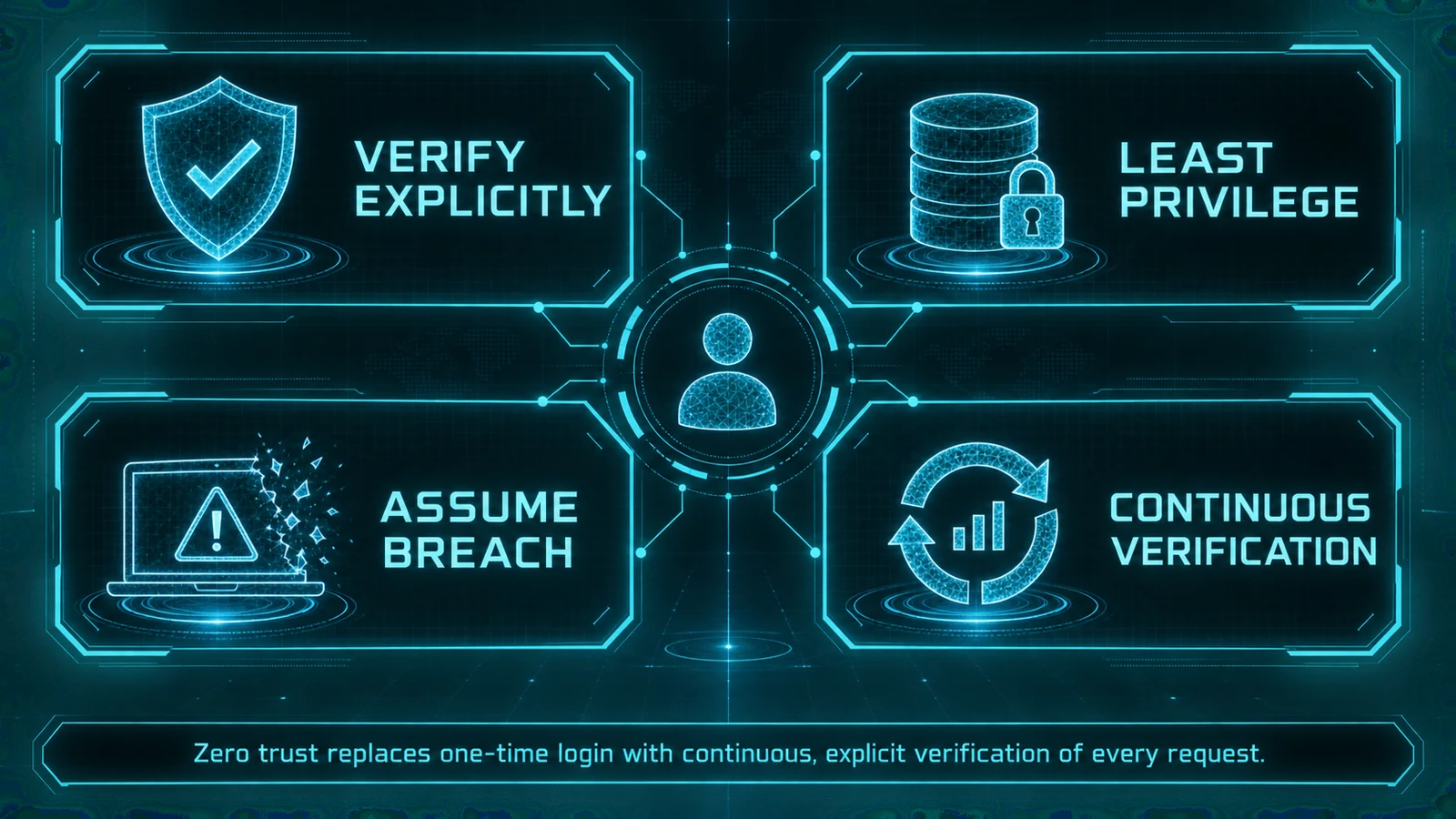
No single principle is zero trust on its own — explicit verification, least privilege, assume-breach, and continuous verification only work as a reinforcing set.
These four are the load-bearing ideas. If you can only remember one framing, remember that explicit verification produces the signals, least privilege limits what any decision can expose, assume-breach sets the design posture, and continuous verification keeps trust from going stale.
Perimeter security vs zero trust
For thirty years, enterprise security was perimeter security — the castle-and-moat model. You built a strong boundary around the corporate network with firewalls and a VPN, and you trusted whatever was inside it. Cross the moat and you were treated as one of the castle's own: broad access, lateral freedom, minimal re-checking. The model was coherent because the assumptions held. Applications ran in the data center, data lived on internal servers, and employees worked from offices on the trusted LAN. Location was a reasonable proxy for trust because everything trustworthy really was in one place.
Those assumptions collapsed. Applications moved to SaaS and public cloud. Data spread across dozens of external services. The workforce went remote, and contractors, partners, and non-human service accounts all needed access from outside the wall. The perimeter still existed, but it no longer enclosed the things it was supposed to protect. Worse, its central weakness became fatal: once an attacker got past the boundary — a phished credential, a compromised VPN — they inherited the same broad trust as a legitimate insider and moved laterally with little resistance. The moat did nothing against a threat that was already inside the walls.
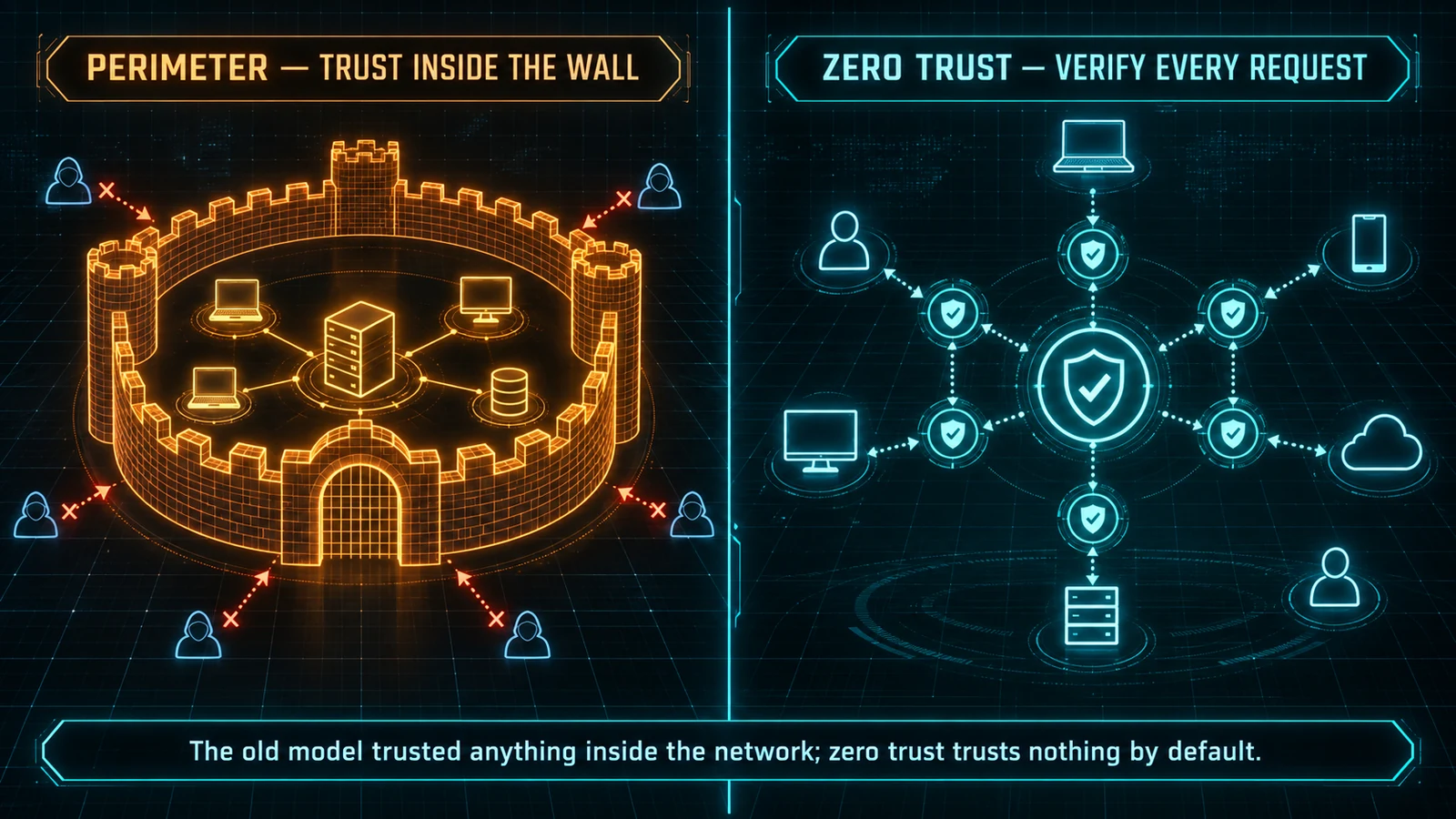
The perimeter trusts a location and collapses once an attacker is inside; zero trust removes the trusted inside and verifies every request on its own merits.
Zero trust is the response. It removes the trusted inside entirely. There is no privileged position on the network, no place where being present is enough. Every request — from an employee at headquarters, a contractor on a home network, or one microservice calling another — is verified on its own merits against live signals, granted narrowly, and revalidated as it proceeds. The shift is precise: perimeter security trusts a location, zero trust trusts a verified identity, for one request, right now. This is why identity, not the network, becomes the control plane — identity is the one attribute that travels with the request no matter where it comes from.
Identity as the control plane
When location stops being a usable trust signal, something has to take its place as the thing you organize security around. In zero trust, that thing is identity. It is the only control plane that spans every environment an enterprise actually runs: on-premises systems, multiple clouds, SaaS applications, remote endpoints, and the fast-growing population of non-human identities — service accounts, workloads, and AI agents that now outnumber human users in many estates.
Making identity the control plane has concrete prerequisites. You need an authoritative source of truth for every identity, so the system knows who and what exists. You need lifecycle automation, so access is granted at onboarding, adjusted as roles change, and — critically — revoked promptly when it should be, because orphaned access is a standing zero-trust violation. You need strong, ideally phishing-resistant authentication, so the "who" in every decision is trustworthy. And you need entitlements that are actually least privilege, because a policy engine can only enforce narrow access if narrow access has been defined.
This is the unglamorous foundation, and it is where most zero-trust programs either succeed or quietly fail. A sophisticated policy engine evaluating rich signals is worthless if it is deciding against identity data that is stale, over-provisioned, or incomplete. Zero trust does not create good identity governance; it consumes it. That dependency is worth stating plainly before any discussion of signals and decisions, because it is the part vendors gloss over.
The signals a zero-trust access decision weighs
The heart of zero trust in operation is the access decision: for this specific request, allow, deny, or challenge? A policy engine makes that call by combining signals across four classes. No single signal is trusted alone — each is weak evidence and several are spoofable — but correlated together they produce a decision that is hard to fake.
Identity. Who or what is making the request, how strongly they authenticated, and what entitlements they hold. A request backed by phishing-resistant MFA from a fully provisioned identity is a different proposition than one backed by a password alone. Identity is the anchor signal; everything else is context around it.
Device posture. Is the device known and managed? Is it patched, encrypted, running current endpoint protection, and free of compromise indicators? An impeccable identity on an unmanaged, out-of-date device is a materially riskier request than the same identity on a compliant corporate machine, and the decision should reflect that.
Location and network. Where does the request originate, and is the network trusted, unfamiliar, or anonymized? Location is no longer a trust grant — being on the corporate LAN earns nothing — but it remains a useful risk input. A login from an implausible geography, or through an anonymizing service, changes the calculus even when identity and device look fine.
Risk and behavior. How does this request compare to the identity's learned baseline and its peer group? Impossible travel, access to resources this identity never touches, activity at odd hours, or velocity that implies automation all raise the risk score. Behavioral signals are what catch a credential that has been stolen but is being used by the wrong person — the authentication is valid, but the behavior is not.
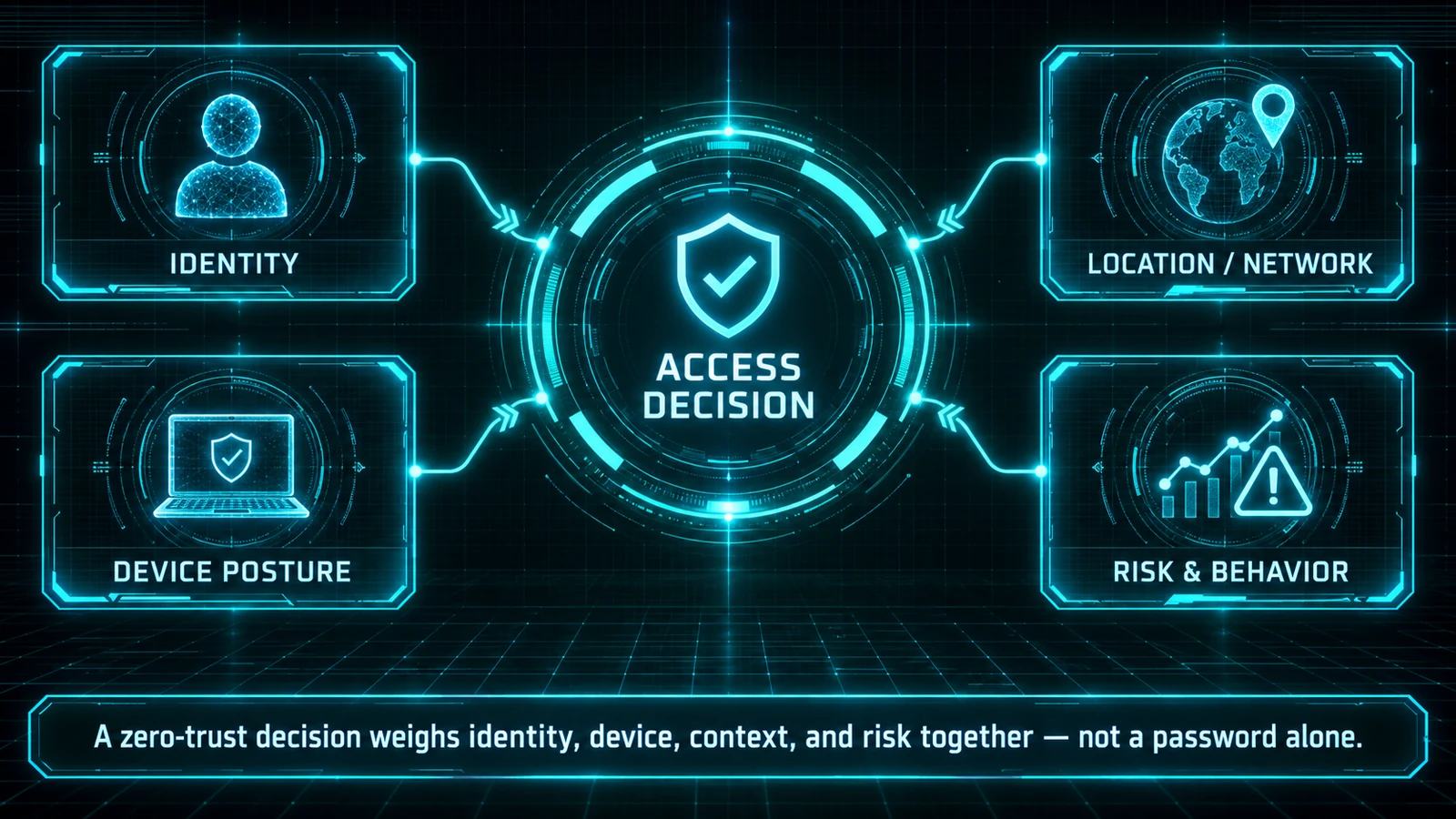
A zero-trust decision correlates identity, device posture, location, and behavioral risk — any one is weak and spoofable, the combination is the control.
The policy engine weighs these together and produces a graduated response. Low combined risk gets access. Moderate risk triggers step-up authentication — prove it again with a stronger factor. High risk denies the request or drops the session, and logs everything. This graduated model is why zero trust is usable rather than paralyzing: most requests from a known identity on a compliant device flow through silently, and friction is reserved for the requests that actually warrant it.
Continuous verification, not one-and-done
The signal model above describes a single decision, but zero trust does not make that decision once. Continuous verification means the policy engine re-evaluates trust across the life of a session, because the signals it depends on are not static. A device that was compliant at login can fall out of patch state. An identity behaving normally at 9 a.m. can start exfiltrating data at noon. Threat intelligence can flag a credential mid-session.
Practically, continuous verification watches for material changes and reacts: it can force re-authentication, narrow or revoke access, or terminate a session when conditions cross a threshold. This is the operational expression of "assume breach" — you never assume the account is still in the right hands just because it was an hour ago. It also constrains session lifetimes and standing tokens, so a stolen session cannot be replayed indefinitely.
The discipline here matters more than the tooling. Many organizations buy adaptive authentication, evaluate signals thoroughly at login, and then trust the resulting session for eight hours — recreating the one-and-done trust model they were trying to escape, just with a fancier front door. Continuous verification is what keeps zero trust honest after the login screen.
What Avatier ships toward this pattern
Avatier builds the identity control plane that a zero-trust architecture runs on. Identity Anywhere provides the authoritative identity foundation zero trust depends on: lifecycle automation that grants access on day one and revokes it the moment it is no longer warranted, so the stale accounts and orphaned entitlements that quietly undermine zero trust do not accumulate. Access governance keeps entitlements aligned to least privilege through certification and continuous review, so the "grant the minimum" principle is enforced rather than aspired to. Self-service access requests with policy-driven approval and separation-of-duties checks mean new access is provisioned narrowly and with an audit trail, not handed out broadly for convenience.
On the enforcement side, Avatier supports phishing-resistant, FIDO2-compatible authentication so the identity signal feeding every access decision is strong, and its governance data gives a policy engine the entitlement context it needs to decide well. None of this is sold as "a zero-trust product," because zero trust is an architecture, not a SKU — Avatier provides the identity governance and lifecycle pillars that make the model enforceable.
That posture is backed by an audited compliance program: Avatier is SOC 2 Type II with zero exceptions, ISO/IEC 27001:2022 certified, PCI DSS v4.0.1 compliant, and CSA STAR Level 1, with a platform aligned to NIST 800-53 Rev. 5, built FedRAMP-aligned, and delivered as a signatory of CISA's Secure-by-Design Pledge. You can review the current attestations and status at trust.avatier.com. For the disciplines that surround this foundational pillar, see how least-privilege access control is defined and enforced, how context-aware access policy turns signals into decisions, and how identity threat detection and response watches for the compromise that assume-breach anticipates. When you are ready to prove the program is working, zero-trust metrics covers what to measure and how.
ABOUT THE AUTHOR

More from IAM & Identity Governance

Hybrid Active Directory and Entra ID: Governing Both as One
Most enterprises run on-premises Active Directory and Microsoft Entra ID at the same time, bridged by identity synchronization. This is the 2026 reference on why the hybrid estate exists, where the sync bridge fails — duplicate identities, sync gaps, conflicting policy, password and hash drift — and the path to inventorying both directories, syncing or federating them, unifying policy, and governing the whole estate as one.

Machine Identity Management for Enterprise Workloads 2026
Machine identity management is the discipline of issuing, governing, and retiring the credentials that workloads, services, APIs, and machines use to authenticate — a population that now outnumbers human users by an order of magnitude. What it is, why machines need managed identities, where the risk concentrates, and the controls that bring workload credentials under lifecycle discipline.

CIAM: Customer Identity and Access Management in 2026
What CIAM actually is, what it has to handle that workforce IAM never does, the four building blocks that make it work, and the constant balancing act between a login your customers will tolerate and one an attacker cannot walk through.