Device Trust and Posture in Access Decisions 2026
Device trust factors the health of the endpoint — managed vs unmanaged, patch level, disk encryption, EDR status — into every access decision, so that a correct password on a compromised laptop no longer buys the same access as a correct password on a verified device. The 2026 enterprise reference on posture-driven access outcomes: healthy allows, risky limits or steps up, non-compliant blocks.

Device trust factors the health of the endpoint — managed vs unmanaged, patch level, disk encryption, EDR status — into every access decision, so that a correct password on a compromised laptop no longer buys the same access as a correct password on a verified device. The 2026 enterprise reference on posture-driven access outcomes: healthy allows, risky limits or steps up, non-compliant blocks.
- Device trust factors the health of the endpoint — managed vs unmanaged, patch level, disk encryption, EDR/health — into every access decision, so identity is no longer the only thing the gate checks.
- Posture-driven outcomes fall into three lanes: a healthy device is allowed, a risky device is limited or stepped up, and a non-compliant device is blocked — the same user gets different access depending on the machine in their hands.
- User-only authentication proves who is knocking; user-plus-device trust proves who is knocking and whether the thing they are knocking from is safe to let in — the second question is the one attackers exploit when you skip it.
- Device signals are inputs to a policy decision, not verdicts on their own; the durable pattern is continuous, so a device that drifts out of compliance mid-session loses access without waiting for the next login.
- Device trust does not replace identity proofing, MFA, least privilege, or governance — it is one signal class layered onto them, and it is only as good as the endpoint inventory and MDM/EDR telemetry feeding it.
For most of the history of enterprise access control, the gate asked one question: are you who you say you are. Get the password right — and, later, the second factor — and you were in, from whatever machine you were holding. Device trust adds a second question that matters just as much: is the thing you are knocking from safe to let in. Device trust is the practice of factoring the health of the endpoint — whether it is managed or unmanaged, how current its patches are, whether its disk is encrypted, whether endpoint protection is running and reporting clean — into every access decision, alongside the identity of the user. Device posture belongs in access decisions because a stolen or phished credential arriving from an unknown, unpatched, unencrypted machine is one of the strongest signals you have that something is wrong, and user-only authentication is structurally blind to it. This reference is about closing that blind spot: what device posture actually checks, how those signals turn into allow, limit, or block outcomes, and where the pattern helps versus where it quietly does not.
Why identity alone stopped being enough
The credential-only model made sense when work happened on a fixed set of company-owned machines behind a company network. Both assumptions are gone. Work happens on laptops that leave the building, on phones the employee bought, on contractor machines the organization has never seen, and from home networks that share a router with a smart fridge. In that world, "the right user authenticated" and "a safe request arrived" have quietly become two different facts, and the credential only ever proved the first one.
The attack economy caught up to that gap first. Credential theft, phishing kits that harvest both password and MFA token, session-cookie theft, and infostealer malware all produce the same output: a valid credential in an attacker's hands, presented from the attacker's device. Under user-only authentication, that request is indistinguishable from a legitimate one, because the only thing being checked is the credential, and the credential is real. The device it comes from — unknown, never enrolled, running whatever the attacker runs — is never inspected, so it never gets a chance to give the attacker away.
Device trust reframes the question. It does not throw out identity; identity is still necessary. It adds the endpoint as a second subject in the decision, on the premise that the health and provenance of the device is independent evidence about whether this request should be honored. The rest of this reference makes that evidence concrete and actionable at the moment of access.
What device posture actually checks
Device posture is the set of measurable, checkable facts about a device's current state that feed the trust decision. The signals fall into a few durable groups. The first is provenance: is this device known to us at all — is it enrolled in management, does it present a device certificate or hardware-backed identity, is it in our inventory, or is it a machine we have never seen. Managed versus unmanaged is the coarsest and most important cut, because everything downstream depends on how much you can actually see.
The second group is configuration hygiene: is the OS patched to our baseline version, is the disk encrypted, is a screen lock enforced, is the local firewall on, is the device free of jailbreak or root modification. The third is protection: is endpoint detection and response (EDR) or equivalent installed, running, and reporting a healthy state rather than merely present-but-disabled. The fourth is freshness: how recently did the device check in, because a compliance verdict from three weeks ago tells you very little about the machine in front of you now.
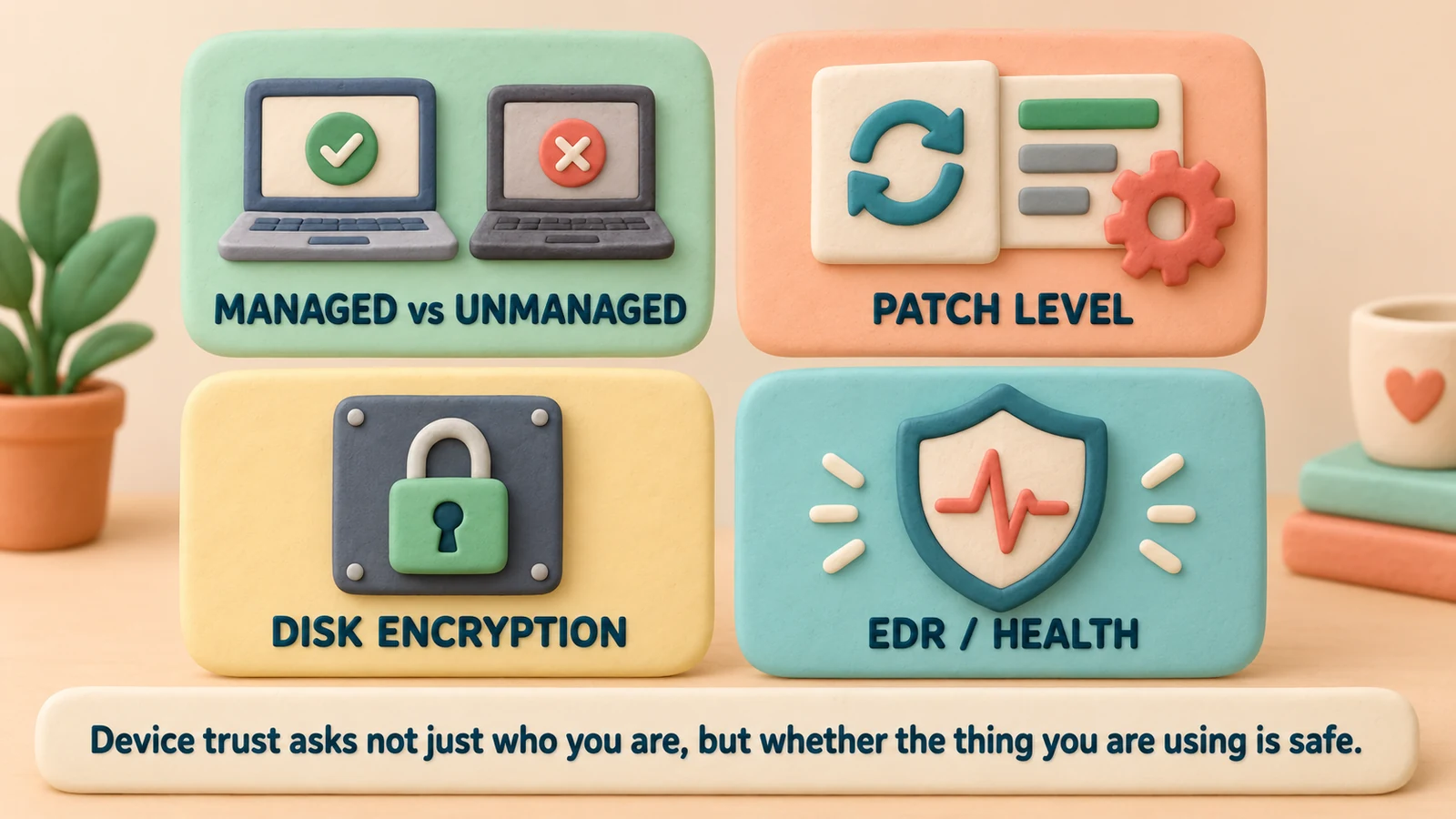 Posture is the evidence, not the verdict — managed status, patch level, encryption, and EDR health are the facts a policy engine reads before it decides what a device is trusted to do.
None of these signals is a verdict by itself. A single missed patch does not make a device malicious, and a managed device is not automatically safe. Posture is raw material. What matters is how the policy engine combines these facts into a trust judgment, and what that judgment is allowed to change about the access grant.
From posture to outcome: allow, limit, step up, block
The value of device posture shows up only when it changes an outcome. The durable pattern sorts every request into one of three lanes based on the device's evaluated posture, and the important design idea is that the middle lane exists at all — that the answer is not simply yes or no.
A healthy device is one that clears the baseline: managed, patched, encrypted, EDR reporting clean, checked in recently. For a healthy device, the posture check passes and the request proceeds on identity and the other contextual signals. Posture, in the healthy case, is invisible to the user — which is exactly what you want, because friction on trusted devices is friction on your actual employees doing their actual jobs.
A risky device is known but degraded: it missed a patch cycle, its last check-in is stale, a protection is present but not confirmed healthy, or it is a personal device with limited visibility. A risky device does not get a flat denial, because a flat denial would either block legitimate work or train people to route around the control. It gets a constrained outcome instead — read-only access rather than write, a narrower scope, a shorter session, or a step-up prompt for stronger authentication before any sensitive action. The device is trusted for some things and not others, and the policy makes that gradation explicit.
A non-compliant device fails the baseline outright: unmanaged where management is required, unencrypted, jailbroken, or missing a required protection. A non-compliant device is blocked from the sensitive resource, ideally with a remediation path that tells the user precisely what to fix and how, so the block is a doorway to compliance rather than a dead end.
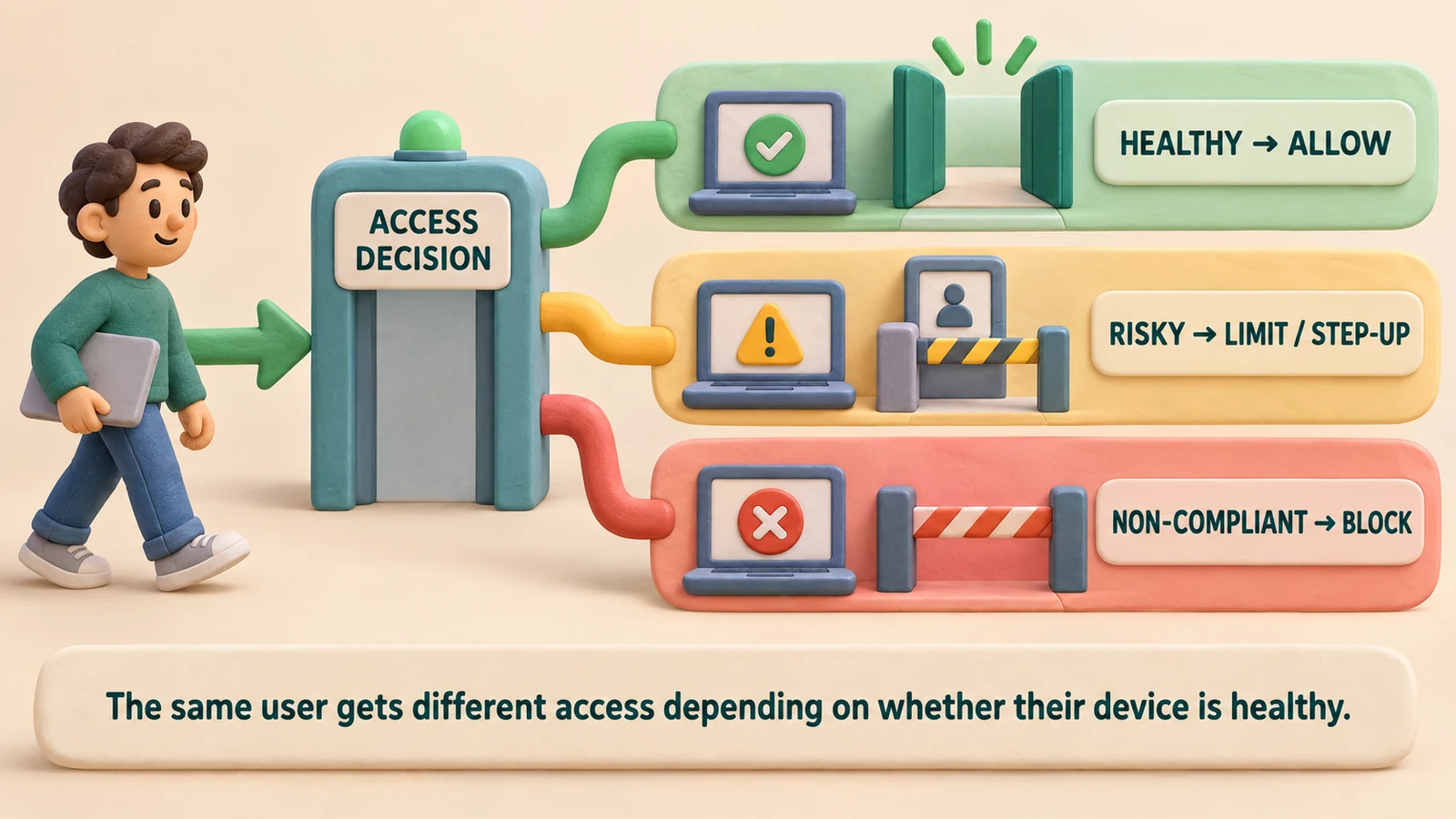 Three lanes, one decision — a healthy device is allowed, a risky device is limited or stepped up, and a non-compliant device is blocked, so the same credential yields different access depending on the machine.
This three-lane model is what people mean, at the mechanism level, by conditional access: the grant is conditional on signals evaluated at request time, and device posture usually carries the most weight. It connects directly to the risk-scoring pattern in AI-driven identity risk scoring, where device posture is one of the strongest inputs into the composite score a policy engine acts on.
User-only authentication versus user-plus-device trust
It helps to state the two models side by side, because the difference is the whole argument. User-only authentication verifies a person and stops there. If the credential is right — and, with MFA, the second factor is right — access is granted, and the device is never part of the decision. The model's entire assurance rests on the credential, which is precisely what modern attacks are best at stealing.
User-plus-device trust verifies a person and evaluates the device. Access is granted only when both the identity is right and the device is one the organization is willing to trust for the resource being requested. The stolen credential, on its own, is no longer sufficient, because the attacker's unmanaged, unknown device fails the posture check even when the credential is perfect.
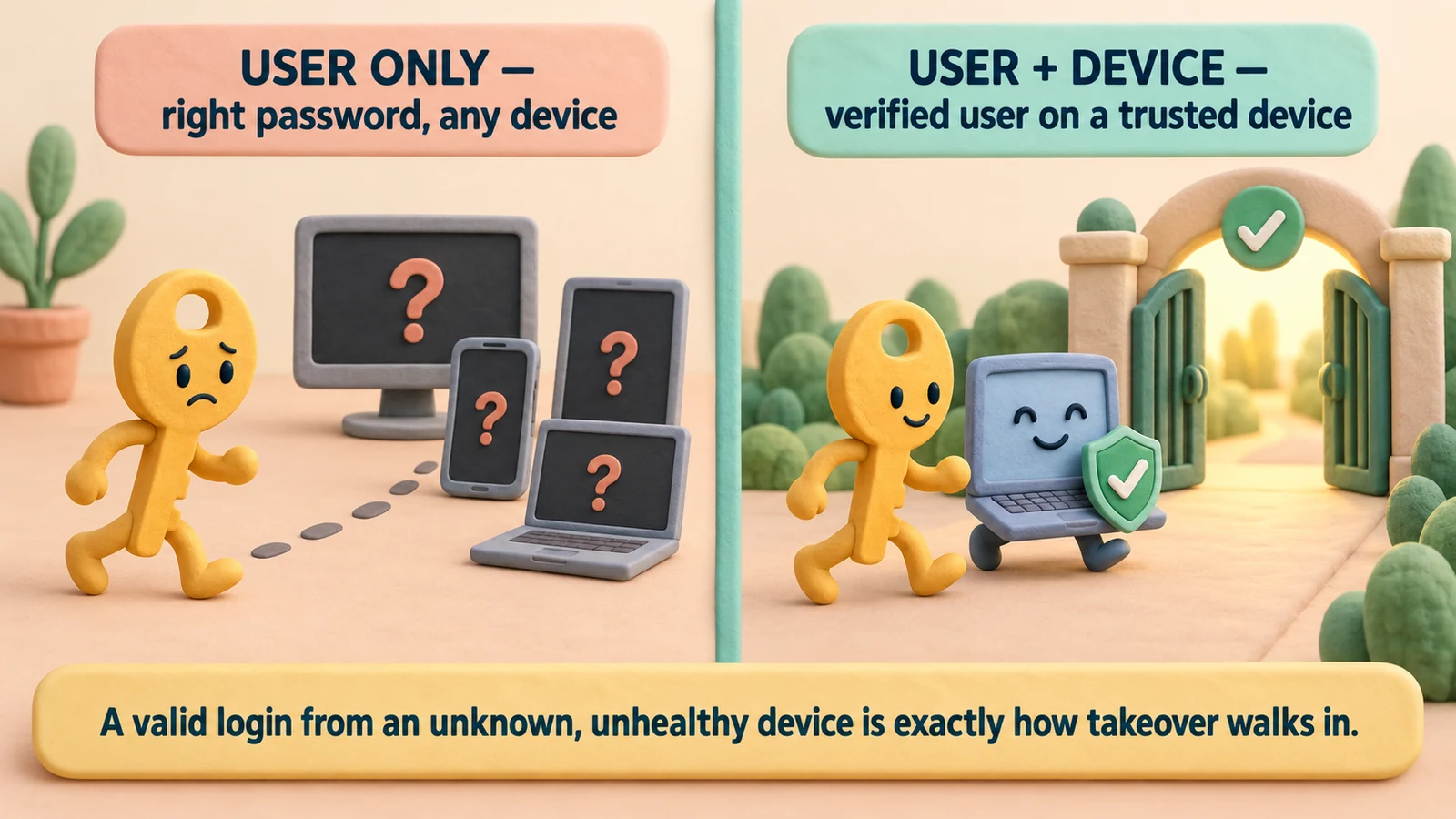 Right password, any device versus verified user on a trusted device — the gap between the two panels is exactly the surface that credential theft and session hijacking exploit.
The practical consequence is a meaningful reduction in what a stolen credential is worth. This is a core mechanic in account takeover prevention: most takeover attempts present a valid credential from an unrecognized device, and device trust turns "valid credential" into "valid credential, wrong machine, denied." It is not a silver bullet — an attacker who compromises a managed, healthy device defeats device trust the way they would any endpoint control — but it removes the cheapest and most common path.
Managed, unmanaged, and the BYOD gradient
The single most consequential posture signal is whether a device is managed, because it determines how much you can see and enforce. On a fully managed corporate device — enrolled in MDM or UEM, carrying a device certificate, running your endpoint agent — you can read deep posture signals and enforce a high bar, so that device can earn trust for the most sensitive resources. Managed devices are where device trust is strongest and cleanest.
Unmanaged and personal (BYOD) devices are where the honest engineering happens. You have far less visibility and control, so the trust ceiling is lower by nature, and realistic designs take one of a few shapes. A lightweight approach uses a managed browser or small agent that reports a limited posture signal without full enrollment — enough to distinguish a patched, encrypted personal laptop from a jailbroken phone. A scope-limiting approach grants unmanaged devices only a constrained surface: web applications, read-only views, no local download of sensitive data. A compensating-control approach leans on step-up authentication and shorter sessions to offset the weaker device assurance.
The point that survives all three shapes is that an unmanaged device can legitimately be granted trust for some things and denied trust for others. Device trust does not mean "block every personal device"; it means make the gradation explicit rather than pretending every device is equal. That framing is what keeps the control deployable in real organizations, where contractors, executives on personal iPads, and field staff on shared devices are facts of life, not exceptions to be wished away.
Posture is not a one-time gate: continuous evaluation
A device's posture is not a fixed property; it changes throughout a session. A laptop that was patched and encrypted at login can have its EDR agent killed, be moved onto a hostile network, or have a protection disabled by malware minutes later. A point-in-time check at login catches none of that, because it evaluated a state that no longer holds.
The durable pattern is therefore continuous. The policy engine re-evaluates device posture on an ongoing basis and on sensitive actions, so that a device which drifts out of compliance mid-session loses access without waiting for the next login. Freshness is the whole game: a compliance verdict is only useful if it reflects the device's current state, which is why mature designs consume live signals from MDM and EDR rather than nightly compliance reports. This is the device dimension of the broader continuous-verification model detailed in context-aware security access policy, where device is one of several signals a policy engine keeps re-deriving rather than checking once at the door.
Continuous evaluation also changes how you think about session length. If posture is checked only at login, long sessions are dangerous because a device can degrade far inside a window you are not watching. If posture is checked continuously, session length becomes less load-bearing. That trade — shorter effective exposure in exchange for the operational cost of continuous signal ingestion — is the central design decision in a device-trust rollout.
Measuring whether device trust is working
Device trust, like any control, earns its budget only if you can show it is doing something. A few measures matter most. The first is coverage: what fraction of access to sensitive resources is actually gated by a device-posture condition, versus still flowing through user-only policies. Coverage is where most programs are weaker than they think, because the policy exists but exempts too many paths.
The second is the block-and-step-up rate and, crucially, its composition: how many blocks were genuine non-compliant devices caught versus legitimate users inconvenienced by a stale or misconfigured posture signal. A control that mostly blocks your own employees because of signal-freshness problems is a control that will be turned off. The third is remediation time: when a device is blocked as non-compliant, how long until the user brings it into compliance and regains access — a proxy for whether your remediation paths are real doorways or dead ends.
These measures sit inside the broader zero-trust program, and the discipline of choosing measures that reflect outcomes rather than activity is the subject of zero-trust metrics: measuring success. The specific warning for device trust is to avoid vanity coverage — counting policies that exist rather than access paths actually gated.
What Avatier ships toward this pattern
Avatier Identity Anywhere treats device and posture as inputs to the access and authentication policy layer, alongside user identity, group and role membership, and other contextual signals. The design principle is composition: your MDM, UEM, and EDR remain the authoritative source of compliance verdicts and posture attributes, and Avatier consumes what they publish.
Concretely, the compliance verdict and posture attributes those platforms expose become conditions the Avatier policy engine evaluates when a user requests access or authenticates. A healthy device proceeds. A degraded device can be routed to step-up authentication before a sensitive action, or granted a constrained scope. A non-compliant device can be blocked or held to a limited surface — and because this all runs through Avatier's existing access-request, recertification, and audit workflows, the device-trust decision is governed, logged, and reviewable rather than living as an opaque rule in a separate system. When a device-driven block or step-up happens, it is visible in the same audit trail as every other access event, which is what lets you answer the auditor's question of why a given request was allowed, limited, or denied.
Avatier's own security posture is published, not asserted: the Avatier Trust Center documents SOC 2 Type II with zero exceptions, ISO/IEC 27001:2022, PCI DSS v4.0.1, CSA STAR Level 1, NIST 800-53 Rev. 5 alignment, FedRAMP-aligned controls, and Avatier's status as a CISA Secure-by-Design Pledge signatory, with FIDO2-compatible authentication in the passwordless path. The relevance to device trust is that the platform enforcing your posture conditions should itself be operated to a verifiable standard.
ABOUT THE AUTHOR

More from Access Management

Identity Sprawl and Consolidation: The 2026 Enterprise Reference
Every enterprise accumulates identity sprawl — the same person represented as a dozen accounts across a dozen directories, SaaS tenants, cloud IAM systems, and acquired-company domains, with no single authority reconciling them. The 2026 reference on why sprawl happens, what it actually costs, and the consolidation path that pulls fragmented identities back under one governed source of truth without a rip-and-replace program.
PIM vs PAM vs PUM: Privileged Access Defined for 2026
PIM, PAM, and PUM get used interchangeably and mean three different things. PIM manages who holds privileged identity and which roles carry it. PAM controls how privilege is exercised through vaulting, session control, and just-in-time elevation. PUM manages the shared privileged accounts nobody personally owns. The 2026 reference on distinguishing the three terms, where they overlap, and where to start.

Identity Verification and Proofing: The 2026 IDV Guide
What identity verification and proofing actually are, how they differ from authentication, the four proofing methods, and how remote onboarding really works — establishing who someone is before you ever hand them a credential.