Hybrid Active Directory and Entra ID: Governing Both as One
Most enterprises run on-premises Active Directory and Microsoft Entra ID at the same time, bridged by identity synchronization. This is the 2026 reference on why the hybrid estate exists, where the sync bridge fails — duplicate identities, sync gaps, conflicting policy, password and hash drift — and the path to inventorying both directories, syncing or federating them, unifying policy, and governing the whole estate as one.

Most enterprises run on-premises Active Directory and Microsoft Entra ID at the same time, bridged by identity synchronization. This is the 2026 reference on why the hybrid estate exists, where the sync bridge fails — duplicate identities, sync gaps, conflicting policy, password and hash drift — and the path to inventorying both directories, syncing or federating them, unifying policy, and governing the whole estate as one.
- Hybrid identity is not a transition state most enterprises are passing through — it is the steady state. On-premises Active Directory runs the domain-joined estate (file shares, GPOs, legacy apps, mainframe adjacency) while Microsoft Entra ID runs cloud and SaaS access, and identity synchronization is the bridge that keeps them looking like one directory to the user.
- Enterprises run both because neither replaces the other cleanly. AD still authenticates the on-prem world that has not moved and often cannot; Entra ID is the front door to Microsoft 365 and thousands of federated SaaS apps. The realistic question is not AD or Entra ID — it is how well you govern the two together.
- The bridge is where hybrid identity fails, and it fails in four recurring ways: duplicate identities that split one person across two objects, sync gaps where a change in one directory never reaches the other, conflicting policy where on-prem and cloud enforce different rules for the same user, and password or hash drift where credentials fall out of alignment.
- Governing a hybrid estate is a four-step path, not a product purchase: inventory both directories so you know every identity and its authority, sync or federate deliberately so the bridge is designed rather than accreted, unify policy so one intent is enforced on both sides, and govern across both so certification and lifecycle reason over the whole estate at once.
- Hybrid identity governance does not fix bad source data, does not remove the operational work of running two directories, and is not a substitute for a real Microsoft-side configuration. It makes the two directories behave as one governable estate — it does not make an unmanaged one managed.
Most enterprises do not choose between on-premises Active Directory and Microsoft Entra ID — they run both, and they run them at the same time. Hybrid identity is the operating model where Active Directory authenticates the domain-joined, on-premises world (Windows logins, file shares, Group Policy, Kerberos-bound and legacy applications) while Microsoft Entra ID fronts the cloud and SaaS estate through modern protocols, and identity synchronization is the bridge that keeps the two looking like one directory to the person signing in. It exists because neither directory cleanly replaces the other: AD still owns the on-prem estate that has not moved and often cannot, and Entra ID is the only native front door to Microsoft 365 and thousands of federated apps. So the useful question in 2026 is not "AD or Entra ID." It is how well you govern the two together — because the bridge between them, not either directory alone, is where identity quietly breaks.
This is a neutral, practitioner-level reference on that estate. Active Directory and Entra ID are the reader's environment, not a contest to be won; the failures below are properties of running two directories in parallel, and the path at the end is about making them behave as one governable system.
Why the hybrid estate exists, and why it persists
The hybrid estate is not a transitional accident that a migration will eventually clean up. For most established enterprises it is the durable architecture, and understanding why keeps you from planning around a cutover that never arrives.
On-premises Active Directory is the authentication and management layer for everything inside the traditional perimeter. Domain-joined workstations authenticate against it with Kerberos. Group Policy configures those machines at scale. File and print services, Kerberos-dependent line-of-business applications, and systems that sit adjacent to mainframe and other legacy platforms all assume AD is present. That installed base is large, it is load-bearing, and in regulated or industrial settings it frequently cannot move to the cloud on any near-term horizon.
Microsoft Entra ID solves a different problem entirely. It is the cloud identity provider that secures Microsoft 365, applies conditional access, and federates the SaaS estate through SAML, OIDC, and OAuth 2.0 — territory where Active Directory has no native reach. An enterprise adopting Microsoft 365 has already adopted Entra ID whether it framed the decision that way or not.
Neither absorbs the other's job. Going cloud-only strands the on-prem world; refusing the cloud plane strands Microsoft 365 and modern SaaS. The pragmatic majority therefore run both and connect them — and then live in that hybrid state for years. The strategic investment is not the migration date. It is the quality of governance across both directories while they run in parallel.
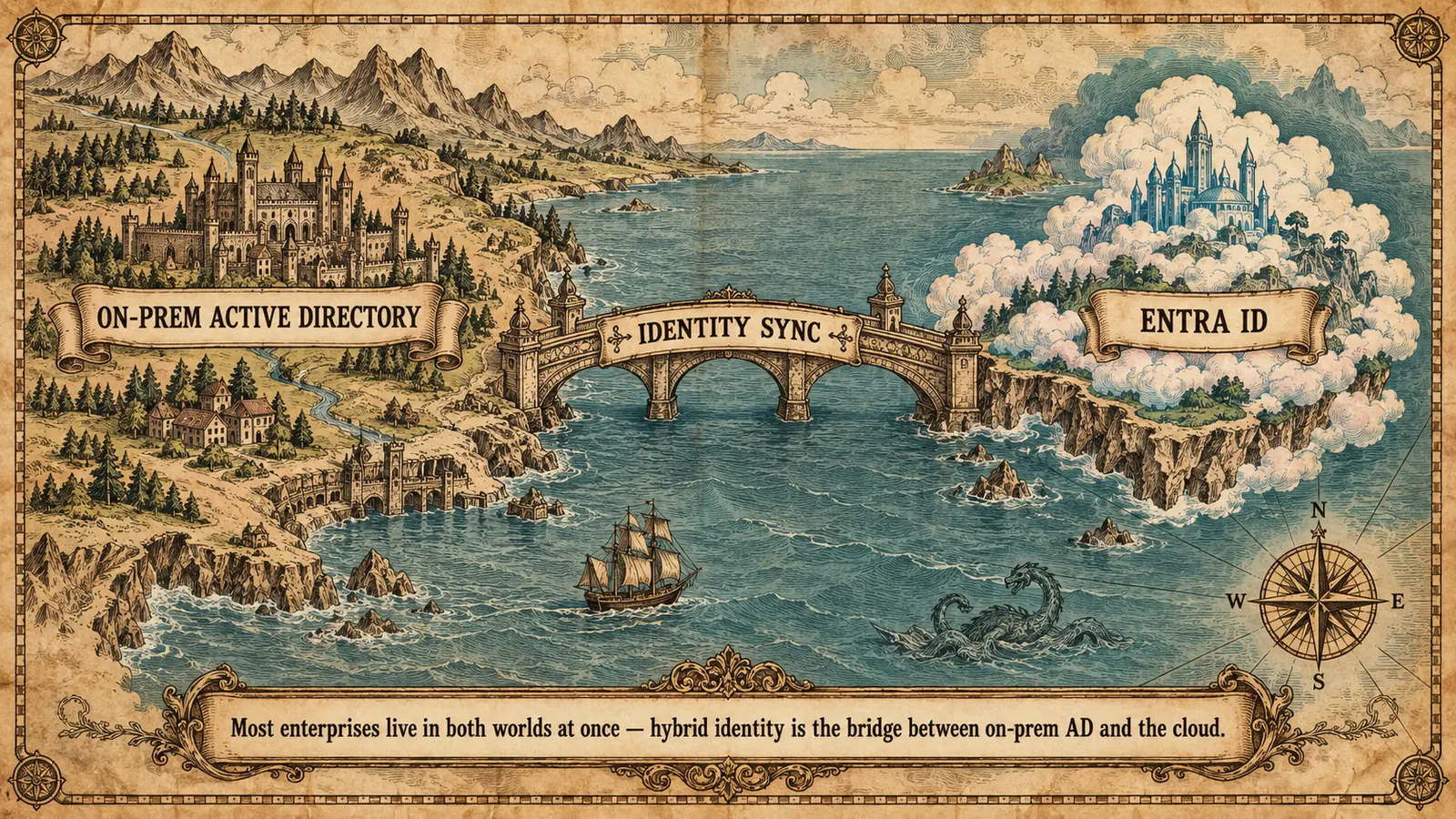 Two territories, one bridge: AD governs the on-prem mainland, Entra ID the cloud island, and identity sync is the single span that has to hold.
How the sync bridge actually works
Before you can reason about where hybrid identity fails, you have to be precise about what the bridge is doing, because most failures are a specific part of this mechanism misbehaving.
A synchronization service — most commonly Microsoft Entra Connect installed on-premises, or the lighter Entra Connect cloud sync agent — reads objects from Active Directory (users, groups, and their attributes) and provisions matching objects into the Entra ID tenant, then keeps them current as source attributes change on a recurring cycle. Each Entra ID object is tied back to its AD object through a source anchor (the immutableID / sourceAnchor), so the two directories never lose track of which cloud object corresponds to which on-prem one. That anchor is the thread the whole bridge hangs on.
Sign-in is a separate decision layered on top of provisioning. Most hybrid estates use password hash synchronization, which syncs a non-reversible transformation of the AD password hash into Entra ID so the same credential works in both places. The alternatives are pass-through authentication, which validates each sign-in against AD in real time via a lightweight agent, and federation, which hands authentication off to AD FS or a third-party identity provider entirely. Each choice has different failure and availability characteristics, which is why "how do users actually sign in" is a question you should be able to answer precisely for your own estate.
Direction of authority is the last piece. In the common configuration AD is authoritative and Entra ID is the downstream copy — changes flow on-prem to cloud. Some estates invert this for specific attributes or run cloud-authoritative for cloud-only populations. When teams cannot state the authority direction for a given object type, the bridge is accreted rather than designed, and that is the soil the next section's failures grow in.
Failure point one: duplicate identities
The cleanest hybrid failure is one person becoming two objects. A user should exist as a single identity — one synced object linked across AD and Entra ID by its source anchor. Instead they end up as two unlinked objects: a synced AD account and a separate cloud-only Entra ID account that the sync never joined to it.
This happens when matching breaks. During initial sync or a re-sync, the service tries to reconcile existing cloud objects with incoming AD objects by hard match (source anchor) or soft match (proxy address / UPN). When the source anchor is missing, changed, or inconsistent — a common consequence of rebuilding the sync server, changing the anchor attribute, or migrating between forests — the match fails and the service creates a duplicate instead of updating the existing object.
The damage is not cosmetic. Access splits across the two objects, so a person may hold entitlements on one and not the other. Licensing double-counts. Conditional access may apply to one identity and not its twin. And audit becomes unreliable, because "what does this person have access to" now has two partial answers that no single query reconciles. Duplicate identities are the failure that most often survives undetected, because both objects appear to work.
Failure point two: sync gaps
A sync gap is a change that should have crossed the bridge and did not. The two directories silently diverge, and because each one is internally consistent, nothing looks broken until the gap causes an incident.
Gaps come from several sources. A synchronization cycle can fail — a service outage, an expired credential, a schema or connector error — and if no one is watching the sync health, changes queue up or are lost without an obvious signal. An attribute can be out of the sync scope, so it updates on one side and never propagates. An object can fall outside the sync filter (wrong OU, excluded group) and simply never appear on the other side. Each of these produces a directory pair that disagrees about reality.
The dangerous instance is deprovisioning. A leaver disabled in Active Directory whose change does not reach Entra ID keeps an active cloud identity — email, Microsoft 365, federated SaaS — after they have left. The reverse also happens: a cloud-side block that never disables the on-prem account leaves domain access alive. Directory sync alone gives you no guarantee that a termination closes both sides, and the window between the two is exactly the window an offboarded account is most dangerous. This is the single strongest argument for a governance layer that treats a leaver event as one action across both directories rather than trusting sync to carry it.
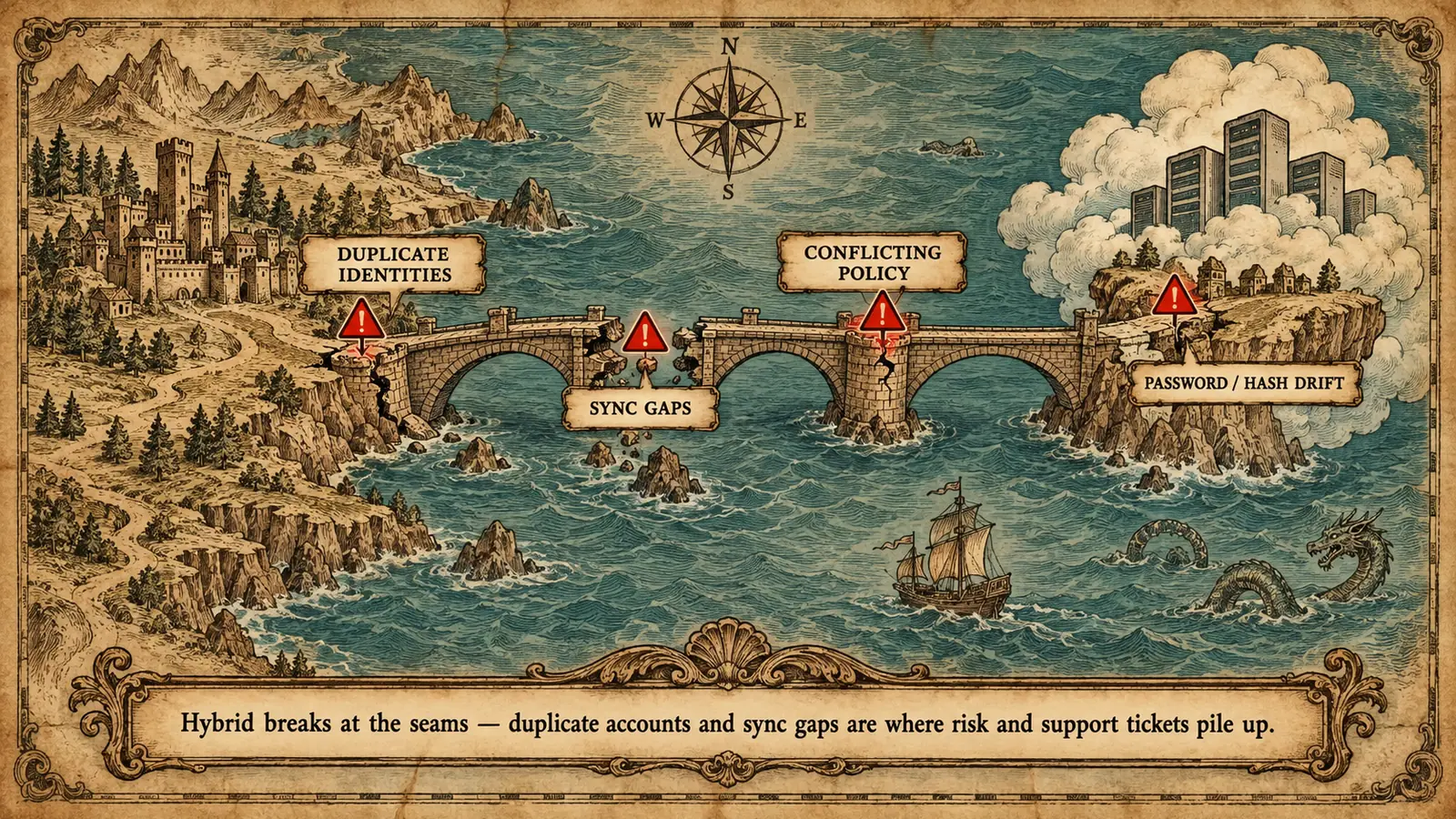 Every hybrid failure lives on the bridge, not in either directory: duplicates, gaps, conflicting policy, and drift are all the span misbehaving.
Failure point three: conflicting policy
Even when identities are single and sync is healthy, the two directories can enforce different rules for the same person — and the control that actually applies depends on which door they came through.
On-premises, Group Policy governs what a domain-joined machine and user can do: password complexity, lockout thresholds, session behavior, and thousands of other settings. In the cloud, Entra ID conditional access governs sign-in: device compliance, location, risk, and multi-factor requirements. These are two separate policy engines with two separate authors, and nothing forces them to agree. A user might face strong MFA and device-compliance checks reaching Microsoft 365 through conditional access, and a materially weaker posture authenticating to an on-prem application governed only by legacy Group Policy — or the reverse.
The consequence is that the enterprise's real access policy is not written in one place. It is the emergent combination of two rule sets maintained by two teams, and the effective control for any given user and resource is whichever engine happened to be in the path. Auditors ask for the policy; the honest answer in an ungoverned hybrid estate is "it depends on the route." Unifying intent — expressing the access rule once and enforcing it consistently on both sides — is the only way "what is our policy for this user" has a single answer.
Failure point four: password and hash drift
The fourth failure is the credential itself falling out of alignment between the two directories, which turns sign-in into an intermittent, hard-to-diagnose problem.
With password hash synchronization, the AD credential and its Entra ID counterpart are supposed to track each other. When the hash sync stalls — a sync failure, a permissions problem on the sync account, a connector fault — a user can change their password on-prem and find the old one still works in the cloud, or the new one not yet accepted. With pass-through authentication, an unhealthy or overloaded agent means cloud sign-ins that should validate against AD start failing even though the on-prem password is correct. With federation, an expiring or misconfigured trust between Entra ID and AD FS breaks cloud authentication wholesale while on-prem stays fine.
Drift is corrosive precisely because it is intermittent and asymmetric. The two directories are each internally correct, so nothing looks broken from inside either one; the failure only appears at the seam, for some users, some of the time. Diagnosing it means knowing exactly which sign-in method is in play and monitoring the health of the specific mechanism carrying credentials across the bridge — which most estates do not do until drift has already generated a wave of help-desk tickets.
The path: governing both directories as one estate
The four failures share a root: the bridge is treated as plumbing that either works or does not, rather than as a designed, governed part of the identity estate. Fixing that is a sequence, and the order matters — each step depends on the one before it.
Inventory both directories. You cannot govern what you have not enumerated. List every identity in Active Directory and every identity in Entra ID, and reconcile them: which objects are linked by a source anchor, which exist in only one directory, which exist in both without a link (your duplicates), and which is authoritative for each attribute. This inventory is what surfaces the duplicate identities and orphaned objects that everything downstream would otherwise inherit.
Sync or federate deliberately. Turn the accreted bridge into a designed one. Decide and document the authority direction, choose the sign-in method (password hash sync, pass-through, or federation) with its failure modes understood, scope precisely what synchronizes and what does not, and instrument the sync health so a failed cycle is an alert, not a discovery. A deliberate bridge is what closes the sync-gap and drift failures at their source.
Unify policy. Express access, lifecycle (joiner-mover-leaver), and separation-of-duties intent once, and enforce it consistently across both the on-prem and cloud engines rather than maintaining two divergent rule sets. The goal is that "what is our policy for this user and this resource" has one answer regardless of the route they take.
Govern across both. Run access certification, provisioning, and deprovisioning over the combined estate so a reviewer sees a person's AD and Entra ID access together, a joiner is granted correctly on both sides, and a single leaver event closes both. This is the layer above synchronization — sync keeps the directories consistent; governance decides and proves what should be true in the first place.
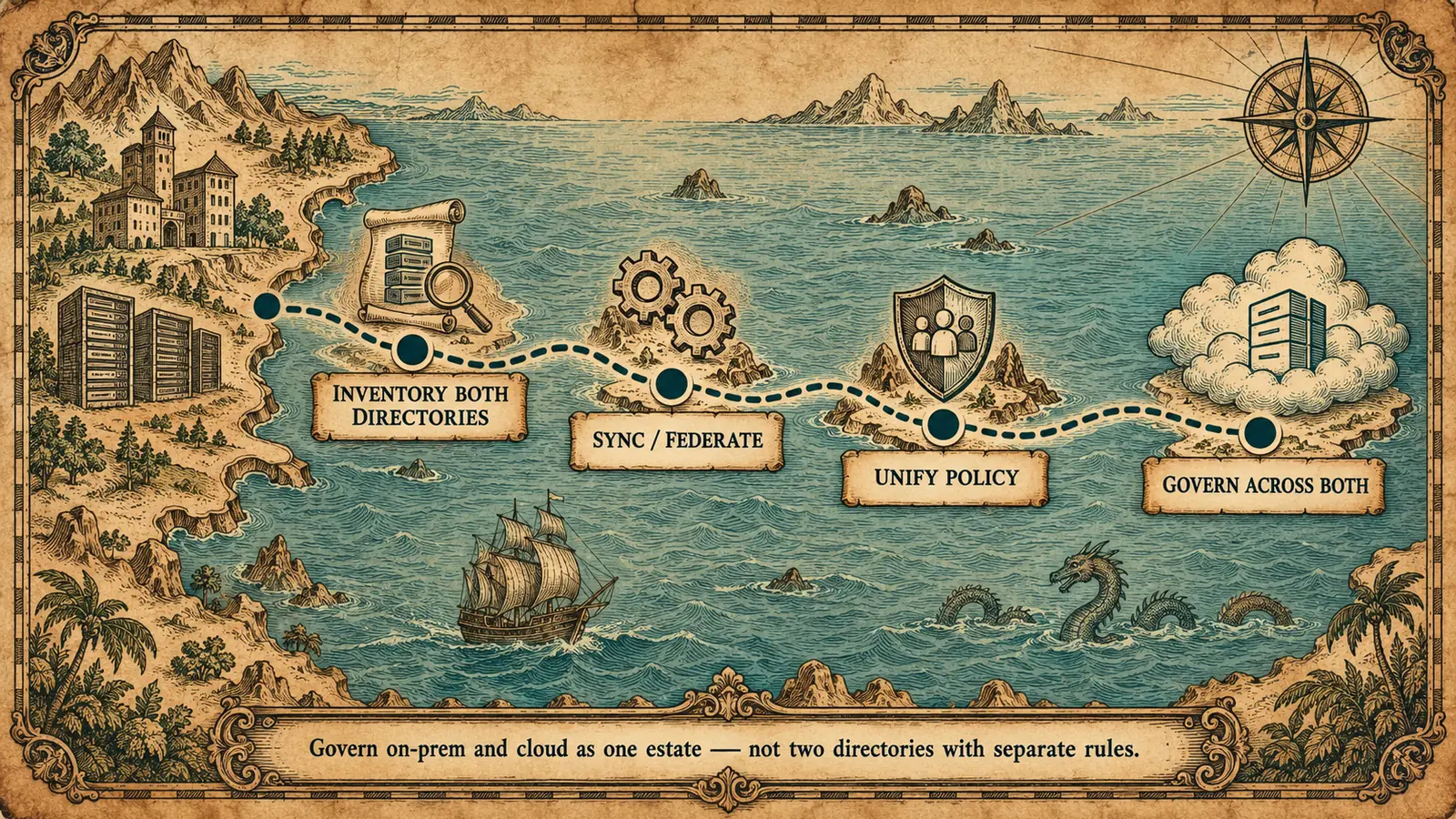 The sequence is the point: inventory before you sync, sync before you unify policy, and govern over the top of all three.
What Avatier ships toward this pattern
Avatier's role in a hybrid Microsoft estate is deliberately not to replace Active Directory or Entra ID. Both are the customer's environment and both keep doing their jobs; Avatier integrates with them as connected systems and adds the governance layer that directory sync alone does not provide.
Concretely, Avatier reads from and writes to both directories, so lifecycle events run through one orchestration path into both sides at once. A joiner from the HR source provisions the correct AD groups and Entra ID app assignments together; a role change updates both; and — the case that matters most — a leaver event disables the person across on-prem and cloud in one action, which is what closes the deprovisioning sync gap that pure directory replication leaves open. Access requests and self-service run against a unified catalog spanning AD groups and Entra ID assignments, so a requester and an approver reason about access without needing to know which directory ultimately holds it. Access certification presents a person's combined on-prem and cloud access to a single reviewer, so the review reflects the whole estate rather than one half of it. Provisioning uses SCIM where a target supports the standard and native connectors where it does not.
On assurance, Avatier is FIDO2-compatible for authentication, and the platform's compliance posture is published at the Avatier Trust Center: SOC 2 Type II audited with zero exceptions noted, ISO/IEC 27001:2022 certified, PCI DSS v4.0.1 compliant, CSA STAR Level 1 attestation, NIST 800-53 Rev. 5 aligned, FedRAMP-aligned, and signatory to the CISA Secure-by-Design Pledge. The through-line is governance over both Microsoft directories as one estate — not a rip-and-replace of either.
This pattern sits alongside the broader identity work covered elsewhere on this blog: resetting and managing credentials on domain-joined Active Directory, extending the same discipline across multi-cloud identity management and hybrid cloud identity management, treating the whole thing as an identity fabric and converged identity layer, and using SCIM as the provisioning standard that makes writing to both directories repeatable.
ABOUT THE AUTHOR

More from IAM & Identity Governance

Machine Identity Management for Enterprise Workloads 2026
Machine identity management is the discipline of issuing, governing, and retiring the credentials that workloads, services, APIs, and machines use to authenticate — a population that now outnumbers human users by an order of magnitude. What it is, why machines need managed identities, where the risk concentrates, and the controls that bring workload credentials under lifecycle discipline.
Identity Fabric and Converged Identity: The 2026 Architecture
An identity fabric unifies fragmented IAM, IGA, PAM, and directories into one system with unified policy and observability. Its building blocks, and what Avatier ships toward the pattern.

Zero Trust Identity Architecture: The 2026 Foundational Guide
Zero trust for identity means never trusting a request by default and verifying every one against live signals — identity, device posture, location, and risk. The foundational 2026 reference on what that actually requires.