Identity Verification and Proofing: The 2026 IDV Guide
What identity verification and proofing actually are, how they differ from authentication, the four proofing methods, and how remote onboarding really works — establishing who someone is before you ever hand them a credential.
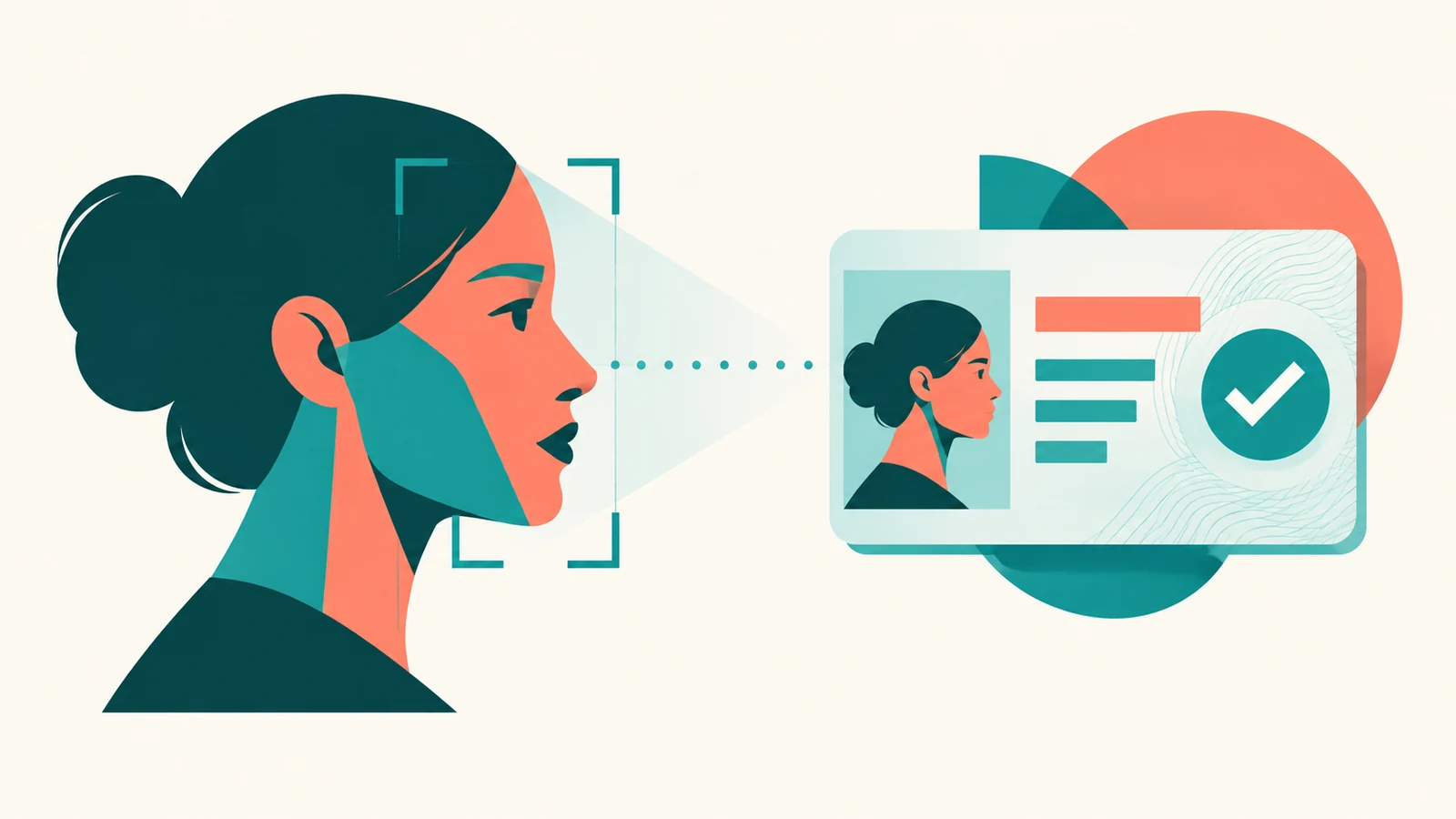
What identity verification and proofing actually are, how they differ from authentication, the four proofing methods, and how remote onboarding really works — establishing who someone is before you ever hand them a credential.
- Identity verification (also called identity proofing or IDV) is the process of establishing who a person actually is before you issue them a credential or grant access. It answers a one-time question at onboarding — is this a real human, are they who they claim, and is the claimed identity theirs — which is categorically different from authentication, the repeated login-time check that the same person is back.
- Proofing rests on four evidence types used in combination: document verification (checking a government ID is genuine and unaltered), biometric and liveness capture (matching a live selfie to the ID and proving a real person is present), knowledge-based verification (dynamic questions from authoritative records), and database or credential checks (corroborating the claim against issuing sources and existing credentials).
- Remote identity verification follows a consistent flow: capture the ID, verify the document is authentic, match it to a live selfie with liveness detection, then approve and enroll the person into your identity system so provisioning and authentication can take over.
- Assurance is a dial, not a switch. A contractor requesting read access and a treasury administrator requesting wire approval should not clear the same proofing bar, so the depth of evidence should scale with the risk of the identity being wrong.
- Proofing establishes identity at a moment in time; it does not keep that identity honest afterward. Strong onboarding proofing paired with weak ongoing authentication, lifecycle, and access governance still leaves the account exposed — verification is the front door, not the whole house.
Identity verification — also called identity proofing, or IDV — is the process of establishing who a person actually is before you issue them a credential or grant them access. It answers a specific, mostly one-time question at the start of a relationship: is this a real, live human; is the identity they are claiming a real identity; and does that identity genuinely belong to the person in front of you. Authentication is a different question asked later and often: is the person logging in right now the same one you already verified. Verification is the front door; authentication is the key you hand out once someone has been let in. Confuse the two and you build a strong lock on a door anyone can walk around — a legitimate account issued to the wrong human, defended by flawless MFA.
That distinction sounds academic until you trace where enterprise identity fraud actually enters. It rarely arrives by defeating a modern login. It arrives at the moment an identity is first created or reclaimed — a new hire onboarded remotely, a contractor stood up in a hurry, an account "recovered" by someone who was never its owner. Everything downstream — provisioning, single sign-on, access certification, privileged access — inherits whatever confidence you did or did not establish at that first moment. If the proofing was weak, every control after it is defending a lie efficiently.
Identity Verification Is Not Authentication
The single most useful thing an identity team can internalize is that verification and authentication solve different problems with different tools on different schedules. Verification is about breadth of evidence gathered once: you assemble a document, a face, a record, and a decision, and you bind a real human to a claimed identity. Authentication is about speed and repetition: you confirm, in a second or two, that whoever is present controls a credential already bound to that identity. One is a background investigation compressed into an onboarding flow; the other is a turnstile.
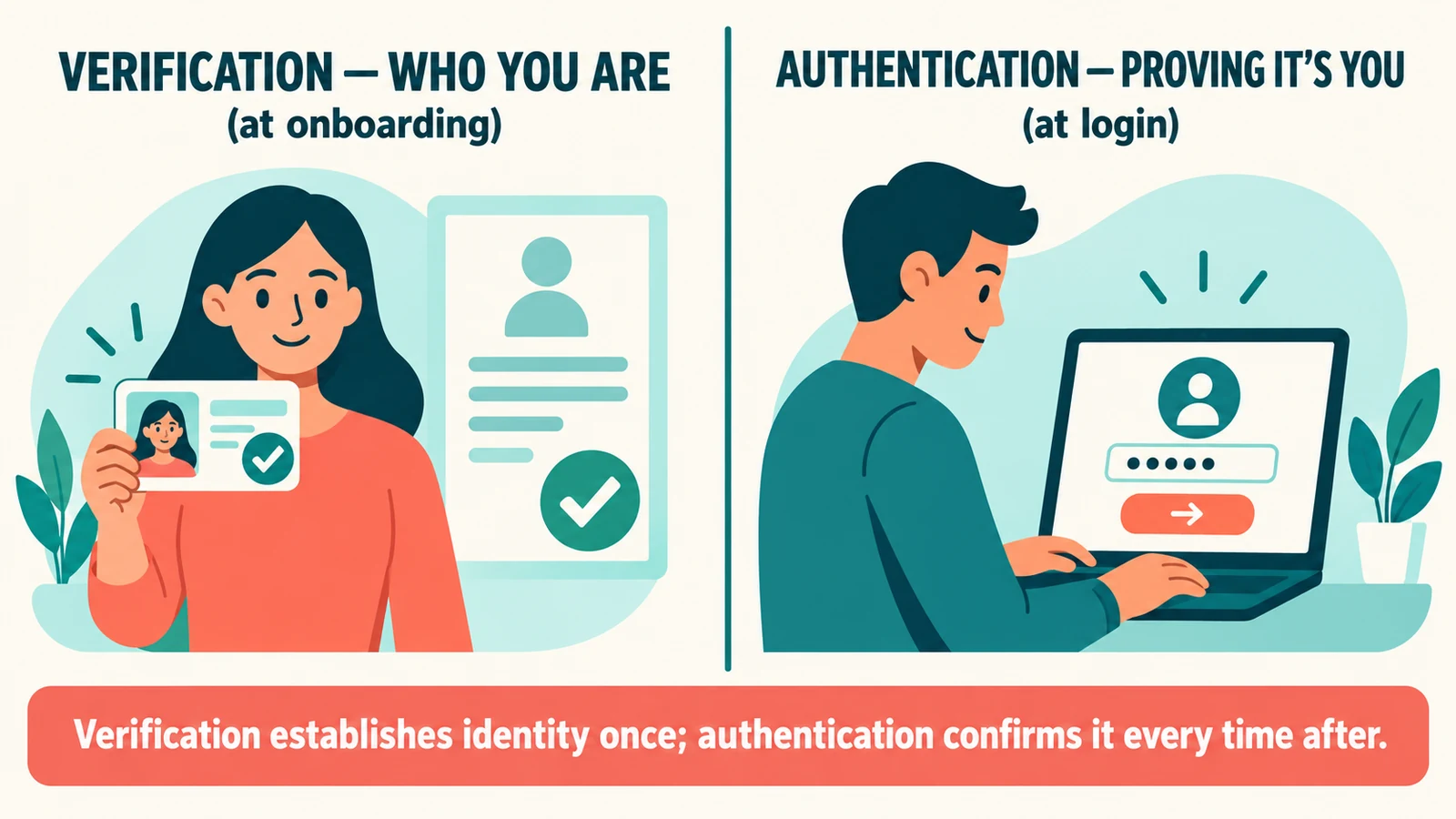 Verification asks who you are and answers it once; authentication asks whether it's still you and answers it every time — treating them as one control is how impostors walk in through legitimate accounts.
The failure modes are mirror images. Weak authentication lets an attacker reuse a real person's credential — the account is legitimate, the person is not. Weak verification lets an impostor obtain a legitimate credential in the first place — the person is present, the identity is not theirs. You cannot fix a verification failure with better authentication, because the attacker will authenticate perfectly with the account you wrongly gave them. This is exactly why account takeover prevention has to reach back into onboarding and recovery, not just harden the login screen. And it is why the industry-wide move toward passwordless login raises rather than lowers the stakes of proofing: when the credential is a durable passkey bound at enrollment, the enrollment had better be bound to the right human.
Why Proofing Became the Weak Point
For years, proofing was something that happened in a lobby. A new employee showed up, a badge was issued, HR photocopied a driver's license, and physical presence did most of the work. Remote and hybrid work dissolved that. The person you are onboarding may never enter a building, may be in another country, and may be indistinguishable — over a video call — from someone reading a script. The lobby check did not scale to a distributed workforce, and the interim substitutes were thin: a scanned PDF emailed to a recruiter, a manager vouching over chat, a help-desk agent trusting a confident voice.
At the same time the offensive side got cheaper and better. Synthetic identities assembled from breached data, generative tools that produce convincing document images, and deepfake video that survives a casual glance all lowered the cost of presenting a fake human. The result is a gap: the credentials we issue got stronger while the process that decides who deserves one lagged behind. Proofing became the soft target precisely because everyone was busy hardening authentication.
The enterprise consequences are concrete. A synthetic new hire becomes a fully provisioned insider on day one. A social-engineered account recovery hands a real employee's identity to an attacker with all the legitimacy of the help desk behind it. Neither event trips an authentication alarm, because in both cases the authentication is working perfectly — for the wrong person.
The Four Proofing Methods
Modern identity verification draws on four families of evidence. None is sufficient alone; the art is combining them so that no single forgeable artifact decides the outcome.
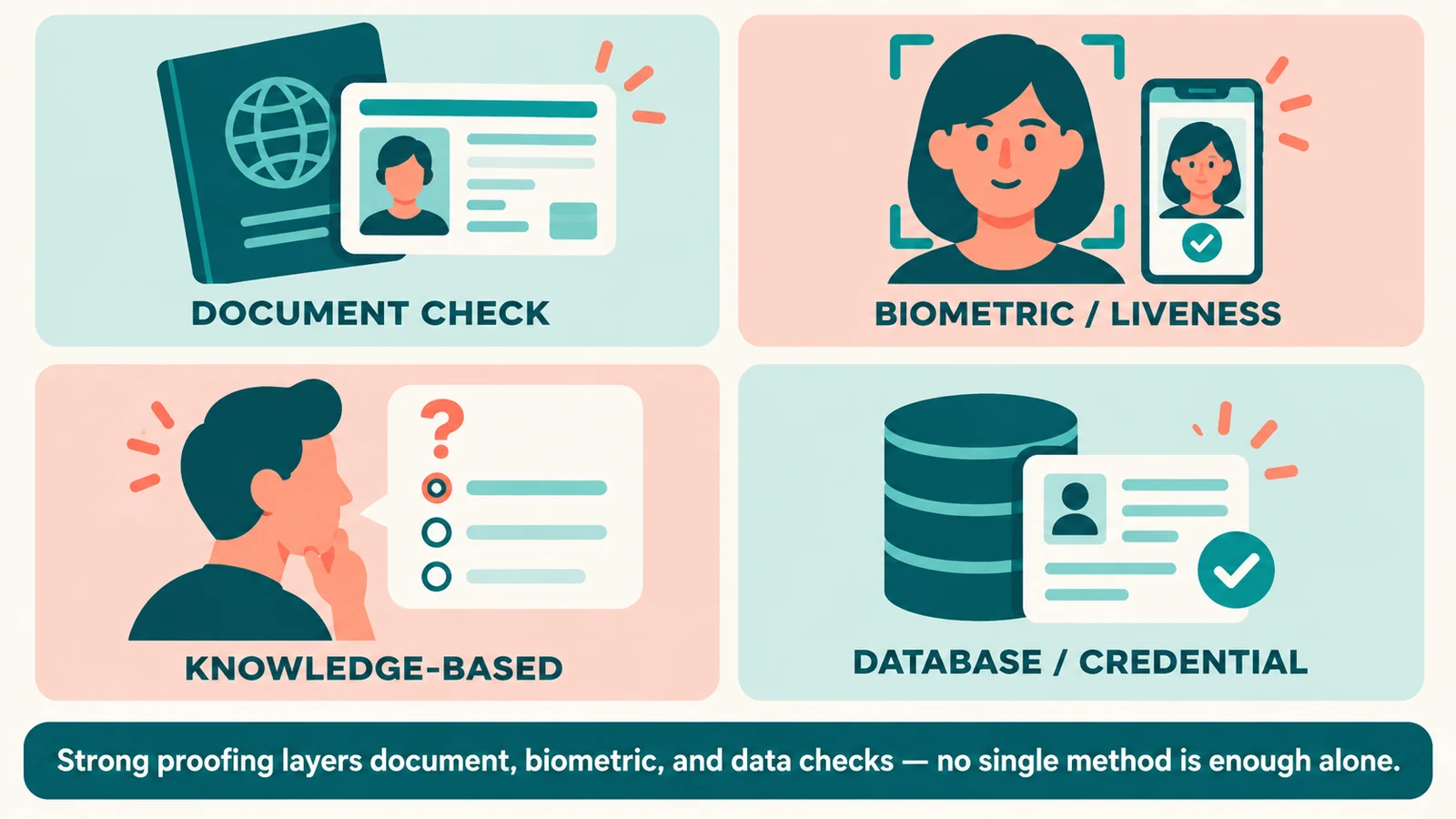 No single artifact should decide who you are — robust proofing layers a genuine document, a live face, corroborating records, and existing credentials so a forgery in one channel is caught by the others.
Document verification checks that a government-issued ID — passport, driver's license, national ID — is genuine, unexpired, and unaltered. Good document checks read the security features, validate the data structure, detect tampering and recapture (a photo of a photo), and extract the identity fields for downstream matching. This is the anchor most other methods build on, because the document ties a name and date of birth to a face and an issuing authority.
Biometric and liveness verification does two jobs. It matches a live capture of the person's face to the photo on the verified document, establishing that the human present is the human the document describes. And liveness detection proves a real, present person is being captured — not a printed photo, a screen replay, a mask, or a deepfake. Liveness is the part attackers work hardest to defeat, which is why it deserves the most scrutiny when you evaluate a solution. This face-matching step is the onboarding cousin of the ongoing biometric checks that later ride alongside multi-factor authentication.
Knowledge-based verification asks dynamic questions derived from authoritative records — questions the real person should be able to answer and a stranger should not. Its value has eroded as breached data made "static" secrets (mother's maiden name, first street) trivially discoverable, so it now works best as dynamic, out-of-wallet questioning and as a secondary corroborator rather than a primary gate.
Database and credential verification corroborates the claim against issuing sources, sanctions and watchlists, or an existing trusted credential the person already holds. In the workforce context, the "database" is frequently the authoritative HR system: an HRIS-driven identity lifecycle means the record of a new hire in Workday or SuccessFactors is itself a strong corroborating source that a claimed employee identity is real and expected.
How Remote Identity Verification Actually Works
Put the methods in sequence and you get the remote onboarding flow most enterprises are converging on. It is designed to run from a phone in minutes, escalate the hard cases to humans, and end with a verified identity that the rest of the identity stack can trust.
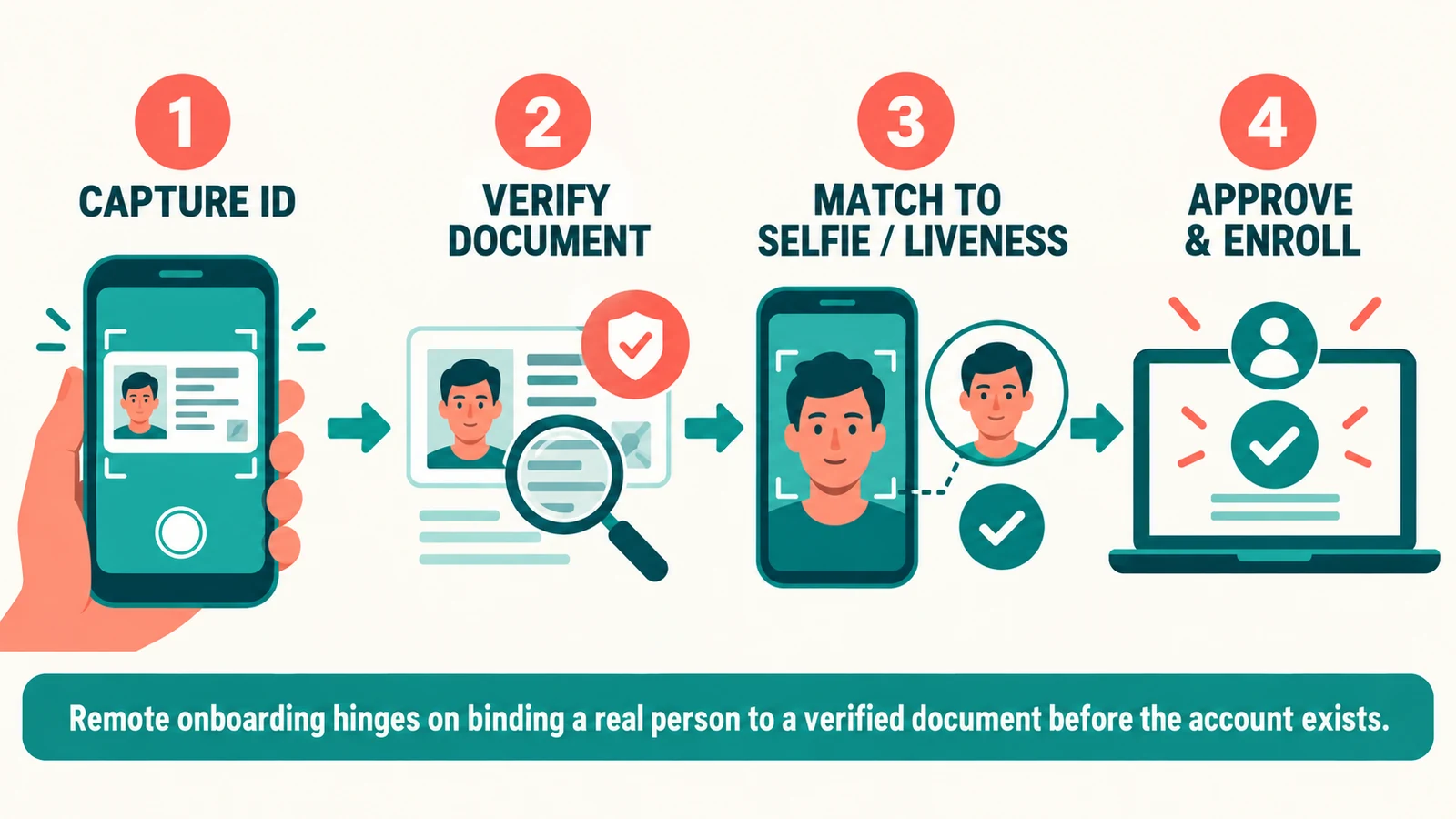 Remote proofing is a pipeline, not a checkbox: capture the ID, prove the document is real, bind it to a live face, then enroll the verified human — with everything below the confidence bar routed to a person rather than waved through.
The flow runs in four steps. First, capture — the person photographs their government ID, front and back, and the system guides framing and quality. Second, verify the document — authenticity and tamper checks run, recapture is detected, and the identity fields are extracted. Third, match to a live selfie — the person takes a face capture, liveness detection confirms a live human, and that face is compared to the document photo. Fourth, approve and enroll — if the combined evidence clears the required assurance bar, the verified identity is bound to an account and handed off to provisioning; if it falls short, the case routes to manual review or a step-up rather than a silent pass or a blunt rejection.
That last handoff is the point of the whole exercise. Enrollment is where verification stops and the rest of identity begins: the verified human is bound to a directory identity, and from there automated provisioning grants the right access, single sign-on issues credentials, and authentication takes over the day-to-day. A clean, high-confidence enrollment is what lets everything downstream operate on trust instead of hope.
Assurance Levels: How Much Proof Is Enough
Not every identity deserves the same scrutiny, and treating them alike wastes effort in one direction and invites fraud in the other. The right frame is assurance as a dial. A read-only contractor who needs a wiki login is a different risk than a treasury administrator who can approve wire transfers or a domain admin who can rewrite access for everyone else. The depth of proofing — how many evidence types, how strict the liveness, whether a human reviews the case — should scale with the consequences of getting that identity wrong.
Public frameworks describe this as tiers of identity assurance, from self-asserted identity at the low end to strongly evidenced, biometrically bound identity at the high end. The specific tier names matter less than the discipline of choosing deliberately: define which populations and which requests require which depth, write it down, and enforce it consistently. This is the same risk-scaling logic that drives risk-based identity scoring at authentication time, applied one step earlier — at the moment the identity is born. It also explains why workforce and customer programs diverge: as the distinction between CIAM and workforce identity makes clear, a consumer signup optimizes for conversion at low assurance, while an employee onboarding can demand strong evidence because the person is motivated to cooperate and the risk of a bad identity is severe.
The mistake to avoid is a single global proofing standard set to the average. Set it low and your privileged identities are under-proofed; set it high and you burn goodwill onboarding low-risk users through friction they did not need. Assurance is a policy decision, and it should be as granular as your risk actually is.
Where Proofing Breaks in the Enterprise
Even organizations that buy good verification technology tend to leak in predictable places. The first is account recovery. Enormous care goes into onboarding proofing, and then the help desk will reset an executive's access on the strength of a caller who knows their birthday and sounds stressed. Recovery is re-verification, and it deserves the same assurance bar as the original — attackers target it precisely because it is usually softer than the front door.
The second is the exception path. Every proofing flow has cases that fall below the confidence threshold, and what happens to them decides whether the whole program is real. If "manual review" means an overwhelmed analyst clicking approve to clear a queue, the threshold is decorative. Exceptions have to be genuinely adjudicated, with the reviewer given the evidence and the authority to say no.
The third is the seam between verification and provisioning. A beautifully verified identity that is then dropped into a manual, ticket-driven access process loses much of its value, because the human granting access is not looking at the proofing result — they are looking at a ticket. The verified identity should flow directly into provisioning so that the confidence established at onboarding is the same confidence access is granted on. And the fourth is staleness: proofing is a point-in-time act. People change roles, leave, or have their circumstances change, and an identity verified two years ago is not re-verified by the fact that it authenticates cleanly today. Lifecycle governance, not verification, is what keeps a once-proven identity honest over time.
What Avatier Ships Toward This Pattern
Avatier's role in identity verification is deliberately scoped: the platform is where a verified identity becomes an operational one, and where the assurance you established at onboarding is enforced everywhere afterward. Avatier Identity Anywhere binds the verified human to a directory identity and drives what happens next — provisioning the right access automatically, issuing credentials through single sign-on, and applying policy at request time so the confidence from proofing is not lost at the handoff to access. The self-service and mobile-first design means the enrollment step is low-friction for the person while still routing low-confidence cases to review rather than waving them through.
On authentication and recovery — the controls that protect the identity after it is proven — Avatier is FIDO2-compatible, supports multi-factor and self-service password reset with configurable verification on the recovery path, and integrates with the HR systems of record that serve as authoritative corroboration for workforce identity. The recurring theme is making the secure path the easy path so that the strong option is the one people actually take.
Avatier's own security posture is published and independently attested rather than asserted. The company is SOC 2 Type II audited with zero exceptions noted, ISO/IEC 27001:2022 certified, PCI DSS v4.0.1 compliant, and CSA STAR Level 1, with controls aligned to NIST 800-53 Rev. 5 and a FedRAMP-aligned posture. Avatier is a signatory to CISA's Secure-by-Design Pledge. The current attestations, scope, and reports live at the Avatier Trust Center. Verification technology should sit on a vendor whose own identity and security claims are evidenced the same way you are asking your users to evidence theirs.
ABOUT THE AUTHOR

More from Access Management

Device Trust and Posture in Access Decisions 2026
Device trust factors the health of the endpoint — managed vs unmanaged, patch level, disk encryption, EDR status — into every access decision, so that a correct password on a compromised laptop no longer buys the same access as a correct password on a verified device. The 2026 enterprise reference on posture-driven access outcomes: healthy allows, risky limits or steps up, non-compliant blocks.
Identity Sprawl and Consolidation: The 2026 Enterprise Reference
Every enterprise accumulates identity sprawl — the same person represented as a dozen accounts across a dozen directories, SaaS tenants, cloud IAM systems, and acquired-company domains, with no single authority reconciling them. The 2026 reference on why sprawl happens, what it actually costs, and the consolidation path that pulls fragmented identities back under one governed source of truth without a rip-and-replace program.

Identity Federation Explained: The 2026 Foundational Guide
Identity federation is a trust relationship between separate identity providers so that one login works across domains and organizations. The foundational 2026 reference on what federation is, how it differs from SSO, and the protocols that carry it.