Data Access Governance in 2026: Govern Who Can Reach Sensitive Data
Data access governance is the discipline of controlling who can reach which sensitive data, under what conditions, and proving it to auditors. It is distinct from IAM, which grants access to systems, and from CIEM, which governs cloud infrastructure. The practical 2026 guide to governing access to the data itself.

Data access governance is the discipline of controlling who can reach which sensitive data, under what conditions, and proving it to auditors. It is distinct from IAM, which grants access to systems, and from CIEM, which governs cloud infrastructure. The practical 2026 guide to governing access to the data itself.
- Data access governance (DAG) is the discipline of controlling who can reach which sensitive data — files, records, and database contents — under what conditions, and being able to prove those controls to an auditor at any time.
- DAG is distinct from general identity and access management: IAM decides who can log into a system or application, while DAG governs access to the sensitive data held inside those systems, which is a finer-grained and often messier problem.
- It is also distinct from cloud infrastructure entitlement management (CIEM), which governs entitlements to cloud infrastructure and services; DAG cuts across on-premises file shares, databases, SaaS repositories, and cloud storage to follow the data itself.
- The core risk DAG addresses is over-access to sensitive data that no system-level login control can see: broad file-share permissions, standing database grants, and inherited group access that quietly widen who can read regulated information.
- Standing up DAG is a four-step loop — discover and classify sensitive data, map who can access it, remediate over-access toward least privilege, then monitor and recertify continuously — run as an ongoing program rather than a one-time cleanup.
Most organizations can tell you, with reasonable confidence, who is allowed to log into a given system. Ask a harder question — who can actually read the sensitive customer records inside that system, or open the folder of exported financial statements sitting on a file share, or query the table that holds regulated health data — and the confident answer usually dissolves. The login is governed. The data behind the login often is not. That gap is exactly what data access governance exists to close.
Data access governance, commonly abbreviated DAG, is the discipline of controlling who can reach which sensitive data, under what conditions that access is permitted, and being able to prove those controls to an auditor at any time. It is deliberately scoped to the data itself — the files, records, and database contents that carry an organization's most sensitive information — rather than to the systems and applications that hold that data. That distinction sounds subtle and turns out to be the whole point, because the controls that govern access to a system are not the same controls that govern access to the data inside it, and the second set is where most organizations are weakest.
This guide draws that boundary precisely. It defines what data access governance actually controls, separates it cleanly from the broader identity and access management that governs systems and from the cloud infrastructure entitlement management that governs cloud services, explains why the problem it addresses is both dangerous and easy to overlook, and then walks the practical loop for standing a DAG program up and keeping it running. The framing throughout is qualitative and vendor-neutral, because the value of data access governance is in the mechanism, not in any single tool that implements it.
What data access governance controls
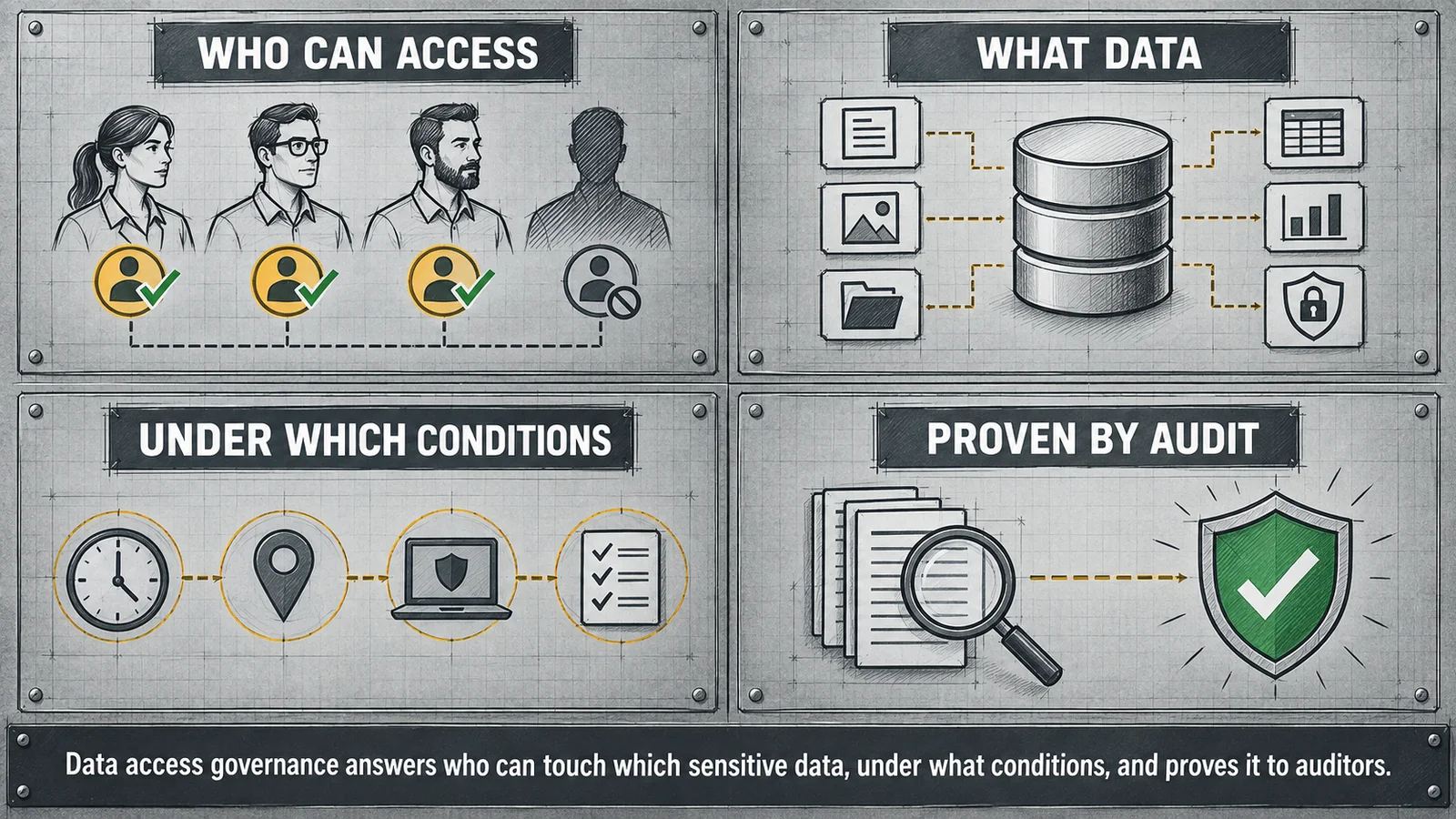
Data access governance controls four things at once, and it is the combination — not any single one — that defines the discipline.
The first is who can access. DAG is concerned with the full population of identities that can reach a given piece of sensitive data, and crucially with their effective access rather than their nominal access. Effective access is what an identity can actually do after every group membership, nested group, inherited permission, and standing grant is resolved. A person may hold no direct permission on a sensitive folder yet still be able to read every file in it because they belong to a group that belongs to another group that was granted access years ago for a reason no one remembers. Nominal access — the permission written next to that person's name — says nothing. Effective access is the truth, and surfacing it is one of the hardest and most valuable things a DAG program does.
The second is what data. Not all data warrants governance, and treating everything as sensitive is as useless as treating nothing as sensitive. DAG focuses on the data whose exposure would cause real harm: personal information, health records, financial data, intellectual property, and other regulated or confidential content. That focus depends on knowing what data exists and how sensitive each piece is, which is why classification is foundational rather than optional. This covers both structured data — the rows and fields inside databases and applications — and unstructured data — the files, documents, spreadsheets, and exports scattered across shares and collaboration platforms. Unstructured data is usually the harder half, because it copies effortlessly and resists inventory.
The third is under what conditions. Governing access is not only a binary of allowed or denied; mature DAG accounts for the context in which access is exercised. Conditions can include the sensitivity of the data, the purpose of the access, whether the access is permanent or time-bound, and the risk signals surrounding a given request. The direction of travel is away from permanent, unconditional access to sensitive data and toward access that is scoped, justified, and expiring — an application of the same conditional thinking that underlies attribute-based access control, where access decisions turn on attributes and context rather than static assignments.
The fourth is proven by audit. A control that cannot be demonstrated is, for governance purposes, a control that does not exist. DAG treats provability as a first-class requirement: at any moment, the organization should be able to produce a defensible answer to who can access a given set of sensitive data, why they can, who approved it, and when it was last reviewed. That evidentiary posture is what turns access hygiene into governance, and it is what auditors and regulators actually test.
Hold those four together — who, what data, under which conditions, proven — and you have the working definition. Drop any one of them and you have something narrower: an access list without classification, a classification without enforcement, or enforcement without evidence.
Why governing data access matters
The instinct that system-level access control is enough is the single most common reason data access governance gets neglected, and it is wrong for a specific, structural reason. Access to sensitive data accumulates in places that login-level controls never inspect, and it accumulates silently.
Consider how over-access actually forms. A file share is created for a project and permissioned to a broad group so no one is blocked. The project ends; the permission stays. People join the group for unrelated reasons and inherit access to the old project's sensitive exports without anyone deciding they should have it. A database grant is issued to a service for a one-time migration and never revoked. A collaboration workspace is opened to "everyone in the department" because scoping it precisely was more work than the deadline allowed. None of these events trips a system-level alarm, because at the system level nothing is wrong — every one of those people has a valid account and a legitimate reason to use the application. The problem lives entirely at the data layer, which is exactly the layer that ordinary identity and access management does not see.
This is why the most damaging exposures so often involve data rather than mere system compromise. When an account is taken over or an insider goes bad, the harm is measured by what data the account could reach, and over-access converts a contained incident into a broad one. An attacker who lands on an account with tightly scoped data access is limited; an attacker who lands on an account that inherited read access to half the organization's sensitive files through forgotten group nesting is not. Over-access is the difference, and it is invisible until something forces it into view.
Regulation makes the stakes concrete. Frameworks governing personal, health, and financial data expect organizations to know who can access sensitive records and to hold that access to what is necessary — the same principle of least privilege that underpins access control generally, applied specifically to regulated data. An organization that cannot demonstrate control over who reaches its sensitive data cannot credibly claim compliance, no matter how strong its perimeter or its login controls are. This is where data access governance becomes a compliance capability and not only a security one, and why the assurance an organization can demonstrate — the kind published at the Avatier Trust Center — rests on data access being genuinely governed rather than merely assumed.
There is also a quieter cost to ungoverned data access: it erodes trust in the data itself. When no one can say with confidence who can see a sensitive dataset, business owners hesitate to put more data into shared systems, teams duplicate data into private copies they believe are safer, and the estate fragments. Good data access governance does the opposite — by making access legible and defensible, it lets the organization use its data more freely, because the controls around it are known rather than hoped for.
Data access governance versus IAM
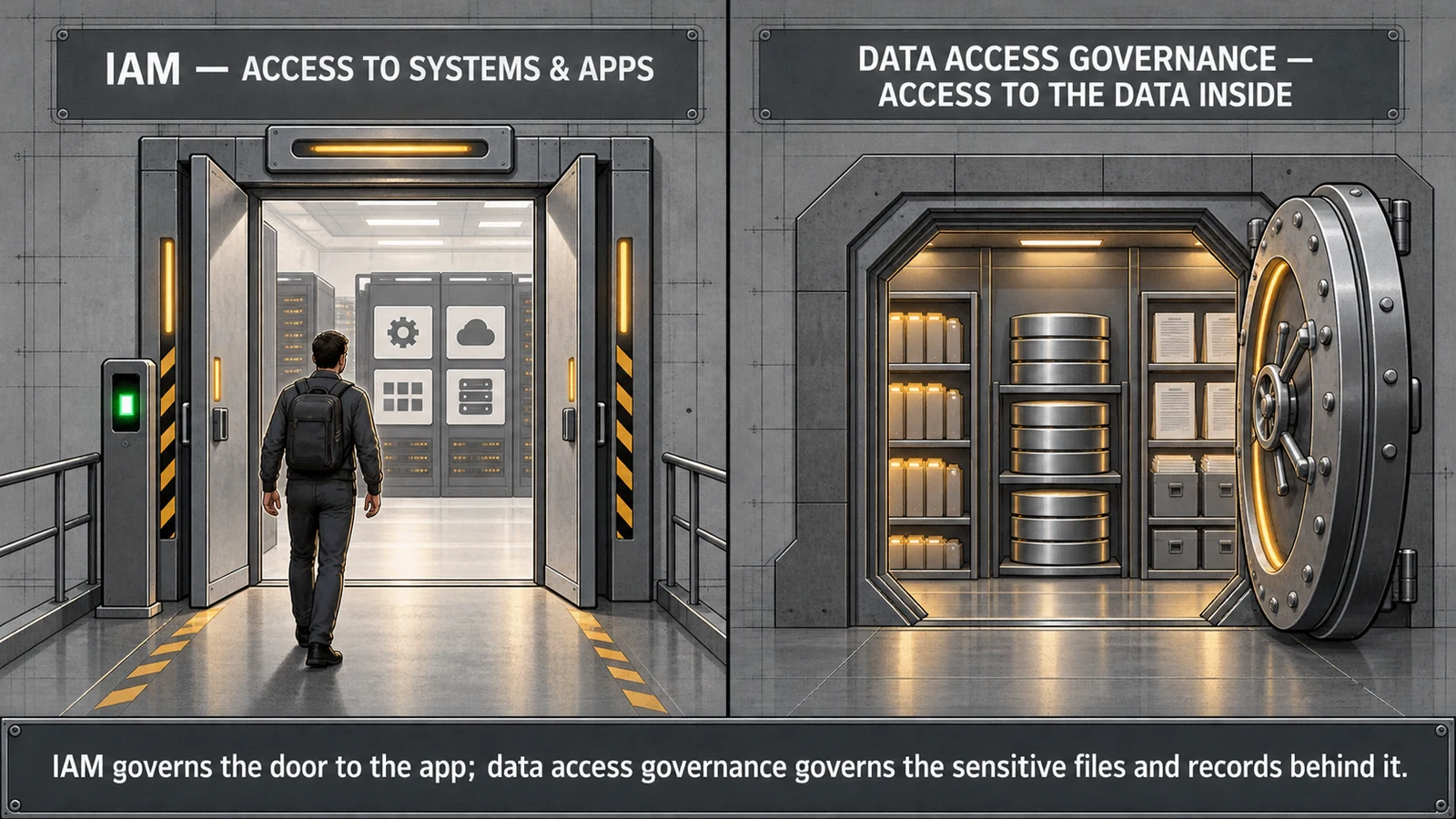
The relationship between data access governance and identity and access management causes real confusion, so it is worth stating plainly: they are complementary layers of one governance stack, not competing approaches, and each does something the other cannot.
Identity and access management governs the systems layer. It answers whether a person is who they claim to be and whether they are entitled to use a given system, application, or account. IAM is the machinery of authentication, of provisioning and deprovisioning accounts, of granting application entitlements, and of the joiner-mover-leaver lifecycle that keeps those entitlements aligned to what people do. When IAM works well, the right people can log into the right applications and the wrong people cannot, and access is granted and removed as roles change. That is essential, and nothing about data access governance replaces it.
Data access governance operates one layer deeper, on the data inside those systems. Its premise is that being able to log into a system is not the same as being entitled to reach every piece of sensitive data the system holds. A user can clear every IAM control cleanly — a valid account, an approved application entitlement, multi-factor authentication, a clean access review at the application level — and still hold wildly excessive access to the data behind that login. IAM confirms the person may enter the building; DAG governs which rooms, cabinets, and files they can open once inside. The two questions are genuinely different, and answering the first does not answer the second.
The practical consequence is that data-layer over-access is invisible to IAM-centric governance. An access review that certifies application entitlements will happily approve a user's access to a system while remaining entirely blind to the fact that, through that system, the user can read sensitive records far beyond their need. Closing that blind spot requires the finer-grained visibility that DAG provides, and it requires reviews that reach the data layer — the depth explored in what a real access review actually requires, where certifying that someone should have an account is only the beginning of certifying that they should have the access that account carries.
DAG also depends on strong IAM beneath it. Data access governance reasons about identities, and it can only be as trustworthy as the identity foundation it stands on. If accounts are orphaned, if group memberships are stale, or if the lifecycle is leaky, then the effective-access picture DAG produces inherits every one of those flaws. The two disciplines reinforce each other: IAM keeps the identities and their system-level access clean, and DAG extends governance from the systems down to the sensitive data those identities can ultimately reach. Neither is sufficient alone, and organizations that invest heavily in one while ignoring the other end up with a governed front door and an ungoverned interior — or the reverse.
It is worth distinguishing DAG from one more neighbor. Cloud infrastructure entitlement management, or CIEM, governs entitlements over cloud infrastructure — the permissions identities hold over compute, storage, and services within cloud platforms — and asks whether any identity has too much power over that infrastructure. DAG is scoped instead to sensitive data wherever it lives, cutting across on-premises file shares, databases, SaaS repositories, and cloud storage alike. The two overlap where cloud storage holds sensitive data, but their questions differ: CIEM is about excessive infrastructure privilege, DAG is about improper reach to data. Knowing which question you are asking keeps the two programs from being confused for each other or assumed to be redundant.
How to stand up data access governance
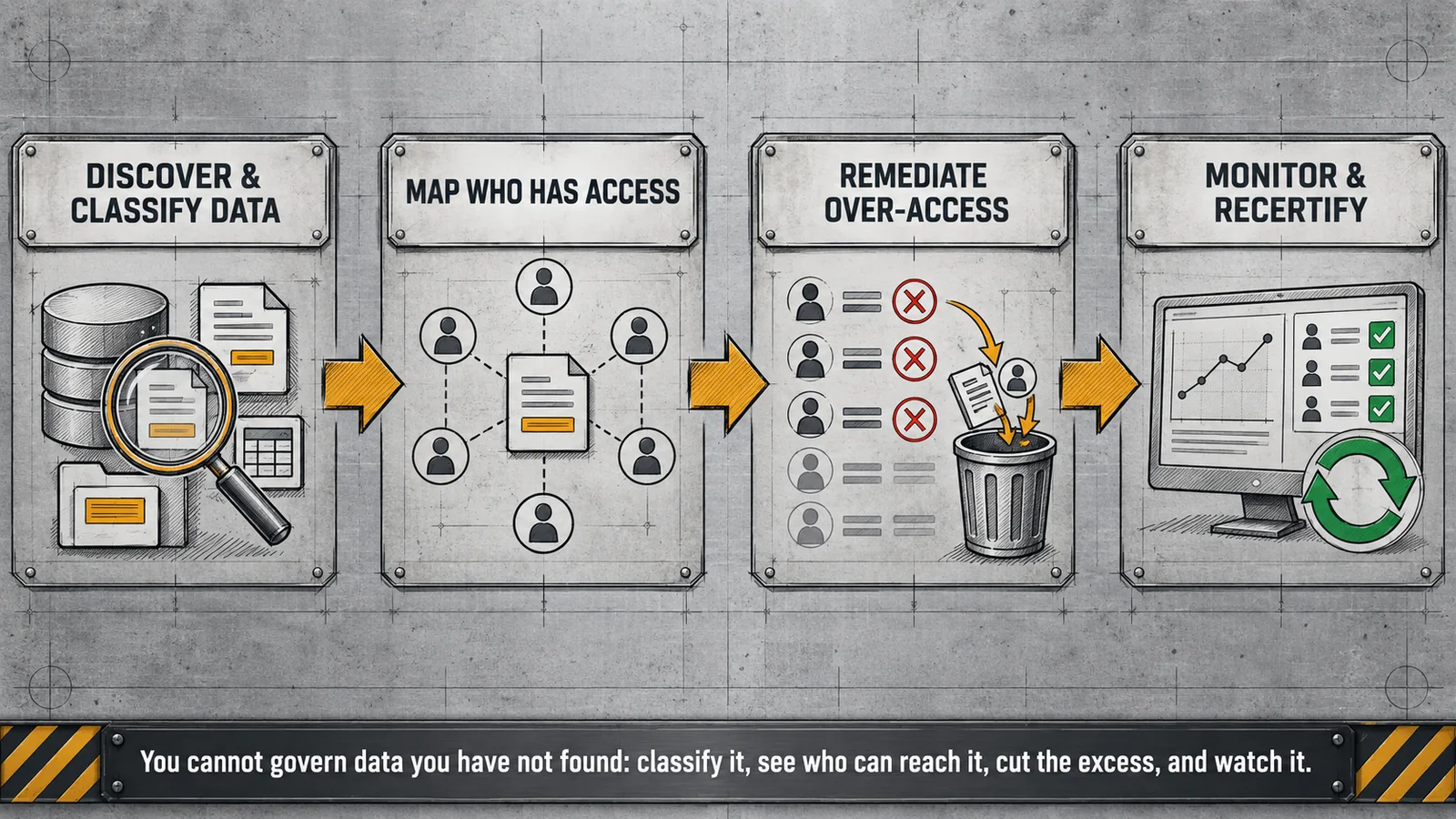
Standing up data access governance is best understood as a continuous loop rather than a one-time project, because the three things it governs — the data, the people, and the permissions between them — all keep changing. The loop has four steps, and the discipline is in running them repeatedly rather than declaring victory after one pass.
Discover and classify sensitive data. You cannot govern access to data you have not located and cannot govern it proportionately until you know how sensitive it is. The first step is therefore to discover where sensitive data lives across the estate — structured stores like databases and applications, and unstructured stores like file shares, document repositories, and collaboration platforms — and to classify what is found by sensitivity and type. Classification is what lets everything downstream be proportionate: it tells you which data warrants tight governance and continuous review and which does not, so effort concentrates where exposure would actually hurt. Without this step, a DAG program either drowns trying to govern everything equally or governs the wrong things. Discovery is also never finished, because new sensitive data is created continuously, which is the first reason the whole exercise is a loop.
Map who can access it. With sensitive data located and classified, the next step is to determine who can actually reach it — the effective-access picture described earlier. This means resolving direct permissions, group and nested-group memberships, inherited permissions, and standing grants down to what each identity can truly do to each sensitive dataset. The output is the answer to the question most organizations cannot currently produce: for this sensitive data, here is precisely who can read, change, or export it, and here is the path by which they can. Getting this right depends on a clean identity foundation underneath, which is why data access governance is so tightly bound to broader identity hygiene and to controlling the identity sprawl that scatters accounts and entitlements across systems faster than any mapping can keep up.
Remediate over-access toward least privilege. Mapping reveals the over-access; remediation removes it. This is where the program converts visibility into risk reduction, by stripping away permissions that no one uses or needs and pulling effective access back toward least privilege for sensitive data specifically. The most durable form of remediation is not just a one-time cleanup of excess permissions but a change in how sensitive-data access is granted going forward — routing it through reviewable, time-bound requests rather than permanent grants, so that access to sensitive data expires by default and must be justified to be renewed. Remediation should be sequenced by the sensitivity established during classification, tackling the highest-risk over-access first rather than trying to fix everything at once. Done well, this step steadily shrinks the population that can reach each sensitive dataset until it matches genuine need.
Monitor and recertify continuously. The final step closes the loop and keeps it closed. Even a perfectly remediated estate drifts, because people change roles, new data appears, and new permissions are granted in the ordinary course of work. Continuous monitoring watches for access to sensitive data that looks unusual — access that departs from an identity's established pattern, or reaches data it never touched before — turning DAG from a static control into an ongoing detective capability. Periodic recertification complements monitoring by forcing data owners to reaffirm, on a schedule, that the people who can reach a sensitive dataset still should. This is the same recertification discipline that governs access generally, and as the volume grows it benefits from the same focus that AI-assisted access certification brings — directing reviewer attention to the access that genuinely warrants scrutiny rather than rubber-stamping long lists. Because monitoring and recertification feed findings back into discovery, mapping, and remediation, the four steps form a cycle that maintains a governed steady state rather than a snapshot that immediately begins to decay.
Two cross-cutting requirements run through all four steps. The first is clear ownership: data owners must decide who legitimately needs access to their data, because that judgment depends on business purpose that security and identity teams cannot make alone, while security, compliance, and identity functions operate the machinery and consume the evidence. The second is provability: every step should produce the record that lets the organization demonstrate control — what data exists, who can reach it, what over-access was removed, who recertified what and when. Governance that cannot be shown is governance that cannot be trusted, and the evidence is not a byproduct of the program but one of its primary outputs.
The bottom line
Data access governance is the discipline that answers the question most access programs quietly leave open: not who can log into a system, but who can actually reach the sensitive data inside it, under what conditions, and how the organization can prove those controls hold. That focus on the data itself is what separates it from the identity and access management that governs systems and from the cloud infrastructure entitlement management that governs cloud services — three complementary disciplines that together cover a stack no single one of them covers alone.
The reason it matters is structural. Access to sensitive data accumulates in the seams that login-level controls never inspect — broad file-share permissions, inherited group memberships, standing database grants — and that over-access stays invisible until a breach, an insider incident, or an audit drags it into the light. Governing it requires seeing effective access rather than nominal access, holding that access to genuine need, and being able to demonstrate the whole picture on demand.
The path through is a loop, not a project: discover and classify the sensitive data, map who can truly reach it, remediate the over-access toward least privilege, and monitor and recertify continuously, with clear ownership and provable evidence running through every step. The organizations that govern data access well are not the ones that permission everything perfectly the first time. They are the ones that accept the estate will always drift, and build the finding, fixing, and proving into how identity runs — so that the answer to "who can read this sensitive data, and why" is always available, and always defensible.
ABOUT THE AUTHOR

More from Access Management

B2B External Identity & Guest Access: The 2026 Enterprise Guide
B2B external identity and guest access is the discipline of governing partner, vendor, contractor, and guest identities that are not employees. The 2026 enterprise guide to what external access is, the controls that keep it safe, and the lifecycle that keeps it from becoming a breach path.

Identity Federation Explained: The 2026 Foundational Guide
Identity federation is a trust relationship between separate identity providers so that one login works across domains and organizations. The foundational 2026 reference on what federation is, how it differs from SSO, and the protocols that carry it.

Identity Verification and Proofing: The 2026 IDV Guide
What identity verification and proofing actually are, how they differ from authentication, the four proofing methods, and how remote onboarding really works — establishing who someone is before you ever hand them a credential.