Enterprise RBAC Implementation: Best Practices for 2026
The operational companion to the RBAC fundamentals reference — how to actually implement enterprise role-based access control well. Rollout sequencing, role design that avoids explosion, least-privilege enforcement in practice, entitlement modeling, provisioning integration, access reviews, and the pitfalls that sink real programs.

The operational companion to the RBAC fundamentals reference — how to actually implement enterprise role-based access control well. Rollout sequencing, role design that avoids explosion, least-privilege enforcement in practice, entitlement modeling, provisioning integration, access reviews, and the pitfalls that sink real programs.
- This is the operational companion to the RBAC fundamentals primer. It assumes you already know what roles, permissions, and separation of duties are, and focuses entirely on implementing enterprise role-based access control well: sequencing, role design, enforcement, provisioning integration, and review.
- RBAC implementation best practices, in one line: discover real roles from entitlement usage before designing, model for least privilege from the start, encode separation-of-duties constraints early, wire assignment to HRIS lifecycle events rather than tickets, and recertify on a schedule. Sequence beats big-bang.
- Role explosion is the dominant failure mode of enterprise RBAC. It comes from minting a bespoke role for every edge case. Prevention — role ownership, a bias toward composing existing roles, and periodic recertification — matters far more than after-the-fact role-mining cleanup.
- Least privilege is produced by architecture, not policy statements. Right-size roles at design time, substitute (not accumulate) access on moves, time-box high-privilege access with just-in-time elevation, and use certification to catch the drift that even good automation lets through.
- RBAC is the load-bearing baseline, not the whole answer. Context-sensitive decisions (time, location, amount, device posture) belong to ABAC layered on top, and standing high-privilege access belongs to just-in-time elevation at the edges. Implement RBAC to be complemented, not to do everything.
If you are implementing enterprise role-based access control, the best practices reduce to a short, opinionated sequence: discover your real roles from actual entitlement usage before you design anything, model each role for least privilege from the start, encode separation-of-duties constraints early, wire role assignment to HRIS lifecycle events rather than manual tickets, roll out function by function instead of big-bang, and recertify roles and assignments on a schedule. Everything else in this piece is detail underneath those six moves. This is the operational, how-to-implement-well companion to the RBAC fundamentals primer — that piece defines what roles, permissions, role hierarchy, and separation of duties actually are, and this one assumes you already have that and focuses entirely on doing the implementation well.
This is the 2026 update of Avatier's original enterprise-permissions article (the legacy version lives at avatier.com/blog/permissions-enterprise). The rewrite deliberately narrows the scope. Rather than re-explaining RBAC from first principles — which the primer now does — it stays with the operational questions a team actually hits when standing up or fixing an enterprise permissions program: how to sequence the rollout, how to design roles that do not explode, how to make least privilege real rather than aspirational, how to model entitlements, how to connect assignment to provisioning, and how to run reviews that catch drift. If you want the conceptual grounding first, start with the primer and come back here.
Sequence the rollout: discovery, design, rollout, review
The single most reliable predictor of whether an enterprise RBAC program succeeds is whether it was sequenced or attempted all at once. Big-bang rollouts — define every role for the whole organization, then flip the switch — fail because the role model is guaranteed to be wrong on first contact with real usage, and a wrong model applied everywhere simultaneously is very hard to unwind. The programs that hold up move through four phases in order, and treat each as a checkpoint rather than a milestone to rush past.
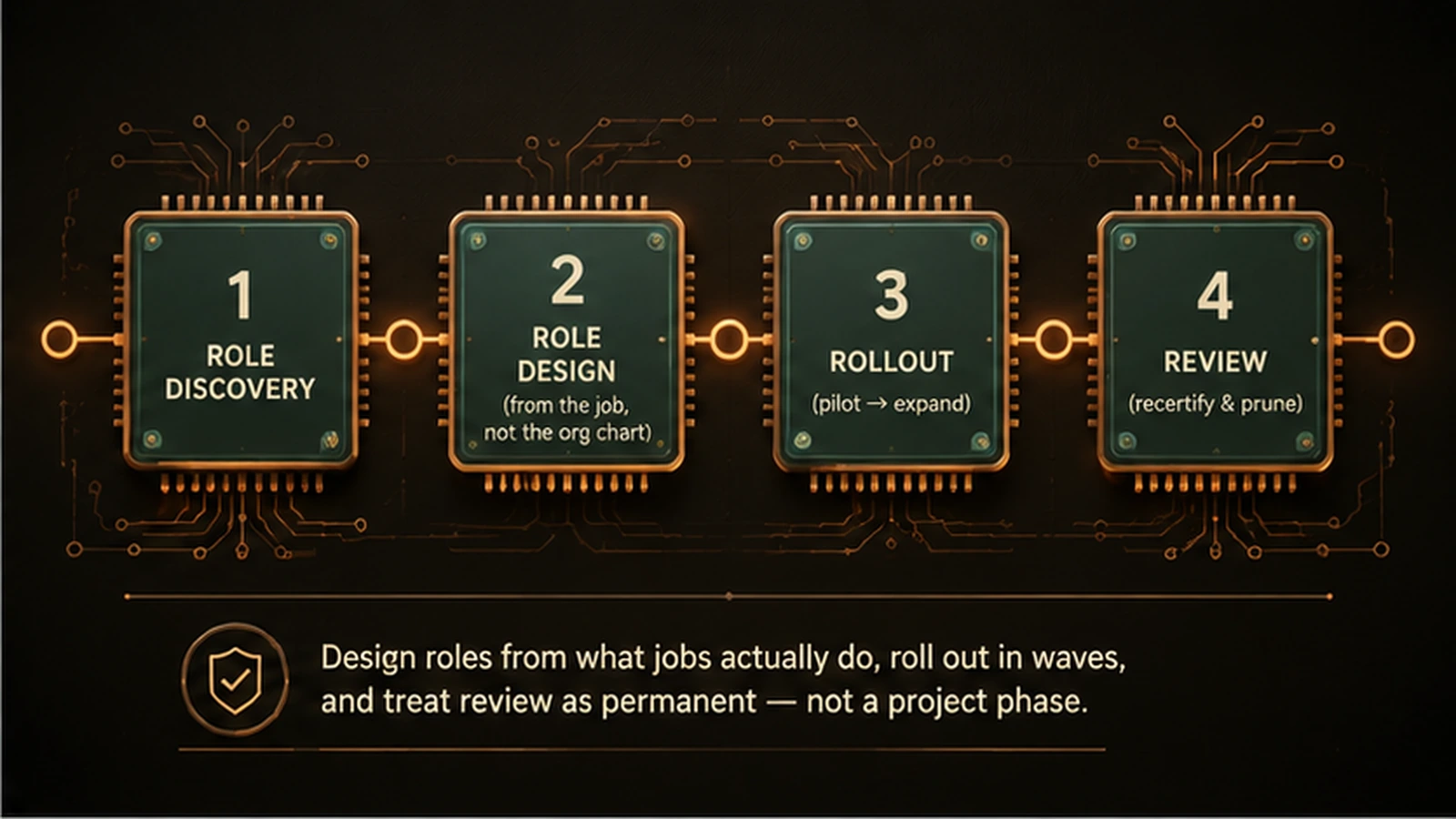 Sequence beats big-bang: discover real roles first, design for least privilege, then roll out function by function and review continuously.
Discovery comes first because you cannot design roles for work you have not observed. Pull the actual entitlement data — who holds which permissions across which systems today — and cluster it by real usage patterns. This is where you learn that the "Finance Analyst" title covers three genuinely different access profiles, or that two departments do the same work under different names. Design turns those clusters into a small core set of least-privilege roles, with separation-of-duties constraints encoded before assignments accumulate. Rollout is where you pilot one business function, prove the model against reality, correct it, and only then expand — with assignment wired to lifecycle events so it scales without manual effort. Review is not a closing phase but a permanent one: scheduled recertification is what keeps the model honest after the project team disbands. The discipline is resisting the pressure to compress these into a single push.
Design roles from job functions, not from the org chart
The most consequential design decision is what you derive roles from. The org chart is the tempting source — it is authoritative, it is already drawn, and it maps neatly onto titles. It is also the wrong source, because an org chart describes reporting lines, not access needs. Two people reporting to the same manager can need entirely different access, and two people in different departments can need nearly identical access. Roles designed top-down from the chart describe titles; roles validated bottom-up against real entitlement data describe work.
The practical method is to design top-down and validate bottom-up. Draft candidate roles from job-function descriptions — what does an accounts-payable clerk actually need to do their job? — then check each candidate against the discovery data. Where the draft role matches observed usage, you have a real role. Where it does not, either the draft is wrong or the observed access is over-provisioned, and both are worth knowing before you codify anything. Design each role to carry the minimum its function requires, and resist the "add everything they might ever touch" reflex, which is the origin of most of the over-privilege that audits later surface. Getting this right early is far cheaper than remediating a permissive role model after it is in production, and it directly feeds the least-privilege discipline that keeps the model defensible over time.
Avoiding role explosion
Role explosion is the characteristic way enterprise RBAC goes wrong, and it is worth treating as a first-class design constraint rather than something to clean up later. The mechanism is always the same: a request arrives that does not fit an existing role, and instead of composing existing roles or adding a constraint, someone creates a new bespoke role. Repeat for a few years and the catalog holds thousands of roles, many assigned to a single person, many differing from a neighbor by one permission. At that point roles have stopped simplifying anything — you are back to managing access one identity at a time, with a role-shaped layer of overhead on top.
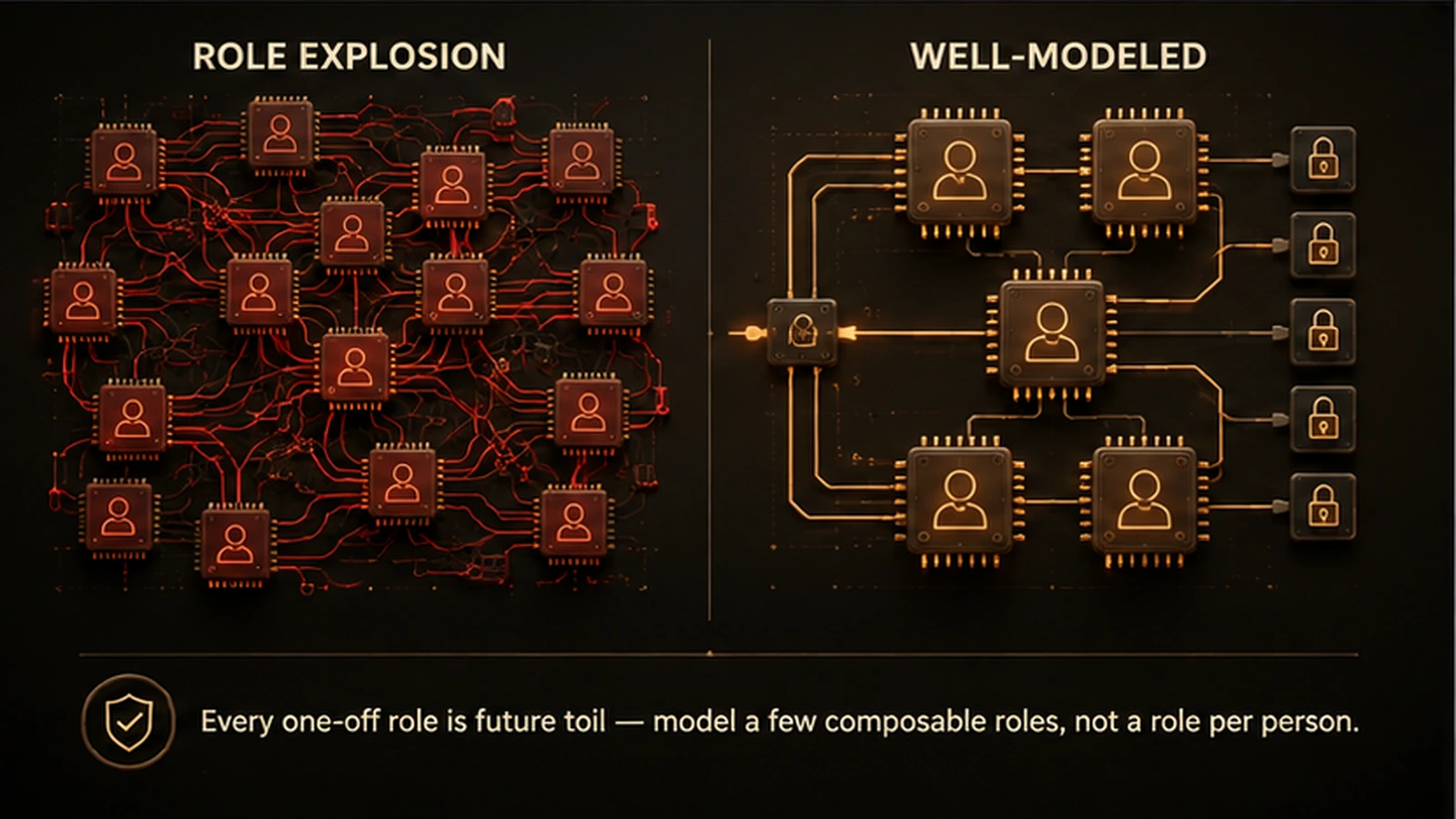 Role explosion turns a governable catalog back into per-identity management. A small, composed, well-owned core set is the defensible alternative.
Prevention beats cure, and it comes down to three habits. First, make new-role creation the exception: when a request does not fit, try composition or a constraint before minting. Second, assign every role a named business owner who is accountable for whether a new role is genuinely necessary — a role nobody owns is a role nobody will ever consolidate. Third, recertify on a schedule so near-duplicate and unused roles surface and get merged. Where sprawl already exists, role mining consolidates it by clustering users on real usage, but it carries a sharp caveat: mining unclean data faithfully reproduces the existing mess as tidy-looking roles, so it is a remediation tool, not a substitute for design discipline. The machine-learning version of role mining — and where human judgment has to stay in the loop — is covered in the AI and RBAC companion.
Enforcing least privilege in practice
Nearly every organization has a least-privilege policy. Far fewer have least-privilege posture, and the gap between the two is entirely operational. Least privilege is produced by architecture — specific mechanisms that keep access sized to current need — not by declaring the principle in a policy document. In an RBAC implementation, four mechanisms do the work, and they have to run together.
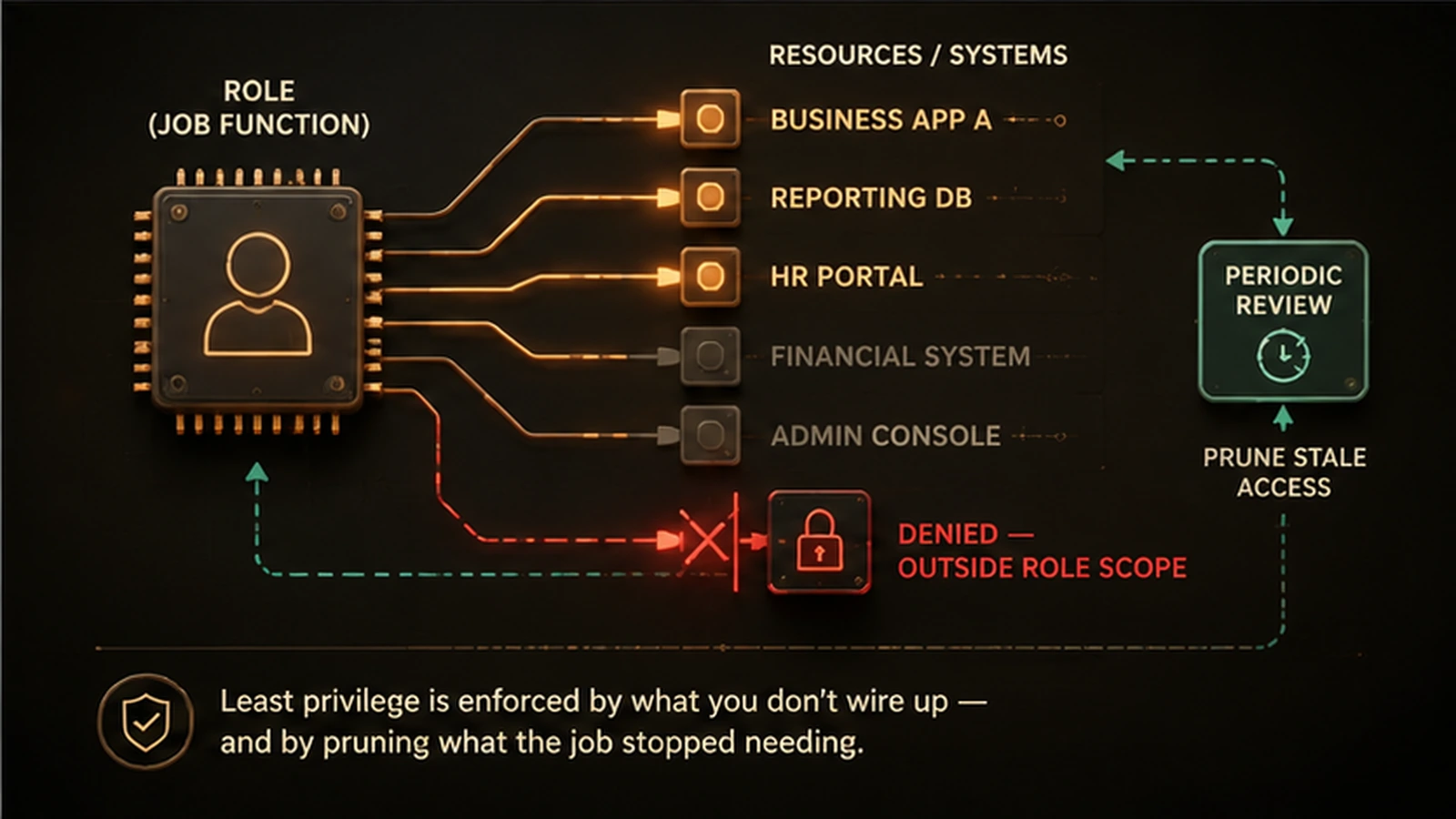 Four mechanisms make least privilege real: right-size at design, substitute on move, time-box the sensitive, recertify to catch drift.
Right-size at design is the first mechanism and the one covered above — roles carry only what their function needs. Substitute on move is the one most implementations get wrong: when a person changes jobs, the mover workflow must remove prior-role access as it grants new-role access, a diff-and-substitute rather than the far more common diff-and-add that silently accumulates entitlements across a career. Time-box the sensitive replaces standing high-privilege access with just-in-time elevation, so administrative and high-impact rights are requested and expire rather than sitting permanently on an account — the pattern detailed in the just-in-time access reference. Recertify to catch drift accepts that no automation is perfect and uses periodic review to surface the over-privilege that slips through. Any one of these alone leaves a gap; together they produce a posture you can defend to an auditor rather than a policy you can only point to.
Model entitlements before you model roles
A subtle implementation failure is treating every target system's raw permissions as if they were already the right granularity for roles. They rarely are. Underneath the role layer sits the entitlement layer — the actual authorizations each connected system exposes — and the quality of your role model is capped by how well you have modeled that layer. If entitlements are opaque, inconsistently named across systems, or bundled by the vendor in ways that do not match how your organization works, roles built on top of them inherit all of that noise.
The practical work is to normalize and describe entitlements before bundling them into roles. Give each entitlement a human-readable description of what it actually grants, group technically-related entitlements that always travel together, and flag the high-risk ones — the permissions that touch regulated data, move money, or grant administrative control — so they can be governed more tightly and reviewed more often. This is also where separation-of-duties analysis has to happen at the entitlement level, not just the role level: two roles can each look benign while a specific pair of underlying entitlements creates a toxic combination. Modeling entitlements first is what lets roles be clean bundles of well-understood permissions rather than opaque grab-bags, and it is the difference between a role catalog a business owner can actually reason about and one only the original implementer understands.
Wire assignment to provisioning and lifecycle
RBAC delivers its value only when role assignment is connected to authoritative lifecycle events and flows through to real provisioning. A role model that looks perfect on paper but is populated by hand through tickets reintroduces exactly the manual, per-identity work RBAC exists to eliminate — and it is the origin of most orphaned accounts and accumulated access that reviews later surface. The integration that matters is HRIS-to-identity-platform-to-target-systems, running automatically on lifecycle events.
A joiner record in the HRIS should trigger baseline role assignment and downstream provisioning into the systems those roles grant, so a new hire is productive on day one without a stack of access tickets. A mover event — transfer, promotion, department change — should trigger the diff-and-substitute that grants new-role access while removing prior-role access, the single most important guard against career-long entitlement accumulation. A termination should trigger prompt deprovisioning across every connected system, closing the window in which an orphaned account is a standing risk. This lifecycle wiring, and the certification wrapper around it, is the operational discipline covered in the access governance and lifecycle-management integration reference. For the underlying model of who may grant what to whom, the distinction between owner-discretionary and centrally-mandated assignment is worth understanding, and it is covered in the mandatory versus discretionary access control piece — enterprise RBAC deliberately leans toward central, policy-driven assignment rather than per-owner discretion.
Run reviews that catch drift, and avoid the common pitfalls
Even a well-designed, well-provisioned role model drifts, because organizations change continuously underneath it. Reviews are how you catch that drift, and running them well means asking two distinct questions on a schedule. Assignment recertification asks whether each person still needs the roles they currently hold. Role review asks whether each role still reflects a genuine job function and carries the right permissions. High-risk access — privileged roles, access to regulated data, separation-of-duties-sensitive functions — warrants more frequent review than routine baseline roles, and event-triggered reviews after major reorganizations or acquisitions catch the fastest drift.
The pitfalls that sink real programs are worth naming plainly, because they recur. Skipping discovery and designing from the org chart produces roles that describe titles, not work. Minting a role per edge case produces role explosion. Diff-and-add mover workflows produce career-long over-privilege. Ticket-driven provisioning produces orphaned accounts and manual toil. Rubber-stamp certifications — where reviewers approve everything without engaging — produce the appearance of governance without the substance, and are worth designing against with focused, risk-prioritized review campaigns rather than mass approve-all lists. Finally, trying to express context (time, location, amount) or privilege timing as more and more roles produces exactly the explosion you are trying to avoid; those belong to other mechanisms, discussed below.
What Avatier ships toward this pattern
Avatier Identity Anywhere is built around a governable role model rather than a pile of point grants, which is what makes the practices above operationally sustainable rather than aspirational. Roles and entitlements live in a catalog that business owners can see and reason about; entitlements can be described and grouped so roles are clean bundles rather than opaque grab-bags; and access requests flow through approval workflows tied to that catalog. Assignment is driven by lifecycle events from authoritative HRIS sources, so joiners land in the right roles, movers have stale roles removed as new ones are added — the diff-and-substitute that prevents accumulation — and leavers are deprovisioned on a defensible timeline across connected systems. Separation-of-duties constraints are enforced at assignment time, which is what turns an SoD policy from a document into a control, and certification campaigns run against the same catalog so over-privilege and role sprawl surface at review rather than at audit.
For regulated customers, the point is that the whole implementation is auditable against a documented role model — the artifact examiners actually ask for. Avatier's own control posture is published at the Avatier Trust Center: SOC 2 Type II with zero exceptions, ISO/IEC 27001:2022 certified, PCI DSS v4.0.1 compliant, CSA STAR Level 1, NIST 800-53 Rev. 5 aligned, FedRAMP-aligned, FIDO2-compatible, and a signatory of the CISA Secure-by-Design Pledge. The role model is the schema; the governance layer is the process that keeps the implementation honest as the organization changes underneath it.
Where RBAC stops: ABAC and JIT at the edges
Implementing RBAC well does not mean implementing it to do everything — and one of the more expensive mistakes is trying to. A well-built enterprise role model is the coarse, auditable baseline of access by job function, and it leaves two edges it cannot cover cleanly on its own. Both are better handled by complementary mechanisms than by piling on more roles.
The first edge is context. Time of day, geographic location, transaction amount, device posture, data-sensitivity level — these are attribute-based access control (ABAC) decisions, evaluated against policy at request time, and they belong layered on top of the role baseline rather than expressed as ever-finer roles. The moment you find yourself creating "Analyst-during-business-hours" and "Analyst-from-corporate-network" as separate roles, you are watching role explosion begin, and the honest fix is ABAC. The second edge is standing high-privilege access, which is better replaced by just-in-time elevation: sensitive administrative rights are requested and time-boxed rather than held permanently, as covered in the just-in-time access reference.
The 2026 reference posture is to implement RBAC as the load-bearing foundation, get the role model genuinely right — coherent roles derived from real usage, real ownership, structural separation of duties, lifecycle-driven assignment — and then build the rest deliberately on top: ABAC for context, JIT for privileged timing, and continuous governance for the maintenance. Get the foundation right and every layer above it has something clean to stand on. Get it wrong, and no amount of context-aware policy or elevation tooling will compensate for a role model that no longer describes how the organization actually works. Start from the RBAC fundamentals primer if you have not, then implement in the order above.
ABOUT THE AUTHOR

More from Access Management

Data Access Governance in 2026: Govern Who Can Reach Sensitive Data
Data access governance is the discipline of controlling who can reach which sensitive data, under what conditions, and proving it to auditors. It is distinct from IAM, which grants access to systems, and from CIEM, which governs cloud infrastructure. The practical 2026 guide to governing access to the data itself.

B2B External Identity & Guest Access: The 2026 Enterprise Guide
B2B external identity and guest access is the discipline of governing partner, vendor, contractor, and guest identities that are not employees. The 2026 enterprise guide to what external access is, the controls that keep it safe, and the lifecycle that keeps it from becoming a breach path.

Identity Federation Explained: The 2026 Foundational Guide
Identity federation is a trust relationship between separate identity providers so that one login works across domains and organizations. The foundational 2026 reference on what federation is, how it differs from SSO, and the protocols that carry it.