Human Error in Data Breaches: What the Numbers Really Say (2026)
There is no single authoritative percentage for human error in breaches — the honest answer is directional: most breaches involve a human element, and the exact figure depends on who is counting and what they count.
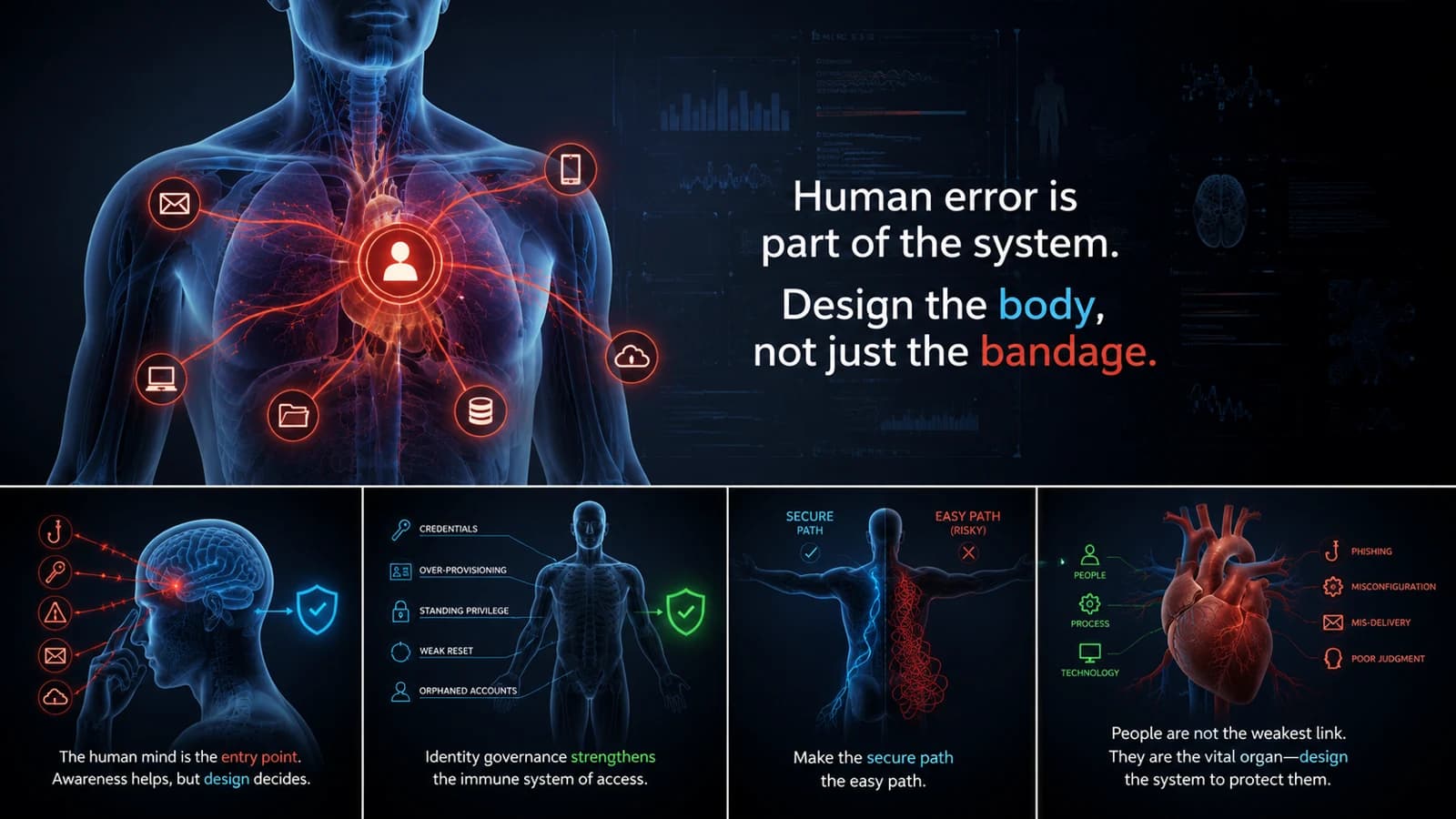
There is no single authoritative percentage for human error in breaches — the honest answer is directional: most breaches involve a human element, and the exact figure depends on who is counting and what they count.
- There is no single authoritative percentage for human error in data breaches, and the reports that publish one rarely agree. The honest, defensible answer is directional: the majority of breaches involve a human element somewhere in the chain. Any team quoting a precise figure as settled fact is over-claiming — the number moves with the source, the methodology, and the definition of what counts.
- The exact percentage varies because "human error" is not one measurable thing. Phishing, weak or reused credentials, misconfiguration, over-provisioned access, and mis-delivered or lost data are all folded into that phrase, and different reports draw the boundary in different places. A study that counts only accidental mistakes lands far lower than one that counts every breach with a human element.
- Human error breaks down into distinct categories, and they do not share a single fix. Treating "the humans" as one problem to be trained away is the mistake that keeps the number high. Each category — social engineering, credential weakness, misconfiguration, over-provisioning, data mishandling — has its own controls, and identity governance addresses some of them directly while barely touching others.
- Identity governance reduces the credential-and-access categories: credential compromise, over-provisioning, standing privilege, weak reset verification, and orphaned accounts. It does not, on its own, fix phishing susceptibility, misconfiguration outside the identity plane, mis-delivered data, or a user's moment-to-moment judgment. Honest scoping of what IAM does and does not cover is what separates a real program from a compliance checkbox.
- The durable move is from blame to system design — making the secure path the default, easy path rather than exhorting people to make fewer mistakes. Least privilege by default, automated deprovisioning, and strong-factor self-service shrink the surface where a human slip turns into a breach. But no control removes human judgment from the loop, which is why the residual risk is worth naming plainly.
If you came here for a single number — the percentage of data breaches caused by human error — the honest answer is that no one authoritative figure exists, and the reports that publish one rarely agree. What the broad body of industry reporting consistently shows is directional and clear: the majority of breaches involve a human element somewhere in the chain. But whether that lands a little over half or up in the high nineties depends entirely on who is counting, what they classify as "human error," and which breaches made it into their sample. That nuance is not a dodge to avoid answering — it is the actual, useful answer, and getting it right is what separates a practitioner's understanding from a slide-deck statistic.
This is the 2026 update of an earlier Avatier post, The Hidden Cost of Human Error. The original leaned on a set of precise-sounding percentages attributed to well-known industry and analyst reports — the kind of figures that make a compelling headline. We have deliberately reframed that here. Not because human error is unimportant — it is central — but because quoting a single decimal as settled fact misrepresents what the underlying research actually supports, and a security audience is better served by the honest version. This piece keeps the original's core point, that manual and human-dependent processes create expensive risk, and points it at what the evidence genuinely says and what identity controls can and cannot do about it.
Why there is no single number: how "human error" is defined and measured
The reason credible reports land on figures ranging from roughly half to nearly all is not that some of them are wrong. It is that they are answering different questions under the same label. "Human error" is not a single, cleanly measurable event the way "number of records exposed" is. It is an umbrella stretched over several distinct failure modes, and each study decides for itself which of them to count.
Start with definition. A report that defines human error narrowly — as an accidental mistake, someone doing the wrong thing without intending harm — will produce a much lower figure than one that counts any breach with a human element, a phrase broad enough to include a user falling for phishing, an admin misconfiguring a server, or an employee reusing a breached password. Both definitions are defensible. They are simply not the same measurement, and averaging them produces a number that means nothing.
Then there is attribution. Real breaches are rarely caused by one clean thing. An attacker phishes a credential, finds that the compromised account has far more access than it needed, pivots through a misconfigured system, and exfiltrates data. Is that a "human error" breach? A study that attributes to the initiating cause counts it as phishing; one that counts every human touchpoint along the path counts it several times over. The same incident inflates or deflates the total depending on a methodological choice made before any data was gathered.
Sampling compounds the spread. A dataset drawn from one industry, one region, or one vendor's customer base does not generalize to yours. Regulated finance looks different from a consumer app; a report built on incidents that were disclosed differs from one built on those that were merely detected. And disclosure norms themselves vary by jurisdiction, so the population of breaches a study can even see is shaped before counting begins.
None of this makes the reporting worthless — far from it. It makes it directional. Read across the credible sources and they agree on the thing that matters: humans are central to most breaches. That is a genuine, actionable finding. What they cannot give you is a precise, portable percentage you can drop into a board deck as fact. A security leader who says "the majority of breaches involve a human element, and here is how ours break down" is on far firmer ground than one who quotes a specific number as if it were a physical constant. This is the same discipline that keeps a security culture KPI program honest: measure your own environment rather than importing someone else's headline.
The categories of human error in breaches
The most useful thing you can do with the "human error" label is take it apart. Once you stop treating it as one problem, it resolves into a handful of distinct categories, each with its own mechanism, its own frequency in your environment, and — crucially — its own set of controls. Lumping them together is what makes the problem feel intractable and keeps the aggregate number stubbornly high.
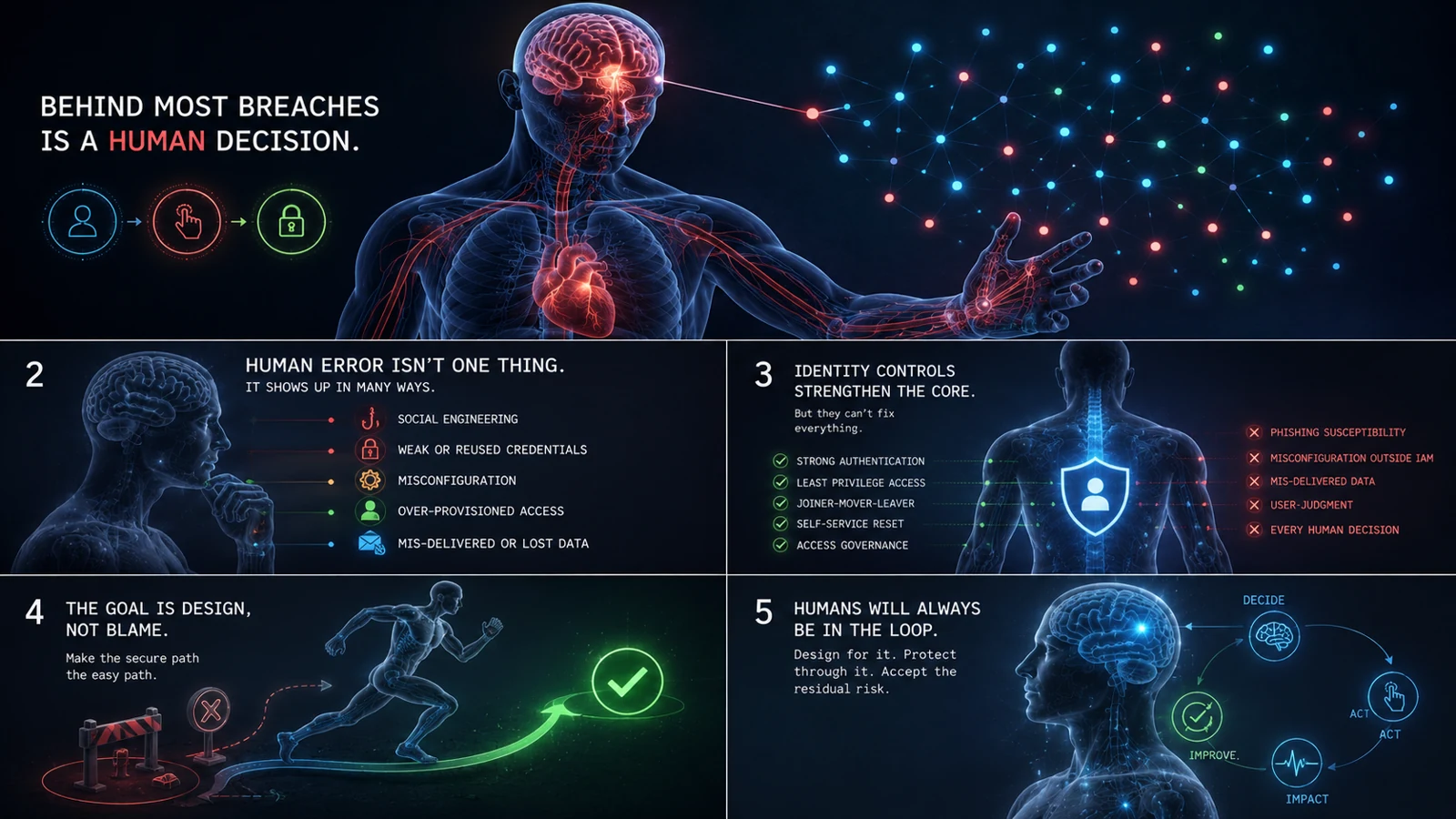 Human error is not one mistake — it is several distinct failure categories, and each one has a different fix.
Phishing and social engineering is the category most people picture first: a person is deceived into handing over a credential, approving a fraudulent prompt, or taking an action that lets an attacker in. The failure is in the moment of judgment, and it is genuinely hard to eliminate because attackers engineer their messages to defeat exactly the vigilance you train for.
Weak and reused credentials is quieter but pervasive. A password that is guessable, or one reused from a site that has already been breached, hands an attacker a working key without any exploit at all. The human error here is not a single dramatic mistake but an accumulation of small, understandable choices — reusing a password because remembering dozens is impractical. The risks of weak passwords run deeper than most credential inventories reveal, because the exposure is invisible until the reused password is tried.
Misconfiguration is the administrator's version of human error: a storage bucket left public, a permission set too broadly, a default that was never changed. It rarely involves malice or even carelessness in the ordinary sense — it involves complexity outrunning attention. Systems have so many settings that some will be wrong, and the wrong one is often invisible until it is exploited.
Over-provisioning is the slow accumulation of access that no one ever takes away. A user changes roles and keeps the old permissions; a project ends and its access lingers; a contractor's account outlives the engagement. Each grant was reasonable when made. The error is the absence of a process to walk it back, and it turns every compromised account into a bigger blast radius than it needed to be — the exact dynamic that makes the principle of least privilege the single highest-leverage control against human-error breaches.
Lost and mis-delivered data rounds it out: an email to the wrong recipient, a laptop left in a taxi, a shared link that was more open than intended. These are the errors that dominate personal-data breach notifications, and they are almost purely human — no attacker required.
Which categories identity governance actually reduces — and which it doesn't
Here is where honesty matters most, because the temptation in a piece published by an identity-governance company is to imply that identity controls solve human error broadly. They do not, and claiming they do would undermine the credibility of the parts that are true. Identity governance is a powerful lever against a specific subset of these categories — the ones where access is the mechanism of harm — and it barely touches others.
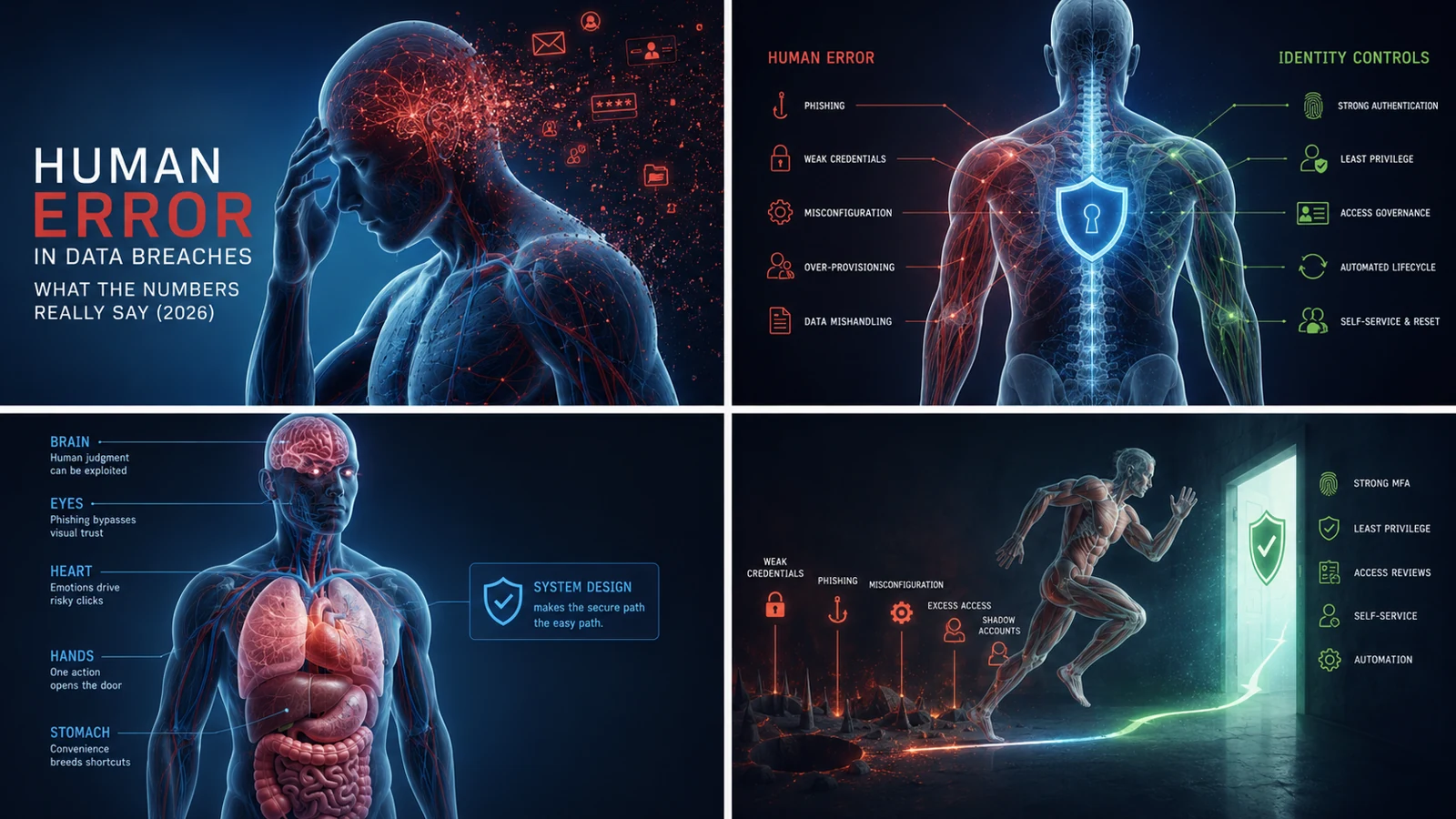 Identity governance shrinks the credential-and-access categories — it does not remove human judgment from the loop.
On the reduces side, the leverage is real and direct. Credential compromise shrinks when you move users onto strong, phishing-resistant factors and retire guessable recovery paths; even if a password leaks, it is no longer sufficient. Over-provisioning and standing privilege are precisely what access reviews, least-privilege defaults, and just-in-time elevation exist to attack — you cannot lose access an account never held. Weak reset verification closes when you replace knowledge-based questions with possession- and biometric-based checks, which is why password reset best practices have shifted decisively toward strong-factor self-service. And orphaned or stale accounts disappear when deprovisioning is automated against the HR lifecycle rather than left to a manual ticket someone forgets to file.
The does-not-solve side deserves equal candor. Identity governance does not stop a person from being deceived by a convincing phishing message — it can limit what the deception yields, since a phishing-resistant factor is useless to an attacker who captured a password, but the human still clicked. It does not fix misconfiguration outside the identity plane: an open storage bucket, a permissive network rule, a default nobody changed. It does not prevent mis-delivered data, a lost device, or a document shared with the wrong person. And it cannot supply judgment in the instant someone decides to approve, click, or work around a control.
The public post-mortem record makes this scoping concrete. When you read the anatomy of a real identity-driven incident — the kind dissected in the Storm-2949 identity governance failure analysis — the failures cluster exactly where governance has leverage: excess standing access, weak verification, accounts that should not have existed. That is the argument for investing in identity controls. It is also, read carefully, the argument for not expecting them to cover the phishing-judgment and misconfiguration categories that need different tools.
From blame to system design: making the secure path the easy path
The oldest and least effective response to human error is to locate the error in the human and demand they do better. "Be more careful. Train harder. Stop making mistakes." It fails for a structural reason: it treats a systemic outcome as a personal failing, and it makes the secure path the hard path — the one that requires vigilance, memory, and friction the person has to supply on their own, every time, forever.
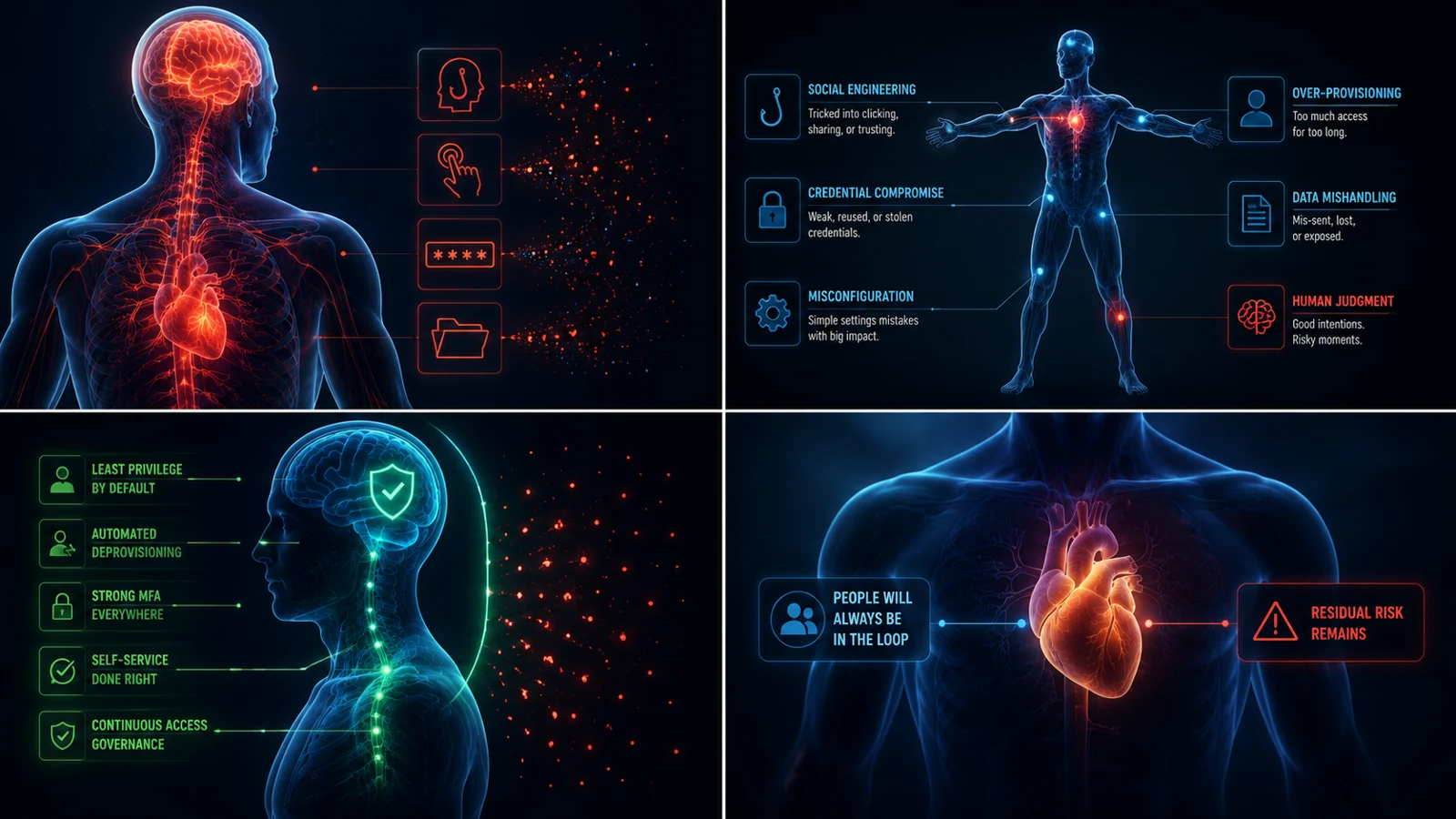 The fix for human error is rarely more willpower — it is a system where the secure choice is the easy one.
System design flips the burden. Instead of asking people to be the last line of defense against their own fallibility, you build an environment where the safe action is the default and the dangerous one takes deliberate effort. Least privilege by default means a new account starts with the minimum and access is added deliberately, so the common failure mode — too much access, accumulated quietly — cannot happen passively. Automated deprovisioning means leaving the organization removes access without anyone remembering to act. Strong-factor self-service reset means the easy path for a locked-out user is also the secure one, not a guessable question. In each case the human does not have to be more careful; the system makes the careful outcome the automatic one.
There is a cultural dimension to this that pure engineering misses, and it is where awareness work earns its keep — done right, not as a blame-shifting checkbox. The point of good security awareness training measured against real identity KPIs is not to manufacture perfectly vigilant humans; that person does not exist. It is to raise the floor of recognition, to make reporting a near-miss safe and normal rather than punishable, and to feed what the organization learns back into the system so the same error becomes structurally harder next time. Blame drives mistakes underground, where they repeat invisibly. Design pulls them into the light, where they get fixed once.
Measuring your own human-error exposure
The practical consequence of everything above is that you should stop trying to benchmark against a borrowed percentage and start instrumenting your own environment. Your human-error exposure is knowable, and the numbers that reveal it are ones your identity and security systems already produce.
Begin with a category audit. Take your recent incidents and near-misses and sort them by failure type — social engineering, credential weakness, misconfiguration, over-provisioning, data mishandling. The distribution alone is more useful than any external statistic, because it tells you where your risk concentrates rather than where the industry's does. A shop drowning in mis-delivery has a different problem than one repeatedly phished, and the same headline number would obscure both.
Then layer in leading indicators — the metrics that move before an incident, drawn straight from your identity plane. Enrollment coverage for strong authentication factors, by segment, tells you how much of the credential-compromise category you have actually closed. The count of accounts holding standing privilege, and the age of the oldest un-reviewed access grant, quantify over-provisioning directly. Orphaned-account count measures the deprovisioning gap. The share of resets still running through weak, knowledge-based verification measures the soft spot in your recovery flow. Each is a number you can drive down deliberately, and each maps to a category identity governance genuinely reduces.
Track them over time and by segment, because the trend and the distribution carry the signal, not the snapshot. Enrollment coverage climbing toward full while standing-privilege counts and orphaned accounts fall is direct evidence that your controls are working on the categories they can reach. This is the same measurement philosophy behind a mature security culture KPI framework: instrument the leading indicators you control, watch them by population, and let the movement — not a borrowed benchmark — tell you whether you are getting safer.
What Avatier ships toward this pattern
Avatier's identity platform is built to attack the specific human-error categories where access is the mechanism of harm. Automated lifecycle provisioning and deprovisioning tie access to the HR source of truth, so accounts are created with least privilege and removed on departure without depending on a manual ticket that someone has to remember to file. That closes the over-provisioning and orphaned-account categories structurally rather than through vigilance.
Access certification and reviews walk back the standing privilege that accumulates over time, turning "access nobody remembers granting" into a recurring, evidence-producing control. Self-service password and account reset is gated by strong factors — authenticator push, passkeys, and FIDO2-compatible hardware keys — rather than guessable security questions, and for users without a smartphone, a deviceless option like the Identity Challenge Card covers the frontline and shared-workstation segments so no population is stranded on weak verification. Each of these maps to a category on the "reduces" side of the split above.
Because these controls sit inside one credential-governance platform, the evidence they produce — who has access, who approved it, when it was reviewed, how a reset was verified — flows into a single audit trail rather than scattering across systems. For teams that need to point auditors at posture rather than assertions, the Avatier Trust Center publishes the current standing: SOC 2 Type II with zero exceptions, ISO/IEC 27001:2022 certified, PCI DSS v4.0.1 compliant, CSA STAR Level 1, NIST 800-53 Rev. 5 aligned, FedRAMP-aligned, and CISA Secure-by-Design Pledge signatory.
ABOUT THE AUTHOR

More from IAM & Identity Governance
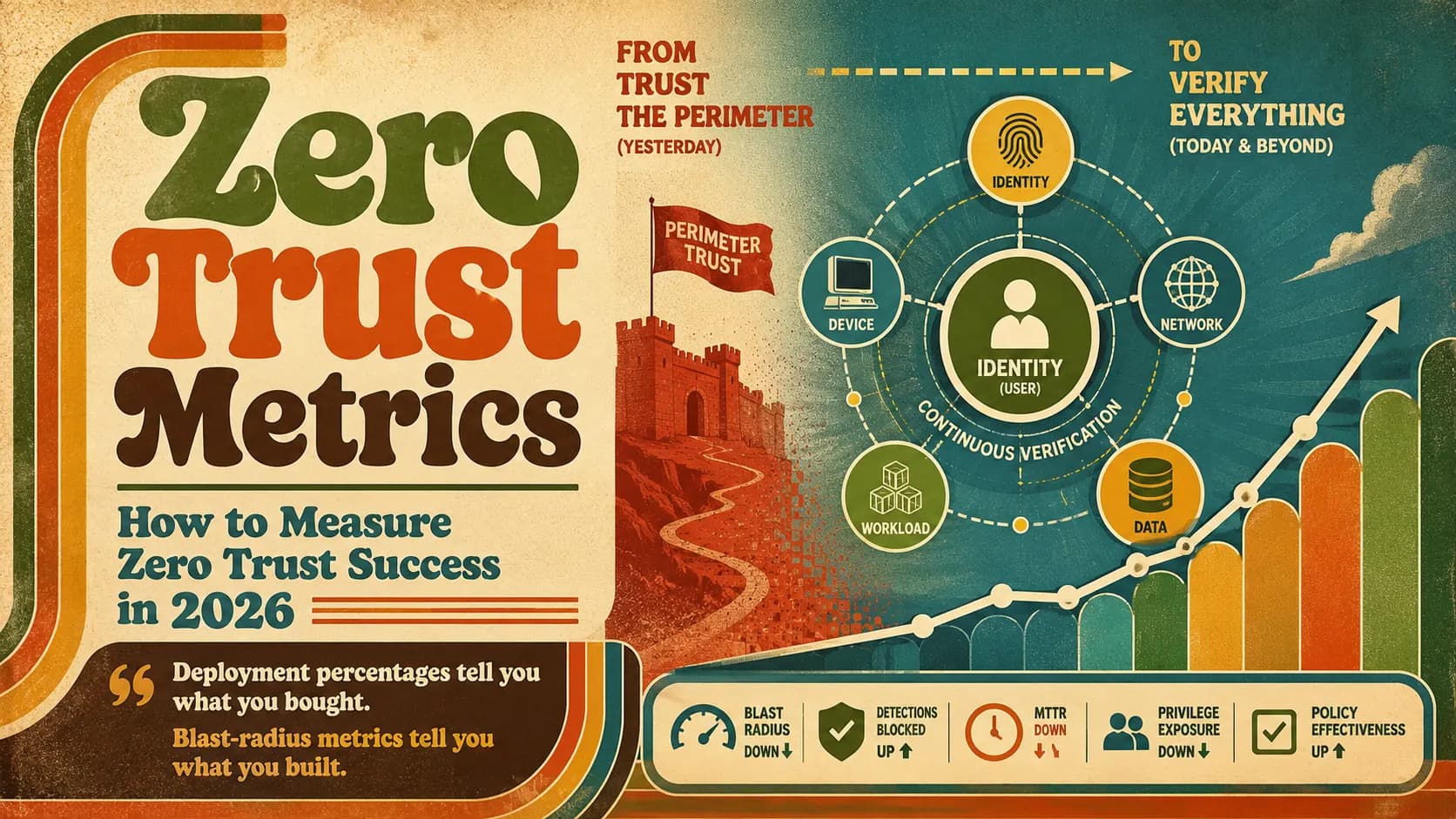
Zero Trust Metrics: How to Measure Zero Trust Success in 2026
The 2026 reference on zero trust metrics: the five measurement domains, the identity KPIs that predict blast radius, maturity checkpoints, and the numbers that mislead.
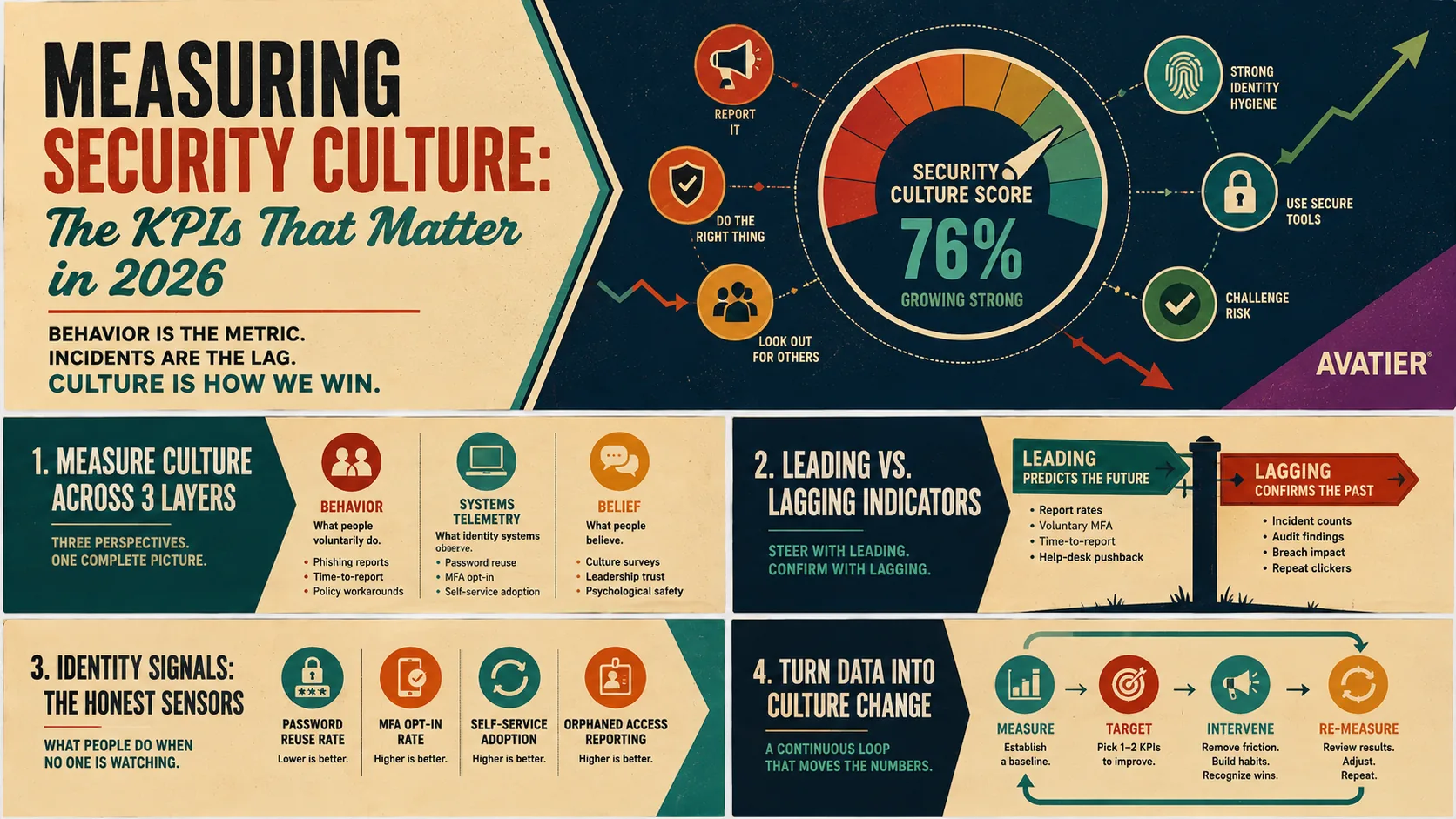
Measuring Security Culture: The KPIs That Matter in 2026
How organizations measure and improve security culture in 2026: leading vs. lagging indicators, behavioral KPIs, identity hygiene signals, survey instruments, and how to actually move the numbers.

User Experience in IAM: Why UX Is a Security Control (2026)
In identity and access management, user experience is not a design nicety layered on top of security — it is the variable that decides whether your controls get used or quietly routed around. The 2026 practitioner guide to why friction drives workarounds, where UX breaks across the identity lifecycle, how to measure it, and the UX-versus-security tradeoff done right.