Beyond Basic Access: What SSO Alone Can't Do in 2026
SSO answers who logged in, not what they can touch or why -- 2026 access management adds governance, analytics, and lifecycle automation, plus a new problem: AI agents that don't federate.

SSO answers who logged in, not what they can touch or why -- 2026 access management adds governance, analytics, and lifecycle automation, plus a new problem: AI agents that don't federate.
- SSO solves authentication -- proving who someone is at the login prompt -- and stops there by design; authorization (what they can touch), governance (whether they should still have it), and analytics (whether the session looks right) are separate capabilities that have to be built or bought on top of it.
- Four capabilities extend access management past basic SSO: adaptive MFA layering that escalates by risk instead of applying one static rule, governance and certification that periodically re-verifies access is still warranted, access analytics that catch anomalous sessions SSO logs alone won't surface, and lifecycle automation that provisions and de-provisions access on a schedule no help desk can match manually.
- SSO maturity runs through four recognizable stages -- basic access, conditional access, adaptive access, and identity fabric -- and most enterprise programs stall at conditional access because the jump to adaptive requires a risk-scoring capability most IdPs don't ship natively.
- AI agents and internal AI tools break the SSO/SAML assumption that the thing requesting access is a human sitting at a browser with a session and a logout button; agents hold long-lived credentials, call APIs directly, and often act on a schedule no human authorization step supervises, which is why 'SSO for AI tools' is turning into its own distinct question rather than a subset of ordinary app federation.
- Extending SSO with governance, analytics, and lifecycle automation is real progress, but it doesn't replace the need for a proper identity governance and administration (IGA) layer, and it does nothing for the password risk sitting in legacy, non-federated applications that were never going to support SAML or OIDC in the first place.
Access management is evolving away from a single login event and toward a continuous, risk-aware layer that keeps evaluating a session long after the password prompt is gone. Single sign-on solved the problem it was built for -- one credential instead of forty, one login instead of a dozen password resets a year -- but SSO alone only answers "is this person who they claim to be." It says nothing about whether they should still have the access they're using, whether their session looks abnormal, or how fast a new hire actually gets working access. The organizations pulling ahead in 2026 have stopped treating SSO as the finish line and started treating it as the entry point to governance, analytics, and lifecycle automation layered on top -- plus a genuinely new problem SSO was never built for: AI agents and tools that don't authenticate the way a human at a browser does.
This is the 2026 update of our original SSO beyond basic access post, rewritten around what's actually changed since 2025: adaptive access has gone from a differentiator to table stakes at the upper end of the market, governance and certification tooling has gotten cheaper to deploy, and AI-agent access has emerged as a distinct category that the original piece didn't anticipate. The core argument hasn't changed -- SSO is necessary but not sufficient -- but the specifics of what "beyond SSO" means in practice have moved considerably.
What SSO Actually Solves (and What It Doesn't)
SSO solves authentication: proving identity once and propagating that proof across a federated set of applications so a user isn't re-entering credentials app by app. That's a real, durable problem, and SAML 2.0 and OpenID Connect solve it well when implemented correctly -- the protocol layer itself is mature, and neither one is going away. But authentication is a narrower claim than most organizations treat it as, and the gap between "SSO is deployed" and "access is well-managed" is where a surprising amount of enterprise risk actually lives.
Three things SSO does not do, by design rather than by oversight. It doesn't do authorization -- deciding what an authenticated user can actually see or act on inside each application is the application's own entitlement model, not something the IdP enforces. It doesn't do governance -- nothing about a SAML assertion tells you whether the access being granted was ever reviewed, approved, or is still warranted six months later; that's a separate certification process, and without one, entitlements accumulate quietly until an audit or an incident forces a manual review. And it doesn't do analytics -- an IdP's login logs record that a session happened, not whether that session's pattern looks anomalous against the user's history. Our common SSO challenges piece goes deeper on the operational failure modes that show up when organizations treat SSO deployment as the end of the identity project instead of the beginning.
The practical consequence is that a mature SSO deployment and a mature access-management program are not the same milestone, even though they're frequently conflated in vendor pitches and internal status reports. An organization can have excellent SSO adoption -- every application federated, every user routed through the IdP -- and still have no idea whether the access being granted through that clean login flow is appropriate, current, or secure. The rest of this piece is about the four capabilities that close that gap.
The Four Capabilities That Extend Beyond Basic SSO
Four capabilities, layered on top of federation, are what actually separate a governed access-management program from a login page that happens to be centralized. None of them replace SSO -- they extend it.
MFA layering moves multi-factor authentication from a single static rule ("always require a push notification") to adaptive step-up that escalates based on risk signal -- an unfamiliar device, an impossible-travel pattern, an access attempt to a sensitive system -- rather than treating every login as equally risky. A user on a known device from a known location gets a frictionless login; the same user attempting the same login from a new country at 3 a.m. gets an additional challenge. Governance and certification re-verify access on a recurring cadence instead of only at provisioning time -- a manager or resource owner periodically confirms that each entitlement is still warranted, and the certification decisions themselves become an audit trail. Access analytics watch session behavior for patterns that a login log alone won't surface -- anomalous session detection, failed-login trend analysis, and confirmed-true-positive tracking on flagged sessions, which is the difference between an alert nobody investigates and a control that actually catches something. Lifecycle automation handles joiner-mover-leaver events on a schedule no help desk can match by hand -- provisioning access the moment a new hire's start date triggers it, adjusting entitlements the moment a role changes, and de-provisioning access the moment someone leaves, rather than relying on a manual ticket that might sit in a queue for days.
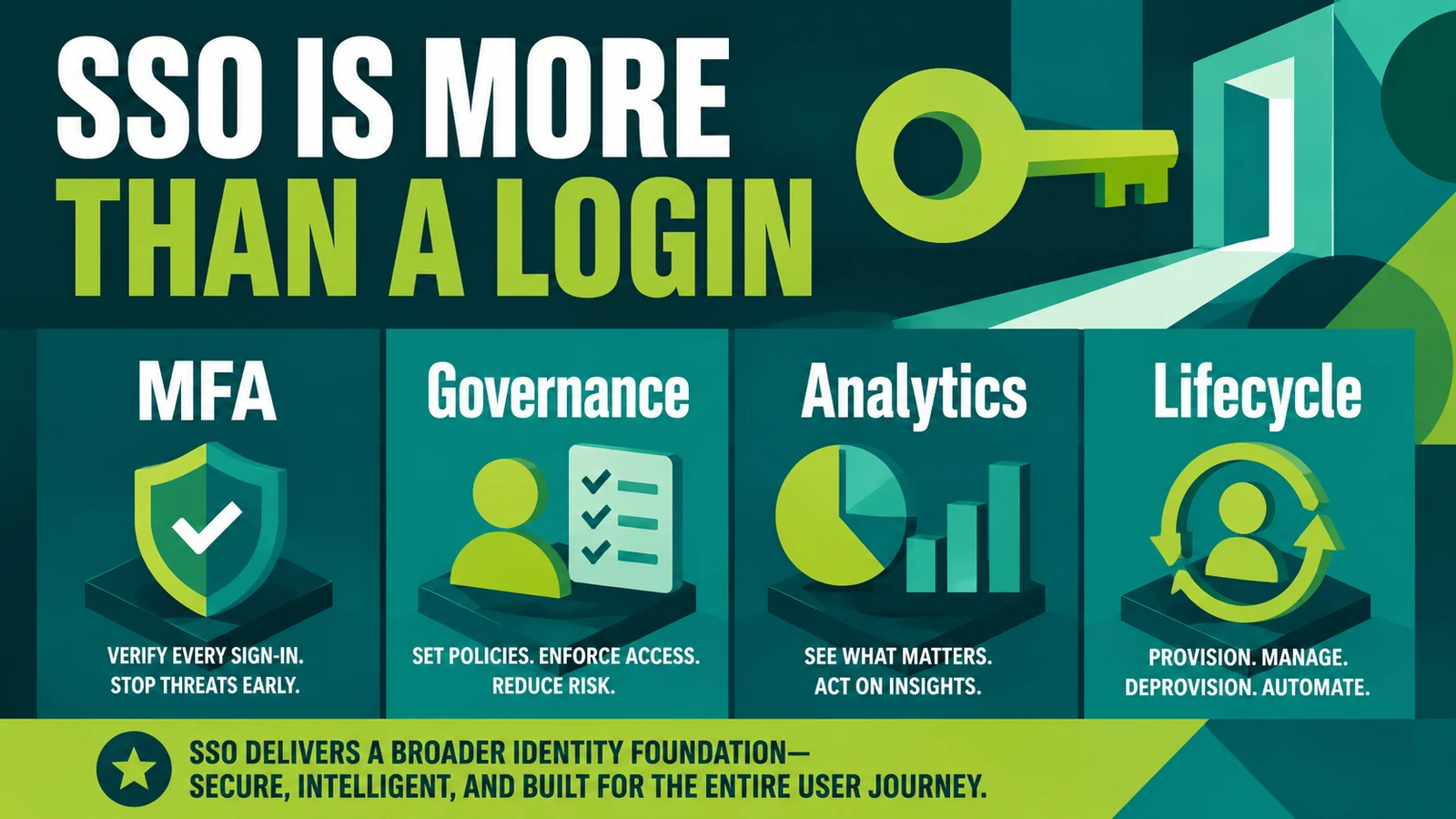 Federation proves identity once; these four layers are what actually govern access after that first login.
None of these four require replacing the SSO layer underneath them -- they're additive capability, typically delivered through a governance platform or an IGA layer that consumes the IdP's authentication events and provisioning hooks rather than competing with them. The OAuth 2.0 vs OpenID Connect piece covers the protocol-level distinction that determines what data these layers can actually pull from a federation event in the first place -- OIDC's identity-token claims give governance and analytics tooling meaningfully more to work with than a bare OAuth 2.0 access token does.
SSO Maturity: From Basic Access to Identity Fabric
Enterprise SSO deployments tend to move through four recognizable stages, and most organizations can place themselves on this curve without much ambiguity. Basic access is federated login only -- SAML or OIDC has replaced per-application passwords, every application in scope routes through the IdP, and that's genuinely a meaningful first milestone. But every login is evaluated identically regardless of context; there's no distinction between a routine login from a managed laptop and a login attempt from an unrecognized device on an unfamiliar network.
Conditional access is the first step past that: static, deterministic rules layered on top of federation -- device-compliance checks, network or IP-range restrictions, geofencing that blocks or flags logins from unexpected regions. It's still rules-based rather than risk-scored, but it closes the most obvious gap in basic access. Adaptive access is where the shift to real-time risk scoring happens -- location, device posture, behavioral pattern, and time-of-access combine into a dynamic score that determines in the moment whether to allow, step up, or deny, rather than applying the same fixed rule every time. Our context-aware access policy piece covers what actually goes into that scoring model and where organizations tend to get the risk weighting wrong. Identity fabric is the governed end state: adaptive access, continuous certification, lifecycle automation, and access analytics operating as one coordinated layer with shared signal, rather than four disconnected tools that each see only part of the picture.
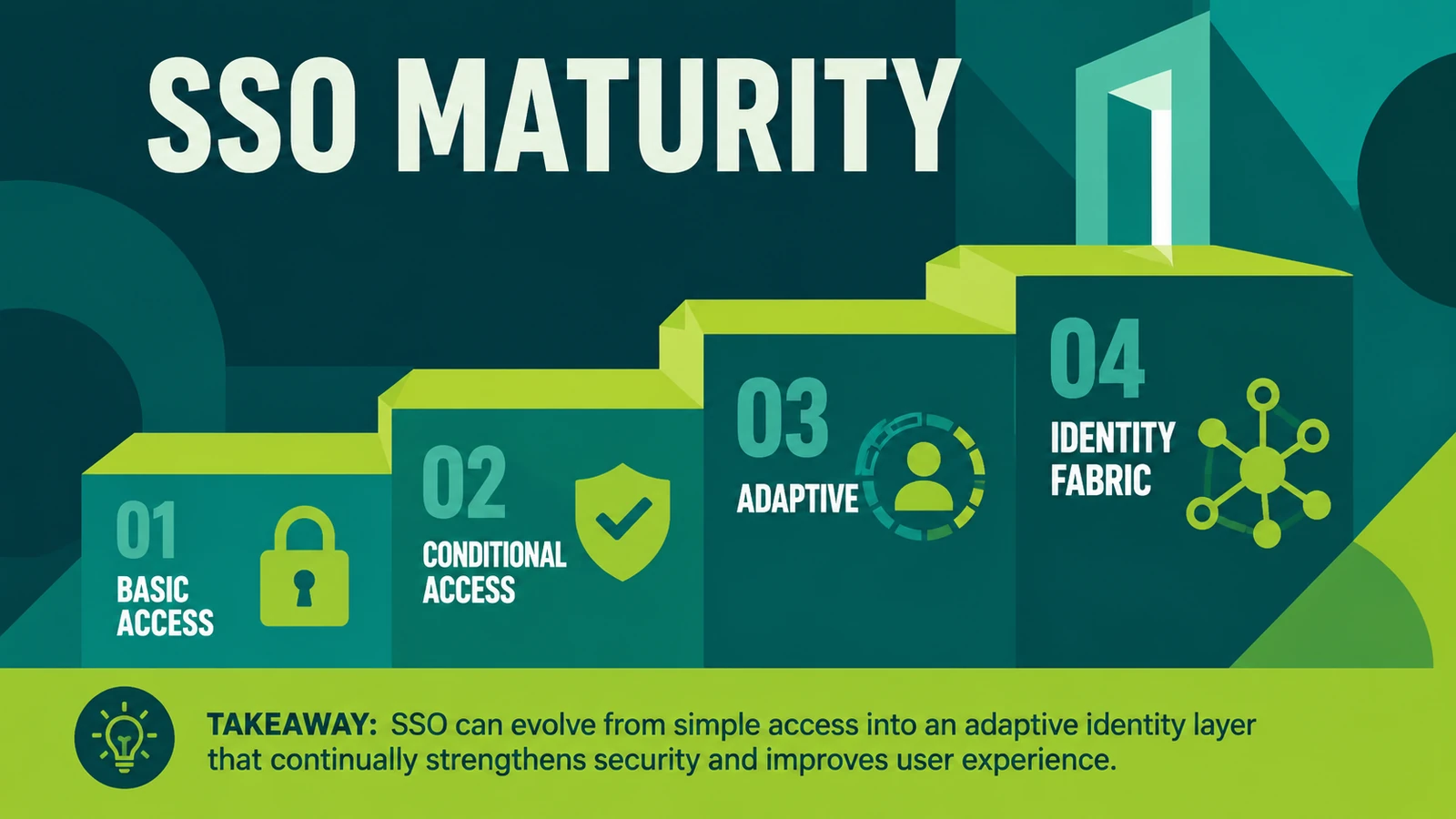 Most SSO programs reach conditional access within the first year and stall there -- the jump to adaptive is where the real payoff starts.
Most enterprises reach conditional access within the first year of an SSO rollout and then stall there for years, not from lack of ambition but because the jump to adaptive access requires a risk-scoring capability most identity providers don't ship natively -- it has to be built, bought as a separate module, or delivered through a governance platform that sits above the IdP. Whether SAML federation itself remains adequate at the protocol layer while an organization climbs this curve is a separate question worth checking -- our is SAML 2.0 still relevant piece covers where SAML holds up fine and where OIDC has genuinely displaced it.
The AI-Tool-Access Problem: Why SSO Wasn't Built for Agents
Every stage of the maturity curve above assumes the thing authenticating is a human at a browser, going through an interactive login flow with a defined session and a logout event. AI agents and AI-powered internal tools break that assumption in a way that's becoming one of the more searched-for gaps in enterprise access management, and for good reason -- it's a real architectural mismatch, not a hypothetical one.
An AI agent that queries an internal data platform, calls an API to pull customer records, or triggers a workflow in another system typically isn't clicking through a SAML redirect. It's authenticating with a long-lived API key, an OAuth client-credentials grant, or a service-account token -- credentials that were never designed to go through the interactive, session-bound flow that SSO governs and that MFA step-up policies apply to. That means the access review, anomalous-session detection, and adaptive risk scoring built around human logins simply don't see this traffic. A dashboard can report excellent SSO adoption for the human workforce while an entirely separate, often much less governed population of AI-agent credentials operates underneath it, frequently provisioned quickly to unblock a project and rarely revisited.
Enterprise data science and ML platforms make the gap concrete. The notebook or workspace UI a data scientist logs into is usually fully SSO-federated -- that part looks clean on paper. But the compute kernel, the scheduled training job, and the model-serving endpoint underneath that UI typically authenticate to data sources and downstream services using their own service-account credentials, not the human's session. The login page is governed; the actual data-access credential underneath it often isn't, and that distinction is easy to miss during a security review that only checks whether "the platform supports SSO."
The related question enterprises are increasingly asking -- what does role-based access control look like for an AI agent, not just for a human user -- points at the same underlying gap. SSO establishes that an identity is who it claims to be; RBAC is supposed to constrain what that identity can actually do once authenticated. Most organizations get the SSO half right for AI tooling and under-build or skip the RBAC half, because fine-grained AI-action authorization tooling is newer and far less standardized than SAML or OIDC federation. Authenticated but not meaningfully authorized is a dangerous middle state for something that can call APIs and take action without a human in the loop on every request.
Service-Account and Agent Identity: A Distinct Governance Challenge
The practical fix isn't extending human SSO patterns to cover agents -- it's treating non-human and agent identity as its own governance category with its own lifecycle, review cadence, and credential rotation policy, rather than trying to force-fit it into a framework built for interactive human logins. A service account or an AI agent's credential needs an owner of record, an expiration or rotation schedule, a documented purpose, and a certification cycle just like a human entitlement does -- arguably a shorter one, since an over-provisioned agent credential with no human clicking through an MFA prompt on each use is a wider blast radius than an over-provisioned human account. Our service account governance and non-human identity piece covers the specific lifecycle and review architecture this requires, and it's the natural next read for anyone whose "SSO for AI tools" question is really a service-account governance question wearing an AI label. The ICC piece on agentic authentication for AI identity covers the authentication-side patterns -- how an agent proves itself in the first place -- that pair with the governance side covered here.
The organizations handling this well aren't waiting for a single standard to settle the question. They're applying the same governance discipline to AI-agent credentials that a mature program already applies to service accounts generally: an inventory of what exists, an owner assigned to each one, a rotation and expiration policy enforced rather than aspirational, and a certification cycle that actually gets exercised instead of skipped because "it's just a technical account." That's less exciting than waiting for an AI-specific identity standard, but it's the approach that actually closes the gap today.
Why It Pays Off
The business case for extending SSO with governance, analytics, and lifecycle automation is straightforward, even without leaning on a borrowed industry statistic to make it. Fewer standing passwords means fewer credentials sitting around to be phished, reused across systems, or leaked in a breach elsewhere and stuffed against the corporate login -- every application moved fully behind federation is one less independent password an attacker can go after. Tighter security comes from replacing static, one-size-fits-all rules with risk-aware decisions that actually distinguish a routine login from an anomalous one, instead of treating every session identically regardless of context. And faster onboarding is the lifecycle-automation payoff: a new hire whose access provisions automatically off an HR trigger is working on day one instead of week two, which is the kind of outcome that reaches leadership through a very different, more visible channel than a quarterly KPI slide.
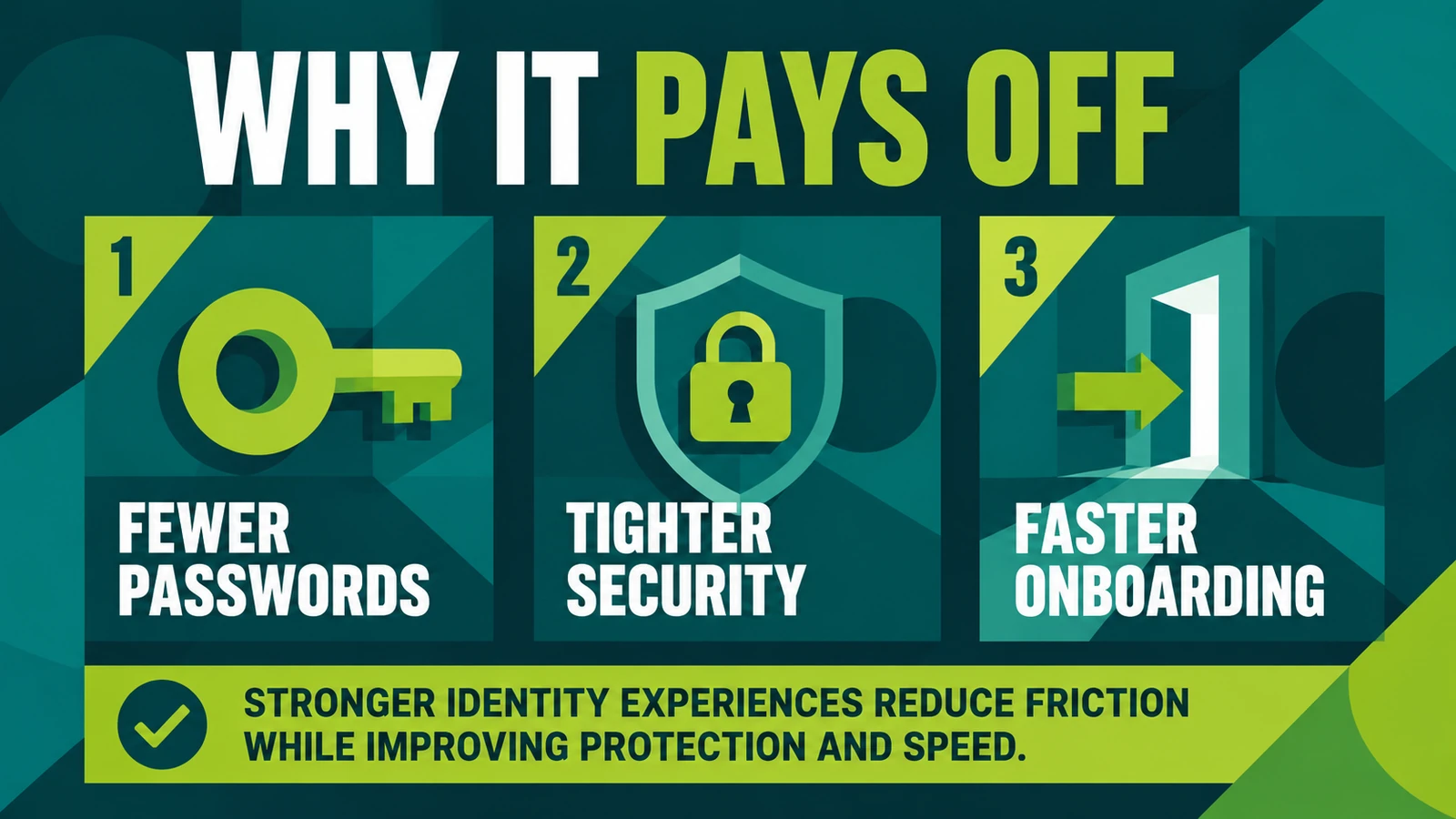 The payoff from extending SSO compounds across three fronts at once -- fewer standing credentials, sharper risk signal, and faster time-to-working-access.
None of these gains show up automatically just from deploying an IdP -- they're the result of the governance, analytics, and automation layered on top, which is exactly why measuring them matters as much as building them. Our measuring SSO program success piece covers the KPI set that actually demonstrates this payoff to a CFO or board committee, rather than asserting it as a round percentage with no baseline behind it.
What Avatier Ships Toward This Pattern
Avatier Identity Anywhere is built around this exact layering -- SSO as the federation foundation, with governance, analytics, and lifecycle automation as first-class capabilities rather than bolted-on modules. Federation supports both SAML 2.0 and OpenID Connect, so the application-coverage picture reflects the actual estate rather than being artificially constrained to whichever protocol got prioritized. Access governance runs certification and review cycles against real entitlement data rather than a static export, and provisioning, access requests, and lifecycle changes sit under the same governance layer end to end, which is what makes joiner-mover-leaver automation and time-to-access measurable instead of a manual reconstruction across disconnected systems. Authentication itself can layer FIDO2-compatible, phishing-resistant credentials on top of adaptive step-up policy, and session and MFA events are logged centrally rather than scattered per application, which is what makes anomalous-session analytics possible in the first place. The platform's compliance posture is published at the Avatier Trust Center: SOC 2 Type II audited with zero exceptions noted, ISO/IEC 27001:2022 certified, PCI DSS v4.0.1 compliant, CSA STAR Level 1 attestation, NIST 800-53 Rev. 5 aligned, FedRAMP-aligned, and a CISA Secure-by-Design Pledge signatory.
ABOUT THE AUTHOR

More from Access Management

Securing Microservices: Identity as the New Perimeter (2026)
How service-to-service authentication, mTLS, and workload identity replace the network perimeter microservices architectures outgrew — the 2026 reference for CISOs and platform teams.
Attribute-Based Access Control: When RBAC Isn't Enough (2026)
ABAC evaluates subject, resource, and environment attributes against policy at request time, not a fixed role. The 2026 reference on what ABAC does differently, and where it earns its complexity.

Cloud Infrastructure PAM: Vaulting and Sessions in 2026
Cloud infrastructure PAM controls privileged sessions into AWS, Azure, and GCP — vaulting root credentials and enforcing just-in-time elevation instead of standing admin roles.