Automating Access Reviews with AI: Avatier Actions and Avatier Ledger
AI can prepare, route, and evidence access reviews, but a named reviewer still decides. Where AI belongs in certification, the evidence auditors test, and what Avatier ships.
AI can prepare, route, and evidence access reviews, but a named reviewer still decides. Where AI belongs in certification, the evidence auditors test, and what Avatier ships.
- Automating access reviews with AI means software prepares, routes, and evidences each certification, while a named human reviewer still makes every keep-or-revoke decision.
- AI fits the preparation work: scoping, context, routing, reminders, flagging unused access, and running approved removals. The decision itself is the control.
- NIST SP 800-53 Rev. 5 AC-6(7) frames privilege review as validating need, then reassigning or removing privileges. Validating need is a business judgment.
- Auditors test a chain: who reviewed, what they saw, what they decided and when, under what authority, what changed, and what remains open.
- Avatier Actions includes Access Governance (campaign management and review) and Workflow Approval; Avatier Ledger turns outcomes into evidence, and the CISO Persona Briefing is formatted to your auditors' templates.
Automating access reviews with AI means letting software prepare, route, and evidence each certification while a named human reviewer still makes every keep-or-revoke decision. The payoff is not a faster click-through. It is a review record an auditor can test, decision by decision.
That distinction matters because automation can make a weak review worse. If AI recommendations are accepted without scrutiny, the program has rebuilt the checkbox review at machine speed. The questions auditors ask of a review, and why checkbox cycles fail them, are covered in The Access Review Your Auditor Actually Wants and The Access Review Your Auditor Wants vs What You're Running. This post takes those basics as given and asks a narrower question: where does AI belong in the review, and what evidence should come out the other end?
Where AI helps in an access review, and where it stops
An access review has two kinds of work. One is preparation: working out who should review what, pulling the context a reviewer needs, chasing late responses, and carrying out removals once decisions are made. The other is judgment: deciding whether a person still needs a specific entitlement. AI is well suited to the first kind. The second kind is the control.
| Review stage | What AI can do | What the reviewer owns |
|---|---|---|
| Scope | Assemble the campaign population and entitlement list | Confirm the scope matches the control being tested |
| Context | Summarize role, peer access, last use, and prior decisions | Read it and weigh it |
| Routing | Send each item to the accountable manager or owner, with reminders | Accept or delegate the item on the record |
| Recommendation | Flag unused or unusual access for attention | Agree or override, with a reason |
| Decision | Nothing | Keep, revoke, or raise an exception |
| Remediation | Run the approved removal through governed workflow | Follow up only if it fails |
| Evidence | Record each step as it happens | Attest to the completed cycle |
The Decision row is the line to hold. Everything above it makes the reviewer faster and better informed. Everything below it makes the decision stick and leaves a record. None of it replaces the decision.
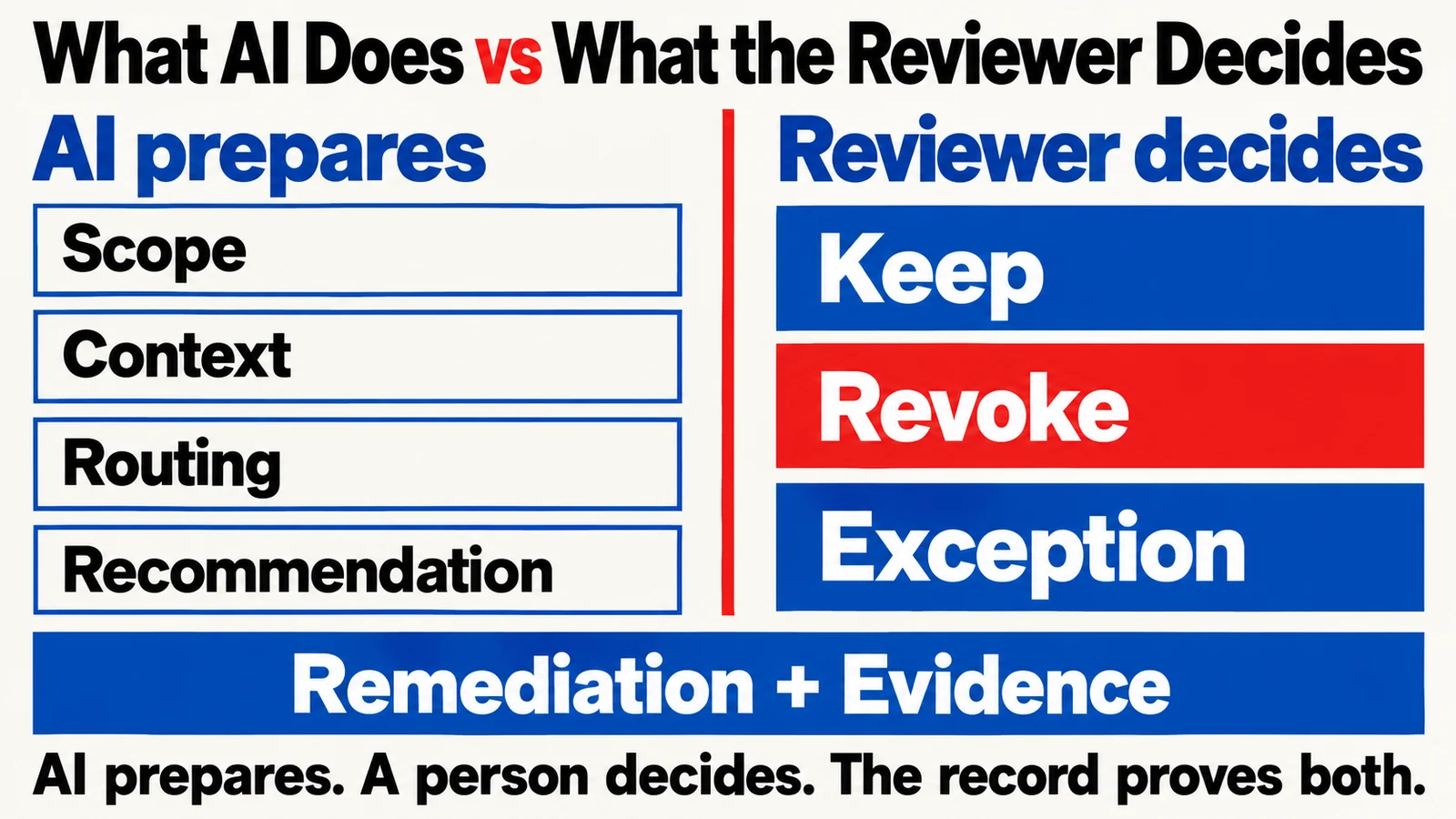 AI prepares the review and carries out the result. The keep-or-revoke decision in the middle stays with an accountable person.
Why the human decision is the control
Control frameworks describe access review as a judgment about need. NIST SP 800-53 Rev. 5 enhancement AC-6(7) asks organizations to review the privileges assigned to defined roles or classes of users "to validate the need for such privileges," and to reassign or remove privileges where necessary. The account-management control, AC-2, requires reviewing accounts for compliance with account management requirements at an organization-defined frequency.
Validating need is a business judgment. A model can tell a reviewer that an entitlement has not been used in months, or that no peer in the same role holds it. It cannot know that the person is covering for a colleague on leave next quarter, or that the unused access belongs to a year-end process. The manager or application owner can, and is accountable for the answer.
Public breach data won't make the case for you. Avatier's Identity Attack Ledger reads 2,161 breach notifications filed with the California Attorney General from January 2023 through August 14, 2026. Orphaned or dormant accounts and over-provisioned standing access each appear in none of them, which the ledger reads as a limit of what letters disclose, not a sign the risk is rare. The evidence that stale access was found and removed has to come from your own review records.
That is also why the recommendation belongs in the record. A review where the reviewer agrees with every AI suggestion, at speed, looks a lot like a review where nobody looked. Capturing whether each decision followed or overrode the recommendation, and why, lets the program see engagement rather than assume it. That is sound practice with any tooling.
The evidence an auditor can use from a review
An auditor testing a review is testing a chain: this person reviewed this access, with this information, decided this, and the decision was carried out. Each link needs its own evidence. For each item in a cycle, the record should show:
- Who reviewed it, and why that person was the right reviewer: manager, application owner, or delegate.
- What they saw, including the context and any AI recommendation presented at decision time.
- What they decided, and when: keep, revoke, or exception, with a reason for overrides and exceptions.
- Under what authority the decision and any resulting change were made.
- What changed as a result: the removal completed, in which system, with the outcome recorded.
- What remains open: exceptions and failed removals, each with an owner and a due date.
This follows the general shape of a good audit record. NIST's AU-3 control asks that audit records establish what type of event occurred, when and where it occurred, its source, its outcome, and the identity of any individuals or entities associated with it. A review decision that cannot answer those questions is hard to test.
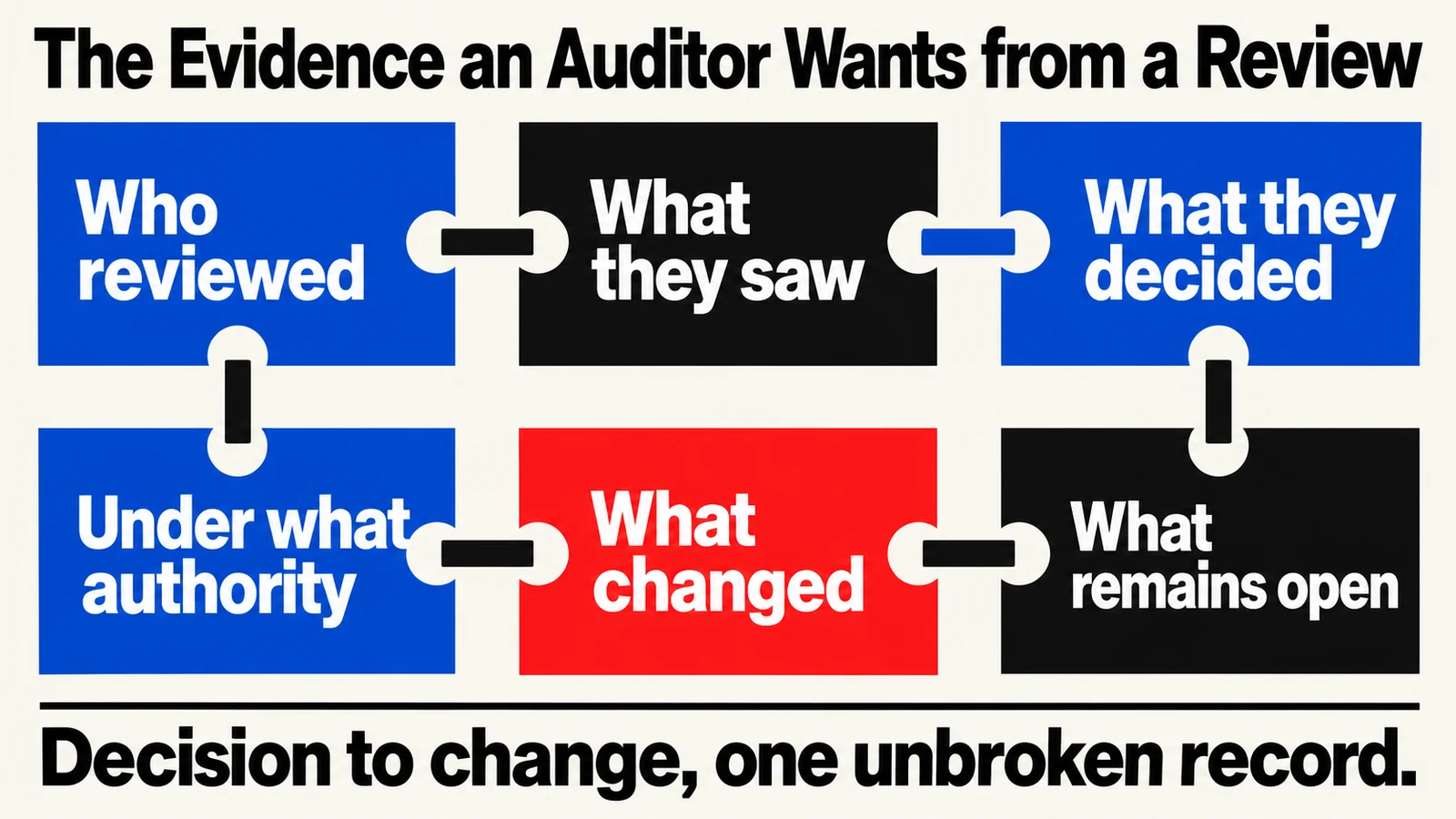 Auditors test the whole chain, from the reviewer and the context they saw to the change that followed and what is still open.
Close the loop: automate the removal, not only the attestation
A revoke decision that sits in a spreadsheet until someone files a ticket is a finding waiting to happen. The review is only as good as the change it produces, so the removal should run from the decision, through the same approvals and policies as any other access change, and report back its result. That turns item 5 above from a claim into a record.
This is where automation earns its keep. Routing a removal into governed workflow, confirming it completed, and escalating the ones that did not is repetitive work nobody should chase by hand. How that kind of record is captured, including who asked, what ran, and under whose authority, is covered in AI Agent Audit Trail: How Avatier Ledger Records Identity Actions.
What Avatier ships toward this pattern
Avatier Actions and Avatier Ledger are two MCP connectors available through Avatier Identity Anywhere 2027™. Avatier Actions exposes more than 50 identity outcomes across eight modules. Two are central here: Access Governance (campaign management and review) and Workflow Approval (pending requests and history). Lifecycle Management covers requesting and removing access and roles. An employee or manager asks in Teams, Outlook, Claude, or Copilot, and the outcome runs through the customer's existing policies, approvals, and roles. In the launch release's words, the assistant is the interface, never the authority. Setup is one administrator connection, with permissions inherited from Microsoft Entra ID, Active Directory, Okta, and Ping.
Avatier Ledger turns every outcome into evidence. Avatier CISO Sam Wertheim describes it as recording who asked, what ran, under whose authority, and what policy allowed it, for human-initiated and agent-assisted actions. Through Persona Briefings, a CISO receives every applicable compliance framework blended with the organization's identity and password statistics, with remediation highlighted in 0–30, 30–90, and 90-plus-day windows, formatted to the evidence templates and language of the organization's own IT auditors. Avatier helps support SOX evidence needs; the audit opinion stays with your auditors.
Founder and CEO Nelson Cicchitto put the goal plainly at launch: customers "receive a certified access review with the evidence attached."
Commercially, Pay Per Identity Action™ means customers pay only for completed, verified, policy-compliant outcomes. Getting started is free, deployment services are included, and a 45-day money-back guarantee applies.
For the preview, see the Avatier Identity Anywhere 2027™ site. For credential lifecycle governance, see the Credential Governance™ home page. For the wider company, see avatier.com. For compliance posture, the Avatier Trust Center lists Avatier as SOC 2 Type II audited with no exceptions noted and ISO/IEC 27001:2022 certified.
ABOUT THE AUTHOR

More from IAM & Identity Governance

How to Inventory and Baseline Identity Action Volume in 2026
Before any per-action conversation makes sense, someone has to count. How to define the unit, find the counts, de-duplicate across sources, and produce a 12-month baseline you can defend.

Dynamic Group Membership Automation: Rules That Hold in 2026
Dynamic groups replace hand-maintained membership lists with rules over identity attributes. The 2026 guide to writing those rules, choosing an evaluation cadence, handling the people the rule gets wrong, and detecting drift.

Shadow AI Agents and the Sanctioned Path Avatier Provides
A shadow AI agent acts with borrowed credentials and no owner. How shadow agents get access, how to find them, when to govern or retire one, and the sanctioned path Avatier provides.