Hybrid Cloud Identity Management: The 2026 On-Prem to Cloud Bridge
Hybrid cloud identity means bridging one on-prem or mainframe estate to a single cloud provider, not spanning multiple public clouds — the architecture, the failure modes, and the limits.

Hybrid cloud identity means bridging one on-prem or mainframe estate to a single cloud provider, not spanning multiple public clouds — the architecture, the failure modes, and the limits.
- Hybrid cloud identity, precisely defined, is the bridge between one on-premises or mainframe estate and one public cloud provider — a single seam, not a federation across AWS, Azure, and GCP. That's a different problem with a different name (multi-cloud), and conflating the two produces architecture that solves neither well.
- The bridge has three layers that have to work together: a canonical identity source (usually still Active Directory or a mainframe registry like RACF/ACF2), a synchronization or federation layer that keeps cloud identity current, and a protocol translation layer that reconciles legacy authentication (Kerberos, LDAP bind, RACF PassTicket) with modern cloud-native standards (SAML, OIDC, SCIM).
- Most hybrid identity failures aren't architectural — they're operational drift. Sync jobs that silently stop, group memberships that diverge between directories, and leaver events that propagate to the cloud IdP but not back to the mainframe (or vice versa) are the actual audit findings, not missing federation diagrams.
- Hybrid and multi-cloud identity require genuinely different design patterns: hybrid is about legacy-to-modern protocol translation across one boundary; multi-cloud is about federating human and workload identity across several cloud-native IAM primitives that already speak comparable protocols. Teams that reach for a multi-cloud playbook to solve a hybrid problem end up over-building for a translation problem they actually have.
- Bridging on-prem and cloud identity doesn't eliminate the need for a canonical source of truth, doesn't remove protocol translation complexity, and doesn't make the mainframe or legacy directory's governance debt disappear — it just relocates where that debt becomes visible, usually at the first access review that spans both sides.
Hybrid cloud identity management is the discipline of governing identity across a boundary that connects one on-premises or mainframe estate to one public cloud provider — not, despite how often the term gets used loosely, the practice of spanning multiple public clouds. That distinction matters more in 2026 than it did a few years ago, because the two problems now have separate literatures, separate tooling patterns, and separate failure modes, and organizations that reach for one playbook while actually facing the other end up over-engineering the wrong layer. If your identity estate includes a mainframe, an on-premises Active Directory forest, or a data center full of legacy applications on one side and a single cloud provider's identity plane on the other, you have a hybrid identity problem regardless of how many clouds you use.
This is the 2026 update of our earlier look at this topic. The core architecture questions haven't changed much — organizations still need a canonical identity source, a synchronization layer, and protocol translation between legacy and cloud-native authentication — but the operating environment around those questions has: zero trust expectations now extend into legacy estates that were never designed for continuous verification, mainframe modernization projects have matured enough that "bridge, don't replace" is a defensible long-term architecture rather than a stopgap, and the multi-cloud literature has grown enough that it's worth being explicit about where it stops applying.
What "hybrid cloud" actually means for identity
The word "hybrid" gets applied loosely enough in vendor marketing that it's worth pinning down before going further. In this piece, hybrid cloud identity means exactly one thing: an identity architecture that spans a traditional on-premises or mainframe environment and a single cloud provider, connected by some form of synchronization, federation, or translation layer. It does not mean an organization that happens to use both AWS and Azure for different workloads — that's multi-cloud, and it's a meaningfully different architecture problem covered in the Multi-Cloud Identity Management piece.
The reason this distinction is worth belaboring: the two problems produce different symptoms and reward different fixes. A multi-cloud identity problem shows up as federation gaps and entitlement drift between cloud-native IAM primitives that mostly speak the same modern protocols. A hybrid identity problem shows up as protocol mismatch — an on-prem directory or mainframe registry that predates SAML and OIDC by decades, bridged to a cloud identity plane that assumes every principal arrives with a modern federated token. Solving the second problem with a multi-cloud federation playbook misses the actual work, which is translation, not federation.
Most enterprises running any meaningful legacy estate are hybrid by this definition whether or not their cloud strategy is single- or multi-cloud. A company with an on-premises Active Directory forest and Microsoft 365 in Azure is hybrid. A company with an IBM mainframe running RACF and an AWS-hosted customer-facing application is hybrid. A company running all three clouds and no legacy on-prem estate at all is multi-cloud, not hybrid, in the sense this piece uses the term — and its identity problem looks different accordingly.
The architecture of the bridge
A working hybrid identity bridge has three layers, and conflating them is where a lot of architecture diagrams go wrong.
The canonical identity source. Somewhere, one system has to be the authoritative record of who a person is, what group they belong to, and when they joined or left. For most hybrid enterprises this is still the on-premises Active Directory forest; for organizations with a significant mainframe footprint, it may be a mainframe security database — RACF, ACF2, or an AS/400 profile store — acting as the authority for a specific population. The cloud IdP, in a well-designed bridge, is a consumer of this authority, not a second authority competing with it.
The synchronization and federation layer. This is the machinery that keeps the cloud side current: directory sync tools that replicate user and group objects into the cloud IdP on a scheduled or event-driven basis, and a federation service that issues SAML or OIDC tokens backed by an on-premises authentication event so the cloud side can trust a sign-in without maintaining its own credential store. Azure AD Connect, cloud-native LDAP sync services, and purpose-built identity bridges all live in this layer.
The protocol translation layer. This is the part that gets skipped in the architecture diagram and shows up as unplanned engineering work six months into the project. Kerberos tickets, LDAP binds, and — where the mainframe is in scope — RACF PassTickets or ACF2 logonids don't map cleanly onto SAML assertions or OIDC tokens. Something has to sit at the boundary and do that translation, and if that something isn't purpose-built, it tends to get improvised as a pile of scripts that nobody fully owns.
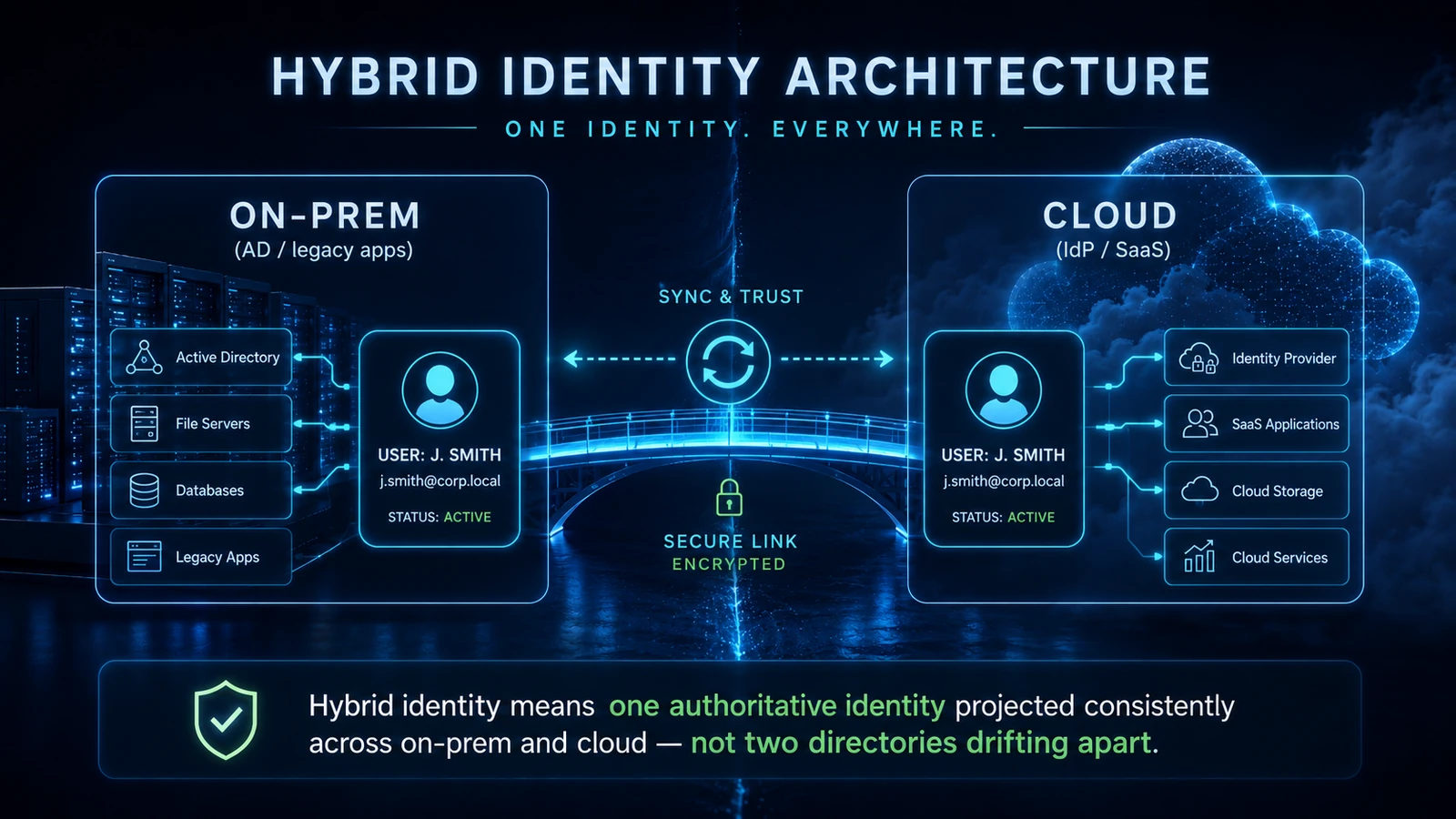 Three layers, one boundary: a canonical source, a sync/federation layer, and a protocol translation layer that too many architecture diagrams leave implicit.
Skipping any of the three layers produces a predictable failure. Skip a clear canonical source and both sides start treating themselves as authoritative, producing conflicting records the moment someone changes a group membership on the "wrong" side. Skip the sync/federation layer and the cloud IdP quietly goes stale, granting access based on an on-prem state that no longer reflects reality. Skip real protocol translation and someone builds an undocumented script that becomes a single point of failure the team doesn't discover until it breaks.
Where hybrid identity bridges actually break
The architecture is rarely the failure point. What actually shows up in incident reviews and audit findings is operational drift accumulating across the three layers over time.
Silent sync failures. A directory-sync job that stops running — because a service account's password rotated, a firewall rule changed, or a scheduled task silently failed — doesn't usually alert anyone immediately. The cloud IdP keeps serving stale data, sometimes for weeks, before someone notices a new hire has no cloud access or a departed employee still does.
Group membership drift. The on-prem directory and the cloud IdP structure groups slightly differently often enough that manual reconciliation creeps in, and manual reconciliation drifts. A group that's supposed to mirror an on-prem security group ends up with cloud-only members added directly, and the two sides diverge without anyone deciding that should happen.
Asymmetric leaver propagation. This is the one that shows up in the worst audit findings. A leaver event fires cleanly in the HRIS, deprovisions the person's cloud accounts through the modern SCIM pipeline — and never reaches the mainframe or legacy application on the other side of the bridge, because that system was never wired into the same lifecycle event stream. The reverse happens too: mainframe deprovisioning that doesn't propagate to the cloud side. Either direction leaves an active credential nobody is watching.
Protocol translation as an unowned dependency. The translation layer between RACF PassTickets or Kerberos tickets and SAML/OIDC tokens is often built once, by whoever was available at the time, and then left alone for years because nobody wants to touch it. When it needs to change — a TLS version deprecation, a mainframe OS upgrade, a new compliance requirement — there's no clear owner, and the fix becomes a fire drill instead of routine maintenance.
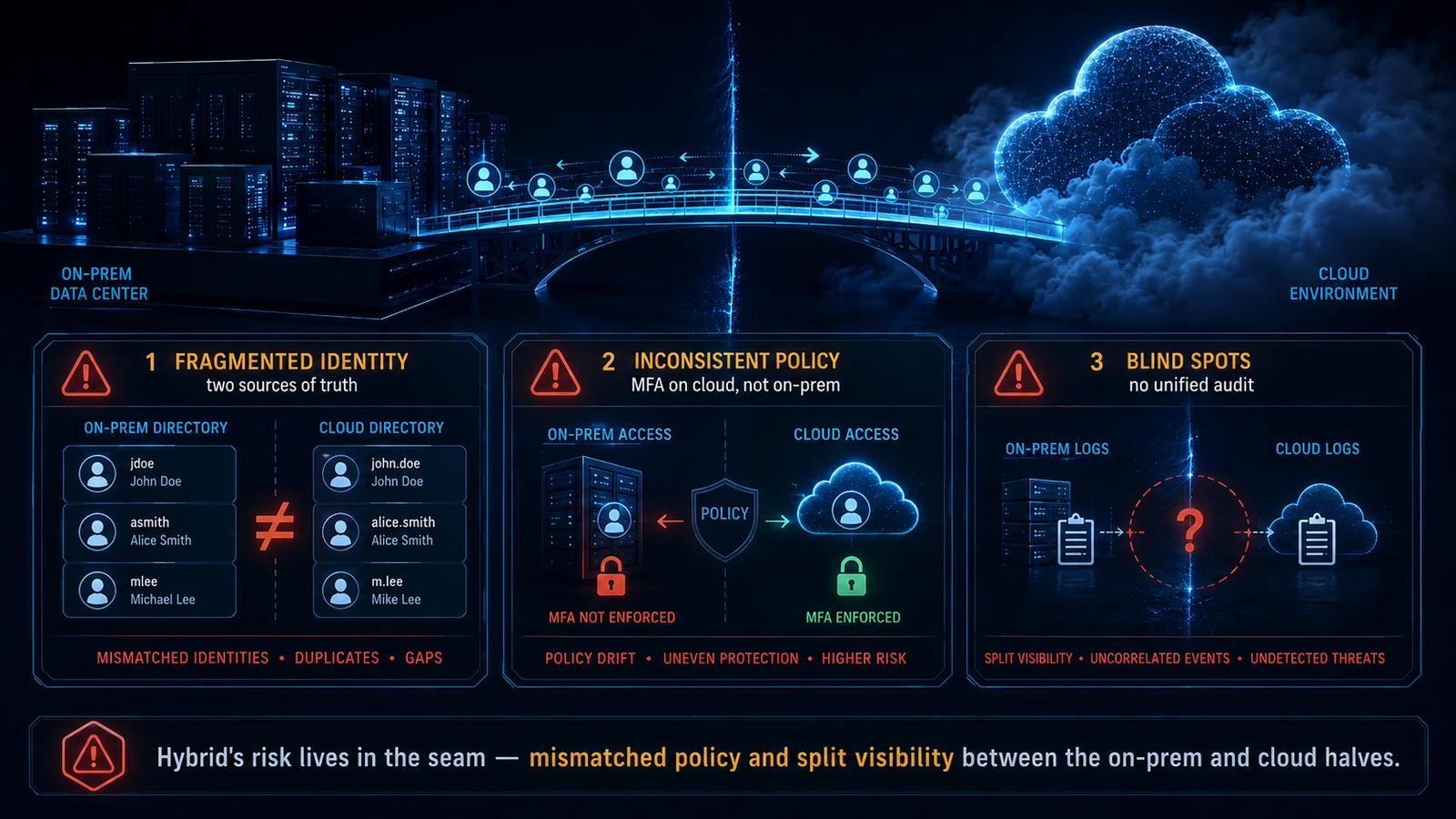 The failures that actually show up in postmortems: silent sync drift, asymmetric leaver propagation, and translation logic nobody owns — not missing architecture diagrams.
Hybrid cloud vs. multi-cloud identity: two different problems
Worth stating plainly, since the terms get used interchangeably in a lot of vendor content: hybrid cloud identity and multi-cloud identity are different engineering problems, and treating them as the same thing produces architecture that's over-built for one and under-built for the other.
Hybrid cloud identity is about the boundary between one legacy estate and one cloud. The central engineering challenge is protocol translation and synchronization discipline across a genuine impedance mismatch — Kerberos and RACF on one side, SAML and OIDC on the other. The population on the legacy side often includes non-human accounts, batch jobs, and applications that were never designed with federation in mind at all. Success looks like a bridge that's reliable, well-owned, and doesn't silently drift.
Multi-cloud identity is about federating human and workload identity across several cloud-native IAM primitives — AWS IAM Identity Center, Azure Entra ID, Google Cloud Identity — that already speak comparable modern protocols to each other. The central engineering challenge is consistency: making sure a single workforce IdP's federated identity produces coherent, comparably-scoped access across clouds that each implement roles and permissions differently, and making sure workload identity federation eliminates long-lived credentials consistently across all of them. The Multi-Cloud Identity Management piece covers that federation-first architecture and its four anti-patterns in depth.
An organization can face either problem, both, or neither. A single-cloud enterprise with a mainframe is purely hybrid. A cloud-native enterprise running AWS and Azure with no legacy estate is purely multi-cloud. A regulated enterprise running a mainframe, an on-prem directory, and three public clouds is both — and needs to keep the two problems architecturally separate rather than solving them with one unified diagram, because the failure modes and the fixes don't transfer between them.
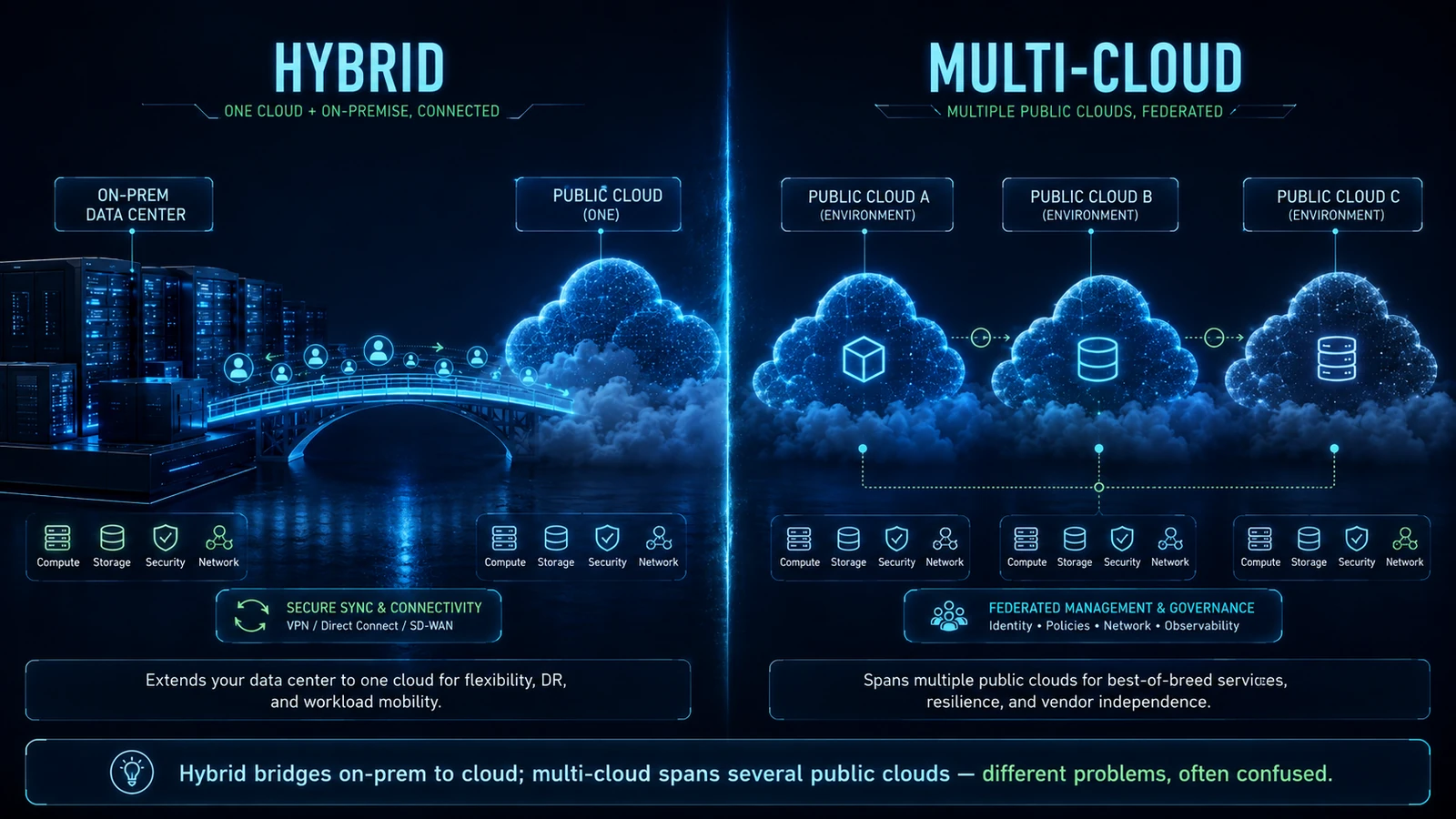 Hybrid is a translation problem across one legacy/cloud boundary. Multi-cloud is a federation-consistency problem across several cloud-native planes. Different diagrams, different fixes.
Zero trust across a legacy-to-cloud boundary
Zero trust's core assumption — that every access decision gets evaluated against a real-time signal rather than granted once and trusted for a session — is comparatively easy to implement natively in a cloud environment and comparatively hard to implement natively in a legacy one. A RACF PassTicket exchange or an NTLM handshake wasn't designed to carry device posture or continuous risk scoring, and retrofitting that signal into the legacy protocol itself is rarely practical.
The workable pattern puts enforcement at the bridge rather than expecting the legacy protocol to carry it. The cloud side of the boundary gets full zero trust treatment natively — continuous verification, conditional access, device posture checks — because the modern protocols support it. The legacy side gets policy wrapped around the translation point instead: step-up authentication requirements applied when a legacy credential is exchanged for a cloud-recognized token, shortened session lengths for sessions that originated from legacy authentication, and anomaly detection watching the translation layer itself for unusual patterns, since that's the one place in the architecture where every legacy-originated access event necessarily passes through.
This is also where governance and zero trust intersect for hybrid environments specifically: the translation layer is a natural point to apply just-in-time elevation and event-driven review, because it's the one chokepoint where legacy access becomes cloud-visible access. Getting audit trail and policy enforcement concentrated there, rather than scattered across every legacy application individually, is most of what makes hybrid zero trust achievable in practice.
Migrating the boundary rather than living with it forever
Bridging is usually a multi-year state, not a permanent architecture — most organizations running a hybrid identity bridge are doing so as a deliberate, extended step in a longer modernization arc, not as a final destination. The bridge buys time to migrate legacy applications, retire mainframe workloads that no longer justify their operating cost, and consolidate identity governance into a single modern system without a disruptive cutover. The Playbook Legacy IAM to Modern piece covers that migration sequencing in depth — the order operations typically move legacy workloads and identity governance to reduce risk at each step.
What doesn't change during that arc is the need for the bridge to be well-governed while it exists. Treating it as temporary and therefore under-invested is exactly how the operational drift described earlier accumulates — sync jobs and translation logic that were meant to be short-term scaffolding end up load-bearing for years, maintained by whoever happened to build them, with no plan for what replaces them.
What Avatier ships toward this pattern
Avatier's identity platform is built with the on-prem/cloud bridge as a first-class architecture pattern rather than an afterthought, which is where the mainframe and legacy integration layer does its work. Native RACF and ACF2 integration turns mainframe authentication events and entitlement structures into governable, auditable identity data instead of a black box the rest of the identity program has to work around — the Demystifying RACF piece and the RACF vs. ACF2 piece cover what that integration actually reasons about on the mainframe side.
On the cloud side, Identity Anywhere synchronizes with the on-prem directory or mainframe registry on an event-driven basis rather than a nightly batch, which directly targets the leaver-propagation and sync-drift failure modes described above — a deprovisioning event fires once and propagates to both sides of the bridge instead of requiring two separate lifecycle pipelines that can silently diverge. IGA workflow — access requests, certification campaigns, entitlement review — runs across both sides of the boundary from one console, so an access review doesn't require exporting mainframe entitlement data into a spreadsheet and reconciling it against cloud access by hand. The Cross-Platform Identity Management piece covers the broader protocol-translation approach that underlies this across more platform combinations than the on-prem/cloud pair specifically, and the SSO architecture piece on ICC covers the federation layer that the cloud side of the bridge builds on.
The Avatier Trust Center publishes the compliance posture underneath the platform: SOC 2 Type II audited with zero exceptions noted, ISO/IEC 27001:2022 certified, PCI DSS v4.0.1 compliant, CSA STAR Level 1 attestation, NIST 800-53 Rev. 5 alignment, FedRAMP-aligned controls, and CISA Secure-by-Design Pledge signatory status. Passwordless and step-up flows at the bridge's enforcement point are built on FIDO2-compatible authentication.
ABOUT THE AUTHOR

More from IAM & Identity Governance

AI and Invisible Security: Removing Friction, Not Prompts (2026)
AI-driven adaptive controls cut security friction by moving verification into passive signals instead of adding prompts — the 2026 reference on invisible security.

SCIM Provisioning: The Standard Behind Automated Identity Sync (2026)
SCIM is the RESTful, JSON-based standard that automates identity provisioning and deprovisioning between a source of truth and downstream apps. What it is, how it works, and where it fits in IGA.

How ML Anomaly Detection Works for Identity: A 2026 Technical Guide
A technical walkthrough of how machine learning models actually detect identity anomalies — baselining, feature signals, unsupervised versus supervised approaches, and false-positive tuning.