AI and Invisible Security: Removing Friction, Not Prompts (2026)
AI-driven adaptive controls cut security friction by moving verification into passive signals instead of adding prompts — the 2026 reference on invisible security.

AI-driven adaptive controls cut security friction by moving verification into passive signals instead of adding prompts — the 2026 reference on invisible security.
- AI reduces authentication friction not by removing security controls, but by relocating them — from a prompt the user has to answer to a passive signal the system evaluates continuously in the background, without asking anything of the user at all.
- Invisible security is not the absence of verification. It's verification that happens on signals already available (device posture, behavioral pattern, network context) instead of on a challenge the user has to actively complete — the check still runs, the user just never sees it unless risk crosses a threshold.
- The old model spent a fixed friction budget on every session, regardless of risk. The AI-driven model spends that budget dynamically — near zero for a low-risk, well-recognized session, and concentrated entirely on the sessions that actually warrant scrutiny.
- Invisible security depends entirely on signal quality and identity data hygiene underneath it. A system making silent risk decisions on stale device records or ungoverned entitlements isn't invisible security — it's a black box making bad calls nobody can see happening.
- This does not eliminate governance, does not remove the need for a human-reviewable audit trail, and does not work as a bolt-on to an identity program that hasn't already solved lifecycle and entitlement hygiene — it amplifies a well-governed program and hides the cracks in a poorly governed one.
AI reduces security friction not by removing controls but by relocating them — from a prompt the user has to actively answer to a passive signal the system evaluates continuously without asking the user anything at all. A well-tuned adaptive system still runs a full risk evaluation on every session; the difference is that most of those evaluations resolve silently, using device posture, network context, and behavioral pattern the identity platform already has, and only surface a visible challenge when those signals actually warrant one. The result isn't less security. It's security that stops announcing itself for the sessions that never needed the announcement.
This is the 2026 update to our earlier piece on this topic, which covered adaptive authentication broadly. The market has since split that topic into distinct disciplines worth treating separately — risk-signal architecture, alert-quality tuning, and the experience-design question this piece is scoped to — and the framing below reflects the narrower, sharper version of the argument rather than the original's broader sweep.
The tradeoff that was never as fixed as it looked
For most of enterprise identity's history, security and user experience were treated as opposite ends of a dial — turn one up, the other goes down. Add a step-up prompt, security improves and experience degrades. Remove the prompt, experience improves and security degrades. Every identity architecture decision got framed as a negotiation between a CISO who wanted more gates and a CIO who wanted fewer complaints, with the actual users caught navigating whatever compromise the two sides landed on.
That framing was never as fixed as it looked, because it assumed a single input variable — challenge frequency — as the only lever available. A system that only knows how to increase or decrease the number of prompts really is stuck on that tradeoff curve. A system that can evaluate risk continuously and apply challenges only where risk is elevated isn't on that curve at all — it can push both variables in the same direction, because the friction it spends is targeted rather than uniform.
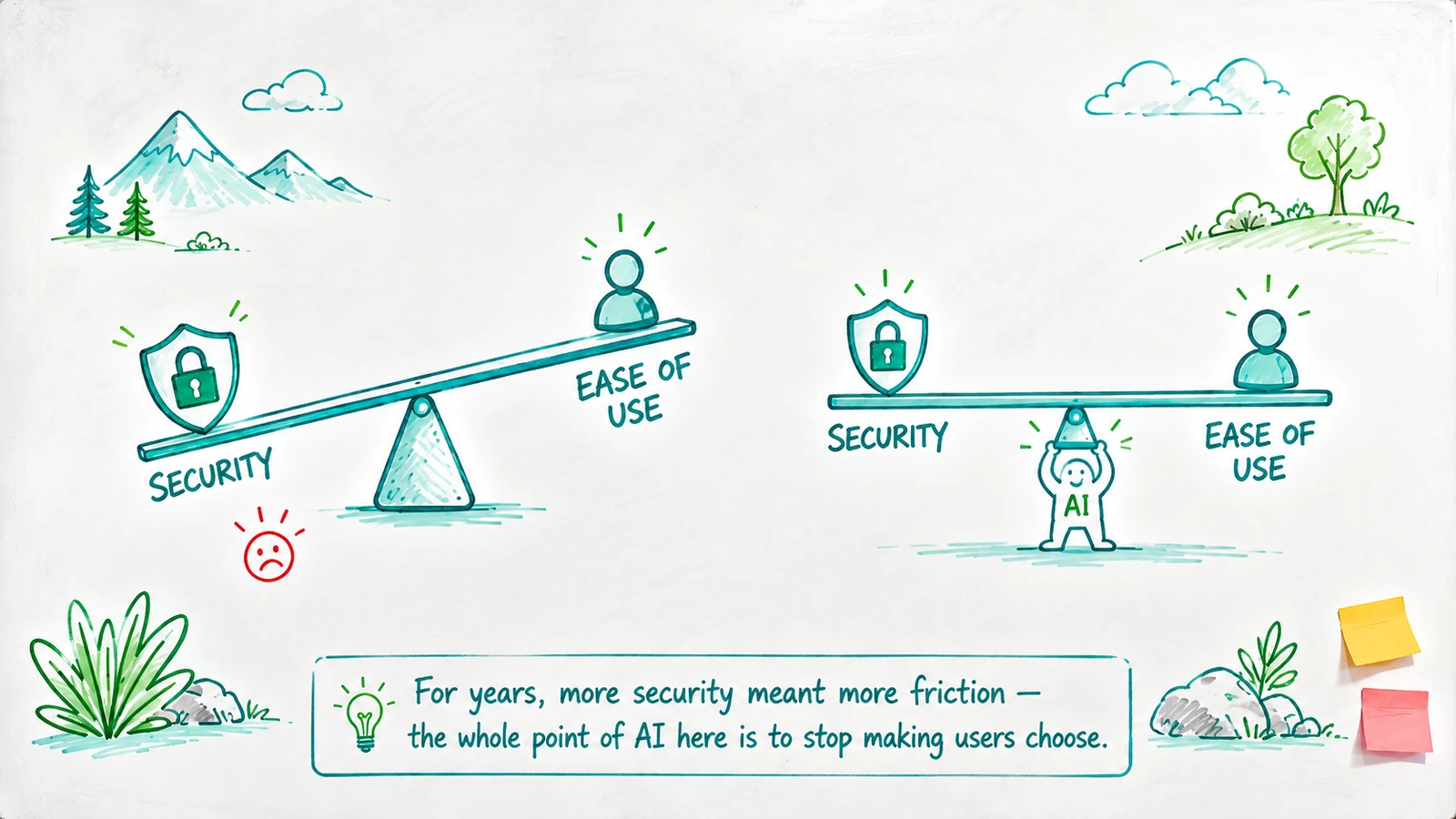 The old tradeoff assumed one lever — prompt frequency. AI-driven risk scoring adds a second lever — targeting — that breaks the straight-line tradeoff.
The practical evidence for this shows up wherever organizations have measured it directly: uniform high-friction authentication doesn't produce uniformly high security. It produces workarounds — shared credentials because the individual reset process is too slow, disabled MFA on systems where it was too disruptive to enforce consistently, shadow SaaS adopted specifically because it doesn't route through the governed, friction-heavy path. Our User Experience in IAM piece covers this workaround dynamic across the identity lifecycle in depth — the point relevant here is narrower: friction that isn't targeted at actual risk isn't buying the security it appears to buy, and AI-driven targeting is the mechanism that lets an organization stop paying that cost uniformly.
What "invisible" actually means — and doesn't
Invisible security is a term that gets used loosely enough to mean almost nothing, so it's worth being precise. It does not mean weaker verification, less monitoring, or a system that trusts by default. It means verification that runs on signals the system already has instead of on a challenge the user has to complete — the evaluation still happens, on every session, it just doesn't require the user's active participation unless the signals cross a risk threshold.
A useful mental model: a building with a card-reader turnstile at the front door checks every person who walks through, every time, without asking anyone to do anything beyond badge in — the check is happening continuously, it's just built into the normal motion of entering rather than requiring a separate verification step. A building that instead stops everyone at a desk to show ID and sign a log isn't more secure by default just because it's more visible; it's differently secure, and probably worse at catching a legitimate-looking badge clone, because the human at the desk gets fatigued by volume the same way users get fatigued by MFA prompts.
The identity-platform equivalent: a session opened from a managed device, on a recognized network, matching the user's established access pattern, already carries several independent trust signals before the user does anything. An adaptive system that recognizes this and lets the session proceed isn't skipping verification — it already ran the verification, using data collected passively, and concluded the active challenge would add negligible additional confidence for real cost in friction. The verification moved from a UI element to a background computation. Nothing about the rigor changed.
Where the friction budget actually goes
Every identity program spends a finite amount of user tolerance for friction before people start finding ways around the controls. The old model spent that budget uniformly — the same MFA prompt, the same session timeout, the same re-authentication requirement, applied identically regardless of whether the session in question carried any actual risk signal. That's not a security decision so much as an absence of one; uniform friction is what a program defaults to when it has no way to tell a risky session from a routine one.
AI-driven risk scoring turns friction into a budget that gets allocated deliberately instead of spent flatly. A session that matches every expected signal — known device, known location, known behavioral pattern, strong credential already presented — draws almost nothing from that budget. A session that breaks pattern in a meaningful way — new device, geographically implausible, off-hours access to a sensitive resource, a credential type weaker than the resource warrants — draws heavily from it, triggering step-up authentication, additional verification, or in the highest-risk cases outright denial pending manual review.
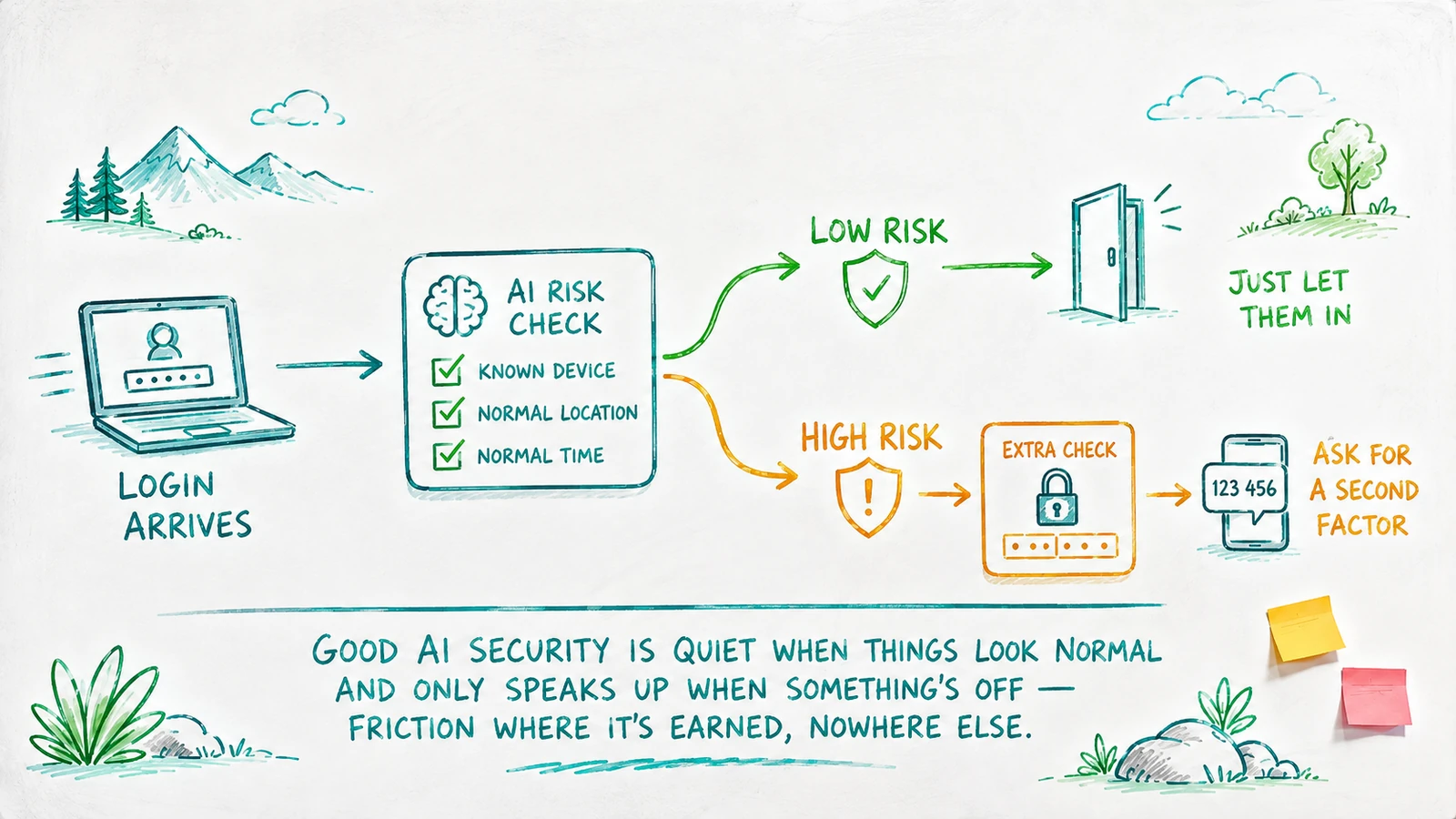 Most sessions carry enough passive signal to clear without a prompt. AI-driven scoring routes the friction budget to the minority that actually need it.
This reallocation is the entire mechanism behind the friction reduction — it isn't that fewer checks are happening, it's that the checks that used to be spent everywhere are now concentrated where risk actually lives. A program running this well typically finds that the great majority of daily authentication events resolve with no visible prompt at all, while the sessions that do trigger step-up are doing so for reasons a security analyst reviewing the log would agree with. That alignment — friction correlating with actual risk rather than with an arbitrary schedule — is the outcome the whole architecture is built to produce, and it's a different claim from simply "fewer prompts," which a program could achieve by lowering the bar instead of raising the intelligence behind it.
Concrete patterns of invisible security in the identity stack
The abstraction is easier to evaluate against specific examples of what invisible security looks like inside a modern identity platform, as distinct from the visible controls most people picture when they hear "security."
Passive device trust. A managed, previously-registered device presenting its certificate or platform attestation establishes identity continuity without the user doing anything — no code, no push notification, no separate step. The device itself is the credential's carrier, verified silently on every connection attempt.
Continuous session risk evaluation. Traditional authentication checks identity once, at login, then trusts the session for its duration. AI-driven continuous evaluation reassesses risk throughout the session against behavioral and contextual drift — if the same session suddenly starts accessing resources far outside its established pattern, that's a signal evaluated in the background, without interrupting a legitimate user mid-task and without waiting for the next login to catch a hijacked one.
Deflected, chat-mediated self-service. A user who needs a password reset or wants to check an access request's status increasingly resolves it through a conversational interface that verifies identity against the same signals the platform already trusts, rather than routing to a help-desk call that reintroduces a slow, high-friction human verification step. The security bar doesn't drop — the verification just happens through a channel that doesn't feel like a security checkpoint.
Background policy evaluation on access requests. When an access request matches a pattern the system has already approved for similar users in similar roles, AI-assisted policy evaluation can clear it without a manager needing to manually review a request that carries no unusual signal — reserving human review for the requests that actually deviate from an established, governed pattern.
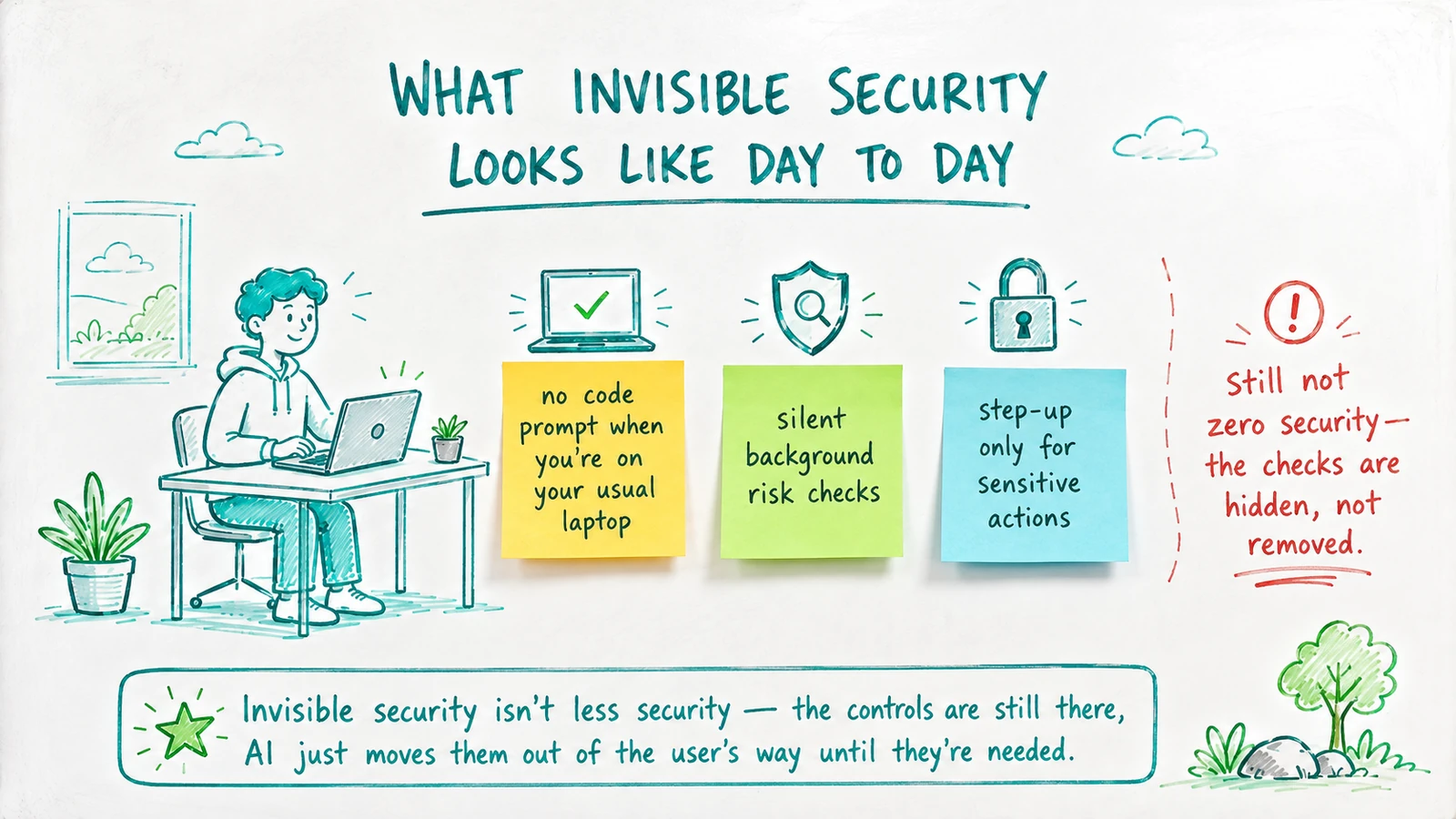 None of these four moments show the user a prompt — each one runs a full verification decision using signals the platform already had.
Each of these patterns is doing the same thing at a different point in the identity lifecycle: substituting passive, already-available signal for an active challenge, while preserving — and in the continuous-evaluation case, improving on — the rigor of the original check. None of them is "trust by default." They're "verify using what we already know, and only ask when what we know isn't enough."
The signal-quality dependency nobody gets to skip
None of the patterns above work if the underlying signals are bad, and this is where invisible security gets dangerous rather than merely imperfect. A risk engine evaluating device posture against a stale asset inventory, or behavioral pattern against a baseline built on six-month-old access data for a role the user no longer holds, isn't making an invisible decision — it's making a wrong decision nobody can see happening, because the entire design goal was to remove the visible checkpoint where a human might have caught the error.
This is the same signal-quality problem that determines whether a detection system produces a usable alert queue or a noisy one that security analysts learn to ignore — our False-Positive Reduction in Identity Security piece covers that side of the same underlying issue in depth. The connection matters here specifically because a false positive in a detection queue costs an analyst's attention; a false negative in an invisible-friction risk engine costs nothing visible at all until it's exploited, which is a materially worse failure mode to have running silently in production.
The dependency runs deeper than tuning. Risk scoring is only as good as the identity data underneath it — accurate device inventories, current role and entitlement records, HR-system-of-record data that reflects who actually still works there and in what capacity. Our AI-Driven Identity Risk Scoring piece covers the scoring architecture directly; the point worth landing here is narrower — invisible security is a multiplier on data quality, not a substitute for it. A program with clean identity data gets a genuinely lower-friction, equally-secure experience. A program with stale or ungoverned identity data gets a system that's confidently wrong in ways nobody notices until an audit or an incident forces the question.
Governance still has to see what the AI decided
The instinct to treat invisible security as "handled" once it's deployed is exactly backward — a system making silent risk decisions on every session needs more auditability, not less, precisely because there's no visible checkpoint where a human naturally observes the decision being made. Every session that clears without a prompt still needs to be reconstructable after the fact: what signals were evaluated, what threshold was applied, why this session cleared and a superficially similar one didn't.
This is where invisible security intersects directly with governance rather than substituting for it. The risk engine's decisions are themselves an access-control policy, and access-control policy needs the same review discipline any other policy gets — periodic validation that the thresholds are still appropriate, periodic review of what's clearing silently versus what a manual audit would expect to see clear silently, and a clear escalation path when the pattern drifts. An identity program that deploys adaptive, invisible controls and then stops watching what those controls are actually approving has traded a visible, if annoying, control for an unmonitored one — a worse trade than either extreme on its own.
What Avatier ships toward this pattern
Avatier's platform contributes the risk-scoring and behavioral-baseline layer that makes silent, signal-based clearance possible — evaluating device posture, network context, and behavioral consistency continuously, and routing only the sessions that actually deviate from established pattern into a visible step-up flow. That scoring composes with the identity provider and MFA infrastructure an enterprise already runs, rather than replacing it; the goal is to make the existing authentication stack apply its strongest controls more selectively, not to introduce a new authentication layer on top of it.
Clean identity data is the foundation. The device inventories, role records, and behavioral baselines the scoring depends on come from the enterprise's own systems of record, and the quality of those records determines the quality of every silent decision built on top of them. Avatier's governance and lifecycle capabilities exist specifically to keep that foundation current — provisioning and deprovisioning tied to HR events, entitlement certification on a cadence that catches drift, and an audit trail that reconstructs why any given session cleared or didn't. Invisible friction reduction and identity governance aren't two separate product decisions; the second is what makes the first trustworthy rather than merely quiet.
The Avatier Trust Center publishes the compliance posture underneath all of this — SOC 2 Type II audited with zero exceptions noted, ISO/IEC 27001:2022 certified, PCI DSS v4.0.1 compliant, CSA STAR Level 1 attestation, NIST 800-53 Rev. 5 aligned, and CISA Secure-by-Design Pledge signatory. None of that replaces the argument in this piece — it's the evidence that the governance discipline the argument depends on is actually being practiced, not just described.
ABOUT THE AUTHOR

More from IAM & Identity Governance

SCIM Provisioning: The Standard Behind Automated Identity Sync (2026)
SCIM is the RESTful, JSON-based standard that automates identity provisioning and deprovisioning between a source of truth and downstream apps. What it is, how it works, and where it fits in IGA.

What Identity-Management Failure Actually Costs (2026)
The cost of identity-management failure is not a single line item — it is a breach that starts with a compromised or over-provisioned credential, the downtime while responders lock the environment down, the compliance penalties that follow inadequate access controls, and the customer and market trust that erodes long after the incident closes. This 2026 reference separates the cost of IAM failure from the cost of the IAM program, gives extractable answers to how each failure channel becomes real money, and covers the controls that lower the risk without ever eliminating it.

Hybrid Cloud Identity Management: The 2026 On-Prem to Cloud Bridge
Hybrid cloud identity means bridging one on-prem or mainframe estate to a single cloud provider, not spanning multiple public clouds — the architecture, the failure modes, and the limits.